As the 19th-century French political philosopher, Alexis de Tocqueville, memorably observed, Americans have a tendency to fight their political battles in court. Barely two months into his presidency, Donald Trump is demonstrating increasing frustration as trade unions, civil rights organisations and states attorneys general challenge the implementation of his policies with lawsuits alleging presidential overreach that undermines the constitutional separation of powers.
More than 130 lawsuits are now pending. As a result, federal courts have put on hold key policies of the Trump administration and Trump lawyers have lodged emergency petitions invoking Supreme Court intervention.
First to face court check was the federal funding freeze order. This was swiftly followed by court rulings against the birthright citizenship order. This controversial measure would withdraw citizenship for children born in the United States to undocumented or non-citizen parents who are in the country legally but temporarily.
Sign up to receive our weekly World Affairs Briefing newsletter from The Conversation UK. Every Thursday we’ll bring you expert analysis of the big stories in international relations.
Donald Trump decrees forbidden terms denying sexual diversity. Image added by https://onaquietday.org
This was blocked for the very fundamental grounds that this has not been authorised by Congress and is not within the scope of the presidential power. Whether Doge can even exist without Congressional authority is also in contention.
The president’s increasing anger with the courts erupted on March 18. The US president launched an astonishing personal attack on a US federal judge who ruled against the summary deportation of alleged members of the Venezuelan Tren de Aragua gang and ordered the administration to turn around the plane carrying them that had already taken off.
The US president calls for a judge to be impeached. TruthSocial.
Trump’s call for Judge James Boasberg to be impeached prompted a rare intervention from Supreme Court chief justice John Roberts. Roberts condemned the impeachment call in a statement that did not name the president but was clearly intended as a rebuke and a reminder of the constitutional boundaries that guarantee the role of the judiciary as the equal third branch of government.
Unrepentant, Trump doubled down the next day on TruthSocial calling Judge Boasberg a “Radical Left Lunatic Judge” who wanted “to assume the role of president”. His charge was then echoed by White House press secretary Karoline Leavitt who accused the judiciary generally of attempting to paralyse the administration’s programme, usurp the power of the president and undermine the will of the American people.
White House press secretary Karoline Leavitt on Judge James Boasberg.
Despite Judge Boasberg’s order, the plane carrying the Venezuelans did not turn back. The administration has denied wrongdoing and Judge Boasberg has yet to impose any penalty.
This was not the first occasion that the administration has appeared to openly defy court orders. The previous week Dr Raiza Alawieh, a Brown University professor with an American visa was deported despite an order from a federal judge in Boston requiring that the court be given advance notice before the government attempted to remove her.
All eyes on the Supreme Court
All these cases are likely to go to the US Supreme Court. As its name suggests, this is the highest level of the judiciary in the US. It has the final say on what the US constitution means and authorises. At issue will be the scope of the presidential power – and the outcome is uncertain.
It’s important to bear in mind that the court now has a six-to-three majority of conservative justices – three of whom were Trump nominees. We also need to be aware that this court, in a previous ruling, considerably extended the scope of presidential immunity to cover all official “core acts” so that, whatever the outcome, the president himself is unlikely to attract personal liability.
But we do know that the Supreme Court’s ruling on a constitutional issue is final – and that all government officials at federal and state level will be required to respect it. The fear now is that the administration may go ahead regardless in which case we will find ourselves in unknown constitutional territory.
To find parallels we could go back to the desegregation era of the middle of the 20th century and specifically to Little Rock in Arkansas where the then governor, Orval Faubus, called out the national guard to prevent the court-ordered desegregation of the local high school.
The ensuing crisis ended when the then president, Dwight D. Eisenhower, sent in federal troops to enforce the court order. The US Supreme Court unanimously declared that its interpretations of what the constitution required were the supreme law of the land, which bound the governor and the state legislature.
The chief justice of that era, Earl Warren, later regarded this ruling (Cooper v Aaron) as the most important of his time on the Supreme Court – more important even than the actual desegregation decision itself (Brown v Board of Education).
It is clear that the judicial branch depends upon the executive to put its orders into effect and demonstrate respect for the rule of law and the separation of powers. But we now see a president who demonstrates open hostility to judges whom he considers have opposed him. His administration has also begun to vindictively target with punitive blocking orders the big law firms who assisted in the prosecutions brought against him before he took office.
Does a constitutional crisis loom? How all this plays out remains to be seen.
Extinction Rebellion activists protest outside the Royal Courts of Justice against the long sentences handed out to climate activists, March 7, 2025
Just six years cut from 41-year jail sentence for Just Stop Oil activists
THIRTY people turned their backs on judges today to reveal T-shirts reading “corruption in court,” after it was announced that only six years would be shaved off a 41-year prison sentence for climate protesters involved in peaceful action.
In January, a rare mass appeal was held for 16 Just Stop Oil (JSO) protesters who were handed the draconian sentences last year.
Today, only six of them saw their sentences reduced in a ruling that has been condemned as having “no place in a democracy that upholds the right to protest.”
Among them were the “Whole Truth Five,” who sparked outrage after being given record-breaking sentences for “conspiracy to cause a public nuisance” after organising a protest on the M25 over Zoom.
JSO founder Roger Hallam, who was handed the longest sentence, five years, saw his jail time reduced to four.
Cressia Gethin, Louise Lancaster, Daniel Shaw and Lucia Whittaker De Abreu, who were originally handed four years each, saw their sentences moderately cut to between 2.5 and three years.
The only other protester who saw a reduction was 78-year old Gaie Delap, whose sentence for participating in an M25 protest was cut from 20 to 18 months.
All 16 protesters had been taking part in non-violent actions calling on the government stop issuing new oil and gas licences, a demand which has now been met.
Among the challenges thrown out were that of Phoebe Plummer and Anna Holland, who were sentenced to two years and 20 months for throwing soup on glass covering Vincent van Gogh’s Sunflowers.
After the ruling, Ms Plummer said in a statement that Britain’s democracy is being “sold off to the highest bidder,” with the nation’s courts “corrupted by the oil and arms industries.”
The harsh sentences were imposed last year after now-sacked extremism adviser Lord Walney released a report agitating for tougher punishments on activists while pocketing money from arms and fossil fuel companies as a paid lobbyist.
At today’s ruling, Lady Chief Justice Baroness Carr acknowledged that “conscientious motivation” was a “factor relevant to sentencing in each case,” but that this “did not preclude a finding that any appellant’s culpability was still high.”
Last year, in cases such as the Whole Truth Five, activists were repeatedly prevented from talking about climate change during trial.
The claimants’ lawyer, Raj Chada, said his team would be reviewing the judgement and considering an appeal to the Supreme Court.
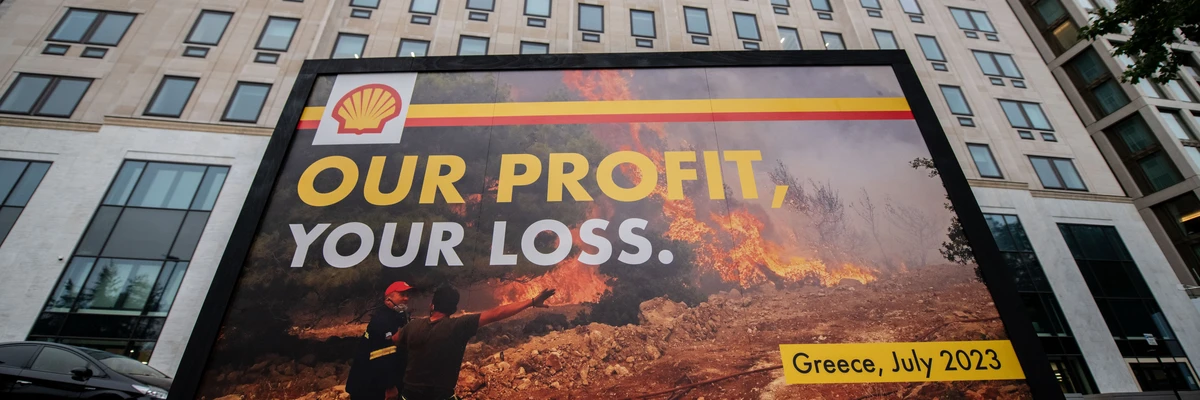
Neo-Fascist Climate Science Denier Donald Trump says Burn, Baby, Burn.Greenpeace activists display a billboard during a protest outside Shell headquarters on July 27, 2023 in London. (Photo: Handout/Chris J. Ratcliffe for Greenpeace via Getty Images)
Keir Starmer is looking at ‘every conceivable way’ to block compensation for myself and over 300 people wrongly imprisoned in the 1970s — an arrogance in full keeping with the British establishment’s imperial mindset.
According to British Prime Minister Keir Starmer, his government is looking at ‘every conceivable way’ to prevent me and at least 300 other people from receiving compensation for wrongful arrest and imprisonment in the 1970s.
This issue of compensation arises from the decision by the British Supreme Court in May 2020 that the Interim Custody Order (ICO) or internment order issued against me was unlawful.
Internment was demanded by the Unionist government in 1971 and imposed by the British on 9 August of that year. It had been used in every decade since partition in 1920. Internment saw thousands of armed troops smash their way into nationalist homes to arrest 342 men and boys.
…
The Supreme Court quashed my two convictions. But the Department of Justice in the North decided in 2021 that I was ineligible for compensation. I challenged this decision. In April 2023 Justice Colton concluded that it was ‘beyond reasonable doubt that there has been a miscarriage of justice, that is, the applicant is innocent of the crime for which he was convicted.’ He added: ‘I am satisfied that the applicant meets the test for compensation under the Criminal Justice Act 1988.’
…
Mr Starmer’s stated intention to subvert the laws he is supposed to uphold will come as no surprise to those in Ireland and in countless other states around the world who have experienced British colonial law. The self-proclaimed leading British counter-insurgency expert Frank Kitson described it well in his 1971 manual, Low-Intensity Operations: Subversion, Insurgency & Peacekeeping:
‘The law should be used as just another weapon in the Government’s arsenal, and in this case it becomes little more than a propaganda cover for the disposal of unwanted members of the public.’
So I will continue to pursue this case. I have no personal interest in compensation for myself. If any comes to me at the end of this process, I will donate it to good causes.
Far-right industry allies with ties to Chevron have mounted an “unprecedented” pressure campaign calling on the Supreme Court to stop a potentially historic climate deception lawsuit against oil majors from going to trial. Graphic design by Tess Abbot
Fossil fuel interests are deploying unprecedented strategies to hide evidence of companies’ deception and block liability lawsuits before they reach trial.
This article by ExxonKnews is published here as part of the global journalism collaboration Covering Climate Now.
In the face of mounting scrutiny from local, state, and federal officials, fossil fuel companies and their allies are deploying a range of tactics to obstruct ongoing lawsuits and investigations concerning evidence that the industry has misled the public about the harms it knew its products would cause to the climate, environment, and human health.
Far-right industry allies with ties to Chevron have mounted an “unprecedented” pressure campaign calling on the Supreme Court to stop a potentially historic climate deception lawsuit against oil majors from going to trial. Republican attorneys general are separately urging the Supreme Court to throw out similar climate fraud lawsuits from five states. Plastics industry trade associations are suing the California state attorney general’s office to block an investigation into whether oil companies lied about plastic recycling. And fossil fuel giants and their trade groups have responded to congressional subpoenas with highly redacted records and “baseless” First Amendment legal defenses.
“I think we’re seeing an escalation by the industry to do anything it can to avoid being held accountable for the consequences of climate change,” said Lisa Graves, executive director of investigative watchdog group True North Research and an expert on dark money special interest groups. “It continues to try to thwart efforts to try to mitigate climate change and it continues to try to stop efforts to get any compensation for the harms it has caused, not just through the burning of fossil fuels but also by the delay and deceit that it has promoted through front groups.”
State and local climate lawsuits, which accuse oil and gas majors of lying about the dangers of fossil fuels and seek to hold them accountable for the resulting damages, are advancing in state courts despite the industry’s efforts. Most recently, a Colorado judge denied nearly all motions by ExxonMobil and Suncor Energy to dismiss the City and County of Boulder’s case against them.
It’s the fifth time to date that a court has rejected Big Oil’s efforts to dismiss climate accountability lawsuits — bringing the companies closer to facing trial and potentially billions of dollars in liability. If any of the cases go to trial, said Michael Gerrard, director of the Sabin Center for Climate Change Law at Columbia University, “it will shine a very harsh light on the fossil fuel companies and it could lead to crushing monetary judgments.”
“Clearly the defendants here are using everything they can think of to derail these cases,” Gerrard said. That attitude has been most evident in Big Oil’s response to a lawsuit from Honolulu, which could be among the first communities to put the companies on trial.
In February, oil company defendants — including Exxon, Chevron, BP, and Shell — petitioned the U.S. Supreme Court to review a Hawai‘i state Supreme Court ruling that allowed Honolulu’s case to move toward trial. The case, the companies argued in their petition, is preempted by federal law and should be dismissed.
But after traditional legal arguments have failed to shield the industry to date, allies seem to be turning to more extreme and novel measures.
Leonard Leo to the Rescue?
In the weeks and months before the Supreme Court was scheduled to hear Big Oil’s petition in Honolulu’s lawsuit, a flood of social media ads and op-eds called for the Supreme Court justices to take up — and throw out — the case.
“To end this nuisance charade, the Supreme Court needs to take up the Honolulu case and declare once and for all that public nuisance is for local issues, not global climate change,” reads the narrator of one such video ad posted to X.
The name behind that ad, the Alliance for Consumers, is part of an organization called the Concord Fund, formerly known as the Judicial Crisis Network. Those groups, Graves and others have pointed out, are projects of billionaire Leonard Leo, head of the far-right legal advocacy group the Federalist Society and known as the architect of the current Supreme Court. CRC Advisors — one of the Leo-backed companies in the effort — appears to have had Chevron, a defendant in Honolulu’s case, as a client.
The fossil fuel industry also helped fund the Federalist Society, and partners at major law firms representing oil and gas companies — including Theodore Olson of Gibson Dunn,the law firm representing Chevron against Honolulu and other communities’ climate liability cases — sit on its board.
Former Hawai‘i Supreme Court Justice Michael Wilson, who served on the state’s highest court for a decade, called the pressure campaign targeting the Supreme Court a “powerful intervention” by “the strongest special interest group in the history of human civilization.”
“This is the most important case in the United States from the point of view that it will allow a jury of citizens to see the fraud and to decide what to do about it,” said Wilson. “This is a high-risk strategy that shows that the fossil fuel industry is desperate.”
Oil companies, which quietly funded front groups like the American Legislative Exchange Council (ALEC) to sow climate denial and oppose climate action on their behalf, are now rallying their allies and benefactors to strike at lawsuits that seek to hold them accountable, explained Graves. In April, 20 Republican attorneys general filed a brief with the U.S. Supreme Court in support of the oil companies’ petition.
“The Leo-tied groups are a soup-to-nuts intervention machine, from the Republican attorneys general to the judges he helped put on the court,” said Graves.
In June, the Supreme Court delivered a one-line order asking the U.S. Justice Department to weigh in on the case — an “extraordinary” response at this stage, according to Wilson, considering that the case has not yet gone to trial. If the Solicitor General neglects to weigh in before the election, that response could be in the hands of a Trump administration. Trump has promised that if re-elected, he will “stop the wave of frivolous litigation from environmental extremists.”
A ‘Highly Unusual’ Request
In May, 19 members of RAGA made a “highly unusual” request to the Supreme Court: to intervene in and undermine climate accountability lawsuits filed by five states — California, Connecticut, Minnesota, New Jersey, and Rhode Island — claiming that their cases would impose “ruinous liability” on fossil fuel companies and threaten “our basic way of life.”
The Supreme Court has original jurisdiction over disputes between states — meaning it can hear a case without it first being heard by another court — but such challenges are more commonly brought over issues like water rights, said Gerrard of Columbia’s Sabin Center. “I’ve never previously heard of an instance where there’s an effort to invoke the original jurisdiction of the [U.S.] Supreme Court to swat down litigation,” he said.
RAGA obtains some of its largest donations from the fossil fuel industry — including Koch Industries, Exxon, and the American Petroleum Institute, all of whom are defendants in climate liability cases — according to an analysis by the Center for Media and Democracy.
“These AGs have now placed their allegiance directly with the special interest group that is threatening the survival of future generations,” said Wilson.
The filing argues that “oil and natural gas have supported improvements in environmental quality and have reduced weather-related deaths,” and claims that “America’s air is cleaner than a century ago thanks in part to the increased use of oil and natural gas.”
It isn’t the first time Republican attorneys general have rushed to shield oil companies from accountability for their climate deception — and overtly used climate denialist talking points first leveraged by Big Oil in their defense. In 2016, Exxon sued the attorneys general of New York and Massachusetts in an attempt to block investigations into the company’s private research and public communications about climate change, claiming the probe was an attack on their free speech and other constitutional rights.
Republican attorneys general from 12 states filed a 2018 brief in support of the oil giant, arguing that “Climate change is the subject of legitimate international debate.”
“[T]he most undeniable fact about climate change is that, like so many other areas of science and public policy, the debate remains unsettled, the research is far from complete, and the path forward is unclear,” they wrote.
A(nother) First Amendment Fight
Another industry strategy to block accountability is playing out in response to California Attorney General Rob Bonta’s investigation into whether Exxon and other petrochemical companies deceived the public about the efficacy of plastic recycling as a solution to plastic waste. In May, the American Chemistry Council and Plastics Industry Association — two major trade groups representing oil and chemical giants including Exxon, Chevron, Amoco, Dow, and DuPont — filed a lawsuit against the attorney general in federal court, claiming the investigation violates their free speech rights.
Bonta, who had said he would decide whether to sue Exxon by the summer, responded with petitions asking the Sacramento County Superior Court to order the groups to comply with his office’s subpoenas.
“For years, the plastics industry has engaged in an aggressive campaign to deceive the public, perpetuating a myth that recycling can solve the plastics waste and pollution crisis,” Bonta said in a statement. “The continuous delay tactics are failing to comply with our subpoena. Enough is enough: What are they trying to hide?”
Members of Congress have similarly accused the Big Oil companies of trying to obstruct investigations.
When Senate Budget Chairman Sheldon Whitehouse (D-RI) and House Oversight Ranking Member Jamie Raskin (D-MD) referred their years-long investigation into the industry’s climate deception to the Justice Department, the lawmakers wrote that “some companies claimed that the First Amendment or undefined ‘privilege’ protected them from the House Oversight Committee’s subpoena.” The main subjects of that investigation have been Exxon, Shell, Chevron, BP, API, and the U.S. Chamber of Commerce.
“The companies further obstructed the investigation by significantly redacting or entirely withholding more than 4,000 documents without any valid basis,” the lawmakers wrote, adding that their refusal to comply “provides a basis to infer that there is even more damning evidence of deceptive practices by the companies and their trade associations waiting to be uncovered.”
Fossil fuel companies and the law firms representing them have used a First Amendment defense to try to dismiss the climate accountability lawsuits, claiming company statements on climate change are protected political speech. One of the most prominent voices for that argument have been attorneys at Gibson Dunn, the firm that represents Chevron, and whose partner Theodore Olson sits on the Federalist Society board.
If these “overt” and “brazen” efforts to escape accountability can be overcome, the industry will no doubt face a reckoning, said Wilson, the former Hawai‘i Supreme Court justice. Communities like Honolulu “are being ravaged by climate” and “will apply the rule of law fairly,” he said.
“Hawai‘i is not a place that can be manipulated by the fossil fuel industry. That is a very big threat to the most powerful special interest group that’s now maintaining its power based on complicity.”
Despite the findings of the Supreme Court, the government is compelling judges to treat Rwanda as a safe country.
The passage of the Rwanda Bill late last night, after a parliamentary showdown ended between the Commons and the Lords, has been met with condemnation and outrage by a number of human rights groups.
Some have described it as a ‘national disgrace’ while others slammed it as cruel and inhumane.
Sunak had made stopping small boat crossings across the channel a major priority, with his Rwanda Bill a key part of his plans in doing so. The Prime Minister says that the first flights removing asylum seekers who arrive illegally to the UK to the east African country are due to take off in 10-12 weeks time.
So why are human rights groups condemning the legislation and why are they concerned?
Rwanda is not a safe country, Supreme Court rules
…
Disregarding domestic and international law
…
‘Genuine refugees would be at risk of being returned to their home countries, where they could face harm’