Declassified UK Exclusive: New study reveals the scale of British intelligence gathering above Gaza, raising fears of complicity in Israeli war crimes
The Royal Air Force (RAF) has conducted at least 518 surveillance flights around Gaza since December 2023, an investigation by Action on Armed Violence (AOAV) for Declassified UK has found.
The flights, carried out by 14 Squadron’s Shadow R1 aircraft from RAF Akrotiri in Cyprus, have been shrouded in secrecy, raising concerns about whether British intelligence has played a role in Israeli military operations that have resulted in mass civilian casualties in Gaza.
These revelations come as Israel faces allegations of genocide at the International Court of Justice (ICJ) and war crimes at the International Criminal Court (ICC), with warrants issued for Israeli prime minister Benjamin Netanyahu and former defence minister Yoav Gallant.
The UK government insists that the flights are purely for hostage recovery, but the lack of transparency has done little to allay suspicions that the intelligence gathered may be facilitating Israeli attacks.
Surveillance sorties continued during and after the ceasefire, despite Israel’s renewed bombing of Gaza killing hundreds of children.
Over 500 missions in 15 months
AOAV’s analysis of flight-tracking data shows that between 3 December 2023 and 27 March 2025, the RAF carried out at least 518 Intelligence, Surveillance, and Reconnaissance (ISR) flights over or close to Gaza’s airspace.
Both Labour and Conservative governments have enacted the policy, with at least 215 flights taking place during Keir Starmer’s tenure as prime minister and 303 under Rishi Sunak’s administration.
The frequency of flights remained high throughout 2024, with some months seeing as many as 49 sorties. The missions have typically lasted up to six hours, with the longest flight recorded at seven hours and four minutes.
UK Foreign Minister David Lammy confirms that UK government and military are active participants in Israel’s genocides and that the F-35 parts that they suspended from supplying to Israel are instead simply diverted via the United States. He says see https://youtu.be/QILgUHrdWRE
The prime minister may have changed, but the welfare policies are the same | Anthony Devlin/Bloomberg via Getty Images
Disabled people are once again living under a government pursuing ever more surveillance of our lives
The Labour government is barely 100 days into office and even its supporters have been reduced to half-hearted attempts at optimism. But this ‘it’s not all doom and gloom’ narrative rings hollow to many Disabled people.
Yet again, we are living under a government pursuing ever more surveillance of our lives. Another prime minister is happy to subject us to increased benefit sanctions and reduced rights.
So much for the party of change. Keir Starmer used his first Labour Party Conference in power last month to make clear that when it comes to Disabled people, his government’s priorities are the same as its predecessors – namely “getting the welfare bill down”.
To this end, the prime minister will continue plans set out by the previous Conservative government to monitor the bank accounts of the 6.3 million people claiming disability benefits without their knowledge. The proposals are expected to be included in the Fraud, Error and Debt Bill, which was announced by the government last month.
Kieran Lewis, rights and migration policy officer at National Survivor User Network (NSUN), told openDemocracy that he is “disappointed at Keir Starmer’s repackaging of invasive bank-spying powers that we and so many other groups pushed back against under the last government”.
The NSUN – which works with people who have lived experience of mental ill-health, distress, and trauma – was a core part of the coalition opposing these powers when the Tory government proposed them mere months ago.
Lewis continued: “Surveillance of this kind is a threat to everyone, and those of us who live with mental ill-health, distress and trauma will feel its effects particularly sharply.
“The harsh rhetoric espoused by Keir Starmer, a continuation of previous governments’ negative messaging, has had considerable impact on Disabled people and other groups of marginalised people.”
Starmer’s conference pledge to “legislate to stop benefit fraud” may be a familiar rhetoric – but it’s one built on shaky foundations. Some 75% of Universal Credit overpayments recorded by the Department for Work and Pension’s debt manager system in 2021 were due to an ‘official error’ – meaning the government miscalculated the amount to be paid – according to new research from the Public Law Project.
The research also found that the subsequent deductions that the DWP inflicts following such ‘overpayments’ led 26% of people to report resorting to food banks. Almost one in ten said they had slept rough due to a deduction.
Elsewhere in his conference speech, Starmer vowed to be “a great reforming government”. Disabled people have already lost an average of £1,200 a year thanks to the ‘reforms’ of the past 15 years, including the introduction of Employment and Support Allowance, the Work Capability Assessment, Personal Independence Payment, the bedroom tax, the benefit cap, the two-child limit, and Universal Credit.
All of these measures have combined to leave the UK with one of Western Europe’s least generous welfare systems. Staff at the Greater Manchester Disabled People’s Panel, which runs regular peer-support group sessions for those navigating the social security system, told openDemocracy there is a serious risk that Starmer’s plans will lead to welfare payments for Disabled and working-class people being wrongfully suspended, forcing them to deal with burdensome appeals processes.
It is important to recognise that ‘benefits fraud’, which the Labour Party appears likely to dedicate so much time to, is a non-issue. The fraud rate for disability benefits is 0.2%. That’s far lower than the percentage of Labour ministers who took free Taylor Swift concert tickets this summer. When will there be a crackdown on that?
Ironically, Starmer closed his conference speech by saying that “every community” should have “the breathing space, the calm, the control to focus on the little things they love in life, not the anxiety and insecurity we have now.”
This is at odds with the experiences of the Greater Manchester Coalition, whose staff told openDemocracy: “We see Disabled people struggling to obtain much-needed benefits, and if obtained, struggling to keep those benefits.
“Having to already prove and then re-prove they’re not fraudsters, being assessed, reassessed and reviewed is a relentless often degrading, soul-destroying experience that leads many to abandon the process.”
This dire situation will only be worsened by the Fraud, Error and Debt Bill, which will massively increase financial surveillance and create yet another punitive, disabling barrier for Disabled people to contend with.
It will put many of us under tremendous stress and, as the Greater Manchester Coalition noted, could leave even more of us “isolated and particularly vulnerable. For some, especially those in mental health crisis, this places them in great harm.”
In short, Disabled people know this bill is not the way forward. If only our community had more music festivals and football games to invite ministers to – imagine how our social security system could look then.
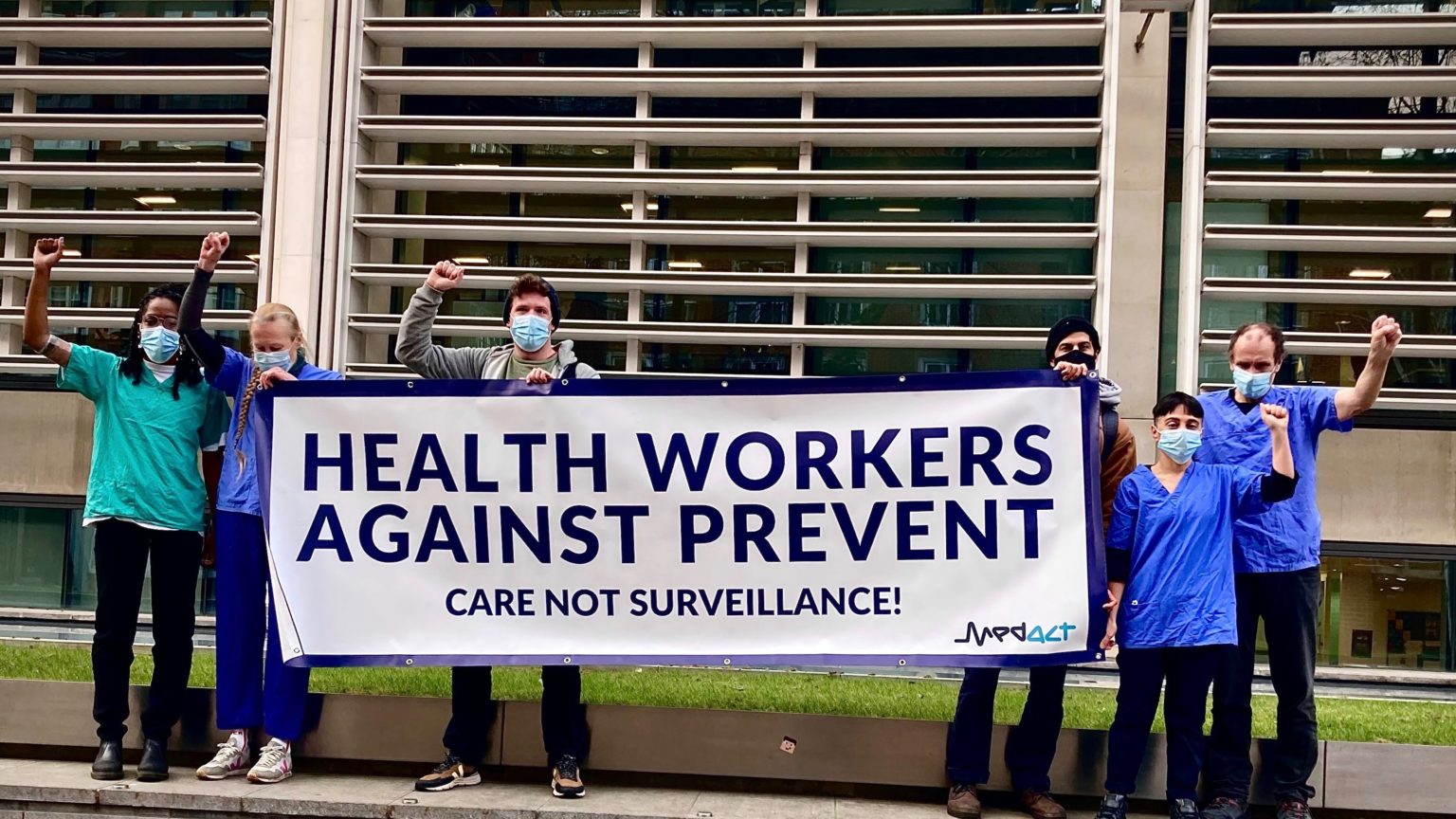
(Action against Prevent by members of Medact’s Securitization of Health group outside the UK Home Office on February 15, 2023. (Photo: Medact/Twitter)
NHS staff pulled into counter-terrorism programs, raising alarms over patient care and professional ethics
Mental health workers in the United Kingdom are being drawn into joint ventures with police and intelligence institutions as part of the national counter-terrorism agenda.
A new report by Medact, an association of health workers advocating for peace and social justice, highlights how the Counter Terrorism Clinical Consultancy Service (CT CCS) integrates National Health Service (NHS) staff with counter-terrorism agents. This service effectively turns health workers into interpreters for the police, who use the information provided to decide on tactics for individuals identified as potential terrorist threats.
In 2024, approximately £17 million was awarded to NHS Trusts to collaborate with security services involved in counter-terrorism. At the report’s launch in London, author Charlotte Heath-Kelly explained that these funds support interdisciplinary teams tasked with analyzing information about selected subjects.
The teams comprise mental health professionals, including nurses, psychiatrists, psychologists, and police officers. Health workers receive basic information on individuals identified as threats, which they then process and explain to their police counterparts. If the decision is made to continue monitoring a person, health workers interpret new information collected and may reach out to the person’s GP practice to encourage them to report on their patients in case they, for example, discontinue therapy or experience a stressful situation.
“This creates an indirect surveillance relationship between health workers and patients and may compromise a patient’s right to discontinue medical treatment since police-led interventions may follow non-compliance,” Heath-Kelly writes.
Unseen patients
CT CCS health professionals contextualize and explain how potential mental health issues could affect an individual’s behavior. This process, referred to as “formulating,” is commonly used in mental health care to better understand a person’s mental health status in the context of their everyday life and offering them support. However, unlike in healthcare settings where formulating is done collaboratively with the patient, CT CCS professionals have no direct contact with the people they are assessing, nor do they have their consent for the process to take place. This puts the teams at odds with professional ethics.
The involvement of health workers means that counter-terrorism teams do not only profile individuals but are guided in using available medical information contextually. Despite these “improvements,” it is likely that those most affected by this new line of intelligence will be racialized. Previous analyses by Medact have shown that Muslims were about 23 times more likely to be referred to a mental health hub for ‘Islamism’ than white British people were for ‘Far Right extremism.’
CT CCS work: legal but controversial
Alarmingly, there is no public accountability or oversight over the implementation of this program. If allowed to continue unchecked, it will persist as a “bubble of trust” between select health professionals and police officers, as described by a high-ranking officer interviewed by Heath-Kelly. This could easily erode the relationship between health workers and their patients and undermine the overall role of the NHS.
The work of CT CCS teams, while controversial, is entirely legal. They operate within regulations such as the GDPR, relying on provisions that allow information sharing when a person is flagged as a risk to themselves or others. However, they apply these rules even at very low levels of perceived risk, including many cases involving young people and children. This potential for misuse in the field of health information and data, which is particularly sensitive, suggests that similar practices could occur in other areas.
There must be a better way to utilize the millions of pounds allocated to the intersection of health and policing services, Heath-Kelly appealed at the launch. Considering the soaring needs in mental health services and the shortage of health workers in the field, the new government might want to divert the budget to address these critical areas instead.
The DWP is seeking powers to require banks to trawl the accounts of millions of people who receive benefits. Photograph: Andy Rain/EPA
Campaigners say ‘fully automated’ approach risks repeat of Post Office Horizon scandal
Plans for automated surveillance of millions of bank accounts to catch welfare cheats should be scrapped, campaigners have said, warning the approach risks a repeat of the Post Office Horizon scandal.
…
But campaigners for welfare claimants, disabled people, human rights and privacy warned ministers it represents an “unprecedented and disproportionate invasion of the public’s financial privacy, the effect of which will be felt most sharply by the most vulnerable”.
The net would also trawl the private banking data of people related to welfare claimants including partners, parents and landlords. It would save around £360m a year – less than 5% of the total lost to welfare fraud, according to the government’s best estimate.
In a letter to Mel Stride, the work and pensions secretary, 42 organisations, from Disability Rights UK to Big Brother Watch, said: “There are approximately 22.6 million individuals in the welfare system, including those who are disabled, sick, caregivers, job seekers, and pensioners. They should not be treated like criminals by default … The Horizon scandal saw hundreds of people wrongfully prosecuted using data from faulty software. The government must learn from this mistake – not replicate it en masse.”
‘The Bill only targets the less well-off. There is no equivalent surveillance of legislators who accept payments to advance the interests of their corporate paymasters.’
Prem Sikka is an Emeritus Professor of Accounting at the University of Essex and the University of Sheffield, a Labour member of the House of Lords, and Contributing Editor at Left Foot Forward.
George Orwell’s iconic novel Nineteen Eighty-Four, published in 1949, warns of a dystopian world where The Party or the government undermines people’s rights, independence and autonomy through fear and propaganda. Constant surveillance is a key weapon for disciplining people and shaping their minds.
That world has arrived in the UK, the self-proclaimed mother of parliaments. The new tyranny isn’t ushered in by some communist, socialist or military regime but by a right-wing elected government.
The Bill uses developments in electronic transactions and artificial intelligence to place the poor, disabled, sick, old and pregnant women under surveillance. It gives Ministers and government agencies powers to direct businesses, particularly banks, and financial institutions, to mass monitor individuals receiving welfare payments, even when there is no suspicion or any sign of fraudulent activity. No court order is needed and affected individuals will not be informed. The Bill enables Ministers to make any further regulations without a vote in parliament.