Netanyahu to skip Auschwitz liberation ceremony fearing arrest

Spread the love

https://www.middleeastmonitor.com/20241221-netanyahu-to-skip-auschwitz-liberation-ceremony-fearing-arrest

Israeli Prime Minister Benjamin Netanyahu addresses a press conference in Tel Aviv on July 13, 2024 [NIR ELIAS/POOL/AFP via Getty Images]

Israeli Prime Minister Benjamin Netanyahu will not participate in the 80th anniversary of the liberation of the Nazi death camp Auschwitz for fear of being arrested following the arrest warrant issued against him by the International Criminal Court (ICC) in The Hague.

The warrant was issued on charges of committing war crimes and crimes against humanity in the war on Gaza, according to reports by Polish newspaper Rzeczpospolita on Friday.

The newspaper quoted Wladyslaw Bartoszewski, Poland’s deputy foreign minister, who is organising the ceremony scheduled to be held on 27 January, saying that his country is committed to respecting the decision of the ICC in The Hague.

The ceremony commemorating the liberation of Auschwitz is expected to be attended by many world leaders. The Polish newspaper predicts Israel will be represented by its Foreign Minister Gideon Sa’ar, but Israeli media quoted Israeli officials saying that Education Minister Yoav Kisch will represent Israel in the ceremony.

The Polish newspaper reported that Israel did not request Netanyahu’s participation in the ceremony and that the Israelis knew how Warsaw would react if Netanyahu arrived in Poland.

READ: Israel: Soldiers admit killing civilians in Gaza, classifying them as ‘terrorists’

Israeli President Isaac Herzog is not expected to participate in the ceremony. His predecessor, Reuven Rivlin, participated in the 75th anniversary of the liberation of Auschwitz.

On 21 November, the ICC issued two international arrest warrants against Netanyahu and former Defence Minister Yoav Gallant on charges of committing war crimes and crimes against humanity in the Gaza Strip, including starving Palestinians.

Spain, the Netherlands, Belgium, Ireland, Lithuania and Slovenia have all confirmed they will arrest Netanyahu if he enters their territory, and outgoing Belgian Prime Minister Alexander De Croo asserted: “There can be no double standards.”

Leaders from several countries are expected to attend the commemoration of the liberation of Auschwitz, including French President Emmanuel Macron, Spanish King Felipe VI, British King Charles, German President Frank-Walter Steinmeier and Hungarian President Tamas Sulyok.

Poland has invited US President-elect Donald Trump to the ceremony, but he is expected to be represented by his vice president, JD Vance, or his secretary of state, Marco Rubio, the Polish newspaper reported.

BLOG: The EU continues to protect Israel and its genocide of the Palestinians

This work by Middle East Monitor is licensed under a Creative Commons Attribution-NonCommercial-ShareAlike 4.0 International License.

Experiencing issues with this image not appearing. I suspect because it's so critical of Zionist Keir Starmer's support of and complicity in Israel's genocides.
Genocide denier and Current UK Prime Minister Keir Starmer is quoted that he supports Zionism without qualification. He also confirms that UK air force support has been essential in Israel’s mass-murdering genocide. Includes URLs https://www.declassifieduk.org/keir-starmers-100-spy-flights-over-gaza-in-support-of-israel/ and https://youtu.be/O74hZCKKdpA
Continue ReadingNetanyahu to skip Auschwitz liberation ceremony fearing arrest

Ireland to join genocide case against Israel, ask Court to ‘broaden its interpretation’

Spread the love

https://www.middleeastmonitor.com/20241211-ireland-to-join-genocide-case-against-israel-ask-court-to-broaden-its-interpretation

Overview of the courtroom at the International Court of Justice (ICJ) in The Hague, Netherlands on 22 April, 2024 [Selman Aksünger/Anadolu Agency]

Ireland will formally join South Africa’s genocide case against Israel following government approval and will be asking the Court to “broaden its interpretation” of what constitutes genocide, the nation’s Foreign Minister said Wednesday, Anadolu Agency reports.

Ireland will join the case at the International Court of Justice (ICJ) in The Hague this month, Micheal Martin said in a statement.

“There has been a collective punishment of the Palestinian people through the intent and impact of military actions of Israel in Gaza, leaving 44,000 dead and millions of civilians displaced,” Martin said following Wednesday’s Cabinet meeting.

He stressed that, by legally intervening in South Africa’s case, Dublin will also be asking the ICJ to “broaden its interpretation of what constitutes the commission of genocide by a State”.

“We are concerned that a very narrow interpretation of what constitutes genocide leads to a culture of impunity in which the protection of civilians is minimised,” underlined Martin.

He went on to say that Ireland’s view of the Convention is broader and prioritises the protection of civilian life as the government will promote that interpretation in its intervention in this case.

Martin added that the government has also approved joining Gambia’s case against Myanmar under the same convention.

In October 2023, Israel launched a genocidal war on the Gaza Strip that has so far killed over 44,800 people, mostly women and children, and now faces a genocide case at the International Court of Justice for its war on Gaza.

Last month, the International Criminal Court issued arrest warrants for Israeli Prime Minister, Benjamin Netanyahu, and former Defence Minister, Yoav Gallant, for war crimes and crimes against humanity in Gaza.

READ: Algeria, South Africa insist on holding Israel accountable before ICJ

This work by Middle East Monitor is licensed under a Creative Commons Attribution-NonCommercial-ShareAlike 4.0 International License.

Continue ReadingIreland to join genocide case against Israel, ask Court to ‘broaden its interpretation’

‘Frontlines of a Crisis We Did Not Create’: Low-Lying Nations Make Climate Case to ICJ

Spread the love

Original article by Eloise Goldsmith republished from Common Dreams under Creative Commons (CC BY-NC-ND 3.0). 

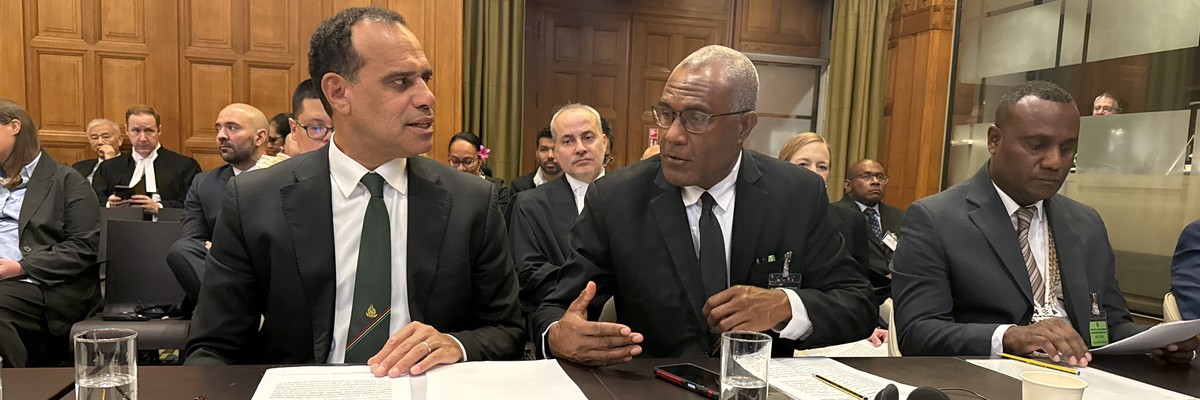
Ralph Regenvanu (left), Vanuatu’s special envoy on climate change and the environment; Arnold Kiel Loughman (center), attorney general of Vanuatu; and Ilan Kiloe (right), legal advisor to the Melanesian Spearhead Group attend the advisory opinion sessions at the International Court of Justice (ICJ) in The Hague, Netherlands on December 2, 2024. (Photo: Selman Aksunger/Anadolu via Getty Images)

“What started in the Pacific is now a historic climate justice campaign, as the world’s most urgent problem of climate change reaches the worlds highest court,” said one campaigner.

The International Court of Justice (ICJ) heard arguments Monday in the largest climate case ever brought before it as a coalition of low-lying and developing nations demanded larger polluting nations be held to account under international law for causing “significant harm to the climate system and other parts of the environment” with runaway fossil fuel emissions over recent decades.

In the first day of hearings in The Hague that could last weeks, multiple representatives from the Pacific island of Vanuatu, which is leading the coalition of over 100 countries and allied organizations, laid the blame for the climate crisis at the feed of a small number of states that are large emitters of greenhouse gases.

“We know what the cause of climate change is: a conduct of specific States … Vanuatu’s contribution to global greenhouse gas emissions is negligible, and yet we are among those most affected by climate change,” said Arnold Kiel Loughman, attorney general of the Republic of Vanuatu.

“We find ourselves on the frontlines of a crisis we did not create,” said Ralph Regenvanu, Vanuatu’s special envoy for climate change and environment, told the court.

Monday’s historic moment at The Hague follows years of work on the part of Pacific Island nations, particularly Vanuatu, to push for the ICJ to take up the issue of global warming and human rights. The stakes of the planetary emergency are particularly high for these countries, which are under threat from rising seas and other climate impacts.

Ilan Kiloe, legal counsel for the Melanesian Spearhead Group, a regional subgroup that includes Fiji, Papua New Guinea, Solomon Islands, and Vanuatu, issued a stark warning during his remarks to the court: “Climate change is now depriving our peoples, again, of our ability to enjoy our right to self-determination in our lands. The harsh reality is that many of our people will not survive.”

Last year, the United Nations General Assembly unanimously adopted a resolution calling on the ICJ to issue an advisory opinion on climate change and human rights. The measure, which was introduced by Vanuatu and co-sponsored by more than 130 governments, requested that the world’s highest court outline countries’ legal responsibilities for combatting fossil fuel-driven climate change and the legal consequences of failing to meet those obligations.

Over the next two weeks, the court will hear statements from nearly 100 nations, including wealthy developed countries such as the United States. Advisory opinions, unlike judgments, are not binding—but Vanuatu and other supporters hope that a forthcoming opinion would accelerate action around the climate emergency.

The country began pushing for the ICJ resolution in 2021, following a campaign launched in 2019 by a group of students from the University of the South Pacific.

“What started in the Pacific is now a historic climate justice campaign, as the world’s most urgent problem of climate change reaches the world’s highest court,” said Shiva Gounden of Greenpeace Australia Pacific.

“The next two weeks of hearings are the culmination of collective campaigning from 2019, powerful advocacy, and mobilizing the world behind this landmark campaign, to ensure the human rights of current and future generations are protected from climate destruction, and the biggest emitters are held accountable.”

Polly Banks, Vanuatu country director for Save the Children, who travelled to The Hague for the proceedings, said that “the hearing before the Court goes to questions about the efficacy, equity and fairness of the current responses to climate change, which are particularly relevant for children, who have contributed the least to climate change but will be most affected by its consequences.”

“Currently, only 2.4% of climate finance from multilateral funding sources is child-responsive. Even without the Court’s opinion, we know that states need to do far more to protect children from the worst impacts of this crisis, by significantly increasing climate finance to uphold children’s basic rights and access to health, education and protection,” Banks added.

The start of hearings at The Hague come on the heels of a COP29 climate summit that was heavily criticized. The summit focused heavily on climate finance, but the resulting deal was panned by critics as rich nations agreed to voluntarily provide just $300 billion to help developing nations decarbonize and deal with the impacts of the climate emergency. Poor nations and climate campaigners had demanded over a trillion dollars in funding in the form of debt-free grants and direct payments.

Original article by Eloise Goldsmith republished from Common Dreams under Creative Commons (CC BY-NC-ND 3.0). 

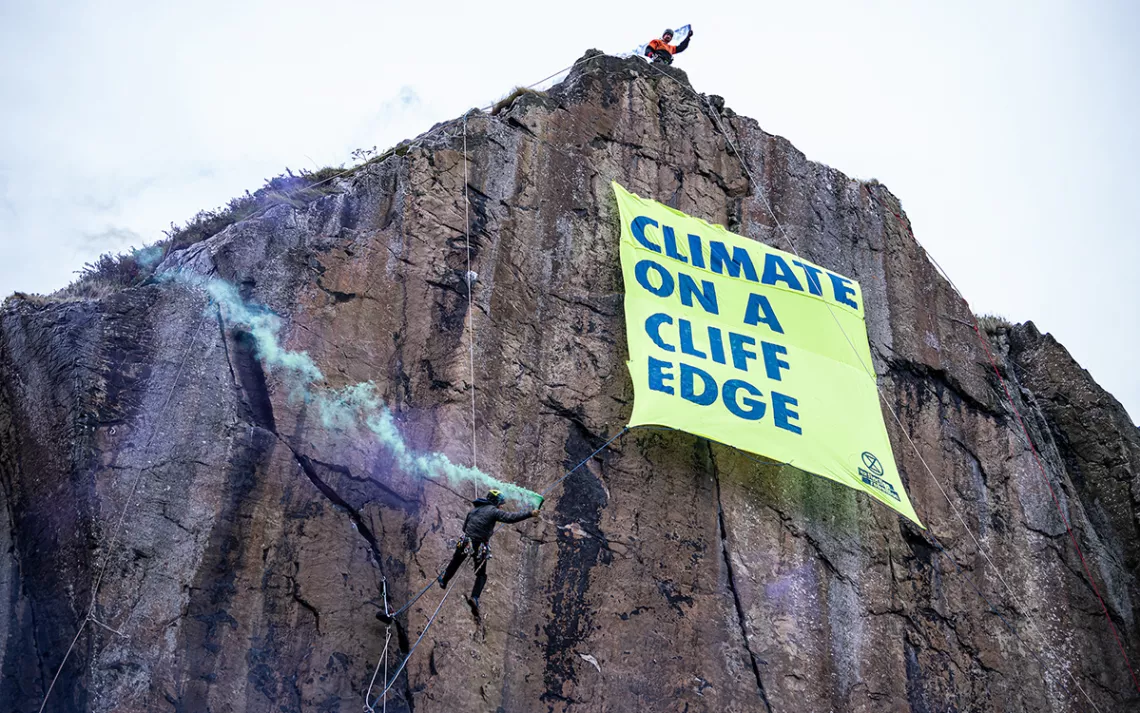
Experienced climbers scale a rock face near the historic Dumbarton castle in Glasgow, releasing a banner that reads “Climate on a Cliff Edge.” One activist, dressed as a globe, symbolically looms near the edge, while another plays the bagpipes on the shores below. | Photo courtesy of Extinction Rebellion and Mark Richards
Continue Reading‘Frontlines of a Crisis We Did Not Create’: Low-Lying Nations Make Climate Case to ICJ

South African lawyer’s speech accusing Israel of genocide at ICJ

Spread the love

https://www.commondreams.org/news/israel-genocidal-statements-2666930604

South African attorney Tembeka Ngcukaitobi on Thursday used the words of Israeli Prime Minister Benjamin Netanyahu and other high-ranking officials to make the case to the International Court of Justice—and to the world—that Israel’s military is acting with clear genocidal intent in the Gaza Strip.

“Let the prime minister’s words speak for themselves,” said Ngcukaitobi, pointing to Netanyahu’s November remarks urging Israelis to “remember what Amalek has done to you. Netanyahu has repeatedly likened Gazans to the Amalekites, whom the Old Testament God orders King Saul to massacre.

Ngcukaitobi went on to cite the deputy speaker of the Israeli Knesset, who called on Israel’s military to “burn Gaza” to the ground—a statement he reiterated ahead of Thursday’s hearing at the United Nations’ highest court.

“There is an extraordinary feature in this case: that Israel’s political leaders, military commanders, and persons holding official positions have systematically and in explicit terms declared their genocidal intent,” said Ngcukaitobi. “And these statements are then repeated by soldiers on the ground in Gaza as they engage in the destruction of Palestinians and the physical infrastructure of Gaza.”

The South African attorney played video footage of Israeli soldiers dancing and chanting that there are “no uninvolved civilians” in Gaza—a precursor to the war crime of collective punishment.

https://www.commondreams.org/news/israel-genocidal-statements-2666930604

Continue ReadingSouth African lawyer’s speech accusing Israel of genocide at ICJ

A Chance to Hold Israel–and the United States–to Account for Genocide

Spread the love

Original article by MEDEA BENJAMIN NICOLAS J.S. DAVIES republished from Common Dreams under Creative Commons (CC BY-NC-ND 3.0). 

A protester reacts as demonstrators are confronted by Palestinian Authority security forces during a protest held in Ramallah as US Secretary of State Antony Blinken met with the Palestinian president in the Israeli-occupied West Bank on January 10, 2024.  (Photo by Marco Longari/AFP via Getty Images)

If the ICJ issues a provisional order for a ceasefire in Gaza, humanity must seize the moment to insist that Israel and the United States must finally end this genocide and accept that the rule of international law applies to all nations.

On January 11th, the International Court of Justice (ICJ) in The Hague is holding its first hearing in South Africa’s case against Israel under the Genocide Convention. The first provisional measure South Africa has asked of the court is to order an immediate end to this carnage, which has already killed more than 23,000 people, most of them women and children. Israel is trying to bomb Gaza into oblivion and scatter the terrorized survivors across the Earth, meeting the Convention’s definition of genocide to the letter.

Since countries engaged in genocide do not publicly declare their real goal, the greatest legal hurdle for any genocide prosecution is to prove the intention of genocide. But in the extraordinary case of Israel, whose cult of biblically ordained entitlement is backed to the hilt by unconditional U.S. complicity, its leaders have been uniquely brazen about their goal of destroying Gaza as a haven of Palestinian life, culture and resistance.

South Africa’s 84-page application to the ICJ includes ten pages (starting on page 59) of statements by Israeli civilian and military officials that document their genocidal intentions in Gaza. They include statements by Prime Minister Netanyahu, President Herzog, Defense Minister Gallant, five other cabinet ministers, senior military officers, and members of parliament. Reading these statements, it is hard to see how a fair and impartial court could fail to recognize the genocidal intent behind the death and devastation Israeli forces and American weapons are wreaking in Gaza.

The Palestinians understand perfectly well who is bombing them—and who is supplying the bombs.

The Israeli magazine +972 talked to seven current and former Israeli intelligence officials involved in previous assaults on Gaza. They explained the systematic nature of Israel’s targeting practices and how the range of civilian infrastructure that Israel is targeting has been vastly expanded in the current onslaught. In particular, it has expanded the bombing of civilian infrastructure, or what it euphemistically defines as “power targets,” which have comprised half of its targets from the outset of this war.

Israel’s “power targets” in Gaza include public buildings like hospitals, schools, banks, government offices, and high-rise apartment blocks. The public pretext for destroying Gaza’s civilian infrastructure is that civilians will blame Hamas for its destruction, and that this will undermine its civilian base of support. This kind of brutal logic has been proved wrong in U.S.-backed conflicts all over the world. In Gaza, it is no more than a grotesque fantasy. The Palestinians understand perfectly well who is bombing them—and who is supplying the bombs.

Intelligence officials told +972 that Israel maintains extensive occupancy figures for every building in Gaza, and has precise estimates of how many civilians will be killed in each building it bombs. While Israeli and U.S. officials publicly disparage Palestinian casualty figures, intelligence sources told +972 that the Palestinian death counts are remarkably consistent with Israel’s own estimates of how many civilians it is killing. To make matters worse, Israel has started using artificial intelligence to generate targets with minimal human scrutiny, and is doing so faster than its forces can bomb them.

Israeli officials claim that each of the high-rise apartment buildings it bombs contains some kind of Hamas presence, but an intelligence official explained, “Hamas is everywhere in Gaza; there is no building that does not have something of Hamas in it, so if you want to find a way to turn a high-rise into a target, you will be able to do so.” As Yuval Abraham of +972 summarized, “The sources understood, some explicitly and some implicitly, that damage to civilians is the real purpose of these attacks.”

Two days after South Africa submitted its Genocide Convention application to the ICJ, Israeli Finance Minister Smotrich declared on New Year’s Eve that Israel should substantially empty the Gaza Strip of Palestinians and bring in Israeli settlers. “If we act in a strategically correct way and encourage emigration,” Smotrich said, “if there are 100,000 or 200,000 Arabs in Gaza, and not two million, the whole discourse on ‘the day after’ will be completely different.”

When reporters confronted U.S. State Department spokesman Matt Miller about Smotrich’s statement, and similar ones by National Security Minister Itamar Ben-Gvir, Miller replied that Prime Minister Netanyahu and other Israeli officials have reassured the United States that those statements don’t reflect Israeli government policy.

We should have learned from America’s lost wars that mass murder and ethnic cleansing rarely lead to political victory or success.

But Smotrich and Ben-Gvir’s statements followed a meeting of Likud Party leaders on Christmas Day where Netanyahu himself said that his plan was to continue the massacre until the people of Gaza have no choice but to leave or to die. “Regarding voluntary emigration, I have no problem with that,” he told former Israeli UN Ambassador Danny Danon. “Our problem is not allowing the exit, but a lack of countries that are ready to take Palestinians in. And we are working on it. This is the direction we are going in.”

We should have learned from America’s lost wars that mass murder and ethnic cleansing rarely lead to political victory or success. More often they only feed deep resentment and desires for justice or revenge that make peace more elusive and conflict endemic.

Although most of the martyrs in Gaza are women and children, Israel and the United States politically justify the massacre as a campaign to destroy Hamas by killing its senior leaders. Andrew Cockburn described in his book Kill Chain: the Rise of the High-Tech Assassins how, in 200 cases studied by U.S. military intelligence, the U.S. campaign to assassinate Iraqi resistance leaders in 2007 led in every single case to increased attacks on U.S. occupation forces. Every resistance leader they killed was replaced within 48 hours, invariably by new, more aggressive leaders determined to prove themselves by killing even more U.S. troops.

But that is just another unlearned lesson, as Israel and the United States kill Islamic Resistance leaders in Gaza, the West Bank, Lebanon, Iraq, Yemen and Iran, risking a regional war and leaving themselves more isolated than ever.

If the ICJ issues a provisional order for a ceasefire in Gaza, humanity must seize the moment to insist that Israel and the United States must finally end this genocide and accept that the rule of international law applies to all nations, including themselves.

Original article by MEDEA BENJAMIN NICOLAS J.S. DAVIES republished from Common Dreams under Creative Commons (CC BY-NC-ND 3.0). 

Continue ReadingA Chance to Hold Israel–and the United States–to Account for Genocide