SCOTTISH Greens warned yesterday of the dangers posed to the country by Nigel Farage’s Reform UK party.
…
He said: “Reform and the politics they represent are a danger to Scotland.
“Whether they have called themselves Ukip, the Brexit Party or Reform, we know what they represent: prejudice, division and environmental vandalism.
“Scotland can and must do so much better than this. We need change, but it has to be rooted in building a fairer and better country, not scapegoating and empty slogans from a cynical millionaire-backed party that offers nothing.
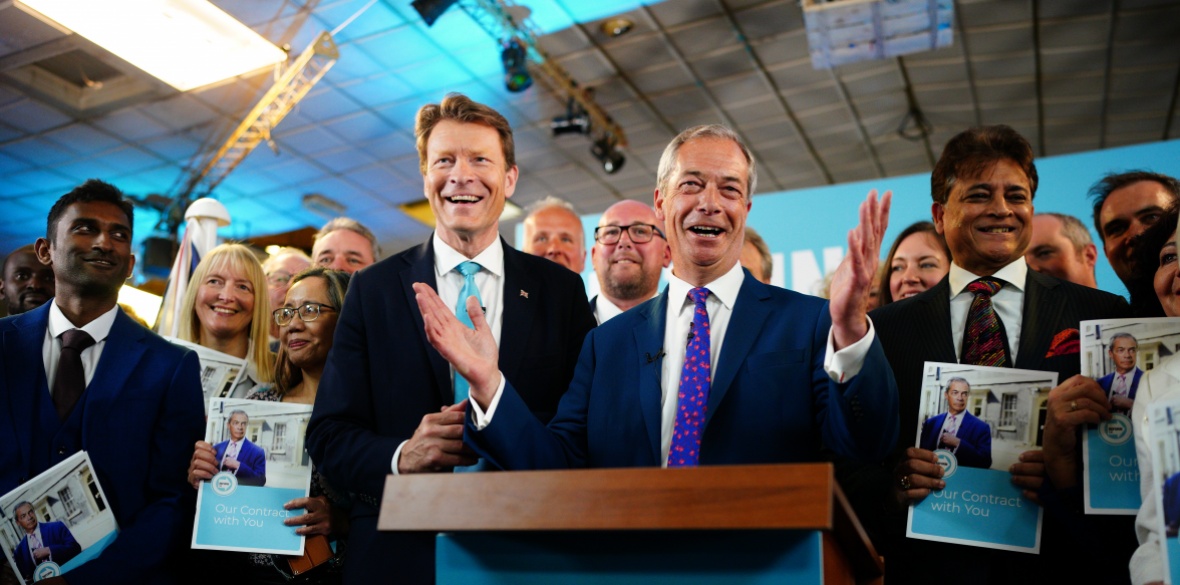
Reform UK chairman Richard Tice (left) and party leader Nigel Farage launch ‘Our Contract with You’ in Merthyr Tydfil while on the General Election campaign trail, June 17, 2024
REFORM started targeting Labour “red wall” voters today as the hard-right party launched its reactionary election manifesto in Wales.
The party’s owner and leader Nigel Farage went to Merthyr Tydfil, once represented by Labour pioneer Keir Hardie, to tell voters that “Labour is not very different to the Conservatives … it is just more incompetent.”
And he restated his aim of being the main challenger to Labour for government by 2029, likely date of the next general election following July 4.
The nationalist party’s platform is anti-migrant, opposed to climate action and supportive of NHS privatisation while cutting foreign aid and leaving the European Court of Human Rights.
It aims to take advantage of muted enthusiasm for Sir Keir Starmer’s Labour in working-class communities by rekindling the Brexit divisions it skilfully exploited in 2019.
Reform’s increasing prominence in the general election comes as the Tory Party’s campaign looks on the verge of expiring.
A number of wealthy climate sceptics are giving funding to Nigel Farage’s Reform UK, rightwing Conservatives, and the climate science-denying thinktank the Global Warming Policy Foundation. But who are they and how are they linked?
The biggest donor to the Reform party this year is the shipping magnate Terence Mordaunt, the head of First Corporate Shipping. His personal company, Corporate Consultants Ltd, has given £200,000 to Reform over the past 12 months. He was previously chair of the Global Warming Policy Foundation (GWPF) and is now a trustee.
Reform was formerly known as the Brexit party and is the third highest polling political party, aiming to win over rightwing voters who are disenchanted with the Tories. It states on its website: “Net zero means reducing man made CO2 emissions to stop climate change. It can’t. Climate change has happened for millions of years, before man made CO2 emissions, and will always change. We are better to adapt to warming, rather than pretend we can stop it. Up to 10 times more people die of cold than warmth.” The party advocates for scrapping net zero targets and increasing fracking and new nuclear power.
The GWPF is the thinktank set up by the former Conservative chancellor Nigel Lawson in 2009. Since then, it has released reports claiming rising carbon dioxide levels are good for humanity, and opposed climate action. Though Mordaunt has not made many public proclamations on climate science, he said when joining the GWPF in 2017: “I am delighted to continue my support for the GWPF which has brought much needed rigour into the climate debate.” His donations could shed some light on his views; his company also donated £100k to Vote Leave in 2016.
Mordaunt is also, according to DeSmog, a significant donor to the Conservative party, having donated £34,600between 2003 and 2009, according to electoral register data. His companies have also donated at least £135,000 to the party since 2008, including a £25,000 donation in 2017.
“Nigel Farage is not just a dodgy salesman. He is a crook and a conman.
“He will package his brand of hate filled politics in a way that is populist and that he thinks he can sell to an electorate who are understandably fed up with mainstream politics.
“Frankly though, we’re not buying it.
“The latest organisation he latched himself onto, “Reform UK”, is another smokescreen. Set up to take money off people without offering them membership like any other established political party.
“Greens can see through these smokescreens and his jovial façade and see the divisive hate that pulsates through his politics.
“His politics belong on the extreme fringes not at the heart of Clacton, let alone on prime time TV.”
He continued, “Through sheer arrogance, what Farage fails to comprehend is that the great British public can also see him for what he is.
“7 failed election attempts later you would think he would have got the message but evidently not.
“I’m hoping that the good people of Clacton make this very clear to him on July 4th and instead look for a party that is offering real hope and real change.
“The Green candidate Dr Natasha Osben was born and bred in Clacton and I know will put the people of Clacton first, not just use them as a stage on which to stand to boost her own ego.”
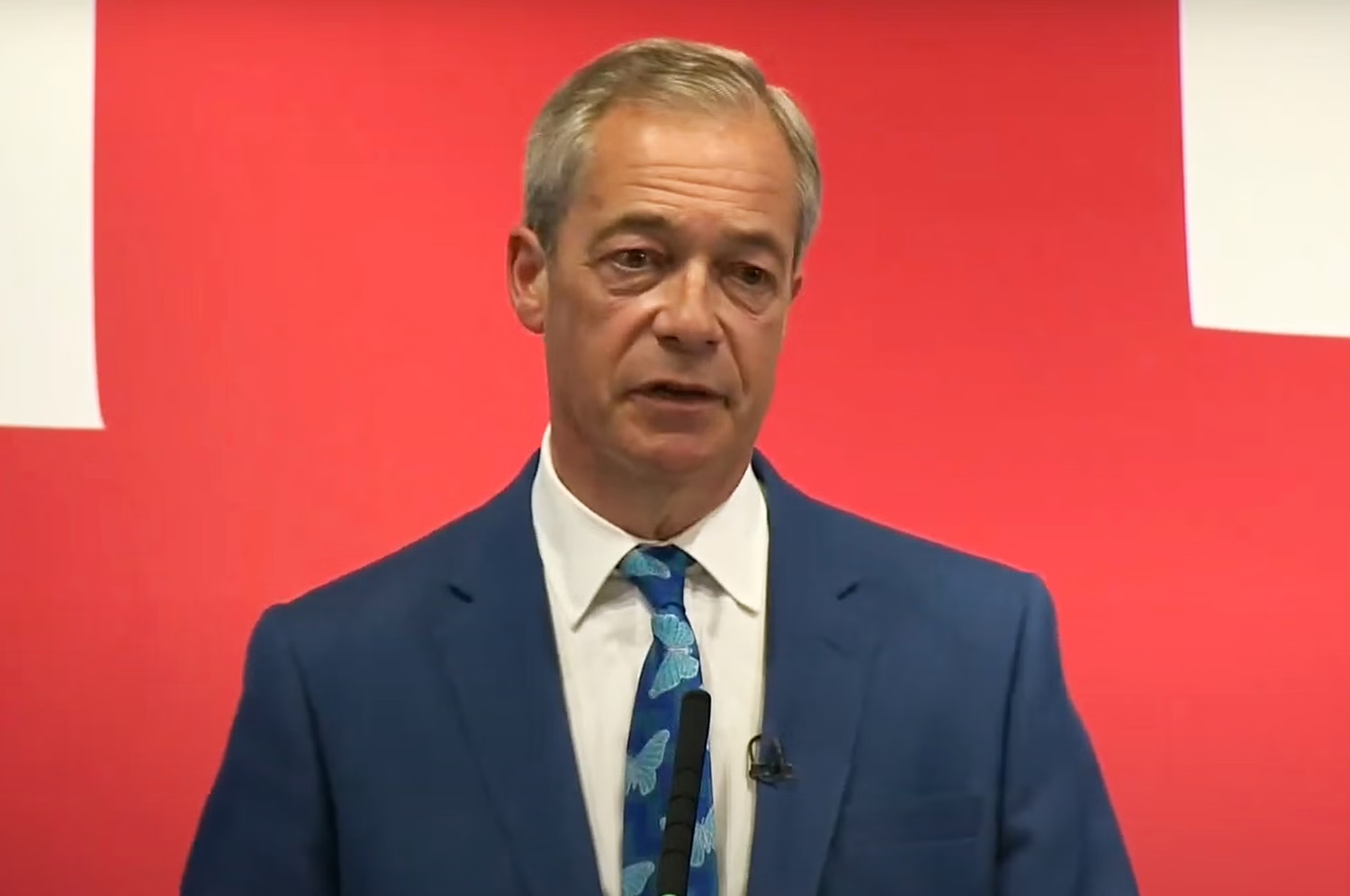
Reform UK Leader Nigel Farage speaking at a Reform UK press conference on 3 June 2024. Credit: Reform UK / YouTube
The Reform UK leader is a vocal opponent of net zero policies, and has questioned the basis of established climate science
Pro-Brexit campaigner Nigel Farage has announced that he will be standing to be an MP at the upcoming general election and will be replacing Richard Tice as leader of the populist party Reform UK.
Farage, who says that he hopes to become “the voice of opposition” in Parliament, has long been a vocal opponent of climate action and a critic of climate science – campaigning for a referendum on the UK’s 2050 net zero emissions target.
When he was the leader of the UK Independence Party (UKIP), the party’s 2015 and 2017 election manifestos pledged to rip up green measures, repeal the UK’s Climate Change Act, withdraw from the 2015 Paris Agreement – the flagship deal to tackle global emissions – and support fossil fuel extraction.
These reflected Farage’s personal views on climate action. In 2015, he told the libertarian website Spiked: “I think wind energy is the biggest collective economic insanity I’ve seen in my entire life. I’ve never seen anything more stupid, more illogical, or more irrational.”
Farage is a presenter on GB News, the right-wing broadcaster that has regularly provided a platform to climate science denial and attacks on green reforms since it launched in June 2021.
Speaking on GB News in August 2021, Farage said that he was “very much an environmentalist” and that he couldn’t “abide things like plastics in our seas, pollution in our rivers.” However, on the issue of climate change, he added: “What annoys me though, is this complete obsession with carbon dioxide almost to the exclusion of everything else, the alarmism that comes with it, based on dodgy predictions and science.”
The world’s foremost climate science body, the UN’s Intergovernmental Panel on Climate Change (IPCC), has stated it is “unequivocal that human influence has warmed the atmosphere, ocean and land”, while scientists at NASA have found that the last 10 years were the hottest on record. Earth’s average surface temperature in 2023 was the warmest since records began in 1880.
The IPCC has also stated that carbon dioxide “is responsible for most of global warming” since the late 19th century, which has increased the “severity and frequency of weather and climate extremes, like heat waves, heavy rains, and drought”.
Farage has been a vocal critic of net zero. He has claimed that the policy is an “act of self harm” and has called for it to be scrapped.
He has said: “It will not bring economic benefits. It will make everybody a whole lot poorer. And yet the lemmings in Parliament are taking us towards an economic cliff,” adding: “I can’t think of an issue on which the public and politicians are more divided.”
In fact, politicians are markedly less in favour of climate action than the general public. New polling by YouGov for the Energy and Climate Intelligence Unit (ECIU) has shown that almost two-thirds (62 percent) of the public believe the best way to achieve energy security is to reduce the use of fossil fuels and instead expand the use of renewable energy, compared to 48 percent of MPs.
The Climate Change Committee, which advises the government on its net zero policies, has estimated that the cost of achieving net zero will be less than 1 percent of UK GDP, while the government independent spending watchdog – the Office for Budget Responsibility – has said that, “the costs of failing to get climate change under control would be much larger than those of bringing emissions down to net zero”.
Farage has also claimed that, “If green technology is going to work, it ought to work without ordinary folk subsidising it” – referring to the government grants and investment dedicated to developing clean energy sources. The UK government has given £20 billion more in support to fossil fuel producers than their renewable energy peers since 2015.
Farage has also spread conspiracy theories about anti-pollution measures being used to control people’s lives.
In a video posted on Twitter, he argued that Mayor of London Sadiq Khan’s calls to reduce air pollution by cutting car engine use would pave the way to “climate lockdowns”.
He said: “Mark my words this isn’t going to end with 20mph zones and low-traffic neighbourhoods. No no. This is the beginning of climate lockdowns. We will have, in years to come, days where we’re told we can’t drive, we can’t do this, you can’t do that while Sadiq Khan is leading the way. Remember you heard it here first. Climate lockdowns.”
The Institute for Strategic Dialogue has highlighted how climate lockdown claims are part of “a conspiratorial narrative which claims that global elites are using climate change as a pretext to restrict individual freedoms and civil liberties.”
Farage and Reform UK
Farage used his announcement to state his belief that Labour will win the general election, which will be held on 4 July, and that the Conservative Party has “crushed itself”. With the Tories predicted to lose in a landslide, Farage appears to believe that he can lead a new right-wing movement.
The Reform leader was already a key figure in the party prior to today’s announcement, effectively owning the party as well as serving as its president. Reform operates as a private company without a democratic structure, so Farage’s majority shareholding meant that could have appointed himself as leader at any time.
Despite Farage failing to be elected as an MP when he stood in seven previous general elections, and Reform only winning two councillors in May’s local elections, polls indicate that Farage may succeed in becoming the MP for Clacton.
If this is the case, Farage will be advocating in Parliament for the anti-climate policies that have been proposed by his party.
Reform has called for the UK’s net zero emissions target to be scrapped, and has proposed holding a referendum on the policy – a campaign launched by Farage in 2022.
The party’s policy agenda states that: “Westminster’s net zero plans send our jobs and money overseas, making us net poorer and net colder”, adding that net zero policies are “net stupid”.
The party’s former leader Tice, who will now become its chairman, is a prominent climate science denier. Tice has claimed that “there is no climate crisis”, and has also expressed the view that “CO2 isn’t a poison. It’s plant food”.
Of the £2.5 million that Reform UK has received in donations since the 2019 election, around 92 percent (£2.3 million) of that income has been given by fossil fuel interests, polluting industries, or climate science deniers.