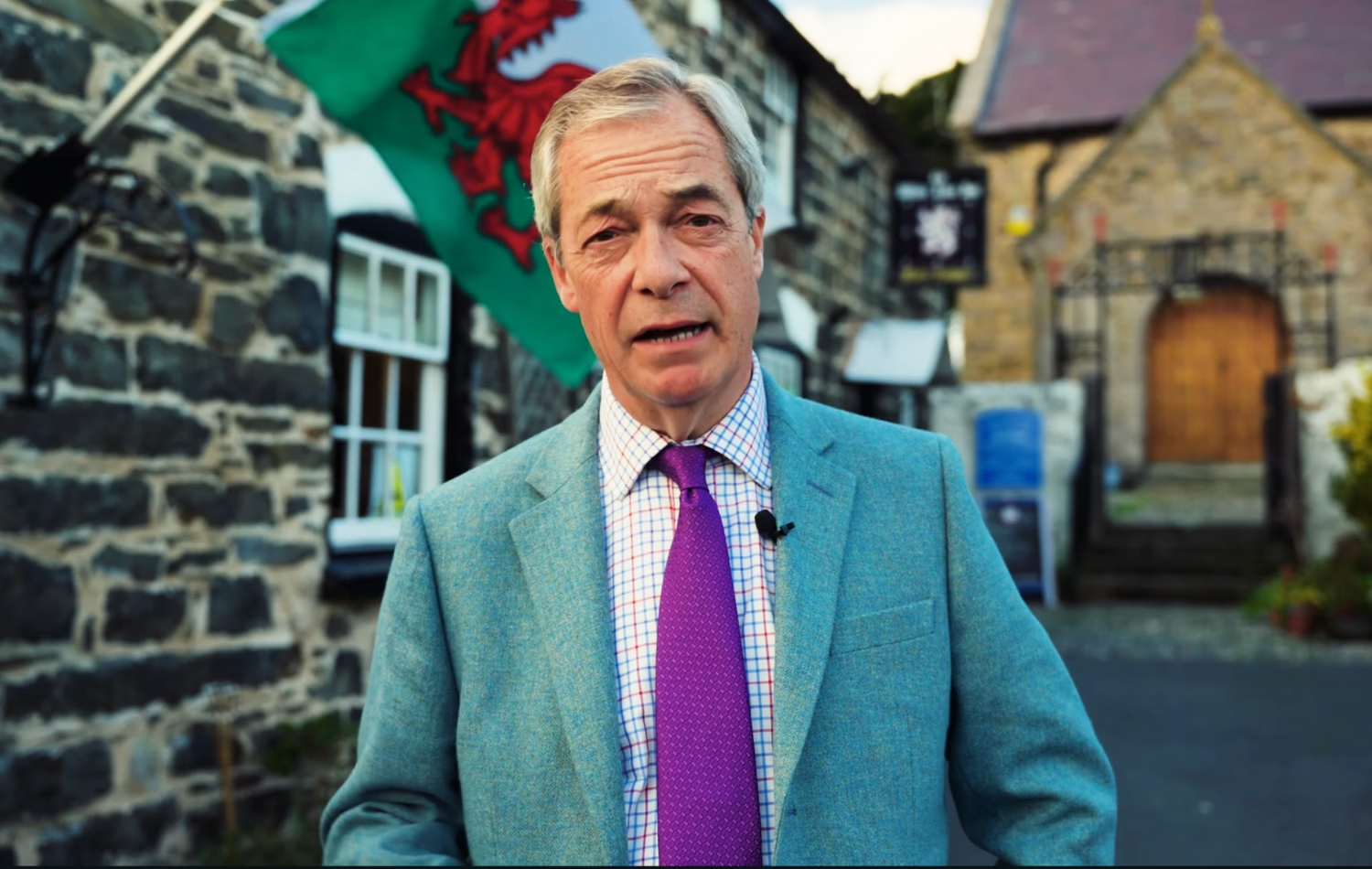
Reform UK leader Nigel Farage campaigning in Wales. Credit: Reform UK / YouTube
Welsh Reform labelled a “retirement home for failed Conservatives”.
The majority of Reform UK’s shadow cabinet in Wales is made up of former Conservative Party politicians, including its leader, chief whip, and shadow economy minister, DeSmog can reveal.
Nigel Farage’s radical right-wing party – which campaigns against climate policies and supports dramatically increased fossil fuel production – became the second largest group in the Senedd following elections on 7 May.
Reform has presented itself as an outsider force and an alternative to the established parties.
However, DeSmog’s analysis finds that almost two thirds (64.2 percent) of Reform’s shadow cabinet posts in Wales are held by individuals who have previously served or stood for the Tories.
That amounts to nine out of Reform’s 14 shadow cabinet members, and includes Reform’s leader in Wales, Dan Thomas, who was Conservative leader of Barnet Council in London before defecting to Farage’s party in June last year.
It also includes the party’s chief whip, Llŷr Powell, a former Tory council candidate, and shadow economy minister Jason O’Connell, a former Tory councillor.
In total, 12 of Reform’s 34 Senedd members are former Conservative politicians – amounting to 35 percent of the party’s representation in the assembly.
A spokesperson for the Wales Green Party said: “In the election campaign, Reform presented themselves as an insurgent anti-establishment party, but it’s looking more like they’re just a retirement home for failed Conservatives.”
Reform’s central party is also replete with ex-Tories. Six of Reform’s eight members of UK Parliament defected from the Conservatives, five while they were serving MPs. This includes Robert Jenrick, a former Tory minister and Reform’s current economic spokesperson, and former Conservative home secretary Suella Braverman, both of whom defected in January.
Of the remaining two – Farage and his deputy Richard Tice – the latter is a former Tory party member and donor.
In Scotland, at least four of Reform’s members of the Scottish Parliament are former Tory politicians, including Max Bannerman in the Highlands and Islands, Thomas Kerr and Kim Schmulian in Glasgow, and Graham Simpson in Central Scot and Lothians West.
Reform’s biggest donor, Thailand-based crypto and jet fuel billionaire Christopher Harborne, was previously a donor to the Conservative Party, giving £1.5 million between 2018 and 2022.
Harborne has donated £22 million to Reform, and gave Farage a £5 million gift in 2024 prior to him reclaiming the Reform leadership and standing for Parliament. Farage did not declare this sum when he was elected as an MP, and it is now the subject of a parliamentary standards investigation.
The Roster
Llŷr Powell, Reform’s chief whip and business manager in Wales, was a Conservative Party candidate for local government in 2022, and supportedKemi Badenoch for Tory leader the same year.
Powell, who was Reform’s unsuccessful candidate in the October 2025 Caerphilly Senedd by-election, used to work for Nathan Gill, the party’s former Welsh leader. Gill is currently serving a 10 and a half year prison sentence for accepting bribes from an agent of the Russian government during his time as a Member of European Parliament (MEP) for the Brexit Party (Reform’s forerunner).
Powell has said he didn’t work for Gill when he committed these offences, and had no knowledge of his crimes, but has refused to say the exact dates when he served under Farage’s former MEP.
James Evans, Reform’s shadow minister for health, prevention and sport, was elected as the Senedd member for Brecon and Radnorshire in 2021 as a Conservative. Before that, he served in Welsh local government as a Tory.
Laura Anne Jones, Reform’s shadow minister for food, farming and rural affairs, was previously a Conservative Senedd member for South Wales East.
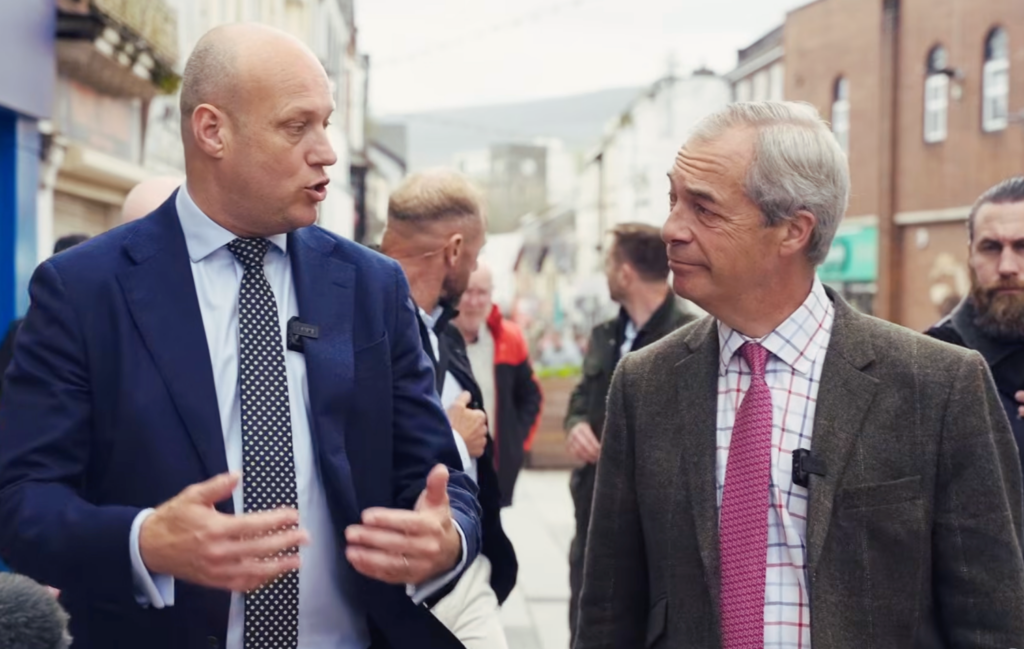
Reform UK leader Nigel Farage and Welsh leader Dan Thomas campaigning in Wales.
Credit: Reform UK / YouTube
Sarah Cooper-Lesadd, the party’s shadow minister for children, young people and skills, was a Conservative candidate for Coventry East in the 2024 general election. From 2022 to 2024 she was also a parliamentary assistant to Vicky Ford, Tory MP for Chelmsford.
Louise Emery, Reform’s shadow minister for culture, tourism and hospitality, was elected in 2017 and 2022 as a Conservative councillor in Conwy.
Francesca O’Brien, shadow minister for local government, housing and planning, was a Tory councillor for the Mumbles elected in 2017.
Adrian Mason, Reform’s shadow Counsel General and shadow minister for the constitution, was a Tory council candidate in Wales in 2017.
Jason O’Connell, shadow minister for economy and transport, was briefly a Welsh Conservative councillor in 2018, having been elected as an independent.
Outside of the shadow cabinet, Reform Welsh Senedd members Iain McIntosh and Tom Montgomery were elected to local government in Wales as Conservatives in 2022, while Stephen Senior stood as a Tory in 2022 and 2023.
Nigel Farage explains the politics of Reform UK: Racism, Fake anti-establishmentism, Deregulation, Corporatism, Climate Change Denial, Mysogyny and Transphobia.Nigel Farage urges you to ignore facts and reality and be a climate science denier like him and his Deputy Richard Tice. He says that Reform UK has received £Millions and £Millions from the fossil fuel industry to promote climate denial and destroy the planet.Nigel Farage reminds you that he’s the man that brought you Brexit and asks what could possibly go wrong.
Reform has run councils for a year. As local elections near, we ask: how has the party performed in power?
Broken promises, broken roads, and broken council leadership teams – that’s the outcome of Reform UK’s first year in power, an investigation by openDemocracy reveals.
Twelve months ago, Nigel Farage’s latest party took control of 10 English councils, meaning they now hold a total of 985 seats across Britain. Now, as Reform seeks to increase its foothold at elections in other English local authorities and pick up seats in the Scottish and Welsh Parliaments next week, we have examined its track record in office, finding that it failed to deliver on its pledges across the board.
Reform is still a young party, founded in 2022. To win so many seats after just three years – and on a promise to do things ‘differently’ – demands scrutiny, particularly when early polls suggest they could win government at the next general election.
While Reform was never going to be able to meaningfully deliver on many of its 2025 campaign points, which focused on policy areas not devolved to local government – such as illegal immigration, net-zero “madness” and law and order – we have been able to shed some light on its local priorities by reviewing election leaflets that it distributed in different areas of the country.
These materials reveal that Reform intended to slash council tax, fix potholes, and cut council waste by emulating Elon Musk’s ‘DOGE’ drive in Donald Trump’s White House. Yet even in these areas, our analysis shows it frequently fell short on its promises.
Instead, Reform raised taxes in every council where it holds or shares power. Potholes continue to cause accidents and damage, and councillors’ struggles over where to make promised savings have put much-loved local services at risk of closure.
For some Reform councillors, the broken promises were too much. The party has lost more than 70 of its elected local politicians in the space of a year, according to research by Liberal Democrat peer Mark Pack, although some were forced to resign or sacked.
One former Reform councillor, David Taylor, resigned from the party during a live BBC interview in February over the 9% council tax rise in Worcestershire, where Reform is the largest party but lacks overall control.
Taylor, who now represents the ward of Redditch East as an independent councillor, told openDemocracy of his discomfort at being expected to pass both the tax increase and bonuses of up to 10% for the council’s senior staff, who reportedly have six-figure salaries.
“I run a small recruitment company, and the party wanted me to sit on the council’s employment panel,” he said. “The discussion was on bonus payments. This was to pay a retention bonus to all staff, but realistically in that panel you are only dealing with senior staff. I was not going to vote for that, not when there is so much debt, redundancies and people being put on shorter hours – and then put up council tax.”
The policy shift felt at odds with the reasons why Taylor ran for office in the first place.
“I live in my community, all my family live in my constituency, all my friends live in my constituency. I talk directly with people who are impacted every day and who know the things we want to change,” he explained. “As a councillor, I could focus on helping people who matter most to me. We campaigned on lowering taxes and saving money, and none of it happened.”
‘If anything, it’s worse’
As last year’s local elections neared, Farage seized on one particular issue that he said was “getting worse all over the country”. He rode into a Reform rally on a JCB Pothole Pro and posted videos of himself playing ‘pothole golf’ and planting flowers in holes in the road.
Since then, though, Reform has struggled to keep its promise to drivers, according to Freedom of Information data obtained by openDemocracy.
We asked the ten Reform-led councils how many complaints they received about potholes in the years before and after the party took power. Only five councils responded; complaints had increased in four.
Staffordshire, where Farage filmed himself planting flowers in potholes, was among four councils to fail to respond to our FOI request within the 20-day legal time limit, while a fifth rejected our request.
In West Northamptonshire, residents made an average of 1,193 complaints about potholes each month after Reform took power – a sharp increase since the council was controlled by the Conservatives, when it received an average of 860 pothole-related complaints each month, according to data obtained by openDemocracy.
The data also shows that many of the complaints made since Reform took office concerned potholes that the council claimed to have already fixed, and that council staff marked 381 as “unable to fix”..
In March of this year, one aggrieved local complained: “Pot hole has been reported, a bodge job infill was done, this was not done to any standard, when your workmen arrived today they were very rude to my husband when he asked if he could help. THIS POT HOLE IS STILL THERE.”
“I had an email though today, marking this pothole as fixed at 15:12,” wrote another resident. “I can confirm that I drove past this pothole at 15:49 and it definitely has not been repaired, and if anything has got significantly worse!”
This sentiment was echoed by Sally Keeble, the leader of the Labour group at West Northamptonshire council. “They are not repairing potholes,” she told openDemocracy. “If anything, it has got worse.”
Doncaster City Council received an average of 165 pothole complaints a month before Reform took power, rising to 147 complaints a month after. It did, however, also fix more potholes under Reform. Other councils recorded smaller numbers of complaints.
While complaints persist, one company benefiting from the pothole crisis is JCB, which donated £200,000 to Reform in 2025 and whose owner, Conservative donor Lord Bamford, paid £8,400 for Farage and an aide to visit the firm’s factory via helicopter in October 2024.
The Reform-run council in Lincolnshire has invited the heavy machinery outfit back to re-trial its Pothole Pro despite it previously being rejected by the council after a nine-week trial in 2021, when engineers concluded “better tools” were available. The same model is now also being trialled by the Reform councils in Derbyshire and Staffordshire.
Culture wars
Reform also promised to cut council waste by slashing spending on projects linked to “diversity, inclusion and equality” and “net-zero”. Once in power, however, the party found little to cut.
Four of the 10 councils had no equality officers even before Reform took control, according to their Freedom of Information responses to openDemocracy. The three that did have a small number of equality staff still employed them one year later (three councils did not respond to our request). DEI training programmes were also still being run at the same levels.
“Everyone thought we’d come in and there were going to be these huge costs we could cut away, but there just aren’t,” one anonymous Reform cabinet member at Kent County Council told the Financial Times in October last year. Months later, a cabinet member at the council, Matthew Fraser Moat, told the same paper that Reform had “not actually made any cuts”. He later resigned from cabinet over the comment, which he said had been “twisted to fit what I believe to be an anti-KCC narrative”.
Durham council chose to attack “DEI” by withdrawing the £2,500 funding set aside for the annual local Pride march, a celebration of LGBTQ+ rights, which is due to take place on 30 May this year. It justified its decision in an email to organisers, and seen by openDemocracy, by saying that “the focus of the modern Pride movement has shifted in a way that many find divisive”.
The council said it was taking “a principled stand that the council should not be in the position of subsidising events that have become primarily associated with the promotion of a specific and contested political ideology.”
This week, it was reported in local media that Reform’s leader of the council, Andrew Husband, had been accused of homophobia after using an offensive slur on a social media post that openDemocracy has reviewed but is choosing not to repeat for legal reasons. We put this allegation to Husband, who called it “desperate deflection from the Labour Party which doesn’t deserve a response”.
Despite the cut, Pride is going ahead, with organiser Mel Metcalf saying: “We are fighting hate with love. We have a lot of support. A lot of unions are coming together to support us.” Still, Reform’s attitude to LGBTQ+ rights has had an effect, he said.
“Some of our volunteers no longer feel confident wearing their rainbow T-shirts or lanyards in public for fear of being challenged. That’s the difference. There is a hesitation now in Durham, about not being as out or open as previous,” he said. “It is sad that people are feeling that way.”
But, Metcalf insists, “what will get us through is love, not hate.”
Reform councils have become embroiled in culture wars on issues surrounding flags, misogyny and racism.
“The equalities stuff is appalling,” said Sally Keeble in West Northants. “Reform’s Peter York was in trouble for saying women should never have left the kitchen. Female councillors have resigned and when I challenged the leader of the council Mark Arnull about what he was doing to get more women into the cabinet, he accused me of promoting toxic identity politics. I thought it was an appalling response when you have to provide services to all communities.”
Further north, in Derbyshire, councillor Stephen Reed apologised at the end of last year after using a council meeting to declare that if having a “view that says our citizens should come first rather than people jumping on boats and getting into the country illegally is racist, then guess what? I’m a racist and I’m proud of it!”
The climate crisis is another front in Reform’s culture war.
Derbyshire council scrapped its climate change committee, with Labour group leader Anne Clarke telling openDemocracy: “They don’t believe in climate change. The committee ran for four years and was looking at the reductions on carbon in the council portfolio. Work was progressing’.” She added that the savings Reform made by scrapping the committee “are small”, describing the decision to do so as “disappointing”.
Reform councillor Carol Wood, Derbyshire County Council’s cabinet member for net zero and environment, said: “Making sure this council is as efficient as it can be and that every pound of council tax-payers’ money is accounted for and spent wisely is our top priority.” Focus on environmental issues, she said, has moved under the “existing ‘Place’ scrutiny committee to streamline operations.”
Kent council has similarly abandoned its Net Zero 2030 Plan in favour of an Energy Efficiency Plan, branding the original as “unattainable” and a source of “financial and operational risk.”
In Lincolnshire, rejecting what Conservative MP-turned-Reform mayor Andrea Jenkyns called “the net-zero bandwagon” has opened the doors to US fracking interests. According to reports in The Guardian, Jenkyns has courted Egdon Resources and its parent company, US fracker Heyco Energy, in the hope of bringing fracking to the region. The controversial energy method was effectively banned in England in 2019 due to earthquake concerns.
Losing out
Despite promises to put Britain’s people first, our investigation learnt that Reform is failing local residents, including by threatening to close much-needed local services such as Glossop tip.
“The local tip is something that everyone uses; it impacts on everyone,” Derbyshire’s Anne Clarke told openDemocracy. “It has really sparked local concerns and the savings made will be small. It’s in a Reform councillor’s patch and even he is campaigning to keep it open!”
Clarke is concerned that a longer drive to a local tip will lead to more fly-tipping, which affects quality of life and tourism. “We are reliant on our visitor economy, so even a small increase in fly tipping could affect our local businesses.”
Also facing permanent closure is the Grange care home, a centre that is close to the heart of Labour district councillor for North East Derbyshire and parish councillor for Eckington, Kathy Clegg. Her grandmother, also a councillor, helped to open the home.
“It’s a special place,” she said. “Everyone would consider this as the place to go to for care. It’s local, we all know each other. It’s hugely sad to see it closed. Residents had to move out and were effectively homeless. There’s an issue of relocation stress syndrome. People die due to the stress when moved out of care homes.” Some of the residents have lived there for more than two decades.
The Grange is one of eight care homes facing closure following a decision by the previous Conservative administration. Local businessman Matt Davison has since offered to buy the Grange, to rescue it for the community and residents, but said he was rebuffed by the Reform council, which planned to sell all eight homes to one buyer. When that sale fell through, Davison again made an offer, telling local media that he was ignored and Reform wants to “close the home.”
This is in contrast to a second care home, with the council currently in negotiations with a private buyer.
Derbyshire council’s cabinet member for adult care, Joss Barnes, told openDemocracy that “all offers to buy [the care homes] were carefully considered – whether singly, in groups, or as a whole package. Unfortunately, despite intensive negotiations with a provider to take over the running of the homes, the sale fell through and we are now in the process of ensuring residents find new, suitable homes to live in.”
“I think people feel let down, people feel terrified,” said Kathy Clegg. “Some of the Grange carers went to visit a former resident in his new care home. He was inconsolable. I am choking up thinking about it, because he was saying ‘I want to go home, I want to go home.’ Our local Reform councillor is silent. He’s done nothing at all.”
“Derbyshire County Council led by Reform has failed in every promise they made before the election,” she added.
A year of broken promises, attacks on equalities, and unfair spending decisions is a warning for the UK as a whole, said Sally Keeble. “What we are seeing is the reality of how Reform behaves, and what they would do if they got into power.”
openDemocracy approached Kent, Durham, West Northants councils and JCB for comment, as well as Peter York and Mark Arnull. We did not receive a response before publication.
Elon Musk urges you to be a Fascist like him, says that you can ignore facts and reality then.Nigel Farage explains the politics of Reform UK: Racism, Fake anti-establishmentism, Deregulation, Corporatism, Climate Change Denial, Mysogyny and Transphobia.Nigel Farage reminds you that he’s the man that brought you Brexit and asks what could possibly go wrong.
Nigel Farage urges you to ignore facts and reality and be a climate science denier like him and his Deputy Richard Tice. He says that Reform UK has received £Millions and £Millions from the fossil fuel industry to promote climate denial and destroy the planet.Nigel Farage reminds you that he’s the man that brought you Brexit and asks what could possibly go wrong.Nigel Farage says he’s too stupid to answer questions about the hit to the UK economy of his plans to suck up to the uber-rich.
Green party leader Zack Polanski (Green Party of England and Wales). Image: Bristol Green Party Creative Commons CC0 1.0 Universal Public Domain Dedication.
Responding to news that Nigel Farage’s Reform UK party has received a £9 million donation from a single donor, Green Party leader Zack Polanski said
“Reform hoovering up vast sums of private donations isn’t a sign of political strength, but a sign of a weakness in the foundations of our democracy. When a single party can be bankrolled by a handful of wealthy individuals, it drowns out the voices of ordinary people and tilts the entire system towards the interests of those elites.
“This is exactly why we need a cap on political donations. Democracy should never be for sale. Every party should compete on ideas, not on the size of their donor spreadsheet.
“While Reform pockets eye-watering cheques, Greens are building a movement powered and funded by people through thousands of new members.
“When we win elections, it will be because of the tens of thousands of people volunteered, not the people who donated tens of thousands. If we want a politics that serves the public, not billionaire backers, then capping donations is essential. Let’s end the influence of big money and put democracy back where it belongs: in the hands of voters.”
Nigel Farage reminds you that he’s the man that brought you Brexit and asks what could possibly go wrong.
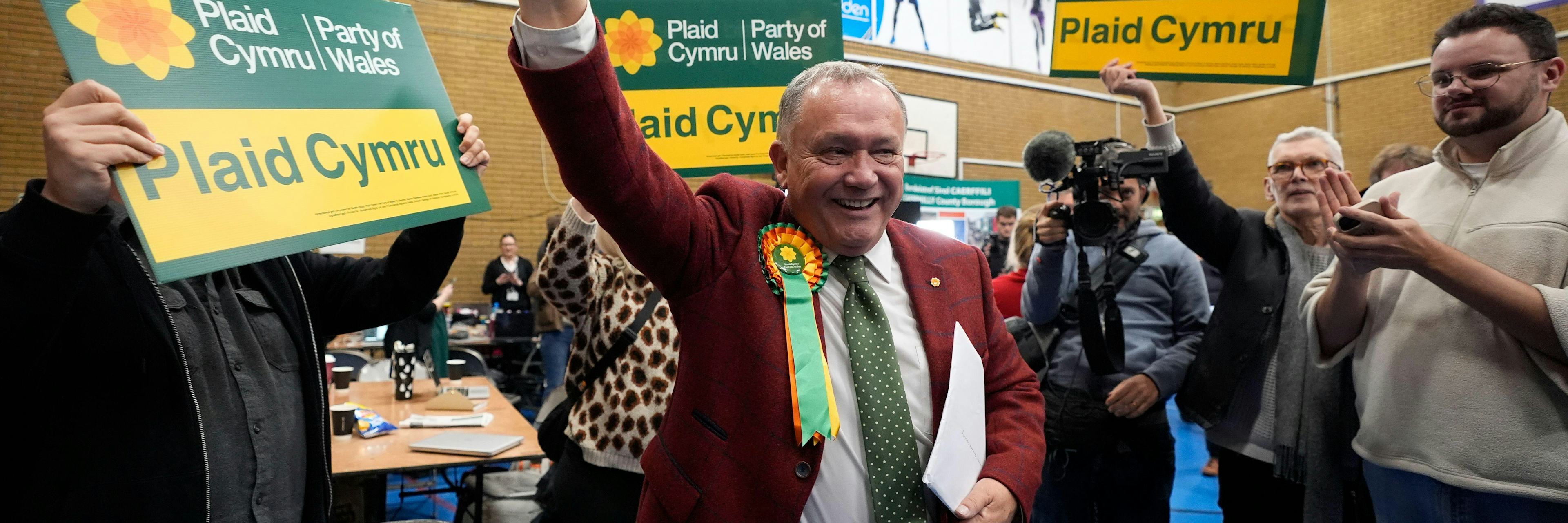
Plaid Cymru’s overwhelming victory in the recent Caerphilly Senedd byelection shattered over a century of political tradition. Lindsay Whittle took the seat with 15,691 votes. Labour, which had held the seat since it was created, came away with just 3,713 votes.
Reform came second to Plaid, with 12,113 votes. And while this was an impressive performance, the fact that it failed to win Caerphilly even after vast amounts of time and money spent on the campaign has led to speculation that tactical voting played a part in this byelection.
A big clue that tactical voting was at work in Caerphilly was the recorded turnout. Typically, byelections in Wales have been low-key affairs. Turnouts are low and incumbents generally win. The national average for a Senedd vote in a constituency has never tipped over 50%. In Caerphilly, turnout climbed from 44% in the 2021 election to 50.4% in this byelection.
And while local voters clearly backed Plaid Cymru for plenty of reasons, the extremely low vote count for other parties does suggest at least some lent their vote to Plaid to keep out Reform. The Conservative vote collapsed to fewer than 700 votes and the Lib Dems and Greens, so often the recipients of tactical votes themselves, each took just 1.5% of the votes in Caerphilly.
Anecdotes from the vote count support this. The BBC recounted “extraordinary stories” of habitual supporters of the Conservatives, a pro-union party, voting Plaid to block Reform.
The increased turnout and Plaid’s 27.4% swing both suggest a mobilisation, triggered by polling and a wider national narrative which persuasively contends that Reform is ahead of other parties. Does the result therefore imply that Reform can be beaten elsewhere if voters take the right approach to tactical voting?
The limits of Reform’s surge
Reform entered the Caerphilly race with no prior foothold in the constituency. The party mobilised heavily and, it had seemed, effectively. Nigel Farage and other senior Reform figures made multiple visits to the area to campaign for their candidate, Llŷr Powell. Pre-election polls, including one by Survation which had Reform leading Plaid by 42% to 38%, raised expectations of a breakthrough.
And it is true that Reform’s ultimate 36% vote share reflects its growing appeal among disaffected working-class voters. It did capitalise on the same anti-establishment sentiment that has seen the party top UK-wide polls for much of the past year.
Yet, the result also exposes Reform’s vulnerabilities. As with the Hamilton, Larkhall and Stonehouse byelection for the Scottish parliament earlier in the summer, Reform failed to convert intensive campaigning into victory.
The role and reach of tactical voting
Underneath the hype, Farage is unpopular. Polls suggest as many as 60% of voters are opposed to him being prime minister. That presents an opportunity for opponents to unite behind a more broadly acceptable candidate.
In this volatile political era, where voters show little loyalty to tradition, smaller parties like Plaid Cymru, the SNP, Greens and even Pro-Gaza independents could frame themselves as the “real alternative” to Reform. Depending on local dynamics, they could attempt to draw tactical support.
It should be noted, however, that tactical voting cuts both ways. While it denied Reform a victory in Caerphilly, the party could attract tactical support from Conservative voters eager to oust Labour governments.
In England, without equivalents to Plaid or the SNP to siphon anti-establishment sentiment, Reform may consolidate its grip on working-class disillusionment. This trend was evident in Labour’s collapse in the Runcorn and Helsby Westminster byelection in May 2025, which enabled Reform to take the seat.
In Caerphilly, Labour’s vote fell amid grievances including the slow pace of change to improve living standards, policy u-turns and a fatigue with Welsh Labour, which has been in power in the Senedd since its creation in 1999.
Such grievances can be felt across the UK more broadly – with winter-fuel policy u-turns, and a general dissatisfaction with how long it is taking Labour to deliver on promises to improve living standards. Concern about immigration is also used to punish Labour in both the regular voting intention polls and at the ballot box in council byelections.
An anti-Reform majority does exist – and it has shown up in several contests, including in races Reform has ultimately won but on less than 50% of the vote. Harnessing this anti-Reform majority, however, requires a level of co-ordination rarely seen in the UK’s electoral history.
Unlike the 1997 anti-Conservative wave, there is no single opposition brand. Instead, the anti-Reform vote is split across Labour, Liberal Democrats, Greens, nationalists and independents – and, arguably, the Conservatives too.
In Caerphilly, we saw this fragmentation briefly turn into coalescence. This implies that a clear polling trigger, showing Reform ahead in a seat, can focus the minds of voters and drive tactical thinking. It also helped that these voters were offered a Plaid candidate with deep community roots and a strong, progressive message.
What is potentially harder in a general election is the presentation of a local contest as extremely high stakes in the media. Caerphilly drew unprecedented attention precisely because it was being framed as a test case for Reform in Wales, which may explain the level of anti-Reform vote.
In a multi-polar UK, the anti-Reform majority is real – but not pro-any one party by default. Importantly, it is anti-populist, anti-incumbent and regionally variable. Nearly all of the mainstream parties on the centre ground and left wing of politics are claiming to be the real alternative to Reform.
Reform’s path to power lies in building a lead that is too large for tactical voting to overcome, or in electoral systems which reward vote share over seat efficiency. This is why it remains hopeful of success in May 2026 in Wales, where the election is being held under a proportional voting system.
As the UK heads towards the 2026 devolved elections and a likely 2029-30 general election, Caerphilly offers a blueprint for resistance to Reform’s national surge. It also offers a warning for the other parties: stopping Reform is not the same as winning.
Want more politics coverage from academic experts? Every week, we bring you informed analysis of developments in government and fact check the claims being made.
Nigel Farage explains the politics of Reform UK: Racism, Fake anti-establishmentism, Deregulation, Corporatism, Climate Change Denial, Mysogyny and Transphobia.Nigel Farage urges you to ignore facts and reality and be a climate science denier like him and his Deputy Richard Tice. He says that Reform UK has received £Millions and £Millions from the fossil fuel industry to promote climate denial and destroy the planet.Nigel Farage reminds you that he’s the man that brought you Brexit and asks what could possibly go wrong.