Category: Rishi Sunak

  • US, UK Bomb Yemeni Capital as Part of ‘Sustained’ Attack on Houthis

    Spread the love

    Original article by BRETT WILKINS republished from Common Dreams under Creative Commons (CC BY-NC-ND 3.0).

    A U.S. warplane takes off from an aircraft carrier en route to airstrikes on Houthi targets in Yemen on January 22, 2024.  (Photo: U.S. Central Command)

    “The U.S. just bombed Yemen again,” the peace group CodePink noted. “The U.S. is illegally attacking Yemen so Israel can continue illegally attacking Gaza.”

    Anti-war voices on Monday condemned the start of what appeared to be the “sustained” assault on Yemen by U.S. and U.K. forces that top Biden administration officials have reportedly been planning—without congressional approval—in a bid to stop Houthi attacks on Red Sea shipping.

    “The U.S. just bombed Yemen again,” the peace group CodePink lamented on social media. “The U.S. is illegally attacking Yemen so Israel can continue illegally attacking Gaza.”

    The intensified attacks on Yemen—an impoverished nation reeling from a decade of civil war and U.S.-backed Saudi-led airstrikes—come amid Israel’s 108-day assault on Gaza, which has killed over 25,000 people and drawn a response from the Houthis in the form of largely ineffective missile and drone strikes.

    “Today, the militaries of the United States and United Kingdom, at the direction of their respective governments with support from Australia, Bahrain, Canada, and the Netherlands, conducted an additional round of proportionate and necessary strikes against eight Houthi targets in Yemen in response to the Houthis’ continued attacks against international and commercial shipping as well as naval vessels transiting the Red Sea,” a joint statement from those six nations explained.

    “These precision strikes are intended to disrupt and degrade the capabilities that the Houthis use to threaten global trade and the lives of innocent mariners, and are in response to a series of illegal, dangerous, and destabilizing Houthi actions since our coalition strikes on January 11, including anti-ship ballistic missile and unmanned aerial system attacks that struck two U.S.-owned merchant vessels,” the statement continued.

    According to the six countries, Monday’s attacks “specifically targeted a Houthi underground storage site and locations associated with the Houthis’ missile and air surveillance capabilities.”

    Fatik Al-Rodaini, a Yemeni journalist and human rights activist who founded the charity Mona Relief, reported on social media that “massive explosions have been heard loudly in the capital Sanaa,” while multiple videos published online showed large explosions rocking the city, raising fears of civilian casualties.

    Houthi spokesperson Mohammed Al-Bukhaiti vowed on social media Monday that “the American-British aggression will only increase the Yemeni people’s determination to carry out their moral and humanitarian responsibilities towards the oppressed in Gaza.”

    “The war today is between Yemen, which is struggling to stop the crimes of genocide, and the American-British coalition to support and protect its perpetrators,” he added. “Thus, every party or individual in this world is faced with two choices that have no thirds: either to preserve its humanity and stand with Yemen, or to lose it and stand with the American-British alliance.”

    Asked last week if bombing Yemen was working, U.S. President Joe Biden—an ardent supporter of Israel’s assault on Gaza—replied: “Well, when you say ‘working,’ are they stopping the Houthis? No. Are they going to continue? Yes.”

    Some Biden administration officials have said it may take weeks or even months to stop Houthi attacks on Israeli-linked commerce. U.S. bombardment is nothing new to Yemenis, who have suffered American air and drone strikes—as well as occasional ground raids like the one in which 8-year-old Yemeni American Nawar al-Awlaki was killed—since the George W. Bush administration.

    According to the U.K.-based monitor Airwars, U.S. forces have killed an estimated 154-273 Yemeni civilians in 181 declared actions since 2002.

    In an article published by The Nation Monday, U.S. Rep. Ro Khanna (D-Calif.) asserted that “President Biden has both the constitutional obligation and a political imperative to seek congressional authorization” for attacking Yemen.

    “To be sure, the president is afforded the authority under the Constitution and the War Powers Act to repel a sudden Houthi attack on the United States, its territories, possessions, or its armed forces, in the narrow case where self-defense requires immediate action,” the congressman added. “But in the absence of such a national emergency, the president must seek authorization from Congress.”

    The online activist group RootsAction weighed in on the latest U.S. war—which Biden administration officials won’t admit is one—by accusing the president of seeking to “starve the region’s poorest country.”

    “Joe Biden is starting a war on Yemen with no exit plan. Just more forever wars that no one wants,” the group said. “The Democratic Party expects us to vote for this in November?”

    Original article by BRETT WILKINS republished from Common Dreams under Creative Commons (CC BY-NC-ND 3.0).

    Rishi Sunak, UK's janitor prime minister.
    Rishi Sunak, UK’s janitor prime minister.
  • Rishi Sunak facing renewed pressure over plans to ‘max out’ North Sea oil

    Spread the love
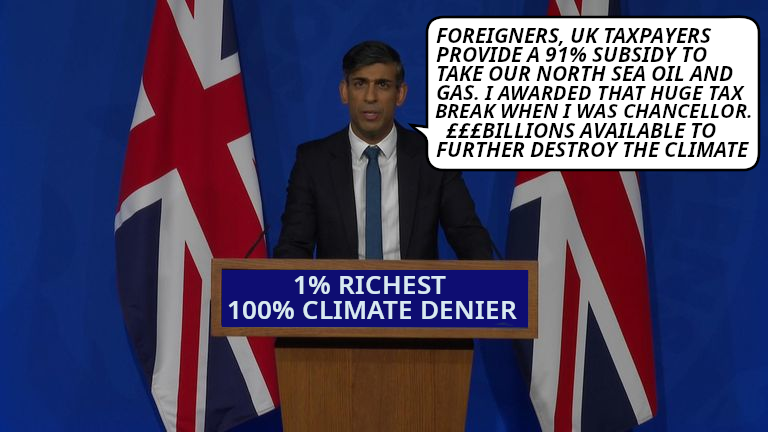
    Rishi Sunak offers huge fossil fuel subsidies to develop fossil fuel extraction in UK.
    Rishi Sunak offers huge fossil fuel subsidies to develop fossil fuel extraction in UK.

    www.theguardian.com/environment/2024/jan/21/rishi-sunak-facing-renewed-pressure-over-plans-to-max-out-north-sea-oil

    Dithering on renewable energy and insulation will leave people in Britain ‘colder and poorer’, campaigners warn

    Rishi Sunak is facing further attacks on his plans to expand oil and gas exploration in the North Sea this week. The Offshore Petroleum Licensing Bill – to be debated in the Commons on Monday – has already triggered widespread protests, including the resignation of Chris Skidmore, a former Conservative energy minister.

    The bill aims to boost fossil fuel extraction by establishing a new system under which licences for North Sea oil and gas projects will be awarded annually.

    Green groups and analysts are lining up to criticise it. UpLift, which campaigns for green energy, pointed out that the bill, which the government says will “max out” the UK’s reserves, will actually result in only a 2% rise in North Sea gas output. “The remaining 98% of gas demand will come from existing North Sea fields,” its analysis finds.

    …

    “Sunak, like his predecessor Liz Truss, is obsessing over oil and gas, but dithering on renewables and insulation which will boost UK energy security and lower bills,” said Tessa Khan, executive director of UpLift. “And it’s making people in this country colder and poorer.”

    …

    www.theguardian.com/environment/2024/jan/21/rishi-sunak-facing-renewed-pressure-over-plans-to-max-out-north-sea-oil

    Image of InBedWithBigOil by Not Here To Be Liked + Hex Prints from Just Stop Oil's You May Find Yourself... art auction. Featuring Rishi Sunak, Fossil Fuels and Rupert Murdoch.
    Image of InBedWithBigOil by Not Here To Be Liked + Hex Prints from Just Stop Oil’s You May Find Yourself… art auction. Featuring Rishi Sunak, Fossil Fuels and Rupert Murdoch.
  • Government ignored ‘overwhelming evidence’ that Israel was breaching international human rights laws in Palestine

    Spread the love

    https://morningstaronline.co.uk/article/government-ignored-overwhelming-evidence-that-israel-was-breaching-international-human-rights-laws-in-palestine

    Protesters during a National March for Palestine in central London, January 13, 2024

    THE government ignored “overwhelming evidence” that Israel was breaching international human rights laws in Palestine and continued to supply the murderous regime with weapons, including those being used in Gaza, legal documents have revealed.

    A Foreign Office assessment unit reviewing UK arms sales to Israel in November raised “serious concerns” with Foreign Secretary David Cameron.

    But the former PM recommended that arms sales continue, accepting Israel’s reasoning that it has a different interpretation of its international humanitarian law obligations.

    The revelations are contained in a document in a case brought by the Global Legal Action Network (GLAN) and Palestinian human rights group Al Haq over UK arms sales to Israel.

    …

    https://morningstaronline.co.uk/article/government-ignored-overwhelming-evidence-that-israel-was-breaching-international-human-rights-laws-in-palestine

  • Military interests are pushing new nuclear power – and the UK government has finally admitted it

    Spread the love

    Original article by Andy Stirling republished from the Conversation under a Creative Commons Attribution-No Derivatives licence.

    Ben Birchall / Alamy

    The UK government has announced the “biggest expansion of the [nuclear] sector in 70 years”. This follows years of extraordinarily expensive support.

    Why is this? Official assessments acknowledge nuclear performs poorly compared to alternatives. With renewables and storage significantly cheaper, climate goals are achieved faster, more affordably and reliably by diverse other means. The only new power station under construction is still not finished, running ten years late and many times over budget.

    So again: why does this ailing technology enjoy such intense and persistent generosity?

    The UK government has for a long time failed even to try to justify support for nuclear power in the kinds of detailed substantive energy terms that were once routine. The last properly rigorous energy white paper was in 2003.

    Even before wind and solar costs plummeted, this recognised nuclear as “unattractive”. The delayed 2020 white paper didn’t detail any comparative nuclear and renewable costs, let alone justify why this more expensive option receives such disproportionate funding.

    A document published with the latest announcement, Civil Nuclear: Roadmap to 2050, is also more about affirming official support than substantively justifying it. More significant – in this supposedly “civil” strategy – are multiple statements about addressing “civil and military nuclear ambitions” together to “identify opportunities to align the two across government”.

    These pressures are acknowledged by other states with nuclear weapons, but were until now treated like a secret in the UK: civil nuclear energy maintains the skills and supply chains needed for military nuclear programmes.

    The military has consistently called for civil nuclear

    Official UK energy policy documents fail substantively to justify nuclear power, but on the military side the picture is clear.

    For instance, in 2006 then prime minister Tony Blair performed a U-turn to ignore his own white paper and pledge nuclear power would be “back with a vengeance”. Widely criticised for resting on a “secret” process, this followed a major three volume study by the military-linked RAND Corporation for the Ministry of Defence (MoD) effectively warning that the UK “industrial base” for design, manufacture and maintenance of nuclear submarines would become unaffordable if the country phased out civil nuclear power.

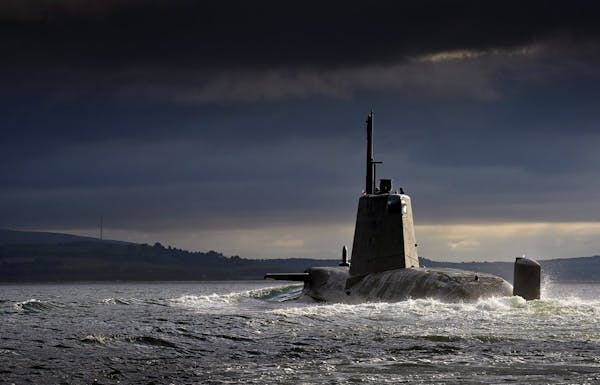
    The UK navy has ten nuclear-powered submarines. Defence Imagery / flickr, CC BY-SA

    A 2007 report by an executive from submarine-makers BAE Systems called for these military costs to be “masked” behind civil programmes. A secret MoD report in 2014 (later released by freedom of information) showed starkly how declining nuclear power erodes military nuclear skills.

    In repeated parliamentary hearings, academics, engineering organisations, research centres, industry bodies and trade unions urged continuing civil nuclear as a means to support military capabilities.

    In 2017, submarine reactor manufacturer Rolls Royce even issued a dedicated report, marshalling the case for expensive “small modular reactors” to “relieve the Ministry of Defence of the burden of developing and retaining skills and capability”.

    The government itself has remained coy about acknowledging this pressure to “mask” military costs behind civilian programmes. Yet the logic is clear in repeated emphasis on the supposedly self-evident imperative to “keep the nuclear option open” – as if this were an end in itself, no matter what the cost. Energy ministers are occasionally more candid, with one calling civil-military distinctions “artifical” and quietly saying: “I want to include the MoD more in everything we do”.

    In 2017, we submitted evidence to a parliamentary public accounts committee investigation of the deal to build Hinkley Point C power plant. On the basis of our evidence, the committee asked the then MoD head (who – notably – previously oversaw civil nuclear contract negotiations) about the military nuclear links. His response:

    We are completing the build of the nuclear submarines which carry conventional weaponry. We have at some point to renew the warheads, so there is very definitely an opportunity here for the nation to grasp in terms of building up its nuclear skills. I do not think that that is going to happen by accident; it is going to require concerted government action to make it happen.

    This is even more evident in actions than words. For instance hundreds of millions of pounds have been prioritised for a nuclear innovation programme and a nuclear sector deal which is “committed to increasing the opportunities for transferability between civil and defense industries”.

    An open secret

    Despite all this, military pressures for nuclear power are not widely recognised in the UK. On the few occasions when it receives media attention, the link has been officially denied.

    UK prime minister Rishi Sunak announces a US-UK-Australia nuclear submarine deal in March 2023. Etienne Laurent / EPA

    Other nuclear-armed states are also striving to maintain expensive military infrastructures (especially around submarine reactors) just when the civilian industry is obsolescing. This is true in the US, France, Russia and China.

    Other countries tend to be more open about it, with the interdependence acknowledged at presidential level in the US for instance. French president Emmanuel Macron summarises: “without civil nuclear power, no military nuclear power, without military nuclear, no civil nuclear”.

    This is largely why nuclear-armed France is pressing the European Union to support nuclear power. This is why non-nuclear-armed Germany has phased out the nuclear technologies it once lead the world in. This is why other nuclear-armed states are so disproportionately fixated by nuclear power.

    These military pressures help explain why the UK is in denial about poor nuclear performance, yet so supportive of general nuclear skills. Powerful military interests – with characteristic secrecy and active PR – are driving this persistence.

    Neglect of this picture makes it all the more disturbing. Outside defence budgets, off the public books and away from due scrutiny, expensive support is being lavished on a joint civil-military nuclear industrial base largely to help fund military needs. These concealed subsidies make nuclear submarines look affordable, but electricity and climate action more costly.

    The conclusions are not self-evident. Some might argue military rationales justify excessive nuclear costs. But history teaches that policies are more likely to go awry if reasons are concealed. In the UK – where nuclear realities have been strongly officially denied – the issues are not just about energy, or climate, but democracy.


    The Conversation asked the UK Department for Energy Security and Net Zero to comment but did not receive a reply before the publication deadline.

    Don’t have time to read about climate change as much as you’d like?
    Get a weekly roundup in your inbox instead. Every Wednesday, The Conversation’s environment editor writes Imagine, a short email that goes a little deeper into just one climate issue. Join the 30,000+ readers who’ve subscribed so far.

    Original article by Andy Stirling republished from the Conversation under a Creative Commons Attribution-No Derivatives licence.

  • Damning poll reveals what the public really think about the Rwanda scheme

    Spread the love

    https://leftfootforward.org/2024/01/damning-poll-reveals-what-the-public-really-think-about-the-rwanda-scheme/

    Rishi Sunak has staked his political future on getting the Rwanda scheme off the ground. Under the proposals, asylum seekers who arrive in the UK other than through an existing asylum scheme would be deported to Rwanda where their claim would then be processed.

    …

    Polling from YouGov found that if Labour were to win the next election, 40% of voters would want Keir Starmer to scrap the plan. That compares to 34% who think it should be kept.

    Asking a slightly different question, YouGov more recently found that just one in five voters think the Rwanda scheme should be pushed through in its current form. Again, 40% of the public think it should be scrapped altogether.

    …

    https://leftfootforward.org/2024/01/damning-poll-reveals-what-the-public-really-think-about-the-rwanda-scheme/