Investigating the so-called ‘windfall tax’
Spread the love
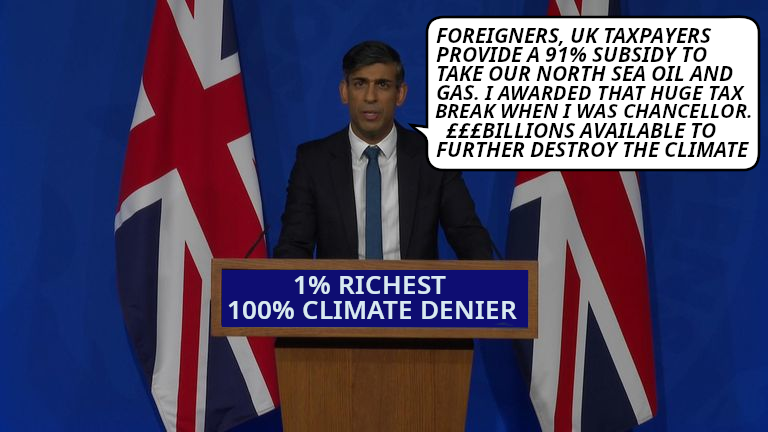
Rishi Sunak offers huge fossil fuel subsidies to develop fossil fuel extraction in UK.

Rishi Sunak awards a huge tax break to further destroy the climate.

It’s called a windfall tax – it’s a further windfall for fossil fuel companies on top of their windfall of higher prices following the invasion of Ukraine.

https://neweconomics.org/2023/11/the-windfall-tax-was-supposed-to-rein-in-fossil-fuel-profits-instead-it-has-saved-corporations-billions#:~:text=The%20levy%20raised%20the%20effective,to%2075%25%20in%20November%202022.

Back in May 2022, the UK government announced the energy profits levy, as a response to the growing pressure for a ​‘windfall tax’ on the massive profits being generated by companies pumping oil and gas in the North Sea. These profits were fuelled by skyrocketing fossil fuel prices in the wake of the Russian invasion of Ukraine. The levy raised the effective rate of corporation tax paid on oil and gas profits from 40% to 65%, and again to 75% in November 2022.

But, it came with a caveat. Despite the UK’s urgent need to kick its addiction to expensive fossil fuels, this government didn’t want to discourage investment in more oil and gas extraction. So they included a tax loophole to ensure that companies investing in new projects to pump fossil fuels out from under the North Sea would see their tax relief (already generous by most standards) rise to 91%. In other words, fossil fuel companies could deduct 91% of their capital investment costs from their corporation tax bill. The ​‘windfall tax’ may have, on the surface, attempted to tackle the grotesque profits being raked in by massive companies in the midst of the cost of living crisis – but it also made it cheaper for these companies to extract the fossil fuels contributing to the sky-high cost of living in the first place.

At NEF, we analysed last week’s new OBR data, and found that the loophole included in the energy profits levy has massively increased the amount of tax relief which fossil fuel companies will potentially receive. We estimate that oil and gas extractors could receive up to £18.1bn in tax relief between 2023 and 2026. That’s a massive increase of £10.5bn, or 136%, from the £7.6bn they were expected to receive before the energy crisis. This is an enormous amount of lost revenue that could go to the government to be spent on lowering our energy bills or improving our public services. The OBR expects the UK oil and gas industry to pay £24.3bn in tax between 2024 and 2027, meaning that closing the tax loophole in the energy profits levy could almost double the amount of tax revenue our government could receive – and the businesses in question would still walk away with billions.

Even if you accept the government’s warped logic, which seeks to encourage greater North Sea extraction, the policy appears to be failing. While total potential for tax relief has risen by £10.5bn, total forecast investment has risen by just £3.4bn. This would represent an abysmal return on a government tax measure. Relief has largely been extended to investments which were expected to occur anyway, suggesting the policy is (intentionally or not) little more than a vehicle for oil and gas companies to keep most of their explosive profit growth, while the windfall tax sustains an illusion of fairness.

The energy profits levy helped pay for the government’s emergency cost of living support measures – in theory. But our energy bills remain extortionate, costing 50% more than they did in early 2022, prior to the Russian invasion of Ukraine. With the poorest households over £200 a week short of the amount they need for an acceptable standard of living, this government has still not provided enough support. Looking forward, removing the perverse tax reliefs extended to the oil and gas industry could free up almost £13bn of tax revenue between 2024 and 2026: enough to give every household in the country three £150 annual payments to help cover their energy costs.

It’s reasonable to compare the so-called windfall tax to Norway’s windfall tax since they are both taxing fossil fuel activities in the North Sea. The Uk’s Labour party has repeatedly said that it intends to impose a “proper windfall tax”. There was further brief mentions of this during the Labour Party’s reformulation and massive restriction of it’s green policies yesterday 8th February 2024 but it remains unclear what is intended.

What’s obviously clear is that Norway’s windfall tax has made and continues to raise huge sums for Norway. There is still a disguised fossil fuel subsidy for exploration and extraction – from what I can see it appears to be 78%. That’s a long way from Sunak’s 91% and since we’re dealing with vast sums of money, 91 – 78 = 13% of vast sums of money is still vast sums of money (as any Chancellor should realise).

https://blogg.pwc.no/skattebloggen-en/the-norwegian-petroleum-tax-system#:~:text=The%20special%20tax%20is%20a,effect%20from%201%20January%202022.

Example:

Investment in an offshore operating asset in Year 1 is 100.

In the ordinary tax base (22%), 100 must be capitalized and depreciated linearly over 6 years. The depreciation in Year 1 is 100 / 6 = 16.7, i.e., a deduction of 16.7. This results in a tax amount in Year 1 of -16.7 * 22% = -3.7

In the special tax base (56%), the entire amount of 100 can be deducted directly. The special tax base will therefore initially be -100. However, we must deduct the tax amount from the ordinary tax base of -3.7 from the -100. The special tax base will thus be -100 – (-3.7) = -96.3. To calculate the special tax amount, we must use the technical special tax rate of 71.8%. The special tax will thus be -96.3 * 71.8% = -69.3.

Hence, total tax on the investment of 100 in the offshore operating asset in Year 1 is 

-3.7 + (-69.3) = -73, i.e., a tax deduction of 73.

In Years 2 – 6, the linear depreciation continues in the ordinary tax base. For each of these years, the tax on the investment of 100 in Year 1 is thus -3.7 in the ordinary tax base. At the same time, this tax is treated as “income” in the calculation of special tax, as the amount must be deducted in the special tax base. The special tax will thus be 3.7 * 71.8 = 2.7 in each of the years. Total tax per year will therefore be -3.7 + 2.7 = -1. 

Looking at the entire period Year 1 – Year 6 as a whole, the total nominal tax for the investment of 100 in Year 1 is the sum of -73 in Year 1 and -1 for each of Years 2 – 6 (5 years), i.e., -73 + (-5) = -78, resulting in a total deduction of 78 over the period.

https://www.globalwitness.org/en/press-releases/despite-windfall-tax-and-record-profits-shell-paid-just-15-million-to-uk-22p-per-brit-last-year/

Despite windfall tax and record profits, Shell paid just £15 million to UK, 22p per Brit last year

By comparison Norway received £6.3 billion from Shell, over a grand per Norwegian

28th March 2023, London – Energy giant Shell paid just £15 million in taxes and fees to the UK last year on their drilling, compared to over £6.3 billion to the Norwegian government over the same period, according to Global Witness analysis of Shell’s latest tax reporting, released today.   

This means Shell paid around just 22p per UK citizen, compared to the £1,171 it paid for every citizen of Norway. This £15 million is much closer to the £9.7 million it awarded its CEO in 2022, than the considerably more it paid to most other countries in which it drills.

The UK ranks 19th out of 25 countries for taxes received by Shell last year, with the likes of the USA, Germany, Qatar and Italy all receiving far more from Shell than the UK. It comes despite the introduction of a UK windfall tax that Rishi Sunak, as Chancellor, described as a “significant set of interventions”.

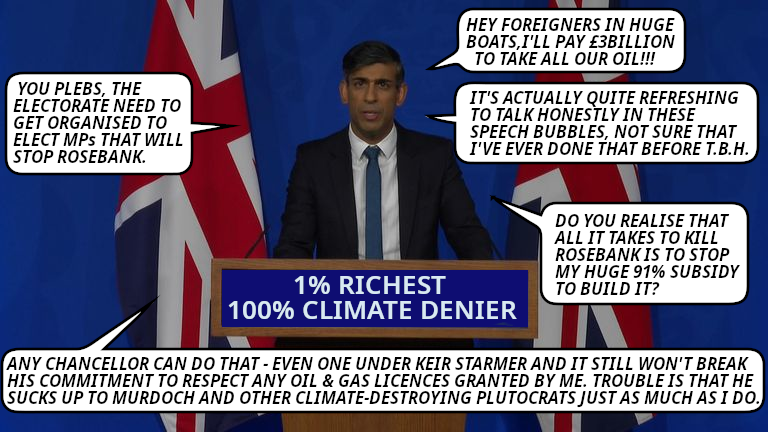
Rishi Sunak on stopping Rosebank says that any chancellor can stop his huge 91% subsidy to build Rosebank, that Keir Starmer is as bad as him for sucking up to Murdoch and other plutocrats and that we (the plebs) need to get organised to elect MPs that will stop Rosebank.
Rishi Sunak on stopping Rosebank says that any chancellor can stop his huge 91% subsidy to build Rosebank, that Keir Starmer is as bad as him for sucking up to Murdoch and other plutocrats and that we (the plebs) need to get organised to elect MPs that will stop Rosebank. [3rd version of image has same text].
Continue ReadingInvestigating the so-called ‘windfall tax’

Could be nasty, Have a pasty

Spread the love

Prime Minister Rishi Sunak stopped off at Philps pasty shop in Hayle, Cornwall yesterday for a pasty.

https://www.cornwalllive.com/news/cornwall-news/rishi-sunak-visits-philps-pasty-9088340

[T]he top team at Philps showed off the moment as soon as they were cleared by the super-tight security regime to do so. They posted on Facebook about hosting the diminutive Conservative leader of the UK, as would anyone.

It didn’t go down as well as they had hoped. The backlash was instant and harsh as the angry and derisory comments poured in. It became so overbearing that the company pulled the post down and even issued an apology.

However many obvious Tory-haters were swearing off buying Philps’ products or spending money there ever again, which clearly the bright business saw as not a good look. As the pile-on mounted, it first turned off commenting. Then killed off the whole post.

Afterwards, it explained its actions – and denied any political party “affiliation” in a new post. It said: “We have decided to remove our post regarding the surprise visit from the Prime Minister today.

“It was with no intent to cause offence and was merely recognition of the Prime Minister popping by for a pasty. We apologise to anyone who feels disappointed or offended, certainly no political affiliations were intended.

“Let’s just say, pasties and politics clearly don’t mix!”

https://www.cornwalllive.com/news/cornwall-news/rishi-sunak-visits-philps-pasty-9088340

Continue ReadingCould be nasty, Have a pasty

Hundreds of thousands expected at pro-Palestine march in London

Spread the love

https://www.theguardian.com/uk-news/2024/feb/03/hundreds-of-thousands-expected-at-pro-palestine-march-in-london

Demonstrators marching through central London last month in solidarity with Palestinians. Photograph: Vuk Valcic/Zuma Press Wire/Rex/Shutterstock

Hundreds of thousands of pro-Palestine demonstrators are expected to march through central London on Saturday in the UK’s first national demonstration since the UN’s international court of justice ordered Israel to ensure its forces do not commit acts of genocide in Gaza.

Last Friday, the international court of justice ordered Israel to ensure its forces did not commit acts of genocide against Palestinians in Gaza. In an interim judgment, the president of the court, Joan Donoghue, said Israel must “take all measures within its power” to prevent acts that fall within the scope of the genocide convention and must ensure “with immediate effect” that its forces do not commit any of the acts covered by the convention.

Earlier this month, the PSC organised a march of hundreds of thousands of people through central London. Little Amal, a 4-metre puppet of a Syrian child refugee, accompanied protesters as they marched towards Parliament Square. The following weekend, hundreds joined a multi-faith peace march in solidarity with people affected by the conflict.

The Gaza health ministry says at least 27,131 Palestinians have been killed and 66,287 have been injured in Israeli strikes on Gaza since the 7 October Hamas attack on Israel, in which 1,200 people were killed and about 250 abducted. Satellite images analysed by the United Nations Satellite Centre show that 30% of Gaza Strip’s buildings have been destroyed or damaged. Unicef estimated on Friday that 170,000 children in Gaza were unaccompanied or had been separated from their families.

This will be the eighth National March for Palestine organised by the Palestine Solidarity Campaign since October.

https://www.theguardian.com/uk-news/2024/feb/03/hundreds-of-thousands-expected-at-pro-palestine-march-in-london

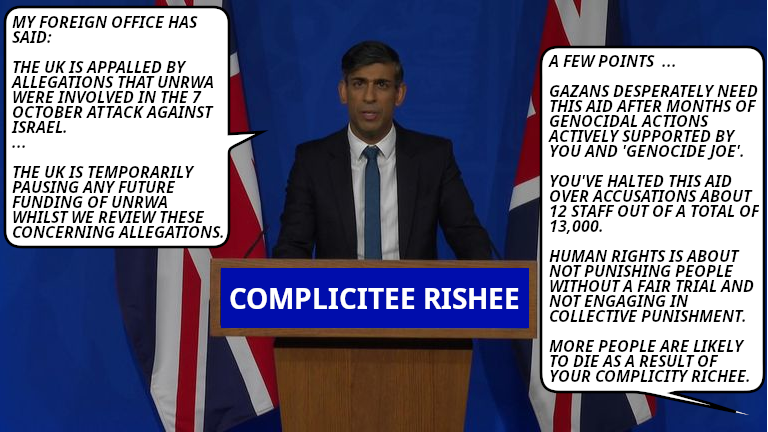
Image of UK Prime Minister Rishi Sunak. UK halts aid to UNRWA in Gaza over Israeli allegations that 12 staff from a total of 13,000 were involved in the 7 October 2024 attack on Israel.
Continue ReadingHundreds of thousands expected at pro-Palestine march in London

Left Foot Forward

Spread the love

A few articles from Left Foot Forward, this blog’s favourite blog

This is how we can start to curb fat-cattery and low pay

Inequitable distribution of income has severe consequences.

The Post Office scandal has once again exposed the shortcomings of performance related pay for company directors. The company had remuneration committees staffed by hand-picked obedient non-executive directors. None opposed the rewards accruing from wrongful prosecution of more than 900 subpostmasters and dutifully rewarded directors. Paula Vennells, chief executive from 2012-2019 picked up bonuses of £2.2m for wrecking lives.

Performance related pay has boosted the remuneration of directors even when performance is negative, as exemplified by the 2007-08 financial crash, collapse of Carillion, BHS, London Capital and Finance, Patisserie Valerie, Debenhams and others.

The bottom line is a key feature of most performance related remuneration schemes. The median tenure of a FTSE100 CEO is about 3.75 years and temptation is to grab higher pay in the shortest possible time. Profits can be boosted by depressing wages, dodging taxes, postponing repair and maintenance; cutting investment and spending on innovation; and by using novel accounting practices. Directors are rewarded for such tactics as shareholders chase short-term returns. Little attention is paid to the long-term damage and social cohesion.

Workers invest their brain, brawn and life in companies but have become just another disposable commodity. In the words of former US President Abraham Lincoln: “Capital is only the fruit of labor, and could never have existed if labor had not first existed. Labor is the superior of capital, and deserves much the higher consideration.”

Inequitable distribution of income has severe consequences. Millions struggle to have access to good food, housing, education, pension and other essentials. Inequalities are a threat to democracy as the rich are able to control media, buy lobbyists and fund political parties to advance their interests, to the exclusion of the vast majority of the people.

Demands for public ownership as water bills set to rise above inflation

Feargal Sharkey exposes injustice of water bill rise in a single tweet

Question Time audience slams government’s position on Gaza ceasefire

“I have never been more upset and disappointed in our current government”

“I think a ceasefire is crucial,” one audience member said, adding: “What I also think is crucial is that the UK government is held to account for their role in licensing arms to Israel at the moment.” Her contribution was met with applause from the rest of the audience.

Another member of the audience echoed her comments, saying: “I have never been more upset and disappointed in our current government, with how they have dealt with the situation.”

He then went on to say: “Whether it’s the Conservative Party, and even the Labour Party – it’s an absolute disgrace. How many lives need to be lost? We have been 25-30,000 Gazan lives, people who have done nothing wrong. I completely echo what you say. Israel do have a right to defend themselves – absolute. But at the risk – not at the risk – the death, murder of 25-30,000 people who have done nothing wrong, I can’t understand this.”

Bombshell poll reveals the extent to which the public think Brexit has been a failure

Four years on after Britain left the European Union, a damning new poll shows just how disillusioned the public are with Brexit, with the majority believing it to be a failure.

The poll, carried out by Ipsos for the Evening Standard, found that 57% believe Brexit has been more of a failure than success, while only 13% say that it has been a success.

Younger adults, Londoners, and graduates are more likely to say that Brexit has been a failure.

A breakdown of the survey results showed that 70% of 18 to 34-year-olds think Brexit has been more of a failure, as do 64% of 35-54s, compared to 38% of those aged 65+.

Many of the promises made by Brexiteers have failed to materialise, including grater control of borders, free trade deals with America and of course who could forget the promise to invest £350 million more a week into the NHS after Brexit.

Continue ReadingLeft Foot Forward

Tory Lord’s Firm Awarded New North Sea Oil and Gas Licences

Spread the love

Original article by Sam Bright republished from DeSmog.

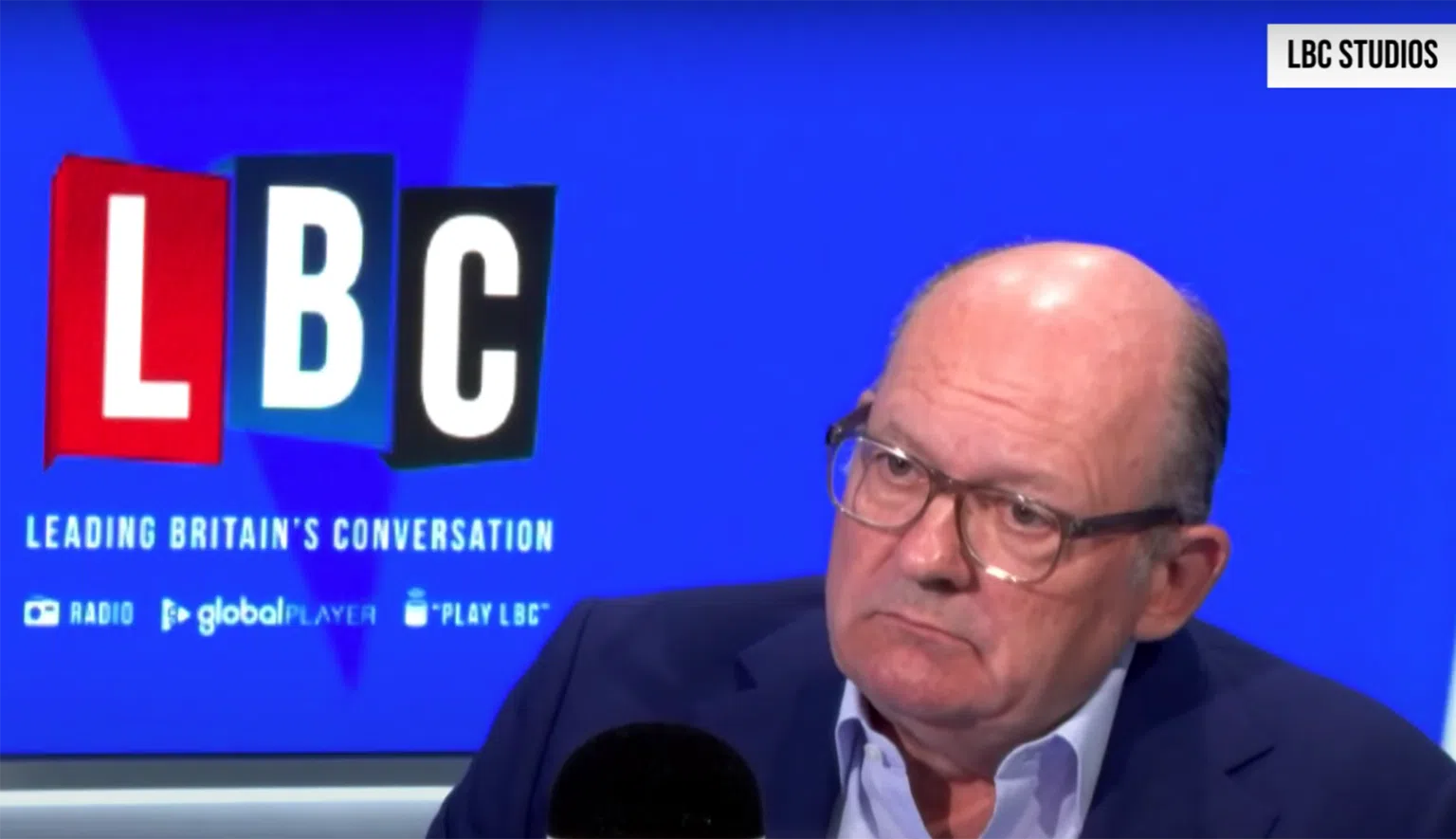
Former Conservative Treasurer Lord Michael Spencer. Credit: LBC / YouTube

Michael Spencer, who has donated millions to the Conservative Party, is the largest shareholder in North Sea exploration firm Deltic Energy.

A company whose largest shareholder is a former Conservative treasurer and major party donor has been awarded two new North Sea exploration licences, DeSmog can reveal.

It was announced on Wednesday (31 January) that Deltic Energy had been awarded the new licences in the latest North Sea oil and gas licensing round. 

Conservative peer Michael Spencer currently holds an 18.8 percent (£4.5 million) stake in the firm.

Spencer has donated over £6 million to the Conservative Party since 2005 and was appointed to the Lords by Boris Johnon in September 2020. The billionaire financier is a former party treasurer and raised an estimated £70 million for the Tories between 2006 and 2010. He currently serves as a director of the Conservative Party Foundation – the party’s multi-million pound endowment fund, created under his watch in 2009 to manage “legacy funds to support the long-term finance” of the party.

The Guardian and the Good Law Project also revealed today that EnQuest Heather, a subsidiary of EnQuest,` had been awarded a new oil and gas licence. EnQuest Chief Executive Officer Amjad Bseisu has donated nearly £500,000 to the Conservative Party in the last decade and has lobbied to maximise oil and gas exploration in the North Sea.

DeSmog revealed in May 2023 that EnQuest had been awarded licences to explore carbon dioxide storage under the North Sea. 

Jolyon Maugham, executive director of the Good Law Project told DeSmog that: “The Electoral Commission records these contributions as donations to the Conservative Party. But, given the extraordinary correlation between donations to the Tories and valuable awards from the government, I wonder whether it would be more accurate to brand them as investments?”

Both personally and through his family office IPGL, Spencer has donated more than £100,000 to the Conservative Party and its candidates since Rishi Sunak became prime minister in October 2022. 

Sunak has been advocating forcefully for North Sea oil and gas exploration in recent months, saying that the UK plans to “max out” the UK’s reserves. In addition to its two new licences, Deltic currently has interests in five licences covering nine North Sea areas, known as blocks. New licences were also awarded this week to fossil fuel giants Shell and Equinor.

“Rishi Sunak’s obsession with doling out new North Sea licences now starts to make some sense,” Tessa Khan, executive director of Uplift, told DeSmog. “It’s clear there is no public benefit from the policy… But new fields could make a tidy little profit for a handful of oil and gas executives and their shareholders, including Conservative Party donors.”

Through the Offshore Petroleum Licensing Bill, passed by MPs last week, the government is attempting to bind future administrations to annual North Sea oil and gas licensing rounds.

This is despite the International Energy Agency stating that new fossil fuel exploration is “incompatible” with the Paris Agreement target of limiting global heating to 1.5C. 

This week, the Climate Change Committee – the independent body that advises the government on its net zero policies – warned that mixed messages, including new fossil fuel projects, have damaged the UK’s international climate standing.

Spencer told DeSmog that: “I believe it is totally in the best interest of the UK to replace imported oil and gas by energy extracted from our own North Sea.”

North Sea gas carries higher emissions than imports from Norway, while there is no guarantee that oil and gas extracted under the new licences will be used to supply the UK, given that it is mined by private companies that sell it on the open international market. 

Khan added that: “new drilling won’t make any difference to our bills, which ministers have admitted; it won’t boost energy security in that the UK has burned most of its gas; and it won’t provide a secure future for the workforce, which has halved in the past decade despite hundreds of licences being issued.

“The prime minister now needs to come clean with the public on any discussions he’s had with Spencer, or any of his party’s other oil and gas donors,” Khan said. “Sunak cannot continue to privilege the short term interests of a few, rich oil execs over the needs of millions of ordinary people who are struggling to afford to heat their homes.”

North Sea licences are awarded by the North Sea Transition Authority, a non-departmental public body owned and funded by the Department for Energy Security and Net Zero. There is no evidence that Deltic or Spencer used political contacts to secure the licences.

According to the NSTA, licensees have to “meet certain financial criteria” and meet the adequate “technical capability”, but there is no published guidance on avoiding conflicts of interest.

The NTSA, Deltic and EnQuest declined to comment on the record. The Department of Energy Security and Net Zero has been approached for comment.  

Spencer and Deltic

Spencer has a number of oil and gas interests. His House of Lords register of interests shows that he has a stake in Pantheon Resources, a UK company exploring for oil in Alaska, and Cluff Energy Africa, described as an “early stage oil prospecting company seeking licences in Africa (Angola and Sierra Leone)”.

Until December last year, Spencer also held shares in Petrofac, an oilfield services firm heavily involved in the North Sea, including the controversial Cambo project.

Spencer has publicly advocated for the fossil fuel industry. He told LBC’s Nick Ferrari last September that the UK “sadly has opposed further investment in North Sea oil and gas”. Spencer used the interview to praise then Prime Minister Liz Truss for opposing windfall taxes on the sector, calling them “not Tory policy” and “not pro-business”. He has also expressed support for the controversial policy of fracking for shale gas.

Spencer is the chair of the Centre for Policy Studies, an influential Conservative think tank whose director was the co-author of the 2019 Tory manifesto. A number of fellow board members have financial interests in oil and gas firms. 

The Conservatives received £3.5 million from polluters, fossil fuel interests, and climate deniers in 2022, and took over £400,000 from individuals and companies in the fossil fuel industry in 2020 and 2021 as the government weighed up decisions on North Sea oil and gas licences.

Original article by Sam Bright republished from DeSmog. ENDS

Rishi Sunak offers huge fossil fuel subsidies to develop fossil fuel extraction in UK.

‘Dishing out licences to climate criminals’

New UK oil and gas exploration licences approved in the North Sea

Continue ReadingTory Lord’s Firm Awarded New North Sea Oil and Gas Licences