Rachel Reeves Promised Oil Industry ‘Quid Pro Quo’ Over Windfall Tax in Private Meeting

Spread the love

Original article by Sam Bright republished from DeSmog.

Chancellor Rachel Reeves speaks at the Semafor World Economy Summit in Washington D.C in April 2025. Credit: Credit: Kirsty O’Connor / Treasury (CC BY-NC-ND 2.0)

The government has been accused of making a “secret exchange deal” with fossil fuel firms to compensate for the tax hike.

Chancellor Rachel Reeves told a fossil fuel giant that the industry would receive a “quid pro quo” in return for higher taxes on its windfall profits, DeSmog can reveal.

In a meeting with the Norwegian state energy company Equinor on 27 August last year, Reeves suggested that the government’s carbon capture, utilisation and storage (CCUS) subsidies were a payoff for oil firms being hit with a higher tax rate.

Minutes of the meeting obtained by DeSmog state that Equinor CEO Anders Opedal raised concerns over the Energy Profits Levy – also known as the “windfall tax” – and “its impact on the value” of Equinor’s UK portfolio.

In response, Reeves said that raising the windfall tax from 35 percent to 38 percent was a “manifesto commitment”, but stated that “Equinor should recognise the quid pro quo – the funds raised enable government investment in CCUS etc.”.

This article was co-published with The Guardian.

CCUS is the controversial practice of trapping the emissions produced by fossil fuel plants before they enter the atmosphere.

The technology is accused of being a favourite climate “solution” of the fossil fuel industry since it allows for the continued extraction of oil and gas. Experts have also suggested that the technology is not economically viable at scale.

The Labour government announced in October that it would provide £22 billion in subsidies to CCUS projects over 25 years following a surge in lobbying by the fossil fuel industry, as revealed by DeSmog.

Green Party co-leader Carla Denyer MP claimed that Reeves and the Labour government had been “caught out making promises in a secret exchange deal which goes against the interests of the British people”.

Denyer added: “In public they claim to be taxing fossil fuel giants more fairly by raising the windfall tax, but behind closed doors they are giving back with dodgy deals to allow the fossil fuel corporates to continue with business as usual under the guise of CCUS – an expensive distraction and largely unproven technology.”

An Equinor spokesperson said: “Government regularly meets with companies like Equinor. This is standard and necessary practice. As with any official meeting, minutes were taken of the conversation between the chancellor and Equinor CEO as a public record of what was said and readily available via a Freedom of Information request.”

Equinor is one of the principal firms investing in the UK’s CCUS sector. In December, the government signed deals with Equinor, BP, and TotalEnergies to develop carbon capture facilities in Teesside. This will involve the development of the Net Zero Teesside Power plant, which will be 25 percent owned by Equinor and aims to be the world’s first gas-fired power station featuring CCUS.

Earlier this year, following a DeSmog investigation, Equinor retracted the claim that it stores 1 million tonnes of carbon dioxide annually at its flagship carbon capture project in the North Sea. Equinor has not captured 1 million tonnes of CO2 per year at the site since 2001, and only captured a tenth of that figure in 2023.

The firm made an $28.7 billion (£21.2 billion) post-tax profit in 2022 after Russia’s invasion of Ukraine triggered higher oil and gas prices – a figure that stood at $8.8 billion (£6.6 billion) in 2024.

Tessa Khan, executive director of the campaign group Uplift, said: “Oil companies, like Equinor, have held sway over successive UK governments, for years shaping policies to benefit their bottom line and slowing down climate action. This Labour government must stand up to them and put our needs – for affordable clean energy and a safe climate that we can pass on to our children – ahead of their insatiable need to profit.”

The House of Commons’ Public Accounts Committee (PAC) – which scrutinises government spending decisions – released a report in February describing the UK’s CCUS subsidies as “risky”.

The report noted that the government has downgraded its ambitions for CCUS storage, scrapping its previous commitment of storing 20 to 30 million tonnes annually by 2030. It also highlighted that the UK’s new CCUS projects don’t allow the government to share any potential profits or for local consumers to benefit from lower energy bills.

The committee also reported that producing liquid natural gas, which will be used in the UK’s CCUS projects, leaks more greenhouse gases into the atmosphere than previously thought.

“This could undermine the rationale for pursuing certain schemes,” the report said.

After being sued by environmental consultant Andrew Boswell over the Net Zero Teesside scheme, the previous Conservative government admitted that it had not taken into account the plant’s full potential emissions, which Boswell estimated could reach more than 20.3 million tonnes during its lifetime.

In summer 2024, a judge rejected Boswell’s case, which argued that officials did not fully explore the environmental impacts of the scheme before approving it. The government also won the appeal in May.

Boswell, who leads the Scrap Carbon Capture campaign, called Reeves’ Equinor meeting “an outrageous spectacle”.

“She begs Norway’s oil colossus to tax its huge profits, and then gifts it with far more in return – many billions over decades for climate-wrecking CCUS.”

Prime Minister Keir Starmer visits Equinor’s Northern Lights CCUS plant with Norway Prime Minister Jonas Gahr Støre in Bergen in December 2024. Credit: Credit: Simon Dawson / No 10 Downing Street (CC BY-NC-ND 2.0)

Equinor and Shell have formed a joint venture to become the UK’s largest North Sea fossil fuel producer. In November, the government admitted that it had unlawfully approved the development of the country’s largest untapped oilfield, Rosebank, which is operated by Equinor, by not taking into account the climate effects of burning the oil and gas extracted from the field. Equinor intends to re-apply for approval to develop the project.

The Labour government has been steadfast in its support for the UK achieving net zero emissions by 2050, with Prime Minister Keir Starmer stating that “home grown clean energy” is “in the DNA” of his administration.

The Climate Change Committee stated in its 2025 appraisal of the government’s net zero policies that the UK needs to scale up its CCUS capacity to 73 million tonnes a-year by 2050 to help meet its climate commitments.

“Investment in carbon capture and storage is a gamble on unproven technology,” said Lily-Rose Ellis, campaigner at Greenpeace UK. “All it does is give oil and gas giants carte blanche to continue causing planet destroying emissions in the hopes that one day they might be able to capture the carbon and store it for all of eternity. Public money should be spent on renewables which guarantee to lower emissions, bring bills down, and boost the economy with new jobs.”

“Equinor has been a reliable energy partner to the UK for over 40 years,” a company spokesperson said, “providing a stable supply of oil and gas, developing the UK’s offshore wind industry, and pioneering solutions to decarbonise the UK economy, including carbon capture and storage.

“Using our experience of decarbonising energy production in Norway, including safely storing carbon emissions under the North Sea for over 25 years, we are supporting the UK to develop its own home grown energy transition.”

A government spokesperson said: “We are delivering first of a kind carbon capture projects in the UK, supporting thousands of jobs across the country, reigniting industrial heartlands and tackling the climate crisis.

“Money raised from changes to the Energy Profits Levy made at the Autumn Budget last year support the transition to clean energy, enhance energy security and independence, provide sustainable jobs for the future, and help protect electricity bills against future price shocks”.

This article was co-published with The Guardian.

Original article by Sam Bright republished from DeSmog.

Continue ReadingRachel Reeves Promised Oil Industry ‘Quid Pro Quo’ Over Windfall Tax in Private Meeting

Rosebank oilfield: why more UK oil means more global emissions

Spread the love
Frode Koppang / shutterstock

Fergus Green, UCL

The UK government will soon face a momentous decision over whether to approve production in the Rosebank oilfield off the coast of Shetland.

Rosebank is the UK’s biggest undeveloped field. Its proponents – the largest of which is Norwegian state-owned petroleum company, Equinor – estimate that it will produce the equivalent of up to 500 million barrels of oil between 2026 and 2051. When burned, this oil will generate up to 200 million tonnes of carbon dioxide, which is more than the combined annual emissions of 28 low-income countries.

Thanks to recent court cases, the climate effects of those “combustion emissions” will need to be taken into account by the government when it decides whether to approve production at Rosebank. In a new report, two colleagues and I reviewed the evidence concerning the implications of new oil and gas fields in the UK.


Get your news from actual experts, straight to your inbox. Sign up to our daily newsletter to receive all The Conversation UK’s latest coverage of news and research, from politics and business to the arts and sciences.


There is a rapidly dwindling global carbon budget for holding temperature increases to below 1.5°C of warming (the more conservative end of the Paris agreement’s temperature goal).

Globally, the emissions from burning the fossil fuels in oil and gas fields and coalmines that are already operating or under development far exceed that budget. In this context, Rosebank’s combustion emissions are highly significant, as they add considerably to that excess.

We also found that the projected production from existing fields is sufficient to meet or exceed global oil and gas demand in modelled economic scenarios in which climate warming is restrained to within 1.5°C. This is further evidence that new fields are not consistent with achieving globally agreed temperature goals.

However, it is often asserted by supporters of new fields that keeping UK oil in the ground won’t reduce global emissions, because another producer will supply the demand and reap the benefits. This is a gross and dangerous oversimplification which, according to the United Nations Environment Programme, “defies basic economics of supply and demand”.

Allowing a new field like Rosebank would increase the supply of oil globally, resulting in a fall in its price which, though small, would cause more oil to be consumed. As UK government advisers at the Climate Change Committee have acknowledged, new petroleum projects “support a larger global market overall” for petroleum. Stopping Rosebank would have the opposite effect, and lead to less oil consumed.

Puffin looks at cliffs
Rosebank is found about 80 miles west of Shetland and its puffins. Philippe Clement / shutterstock

The oil industry likes to trumpet the UK’s relatively low upstream emissions – that is, from the process of extracting oil – compared with those of competitors overseas. But this is a distraction from the bigger issue: the additional greenhouse gases emitted from consuming the extra oil that new fields produce.

A recent peer-reviewed study by economists and experts in the emissions-intensity of oil and gas production concluded that limiting oil supply will almost always lead to lower overall emissions, regardless of the intensity of upstream emissions from different fields. It is highly likely that leaving Rosebank’s oil in the ground will result in lower global greenhouse gases than would occur if the field were developed.

However, this focus on Rosebank’s aggregate emissions ignores two further reasons the field’s development consent should be refused on climate grounds.

A litmus test of climate leadership

First, exploiting new sources of oil supply like Rosebank locks in future oil and gas production, ultimately making it economically, politically and legally harder to wind the industry down.

Second, as the Climate Change Committee also stated, decisions by the UK government concerning petroleum production have an important “signalling effect” internationally and at home.

Internationally, the UK government has rightly acknowledged that climate action “must be accelerated drastically” to keep the average global temperature rise “below 1.5°C”.

The UK has a proud reputation for climate leadership. It was the first country to enact a legally binding framework to reduce greenhouse gas emissions, it rapidly phased out coal-fired power generation, and in 2019 it became the first country to adopt a net zero emissions target.

Building on this legacy, the foreign secretary David Lammy has vowed to “push for the ambition needed to keep 1.5 degrees alive”. But approving Rosebank would signal to the world that the UK government is not sincere about keeping the Paris agreement’s 1.5°C goal “alive”, after all.

Some might think that aspirations to climate leadership are futile given the Trump administration’s “drill, baby, drill” approach to fossil fuels. But Trump’s recklessness at a critical time for global climate efforts makes UK climate leadership more important than ever.

The UK already chairs a suite of international energy transition alliances focused on the international phase-out of coal-fired power, the scale-up of renewables, and the financing of these transitions. It could plug a gap in its influence by rejecting Rosebank and joining the Beyond Oil & Gas Alliance, a “club” of (currently) 25 national and sub-national governments that are working to phase-out oil and gas production and persuade other countries to follow suit.

And it could deepen cooperation with the EU to drive down oil and gas demand and scale up clean energy throughout the region, yielding benefits that will outlive the Trump administration.

Domestically, rejecting Rosebank would send a powerful signal to investors about the sincerity of the government’s commitment to achieve economic growth by becoming a “clean energy superpower”, as the governing Labour party pledged to do at the last election.

But the benefits of clean prosperity must extend to the people and communities caught up in the transition, too. The UK’s North Sea oil and gas reserves, along with the jobs their production supports, are in terminal decline.

Oil and gas workers and the communities in which they are based already face a volatile future. New fields like Rosebank would create some additional jobs in this declining industry. But they cannot arrest its long-term decline.

The government recognises that this transition is already taking place and will continue. With targeted regional and industrial investment, support for workers and their families, and careful planning that meaningfully involves affected communities, the UK has an opportunity to demonstrate to the world how to achieve a just transition away from oil and gas.


Don’t have time to read about climate change as much as you’d like?
Get a weekly roundup in your inbox instead. Every Wednesday, The Conversation’s environment editor writes Imagine, a short email that goes a little deeper into just one climate issue. Join the 45,000+ readers who’ve subscribed so far.


Fergus Green, Associate Professor in Political Theory and Public Policy, UCL

This article is republished from The Conversation under a Creative Commons license. Read the original article.

Continue ReadingRosebank oilfield: why more UK oil means more global emissions

Oil giant funds computer game that promotes fossil fuels to schoolchildren

Spread the love

Original article by Josephine Moulds republished from TBIJ  under a Creative Commons Attribution-NonCommercial-NoDerivs 3.0 Unported License.

The online game is targeted at pupils as young as seven

Equinor, the company looking to develop the Rosebank oil field in the North Sea, has funded a computer game aimed at UK school children, promoting the idea that fossil fuels are part of a green energy mix.

In an unusually frank admission of lobbying children, a web page promoting the game stated that it “aligns with our work to build future talent pipelines and secure permission to operate at a time of sensitivity around fossil fuels, particularly in light of . . . the Rosebank development”. The story was first revealed by the Norwegian news publication E24.

Rosebank – the UK’s largest untapped oilfield – was greenlit by the Conservative government in 2023, prompting condemnation from climate campaigners. That decision was ruled unlawful by the courts in January this year because it had not taken into account the carbon emissions created by burning any oil and gas produced. Equinor, Norway’s state energy company, continues preparation work on the site under its joint venture with Shell. [*1]

The game lets players choose between renewable energy or fossil fuels to power their city.

Marketing agency We Are Futures, which describes itself as “the go-to partner for building advocacy for brands amongst young people”, developed Equinor’s schools-based, curriculum-linked education programme, Wonderverse. It also received support from the Association for Science Education (ASE), a UK membership organisation for science teachers and technicians.

Read more: £4bn in UK public pensions funding North Sea oil giants drilling new wellsBP has been rowing back on renewables for years. So why was it helped by ‘net zero’ banks?Allianz’s board says it’s time to save the planet. They can start with their own investments

The game was promoted on ASE’s School Science website, which also stated: “With over two-thirds of teens believing the oil and gas industry causes more problems than it solves, Wonderverse helps lay misconceptions to rest by exploring some of the challenges involved in a just energy transition.”

The ASE web page, which has been taken down since the story first broke, said the programme, aimed at 7–14 year olds, is “designed to spark wonder for science and the future of energy”. It includes a game, in which players attempt to build a city that survives until the year 2050, and in-school education materials to “showcase how modern cities use energy resources and the ways the energy transition can be managed”.

While players are encouraged to invest in research into renewable energy, TBIJ successfully ran a city powered by oil and some renewables until 2050. Meanwhile, scientists say there must be huge declines in the use of coal, oil and gas to reach net zero emissions by 2050 and avoid further catastrophic climate change.

Screenshot from Game Over screen of Energy Town

Charlotte Howell, who leads the climate campaign group Parents for Future, was shocked that Equinor was behind an energy-themed game aimed at UK schoolchildren. She told E24: “We want to know how this can be allowed. I’m horrified that Equinor, as a partly state-owned company, is working against UK ambitions on climate. They are lobbying directly against our children.”

Tessa Khan, executive director at climate campaign group Uplift, said it was “morally indefensible” to pretend that the UK needed Rosebank for energy security when in reality it would accelerate the climate crisis.

Khan told TBIJ: “It’s one thing for Equinor to mislead the public about the benefits of new oil fields like Rosebank, but it is quite another to target children with blatant fossil fuel propaganda disguised as ‘education’. This so-called ‘computer game’ is not about learning – it’s about teaching the next generation to see oil and gas as inevitable, when the climate science could not be clearer that we need to leave new fossil fuels in the ground.”

Equinor told TBIJ it was not aware of the promotional material associated with the game until notified by media, and denied that rolling out the school game is part of a lobbying campaign to promote developing Rosebank.

A spokesperson said: “The overall intention and aim for Wonderverse and Energy Town is to provide schools and teachers with a suite of high-quality resources to help students learn more about where energy comes from, whilst building … the employability skills needed to successfully enter employment. The learning resources have been awarded a green tick by the Association for Science Education, assuring the programme’s quality for use in schools.” They also said the game was developed using data from the International Energy Agency.

ASE’s School Science website provides free online science resources for teachers and students. The site was sponsored by partners including ExxonMobil, which ASE describes as “the world’s leading nongovernmental energy company aiming to meet world energy demand in an economically, environmentally and socially responsible manner”. ExxonMobil is the world’s third most polluting company, according to Carbon Majors, a database of historical fossil fuel production data.

A spokesperson for ASE said the promotional text was provided via briefing materials from We Are Futures. They said the School Science website was no longer actively maintained and will be decommissioned, and that ExxonMobil is no longer a partner of ASE.

We Are Futures, which also works for the UK government and BP, did not respond to a request for comment.

After the court ruling in January, Equinor is set to reapply to the UK government for approval to develop Rosebank. This time it must include information about the emissions that will be produced by burning the oil extracted from Rosebank. According to Uplift, those emissions could be more than the combined annual CO2 emissions of all 28 lowest-income countries in the world, including Uganda, Ethiopia, and Mozambique. Equinor is reportedly “confident” that the project will go ahead and expects it to start up in 2026 or 2027.

Khan said: “If Equinor is serious about supporting the next generation, it should start by walking away from Rosebank and using its power and influence to focus solely on renewable energy. That’s the only way to really protect our children’s future.”

Reporter: Josephine Moulds
Environment editor: Rob Soutar
Deputy editor: Chrissie Giles
Editor: Franz Wild

Fact checker: Frankie Goodway
Production editor: Sasha Baker

TBIJ has a number of funders, a full list of which can be found here. None of our funders have any influence over editorial decisions or output.

Original article by Josephine Moulds republished from TBIJ  under a Creative Commons Attribution-NonCommercial-NoDerivs 3.0 Unported License.

*1 by dizzy. Equinor is attempting to develop the Rosebank oil field in partnership with Ithaca Energy, not Shell.

Campaigners take part in a Stop Rosebank emergency protest outside the U.K. Government building in Edinburgh, after the controversial Equinor Rosebank North Sea oil field was given the go-ahead Wednesday, September 27, 2023. (Photo: Jane Barlow/PA Images via Getty Images)
Experienced climbers scale a rock face near the historic Dumbarton castle in Glasgow, releasing a banner that reads “Climate on a Cliff Edge.” One activist, dressed as a globe, symbolically looms near the edge, while another plays the bagpipes on the shores below. | Photo courtesy of Extinction Rebellion and Mark Richards
Greenpeace activists display a billboard during a protest outside Shell headquarters on July 27, 2023 in London.
Greenpeace activists display a billboard during a protest outside Shell headquarters on July 27, 2023 in London. (Photo: Handout/Chris J. Ratcliffe for Greenpeace via Getty Images)

Continue ReadingOil giant funds computer game that promotes fossil fuels to schoolchildren

Human rights groups intervene over Rosebank links to illegal Israeli settlements

Spread the love

https://morningstaronline.co.uk/article/human-rights-groups-intervene-over-rosebank-links-illegal-israeli-settlements

 Climate activists from Greenpeace and Uplift during a demonstration outside the Scottish Court of Session, Edinburgh, on the first day of the Rosebank and Jackdaw judicial review hearing, November 12, 2024

HUMAN rights and environmental groups have challenged Rosebank oil field’s links to illegal Israeli settlements at its owner’s AGM.

Amnesty International intervened at the AGM of Equinor — the majority owner of the controversial Rosebank oil field — in Norway on Wednesday over its links to Delek Group, an Israeli fuel conglomerate.

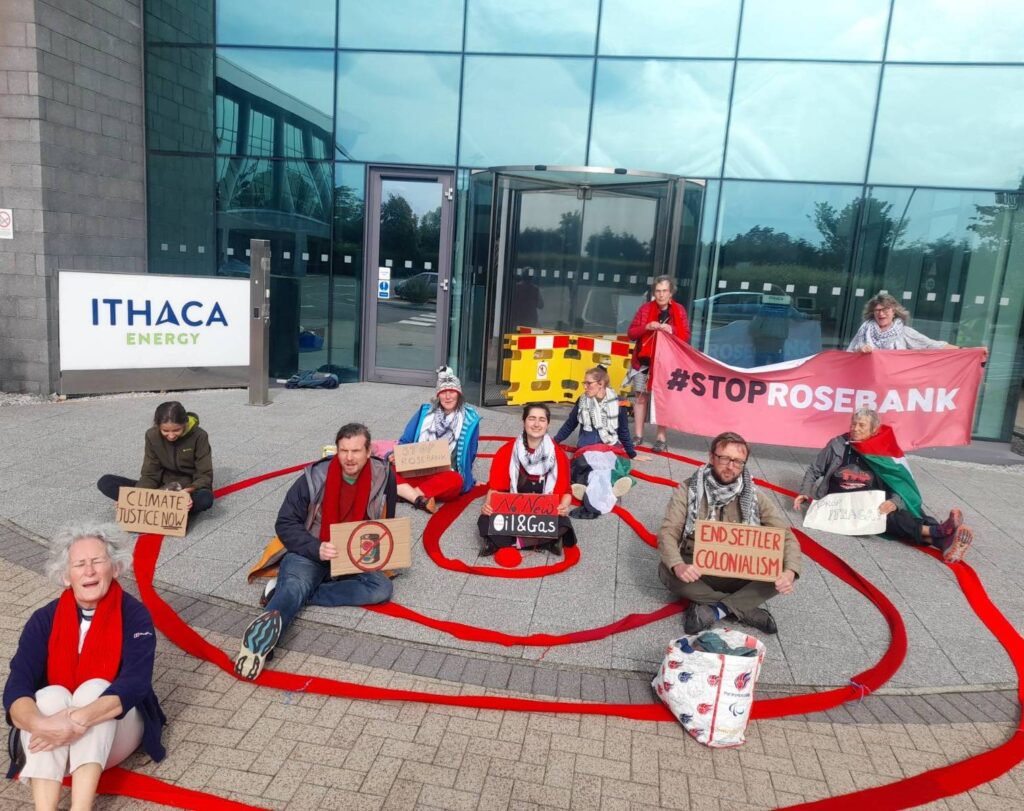
Equinor shares ownership of Rosebank with Ithaca Energy, which is majority-owned by Delek Group.This means Equinor’s Rosebank project could send £253 million to the group, which operates in illegal settlements and provides fuel to the IDF, the campaigners say.

Delek Group has also been flagged by the UN for human rights violations in Palestine.

Greenpeace also tabled a first-of-its-kind shareholder proposal, which calls on Equinor to conduct due diligence over its links to companies operating in Israel’s illegal settlements.

Article continues at https://morningstaronline.co.uk/article/human-rights-groups-intervene-over-rosebank-links-illegal-israeli-settlements

Orcas comment on killer apes destroying the planet by continuing to burn fossil fuels.
Continue ReadingHuman rights groups intervene over Rosebank links to illegal Israeli settlements

Oil group Equinor must explain climate discrepancy, minority owners say

Spread the love
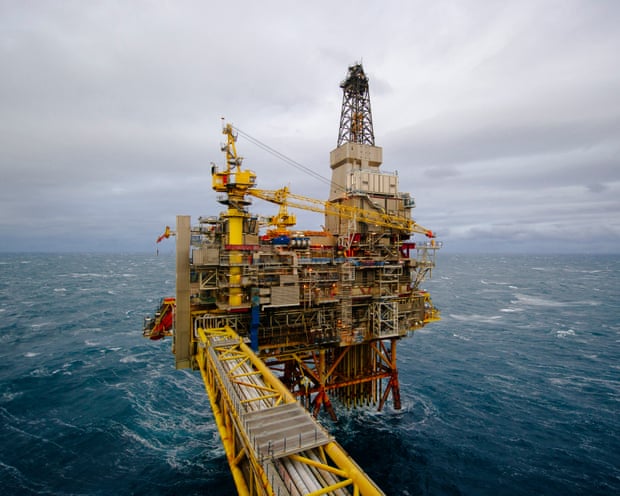
North Sea oil rigs in Cromarty Firth, Scotland. Credit: joiseyshowaa (CC BY-SA 2.0)

https://www.reuters.com/sustainability/cop/oil-group-equinor-must-explain-climate-discrepancy-minority-owners-say-2025-04-22/#:~:text=OSLO%2C%20April%2022%20(Reuters),minority%20shareholders%20said%20on%20Tuesday.

OSLO, April 22 (Reuters) – The board of Norway’s Equinor (EQNR.OL), opens new tab must explain how the company’s plan to raise oil and gas production aligns with its stated commitment to the Paris agreement on curbing climate change, a group of minority shareholders said on Tuesday.

Equinor, which is 67% government owned, this year joined the likes of Shell (SHEL.L), opens new tab and BP (BP.L), opens new tab in promising higher petroleum output while scaling back investment in renewables.

In a resolution to be voted on at Equinor’s May 14 annual general meeting, the minority owners said there were “material inconsistencies” between the company’s climate strategy and the policy expectations expressed by its majority shareholder.

Those expectations, laid out by Noway’s government two years ago, included Equinor setting targets and implementing measures to reduce greenhouse gas emissions “in both the short and long term” in line with the 2015 Paris climate accord.

Article continues at https://www.reuters.com/sustainability/cop/oil-group-equinor-must-explain-climate-discrepancy-minority-owners-say-2025-04-22/#:~:text=OSLO%2C%20April%2022%20(Reuters),minority%20shareholders%20said%20on%20Tuesday.

Continue ReadingOil group Equinor must explain climate discrepancy, minority owners say