For decades, governments have subsidised fossil fuels. But why?

Spread the love
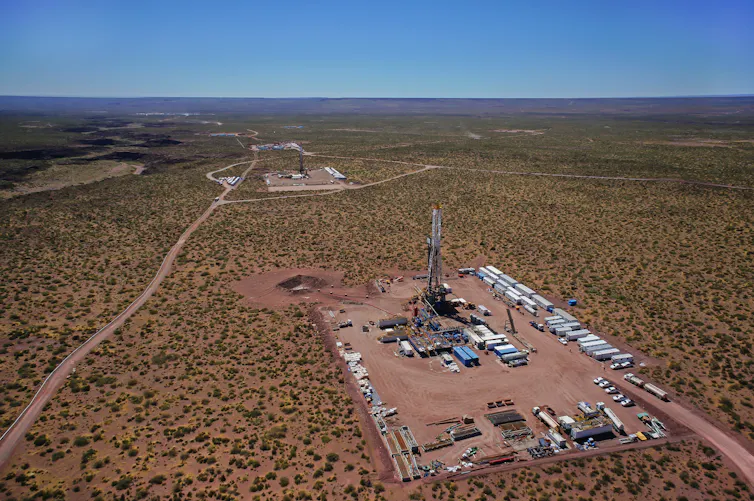
Sobrevolando Patagonia/Shutterstock

Bernard Njindan Iyke, La Trobe University

Even now, decades after we first began trying to avert the worst of global warming, more than 80% of the world’s total energy comes from fossil fuels.

You might think this would make fossil fuel production extremely profitable. But it’s not always the case. Much of the most accessible oil has already been extracted and burned. Many countries want to shore up domestic sources of fossil fuels to boost energy security. Energy price fluctuations and competition from new energy sources such as solar, wind and fossil gas have made it harder for some fossil fuel companies to make money, especially in coal.

This is where fossil fuel subsidies come in. Australia gave A$14.5 billion in subsidies to major fossil fuel producers and consumers in 2023–24 alone.

You might have wondered – why would some of the largest companies on Earth need subsidies? Here’s why.

LNG tanker
Australia’s surging liquefied natural gas industry has been boosted by government funding. KDS Photographics/Shutterstock

Private companies, public money

Globally, private companies dominate fossil fuel production, though fossil fuel-rich nations often have state-owned companies, such as Saudi Arabia’s Aramco and Russia’s Rosneft.

Why would governments give fossil fuel companies money? Many reasons. But the most important is that wealthy countries have historically needed huge volumes of fossil fuels for manufacturing, transport and power. Many countries have some sources of fossil fuels inside their borders, but only a few are self-sufficient. This has enabled fossil fuel giants such as Saudi Arabia to become wealthy beyond belief.

Many governments have used subsidies to boost their energy security and encourage local producers to seek out new sources of coal, gas and oil. These subsidies can make all the difference in making fossil fuel companies competitive internationally. For instance, Canada spent billions on subsidies to boost its oil sands and fracking projects.

Subsidies were essential in the United States’ fracking revolution. Novel approaches to extracting fossil gas and oil – boosted by major tax incentives – turned the US from a major importer of oil and gas into a net exporter by 2019.

You can see why the US did this. At a stroke, it went from being dependent on energy provided by foreign nations to being independent.

Once subsidies are in place, they become very hard to remove. Indonesia’s lavish fuel subsidies now account for 2% of the nation’s GDP. When the national government tried to walk these back, there were riots.

And there’s another reason, too. Fossil fuels are still playing an important role in boosting the economy in most nations. Subsidising them has long been seen as a way to maintain economic growth and stability.

Globally, these subsidies are estimated at a staggering $10.5 trillion each year.

This figure has grown sharply in recent years, after Russia’s invasion of Ukraine. As European nations tried to wean themselves off Russia’s gas, energy prices surged worldwide. In response, some countries introduced new subsidies to support businesses and consumers.

The top-line figure of $10.5 trillion includes two types of subsidy – explicit (meaning real dollars change hands) and implicit (for example, governments building roads and railways to encourage crude oil transport).

Explicit subsidies

Explicit fossil fuel subsidies are direct financial incentives from governments to fossil fuel producers and consumers. These incentives come in different forms, such as tax breaks, direct payments, grants and price controls. All of them aim to reduce the financial burden associated with fossil fuel production and use.

In Australia, explicit subsidies include fuel tax credits and exploration tax reductions. Fossil fuel companies can get subsidies to offset the losses they make during the years it takes to find and begin extracting new fossil fuels.

In the US, oil and gas companies benefit from the oil depletion allowance, which permits them to deduct a percentage of their gross income from oil and gas sales as an expense. They can also claim tax deductions for intangible drilling costs, such as the wages of workers and material needed to find new sources of oil and gas.

China, too, uses direct subsidies, discounted land-use fees, and preferential loans as explicit subsidies to boost coal production and consumption. The national government also supports fossil fuel consumption through direct payments to consumers.

coal miners China
China has used subsidies to encourage exploitation of its large coal resources. zhaoliang70/Shutterstock

Implicit subsidies

Implicit subsidies are often described as “imaginary”. That doesn’t mean they don’t exist, just that they’re not a direct transfer to directly paid to fossil fuel producers.

For instance, the cost of burning fossil fuels is borne by the global community and the natural world, in the form of climate change, damage to human health and other harms. Most fossil fuel companies don’t have to pay a cent for the pollution their products cause – so in effect, they are being granted an indirect subsidy.

Implicit incentives also include government investment in facilities such as transport networks, pipelines, oil refineries and port infrastructure, which will accelerate fossil fuel production and delivery. Think of the Middle Arm development in Darwin, funded by both the federal and territory government.

Why are these subsidies still being paid?

As the world grapples with a worsening climate crisis, fossil fuel subsidies are under great scrutiny.

It’s politically difficult to withdraw subsidies once given. This is why governments around the world have instead begun to give subsidies and tax incentives to green energy developers, including the enormous $500 billion Inflation Reduction Act in the US, the European Union’s Green Deal, and China’s massive subsidies of green technologies such as electric vehicles and solar panels.

The goal here is to make renewable energy and electrified transport steadily more affordable and competitive – just as fossil fuel subsidies did for oil, gas and coal.

Bernard Njindan Iyke, Lecturer in Finance, La Trobe University

This article is republished from The Conversation under a Creative Commons license. Read the original article.

Continue ReadingFor decades, governments have subsidised fossil fuels. But why?

Dozens of Climate Activists Arrested at Citibank Headquarters in New York City During Earth Week

Spread the love

https://insideclimatenews.org/news/25042024/citibank-headquarters-new-york-climate-activists-arrested/

During a demonstration at Citibank’s headquarters in Manhattan on Wednesday, 33 protesters were taken into custody, including Rachel Rivera (center), a board member with New York Communities for Change. Credit: Keerti Gopal/Inside Climate News

Campaigners pressuring Citibank say they see the bank as potentially movable on its funding of fossil fuels, citing the company’s commitments to sustainability.

NEW YORK—Climate demonstrators blocked entrances to Citibank’s headquarters in Manhattan at the start of the workday on Wednesday and Thursday, part of a series of Earth Week actions pressuring the bank to end its financing of fossil fuels. On both mornings, it took the New York Police Department less than 10 minutes to start making arrests.

Climate activists, citing Citibank as the second largest financier of fossil fuels in the world, are engaged in a multi-year campaign to pressure the bank to stop financing oil, gas and coal projects. The week’s protests follow a mock environmental justice hearing at a New York church on Monday, where advocates spoke about the health harms and human rights violations of Citibank-financed fossil fuel projects in Peru, Canada and domestically. The New York demonstration was timed alongside actions in Seoul, South Korea, Melbourne, Australia, Jakarta, Indonesia, Belfast, Northern Ireland, and Dallas that also targeted Citibank’s financing of coal, oil, natural gas and military projects.

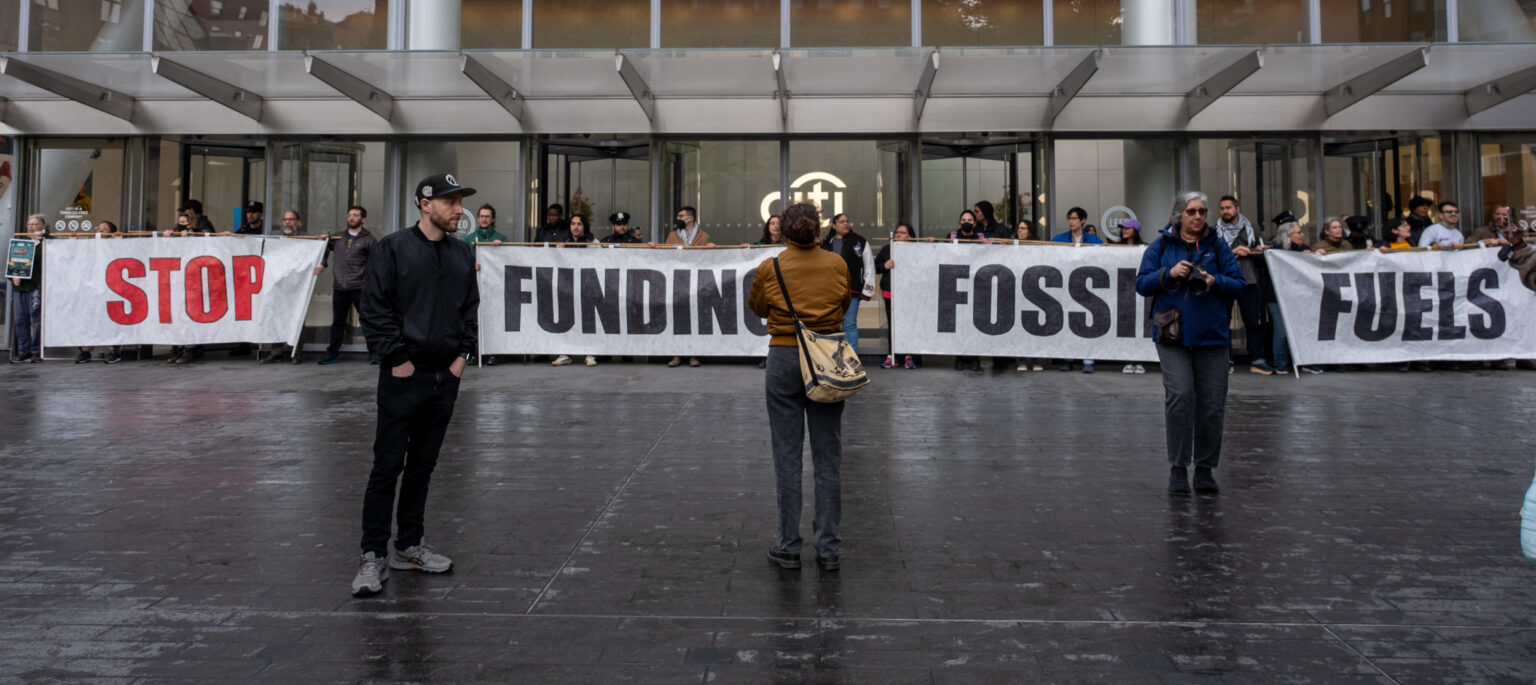
At about 8:15 Wednesday morning, activists holding four large white banners that together read “Stop Funding Fossil Fuels” blocked the main entrance to Citibank’s headquarters while smaller groups of demonstrators stood outside other entrances to the building. Police began taking protesters into custody at 8:30 and arrested approximately 33 activists for disorderly conduct at Wednesday’s protest, according to activists and the office of NYPD’s deputy commissioner of public information. 

Protesters barricaded the main entrance to Citibank’s headquarters in Manhattan on Wednesday morning. Credit: Keerti Gopal/Inside Climate News

Campaigners have said that, since 2016, Citibank has provided $332 billion in fossil fuel financing, and calculate that the bank has given $1.85 billion in financing to oil and gas operations in the Amazon since 2009 and $1.78 billion in financing to ConocoPhillips, the company behind the contentious Willow Project. 

https://insideclimatenews.org/news/25042024/citibank-headquarters-new-york-climate-activists-arrested/

Continue ReadingDozens of Climate Activists Arrested at Citibank Headquarters in New York City During Earth Week

International coordinated actions shut it down for Gaza

Spread the love

Original article republished from peoples dispatch under a Creative Commons Attribution-ShareAlike 4.0 (CC BY-SA) license.

Across the United States, Australia, and the UK, Palestine solidarity activists took action on April 15 as part of global call to strike for Gaza

Protesters blockade the entrance to O’Hare International Airport in Chicago (Photo: Dissenters)

April 15 marked yet another global day of solidarity with Palestine, in which activists across the globe in countries such as the United States, Australia, and the UK took action for Gaza. Activists were responding to a global call to strike for Gaza, which originated within Palestinian civil society.

In the United States, the global strike for Gaza also coincided with the day that taxes are due in the country (Tax Day). Activists used this as an opportunity to highlight how much of taxpayer money goes to the weapons industry.

In several cities, activists strategically targeted sectors of the war machine, including the offices of Lockheed Martin in Arlington, Virginia, the largest weapons manufacturer in the world. Activists who occupied the Arlington office highlighted that Lockheed Martin receives billions of dollars in taxpayer money each year, which is used to produce the arms that Israel uses to kill Palestinians.

While activists occupied the building, protesters outside marched up to the office doors, staging a rally and shouting at employees inside the building to quit their jobs. 

Activists also blockaded the entrance to a facility belonging to Boeing, another massive weapons manufacturer that supplies Israel, in St. Charles, Missouri.

A facility of weapons manufacturer Pratt and Whitney was also targeted in Connecticut, where organizers blocked the entrance to the factory to impede production. 

On the same day, several activists blockaded the road going to the Chicago O’Hare International Airport, blocking Terminals 1 through 3. Over 40 protesters were arrested after taking this action, who have as of now all been released.

Several bridge blockades took place in the Bay Area. Protesters first stopped traffic on the Golden Gate Bridge, holding banners that read “Stop the world for Gaza” and “End the siege on Gaza now!”

Protesters later took further action and shut down the Interstate 880 in Oakland. Altogether, the California Highway Patrol announced the arrests of 38 people. 

In London, activists with Palestine Action targeted the office of BNY Mellon, demanding that the bank divest with Elbit Systems, Israel’s largest weapons company. BNY Mellon offices in Manchester were also targeted. 

In Adelaide, Australia, pro-Palestine activists occupied the office of Australian Foreign Minister Penny Wong’s office. Activists said this action had been undertaken to “protest the government’s ongoing complicity in, and facilitation of, the genocide occurring in Gaza—a genocide which has been enabled by international forces, like Australia, to continue for over six months.”

In Melbourne, hundreds gathered in front of the parliament building, demanding that the Australian government stop cutting deals with Elbit systems. 

Original article republished from peoples dispatch under a Creative Commons Attribution-ShareAlike 4.0 (CC BY-SA) license.

Continue ReadingInternational coordinated actions shut it down for Gaza

Great Barrier Reef Suffering Record Coral Bleaching With Damage 59 Feet Below the Surface

Spread the love

https://www.ecowatch.com/great-barrier-deep-coral-bleaching.html

New video footage released on April 11, 2024 shows that bleached corals on the southern part of the Great Barrier Reef extend to greater depths than has been reported during the current mass bleaching event. Australian Marine Conservation Society / Facebook screenshot

The Australian Marine Conservation Society (AMCS) has released video footage showing that the southern portion of the Great Barrier Reef is suffering from deep-sea coral bleaching, reported The Guardian.

The footage shows that the bleaching extends at least as far down as 59.1 feet — the deepest reported during this mass bleaching event, a press release from AMCS said. Some of the corals have begun to die in the face of record marine heat waves.

“I feel devastated. This bleaching event is the worst I have seen. It’s a severe bleaching event,” said Dr. Selina Ward, University of Queensland’s former academic director of the Heron Island Research Station, in the press release.

Ward reported extensive coral bleaching at all 16 southern Great Barrier Reef sites she had visited, saying it was the worst she had seen in three decades.

“I’ve been working on the Reef since 1992 but this [mass coral bleaching event], I’m really struggling with. The diversity of species involved has been hard to deal with. Look at bleached areas, there are many different species that are bleached – many of which are pretty resistant to bleaching so it’s not a pleasant one,” Ward added.

Last week, aerial survey data showed that 75 percent of the reef had experienced bleaching during the current bleaching event, with much of it classed as “high to extreme bleaching.”

During climate change-driven marine heat waves, extended periods of warmer ocean temperatures cause corals to become stressed, which leads them to expel the algae that live in a symbiotic relationship with them. These algae not only give corals their colorful appearance, but they are also their main source of energy, so long periods without them can lead to starvation.

“This new footage shows extensive coral bleaching in southern reefs, but there are images from the central and northern parts that show bleaching is extensive and severe in some of those areas too. Although in-water surveys will take months, the Great Barrier Reef Marine Park Authority has completed the aerial surveys but only released the data. The authority must urgently release the maps to show to the public the extent and severity of this bleaching event,” said Dr. Lissa Schindler, campaign manager with AMCS, in the press release.

https://www.ecowatch.com/great-barrier-deep-coral-bleaching.html

Continue ReadingGreat Barrier Reef Suffering Record Coral Bleaching With Damage 59 Feet Below the Surface

On a climate rollercoaster: how Australia’s environment fared in the world’s hottest year

Spread the love
An endangered yellow-footed rock wallaby. Joshua Bergmark

Albert Van Dijk, Australian National University; Shoshana Rapley, Australian National University, and Tayla Lawrie, The University of Queensland

Global climate records were shattered in 2023, from air and sea temperatures to sea-level rise and sea-ice extent. Scores of countries recorded their hottest year and numerous weather disasters occurred as climate change reared its head.

How did Australia’s environment fare against this onslaught? In short, 2023 was a year of opposites.

For the past nine years, we have trawled through huge volumes of data collected by satellites, measurement stations and surveys by individuals and agencies. We include data on global change, oceans, people, weather, water, soils, vegetation, fire and biodiversity.

Each year, we analyse those data, summarising them in an that includes an overall Environmental Condition Score and regional scorecards. These scores provide a relative measure of conditions for agriculture and ecosystems. Scores declined across the country, except in the Northern Territory, but were still relatively good.

However, the updated Threatened Species Index shows the abundance of listed bird, mammal and plant species has continued to decline at a rate of about 3% a year since the turn of the century.

Environmental condition indicators for 2023, showing the changes from 2000–2022 average values. Such differences can be part of a long-term trend or within normal variability.
Australia’s Environment 2023 Report.

Riding a climate rollercoaster in 2023

Worldwide, 77 countries broke temperature records. Australia was not one of them. Our annual average temperature was 0.53°C below the horror year 2019. Temperatures in the seas around us were below the records of 2022.

Even so, 2023 was among Australia’s eight warmest years in both cases. All eight came after 2005.

However, those numbers are averaged over the year. Dig a bit deeper and it becomes clear 2023 was a climate rollercoaster.

The year started as wet as the previous year ended, but dry and unseasonably warm weather set in from May to October. Soils and wetlands across much of the country started drying rapidly. In the eastern states, the fire season started as early as August.

Nonetheless, there was generally still enough water to support good vegetation growth throughout the unusually warm and sunny winter months.

Fears of a severe fire season were not realised as El Niño’s influence waned in November and rainfall returned, in part due to the warm oceans. Combined with relatively high temperatures, it made for a hot and humid summer. A tropical cyclone and several severe storms caused flooding in Queensland and Victoria in December.

As always, there were regional differences. Northern Australia experienced the best rainfall and growth conditions in several years. This contributed to more grass fires than average during the dry season. On the other hand, the rain did not return to Western Australia and Tasmania, which ended the year dry.

So how did scores change?

Every year we calculate an Environmental Condition Score that combines weather, water and vegetation data.

The national score was 7.5 (out of 10). That was 1.2 points lower than for 2022, but still the second-highest score since 2011.

Scores declined across the country except for the Northern Territory, which chalked up a score of 8.8 thanks to a strong monsoon season. With signs of drought developing in parts of Western Australia, it had the lowest score of 5.5.

The Environmental Condition Score reflects environmental conditions, but does not measure the long-term health of natural ecosystems and biodiversity.

Firstly, it relates only to the land and not our oceans. Marine heatwaves damaged ecosystems along the eastern coast. Surveys in the first half of 2023 suggested the recovery of the Great Barrier Reef plateaued.

However, a cyclone and rising ocean temperatures occurred later in the year. In early 2024, another mass coral bleaching event developed.

Secondly, the score does not capture important processes affecting our many threatened species. Among the greatest dangers are invasive pests and diseases, habitat destruction and damage from severe weather events such as heatwaves and megafires.

Threatened species’ declines continued

The Threatened Species Index captures data from long-term threatened species monitoring. The index is updated annually with a three-year lag, largely due to delays in data processing and sharing. This means the 2023 index includes data up to 2020.

The index showed an unrelenting decline of about 3% in the abundance of Australia’s threatened bird, mammal and plant species each year. This amounts to an overall decline of 61% from 2000 to 2020.

Line graph of Threatened Species Index
Threatened Species Index showing the abundance of different categories of species listed under the EPBC Act relative to 2000.
Australia’s Environment 2023 Report

The index for birds in 2023 revealed declines were most severe for terrestrial birds (62%), followed by migratory shorebirds (47%) and marine birds (24%).

A record 130 species were added to Australia’s threatened species lists in 2023. That’s many more than the annual average of 29 species over previous years. The 2019–2020 Black Summer bushfires had direct impacts on half the newly listed species.

Population boom adds to pressures

Australia’s population passed 27 million in 2023, a stunning increase of 8 million, or 41%, since 2000. Those extra people all needed living space, food, electricity and transport.

Australia’s greenhouse gas emissions have risen by 18% since 2000. Despite small declines in the previous four years, emissions increased again in 2023, mostly due to air travel rebounding after COVID-19.

Our emissions per person are the tenth-highest in the world and more than three times those of the average global citizen. The main reasons are our coal-fired power stations, inefficient road vehicles and large cattle herd.

Nonetheless, there are reasons to be optimistic. Many other countries have dramatically reduced emissions without compromising economic growth or quality of life. All we have to do is to finally follow their lead.

Our governments have an obvious role to play, but we can do a lot as individuals. We can even save money, by switching to renewable energy and electric vehicles and by eating less beef.

Changing our behaviour will not stop climate change in its tracks, but will slow it down over the next decades and ultimately reverse it. We cannot reverse or even stop all damage to our environment, but we can certainly do much better.The Conversation

Albert Van Dijk, Professor, Water and Landscape Dynamics, Fenner School of Environment & Society, Australian National University; Shoshana Rapley, Research Assistant, Fenner School of Environment & Society, Australian National University, and Tayla Lawrie, Project Manager, Threatened Species Index, The University of Queensland

This article is republished from The Conversation under a Creative Commons license. Read the original article.

Continue ReadingOn a climate rollercoaster: how Australia’s environment fared in the world’s hottest year