[Guardian] Exclusive: António Guterres says world’s accounting systems should place true value on the environment
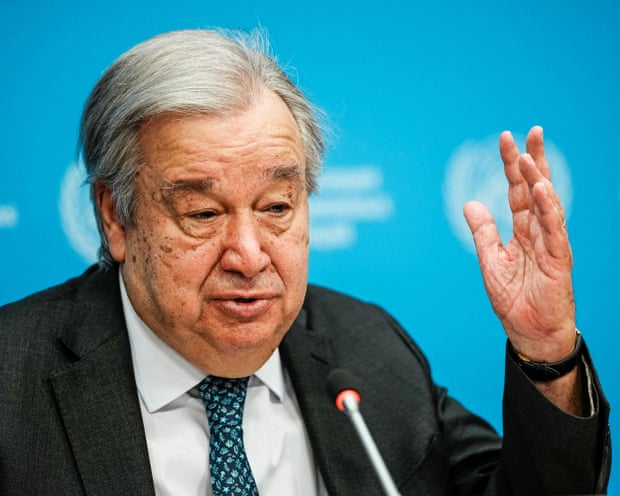
AntónioGuterres called for economies to ‘move beyond GDP’ as a measure of economic and societal success. Photograph: Eduardo Muñoz/Reuters
The global economy must be radically transformed to stop it rewarding pollution and waste, UN secretary general António Guterres has warned.
Speaking to the Guardian after the UN hosted a meeting of leading global economists, Guterres said humanity’s future required the urgent overhaul of the world’s “existing accounting systems” he said were driving the planet to the brink of disaster.
“We must place true value on the environment and go beyond gross domestic product as a measure of human progress and wellbeing. Let us not forget that when we destroy a forest, we are creating GDP. When we overfish, we are creating GDP.”
For decades, politicians and policymakers have prioritised growth – as measured by GDP – as the overarching economic goal.
But critics argue that endless, indiscriminate growth on a planet with finite resources is driving not only the climate and nature crisis but increasing inequality.
Guterres said: “Moving beyond gross domestic product is about measuring the things that really matter to people and their communities. GDP tells us the cost of everything, and the value of nothing. Our world is not a gigantic corporation. Financial decisions should be based on more than a snapshot of profit and loss.”
…
In January, the UN held a conference in Geneva titled Beyond GDP attended by senior economists from around the world – including Nobel laureate Joseph Stiglitz, leading Indian economist Kaushik Basu and equity expert Nora Lustig.
The trio are part of a group set up by Guterres that has been tasked with devising a new dashboard of measures of economic success that takes “human wellbeing, sustainability and equity” into account.
A report published by the group late last year argued that, as the world wrestled with repeated global shocks over the past two decades, the need for an economic transformation had become increasingly urgent – from the financial crash of 2008 to the Covid-19 pandemic.
It said those events were exacerbated by the “triple planetary crisis of climate change, biodiversity loss, and pollution” and, in addition, warned that rapid technological change was upending labour markets and exacerbating growing inequality.
Donald Trump urges you to be a Climate Science denier like him. He says that he makes millions and millions for destroying the planet, Burn, Baby, Burn and Flood, Baby, Flood.Nigel Farage explains the politics of Reform UK: Racism, Fake anti-establishmentism, Deregulation, Corporatism, Climate Change Denial, Mysogyny and Transphobia.Elon Musk urges you to be a Fascist like him, says that you can ignore facts and reality then.
For far too long, the decline in the biodiversity of our rivers and lakes has been out of sight and out of mind. As a freshwater ecologist I have long felt frustrated as conservation and research is dominated by land and sea species, even though our rivers, lakes, ponds and other wetlands host a hugely disproportionate amount of the world’s biodiversity in their relatively small area.
The first comprehensive assessment of the risk of extinction of freshwater species, now published in the journal Nature, is set to change this. The scientists involved in the new study used the recently completed “red list” for freshwater fishes, and the one for dragonflies and damselflies.
Red lists are official inventories of conservation status compiled by the International Union for Conservation of Nature (IUCN). They combined this with data from the previously published red list for freshwater crabs, crayfishes and shrimps. In total, they assessed more than 23,000 species.
The authors conclude that close to a quarter (24%) of freshwater species are threatened with extinction. That is, they have been officially assessed as vulnerable, endangered, critically endangered or extinct in the wild.
These include the critically endangered European eel, and the endangered white-clawed crayfish, both of which were abundant in the streams of my childhood.
Once abundant, now endangered: a juvenile white clawed crayfish. valda butterworth / shutterstock
There is some uncertainty in the estimates, especially as there is insufficient data to establish the extinction risk for some species. The authors use an accepted and robust method to address this uncertainty but note that this lack of data affects a substantially larger proportion of freshwater species than those that live on land.
In fact, despite indications that a greater proportion of freshwater mollusc species are at risk of extinction, the authors could not include molluscs in their analysis as so many species are data deficient.
Furthermore, we have only the most rudimentary understanding of the status of the wide array other freshwater species, particularly invertebrates such as mayflies, stoneflies, or various beetles, many of which are highly sensitive to pollution. Although this new study represents an important step forward in our understanding, it should also act as a clarion call to galvanise efforts to fill these critical data gaps.
Freshwater species overlooked
While shocking, this figure of 24% of freshwater species threatened with extinction is comparable with the estimate for predominantly land-based amphibians, reptiles, birds and mammals, of which 23% are threatened. Comprehensive assessments of birds, amphibians and mammals have been available for over 20 years, with repeat assessments now available.
Rivers and lakes support whole ecosystems with all sorts of species. Martine Liu 58 / shutterstock
As the IUCN’s red lists are used to document trends in biodiversity and therefore to inform national and global strategy, data on terrestrial vertebrates has dominated conservation science and policy. Hence, to date, global environmental governance has focused on land and sea ecosystems, despite evidence that freshwaters require distinct management needs.
With this assessment, it is now clear that policy will have to be developed that protects and delivers improvements for freshwater species. That means thinking about entire river basins as a whole, rather than the immediate area occupied by the species.
It also means considering things like how rivers and lakes are connected and how the water available varies from season to season. Bodies of freshwater are like islands in a sea of land. Facilitating movement between these islands can help preserve species, particularly where they disappear seasonally.
Most species face multiple threats
In the new study, pollution, dams, water abstraction, land-use change, over-exploitation, invasive species and disease feature prominently as threats, with most species impacted by more than one. Freshwaters in areas of limestone and other porous calcium-rich rocks host consistently more threatened species than would be expected, highlighting the importance of chalk streams for example, where pressure due to exploitation of water resources and pollution is pronounced.
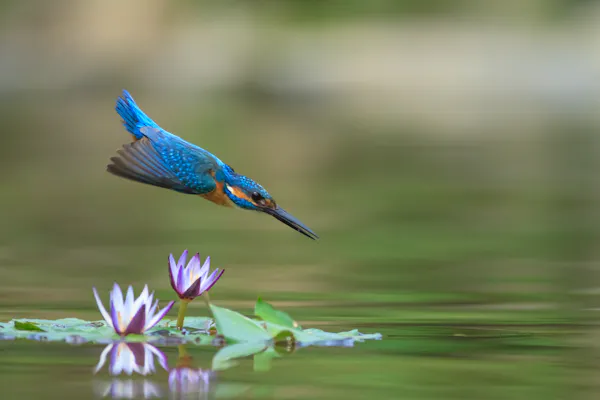
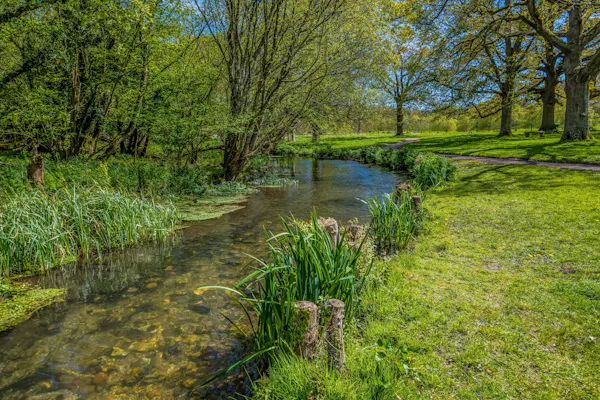
Chalk streams are valuable habitats for salmon, trout, otters, kingfishers and many other species. Tony Martin Long / shutterstock
While current efforts to hold UK water companies responsible for reducing inputs of sewage to rivers and lakes are commendable, water use efficiency and run-off should be considered throughout the decision-making process, from building design and town planning though to our individual daily use of water. Nature-based solutions such as tree planting or wetland protection offer a way forward that simultaneously benefit biodiversity and human well-being.
A lack of understanding can no longer be used as an excuse for inaction. As the authors of the new study point out, freshwaters support more than 10% of all known species, including about a third of vertebrates and half of fishes, while covering less than 1% of the surface of the Earth.
Many of the freshwater species considered in this study are socially and economically important. Freshwater fish provide an important source of protein for many human societies, and species such as Atlantic salmon support a fishing-tourism industry critical to many areas with limited opportunities to generate income.
Other species, while superficially unimportant to human society, thrive in clean water. The widespread decline in these species reflects increasing pollution and other pressures, which does not bode well for our society in the face of climate change and diminishing water availability.
Dolphins off the coast of the island of San Miguel in the Azores. Juan Miguel Cervera Merlo / iStock / Getty Images Plus
The regional assembly of the Azores Islands — a nine-island archipelago in Portugal — has approved the North Atlantic’s largest marine protected area.
Its creation will allow Portugal to meet the United Nations goal of safeguarding 30 percent of the planet’s land and sea by the end of the decade.
“We have acted in advance of the international conservation goals for 2030 with the creation of the largest marine park in the North Atlantic, with fully protected areas and highly protected areas,” Bernardo Brito e Abreu, maritime affairs adviser to the Azorean government, told Reuters.
The UK is considered one of the most nature-depleted countries in the world. This is not surprising given its history of early industrialisation and agricultural intensification.
These islands have lost species and unique habitats have shrunk to tiny remnants. Nearly every landscape and view has transformed.
What is more surprising is that over the last 50 years or so, from when scientists started to collect information about biodiversity systematically, there has been no let-up in that downward slide.
More than 750 assessed species have declined by 19% on average since monitoring began in 1970. The losses continue despite the heroic efforts of many passionate people and organisations. Today, out of over 10,000 species assessed, 16% (1,500, or one in six) are threatened with extinction.
That is the sobering conclusion of the latest state of nature report, compiled by experts from over 60 of the top research and conservation organisations in the UK, using the latest and most accurate information about biodiversity on land, in freshwater, around the coast and in the ocean.
The evidence that species and habitats are being lost is clear. And yet, as the report shows, there has never been a better understanding of the state of nature and, importantly, what is needed to fix it.
Nature continues to decline
Everyone depends on nature for the things it provides for free: so-called ecosystem services like healthy food, materials, clean air and water. You could add human wellbeing, physical and mental health – and for many, inspiration, solace and joy.
There is cause to protect nature because it aligns with our values, from the moral responsibility we feel to future generations to the intrinsic worth we know nature has. These are all good reasons, but self-preservation is compelling.
The new report presents evidence on how and why nature is changing in the UK and in its four constituent countries. To do this, the authors analysed three measures: species abundance (the number of individuals), species distribution (the proportion of sites occupied) and national extinction risk.
These measures have been assessed for hundreds – and in some cases thousands – of species native to the UK. Our new findings are in line with previous reports (2013, 2016, 2019) in pointing to a pattern of continued biodiversity loss.
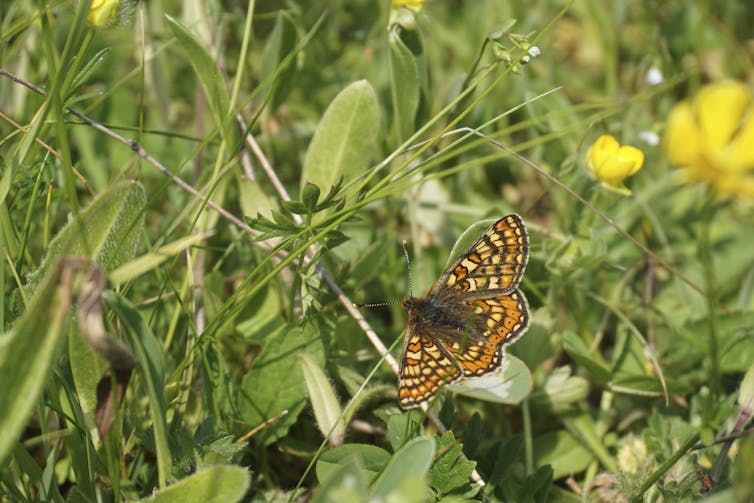
The threatened marsh fritillary butterfly. Patrick Cashman/RSPB
The new report’s key findings include:
The distributions of almost 5,000 invertebrate species have on average shrunk by 13% since 1970. Strong declines were seen in insect groups that perform key ecosystem functions, including pollinators (18% decrease) and pest controllers (34% decrease).
The distributions of 54% of flowering plant species and 59% of bryophytes (mosses and liverworts) have decreased across Britain since 1970. By comparison, only 15% and 26% of these groups have increased respectively.
The abundance of 13 species of seabird has fallen by an average of 24% in the UK since 1986. But these results pre-date an ongoing outbreak of Highly Pathogenic Avian Influenza, which has killed thousands of seabirds, some belonging to populations constituting the bulk of an entire species.
The report shows that climate change – which is predominantly caused by burning fossil fuels – is among the biggest threats to wildlife in all ecosystems. The intensive way in which land is managed for farming (with the loss of hedgerows, farm ponds and scruffy margins and the increasing use of pesticides and fertilisers, as well as changes in crops and cropping patterns) is also a major driver of biodiversity loss, and contributes to climate change.
At sea, unsustainable fishing practices are a major factor. Added to these pressures on wildlife are invasive species, pollution and for some, such as birds of prey, persecution.
Solving all of these problems will involve several actions that can be joined up to support each other. This must be swift and extensive to be effective.
The report establishes what is known about the success or failure of conservation efforts. Fortunately, there are many success stories. Species like natterjack toads, Duke of Burgundy butterflies, bitterns, and large marsh grasshoppers have all benefited from bespoke conservation projects and are bouncing back.
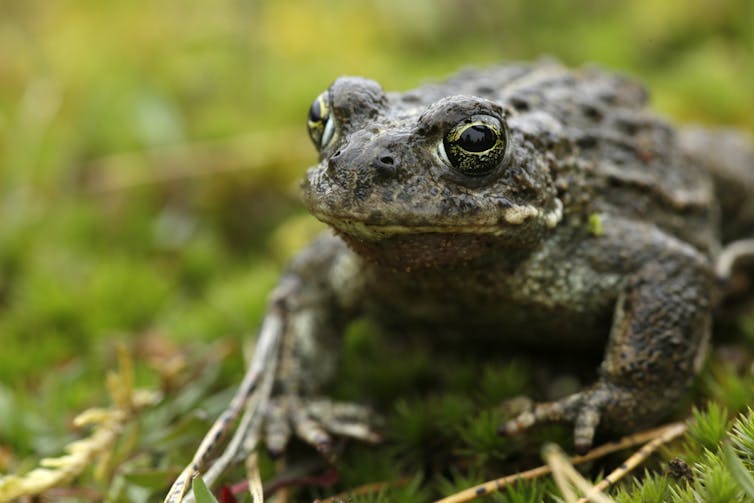
Natterjack toads cling on in a handful of shallow coastal pools. Andy Hay/RSPB
Cairngorms Connect is the UK’s largest habitat restoration project, covering 60,000 hectares in the Scottish national park. It aims to restore native woodland, peatlands and rivers over the next 200 years. This is the scale at which conservationists need to operate in order to reverse nature’s decline.
Recovery by 2050?
It is only through the collective efforts of thousands of people, most of them volunteers, that we can report on the state of nature with such clarity and breadth. Without their enthusiasm, commitment and skill, we’d only have a sketchy understanding of how the environment is changing, and whether conservation efforts are making a difference.
The 2023 state of nature report is timely given the recent adoption of global targets to recover nature. The Convention on Biological Diversity’s new global framework, signed by nearly 200 countries in December 2022, aims to maintain, enhance, restore and expand ecosystems, reduce the number of species threatened with extinction and increase the abundance of native species by 2030, putting nature on a path to recovery by 2050.
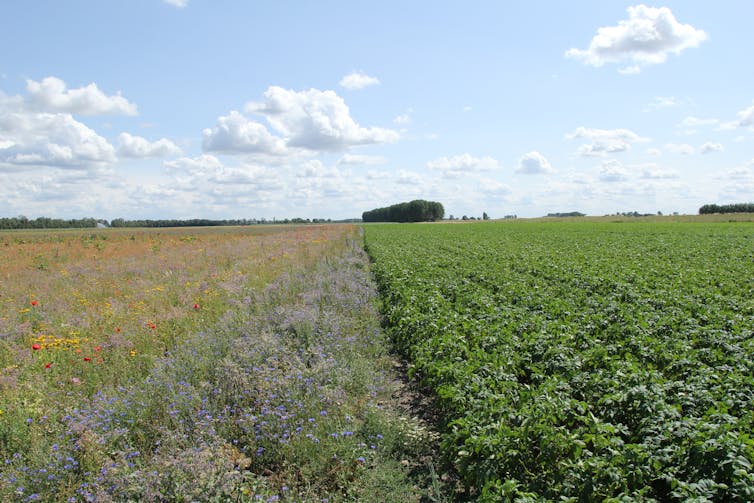
Restoring meadows on farmland could benefit pollinating insects. Angel217/Shutterstock
To halt and reverse biodiversity loss in the UK, efforts to conserve and restore species and habitats must ramp up. But the underlying drivers of this loss must be addressed too, especially those attached to our food system.
That means making food production more sustainable and nature-friendly on land and at sea, and adjusting our diets to cut demand for products that drive the loss of nature, such as meat.
Nature-based solutions to climate change, such as restoring and protecting carbon-absorbing forests and wetlands in river catchments, or restoring coastal habitats, can also boost biodiversity if well designed (think saving two birds with one tree).
We have never had a better understanding of the state of nature and what is needed to fix it. Now we need action.
Don’t have time to read about climate change as much as you’d like?
Climate change is one of the main drivers of species loss globally. We know more plants and animals will die as heatwaves, bushfires, droughts and other natural disasters worsen.
But to date, science has vastly underestimated the true toll climate change and habitat destruction will have on biodiversity. That’s because it has largely neglected to consider the extent of “co-extinctions”: when species go extinct because other species on which they depend die out.
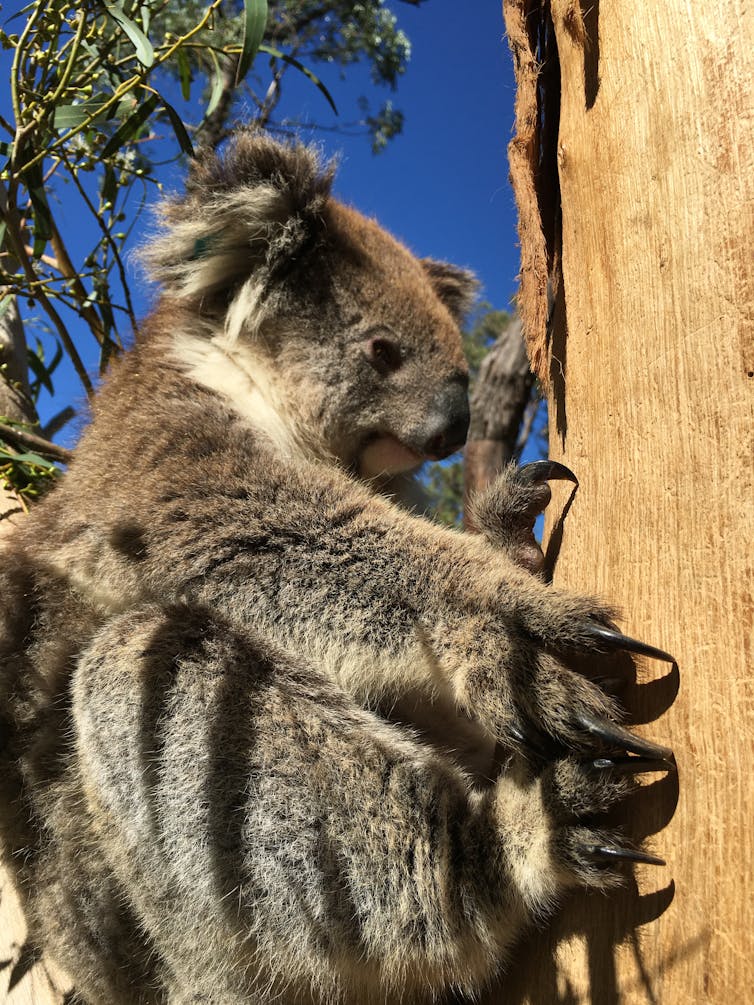
Our new research shows 10% of land animals could disappear from particular geographic areas by 2050, and almost 30% by 2100. This is more than double previous predictions. It means children born today who live to their 70s will witness literally thousands of animals disappear in their lifetime, from lizards and frogs to iconic mammals such as elephants and koalas.
But if we manage to dramatically reduce carbon emissions globally, we could save thousands of species from local extinction this century alone.
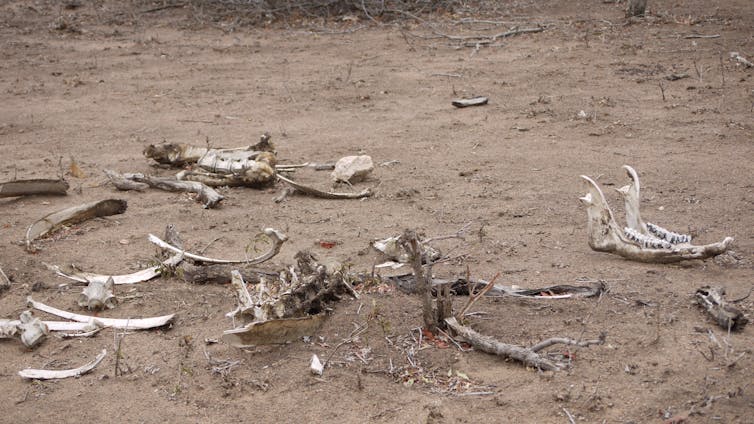
Ravages of drought will only worsen in coming decades. CJA Bradshaw
An extinction crisis unfolding
Every species depends on others in some way. So when a species dies out, the repercussions can ripple through an ecosystem.
For example, consider what happens when a species goes extinct due to a disturbance such as habitat loss. This is known as a “primary” extinction. It can then mean a predator loses its prey, a parasite loses its host or a flowering plant loses its pollinators.
A real-life example of a co-extinction that could occur soon is the potential loss of the critically endangered mountain pygmy possum (Burramys parvus) in Australia. Drought, habitat loss, and other pressures have caused the rapid decline of its primary prey, the bogong moth (Agrotis infusa).
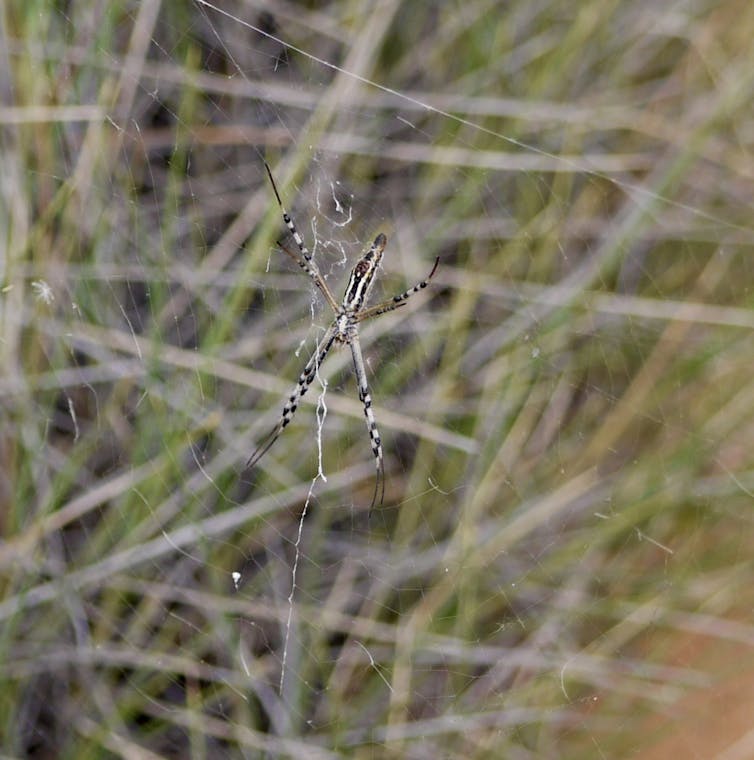
All species are connected in food webs. The spider shown here is an elongated St. Andrews cross spider Argiope protensa from Calperum Reserve, South Australia. CJA Bradshaw
Research suggests co-extinction was a main driver of past extinctions, including the five previous mass extinction events going back many hundreds of millions of years.
But until now, scientists have not been able to interconnect species at a global scale to estimate how many co-extinctions will occur under projected climate and land-use change. Our research aimed to close that information gap.
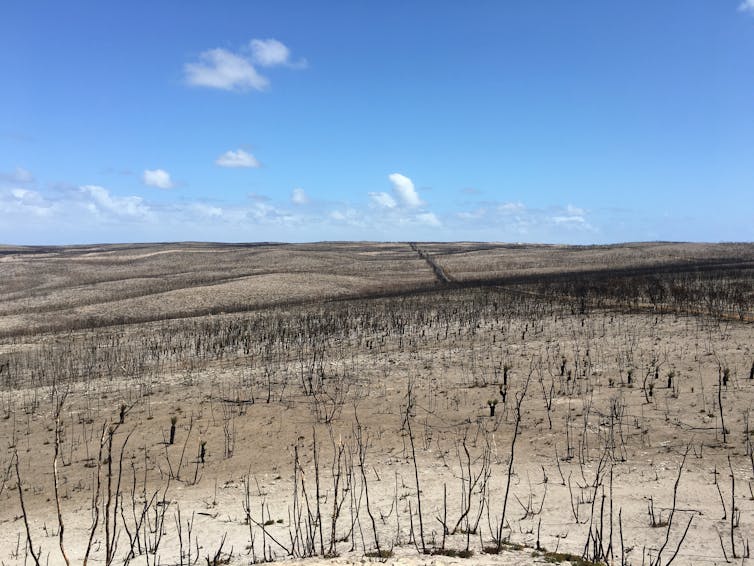
The unprecedented bushfires of 2019/2020 on Kangaroo Island killed thousands of individuals in many different wildlife populations. CJA Bradshaw
The fate of wildlife
Using one of Europe’s fastest supercomputers, we built a massive virtual Earth of interconnected food-web networks. We then applied scenarios of projected climate change and land-use degradation such as deforestation, to predict biodiversity loss across the planet.
Our virtual Earths included more than 15,000 food webs that we used to predict the interconnected fate of species to the end of the 21st Century.
Our models applied three scenarios of projected climate change based on future pathways of global carbon emissions. This includes the high-emissions, business-as-usual scenario that predicts a mean global temperature increase of 2.4℃ by 2050, and 4.4℃ by 2100.
If this scenario becomes reality, ecosystems on land worldwide will lose 10% of current animal diversity by 2050, on average. The figure rises to 27% by 2100.
Adding co-extinctions into the mix causes a 34% higher loss of biodiversity overall than just considering primary extinctions. This is why previous predictions have been too optimistic.
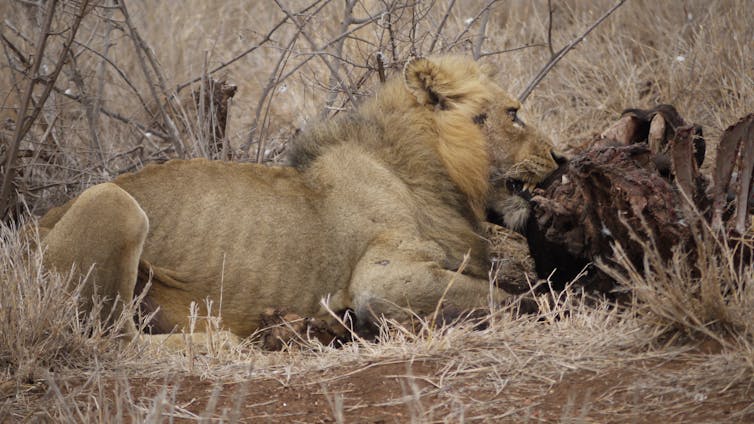
Worse still is the fate of the most vulnerable species in those networks. For species highest in food chains (omnivores and carnivores), the loss of biodiversity due to co-extinctions is a whopping 184% higher than that due to primary extinctions.
Without enough prey, predators like this African lion, will perish. CJA Bradshaw
We also predict that the greatest relative biodiversity losses will occur in areas with the highest number of species already – a case of the rich losing their riches the fastest.
These are mainly in areas recognised as “biodiversity hotspots” — 36 highly threatened areas of the Earth containing the most unique species, such as Southwest Australia and South Africa’s Cape Floristic region. This is because the erosion of species-rich food webs makes biological communities more susceptible to future shocks.
Tropical forest is the main ecosystem found in many biodiversity hotspots worldwide.
We also detected that these networks of interacting species themselves will change. We used a measure of “connectance”, which refers to the density of network connections. Higher connectance generally means the species in a food web have more links to others, thereby making the entire network more resilient.
Connectance, we learnt, will decline between 18% and 34% by the end of this century in the worst-case climate scenario.
This reduction in connectance was also driven by the loss of some key species occupying the most important positions in their local networks. These could be top predators such as wolves or lions keeping plant eaters in check, or an abundant insect eaten by many different insectivores.
When such highly connected species go extinct, it makes the network even less resilient to disturbance, thereby driving even more loss of species than would otherwise have occurred under a natural ecological regime. This phenomenon illustrates the unprecedented challenges biodiversity faces today.
It follows the recent COP27 climate change summit in Egypt, where the resulting agreement was inadequate to deal with the global climate crisis.
We hope our findings will, in future, help governments identify which policies will lead to fewer extinctions.
For example, if we manage to achieve a lower carbon-emissions pathway that limits global warming to less than 3℃ by the end of this century, we could limit biodiversity loss to “only” 13%. This would translate into saving thousands of species from disappearing.
Clearly, humanity has so far underestimated its true impacts on the diversity of life on Earth. Without major changes, we stand to lose much of what sustains our planet.