NHS logo. Resident doctors in England will strike later this month after being offered a 5.4% pay rise, which the government say will not be revisited.
Resident doctors’ 29% pay claim is non-negotiable, reasonable and easily affordable for the NHS, the new leader of the medical profession has said.
Strikes to ensure resident – formerly junior – doctors in England get the full 29% could drag on for years, according to Dr Tom Dolphin, the British Medical Association’s new council chair.
The doctors’ union will not negotiate on or accept a lower figure because that is the extent of the real-terms loss of earnings resident doctors have suffered since 2008, which they want restored – in full – Dolphin told the Guardian in his first interview since taking over last month.
The 29% demand is not up for negotiation “because it’s based on a principle”, said Dolphin, a consultant anaesthetist. “If we picked a different number, that wouldn’t achieve the pay restoration. So that’s why it looks inflexible.”
Dolphin blamed the five-day strike that tens of thousands of resident doctors plan to stage later this month on Wes Streeting, the health secretary, giving them a 22% pay rise over two years last year but not following it up with an award this year to take account of the 29% claim. He said the disruption that the 120-hour walkout would cause was his fault, not theirs.
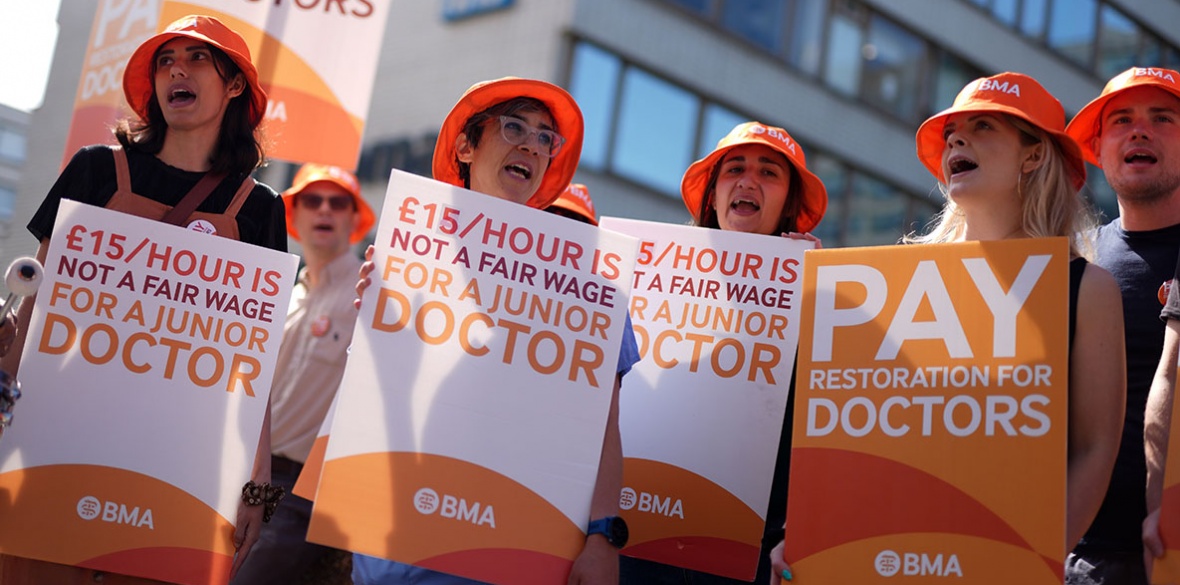
Junior doctors on the picket line outside St Thomas’ Hospital, London, during their continuing dispute over pay, June 27, 2024
SIR KEIR STARMER was warned today against repeating Rishi Sunak’s mistakes as 25,000 junior doctors began a five-day pay walkout across England, threatening further strike action this summer.
The British Medical Association (BMA) members hit out at the Labour leader’s “lies” over NHS funding as they staged their 11th walkout since March last year, including at the Friarage Hospital close to the Prime Minister’s constituency in North Yorkshire.
Shadow health secretary Wes Streeting has said he would not grant the BMA’s demands for real-terms pay restoration in one go as it would mean any “trade union worth their salt” would ask for the same the following year.
But with the dispute now in its 20th month, BMA junior doctors committee co-chairman Rob Laurenson said: “Keir Starmer would do well not to repeat the mistakes of Rishi Sunak, and to empower his health secretary to negotiate in good faith.”
He welcomed Mr Streeting describing pay negotiations as a “journey, not an event,” saying the union was happy to negotiate a multi-year deal.
But he added: “The truth of the matter is a doctor starts with £15 an hour and we are asking for doctors to be paid about £21 an hour — that is affordable.
“The government has spent £3 billion on strikes and pay restoration costs £1.3 billion — again if an incoming government under Keir Starmer wants to continue lying then it looks like strikes will have to continue as well.”
His committee co-chairman Dr Vivek Trivedi warned that as the current strike mandate ends on September 19, “if talks do not move in a timely manner, then of course our members would expect us to call for strike action.”
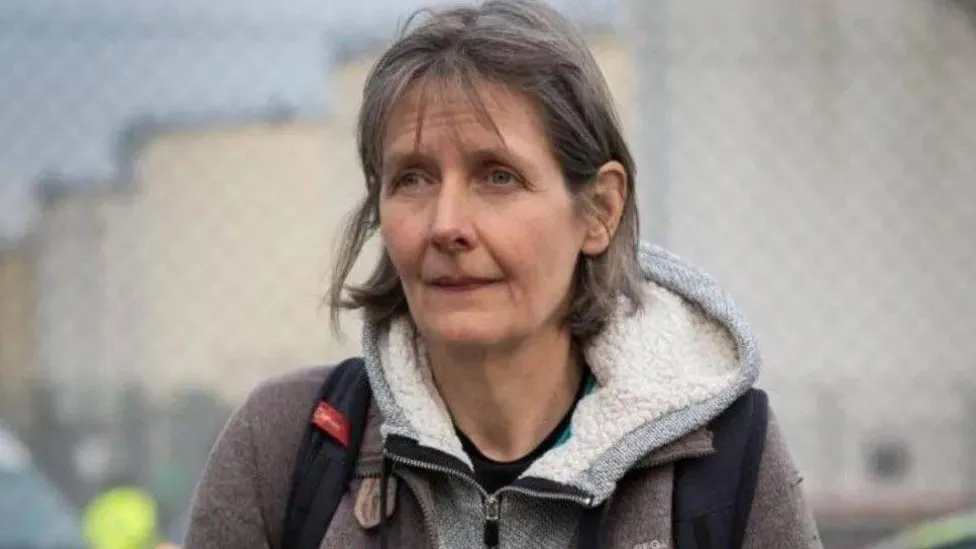
A tribunal has found Dr Sarah Benn’s fitness to practise to be impaired
The British Medical Association (BMA) has said it is “very concerned” by a tribunal’s finding that a doctor’s participation in Just Stop Oil protests amounted to professional misconduct.
The Medical Practitioners Tribunal Service ruled Dr Sarah Benn’s fitness to practise was impaired and said it must consider whether a sanction should be imposed on her registration.
The General Medical Council (GMC), which referred the case, said the hearing was convened due to the fact her actions at Kingsbury oil terminal in Warwickshire broke the law and resulted in her imprisonment.
But Dr Emma Runswick, BMA deputy chair of council, said there was “no possible public or patient interest” in such circumstances for proceedings where potential sanctions included the removal of a doctor’s licence.
Addressing the tribunal’s findings, Dr Runswick said the BMA was concerned Dr Benn’s registration as a doctor could be threatened for taking part in peaceful protests relating to the climate change emergency.
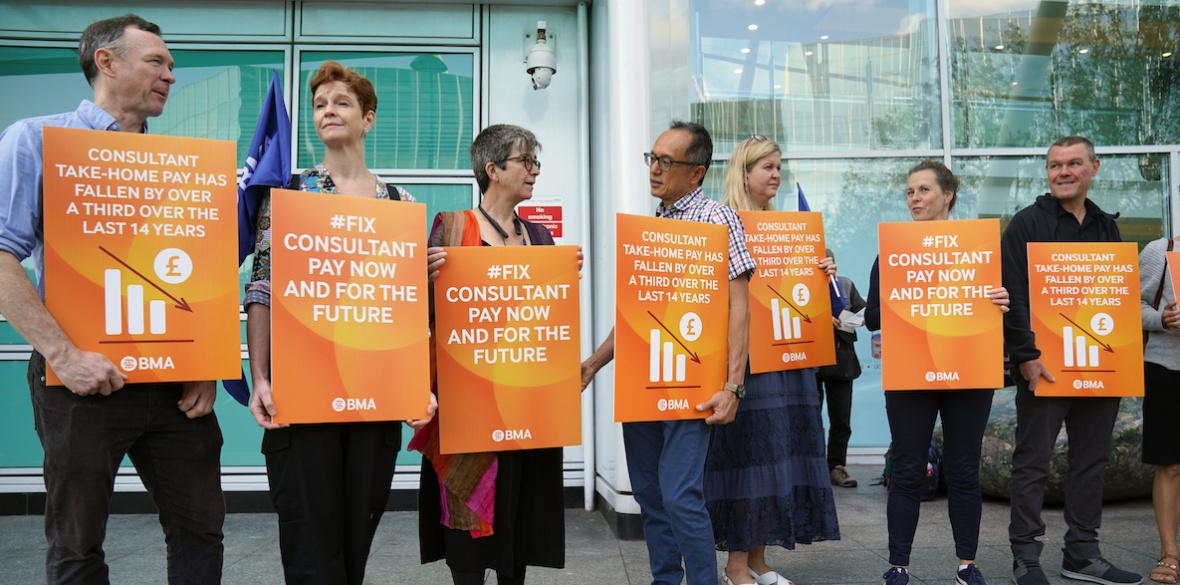
Medical consultant members of the British Medical Association (BMA) on the picket line outside University College London (UCL) hospital as consultants took industrial action for the first time in more than a decade. Picture date: Thursday July 20, 2023.
NURSES were left infuriated today after the government made an improved pay offer for hospital consultants in England.
The Department of Health and Social Care said that it had reached an agreement with the British Medical Association (BMA) and the Hospital Consultants and Specialists Association (HCSA) after a month of talks and more than six months of strikes.
Union members will now vote on the deal which offers the majority of consultants an additional uplift of up to 12.8 per cent from next January — more than double the minimum of 6 per cent in 2023/24 as a result of the previously implemented pay award — although it won’t be paid until April.
BMA consultants committee chair Dr Vishal Sharma said: “It is a huge shame that it has needed consultants to take industrial action to get the government to this point when we called for talks many months ago.”
Sunak met with the CEOs of several UK private health corporations in Number 10 in December. | No 10 Downing Street
Rishi Sunak hosted a meeting with seven bosses from the UK’s biggest private health companies to discuss how to tackle the NHS backlog, openDemocracy can reveal.
Campaigners have raised concerns that the close involvement of private healthcare corporations in the government’s response to the NHS crisis will benefit shareholders at the expense of public investment.
The government announced the creation of the Elective Recovery Taskforce in December to provide advice on how to “turbocharge NHS recovery from the pandemic, reduce waiting times for patients and eliminate waits for routine care of over a year by 2025”.
At the time, the Department of Health and Social Care (DHSC) refused to give openDemocracy details of the group’s members, or say who had attended its launch at Number 10 led by the PM and health secretary Steve Barclay in December.
A guestlist for the event, obtained by openDemocracy through a Freedom of Information request, reveals that half a dozen CEOs from private health firms were in attendance.
Guests included the chief execs of the UK’s two largest private hospital operators: Paolo Pieri, the chief exec of Circle Health Group, and Justin Ash, who heads up Spire Healthcare. Also present was Jim Easton, the chief executive of Practice Plus Group, the NHS’s top private healthcare provider.
They were joined by David Hare, the chief executive of Independent Healthcare Provider Network, a lobby group that represents for-profit and not-for-profit private health organisations including Bupa and HCA, one of the biggest healthcare facility companies in the US.
Private health tycoons have wined and dined senior ministers while cashing in on NHS contracts
The private healthcare executives, which also included CEOs from Horder Healthcare, Newmedica, InHealth and Medefer, outnumbered the five NHS England directors invited to the event.
DHSC said it could not provide openDemocracy with minutes from the meeting because none were taken, and refused to share any papers handed out to attendees.
Separately, the government quietly published a list of members of the Elective Recovery Taskforce on Monday. The 16-person group includes DHSC ministers, six NHS bosses, and Hare.
Other members include Bill Morgan, a private healthcare lobbyist whose past clients included Virgin Care, who was appointed a Number 10 adviser in November, and Paul Manning, an NHS consultant surgeon who is also chief medical officer for Circle Healthcare.
The government said the role of the task force would be to “shape proposals for how the healthcare system can make use of all resources at its disposal, further tackling the backlog caused by the Covid-19 pandemic”. It will conclude its work in March.
Last week, the prime minister said he had signed up to an NHS GP after the Guardian reported that he had registered with a private clinic in west London that charges £250 for a consultation.
Tony O’Sullivan, a retired consultant paediatrician and co-chair of Keep Our NHS Public, told openDemocracy: “The head parasites are at the table to maximise future extraction of NHS funds.”
He added: “This is an important disclosure extracted from the government proving the direction of travel – to continue disinvesting in the NHS and increase its enforced dependence on private health care.
“The private sector was bailed out during Covid, has a lucrative four-year £10bn deal ongoing and is also in a position to earn massive profits from patients forced to go privately to avoid NHS queues of 7.2 million.”
openDemocracy has no paywall and relies on the backing of thousands of our readers to make stories like this freely available to everyone. You cansupport our work by making a donation here.