A new Ipsos in the UK poll reveals that the left-wing political party recently founded by former Labour leader Jeremy Corbyn and MP Zarah Sultana could capture a significant segment of the British electorate, particularly among younger voters and those who supported the Labour and Green parties in the 2024 General Election.
Overall, 20% of British adults say they would be ‘very’ or ‘fairly likely’ to consider voting for a new left-wing party. This figure, however, masks a sharp generational divide. A third (33%) of those aged 16-34 would consider voting for the new party, a figure that drops to 22% among 35-54s and just 9% among those aged 55 and over.
The potential for this new party to disrupt the existing political landscape is most evident in its appeal to voters of other left-leaning parties. One-third (33%) of those who voted Labour in 2024 and 43% of 2024 Green party voters would consider lending their vote to a Corbyn-Sultana-led party.
…
Commenting on the findings, Keiran Pedley, Director of UK Politics at Ipsos said:
These figures show that a new left-wing party led by Jeremy Corbyn and Zarah Sultana has the potential to shake up British politics. A significant number of younger people are at least prepared to consider voting for it and a majority of those aged under 35 say they would consider voting for some kind of alliance between the new party and the Greens. Clear policies around change, the NHS, poverty and wealth taxes could be popular. Time will tell if the new party can turn this hypothetical appeal into real votes on a significant scale.
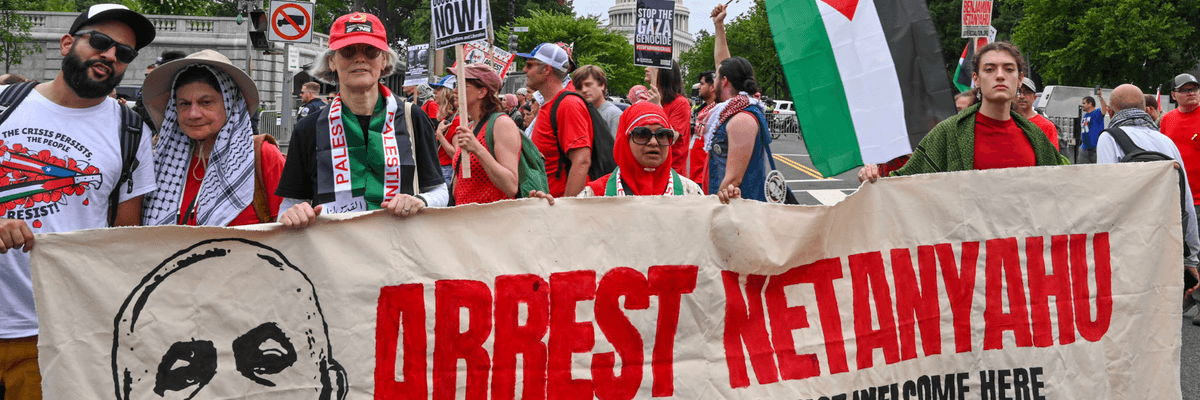
Pro-Palestine protesters hold a banner calling for the arrest of Israeli Prime Minister Benjamin Netanyahu during a July 24, 2024 demonstration in Washington, D.C. (Photo: Joe Piette/flickr/cc)
Growing support for Palestine means that more U.S. voters will base their future political decisions on how the U.S. engages with Israel and its disregard for Palestinian rights.
It is crucial for any American administration to recognize that, regardless of political agendas, the views of the American public regarding the situation in Palestine and Israel are undergoing a significant shift. A critical mass of opinion is rapidly forming, and this change is becoming undeniable.
Paradoxically, while Islamophobia continues to rise across the U.S., sentiments supporting Palestinians and opposing Israeli occupation are steadily increasing.
In theory, this means that the pro-Israeli media’s success in linking Israel’s actions against the Palestinian people to the so-called “war on terror”—a narrative that has demonized Islam and Muslims for many years—is faltering.
Palestine may not be the sole measure by which the Trump administration will be judged, nor the only factor shaping future voting patterns. Yet, it is undoubtedly a crucial test.
Americans are increasingly viewing the situation in Palestine as a human rights issue, and one that is deeply relevant to domestic politics. A recent Gallup poll underscores this shift.
The poll, released on March 6, was conducted between February 3 and 16. It found that American support for Israel is at its lowest point in 25 years, while sympathy for Palestinians has reached its highest level. Having 46% of Americans supporting Israel and 33% supporting Palestinians would have seemed inconceivable in the past, when the plight of Palestine and its people was largely overlooked by the general public.
Even more remarkable is that this shift continues to gain momentum, despite the fact that mainstream media and American politicians have been more biased than ever, promoting a dehumanizing discourse of Palestinians and unprecedented, uncritical support for Israel.
While the growing shift in favor of Palestine—particularly the genocide in Gaza, which played a role in influencing political outcomes in several states during the last presidential election—had gone largely unnoticed by the Biden administration, it’s clear that the dissatisfaction with the government’s position remains unchanged.
The previous administration approved significant military aid to Israel, topping $17.9 billion in the first year alone, enabling its genocidal war in Gaza, resulting in over 160,000 casualties over a span of 15 months.
Yet, this blatant disregard for Palestinian lives and rights persisted under the new administration of President Donald Trump, who appointed some of the most staunchly anti-Palestinian, pro-Israel figures to key positions in his government.
Trump did this despite making repeated, though often contradictory, promises to end the war and resolve the Israeli-Palestinian conflict.
Instead, the U.S. president approved the release of a shipment of heavy MK-84 bombs and passed a nearly $3 billion arms sale to Israel.
Trump also introduced a new U.S. policy that solely focused on “taking ownership” of Gaza and displacing its population. Although this position was inconsistently articulated, Trump ultimately, on March 14, seemed to reverse it altogether. This left many wondering whether U.S. foreign policy was truly independent or simply a reflection of Israel’s influence and its Washington lobby.
Unlike Biden, whose support for Israel has been consistent, Trump’s stance has been confusing and contradictory. The U.S. news portal Axios reported on March 5 that talks between the U.S., led by Adam Boehler, and Hamas had taken place in Doha. In an interview with CNN four days later, Boehler made the striking statement that U.S. and Israeli foreign policies should be seen as separate. “We’re the United States. We’re not an agent of Israel,” he said.
However, as analysts began mulling over this unprecedented language, it was soon revealed that Boehler was removed from his position, and the traditional, unwavering support for Israel quickly returned.
As U.S. policymakers continue to swing between their unwavering commitment to Israel and the “America first” rhetoric, they must keep in mind the following.
First, the American public is increasingly aware of events in Palestine, so masking Israel’s violations of Palestinian rights under the guise of “Israel’s right to defend itself” no longer suffices.
Second, U.S. and Israeli interests are not identical: The U.S. seeks geopolitical dominance followed by stabilization and so-called “containment,” while Israel thrives on provocations, destabilization, and long-lasting conflicts.
Third, Palestine has become a domestic issue in the U.S., and the debate on Palestine and Israel is no longer one-sided. Growing support for Palestine means that more U.S. voters will base their future political decisions on how the U.S. engages with Israel and its disregard for Palestinian rights.
Fourth, crackdowns on dissent, arrests of activists, and funding cuts will only deepen the polarization around this issue, rather than fostering an open, informed, and productive debate about a matter of great importance to millions of Americans. Such actions are quickly eroding the reputation of the U.S. as a democratic state and undermining confidence in its commitment to a peaceful resolution of the conflict.
Palestine may not be the sole measure by which the Trump administration will be judged, nor the only factor shaping future voting patterns. Yet, it is undoubtedly a crucial test. If the contradictions persist, and the U.S. continues to provide unwavering military support for Israel, Palestine could become the defining issue that contributes to the unraveling of U.S. foreign policy, not only in the Middle East but around the world.
It is not too late for this trajectory to shift, or for some degree of balance to emerge. The lives of millions are at stake.
Neo-Fascist Climate Science Denier Donald Trump says Burn, Baby, Burn.Elon Musk urges you to be a Fascist like him, says that you can ignore facts and reality then.
IT is no surprise that so many big business leaders have come out in support of the Labour Party.
It reflects two things. One is the banal fact that Labour looks like winning, and it does corporate leaders no harm at all to be able to say “I backed you at the election” when sitting down opposite ministers in a couple of months’ time to beg for assistance of one sort or another.
…
Keir Starmer and shadow chancellor Rachel Reeves have bent over backwards to place themselves in the service of monopoly capitalism.
That has been reflected in their rhetoric, pledging the “most business-friendly government” in British history, which is a very high hurdle, but is a clear indication of their aspiration.
Sometimes this is extended by a commitment to be “pro-worker and pro-business” as if there were never a conflict between the two.
…
As Unite’s Sharon Graham says, Labour’s New Deal for Working People now “has more holes than a Swiss cheese.” One can only hope that unions will be able to plug some of those gaps in Labour’s manifesto negotiations.
But the pro-capitalist turn goes much wider than safeguarding the bosses’ sacred right to exploit labour. It has permeated all aspects of the Starmer-Reeves approach.
The 120 signatories to the Labour-backing letter will have noticed that their corporation tax rate is not going to rise under Reeves.
They will have noticed that there is to be no wealth tax — of the kind Starmer once promised — under the impending Labour dispensation.
They will have noticed that outside a railway sector already under semi-control by the state, there is to be no extension of public ownership.
And they have noticed that despite the campaign slogan of “change” in fact Labour is offering nothing of the sort, but rather “economic stability.” That might have marked a point of divergence from the excitable Liz Truss but it hardly differs from Rishi Sunak, whose election boast is that he has restored — economic stability.
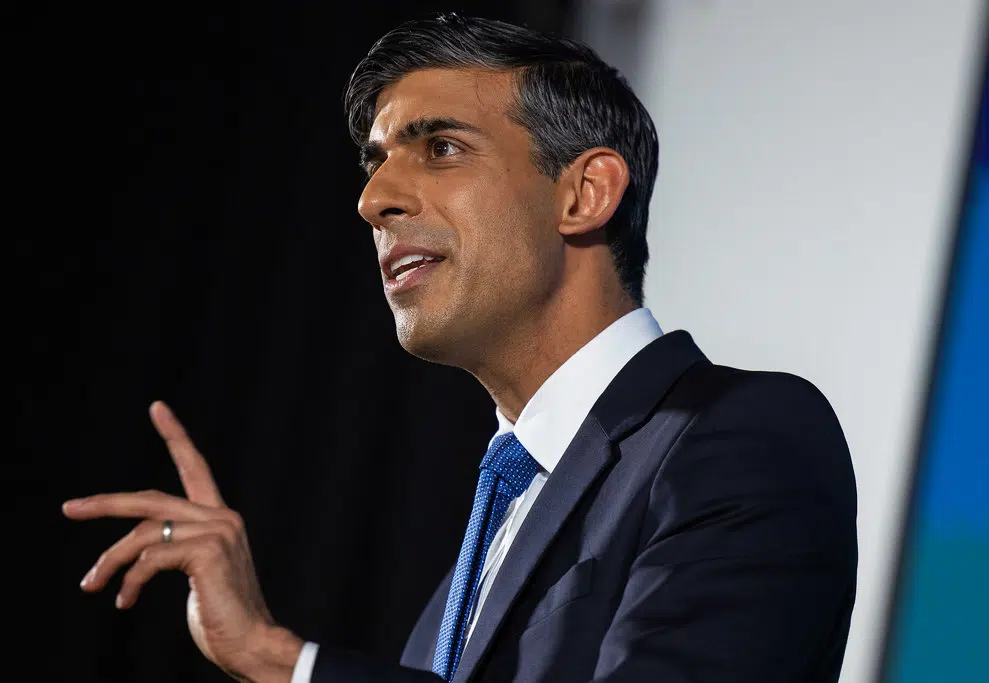
Rishi Sunak used the word change 30 times in his conference speech. His party has been in power for 13 years
Listening to the PM in Manchester, you’d be forgiven for thinking a different party has been running the country
Moments before Rishi Sunak took to the stage at the Conservative Party Conference, a video flashed on a screen. Images of fields, children, roads and vaccines appeared above the heads of the hundreds waiting for the PM’s speech. “Change is…” the words read. “Change is…the Conservatives.”
In his address in Manchester, the prime minister told his party: “It is time for a change.” He confirmed his intention to scrap HS2, Europe’s largest infrastructure project, claiming “the right thing to do when the facts change, is to have the courage to change.” And speaking about his decision to U-turn on manifesto net zero pledges, he added: “Change is difficult, particularly for those who disagree.”
Altogether, Sunak used the word change 30 times. You would be forgiven for thinking another party has been in power for the last 13 years.
The PM, who also served as chancellor for two and a half years, and before that was a senior minister in the Treasury, seems to be running a re-election strategy on the potential amnesia of the country.
This is someone who governs a party focused on conserving, asking voters to believe that another term of Conservative rule will change what has been a reality for the last 13: rising homelessness, a cost of living crisis, crippling rents, spiralling mortgage rates, attacks on minority communities, months of waiting for essential NHS treatment, and a system that puts corporate interest over workers.
While hoping you’ll forget his impact, the speech also hit some key Tory attack lines. Sunak demonised trans people, in an attempt to curry favour through division, and to outsource blame from those in power to those with none. He attempted to rewrite his own history, painting himself as someone with humble beginnings, rather than as someone who attended a £60,000 a year private school. He also bashed striking workers, pretending to care about a National Health Service he’s admitted to not using.
And then there’s everything that was left out. Housing, arguably one of the most important long-term strategies any government needs to form, was mostly absent from the speech. Sunak briefly mentioned housebuilding, which would have been helpful if he hadn’t ditched housebuilding targets in April. Otherwise, the biggest issue facing most young voters was ignored. Rents are rising at their fastest rate since records began, and no-fault evictions, which were meant to be banned under the delayed Renters Reform Bill, are still a leading cause of homelessness. The absence was deafening.
Ultimately, these contradictory threads of Sunak’s speech could cause his downfall. He offers no solution, just buzzwords. It speaks to an underestimation of the British people, to think that you can tell them you care about long-term decisions while scrapping long-term projects. He even deployed his wife, Akshata Murthy, to introduce him with a gushing speech, but refuses to speak about his family when challenged on things like their non-dom status.
Without a coherent pledge, voters may well feel unsure. Sitting in the hall and listening to him deliver his speech, there was a quiet sense of confusion.
It’s easy for Sunak to forget that we’re in a cost of living crisis. He is, after all, the richest Prime Minister we’ve ever had and is wealthy enough to buy himself out of problems. He sends his children to private schools, uses private healthcare to avoid waiting lists, and flies in a helicopter to avoid train cancellations.
Unfortunately for him, most of the country can’t forget.