‘Climate Arsonists’: 8 Major Oil Companies Fail to Align With Paris Agreement

Spread the love

Original article by OLIVIA ROSANE republished from Common Dreams under Creative Commons (CC BY-NC-ND 3.0).

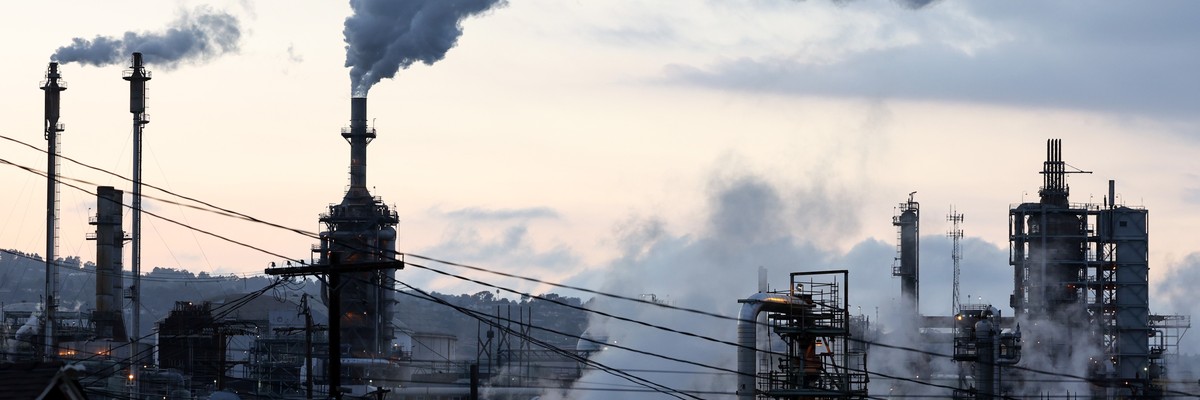
An ExxonMobil oil refinery is pictured in Baton Rouge, Louisiana. (Photo: Barry Lewis/InPictures via Getty Images)

“We cannot trust fossil fuel corporations to do anything but line the pockets of their CEOs and investors at the cost of our climate and communities,” one campaigner said.

The eight largest U.S. and Europe-based oil and gas producing companies are failing to align their plans with the Paris agreement goal of limiting global heating to 1.5°C above preindustrial levels and avoiding ever more catastrophic climate impacts.

Oil Change International’s Big Oil Reality Check report, released Tuesday, concludes that the plans of BP, Chevron, ConocoPhillips, Eni, Equinor, ExxonMobil, Shell, and TotalEnergies would actually put the world on track for more than 2.4°C of warming and burn through nearly one-third of the global carbon budget for hitting the 1.5°C target.

“It’s clearer than ever that oil and gas companies—the climate arsonists fueling climate chaos—cannot be trusted to put out the fire,” David Tong, report author and global industry campaign manager at Oil Change Internationalsaid in a statement. “There is no evidence that big oil and gas companies are acting seriously to be part of the energy transition.”

The Big Oil Reality Check report reveals that oil and gas corporations are more interested in looking like they are acting on climate change than actually acting on climate change.”

For its fourth annual Big Oil Reality Check, Oil Change International judged the oil companies’ climate plans and pledges against a set of minimum standards for alignment with the Paris agreement. The standards were divided into three main categories: ambition, integrity, and people-centered transitions.

Under ambition, the companies were assessed on whether they had plans to stop oil and gas exploration, stop approving new extraction projects, decrease production every year through 2030, and stop extraction on a certain date while outlining a long-term plan to end production.

Under integrity, the companies were assessed on whether their emissions-reduction plans included their entire supply chain, whether they relied on carbon capture or offsets, whether their methane-reduction plans were really in line with climate goals, and whether they lobbied or advertised against climate action.

For people-centered transitions, they were assessed on whether they had just transition plans for employees and members of frontline communities and whether they respected human rights overall and the rights of Indigenous peoples, including to free, prior, or informed consent to any fossil fuel activities.

The companies were then rated from “fully aligned” to “grossly insufficient” for how well their plans complied with the Paris goals within the assessment’s framework, but all eight companies scored “insufficient” or “grossly insufficient” for a majority of the criteria.

Only one company—Eni—scored above “insufficient” in any category, earning a ranking of “partially aligned” for having greenhouse gas-reduction plans that included its supply chains. The three U.S.-based companies—Chevron, ConocoPhillips, and ExxonMobil—scored “grossly insufficient” for all 10 criteria.

“American fossil fuel corporations are the worst of the worst,” Oil Change International’s U.S. program manager Allie Rosenbluth said. “Chevron, ExxonMobil, and ConocoPhillips perpetuate harm in frontline communities not only across the U.S. but worldwide.”

Oil Change found that six out of the eight companies have official plans to increase oil and gas production. The only two that did not were BP and Shell; however, these companies employ a misleading strategy. They compensate for new oil and gas projects by selling off polluting assets. While the emissions from the sold operations no longer count toward company emissions, they still count toward the planet’s total. This practice is out of line with the GHG Protocol on corporate emissions accounting and may violate the United Nations Guiding Principles on Business and Human Rights.

Four of the companies assessed in the report—BP, Shell, Exxon, and Chevron—were also the subject of a recent U.S. House investigation and Senate hearing detailing how the fossil fuel industry playbook has shifted from outright denial of climate science to greenwashing its activities by presenting itself as part of the solution to the climate crisis while its day-to-day operations continue to raise global temperatures.

“The efforts of climate and social movements have forced oil and gas companies to acknowledge that fossil fuels are dirty and dangerous, leading to a variety of climate pledges and ‘plans,'” said Oil Change campaigner Myriam Douo. The Big Oil Reality Check report reveals that oil and gas corporations are more interested in looking like they are acting on climate change than actually acting on climate change.”

“They spend billions on smoke and mirrors to try to fool us into believing they have solutions for a livable planet when, in reality, they are perpetuating harm to the climate and local communities while trying to suck every last ounce of profit out of their dirty fossil fuel business,” Douo concluded.

All told, Rystand energy data suggests that the combined production of the eight companies will be 17% by 2030 than they were last year.

“Such an increase in production on a global scale would put the world on a path towards global heating well beyond 2°C, locking in destruction of vulnerable communities and ecosystems,” the report authors wrote.

The report finds that all of the companies intend to rely on unproven carbon capture technology or offsets schemes to meet their claimed emission-reduction goals and have continued to spend money on lobbying against climate action and greenwashing their own activities since the agreement in Paris.

Further, no company has plans consistent with ensuring a just transition or protecting human rights. In one recent and urgent example, ExxonMobil, Chevron, TotalEnergies, BP, Shell, and Eni all continue to provide Israel with crude oil despite “the Israeli military’s ongoing assault on Palestinian civilians, ecosystems, and infrastructure in Gaza and mounting evidence of war crimes,” a March Oil Change investigation found.

The report comes nearly half a year after world leaders agreed to contribute to “transitioning away from fossil fuels” at the COP28 U.N. climate change conference in Dubai. In light of its conclusions, Oil Change called on governments to take action to further a just transition:

  1. Stop permitting or approving new fossil fuel projects or infrastructure;
  2. Set a Paris-aligned date for phasing out fossil fuel production;
  3. End subsidies and financing for fossil fuels and false solutions like carbon capture;
  4. Use tax policy to incentivize against investing in fossil fuels;
  5. Craft a just transition, including by making polluters pay for cleanup and reparations; and
  6. Passing laws to protect human rights and Indigenous rights and giving communities a legal mechanism to seek redress from corporate polluters.

Oil Change also argued that governments in the Global North should hold companies headquartered within their borders accountable for harm abroad and put money into funds to enable the Global South to transition to renewable energy, adapt to climate change, and pay for inevitable loss and damage.

“This year’s Big Oil Reality Check makes it clearer than ever—we cannot trust fossil fuel corporations to do anything but line the pockets of their CEOs and investors at the cost of our climate and communities,” Rosenbluth said. “People around the world are rising up to end the era of fossil fuels and build a just energy system that puts climate and communities first.”

Original article by OLIVIA ROSANE republished from Common Dreams under Creative Commons (CC BY-NC-ND 3.0).

Continue Reading‘Climate Arsonists’: 8 Major Oil Companies Fail to Align With Paris Agreement

Climate Justice Groups Confront Chevron on San Francisco Bay

Spread the love

https://insideclimatenews.org/news/06052024/san-francisco-bay-kayaktivists-confront-chevron/

Grassroots “kayaktivists,” the Rich City Rays, challenged tankers that import crude oil for Chevron and ship its refinery products around the world.

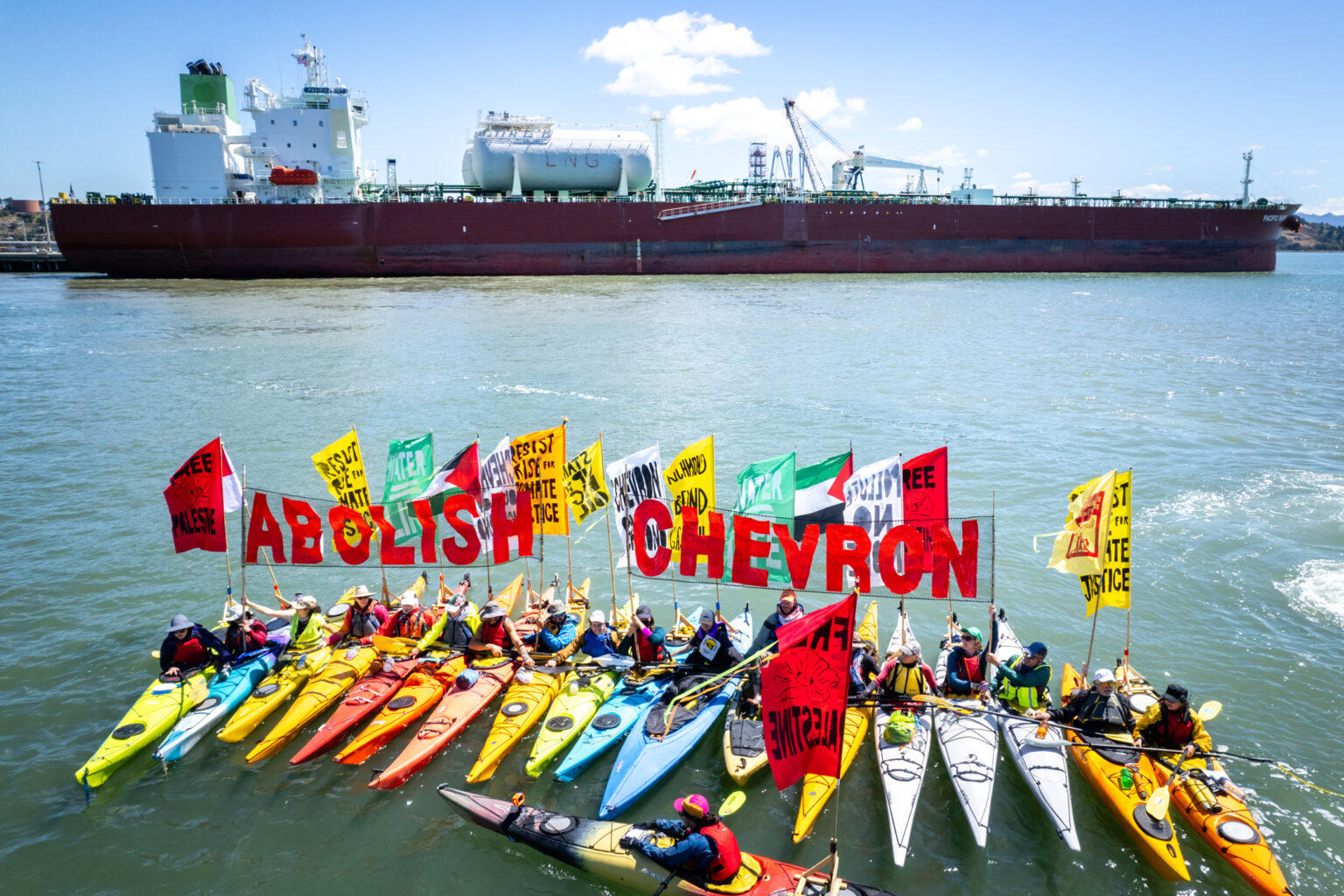
A generation of Richmond’s children, now grown, took to San Francisco Bay in nearly five dozen kayaks Sunday morning, in the shadow of Chevron’s massive refinery, headed for tankers controlled by the oil giant in an act of resistance, prayer and joy. 

After singing a ceremonial song led by a local Indigenous leader, activists launched their kayaks around 9:30 a.m. from the shores of Point Molate, 20 miles north of San Francisco, to protest the environmental and health harms caused by Chevron’s Richmond Oil Refinery. 

By noon, a core group of the Rich City Rays, a coalition of grassroots community groups based in Richmond, a San Francisco suburb where most residents are Asian, Black or Latino, had entered restricted waters alongside two giant tankers docked at the Chevron Long Wharf. Once activists in about 20 kayaks had jockeyed into position, side by side, they unfurled a banner with “Abolish Chevron” written in bright red letters, as the rest of the flotilla erupted in cheers.

Activists with Rich City Rays took to San Francisco Bay near Chevron’s Richmond Refinery to protest the oil giant’s impacts on communities of color around the world. Credit: Brooke Anderson

https://insideclimatenews.org/news/06052024/san-francisco-bay-kayaktivists-confront-chevron/

Continue ReadingClimate Justice Groups Confront Chevron on San Francisco Bay

Congressional Investigation Reveals New Evidence of Big Oil’s Decades-Long Campaign to Deny Climate Science

Spread the love

Original article by Adam M. Lowenstein republished from DeSmog.

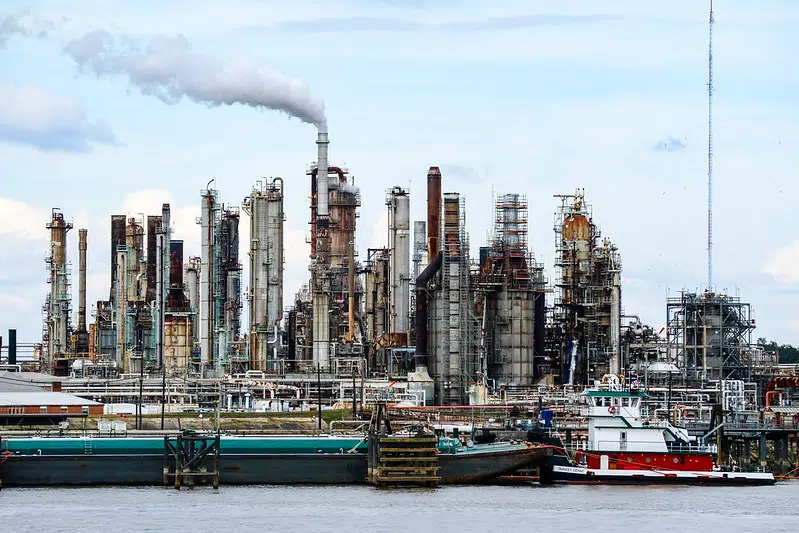
An ExxonMobil refinery on the banks of the Mississippi River. Credit: Terekhova/Flickr (CC CREATIVE COMMONS INFO)

Oil and gas companies and their top trade groups were aware for decades that carbon emissions contribute to climate change, according to a scathing new report from congressional investigators. Moreover, industry giants knew that many of the technologies they presented publicly as solutions to the climate crisis – such as algae-based biofuels and carbon capture and storage (CCS) – were neither as green nor as feasible as they promised, the study reveals.

The Senate Budget Committee and Democrats on the House Committee on Oversight and Accountability published the report and related documents on April 30, three years after launching a joint investigation of Shell, Chevron, BP, ExxonMobil, and two leading industry trade groups..

Fossil fuel obstructionism has evolved “from denial to duplicity,” said Senate Budget Committee Chairman Sheldon Whitehouse (D-RI), in a May 1 congressional hearing based on the report.

Both the hearing and the report capture what Whitehouse described as “climate denial lite,” in which the industry pivots “to pretending it is taking climate change seriously, while secretly undermining its own publicly stated goals.”

The investigation reveals that for ExxonMobil and other leading fossil fuel companies in the report, the perception of taking some sort of action on climate appears to have been as high a priority as actually taking action.

For example, for years, Exxon sought to associate its brand with algae-based biofuels. In a 2019 video, the company claimed these biofuels “would one day power planes, propel ships, and fuel trucks – and cut their emissions in half.”

Closeup of biofuel in a laboratory. Credit: Steve Jurvetson, CC BY 2.0 , via Wikimedia Commons

Between 2009 and 2023, Exxon spent some $175 million on algae-related marketing like this video – almost half as much as the company spent working on the technology. (Exxon and other industry leaders largely stopped funding for algae biofuel research by 2023.)

Even as the company publicly touted algae biofuels as a climate solution, the company knew the technology remained unproven – and, moreover, that Exxon was not investing nearly enough money if it were serious about developing algae as a viable technology.

In an email made public by the committee, an Exxon employee noted that one of the company’s executives had “made comments about us getting too far out there on the original algae ads.”

In an Exxon document released by House investigators with the header “Algae Biofuels Program Talking Points,” the company noted, “ExxonMobil’s analysis has concluded that final development and broad deployment of algae-based biofuels by the company would require future investments of billions of dollars” – orders of magnitude more than the $350 million that Exxon eventually spent.

Repeating Patterns

Congressional investigators identified a similar pattern in industry responses to a 2019 decision by Andrew Wheeler, then the head of the Environmental Protection Agency (EPA) under Donald Trump, to roll back a rule designed to reduce methane emissions.

Internally, BP agreed with Wheeler’s decision. In a 2019 email published by the committee, one executive noted that Wheeler’s “legal theory … for rolling back direct regulation of methane” was “aligned with our thinking.” The American Petroleum Institute (API), the leading trade association for the oil and gas industry, which counts BP as a dues-paying member, lobbied for the rollback.

In public, however, BP and other oil giants claimed to be disappointed by the Trump administration’s decision. David Lawler, then-chairman and president of BP America, said publicly that “direct federal regulation of methane emissions is essential.”

“Time and again, the biggest oil and gas corporations say one thing for the purposes of public consumption, but do something completely different to protect their profits,” Jamie Raskin (D-MD), the top Democrat on the House Oversight Committee and one of the leaders of the investigation, said in his prepared testimony.

“Company officials will admit the terrifying reality of their business model behind closed doors, but say something entirely different, false, and soothing to the public,” Raskin said.

Yet, even as Raskin and Whitehouse were able to reveal damning new evidence of this corporate doublespeak, they pointed out that a complete public reckoning remained impossible, since the industry refused to fully engage with investigators.

Denying Reality

In a pattern that echoes the fossil fuel industry’s decades-long efforts to deny the reality of climate change and, more recently, to portray oil and gas companies as committed to solving the crisis, the four companies and two trade groups that received congressional subpoenas appear to have withheld meaningful information while simultaneously flooding the committees with “hundreds of thousands of generic and non-responsive documents,” Raskin said.

Many documents submitted by the API were almost entirely redacted. The U.S. Chamber of Commerce produced only 24 documents that congressional investigators considered within the scope of the subpoena, including an invitation to a virtual meeting about “the future of natural gas infrastructure.”

Fossil fuel interests “completely obstructed the committees’ investigation,” Raskin said in a video played at the hearing.

During the hearing, this disinformation effort was assisted by congressional Republicans.

Sen. Ron Johnson (R-WI) read into the record debunked right-wing claims that carbon dioxide is good for the climate because it is “plant food.”

Source: Senate Budget Committee on X

Sen. John Kennedy (R-LA) spent significant time alleging that Dr. Geoffrey Supran, a University of Miami climate disinformation expert who testified at the hearing, wrote tweets that Supran did not, in fact, write.

“These are not my tweets, these are retweets,” Supran attempted to explain when he was finally shown the tweets, as Kennedy continued to speak over him.

“I’d like to make very clear that this form of character assassination is characteristic of the propaganda techniques of fossil fuel interests,” Supran added.

Supran’s point, however, was mostly obscured by Kennedy’s ongoing hectoring from the committee dais.

In a more productive exchange, Sen. Tim Kaine (D-VA) asked Raskin about the argument Exxon put forth that the investigators’ subpoena was “designed to intrude on ExxonMobil’s First Amendment activities, including its constitutionally protected right to petition the government.”

“That would obviously lead to the end of our civil and criminal discovery system, if the first amendment gave you the right not to turn over documents,” Raskin, a former constitutional law professor, replied.

“When an objection is made – if it is an extremely unpersuasive, novel, imaginative, unsupported objection – you can always tell, there’s something they really don’t want you to see,” Kaine noted. “I can only imagine the extent of the iceberg under the water that you were not allowed to see.”

The fossil fuel industry’s refusal to respond adequately to congressional subpoenas, while also flooding the committee with what Raskin’s testimony called a “paper blizzard” of some 125,000 “mass emails, newsletters, flyers, and otherwise meaningless fluff documents,” appeared designed to distract investigators and forestall potential legal action against companies and their executives.

“There is certainly an adequate legal foundation for litigation against this industry,” Sharon Eubanks, the former head of the tobacco litigation team at the Department of Justice, and leader of the U.S. government’s racketeering case against Big Tobacco, told members of the committee.

“Both industries lied to the public and regulators about what they knew about the harms of their products, and when they knew it.”

Original article by Adam M. Lowenstein republished from DeSmog.

Continue ReadingCongressional Investigation Reveals New Evidence of Big Oil’s Decades-Long Campaign to Deny Climate Science

Report Outlines Which Companies Are Most Responsible for Climate Crisis

Spread the love

Original article by THOR BENSON republished from Common Dreams under Creative Commons (CC BY-NC-ND 3.0).

“It is morally reprehensible for companies to continue expanding exploration and production of carbon fuels in the face of knowledge now for decades that their products are harmful,” said Richard Heede, who established the Carbon Majors dataset.

report released by Carbon Majors on Thursday says that 57 companies were responsible for 80% of the world’s CO2 emissions from fossil fuel and cement production between 2016 to 2022.

Saudi Aramco, Russia’s state-owned energy company Gazprom, and state-owned producer Coal India were at the top of the list. Carbon Majors has been keeping track of which companies are contributing the most to the climate crisis since 2013.

“The Carbon Majors research shows us exactly who is responsible for the lethal heat, extreme weather, and air pollution that is threatening lives and wreaking havoc on our oceans and forests,” Tzeporah Berman, international program director at Stand.earth and chair at Fossil Fuel Non-Proliferation Treaty, said in a statement. “These companies have made billions of dollars in profits while denying the problem and delaying and obstructing climate policy.”

The report states that nation-state producers account for 38% of CO2 emissions in the database. That’s the highest percentage of any of the types of companies listed in the database.

“The Carbon Majors database finds that most state- and investor-owned companies have expanded their production operations since the Paris agreement. Fifty-eight out of the 100 companies were linked to higher emissions in the seven years after the Paris agreement than in the same period before,” the report reads.

In terms of investor-owned companies, Chevron, ExxonMobil, and BP contributed the most to CO2 emissions. ExxonMobil alone was responsible for 3.6 gigatons of CO2 emissions over a seven-year period.

“It is morally reprehensible for companies to continue expanding exploration and production of carbon fuels in the face of knowledge now for decades that their products are harmful,” said Richard Heede, who established the Carbon Majors dataset, told The Guardian. “Don’t blame consumers who have been forced to be reliant on oil and gas due to government capture by oil and gas companies.”

Original article by THOR BENSON republished from Common Dreams under Creative Commons (CC BY-NC-ND 3.0).

Continue ReadingReport Outlines Which Companies Are Most Responsible for Climate Crisis

World’s largest oil companies ‘way off track’ on emissions goals, report finds

Spread the love

https://www.theguardian.com/us-news/2024/mar/22/oil-companies-emissions-goals-report

Gas flares at BP’s Grangemouth oil refinery at dusk in Scotland. Photograph: Murdo Macleod/The Guardian

Despite splashy climate pledges, firms including BP and Saudi Aramco have plans to expand fossil fuel production, says analysis

In recent years, virtually all of the world’s largest oil companies have made splashy climate pledges. But when it comes to actually slashing emissions, those firms are “way off track”, a new report has found.

The analysis from the thinktank Carbon Tracker assessed the production and transition plans of 25 of the world’s largest oil and gas companies. None align with the central goal of the 2015 Paris climate agreement to keep global warming “well under” 2 degrees above pre-industrial levels, the report found.

“Companies worldwide are publicly stating they are supportive of the goals of the Paris-Agreement, and claim to be part of the solution in accelerating the energy transition,” said Maeve O’Connor, analyst at Carbon Tracker and co-author of the report. “Unfortunately, however, we see that none are currently aligned with the goals of the Paris agreement.”

The analysis comes as oil and gas companies are publicly reneging on their climate commitments. Shell last week watered down earlier emissions targets, following BP, which made a similar announcement last year. In October, ExxonMobil also made a deal to buy the shale group Pioneer Natural Resources, while Chevron announced plans to acquire the Texas oil company Hess – marking two of the country’s largest oil and gas deals in decades.

https://www.theguardian.com/us-news/2024/mar/22/oil-companies-emissions-goals-report

Continue ReadingWorld’s largest oil companies ‘way off track’ on emissions goals, report finds