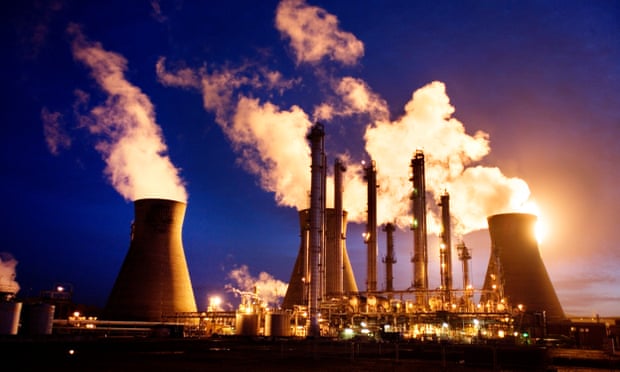
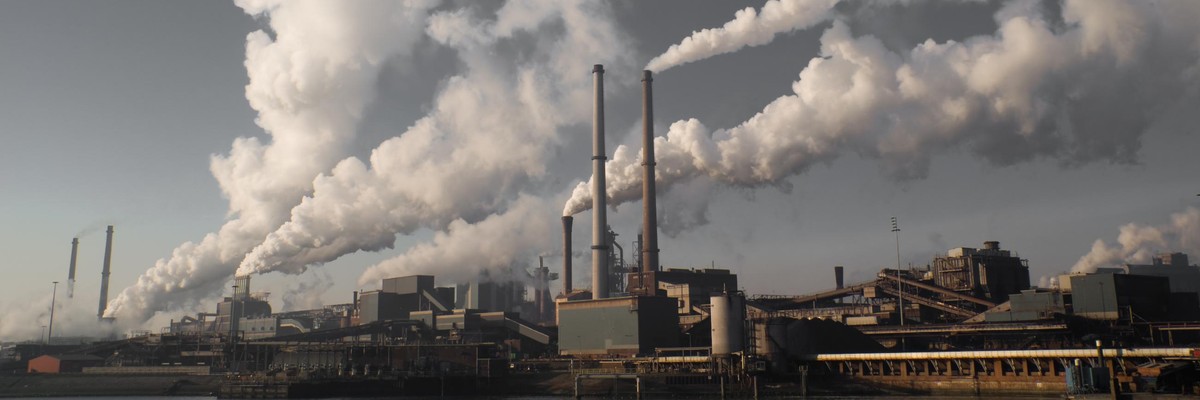
Gas flares at BP’s Grangemouth oil refinery at dusk in Scotland. Photograph: Murdo Macleod/The Guardian
Despite splashy climate pledges, firms including BP and Saudi Aramco have plans to expand fossil fuel production, says analysis
In recent years, virtually all of the world’s largest oil companies have made splashy climate pledges. But when it comes to actually slashing emissions, those firms are “way off track”, a new report has found.
The analysis from the thinktank Carbon Tracker assessed the production and transition plans of 25 of the world’s largest oil and gas companies. None align with the central goal of the 2015 Paris climate agreement to keep global warming “well under” 2 degrees above pre-industrial levels, the report found.
“Companies worldwide are publicly stating they are supportive of the goals of the Paris-Agreement, and claim to be part of the solution in accelerating the energy transition,” said Maeve O’Connor, analyst at Carbon Tracker and co-author of the report. “Unfortunately, however, we see that none are currently aligned with the goals of the Paris agreement.”
…
The analysis comes as oil and gas companies are publicly reneging on their climate commitments. Shell last week watered down earlier emissions targets, following BP, which made a similar announcement last year. In October, ExxonMobil also made a deal to buy the shale group Pioneer Natural Resources, while Chevron announced plans to acquire the Texas oil company Hess – markingtwo of the country’s largest oil and gas deals in decades.
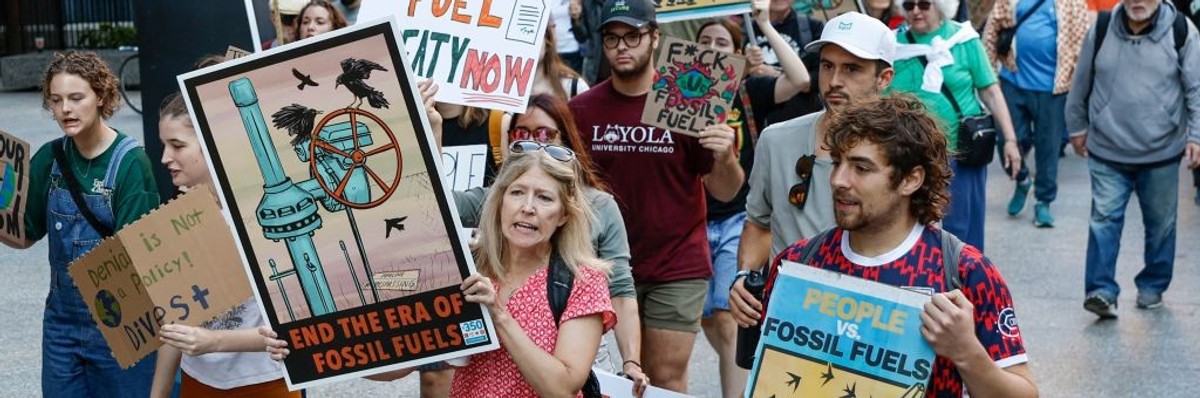
Environmental activists march during the Global Climate Strike in downtown Chicago, Illinois, on September 15, 2023. (Photo: Kamil Krzaczynski/AFP via Getty Images)
The city alleges the industry “funded, conceived, planned, and carried out a sustained and widespread campaign of denial and disinformation about the existence of climate change and their products’ contribution to it.”
Chicago on Tuesday joined the growing list of U.S. cities and states suing Big Oil for lying to the public about how burning fossil fuels causes and exacerbates the climate emergency.
The administration of Chicago Mayor Brandon Johnson, a progressive Democrat, filed a lawsuit in Cook County Circuit Court against ExxonMobil, Chevron, BP, Shell, ConocoPhillips, Phillips 66, and the industry lobby American Petroleum Institute, which “funded, conceived, planned, and carried out a sustained and widespread campaign of denial and disinformation about the existence of climate change and their products’ contribution to it.”
“The climate change impacts that Chicago has faced and will continue to face—including more frequent and intense storms, flooding, droughts, extreme heat events, and shoreline erosion—are felt throughout every part of the city and disproportionately in low-income communities,” the suit contends.
In a statement, Johnson said that “there is no justice without accountability.”
“From the unprecedented poor air quality that we experienced last summer to the basement floodings that our residents on the West Side experienced, the consequences of this crisis are severe, as are the costs of surviving them,” he added. “That is why we are seeking to hold these defendants accountable.”
🚨BREAKING: Chicago is suing Big Oil companies for climate deception!
“The fossil fuel industry should be able to pay for the damage they’ve caused. We have to see accountability for the climate crisis.”https://t.co/CTrqbzcc0v
“Big Oil has lied to the American people for decades about the catastrophic climate risks of their products, and now Chicago and communities across the country are rightfully insisting they pay for the damage they’ve caused,” Center for Climate Integrity president Richard Wiles said in a statement.
“With Chicago, the nation’s third largest city, joining the fray, there is no doubt that we are witnessing a historic wave of lawsuits that could finally hold Big Oil accountable for the climate crisis they knowingly caused,” he added.
Chicago joins eight U.S. states plus the District of Columbia and numerous municipalities across the country that have sued to hold Big Oil accountable for deceiving the public about its role in the climate emergency.
“To date, eight federal appeals courts and dozens of federal district courts have unanimously ruled against the fossil fuel industry’s arguments to prevent these lawsuits from moving forward in state courts,” noted the Center for Climate Integrity. “In 2023, the U.S. Justice Department added its support for the communities. The U.S. Supreme Court has denied Big Oil petitions to consider the industry’s appeals of those lower court rulings three separate times, most recently in January.”
Angela Tovar, Chicago’s chief sustainability officer, told the Chicago Sun-Times that “the fossil fuel industry should be able to pay for the damage they’ve caused.”
“We have to see accountability for the climate crisis,” she added.
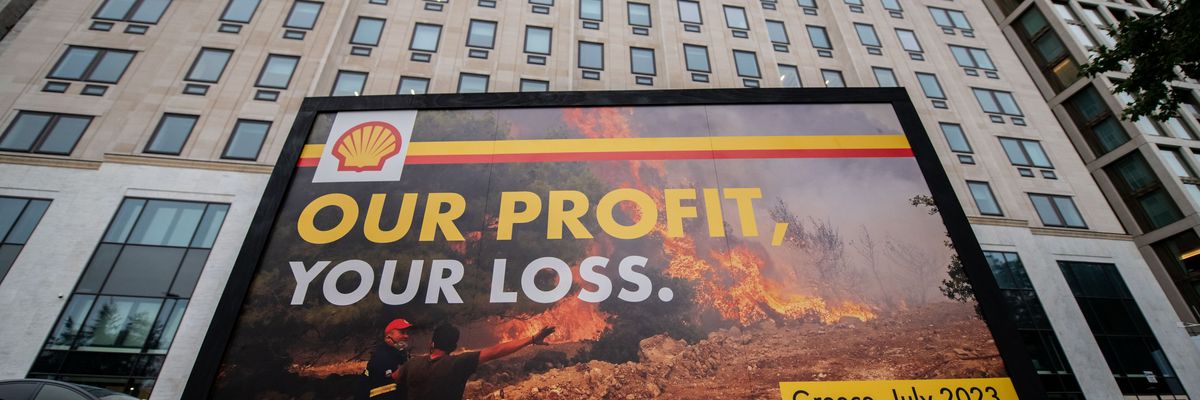
Greenpeace activists display a billboard during a protest outside Shell headquarters on July 27, 2023 in London. (Photo: Handout/Chris J. Ratcliffe for Greenpeace via Getty Images)
“The global energy crisis has been a giant cash grab for fossil fuel firms,” said one campaigner. “And instead of investing their record profits in clean energy, these companies are doubling down on oil, gas, and shareholder payouts.”
The year 2023 was marked by weather events that made it increasingly clear that the Earth has entered what United Nations Secretary General António Guterres called the “era of global boiling,” with wildfires and prolonged heatwaves impacting millions of people and scientists confirming their suffering was the direct result of fossil fuel extraction and planetary heating.
But for the world’s five largest oil giants, the year marked record profits and the approval of several major new fossil fuel projects, allowing the companies to lavish their shareholders with payouts that are expected to exceed $100 billion—signaling that executives have little anxiety that demand for their products will fall, said one economist.
The companies—BP, Shell, Chevron,ExxonMobil, and TotalEnergies—spent $104 billion on shareholder payouts in 2022, and are expected to reward investors with even more in buybacks and dividends for 2023, The Guardian reported.
Shell announced plans in November to pay investors at least $23 billion—more than six times the amount it planned to spend on renewable energy projects—while BP promised shareholders a 10% raise in dividends and Chevron could exceed the $75 billion stock buyback it announced early last year.
Alice Harrison, a campaigner for Global Witness, noted that fossil fuel shareholders will be enjoying their paydays as households across Europe struggle with fuel poverty and the world faces the rising threat of climate disasters brought on by the industry.
“The global energy crisis has been a giant cash grab for fossil fuel firms,” Harrison told The Guardian. “And instead of investing their record profits in clean energy, these companies are doubling down on oil, gas, and shareholder payouts. Yet again millions of families won’t be able to afford to heat their homes this winter, and countries around the world will continue to suffer the extreme weather events of climate collapse. This is the fossil fuel economy, and it’s rigged in favor of the rich.”
It’s a happy new year for oil company shareholders enjoying massive dividends. The 5 largest majors are distributing over $100 billion. Not so happy a new year for British energy consumers who are subject to a new round of price increases, plunging more households into poverty. https://t.co/g3i4Zdoxo7
In 2023 campaigners intensified their demands for accountability from the oil, gas, and coal industries, and as of last month had successfully pressured more than 1,600 universities, pension funds, and other institutions to divest from fossil fuels. In the U.S., provisions in the Inflation Reduction Act, which has been touted as the “largest investment in climate and energy in American history,” went into effect.
But Dieter Helm, a professor of economic policy at the University of Oxford, The Guardian that if the industry were truly fearful of policymakers phasing out fossil fuel extraction and expediting a transition to renewable sources, they would be spending far less on new projects and shareholder payouts.
“For this to be the case you would have to believe that the energy transition is happening, and that demand for fossil fuels is going to fall,” Helm told The Guardian.
In 2023, U.S. President Joe Biden infuriated climate campaigners by approving the Willow oil drilling project in Alaska, which could lead to roughly 280 million metric tons of heat-trapping carbon dioxide emissions. His administration also included in a debt limit deal language that would expedite the approval of the Mountain Valley Pipeline, which could emit the equivalent of more than 89 million metric tons of carbon dioxide, while the U.K. government greenlit a massive oil drilling field in the North Sea and French company TotalEnergies continued to construct the 900-mile-long East African Crude Oil Pipeline, which would transport up to 230,000 barrels of crude oil per day.
“These companies are investing a huge amount in new projects, and they’re handing out bigger dividends because they are confident that they’re going to make big returns,” Helm said. “And when we look at the state of our current climate progress, who’s to say they’re wrong?”
Climate campaigner Vanessa Nakate pointed out that the shareholder paydays are expected following a deal on a loss and damage fund at the 28th annual United Nations Climate Change Conference, aimed at helping developing countries to fight the climate emergency. That fund was hailed as “historic” and included a commitment of $700 million from wealthy countries—a sum that is expected to be dwarfed by fossil fuel investors’ profits.
Leaders at COP28 agreed to a “historic” $700 million in loss and damage funding.
Meanwhile BP, Shell, Chevron, ExxonMobil and TotalEnergies are about to reward their investors with record payouts of more than $100 billion. https://t.co/LRIrH4mFmz
“They have picked people’s pockets, fueled inflation and pollution, and deepened poverty,” U.K. House of Lords member and Tax Justice Network co-founder Prem Sikka said of the oil giants. “Governments do nothing to end their monopolistic control. Need to break-up this cartel.”
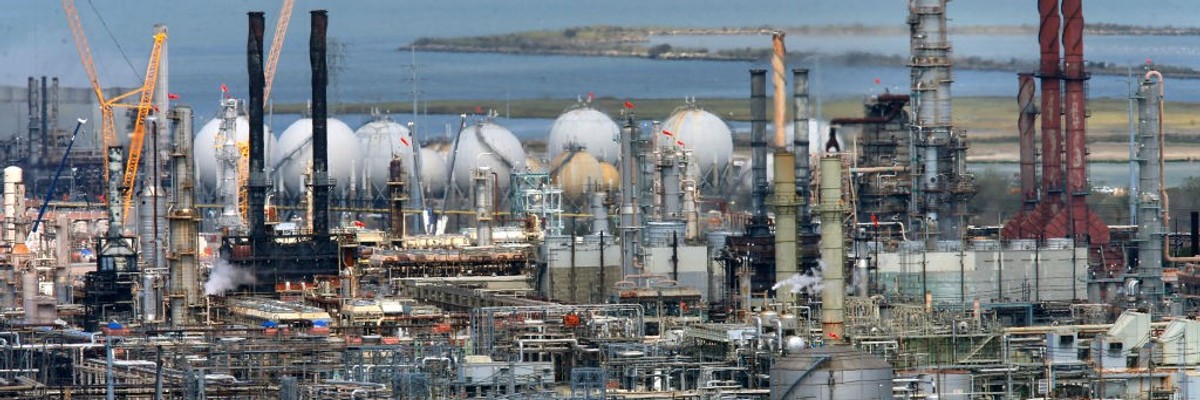
A Chevron refinery in Richmond, California is seen on September 12, 2017. (Photo: Michael Macor/The San Francisco Chronicle via Getty Images)
“These oil companies knew their products were dangerous, yet they did nothing to mitigate those dangers or warn any of us about them, for decades,” said the chairwoman of the Shoalwater Bay Indian Tribe.
Two Indigenous tribes in Washington state said Wednesday that they intend to force several oil giants “to help pay for the high costs of surviving the catastrophe caused by the climate crisis,” as they filed lawsuits in the state’s largest trial court.
The Makah Indian Tribe and Shoalwater Bay Indian Tribe filed two separate complaints in King County Superior Court against ExxonMobil, Shell, Chevron, BP, ConocoPhillips, and Phillips 66, saying the defendants must be held “accountable for their deceptive and unfair conduct, and pay for the damage their deceptive conduct has caused and will cause for decades to come.”
The lawsuits—among dozens filed against Big Oil since 2017—detail the extent to which the companies have long known that their fossil fuel extraction would drive planetary heating and the resulting sea-level rise, extreme weather, public health crises, and other impacts of the climate crisis, which now costs the U.S. roughly $150 billion per year just in damages from hurricanes and other weather disasters.
“We are seeing the effects of the climate crisis on our people, our land, and our resources. The costs and consequences to us are overwhelming,” said Timothy Greene Sr., chairman of the Makah Tribal Council. “We intend to hold these companies accountable for hiding the truth about climate change and the effects of burning fossil fuels.”
“We are facing hundreds of millions of dollars in costs to relocate our community to higher ground and protect our people, our property, and our heritage. These companies need to be held accountable for that.”
Newly uncovered documents revealed earlier this year that scientists at Shell warned executives of the climate impact of the company’s products in the 1980s, and an analysis published in Science in January showed that 63-83% of the global warming projections documented by Exxon scientists between 1977 and 2003 were accurate.
“These oil companies knew their products were dangerous, yet they did nothing to mitigate those dangers or warn any of us about them, for decades,” said Charlene Nelson, chairwoman of the Shoalwater Bay tribe. “Now we are facing hundreds of millions of dollars in costs to relocate our community to higher ground and protect our people, our property, and our heritage. These companies need to be held accountable for that.”
The tribes said in their complaints that they are “particularly vulnerable” to rising sea levels because their reservations are adjacent to the Pacific Ocean, and they have already incurred “significant costs” as they try to mitigate its risk by preparing to build and move housing and government buildings to higher ground.
The tribes accused the companies of creating a “public nuisance” and violating Washington’s Products Liability Act by misrepresenting and intentionally concealing the risks involved in their fossil fuel extraction activities. They asked the court for jury trials and requested that the court order the companies to fund “an abatement fund to be managed by the tribe[s] to remediate and adapt [their] Reservation lands, natural resources, and infrastructure.”
Two-thirds of U.S. voters surveyed by Data for Progress support making fossil fuel companies pay for the damage their products cause to the climate. (Photo: rmitsch/Getty Images)
“Voters resoundingly endorse fossil fuel companies contributing their fair share to address a crisis they helped manufacture and still refuse to help fix,” said one campaigner.
As yet another United Nations Climate Change Conference winds down without a meaningful agreement on phasing out fossil fuels, polling released Tuesday by Data for Progress revealed strong bipartisan support among U.S. voters for legislation forcing oil and gas companies to pay for their role in fueling the planetary emergency.
The survey of 1,279 U.S. voters, conducted November 3-6, found that around two-thirds of all likely voters support such legislation, a +40-point net margin. Among Democrats, support for the proposed bill is 88%, while 61% of Independent and 46% of Republicans either strongly or somewhat back the proposal.
“In a resounding call for accountability, two-thirds of the American people support legislation demanding industry titans like Exxon and Shell shoulder their fair share of the climate damages inflicted by fossil fuels.”
Asked if they were more or less likely to support elected officials who prioritize making Big Oil pay for its climate pollution, 64% of overall respondents, 89% of Democrats, and 58% of Independents answered “more likely.” Republicans were the only group whose members were less likely to back officials who would make oil and gas companies pay for their pollution.
“In a resounding call for accountability, two-thirds of the American people support legislation demanding industry titans like Exxon and Shell shoulder their fair share of the climate damages inflicted by fossil fuels,” Fossil Free Media communications director Cassidy DiPaola said in a statement.
“With COP spotlighting the towering price tag of climate change, voters resoundingly endorse fossil fuel companies contributing their fair share to address a crisis they helped manufacture and still refuse to help fix,” she added, referencing the U.N. summit.
The poll follows the September launch of the “Make Polluters Pay” campaign, a public relations blitz meant to drum up public support for suing fossil fuel corporations—which knew that their products caused climate change decades before publicly saying so.
That month, California joined dozens of states and municipalities that have targeted fossil fuel giants in court,suing five fossil fuel giants—ExxonMobil, Shell, BP, ConocoPhillips, and Chevron—over their decadeslong effort to deceive the public about their products’ role in fueling global heating.
The new survey’s findings also came as so-called “loss and damage”—the harm caused by anthropogenic climate change—features prominently at COP28. However, climate campaigners were once again disappointed as the United States and other top polluters failed to make meaningful contributions to the fund.
The rich nations most responsible for the climate catastrophe pledged just $700 million between them, the equivalent of under 0.2% of the irreversible losses Global South countries suffer each year during the worsening planetary crisis. The United States pledged a paltry $17.5 million.
“Every year, we travel across oceans to come to these negotiations and we continue to get only drops of ambition,” Drue Slatter, a Fijian climate campaigner attending COP28, wrote in an opinion piece published Tuesday by Common Dreams.
“Facing the catastrophic effects of extreme weather at home and watching the slow progress of the negotiations, it was hard not to be pessimistic before we even arrived at COP28,” Slatter added. “But the point is that we can’t afford not to be here, we can’t afford to stop fighting because what’s at stake is our very survival.”