Tag: Climate denialism

  • The Direct Links Between Southern Brazil’s Massive Flooding and Climate Denial

    Spread the love

    Original article by Lucas Araldi republished from DeSmog.
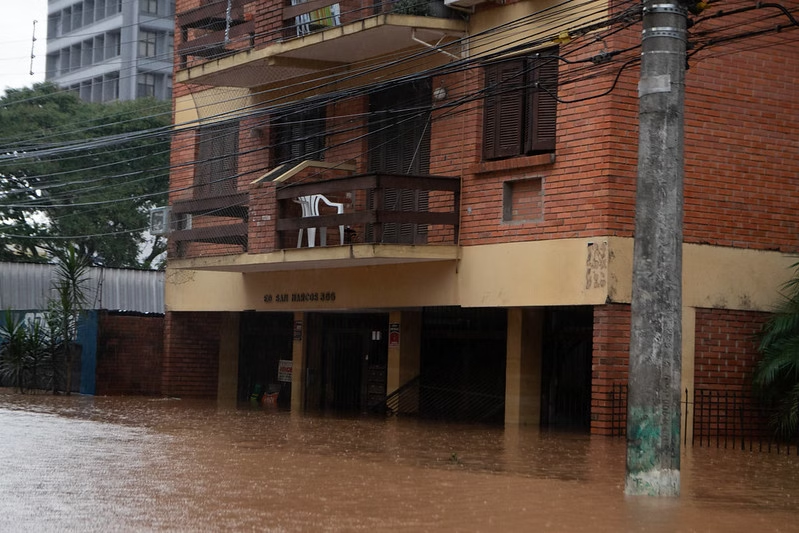
    Flooding in Rio Grande do Sul on May 8. Credit: Thales Renato/Flickr (CC BY-NC-ND 2.0)

    Right-wing groups are peddling false claims that the heavy rainfall that led to the region’s disastrous flooding in May is not related to climate change.

    On May 9, volunteers and emergency workers were still rescuing people and animals who remained stranded on the sixth day of flooding on the streets of Rio Grande do Sul’s capital, Porto Alegre. Social media images of the rooftop rescue of a horse named Caramelo shocked the world. 

    A day before the dramatic rescue, Porto Alegre’s deputy mayor, Ricardo Gomes, appeared on a livestream wearing a cap with the Brasil Paralelo logo. Brasil Paralelo is a far-right media company with a streaming platform focusing on “journalism, entertainment, and education,” as its website states. The company was founded in Porto Alegre in 2016 and serves as a main channel of climate denialism among right-wing groups in Brazil. By wearing the Brasil Paralelo logo, Gomes associated himself with an institution that experts say is a purveyor of climate denialism, at the height of a climate-related disaster. 

    Some days later, Ricardo Felício, a professor of Brasil Paralelo’s education wing who has also appeared on many of the platform’s documentaries, wrote that climate change did not cause the extreme rainfall in South Brazil. He published his opinions in the Revista Oeste (West Magazine), a print and online publication that caters to far-right followers of former President Jair Bolsonaro, saying “CO2 has nothing to do with it!” 

    Southern Brazil was under water for the entire month of May, and two months later, it’s still facing the consequences of the worst flood in its history. Hundreds of thousands have been displaced – 180 have died, and 32 are still missing. 

    Flooded rivers swept away entire communities in a disaster on par with 2005’s Hurricane Katrina. The town of Estrela, located on the banks of Taquari River, was more than 70 percent submerged. In recent years, the region has experienced more and more extreme rainfall. Residents of towns on the Taquari River are still feeling the impacts of their third consecutive flood in a six-month period.

    Porto Alegre, with 1.4 million inhabitants, was flooded for four weeks between May and June due to swelling water from the Guaiba River and failures of the city’s anti-flood system. The region’s main airport, Salgado Filho International Airport, is not expected to operate again until December.

    Porto Alegre’s mayor, Sebastião Melo, and Deputy Mayor Gomes have led its city council since 2021. Both were elected in the wake of Bolsonarism and won decisive victories. And both have faced media criticism for failures in managing the city’s emergency responses to the flood and for failing to update its anti-flood system.

    Gomes has participated in events run by Atlas Network, an extensive global collective of more than 500 think tanks, many known to have a history of working against climate action. He attended Atlas Network’s 2019 CEO Summit of the Americas, where leaders of right-wing think tanks gathered to exchange ideas. He appeared at the summit as president of RELIAL, a network of right-wing Latin American research organizations. He is a member of Atlas Network’s Global Council of CEOs team.

    Gomes also participated in Atlas Network’s 2020 Latin America Liberty Forum online, again representing RELIAL. The politician is also a long-standing ally, teacher, and host of a political series on Brasil Paralelo’s YouTube channel. His political connections reveal an intricate network that links Brazilian far-right organizations that deny climate change with international think tanks.

    Brasil Paralelo’s Roots

    In the months after the center-left Brazilian president Dilma Rousseff was impeached in 2016, far-right proponents established Brasil Paralelo, which arose from the growth of far-right ideas that gained ground in the country at the time. Its five founders, who were students, claimed that mass media was overwhelmingly left-wing, and they wanted to challenge mainstream public opinion about the nation’s political crisis after Rouseff’s impeachment.

    Three of the original founders, Lucas Ferrugem, Henrique Viana, and Filipe Valerim, now run the company. Experts interviewed for the platform’s first documentaries included names from Instituto Millenium, Instituto Liberal, and Instituto Mises, partner think tanks of Atlas Network in Brazil in 2016.

    Inside Brasil Paralelo’s studios. Credit: Brasil Paralelo/Wikimedia Commons.

    A panel titled “Entrepreneurship for Common Good” by Atlas Network partner Acton Institute used Brasil Paralelo’s founding and development as a case study in 2021. The panel explored how “entertainment can shape a society’s culture,” and Brasil Paralelo’s role within the “prevailing cultural winds to point Brazil towards pillars of freedom and virtue through a holistic approach to education and entrepreneurship,” as the video states. 

    Alejandro Chafuenpresident of Atlas Network between 1991 and 2018 and a Mont Pelerin Society member, taught a Brasil Paralelo course about faith and free-market ideas in 2019. Chafuen also mentioned the media company in his Forbes magazine column in 2023, in which he compared the Brazilian organization to the U.S. nonprofit conservative media group PragerU. He made the same comparison to his YouTube subscribers (over 3.38 million) and Instagram followers (2.5 million), indicating that Brasil Paralelo surpassed PragerU’s audience levels with more than 300,000 subscribers on YouTube and around 400,000 on Instagram. 

    Chafuen compares the popularity of Brasil Paralelo to widespread support for Olavo de Carvalho, the deceased influential far-right philosopher who was also known for his strident scientific denialism, including climate denialism. Chafuen also wrote in Forbes that “Brasil Paralelo is planning to land in the United States and replicate its success with U.S.-focused topics, teams, and profiles.”

    In August 2023, Brasil Paralelo ran an article raising doubts about the effects of climate change stemming from a speech by UN Secretary Antonio Guiterrez claiming that “the era of global boiling has arrived”. According to the article,”It is not a question of denying climate change, but of discussing whether or not humankind influences this process and to what degree the planet will warm up (or cool down).” 

    Chafuen’s article promoted a 2021 Brasil Paralelo documentary called “Cortina de Fumaça” (“Smoke Screen”). It stated that the documentary seeks to answer questions such as, “How does the environmental movement affect the economy in Brazil and other countries? What lies behind some of the main environmentalist misinformation?”

    Patrick Moore, a known climate science denier, is presented in the documentary as a co-founder of Greenpeace. Years before, DeSmog had reported that this claim was false. Moore stated in the documentary that Greenpeace is “a conspiracy organization, spreading junk science around the world.” 

    One of the sections in “Smoke Screen,” which is available on YouTube, is titled “Environmental apocalyptic predictions that are false.” The journalist Augusto Nunes, one of the founders of Revista Oeste, said in the segment that the Amazon rainforest is not being destroyed, contradicting official data from 2021. Other sources in Brazil, including Aldo Rebelo, former minister of defense during Rousseff’s government, supported the same argument. 

    According to the documentary, environmental campaigners’ criticisms and so-called “lies” about the Amazon rainforest’s deforestation are attempts to protect the U.S. and European agricultural markets. 

    In another article in September 2023, Brasil Paralelo defended the idea that global warming legitimizes NGOs’ actions pushing international actions such as the Paris Agreement, which the platform claims keeps developing countries producing less while first-world countries maintain their production. 

    In an interview with The Intercept Brasil, researcher Renata Nagamine from the Brazilian Center of Analysis and Planning (Cebrap) said Brasil Paralelo’s “Smoke Screen” uses a “scientific repertoire on the margins of climate science.” 

    When contacted by DeSmog, representatives for Brasil Paralelo did not respond to requests for comment.

    “CO2 Has Nothing to Do With It!”

    Climate change boosted the rainfall volume in Rio Grande do Sul by 15 percent, according to a study by the website Clima Meter, which confirmed the influence of climate change on the recent  flooding disaster in the region. 

    Clima Meter is “an experimental rapid framework for understanding extreme weather events in a changing climate based on looking at similar past weather situations.” From the analysis of the patterns of local precipitation and the ElNiño-Southern Oscillation, the researchers interpreted the “Brazil floods as an event whose local characteristics can mostly be ascribed to human driven climate change.”
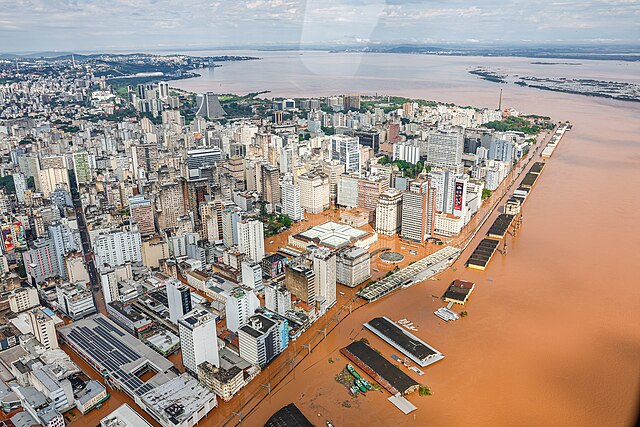
    Flooding in South Brazil on May 5. Credit: Ricardo Stuckert/Wikimedia Commons

    Davide Faranda, a researcher of the Laboratory for Sciences of Climate and Environment at the Institute Pierre Simon Laplace and coauthor of Clima Meter’s study on Brazil’s flooding, said in an interview with the local newspaper, GaúchaZH, that floods have been intensified by the burning of fossil fuels and have a major impact on vulnerable communities, which bear the brunt of climate change.

    However, Ricardo Felício, who teaches courses at Brasil Paralelo and is a professor of geography at the University of São Paulo (USP), offered a contradictory explanation for the disaster.

    “It is confusing to relate the climate to a meteorological scenario of large dimensions, which is the case here,” wrote Felício in his May 12 weekly column in Revista Oeste. “CO2 has nothing to do with it!” 

    In addition to writing for Revista Oeste, Felício is a well-known climate denier in Brazilian politics. DeSmog uncovered an interview with Felício on a once-popular Brazilian TV show, where Felício stated in 2012, “There is no scientific proof of global warming.” Brazil’s ex-president Bolsonaro tweeted an interview between Nando Moura, a well-known right-wing influencer, and Felicio in 2017.

    Between 2017 and 2021, Felício gave several lectures at universities and trade associations across the country denying climate change after the Aprosoja Mato Grosso (an association of soybean growers) sponsored his talks, according to a BBC investigation.

    Journalists and media executives founded Revista Oeste in 2020. It is a self-proclaimed conservative outlet and claims the problems of capitalism should be solved with more capitalism.

    The magazine’s print cover in June 2024, a month after the tragedy in Rio Grande do Sul, showed the planet resting on a palm, followed by the headline “The global warming hoax.” The periodical also published other articles on the floods in Rio Grande do Sul, denying climate change had a part in the disaster.

    “Historically, apocalyptic predictions about the climate have not come close to coming true. Now, activists are blaming climate change for the floods in Rio Grande do Sul,” wrote the journalist Myllena Valença. The piece claimed that “facts overturn the delirious prophecies of environmental activists, who for decades have been announcing disasters caused by global warming.” Felício is a leading source in the report. 

    Revista Oeste’s June 2024 cover. Credit: The Wayback Machine

    The June print edition also featured an interview with the president of Environmental Progress, Michael Shellenberger, a well-known nuclear energy enthusiast and a Republican witness in climate hearings in the U.S. Congress. In the interview, he pointed out he is optimistic about the environment and pessimistic about civilization. “I’m worried about the hysteria around global warming,” Shellenberger said. 

    When contacted by DeSmog, representatives for Revista Oeste did not respond to requests for comment.

    A Well-Connected Deputy Mayor 

    Donations poured into Rio Grande do Sul in the aftermath of the flooding disaster to help people who had lost everything. Brasil Paralelo asked for donations for an organization called Instituto Cultural Floresta (ICF). 

    Porto Alegre’s Deputy Mayor Gomes also requested donations to the same organization, even though his City Hall made its own donation channel available, an Agência Pública investigation revealed last month. 

    The ICF is a nonprofit organization based in Porto Alegre, and according to its website, it focuses on providing security forces with military equipment. Leaders and members of the organization are connected to the Instituto de Estudos Empresariais (IEE), an Atlas Network think tank partner in Brazil that promotes the right-wing annual meeting, Liberty Forum, which is sponsored directly by Atlas Network, and boosts right-wing political candidates. 

    Leonardo Fração is president of the ICF and a former IEE president. He spoke at the Liberty Forum in 2018 and in 2010.

    Other ICF members are affiliated with IEE, including Bruno Zaffari, the owner of real estate and supermarket companies, and Wilson Ling, the director of the plastic packaging and forestry company Évora S.A. 

    Gomes held various positions, including president of the IEE from 2009 to 2012. But his relations with right-wing think tanks stretch much further. Between 2016 and 2020, he served as the president of RELIAL, and he also is a member of the Mont Pelerin Society. DeSmog research found that Mont Pelerin Society members are affiliated with over 100 organizations that also appear on the membership list of the Atlas Network.

    Atlas Network also quoted Gomes in a report about the Latin America Liberty Forum in 2021.

    RELIAL presents itself as a network of brain trusts that “disseminate and implement liberal principles as their flag.” Agustín Etchebarne, a member and a former director of  RELIAL, is also the general director of the Fundación Libertad y Progreso, an Argentinian Atlas-affiliated think tank that supported the election of far-right Argentinian President Javier Gerardo Milei.   

    Atlas Network awarded Fundación Libertad y Progresoa a grant in 2024. The organization spent the money to promote an international summit in partnership with the Cato Institute for the six-month anniversary of the inauguration of Milei. The event took place June 11-12 in Buenos Aires, and Milei attended.
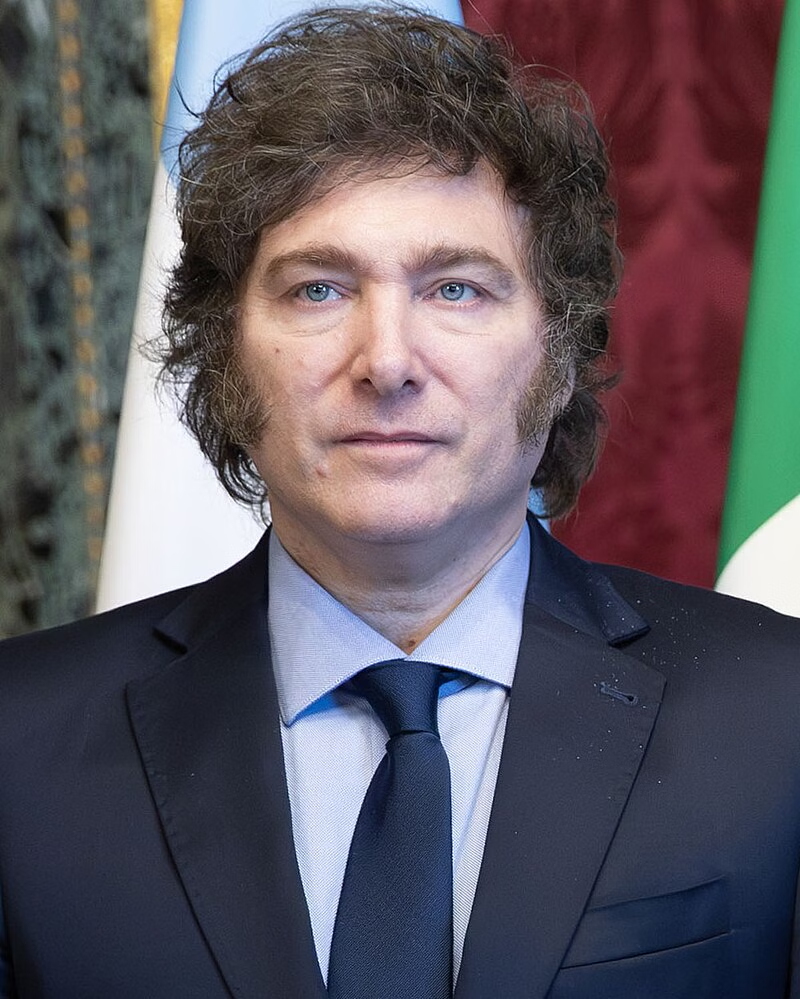
    Fundación Libertad y Progresoa promoted an international summit in partnership with the Cato Institute for the six-month anniversary of the inauguration of Argentininan President Javier Milei. Credit: Wikipedia

    When contacted for comment,  Atlas Network said in a statement that the organization “has no grant programs related to climate change and makes no policy prescriptions to its partners on the subject of climate change.” It also stated that it “does not fund initiatives advocating against the existence of climate change.”

    The organization stated that it “has no partnerships with candidates, parties, or government officials,” and that its “partners are independent, nonprofit organizations engaged in public policy issues.”  

    Atlas also asserted that “there are no ‘Atlas Network groups’ in Brazil,” but instead “independent partner organizations that apply to receive training, grants, and networking opportunities from Atlas Network.”  The think tank network also stated that its partners are “each governed independently and are not managed by our organization.” 

    Political Negligence and Climate Denialism

    The media has widely criticized Porto Alegre’s Mayor Melo for his crisis management issues and his administration’s low budget for flood prevention. To defend against the criticism, Melo claimed online that, “I’m not a denialist on anything, much less on the climate issue.”

    Porto Alegre suffered two severe floods in 2023, including its biggest flood since 1941. However, since 2021, the city council reduced its investment in flood protection, and added no additional protection in 2023. 

    Experts also condemned the city’s failure to maintain its anti-flooding system, which was designed in the 1970s. The Municipal Department of Water and Sewage, which operates the system, has laid off more than half of its employees since 2013. In addition, Melo’s term in office has included environmental scandals and conflicts with environmentalists and indigenous people. 

    When contacted by DeSmog, Porto Alegre’s City Hall Press Office, which represents Melo and Gomes, did not respond to requests for comment.

    When the flooding crisis deepened in Porto Alegre, Melo used a Bolsonarist style, applying the motto that every person looks out for his own, which summarizes his way of doing politics. “If you have a house on the beach and can afford to leave, I recommend that you leave and go to the beach,” he said, talking about wealthier families who have second homes at the beach. This comes from the mayor of a city where inequality is so entrenched that many people don’t have one home, let alone a second beach house. 

    Gomes has said he will not seek reelection with Melo this year, but that he will continue supporting Melo against “the radical left.” Everything suggests, however, that the Brasil Paralelo cap will officially be part of his uniform. 

    Original article by Lucas Araldi republished from DeSmog.

  • Two Thirds of Anti-Net Zero Tories Wiped Out in UK Election

    Spread the love

    Original article by Adam Barnett and Joey Grostern republished from DeSmog.

    From left to right, outgoing net zero sceptic MPs Steve Baker, Miriam Cates, Liz Truss, Jacob Rees-Mogg, Andrea Jenkyns and Philip Davies. Credit: Official House of Commons portraits. Design: Adam Barnett

    The result has “buried Sunak’s anti-green agenda once and for all”, said Will McCallum of Greenpeace UK.

    Labour’s landslide victory over the Conservatives has left the party’s anti-net zero wing in tatters. 

    DeSmog’s analysis of Westminster’s influential Net Zero Scrutiny Group (NZSG) found that two thirds of its supporters are no longer represented in parliament following the July 4 general election.

    Twenty-four of the 37 MPs supportive of the backbench grouping were voted out – a loss of 65 percent of its backers. Outgoing supporters include former energy secretary Jacob Rees-Mogg, former NZSG co-chair Steve Baker, and Net Zero Watch board member Andrea Jenkyns. 

    A further five stood down or resigned before the election, among them veteran climate crisis John Redwood.

    The group’s former chair Craig Mackinlay, who contracted sepsis in September, has been appointed to the House of Lords by outgoing prime minister Rishi Sunak. Mackinlay has said he would use this platform to campaign for “sensible net zero”. 

    The NZSG has actively campaigned against climate action since it was formed in 2021. The group’s joint letters to the Telegraph made front page news, as supporters urged the government to scrap “environmental levies on domestic energy”, “expand North Sea exploration” for oil and gas, and support “shale gas extraction” by lifting the ban on fracking. 

    In addition to the NZSG grouping, former Prime Minister Liz Truss, who has become an outspoken critic of net zero since leaving Downing Street in 2022, was voted out on Thursday. 

    Campaigners have welcomed the departure of MPs opposed to climate action. “This landslide election victory has buried Sunak’s anti-green agenda once and for all along with many of its principle architects”, Will McCallum, co-executive director at Greenpeace UK, told DeSmog. 

    “Most of the former MPs who sought to sow division and disinformation about net zero have lost at the ballot box.”

    Meanwhile, 14 anti-net zero MPs were re-elected, including Labour MP Graham Stringer, who is on the board of the Global Warming Policy Foundation (GWPF), the UK’s main climate denial group, and Lee Anderson, who defected from the Tories to Reform UK earlier this year.  

    Four new Reform MPs were also elected, including party leader Nigel Farage and chairman Richard Tice, both of whom have a record of climate science denial. 

    Despite this, campaigners are still positive. McCallum added that “the biggest winners [in the election] – Labour, the Liberal Democrats and the Green Party – contested this election on strong green policies that will slash emissions, lower bills and deliver hundreds of thousands of new jobs”. 

    “There is and has long been a public consensus on climate action in this country”, he said, and “the new government should feel empowered to be bold”. 

    Here are some of the most prominent critics of net zero who have lost their seats: 

    Jacob Rees-Mogg

    Jacob Rees-Mogg, who lost his North East Somerset seat by more than 6,000 votes to Labour’s Dan Norris, was secretary of state for business, energy and industrial strategy under Liz Truss between September and October 2022. 

    While in office he reportedly argued for lifting the ban on fracking for shale gas, and told the head of the UAE’s state investment company, in a private meeting revealed by DeSmog, that people need to “stop demonising oil and gas”. 

    Since January 2023, Rees-Mogg has presented his own show on GB News, which regularly broadcasts climate science denial. Rees-Mogg has been a harsh critic of the government’s net zero policies, stating that “the current headlong rush to net zero risks impoverishing the nation to no global benefit on emissions”.

    Steve [“Number two”] Baker

    Steve Baker has led the charge against climate policies in parliament. Baker was a trustee of the UK’s main climate denial group, the Global Warming Policy Foundation (GWPF), from May 2021 to September 2022, when he stepped down to serve as Northern Ireland minister. He was co-chair of the NZSG, which operated as the GWPF’s caucus in parliament.  

    At a 2021 Conservative Party conference event, Baker said that much climate science is “contestable” and “sometimes propagandised”, while claiming that some UN climate scenarios were “implausible”.

    In February 2022, Baker received £5,000, and a further £10,000 in February 2023, from Neil Record, chair of Net Zero Watch, the campaign arm of the GWPF. 

    On Thursday Baker lost his Wycombe seat to Labour’s Emma Reynolds by more than 4,000 votes. 

    Dame Andrea Jenkyns 

    Andrea Jenkyns, who lost her seat of Leeds and South West Morley by more than 7,000 votes to Labour’s Mark Sewards, sits on the board of Net Zero Watch, the campaign arm of the GWPF, the UK’s main climate science denial group. 

    In March 2023 Jenkyns told parliament: “Personally, net zero, I think we need to ditch these targets, especially at the moment, and use whatever resources we’ve got under our feet.” She has described herself on Twitter as holding “no-to-net-zero views”.

    Miriam Cates

    Miriam Cates lost her Penistone and Stocksbridge seat by more than 9,000 votes to Labour’s Marie Tidball in Thursday’s general election. 

    Cates was tipped as a rising star of the Conservative party, a “darling” of the Tory right. She is the co-chair of the New Conservatives, a socially conservative faction of the Tory party which received £50,000 in January from GB News investors the Legatum Group.

    Cates also sits on the advisory board of the Alliance for Responsible Citizenship (ARC), a right-wing group fronted by prominent climate denier Jordan Peterson

    Speaking at the National Conservatism Conference in London last year, Cates suggested that “epidemic levels of anxiety and confusion” are being caused by teaching children that “humanity is killing the Earth”. 

    Philip Davies  

    Philip Davies, who lost his Shipley seat by more than 8,000 votes to Labour’s Anna Dixon, has a long record of opposing climate policies. Davies was one of only five MPs to vote against the UK’s Climate Change Act in 2008. 

    He currently works as a presenter for GB News, as does his wife and fellow Conservative politician Esther McVey, who was re-elected on Thursday. 

    Liz Truss

    A number of net zero sceptic MPs existed outside the NZSG grouping, among them former prime minister Liz Truss, who resigned in October 2022 after just 49 days in the job. As well as appointing Rees-Mogg energy secretary, Truss overturned the UK’s moratorium on fracking for shale gas – a key demand from the Net Zero Scrutiny Group.

    Since leaving Downing Street – and in between giving paid speeches to U.S. anti-climate groups like CPAC and the Heritage Foundation – Truss has become an open opponent of net zero policies. 

    In her 2024 book “Ten Years to Save the West”, Truss called for the independent Climate Change Committee to be abolished, and attacked the UN COP process, which coordinates international action on climate change. Truss also claimed that while in cabinet she argued against the UK hosting the COP26 climate summit.

    On Thursday, Truss lost her South West Norfolk seat by 630 votes to Labour’s Terry Jermy.

    ‘Watching Closely’

    “It’s obviously fantastic news that 30 Tory MPs who’ve lobbied against climate policies are no longer in parliament”, said Jessica Townsend, founder of the MP Watch campaign group, which used DeSmog research in a recent event on “top ten climate denial MPs”.

    Townsend noted that seven of the campaign’s list have won seats, including Reform’s Farage and GWPF director Graham Stringer.

    “MP Watch will be watching these MPs closely in coming months as well as the influence fossil fuel companies and their think tanks may have on Labour in Westminster now that the power base has shifted,” she added.

    Original article by Adam Barnett and Joey Grostern republished from DeSmog.

    What does it mean to be a climate denier?

  • Labour abandons green commitment

    Spread the love

    It was three months ago that the Red Tories / Labour party abandoned their commitment to green policies.

  • BP and Shell Funded Group Was Sunak Government’s Most Popular Think Tank in 2023

    Spread the love

    Original article by Andrew Kersley republished from DeSmog.

    An Onward event at the 2022 Conservative Party conference featuring Cabinet minister Michael Gove. Credit: PA Images / Alamy

    Ministers met with Onward, accused of being “a fossil fuel dinosaur in new clothing”, more than any other think tank last year.

    An oil and gas funded group had the most registered meetings with government ministers among all think tanks last year, DeSmog can reveal.

    Onward describes itself as a think tank bringing “bold and practical ideas for the centre right”. Since its launch in 2018 it has gone through a meteoric rise, quickly becoming one of Westminster’s most influential think tanks.

    DeSmog analysed the meetings of every government department in 2023 and found that ministers met with the group on 17 occasions across the year, an average of well over once a month and more than any other think tank.

    Onward doesn’t disclose full details of its funding but unlike many think tanks it publicly shares the list of organisations that have donated “more than £5,000 twice a year” to the group.

    Its list of funders in the first half of 2023 included several oil and gas giants, including Shell, BP, and Equinor. These three companies are also listed as members of Onward’s ‘Business Network’, which is open to those who donate £12,000 a year. In exchange, Onward says that it offers its members quarterly “invitations to private roundtables with senior policymakers and opinion formers”.

    Onward offers other perks to its Business Network members, including the opportunity to see its reports before they are published, though it insists that donors are precluded from influencing the contents of its publications.

    In the second half of the year, Onward also received funding from Lord Michael Spencer, a Tory mega-donor and former party treasurer who holds shares in oil and gas companies.

    Onward’s corporate supporters included Drax, the UK’s largest single source of CO2 emissions. Drax is the operator of a major wood pellet burning power station in Yorkshire that receives billions of pounds in government environmental subsidies despite producing millions of tonnes of carbon emissions a year while burning trees from historic woodlands.

    “Onward might sound progressive, but it looks suspiciously like a fossil fuel dinosaur in new clothing,” Green Party co-leader Carla Denyer told DeSmog.

    “With so much fossil fuel money oiling the wheels of Westminster it is small wonder the Tories are maxing out oil and gas licences and have granted approval for Rosebank, the largest undeveloped oilfield in the North Sea.

    “It’s time to break the links between government and fossil fuel funded think tanks and engage instead in a bit of blue sky thinking.”

    Onward’s meetings in 2023 included two with ministers from the Department for Energy Security and Net Zero (DESNZ), which is responsible for the government’s climate policies. 

    One of those meetings, held in June with Net Zero Minister Andrew Bowie, was to discuss the role of hydrogen in the transition to net zero.

    Though it’s widely acknowledged that hydrogen will have a role in decarbonising some industrial processes, it has become the subject of growing controversy. Experts have warned that exaggerating the potential of the technology risks delaying climate action by distracting from the transition to renewable energies. Hydrogen is favoured by gas companies, as it is often made using natural gas and deploys existing infrastructure. 

    As a result, hydrogen continues to be the subject of a major lobbying effort in Westminster.

    Vested interests, including oil and gas companies, have spent hundreds of thousands of pounds in recent years sponsoring political party conferences and parliamentary advocacy groups, advocating for the role of hydrogen in the clean energy transition. 

    UK gas infrastructure operator National Gas hosted an Onward event at the 2023 Conservative conference on the UK’s “need” for hydrogen, entitled “Gassed up”.

    An Onward spokesperson said that as a not-for-profit organisation the group relies “entirely on the generosity of our network to support our research programme”, which allows the group to “routinely meet and share our research with government and shadow ministers”.

    They stressed that they “do not take commissions from companies or government for specific pieces of research” giving the group “complete editorial control over our priorities and conclusions”.

    Onward and Tufton Street

    Onward is currently led by former Financial Times journalist Sebastian Payne, who is attempting to become a Conservative parliamentary candidate. 

    The think tank’s advisory board and board of directors are manned by Conservative MPs and peers, former Conservative Party treasurers, and business figures. Current Net Zero Secretary Claire Coutinho was a member of the Onward advisory board prior to her appointment to the Cabinet. 

    When Rishi Sunak became prime minister in October 2022, it was reported that Onward alumni had taken up several advisory posts in his government – the second highest number of any think tank. Sunak’s deputy chief of staff Will Tanner, who leads on policy, is the co-founder and former director of Onward. 

    Onward alumni were only outnumbered by former staff members of Policy Exchange, a right-wing think tank that formerly employed Sunak. Policy Exchange has received funding from fossil fuel giant ExxonMobil, and has been credited by Sunak for helping to draft laws that have cracked down on climate protests. DeSmog has also revealed that Shell and BP were allowed “ample opportunity” to shape a Policy Exchange report on carbon taxes that was later endorsed by Sunak’s government. 

    Over the last year, the prime minister has also overseen a row-back of several key climate pledges. In July, Sunak confirmed that his government planned to issue hundreds of new oil and gas licences, a move condemned by opposition MPs and charities. Oxfam’s climate policy adviser Lyndsay Walsh said the move “will send a wrecking ball through the UK’s climate commitments”.

    Sunak has said his government intends to “max out” the UK’s oil and gas reserves, and has legislated to introduce annual North Sea licensing rounds. This is despite the International Energy Agency stating that new fossil fuel exploration is “incompatible” with the Paris Agreement target of limiting global heating to 1.5C. 

    Regulators also approved government plans for the development of the controversial Rosebank oil field, operated by Equinor, even though the project has been dubbed a “carbon bomb” by environmental law charity ClientEarth.

    In September, the government scrapped a number of net zero pledges, including pushing back a ban on the sale of combustion engine vehicles, and weakening plans to phase out gas boilers.

    Sunak’s predecessor Liz Truss had close ties to a number of “free market” think tanks based in and around 55 Tufton Street, Westminster. This included the Institute for Economic Affairs (IEA), a think tank that was funded by BP for at least 50 years. Former IEA director general Mark Littlewood said that Truss had spoken at IEA events more than “any other politician over the past 12 years”, and the pair have now launched the group Popular Conservatism to lobby for more libertarian policies.

    DeSmog found that the IEA met with ministers on nine occasions in 2023, almost half as many as Onward.

    Original article by Andrew Kersley republished from DeSmog.

  • Amid Record Heat, Florida Meteorologist Rips GOP ‘Don’t Say Climate Change’ Law

    Spread the love

    Original article by BRETT WILKINS republished from Common Dreams under Creative Commons (CC BY-NC-ND 3.0).

    WTVJ meteorologist Steve McLaughlin stands before a graphic showing record average global temperatures during a May 19, 2024 broadcast.
     (Photo: WTVJ screen grab)

    “We implore you to please do your research and know that there are candidates that believe in climate change and that there are solutions, and there are candidates that don’t.”

    Amid what’s shaping up to be the hottest May on record in Miami, one local South Florida TV meteorologist recently slammed new Republican legislation prohibiting the mention of climate change in state law and implored Floridians to vote for candidates who “believe in climate change” and solutions to the planetary emergency.

    The new law, signed last week by Republican Gov. DeSantis, also deprioritizes climate considerations in policy decisions, promotes fossil fuel infrastructure development, and bans the installation of wind turbines in state waters. While signing the bill, the failed 2024 GOP presidential contender said Florida was “restoring sanity in our approach to energy and rejecting the agenda of the radical green zealots.”

    As South Floridians suffered record-breaking temperatures and a heat index that made it feel as hot as 110°F on Saturday, WTVJ meteorologist Steve MacLaughlin stood before a graphic showing that April was the 11th straight hottest month on record globally and said that Florida’s government is “starting to roll back really important climate change legislation and really important climate change language.”

    https://twitter.com/SteveMacNBC6/status/1791992358780711264?ref_src=twsrc%5Etfw%7Ctwcamp%5Etweetembed%7Ctwterm%5E1791992358780711264%7Ctwgr%5E81c1848eff1bf911ed088784f174c01f094d2485%7Ctwcon%5Es1_c10&ref_url=https%3A%2F%2Fwww.commondreams.org%2Fnews%2Fflorida-climate-change

    This, despite the “record heat, record flooding, record rain, record insurance rates, and the corals are dying all around the state” in recent years, MacLaughlin continued. “The entire world is looking to Florida to lead in climate change and our government is saying that climate change is no longer the priority it once was.”

    While not mentioning DeSantis by name, MacLaughlin said: “Please keep in mind the most powerful climate change solution is the one you already have in the palm of your hand: the right to vote… We implore you to please do your research and know that there are candidates that believe in climate change and that there are solutions, and there are candidates that don’t.”

    The so-called “Don’t Say Climate Change” law signed by DeSantis is but the latest salvo in the right-wing governor’s “war on woke” that includes rolling back LGBTQ+studentmigrantreproductiveprotestFirst Amendment, and other rights and protections.

    As the planetary emergency fuels hotter, more dangerous weather in Florida, DeSantis has also attacked the state’s workers by signing a law prohibiting local governments from requiring employers to provide water breaks and other cooling measures.

    “Workers in Florida will die in the Florida heat as a result of Gov. DeSantis’ signing this bill,” Public Citizen worker health and safety advocate Juley Fulcher said after the governor signed the law last month. “Denying any worker access to water or shade in the heat of summer is inhumane and cruel, yet Florida just allowed employers to do exactly that.”

    Original article by BRETT WILKINS republished from Common Dreams under Creative Commons (CC BY-NC-ND 3.0).