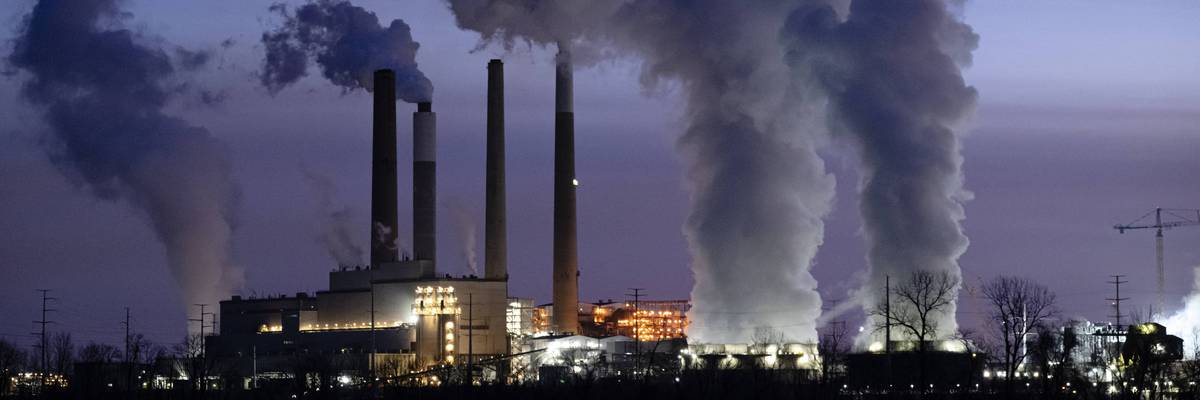
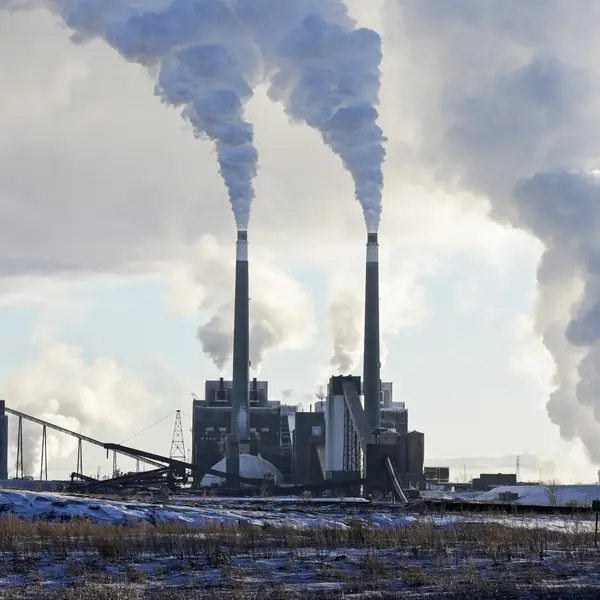
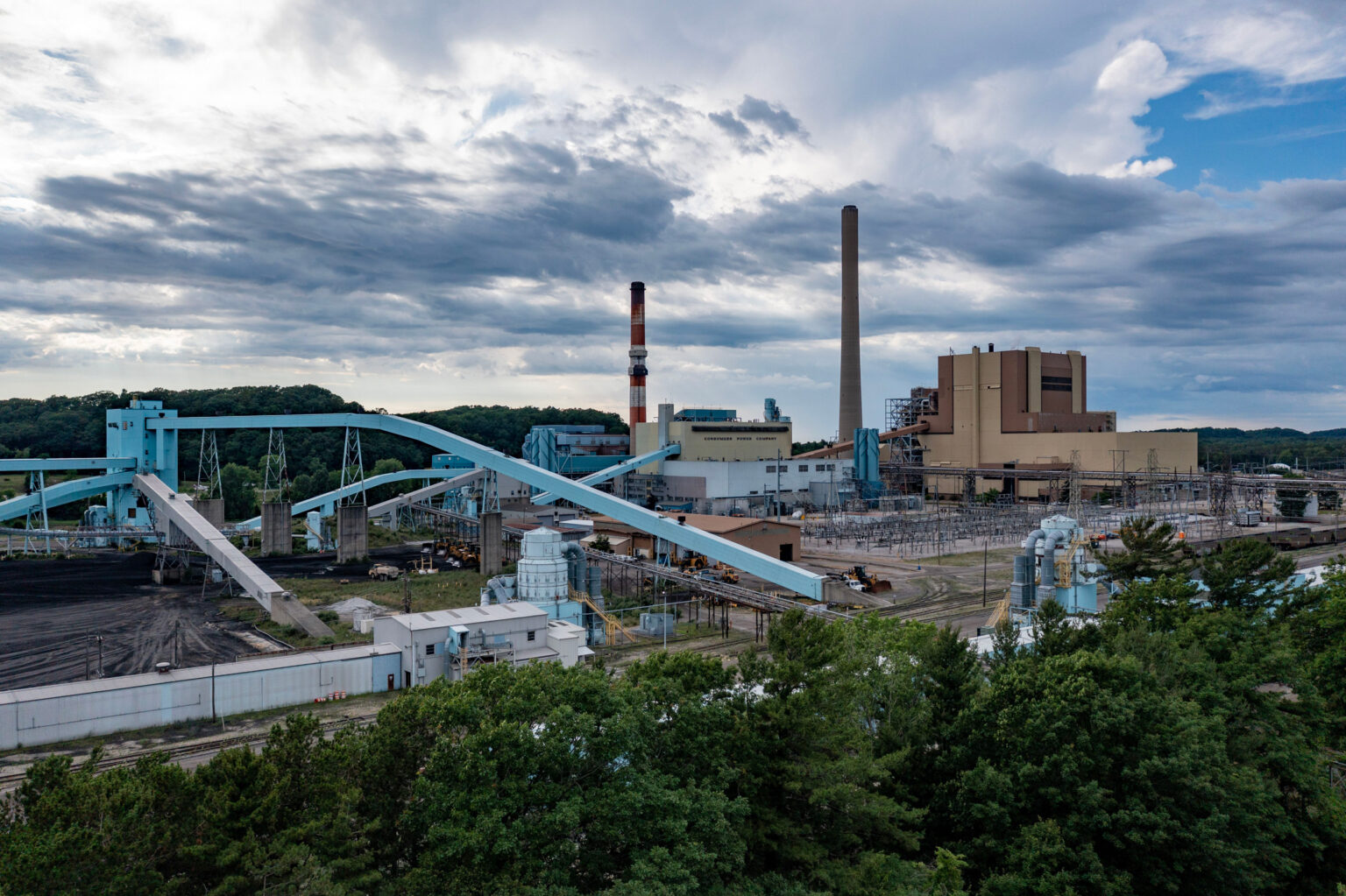
Mill Creek Generating Station, a coal-fired power plant in Louisville, Kentucky, is seen on February 14, 2026 in Elizabeth, Indiana. (Photo by Jon Cherry/Getty Images)
One critic of the president recently said that he’s “forcing higher power bills” on Americans while “fattening the wallets of his cronies—all with billions of our tax dollars.”
President Donald Trump’s administration has dedicated over $1 billion to boosting the coal industry, and on Thursday announced a report about reserves beneath federally managed public lands, with Interior Secretary Doug Burgum claiming that the polluting fossil fuel “is more important than ever to the production of electricity.”
“These 34 coal mines control more than 4.2 billion short tons of reported coal reserves. Most of the coal mines (31) and more than 98% of the reported coal reserves are on federal lands west of the Mississippi River,” according to the report. “Of all the states, Wyoming has the most coal mines on federal lands (14) and produces the most coal from federal lands.”
“The USGS estimates that more than 355 billion short tons of available coal resources remain beneath federal lands in the conterminous United States,” the document details. “Alaska contains substantial quantities of coal resources. The USGS estimates that Alaska has at least 140 billion short tons of identified available coal resources but may ultimately have as much as 5.5 trillion short tons of coal resources.”
A US Department of the Interior statement announcing the report highlights that if the reserves accounted for in the document were produced, “that would be enough coal to supply all the nation’s needs for at least 600 years at the current rate of consumption.”
Scientists have long argued that the international community must stop burning coal—plus oil and gas—to prevent a worst-case scenario future as the planet’s inhabitants already face a fossil fuel-driven climate emergency and its relatedextreme weather.
However, climate crisis-denying Trump—who returned to the White House backed by Big Oil’s campaign cash—and his Cabinet have spent his second term pushing polluting sources of energy, particularly as his illegal war on Iran drives up global prices, with oil surpassing $100 per barrel on Thursday.
Staying on message, Burgum declared in Interior’s Thursday statement that “American Energy Dominance is more important than ever, and so is beautiful clean coal’s role in the production of electricity needed to fuel our future prosperity.”
“Thanks to the USGS’s rigorous and independent assessment, we’re better equipped to manage America’s vast public lands responsibly while supporting energy security and economic opportunity,” he continued.
Sharing the statement on the social media platform Bluesky Thursday, sciencejournalist Emily Willingham said, “What an abuse of the USGS, the environment, and our intellects.”
An ore deposit geologist named Elizabeth also ripped the statement on Bluesky, writing: “There is a lot messed up with this press release, but the thing that bothers me the most is how poorly it is written. What an embarrassment!”
The USGS report came just two days after the Energy and Labor departments signed a memorandum of understanding (MOU) creating a framework to accelerate the deployment of artificial intelligence, automation, and other emerging technologies in the mining sector.
Acting Secretary of Labor Keith Sonderling said, “It is our commitment to you that this MOU will further President Trump’s promise to restore coal as a key driver of America’s energy supply chain and American coal will again be the envy of the world for generations to come.”
While attacking clean energy initiatives, including offshore wind projects, the administration “has bolstered coal, the dirtiest and most expensive fossil fuel,” The Guardian reported earlier this month.
According to the newspaper:
In September, the Department of Energy announced it would spend $625 million to “expand and extend the life of” coal-fired power plants, allocating $350 million to “modernize” coal plants, $175 million to fund coal projects powering rural communities, and $50 million to upgrade wastewater management systems to extend coal plants’ lifespans.
Last month, the agency also set aside up to $500 million from the Defense Production Act to “expand and reinvigorate” the capacity of 13 coal plants, and to help build a coal export terminal in Oakland, California. A week later, the department announced an additional $3.6 million to “refurbish or retrofit” nine existing coal plants.
Former Democratic Washington Gov. Jay Inslee, a climate advocate and Trump critic, told the paper that the president is “forcing higher power bills” on Americans “by blocking clean energy, then he’s fattening the wallets of his cronies—all with billions of our tax dollars.”
“We pay more,” he said, “Republicans rubber-stamp it, and Trump’s donors walk off with the bag.”
Explainer by dizzy: Coal is regarded as an unnecessary, particularly highly-polluting fossil-fuel
Power-mad orange gasbag Donald Trump says Burn, Baby, Burn.Donald Trump urges you to be a Climate Science denier like him. He says that he makes millions and millions for destroying the planet, Burn, Baby, Burn and Flood, Baby, Flood.Nigel Farage urges you to ignore facts and reality and be a climate science denier like him and his Deputy Richard Tice. He says that Reform UK has received £Millions and £Millions from the fossil fuel industry to promote climate denial and destroy the planet.
Original article by republished from Common Dreams under Creative Commons (CC BY-NC-ND 3.0).
Environmental Protection Agency Administrator Lee Zeldin listens as President Donald Trump holds a Cabinet meeting in the Cabinet Room of the White House in Washington, DC on August 26, 2025. (Photo by Mandel Ngan/AFP via Getty Images)
“Administrator Zeldin is removing all incentives for big polluters to follow the law and turning a blind eye to those who suffer from the impacts of pollution.”
The Trump administration settled just 15 of the illegal pollution cases referred by the US Environmental Protection Agency in the first year of President Donald Trump’s second term in the White House, according to data compiled by a government watchdog—the latest evidence that Trump officials are placing corporate profits above the EPA’s mission to “protect human health and the environment.”
“Under [EPA Administrator] Lee Zeldin, anti-pollution enforcement is dying a quick death,” said Tim Whitehouse, executive director of PEER and a former enforcement attorney at EPA.
The DOJ lodged just one environmental consent decree in a case regarding a statutory violation of the Clean Air Act from the day Trump was inaugurated just over a year ago until now—signaling that the agency “virtually stopped enforcing” the landmark law that regulates air pollution.
“Enforcing the Clean Air Act means going after violators within the oil, gas, petrochemical, coal, and motor vehicle industries that account for most air pollution,” reads the report. “But these White House favorites will be shielded from any serious enforcement, at least, while Lee Zeldin remains EPA’s administrator.”
“For the sake of our health and the environment, Congress and the American people need to push back against Lee Zeldin’s dismantling of EPA’s environmental enforcement program.”
In the first year of his first term, Trump’s DOJ settled 26 Clean Air Act cases, even more than the 22 the department prosecuted in Biden’s first year.
The report warns that plummeting enforcement actions are likely to contribute to health harms in vulnerable communities located near waterways that are filled with “algae blooms, bacteria, or toxic chemicals” and near energy and chemical industry infrastructure, where people are more likely to suffer asthma attacks and heart disease caused by smog and soot.
“Enforcing environmental laws ensures that polluters are held accountable and prevented from dumping their pollution on others for profit,” said Joanna Citron Day, general counsel for PEER and a former senior counsel at DOJ’s Environmental Enforcement Section. “For the sake of our health and the environment, Congress and the American people need to push back against Lee Zeldin’s dismantling of EPA’s environmental enforcement program.”
EPA’s own enforcement and compliance database identifies 2,374 major air pollution sources that have not had a full compliance evaluation in at least five years, and shows that no enforcement action has been taken at more than 400 sources that are marked as a “high priority.”
Nearly 900 pollution sources reported to the EPA that they exceeded their wastewater discharge limits at least 50 times in the past two years.
The agency has also repealed its rules limiting carbon pollution from gas-powered cars, arguing that the EPA lacks the authority to regulate carbon.
As public health risks mount, PEER noted, Zeldin is moving forward with plans to stop calculating the health benefits of rules aimed at reducing air pollution, and issued a memo last month detailing a “compliance first” policy emphasizing a “cooperative, industry-friendly approach” to environmental regulation.
“Administrator Zeldin is removing all incentives for big polluters to follow the law,” said Whitehouse, “and turning a blind eye to those who suffer from the impacts of pollution.”
Donald Trump urges you to be a Climate Science denier like him. He says that he makes millions and millions for destroying the planet, Burn, Baby, Burn and Flood, Baby, Flood.Elon Musk urges you to be a Fascist like him, says that you can ignore facts and reality then.Orcas discuss Donald Trump and the killer apes’ concept of democracy. Front Orca warns that Trump is crashing his country’s economy and that everything he does he does for the fantastically wealthy.
The world’s fossil-fuel use is still on track to peak before 2030, despite a surge in political support for coal, oil and gas, according to data from the International Energy Agency (IEA).
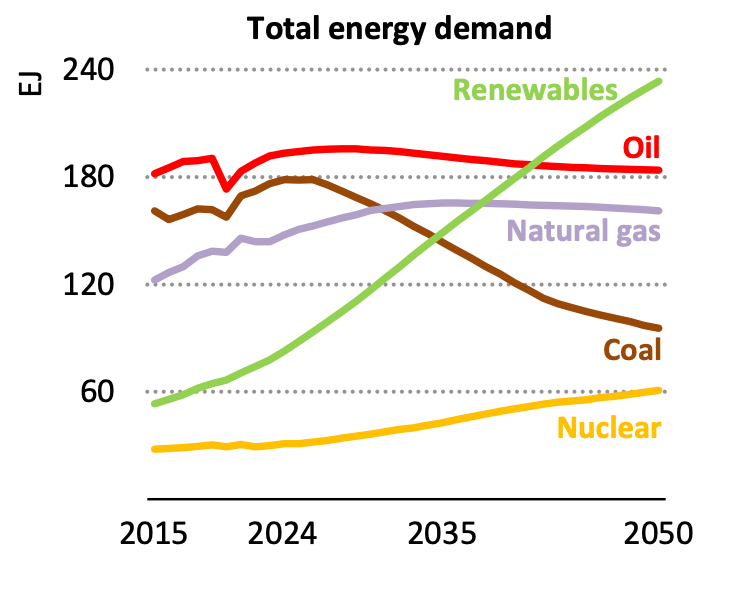
The IEA’s latest World Energy Outlook 2025, published during the opening days of the COP30 climate summit in Brazil, shows coal at or close to a peak, with oil set to follow around 2030 and gas by 2035, based on the stated policy intentions of the world’s governments.
Under the same assumptions, the IEA says that clean-energy use will surge, as nuclear power rises 39% by 2035, solar by 344% and wind by 178%.
Still, the outlook has some notable shifts since last year, with coal use revised up by around 6% in the near term, oil seeing a shallower post-peak decline and gas plateauing at higher levels.
This means that the IEA expects global warming to reach 2.5C this century if “stated policies” are implemented as planned, up marginally from 2.4C in last year’s outlook.
In addition, after pressure from the Trump administration in the US, the IEA has resurrected its “current policies scenario”, which – effectively – assumes that governments around the world abandon their stated intentions and only policies already set in legislation are continued.
If this were to happen, the IEA warns, global warming would reach 2.9C by 2100, as oil and gas demand would continue to rise and the decline in coal use would proceed at a slower rate.
This year’s outlook also includes a pathway that limits warming to 1.5C in 2100, but says that this would only be possible after a period of “overshoot”, where temperature rise peaks at 1.65C.
The IEA will publish its “announced pledges scenario” at a later date, to illustrate the impact of new national climate pledges being implemented on time and in full.
The IEA’s annual World Energy Outlook (WEO) is published every autumn. It is regarded as one of the most influential annual contributions to the understanding of energy and emissions trends.
The outlook explores a range of scenarios, representing different possible futures for the global energy system. These are developed using the IEA’s “global energy and climate model”.
The latest report stresses that “none of [these scenarios] should be regarded as a forecast”.
However, this year’s outlook marks a major shift in emphasis between the scenarios – and it reintroduces a pathway where oil and gas demand continues to rise for many decades.
This pathway is named the “current policies scenario” (CPS), which assumes that governments abandon their planned policies, leaving only those that are already set in legislation.
If the world followed this path, then global temperatures would reach 2.9C above pre-industrial levels by 2100 and would be “set to keep rising from there”, the IEA says.
The CPS was part of the annual outlook until 2020, when the IEA said that it was “difficult to imagine” such a pathway “prevailing in today’s circumstances”.
It has been resurrected following heavy pressure from the US, which is a major funder of the IEA that accounts for 14% of the agency’s budget.
For example, in July Politico reported “a ratcheted-up US pressure campaign” and “months of public frustrations with the IEA from top Trump administration officials”. It noted:
“Some Republicans say the IEA has discouraged investment in fossil fuels by publishing analyses that show near-term peaks in global demand for oil and gas.”
The CPS is the first scenario to be discussed in detail in the report, appearing in chapter three. The CPS similarly appears first in Annex A, the data tables for the report.
The second scenario is the “stated policies scenario” (STEPS), featured in chapter four of this year’s outlook. Here, the outlook also includes policies that governments say they intend to bring forward and that the IEA judges as likely to be implemented in practice.
In this world, global warming would reach 2.5C by 2100 – up marginally from the 2.4C expected in the 2024 edition of the outlook.
Beyond the STEPS and the CPS, the outlook includes two further scenarios.
One is the “net-zero emissions by 2050” (NZE) scenario, which illustrates how the world’s energy system would need to change in order to limit warming in 2100 to 1.5C.
The NZE was first floated in the 2020 edition of the report and was then formally featured in 2021.
The report notes that, unlike in previous editions, this scenario would see warming peak at more than 1.6C above pre-industrial temperatures, before returning to 1.5C by the end of the century.
This means it would include a high level of temporary “overshoot” of the 1.5C target. The IEA explains that this results from the “reality of persistently high emissions in recent years”. It adds:
“In addition to very rapid progress with the transformation of the energy sector, bringing the temperature rise back down below 1.5C by 2100 also requires widespread deployment of CO2 removal technologies that are currently unproven at large scale.”
Finally, the outlook includes a new scenario where everyone in the world is able to gain access to electricity by 2035 and to clean cooking by 2040, named “ACCESS”.
While the STEPS appears second in the running order of the report, it is mentioned slightly more frequently than the CPS, as shown in the figure below. The CPS is a close second, however, whereas the IEA’s 1.5C pathway (NZE) receives a declining level of attention.
Number of mentions of each scenario per 100 pages of text. Source: Carbon Brief analysis.
US critics of the IEA have presented its stated policies scenario as “disconnected from reality”, in contrast to what they describe as the “likely scenario” of “business as usual”.
Yet the current policies scenario is far from a “business-as-usual” pathway. The IEA says this explicitly in an article published ahead of the outlook:
“The CPS might seem like a ‘business-as-usual’ scenario, but this terminology can be misleading in an energy system where new technologies are already being deployed at scale, underpinned by robust economics and mature, existing policy frameworks. In these areas, ‘business as usual’ would imply continuing the current process of change and, in some cases, accelerating it.”
In order to create the current policies scenario, where oil and gas use continues to surge into the future, the IEA therefore has to make more pessimistic assumptions about barriers to the uptake of new technologies and about the willingness of governments to row back on their plans. It says:
“The CPS…builds on a narrow reading of today’s policy settings…assuming no change, even where governments have indicated their intention to do so.”
This is not a scenario of “business as usual”. Instead, it is a scenario where countries around the world follow US president Donald Trump in dismantling their plans to shift away from fossil fuels.
More specifically, the current policies scenario assumes that countries around the world renege on their policy commitments and fail to honour their climate pledges.
For example, it assumes that Japan and South Korea fail to implement their latest national electricity plans, that China fails to continue its power-market reforms and abandons its provincial targets for clean power, that EU countries fail to meet their coal phase-out pledges and that US states such as California fail to extend their clean-energy targets.
Similarly, it assumes that Brazil, Turkey and India fail to implement their greenhouse gas emissions trading schemes (ETS) as planned and that China fails to expand its ETS to other industries.
The scenario also assumes that the EU, China, India, Australia, Japan and many others fail to extend or continue strengthening regulations on the energy efficiency of buildings and appliances, as well as those relating to the fuel-economy standards for new vehicles.
In contrast to the portrayal of the stated policies scenario as blindly assuming that all pledges will be met, the IEA notes that it does not give a free pass to aspirational targets. It says:
“[T]argets are not automatically assumed to be met; the prospects and timing for their realisation are subject to an assessment of relevant market, infrastructure and financial constraints…[L]ike the CPS, the STEPS does not assume that aspirational goals, such as those included in the Paris Agreement, are achieved.”
Only in the “announced pledges scenario” (APS) does the IEA assume that countries meet all of their climate pledges on time and full – regardless of how credible they are.
The APS does not appear in this year’s report, presumably because many countries missed the deadlines to publish new climate pledges ahead of COP30.
The IEA says it will publish its APS, assessing the impact of the new pledges, “once there is a more complete picture of these commitments”.
Fossil-fuel peak
In recent years, there has been a significant shift in the IEA’s outlook for fossil fuels under the stated policies scenario, which it has described as “a mirror to the plans of today’s policymakers”.
In 2020, the agency said that prevailing policy conditions pointed towards a “structural” decline in global coal demand, but that it was too soon to declare a peak in oil or gas demand.
By 2021, it said global fossil-fuel use could peak as soon as 2025, but only if all countries got on track to meet their climate goals. Under stated policies, it expected fossil-fuel use to hit a plateau from the late 2020s onwards, declining only marginally by 2050.
There was a dramatic change in 2022, when it said that Russia’s invasion of Ukraine and the resulting global energy crisis had “turbo-charged” the shift away from fossil fuels.
As a result, it said at the time that it expected a peak in demand for each of the fossil fuels. Coal “within a few years”, oil “in the mid-2030s” and gas ”by the end of the decade”.
This outlook sharpened further in 2023 and, by 2024, it was saying that each of the fossil fuels would see a peak in global demand before 2030.
This year’s report notes that “some formal country-level [climate] commitments have waned”, pointing to the withdrawal of the US from the Paris Agreement.
The report says the “new direction” in the US is among “major new policies” in 48 countries. The other changes it lists include Brazil’s “energy transition acceleration programme”, Japan’s new plan for 2040 and the EU’s recently adopted 2040 climate target.
Overall, the IEA data still points to peaks in demand for coal, oil and gas under the stated policies scenario, as shown in the figure below.
Alongside this there is a surge in clean technologies, with renewables overtaking oil to become the world’s largest source of energy – not just electricity – by the early 2040s.
In this year’s outlook under stated policies, the IEA sees global coal demand as already being at – or very close to – a definitive peak, as the chart above shows.
Coal then enters a structural decline, where demand for the fuel is displaced by cheaper alternatives, particularly renewable sources of electricity.
The IEA reiterates that the cost of solar, wind and batteries has respectively fallen by 90%, 70% and 90% since 2010, with further declines of 10-40% expected by 2035.
(The report notes that household energy spending would be lower under the more ambitious NZE scenario than under stated policies, despite the need for greater investment.)
However, this year’s outlook has coal use in 2030 coming in some 6% higher than expected last year, although it ultimately declines to similar levels by 2050.
For oil, the agency’s data still points to a peak in demand this decade, as electric vehicles (EVs) and more efficient combustion engines erode the need for the fuel in road transport.
While this sees oil demand in 2030 reaching similar levels to what the IEA expected last year, the post-peak decline is slightly less marked in the latest outlook, ending some 5% higher in 2050.
The biggest shift compared with last year is for gas, where the IEA suggests that global demand will keep rising until 2035, rather than peaking by 2030.
Still, the outlook has gas demand in 2030 being only 7% higher than expected last year. It notes:
“Long-term natural gas demand growth is kept lower than in recent decades by the expanding deployment of renewables, efficiency gains and electrification of end-uses.”
In terms of clean energy, the outlook sees nuclear power output growing to 39% above 2024 levels by 2035 and doubling by 2050. Solar grows nearly four-fold by 2035 and nearly nine-fold by 2050, while wind power nearly triples and quadruples over the same periods.
Notably, the IEA sees strong growth of clean-energy technologies, even in the current policies scenario. Here, renewables would still become the world’s largest energy source before 2050.
This is despite the severe headwinds assumed in this scenario, including EVs never increasing from their current low share of sales in India or the US.
The CPS would see oil and gas use continuing to rise, with demand for oil reaching 11% above current levels by 2050 and gas climbing 31%, even as renewables nearly triple.
This means that coal use would still decline, falling to a fifth below current levels by 2050.
Finally, while the IEA considers the prospect of global coal demand continuing to rise rather than falling as expected, it gives this idea short shrift. It explains:
“A growth story for coal over the coming decades cannot entirely be ruled out but it would fly in the face of two crucial structural trends witnessed in recent years: the rise of renewable sources of power generation, and the shift in China away from an especially coal-intensive model of growth and infrastructure development. As such, sustained growth for coal demand appears highly unlikely.”
Elon Musk urges you to be a Fascist like him, says that you can ignore facts and reality then.Donald Trump urges you to be a Climate Science denier like him. He says that he makes millions and millions for destroying the planet, Burn, Baby, Burn and Flood, Baby, Flood.Nigel Farage urges you to ignore facts and reality and be a climate science denier like him and his Deputy Richard Tice. He says that Reform UK has received £Millions and £Millions from the fossil fuel industry to promote climate denial and destroy the planet.
A view of Consumers Energy’s J.H. Campbell coal-fired power plant in West Olive, Mich. Credit: Jim West/UCG/Universal Images Group via Getty Images
Midwestern electricity ratepayers will pay the still-mounting tab under a plan Consumers Energy reported to regulators and investors.
The Trump administration’s emergency order to keep the huge J.H. Campbell coal plant on Lake Michigan operating past its planned retirement date has cost at least $80 million since May, its operator, Consumers Energy, told regulators and investors this week.
The company said in its third-quarter earnings report Thursday that it would pursue the process laid out in the U.S. Department of Energy’s order for collecting those costs: It will seek payment from ratepayers across the Midwest.
Even though the peak summer electricity demand season has passed, executives at Consumers, Michigan’s largest energy provider, said that they see no sign of let-up in the emergency orders.
“We expect those to continue for the long-term,” said CEO Garrick Rochow in a conference call for investors. “And we’re prepared to continue to operate the plant and comply with those orders.”
He said the costs—$615,385 per day—should be shared beyond the 1.9 million electricity customers of Consumers Energy. The company plans to propose the tab be split among ratepayers (an estimated 42 million to 45 million electricity customers) in the nine states served by the regional electric grid operator, the Midcontinent Independent System Operator (MISO).
“The benefits go to MISO,” Rochow said. “Not just to our customers, they go to MISO.”
Rochow said the Trump administration envisioned this approach. “That order from the Department of Energy has laid out a clear path to cost recovery,” he said. Consumers Energy will have to apply to the Federal Energy Regulatory Commission in order to pass the costs to the ratepayers, and states that oppose such a cost allocation could move to intervene in those proceedings.
U.S. Energy Secretary Chris Wright issued two consecutive 90-day orders—on May 23 and on Aug. 20—to keep the Campbell plant open under the emergency provisions of the Federal Power Act. In the past, such orders have been used to ensure energy delivery at times of natural disasters. But Wright used the act to execute Trump’s agenda to ramp up energy production, saying Campbell needed to stay open to minimize the risk of power outages and address critical grid security issues in the Midwest.
The Department of Energy did not immediately respond to a request for comment on the Campbell cost figures, nor did MISO. When he extended the Campbell order in August, Wright said that he was directing MISO “to take every step to minimize cost to the American people.”
“This order will help ensure millions of Americans can continue to access affordable, reliable, and secure baseload power,” he said in that statement.
But critics say the operation of the 63-year-old plant is generating unnecessary costs as well as pollution. In a September regulatory filing challenging the DOE’s order, a coalition of environmental groups pointed out that even on the day of highest peak demand this summer, MISO had an unused surplus of resources greater than 10 times the power provided by the Campbell plant.
And indeed, according to recent Environmental Protection Agency data, two of the three units at the Campbell plant were not operating at all for about 30 days of the 131 days from the start of the DOE order through Sept. 30. The third unit at the plant only ran for 18 days. Such stoppages could occur for maintenance or simply because the grid operator did not call on the plant to deliver energy to the grid.
“Forcing this unnecessary coal plant to keep operating is bilking consumers for the benefit of the coal industry,” said Michael Lenoff, senior attorney for Earthjustice, which is representing the environmental groups.
Because DOE did not respond to their petition for reconsideration of the Campbell order within 30 days, the environmental groups and the states of Michigan, Minnesota and Illinois have asked the D.C. Circuit Court of Appeals to review the case. The purpose of the litigation, Lenoff said, is “to stop the administration from harming consumers, trampling markets and unlawfully usurping the authority of states and regulators to make decisions in the public interest.”
Campbell is by far the largest of three fossil fuel electricity plants that are staying open beyond their planned retirements under Trump administration emergency orders. Campbell released 6.6 million metric tons of carbon in 2023, the most recent year for which data is available. Talen Energy’s Wagner plant near Baltimore and Constellation Energy’s Eddystone plant just south of Philadelphia, both run on oil and natural gas. Some detail on their costs for keeping open may emerge next week, when Talen and Constellation report their third-quarter earnings.
Consumers Energy, which is continuing to work toward its previously stated goal of achieving net-zero carbon emissions by 2040, had projected that the retirement of the Campbell plant would save its customers $600 million over the next 20 years, or $30 million per year. Instead, running the plant for the past five months has cost close to three times that annual amount.
Elon Musk urges you to be a Fascist like him, says that you can ignore facts and reality then.Donald Trump urges you to be a Climate Science denier like him. He says that he makes millions and millions for destroying the planet, Burn, Baby, Burn and Flood, Baby, Flood.Nigel Farage urges you to ignore facts and reality and be a climate science denier like him and his Deputy Richard Tice. He says that Reform UK has received £Millions and £Millions from the fossil fuel industry to promote climate denial and destroy the planet.
A coal power station in Ohio, US. Donald Trump has declared his support for coal and other fossil fuels. Photograph: Jason Whitman/NurPhoto/Shutterstock
Bleak report finds greenhouse gas emissions are still rising despite ‘exponential’ growth of renewables
Coal use hit a record high around the world last year despite efforts to switch to clean energy, imperilling the world’s attempts to rein in global heating.
The share of coal in electricity generation dropped as renewable energy surged ahead. But the general increase in power demand meant that more coal was used overall, according to the annual State of Climate Action report, published on Wednesday.
The report painted a grim picture of the world’s chances of avoiding increasingly severe impacts from the climate crisis. Countries are falling behind the targets they have set for reducing greenhouse gas emissions, which have continued to rise, albeit at a lower rate than before.
Clea Schumer, a research associate at the World Resources Institute thinktank, which led the report, said: “There’s no doubt that we are largely doing the right things. We are just not moving fast enough. One of the most concerning findings from our assessment is that for the fifth report in our series in a row, efforts to phase out coal are well off track.”
Orcas comment on killer apes destroying the planet by continuing to burn fossil fuels.Donald Trump urges you to be a Climate Science denier like him. He says that he makes millions and millions for destroying the planet, Burn, Baby, Burn and Flood, Baby, Flood.Nigel Farage urges you to ignore facts and reality and be a climate science denier like him and his Deputy Richard Tice. He says that Reform UK has received £Millions and £Millions from the fossil fuel industry to promote climate denial and destroy the planet.