Expanding Heathrow is incompatible with net zero – here’s the evidence

Spread the love

Plane Photography / shutterstock

Richard Sulley, University of Sheffield

The UK government is set to back plans for a third runway at Heathrow, the country’s busiest airport, and to expand two other airports near London: Gatwick and Luton. The move is designed to support the government’s “mission” to grow the economy.

Air transport is notoriously hard to decarbonise. Unlike the energy system, or even road transport, there is no renewable alternative to switch to immediately. If electric or hydrogen planes become reality, it won’t be for many years yet. Therefore it’s not clear this airport expansion can fit within the UK’s legal and arguably moral requirement to cut emissions and remain within its carbon budget.

It certainly goes against what the government’s official advisory body the Committee on Climate Change (CCC) recommends. The CCC’s 2023 report to parliament stated that: “No airport expansions should proceed until a UK-wide capacity management framework is in place to annually assess and, if required, control sector GHG [greenhouse gas] emissions and non-CO₂ effects.”

Those non-CO₂ effects of aviation include water vapour, soot and other gases like nitrous oxides and sulfur dioxide, all released directly into the high atmosphere where they help form heat-trapping clouds. Estimates suggest they could triple the greenhouse impact of aviation.

In 2019, the last year of available data pre-COVID, domestic and international aviation accounted for around 8% of the UK’s total emissions. The non-CO₂ effects makes aviation a larger contributor to climate change than that number suggests.

The sector itself struggles to build a coherent decarbonisation roadmap based solely on “supply-side” improvements to things like fuel efficiency or, in a recent example from EasyJet, thinner paint. The demand side – taking fewer flights, frequent flyer levies, or restrictions on domestic flights as have been introduced in France – is rarely mentioned.

Unfortunately aviation is a prime example of the Jevons effect where any improvement in efficiency has been wiped out by increased demand. With a growing global middle class pursuing a higher consumption lifestyle, aviation emissions continue to grow even while other sectors have shows some efforts to reduce their own.

'3rd runway plane stupid'
A third runway at Heathrow was first proposed back in the 2000s. This photo is from a 2016 protest. Dinendra Haria / shutterstock

The UK has mandated that synthetic aviation fuel (SAF), a more sustainable alternative to regular jet fuel, must make up 10% of aviation fuel by 2030. But only 1.2% of aviation fuel is currently SAF and the industry has not published any plans to show it can scale up in time. Indeed, the sector’s own plans for growth will outstrip efforts to decarbonise through synthetic fuel, delivering a neutral effect at best.

The consumer-facing airport sector has also been accused of greenwash. For instance, Luton Airport recently published adverts making the claim that its own expansion would be stopped if it did not meet stringent environmental targets. However, the Advertising Standards Authority found that consumers would naturally believe that would include air traffic and not just terminal operations (a terminal’s heating or lighting is, of course, largely irrelevant when its core business is as emissions-intensive as flying).

The difficulty of decarbonising aviation while the sector still grows is exemplified by the government’s recently launched consultation on adopting the Corsia carbon offsetting scheme for international flights and how it might work with existing cap and trade schemes. All of which encourage or excuse excess emissions through a charging mechanism.

Growing pains

“Kickstarting economy growth” and “Make Britain a clean energy superpower” are two of the UK government’s six “missions”. However, by expanding airports in support of the former, it risks failing the latter.

A new report by thinktank the New Economics Foundation shows that airport expansion could balance out all of the emissions saved by the government’s clean power plans by 2050.

There is evidence that airport expansion can bring some of the economic benefit that government needs. However, another New Economics Foundation report has found that air travel is no longer a catalyst for productivity growth. So the economic benefits of a new runway are really confined to the airport operation itself – projects for engineers and builders, service jobs for people living near Heathrow, and so on.

Aviation is the privilege of the richer part of society, both globally and within the UK. Figures from Our World in Data shows the richest 50% of the global population produces 90% of the aviation emissions.

While many more UK residents have experienced flying than in the past, most flights are still taken by a small, wealthy subset of the population, which will typically capture the largest share of any new capacity. Each year, around half of British residents do not fly at all.

The focus on London airports for the largest scale expansions will shift the balance of the economy further towards south-east England, and increase inequality within the UK economy. And while these plans might bring some of the GDP gains the government is desperate to deliver, all the evidence shows they will be at the expense of its environmental targets.


Don’t have time to read about climate change as much as you’d like?
Get a weekly roundup in your inbox instead. Every Wednesday, The Conversation’s environment editor writes Imagine, a short email that goes a little deeper into just one climate issue. Join the 40,000+ readers who’ve subscribed so far.


Richard Sulley, Senior Research Fellow, Sustainability Policy, University of Sheffield

This article is republished from The Conversation under a Creative Commons license. Read the original article.

Orcas comment on killer apes destroying the planet by continuing to burn fossil fuels.
Continue ReadingExpanding Heathrow is incompatible with net zero – here’s the evidence

UK plans to adapt to climate crisis ‘fall far short’ of what is required

Spread the love

https://www.theguardian.com/environment/2024/mar/13/uk-climate-crisis-plans-fall-far-short-of-what-is-required-ccc-says

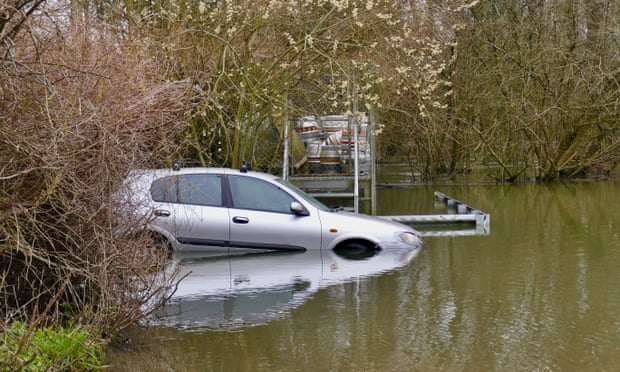
A car gets submerged in flood waters in a pub car park in Sonning on Thames, Berkshire, UK. Photograph: Geoffrey Swaine/REX/Shutterstock

Government has no credible plan for effects of extreme weather, says Committee on Climate Change

The UK’s plans for adapting to the effects of the climate crisis “fall far short” of what is required, the government’s statutory adviser has said.

The Climate Change Committee (CCC) has examined the national adaptation programme published by ministers last July, intended to set out how people, buildings and vital national infrastructure such as water, transport, energy and telecommunications networks could be protected from the increasing severity of storms, floods, heatwaves and droughts that are afflicting the UK as a result of global heating.

In a damning verdict delivered on Wednesday, the committee found that the government had no credible plan for making the UK resilient to the increasing effects of extreme weather.

Julia King, chair of the adaptation subcommittee of the CCC, said: “The evidence of the damage from climate change has never been clearer, but the UK’s current approach to adaptation is not working.”

https://www.theguardian.com/environment/2024/mar/13/uk-climate-crisis-plans-fall-far-short-of-what-is-required-ccc-says

Continue ReadingUK plans to adapt to climate crisis ‘fall far short’ of what is required

UK has made ‘no progress’ on climate plan, say government’s own advisers

Spread the love

https://www.theguardian.com/technology/2023/jun/28/uk-has-made-no-progress-on-climate-plan-say-governments-own-advisers

Just Stop Oil protesting in London 6 December 2022.

UK has lost leadership in climate action and almost all targets are being missed, Committee on Climate Change finds

The government’s plans to hit net zero have been comprehensively criticised in a withering report by its own advisers that warns targets are being missed on nearly every front.

Fewer homes were insulated last year under the government-backed scheme than the year before, despite soaring energy bills and a cost of living crisis. There is little progress on transport emissions, no coherent programme for behaviour change, and still no decision on hydrogen for home heating.

Meanwhile the installation of new wind and solar farms and the upgrading of the electricity grid are still too slow to meet net zero, according to the Committee on Climate Change, which says that the lack of urgency of government and a failure of political leadership means progress has stalled.

Lord Deben, outgoing chair of the CCC, said the UK had “lost the leadership” on climate action shown at Cop26 in 2021 and done “a number of things” – such as greenlighting a new coal mine and new oil and gasfields in the North Sea – that were “utterly unacceptable”.

https://www.theguardian.com/technology/2023/jun/28/uk-has-made-no-progress-on-climate-plan-say-governments-own-advisers

Continue ReadingUK has made ‘no progress’ on climate plan, say government’s own advisers

Time is short for Tories and Labour to show leadership on the climate crisis

Spread the love

https://www.theguardian.com/environment/2023/jun/28/time-is-short-for-tories-and-labour-to-show-leadership-on-the-climate-crisis

Neither party is showing much appetite for the hard policy decisions that are necessary to cut CO2 emissions – and time is running out

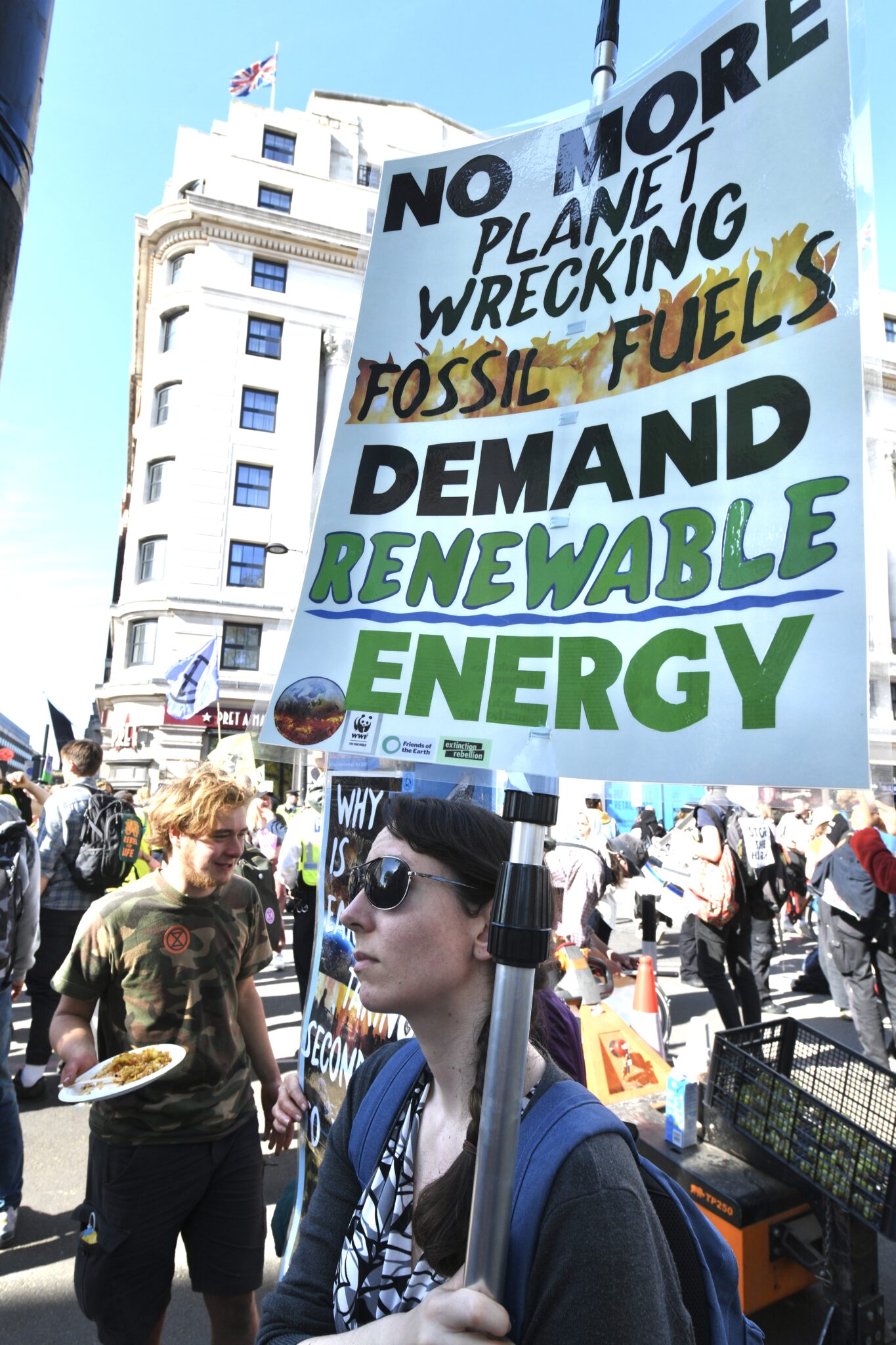
Extinction Rebellion protest, banner reads NO MORE PLANET WRECKING FOSSIL FUELS DEMAND RENEWABLE ENERGY
The UK’s Committee on Climate Change has accused the government of dithering about expanding onshore wind.

The Conservatives are lagging far behind on the climate crisis, that much we know. But the Labour party is not showing the leadership that the country needs on reaching net zero greenhouse gas emissions, the chairman of the Committee on Climate Change (CCC) has warned.

Lord Deben, a former Conservative environment secretary, has long been a critic of the government, and recently praised Labour’s stance on opposing new oil and gas licences in the North Sea.

But as he presented his final annual progress report as chairman, he warned that Labour was failing to take on vested interests.

“If you lead, then there are bound to be people who would prefer you not to have made those decisions,” Deben said. “And what we are seeing at the moment is not only in government but in opposition, people being unwilling to lead lest some people don’t like the decisions that are being made. But these decisions have to be made, and there will be some people who disagree with them, and it is no good hoping that it will all go away.”

He added: “Right across the political spectrum, there is an unwillingness to lead.”

https://www.theguardian.com/environment/2023/jun/28/time-is-short-for-tories-and-labour-to-show-leadership-on-the-climate-crisis

Continue ReadingTime is short for Tories and Labour to show leadership on the climate crisis

Halt new roads and developments adding to emissions, advisers to tell UK government

Spread the love

https://www.theguardian.com/environment/2023/jun/23/halt-new-roads-and-developments-adding-to-emissions-advisers-to-tell-uk-government

The government should halt all new roads unless there are exceptional circumstances, the government’s climate advisers are likely to say next week.

On Wednesday the Committee on Climate Change will publish its latest report on the UK’s progress in dealing with the climate crisis. Speaking at Glastonbury on Friday, the climate change committee chair, Lord Deben, said new roads inevitably increased traffic and emissions.

The report is likely to advise that any new developments that make climate breakdown worse should be banned.

If the recommendation is followed through, it would sound the death knell for the government’s road-building programme – and had it been adopted earlier, it would have meant the high-speed HS2 rail line would never have been approved. 

https://www.theguardian.com/environment/2023/jun/23/halt-new-roads-and-developments-adding-to-emissions-advisers-to-tell-uk-government

Continue ReadingHalt new roads and developments adding to emissions, advisers to tell UK government