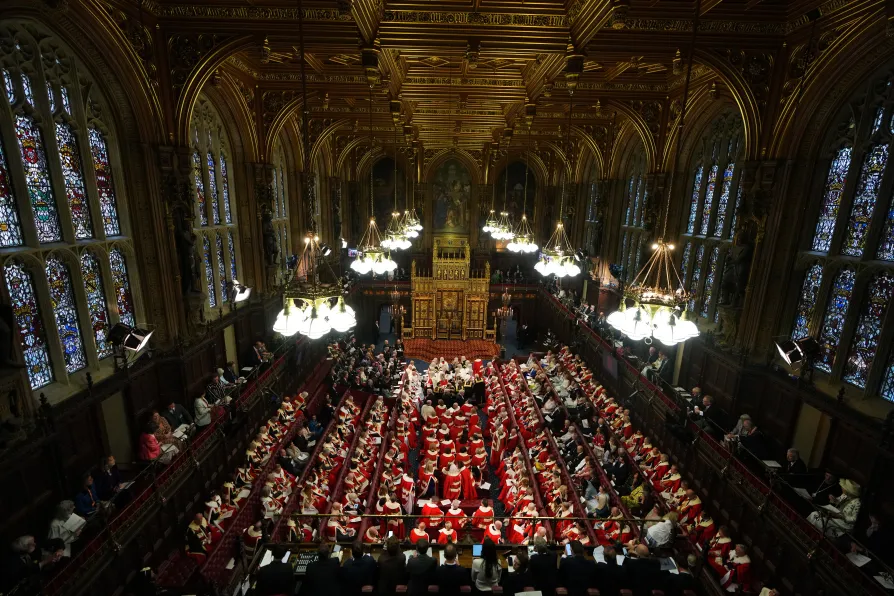
A view of the Chamber of the House of Lords ahead of the State Opening of Parliament at the Palace of Westminster in London, May 13, 2026
PEERS have seen their shares in oil and gas firms soar by tens of thousands since the start of the US war on Iran as the energy price cap jumped today, the Morning Star can reveal.
At least seven lords and one baroness have seen their stock holdings in companies such as Equinor, Chevron and Shell, increase since the war-driven energy shock.
New research from the End Fuel Poverty Coalition (EFPC) shared exclusively with the Star revealed the estimated gains made by peers as households “dread” the next energy bill.
EFPC co-ordinator Simon Francis slammed the lords who “may be leaping at the prospect of increased dividends and share prices” on the backs of “suffering households.”
Among the lords who saw the highest rise in their holdings was former Treasury and Cabinet Office minister Lord Agnew of Oulton.
A Tory peer and board member on GB News’ holding company, Lord Agnew saw his shares in Britain’s largest gas supplier Equinor grow by around £28,000 since the February 28 US-Israeli strikes on Iran which kicked off the war.
Former Tory Treasury minister Lord Sassoon saw shares in Chevron, ConocoPhillips, Occidental Petroleum and Shell grow by a combined value of just under £28,000.
EFPC highlighted other sitting peers holding shares in Shell, including former Hong Kong governor Lord Patten, former Tory home secretary and chancellor Lord Clarke and crossbencher Lord Rees.
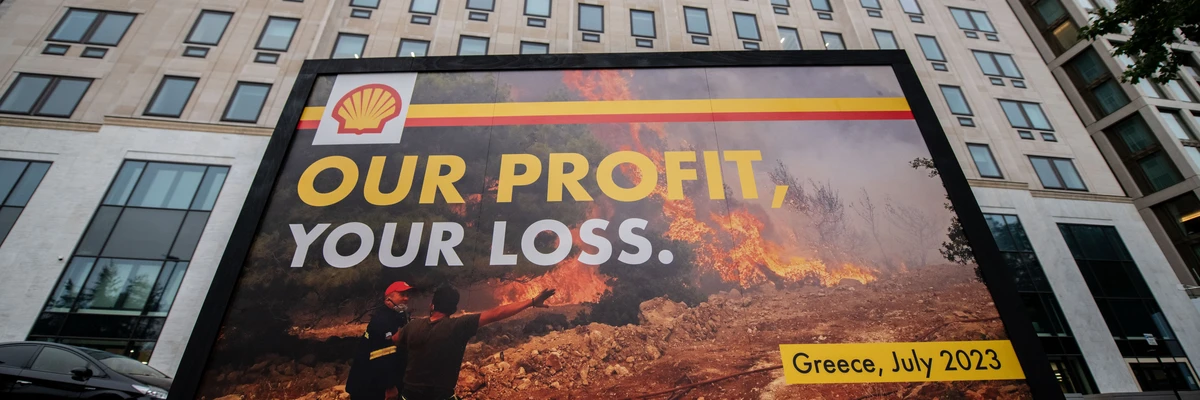
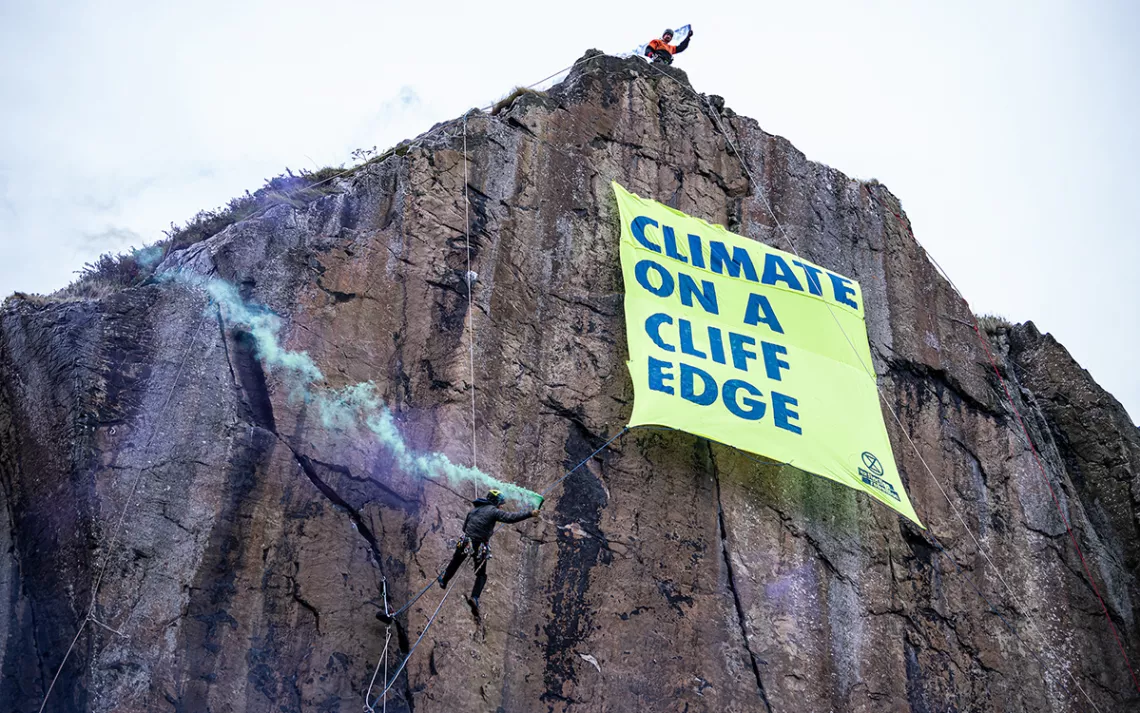
Orcas discuss Donald Trump and the killer apes’ concept of democracy. Front Orca warns that Trump is crashing his country’s economy and that everything he does he does for the fantastically wealthy.Greenpeace activists display a billboard during a protest outside Shell headquarters on July 27, 2023 in London. (Photo: Handout/Chris J. Ratcliffe for Greenpeace via Getty Images)Experienced climbers scale a rock face near the historic Dumbarton castle in Glasgow, releasing a banner that reads “Climate on a Cliff Edge.” One activist, dressed as a globe, symbolically looms near the edge, while another plays the bagpipes on the shores below. | Photo courtesy of Extinction Rebellion and Mark Richards
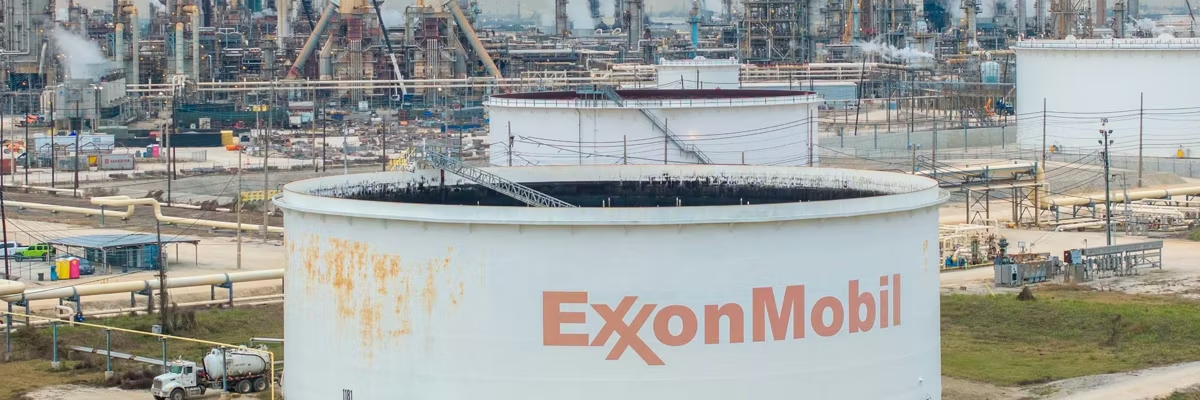
In an aerial view, the ExxonMobil Baytown Refinery is seen on January 13, 2026, in Baytown, Texas. (Photo by Brandon Bell/Getty Images)
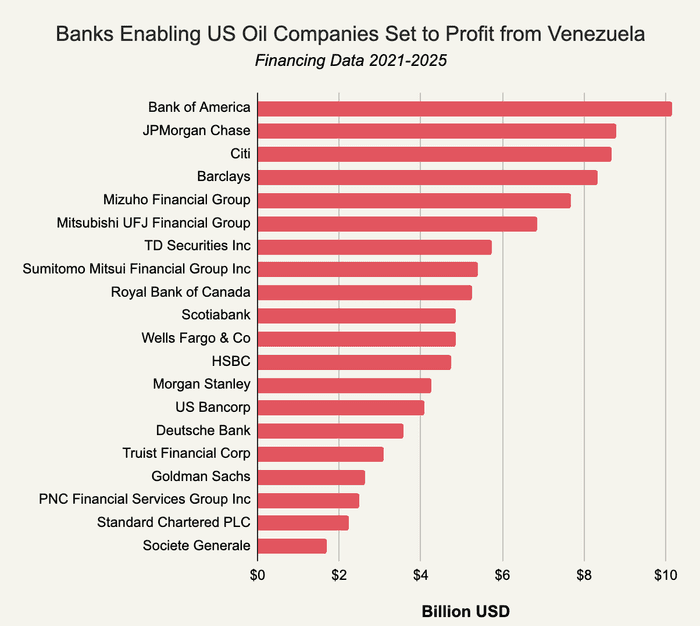
Since 2021, top Wall Street banks have committed more than $124 billion in investments to the nine companies set to profit most from the toppling of Venezuela’s government.
As oil industry giants are being set up to profit from President Donald Trump’s invasion of Venezuela, a new analysis shows the ample backing those companies have received from Wall Street’s top financial institutions.
Last week, Bloombergreported that stock traders and tycoons were “pouncing” after Trump’s kidnapping of President Nicolás Maduro earlier this month, after having pressured the Trump administration to “create a more favorable business environment in Venezuela.”
A dataset compiled by the international environmental advocacy group Stand.earth shows the extent to which these interests are intertwined.
Stand.earth found that since 2021, banks—including JPMorgan Chase, HSBC, TD, RBC, Citigroup, Wells Fargo, and Bank of America—have committed more than $124 billion in investments to the nine companies set to profit most from the toppling of Venezuela’s government.
More than a third of that financing, $42 billion, came in 2025 alone, when Trump launched his aggressive campaign against Venezuela.
Among the companies expected to profit most immediately are refiners like Valero, PBF Energy, Citgo, and Phillips 66, which have large operations on the Gulf Coast that can process the heavy crude Venezuela is known to produce. These four companies have received $41 billion from major banks over the past five years.
Chevron, which also operates many heavy-crude facilities, benefits from being the only US company that operated in Venezuela under the Maduro regime, where it exported more than 140,000 barrels of oil per day last quarter.
At a White House gathering with top oil executives on Friday, the company’s vice chair, Mark Nelson, told Trump the company could double its exports “effective immediately.”
According to Jason Gabelman, an analyst at TD Cowen, the company could increase its annual cash flow by $400 million to $700 million as a result of Trump’s takeover of Venezuelan oil resources.
Chevron was also by far the number-one recipient of investments in 2025, with more than $11 billion in total coming from the banks listed in the report—including $1.78 billion from Barclays, another $1.78 billion from Bank of America, and $1.32 billion from Citigroup.
According to Bloomberg, just weeks before Maduro’s removal, analysts at Citigroup predicted 60% gains on the nation’s more than $60 billion in bonds if he were replaced.
Even ExxonMobil, whose CEO Darren Woods dumped cold water on Trump’s calls to set up operations in Venezuela on Friday, calling the nation “uninvestable,” potentially has something major to gain from Maduro’s overthrow.
Exxon and ConocoPhillips each have outstanding arbitration cases against Venezuela over the government’s 2007 nationalization of oil assets, which could award them $20 billion and $12 billion, respectively.
The report found that in 2025, ExxonMobil and ConocoPhillips received a combined total of more than $12.8 billion in investment from major financial institutions, which vastly exceeded that from previous years.
Data on these staggering investments comes as oil companies face increased scrutiny surrounding possible foreknowledge of Trump’s attack on Venezuela.
Last week, US Senate Democrats launched a formal investigation into “communications between major US oil and oilfield services companies and the Trump administration surrounding last week’s military action in Venezuela and efforts to exploit Venezuelan oil resources.”
Richard Brooks, Stand.earth’s climate finance director, said the role of the financial institutions underwriting those oil companies should not be overlooked either.
“Without financial support from big banks and investors, the likes of Chevron, Exxon, ConocoPhillips, and Valero would not have the power that they do to start wars, overthrow governments, or slow the pace of climate action,” he said. “Banks and investors need to choose if they are on the side of peace, or of warmongering oil companies.”
Elon Musk urges you to be a Fascist like him, says that you can ignore facts and reality then.Donald Fuhrump says that Amerikkka doesn’t bother with crimes or charges anymore, not being 100% Amerikkkan and opposing his real estate intentions is enough.Orcas discuss how Trump was re-elected and him being an obviously insane, xenophobic Fascist.
Donald Trump urges you to be a Climate Science denier like him. He says that he makes millions and millions for destroying the planet, Burn, Baby, Burn and Flood, Baby, Flood.
Companies and individuals linked to the fossil fuel industry donated more than $19 million to Donald Trump’s inaugural fund, new Global Witness analysis reveals. The analysis, based on itemised data published by the US Federal Election Commission, identified 47 individual donations from November 2024 to January 2025, accounting for around 7.8% of the total $245 million raised by the fund. Presidential inaugural funds are used to cover the costs of inauguration events, such as parades, galas and receptions.
Donald Trump used funds from his first inaugural fund in 2017 to organise a party at his own hotel, for which he was sued by the D.C. Attorney General. Of fossil fuel-linked donors, US oil giant Chevron made the largest contribution – $2 million – and was the joint fourth-largest donor overall. A string of other fossil fuel companies made donations of $1 million, including ExxonMobil, ConocoPhillips and Occidental Petroleum. A Chevron spokesperson said that “Chevron has a long tradition of celebrating democracy by supporting the inaugural committees of both parties” and that they were “proud to have done so again this year.” None of the other companies mentioned above responded to our inquiries.
In his inaugural address, Donald Trump promised to “drill, baby, drill” and said that the US “will be a rich nation again, and it is that liquid gold under our feet that will help to do it”. In the following months, the President signed a blitz of Executive Orders aimed at boosting the fossil fuel industry and kneecapping federal climate action. These include:
Opening up federal lands and waters to fossil fuel exploration as official US policy and revoking several climate action policies;
Establishing a new group to advise his office on how to accelerate the ‘permitting, production, generation, distribution, regulation, and transportation’ of oil and gas;
Removing regulations on coal production to revive the flagging industry; and,
Ordering the US Attorney General to quash state-level “polluters pay” laws that would push fossil fuel companies to pay their fair share of climate damages.
Neo-Fascist Climate Science Denier Donald Trump says Burn, Baby, Burn.
Global Witness Senior Data Investigator Nicu Calcea said: “It’s no surprise the oil and gas industry handed millions to Donald Trump for his inauguration, and they seem to have reaped a huge return on their investment.
“Every month that Donald Trump has been in power, we’ve seen a raft of anti-climate measures come out which are music to the fossil fuel industry’s ears. From plans to steamroll through dirty new coal plants, to the attempted quashing of ‘polluter pays’ laws that would hold oil giants accountable, it’s clear where his political priorities lie.
“While Trump sides with his friends in oil and gas, we must keep up the fight for a fair, green future – that means pushing for wind and solar where we live, backing polluters pay bills, and resisting the development of oil, gas and coal projects across the country.”
Many of the world’s worst environmental and human rights abuses are driven by the exploitation of natural resources and corruption in the global political and economic system. Global Witness is campaigning to end this. We carry out hard-hitting investigations, expose these abuses, and campaign for change. We are independent, not-for-profit, and work with partners around the world in our fight for justice.
Orcas discuss how Trump was re-elected and him being an insane, xenophobic Fascist.Nigel Farage urges you to ignore facts and reality and be a climate science denier like him. He says that Reform UK has received millions and millions from the fossil fuel industry to promote climate denial and destroy the planet.
Hedge fund Quadrature Capital has given £4m to Keir Starmer’s Labour – the largest donation in the party’s history | Jack Taylor – WPA Pool / Getty Images
Quadrature’s donation is noteworthy not just for being Labour’s largest-ever, but for its timing ahead of election
The Labour Party’s largest-ever donation came from a Cayman Islands-registered hedge fund with shares worth hundreds of millions of pounds in fossil fuels, private health firms, arms manufacturers and asset managers.
While the £4m donation by Quadrature Capital is the sixth-largest in British political history, it is noteworthy not just for its size, but also its timing.
Electoral Commission records suggest Labour received the donation in the one-week window between former prime minister Rishi Sunak announcing the general election and the start of the ‘pre-poll reporting period’ in which all political donations over £11,180 had to be published weekly, rather than the quarterly norm.
This means that despite being made on 28 May, Quadrature’s generous donation was published by the Electoral Commission only last week, more than two months after Labour won the election.
Neither the Labour Party press office nor No 10 responded to openDemocracy’s questions on whether the timing of accepting this donation was intended to minimise scrutiny and critical coverage during the election.
Paul Holden, an investigative journalist and author of The Fraud, a forthcoming book on Starmer’s leadership, told openDemocracy that the donation’s timing fits the Starmer project’s pattern of delaying the disclosure of potentially sensitive or controversial political donations.
Holden said: “Sir Keir Starmer and the organisations close to him have an unfortunate history of reporting donations in controversial ways.
“During his bid to become leader of the Labour Party, Starmer refused to contemporaneously publish details of who had donated to his leadership campaign. His rivals, Rebecca Long-Bailey and Lisa Nandy, agreed to share details of their donors in real-time, which they published. Starmer, however, decided only to declare his donations via his MP’s register of interests, which created a significant lag between when Starmer accepted his donations and when they were made public.
“Labour members, as a result, had no idea at the time of voting that Starmer had been funded with large donations from the likes of wealthy millionaires like Martin Taylor and Sir Trevor Chinn and Baron Waheed Ali; the latter now at the centre of the furore about Starmer’s acceptance of gratuities.”
Holden also referred to a fine issued by the Electoral Commission to Starmerite think tank Labour Together in 2021 for its failure to declare donations worth more than £800,000 – including £730,000 received while it was under the directorship of Starmer’s key adviser and No 10’s director of political strategy, Morgan McSweeney.
openDemocracy has consistently reported on Labour’s increasingly strong ties with the financial sector in recent years.
The party has received more than £8m from businesses or people linked to the financial industry since Starmer became leader in 2020 and now boasts two multi-million-pound donors from the world of hedge funds; Quadrature and Taylor, who has managed several billion-dollar funds over his career.
While Quadrature had not donated to Labour before May, one of its senior employees has contributed significantly to the party under Starmer. Daniel Luhde-Thompson, a strategic adviser at the firm, has given the party more than £500,000 this year, according to the Electoral Commission.
Transparency campaigners have warned Quadrature’s huge donation raises questions about what the financial sector is getting in return.
Rose Whiffen, senior research officer at Transparency International UK told openDemocracy: “When the public see political parties relying on such large sums of money in donations from private sources, it understandably raises questions as to in whose interest politicians are working and can give the impression our democracy is for sale.
“More must be done to take this kind of big money out of politics. The new government should commit to introducing caps on individual donations to tackle this problem [and] restore public trust in how our democracy functions.”
Green Party co-leader Zack Polanski told openDemocracy that the donation shows Labour now “stands for multi-millionaires and billionaires over our working-class communities”.
Polanski said: “Far from being the party in service of working people, Starmer’s Labour Party seems indebted to the bankers and bosses who profit from pillaging our public services and our planet.
“Simply ‘following the rules’ and declaring donations isn’t enough to cast aside the doubts that the main parties have their loyalties tested by big donors. It’s time to implement strict rules on funding political parties, including a cap on how much any individual or business can donate to politics. Elections should be won by the people with the best ideas, not the parties with the biggest donors.”
Registered in the Cayman Islands
Quadrature Capital has a diversified share portfolio worth around $6bn, according to records filed with the US Securities and Exchange Commission (SEC) last month.
After its donation was made public last week, the firm shared a statement on its website.
It said: “In May 2024, we came to the view that a UK government with a commitment to the green transition of the economy would have the ability to drive change that is so urgently needed. Having analysed commitments set out by each party, we donated £4m to The Labour Party, in support of policies that will deliver climate action while also promoting social equity and economic resilience.
“This was a values-based donation, not a political donation, as Quadrature Capital Ltd remains non-partisan and apolitical. Going forward, our private giving will continue to be led by our values, and any further donations to political parties will depend on the parties’ commitments, track record and alignment with our mission for sustainable and equitable growth.”
Last year, the Guardian reported that despite donating to environmental charities through its climate foundation, Quadrature had holdings in fossil fuel companies worth more than $170m. The paper highlighted three holdings in particular with major polluters: ConocoPhillips, Cheniere Energy and Cenovus Energy.
openDemocracy’s analysis of the firm’s latest SEC filings shows that Quadrature has since increased its holdings in Cenovus, which was this year fined millions for an oil spill that released 250,000 litres into the Atlantic Ocean. Quadrature has scaled back its holdings with the other two firms but has taken up a major $67m stake in ExxonMobil, one of the largest oil and gas producers in the world.
Among Quadrature Capital’s other investments, its largest holding is in Apple, valued at $231m, and among its 10 largest holdings are other ‘bluechip’ stocks like Amazon, Shopify and Costco.
Quadrature also maintains significant holdings in the arms manufacturers Northrop Grumman ($31m) and Lockheed Martin ($6m); US private healthcare companies such as UnitedHealth ($31m) and HCA Healthcare ($16m); some of the largest asset management companies like Blackstone ($22m) and KKR ($7m), who potentially stand to benefit significantly from Labour’s plans to utilise private investment for infrastructure; and tech firms, including Palantir ($71m) and Oracle ($8m).
UK accounts filings for the firm show profits before tax of more than £230m in the financial year ending 31 January 2023, but paid corporation tax of only £5.3m. As is noted in the accounts, had the firm paid the standard rate of UK corporation tax of 19% during that period, this would have amounted to more than £43m.
The UK-based fund paid out £343m in wages last year – an average of £3m for each of its 113 employees – while back in 2021 one of its founders was eyeing a luxury central London penthouse valued at around £110m, according to a report by Bloomberg that cited “two people with knowledge of the transaction”.
openDemocracy can reveal that Quadrature was last year acquired by QC Ventures, a company registered in the Cayman Islands, which is now the 100% shareholder in the firm.
The Cayman Islands is a well-known tax haven, and the transparency requirements for companies registered there are much less than in the UK and most other countries.
Documents obtained by openDemocracy show that when QC Ventures was established in the Cayman Islands back in 2018, its directors were three senior directors at Quadrature and a corporate services provider based in Cayman.
Speaking in the Commons in July, Labour’s foreign secretary David Lammy pledged to tackle individuals and companies taking advantage of offshore tax havens “with full vigour”.
He added: “We were concerned that parts of the last government were turning a blind eye to these issues. I hope to come forward with further proposals in the coming weeks.”
When openDemocracy contacted Quadrature to ask about the donation and the acquisition by QC Ventures, a representative of the firm directed us to the statement on the company’s website. They also said the decision to set up a holding company based in the Cayman Islands to acquire Quadrature was not motivated by, or related to, taxation.
Robert Palmer, director of Tax Justice UK, said that “any company moving to a tax haven like the Cayman Islands has questions to answer” as the islands are “notorious for a lack of transparency and for ultra-low taxes”.
“Ultimately governments need to make sure that everyone is paying their fair share in tax, especially when public services are desperately in need of investment and we need to fund the transition to a greener economy,” he said.
Fran Boait, co-executive director at Positive Money, said: “In taking large donations from financial firms registered in tax havens, we have to question what influence the sector is getting in return.
“Labour’s plans to continue the previous government’s deregulation of the City of London are particularly concerning, especially when it has been shown that an oversized financial sector hinders rather than helps the rest of the economy.
“Labour should be looking at how to weaken the power of big finance in our democracy and economy. Right now it seems they are doing the opposite.”
A new report shows oil majors fall short of meeting Paris Agreement targets while fueling global military conflicts.
Oil majors are not on track to hit Paris Agreement climate targets that limit global temperature rise to 1.5°C, a new report reveals.
Eight fossil fuel giants – Chevron, ExxonMobil, Shell, TotalEnergies, BP, Eni, Equinor, and ConocoPhillips – are on course to use 30 percent of the world’s remaining carbon budget for that 1.5°C goal, according to the Big Oil Reality Check report by nonprofit Oil Change International (OCI).
Combined, the oil and gas companies’ extraction plans are consistent with a temperature rise of over 2.4°C, the report found.That level of warming, according to the Intergovernmental Panel on Climate Change, will reduce food security, risk irreversible loss of ecosystems, and increase heat waves, rainfall, and extreme weather events.
“We analyzed the climate promises and plans of the largest eight international oil and gas companies that are owned in North America and Europe. What would it take for an oil and gas producer to align their production with limiting warming to 1.5?” David Tong, global industry campaign manager at OCI and co-author of the report, told DeSmog.
“If an oil and gas company were serious about transitioning its business model, the first step would be ending all new production and then setting a Paris-aligned phaseout plan,” he added.
‘No New Fossil’ Standard
A recent paper by academics at University College London and the International Institute for Sustainable Development, published in Science in May, calls for stopping fossil fuel expansion and building a “No New Fossil” global norm. According to the authors, this would make it “easier to phase down fossil fuels” and achieve the Paris Agreement climate goals.
No new fossil fuel projects would be needed in a 1.5°C world, they wrote, because the “existing fossil fuel capital stock” is sufficient to meet energy demand. The authors also note that preventing new fossil fuel projects is, in general, more feasible than closing existing projects from an economic, political, and legal viewpoint.
In the face of continuing global pressure to stop fossil fuel expansion, Chevron, ConocoPhillips, Equinor, Eni, ExxonMobil, and TotalEnergies have goals to increase oil and gas production within the next three years or beyond, the OCI report finds. While Shell does not quantify a target, the company plans to keep oil production steady while growing gas production in the near future, OCI said.
#BigOil has, in recent years, made splashy climate pledges to cut their greenhouse gas emissions & take on the climate crisis, but those plans don't stand up to scrutiny.
— Center for International Environmental Law (@ciel_tweets) May 27, 2024
“None of those companies came anywhere close to alignment [with climate goals],” said Tong. “Six of the eight companies we analyzed have explicit plans to increase their oil and gas production in this critical decade when we need to be cutting our reliance on fossil fuels, cutting oil, gas, and oil production.”
Plateauing oil and expanding gas production, like some of these companies plan to do, is “grossly insufficient” compared with the action that’s needed, Tong added. Even commitments to make businesses more efficient aren’t going to cut it alone, he said.
“It’s like a cigarette company claiming that it will solve lung cancer by producing cigarettes more efficiently,” he noted. “That’s not just not a credible claim. It’s a promise to become a more efficient climate breaker.”
Big Oil and War
According to the OCI report, all the oil majors fail to meet basic criteria for just transition plans for workers and communities where they operate.
“A number of these companies also face significant ongoing, unresolved allegations of human rights … and Indigenous people’s rights violations,” Tong told me.
A March 2024 investigation, commissioned by OCI and conducted by DataDesk, revealed that ExxonMobil, Chevron, TotalEnergies, BP, Shell, and Eni are “complicit in facilitating the supply of crude oil to Israel.” These findings are particularly noteworthy in the context of “Israel’s mounting evidence of war crimes” against Palestinians in Gaza, the OCI states in its new report.
Diesel and gasoline for tanks and other military vehicles are supplied by Israel’s refineries, which rely on regular imports of crude oil by these companies and, since October 2023, supplies mainly from Azerbaijan, Kazakhstan/Russia, Gabon, and Brazil, the research has found.
The fossil fuel industry is “fueling war and military conflicts” in many regions of the world, said Svitlana Romanko, a prominent Ukrainian activist and founder and director of Razom We Stand, a Ukrainian organization campaigning to ban all imports of fossil fuels from Russia.
According to Romanko, the OCI Big Oil Reality Check report “reinforces the importance of moving away from fossil fuels and investing into distributed renewable energy.”
A new analysis by a group of climate experts estimates that the first two years of Russia’s war on Ukraine resulted in greenhouse gas emissions equivalent to around 175 million tonnes of carbon dioxide. The estimated global cost of this warming in extreme weather impacts: $32 billion.
After Russia launched its full-scale invasion of Ukraine in February 2022, Russia earned over 681 billion euros in revenue from fossil fuel exports. European Union countries purchased fossil fuels from Russia for more than 195 billion euros.
Big Oil, as well as Russia, is profiting from the war, Romanko said. After the invasion, BP, Chevron, Equinor, ExxonMobil, Shell, and TotalEnergies raked in $219 billion, more than double their profits compared to the previous year.
“Most [governments] subsidize fossil fuels, and these subsidies are accounting for trillions of U.S. dollars annually,” Romanko said. “This is a big part of fossil fuel profits, and the more fossil fuels are subsidized, [the] less investments are made available for renewable energies.”
She pointed out that the partnership between TotalEnergies and Russia’s largest private gas producer, Novatek, was also “instrumental” in helping Russia get access to technologies and engineering services to launch Novatek’s Yamal LNG and Arctic LNG 2 projects.
Romanko notes that fossil fuel infrastructure can also constitute a liability for military attacks and quickly become a target.
“Centralized infrastructure endangers energy supply and overall safety of the supply,” she said. In Ukraine, a massive effort to install solar power plants in schools and hospitals helped decentralize this key resource, Romanko explained. “Decentralized energy supply is essential to building true energy independence,” she added. “And this is the future.”
Pressure for Accountability
Some of the eight oil majors in OCI’s report have faced more international and national scrutiny than others. Such pressure can facilitate accountability, but that’s less likely when the fossil fuel company is closely intertwined with the institutional, political, and economic life of its country.
“We need to look at what has succeeded in putting so much pressure on companies like Shell and BP,” OCI’s Tong said.
One factor: when communities in a company’s home country work closely in partnership with communities in fossil fuel-producing countries. Tong said that positive results also happen when campaigners use a range of strategies to expose producers, from nonviolent direct action to op-eds, research, and court action.
“This is particularly challenging with Eni, TotalEnergies, and Equinor in different ways because of the close interactions that each of the companies have with their home states,” he added.
Public, political, and legal pressure for accountability must also be coupled with industry regulation, according to Tong.
“We concluded that there is no evidence that the oil and gas sector will voluntarily transition to renewable energy, or voluntarily act to align their production with what’s needed for the Paris Agreement,” Tong said. Instead, governments must no longer license new production sites.
The strong right-wing result in the latest EU Parliament elections could also affect Big Oil’s energy transition.
“The more the links between the state and big polluters are overt, the more people get out in the streets and protest,” Tong said.
What is safe to say is that Big Oil’s business as usual will increase climate change effects.
“Floods, hurricanes, extreme weather events, and the millions of human lives affected and lost – this damage to nature, to human lives and to life on earth will only mount,” Romanko said. “What will be lost in a few more years will also mount if fossil fuel companies are allowed to continue with business as usual.”
 A view of the Chamber of the House of Lords ahead of the State Opening of Parliament at the Palace of Westminster in London, May 13, 2026