Only the Green Party has responded to a Makerfield public ownership pledge launched today, explaining which local public services they would take back if elected. Andy Burnham has not clarified his position, despite his critique of privatisation in recent weeks.
Campaign group We Own It asked the six main Makerfield candidates for their positions on public ownership of water, energy and buses, as well as a local BlackRock deal with Greater Manchester Pension Fund to buy up GP surgeries.
It’s really shocking that Andy Burnham has spent the last few weeks attacking 40 years of Thatcherite privatisation but won’t take a clear position on the local water and energy companies ripping off the people of Makerfield.
Voters deserve to know if he will stand up for them or for a handful of shareholders around the world. Keir Starmer promised public ownership and then betrayed voters. Burnham can’t fool us twice.
Water and energy are profitable assets with a revenue stream so it’s a great deal for the public purse to bring them into public hands. United Utilities and the North West energy grid are monopolies – there is no market. So we need accountability as citizens, and profits reinvested instead of leaking out.
ALMOST half of Britons are worried they won’t be able to pay their energy bills as inflation is projected to rise following the US-Israeli war on Iran, according to a survey published today.
The research by debt charity StepChange found that 24 million people (45 per cent) said they were concerned about increasing energy costs, up from 29 per cent when they were last asked in January.
A further 14 million (28 per cent) of adults in England and Wales were specifically worried about their ability to afford water bills.
…
StepChange chief executive Vikki Brownridge said: “Making ends meet is getting harder — household essentials like energy and water are becoming increasingly unaffordable and are driving problem debt at alarming rates.
“Where people once commonly came to us after a life shock and emergency borrowing, more often we have clients telling us they simply cannot afford the cost of living as cumulative rises and historic arrears cripple budgets.”
Their report used data from 153,829 clients who completed online or telephone debt advice in 2025, with a further online survey of 257 clients.
Keir Starmer explains that he feels no shame or guilt benefitting personally from gifts from the rich and powerful while insisting on policies of severe austerity causing suffering and death.Keir Starmer says that the Labour Party under his leadership is intensely relaxed about assaulting those least able to defend themselves – the very poorest and most vulnerable.
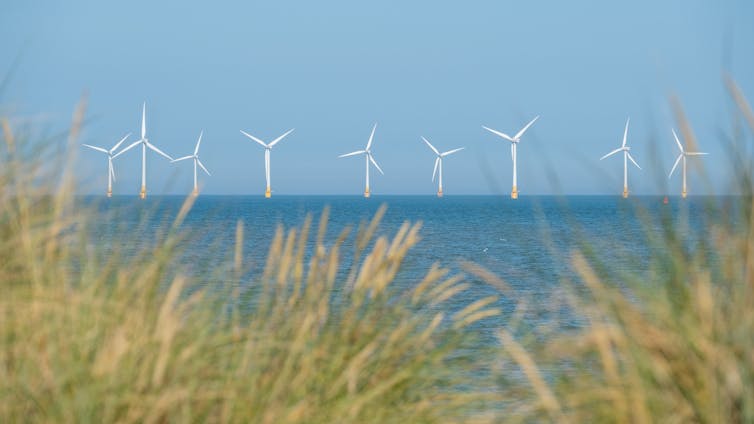
Renewable energy is often pitched as cheaper to produce than fossil fuel energy. To quantify whether this is true, we have been studying the financial impact of expanding wind energy in the UK. Our results are surprising.
From 2010 to 2023, wind power delivered a benefit of £147.5 billion — £14.2 billion from lower electricity prices and £133.3 billion from reduced natural gas prices. If we offset the £43.2 billion in wind energy subsidies, UK consumers saved £104.3 billion compared with what their energy bills would have been without investment in wind generation.
UK wind energy production has transformed over the past 15 years. In 2010, more than 75% of electricity was generated from fossil fuels. By 2025, coal has ceased and wind is the largest source of power at 30% – more than natural gas at 26%.
This massive expansion of UK offshore wind is partly due to UK government subsidies. The Contracts for Difference scheme provides a guaranteed price for electricity generated, so when the price drops below this level, electricity producers still get the same amount of money.
The positive contribution of wind power to reducing the UK’s carbon footprint is well known. According to Christopher Vogel, a professor of engineering who specialises in offshore renewables at the University of Oxford, wind turbines in the UK recoup the energy used in their manufacture, transport and installation within 12-to-24 months, and they can generate electricity for 20-to-25 years. The financial benefits of wind power have largely been overlooked though, until now.
Our study explores the economics of wind in the energy system. We take a long-term modelling approach and consider what would happen if the UK had continued to invest in gas instead of wind generation. In this scenario, the result is a significant increased demand for gas and therefore higher prices. Unlike previous short-term modelling studies, this approach highlights the longer-term financial benefit that wind has delivered to the UK consumer.
The authors’ new study quantifies the financial benefit of wind v fossil fuels to consumers. Igor Hotinsky/Shutterstock
Central to this study is the assumption that without the additional wind energy, the UK would have needed new gas capacity. This alternative scenario of gas rather than wind generation in Europe implies an annual, ongoing increase in UK demand for gas larger than the reduction in Russian pipeline gas that caused the energy crisis of 2022.
Given the significant increase in the cost of natural gas, we calculate the UK would have paid an extra £133.3 billion for energy between 2010 and 2023.
There was also a direct financial benefit from wind generation in lower electricity prices – about £14.2 billion. This combined saving is far larger than the total wind subsidies in that period of £43.2 billion, amounting to a net benefit to UK consumers of £104.3 billion.
Wind power is a public good
Wind generators reduce market prices, creating value for others while limiting their own profitability. This is the mirror image of industries with negative environmental consequences, such as tobacco and sugar, where the industry does not pay for the increased associated healthcare costs.
This means that the profitability of wind generators is a flawed measure of the financial value of the sector to the UK. The payments via the UK government are not subsidies creating an industry with excess profits, or one creating a financial drain. They are investments facilitating cheaper energy for UK consumers.
Wind power should be viewed as a public good — like roads or schools — where government support leads to national gains. The current funding model makes electricity users bear the cost while gas users benefit. This huge subsidy to gas consumers raises fairness concerns.
Wind investment has significantly lowered fossil fuel prices, underscoring the need for a strategic, equitable energy policy that aligns with long-term national interests. Reframing UK government support as a high-return national investment rather than a subsidy would be more accurate and effective.
Sustainability, security and affordability do not need to be in conflict. Wind energy is essential for energy security and climate goals – plus it makes over £100 billion of financial sense.
Colm O’Shea, Researcher, Renewable Energy, Geography Department, UCL and Mark Maslin, UCL Professor of Earth System Science and UNU Lead for Climate, Health and Security, UCL
Nigel Farage urges you to ignore facts and reality and be a climate science denier like him and his Deputy Richard Tice. He says that Reform UK has received £Millions and £Millions from the fossil fuel industry to promote climate denial and destroy the planet.Donald Trump urges you to be a Climate Science denier like him. He says that he makes millions and millions for destroying the planet, Burn, Baby, Burn and Flood, Baby, Flood.Orcas comment on killer apes destroying the planet by continuing to burn fossil fuels.
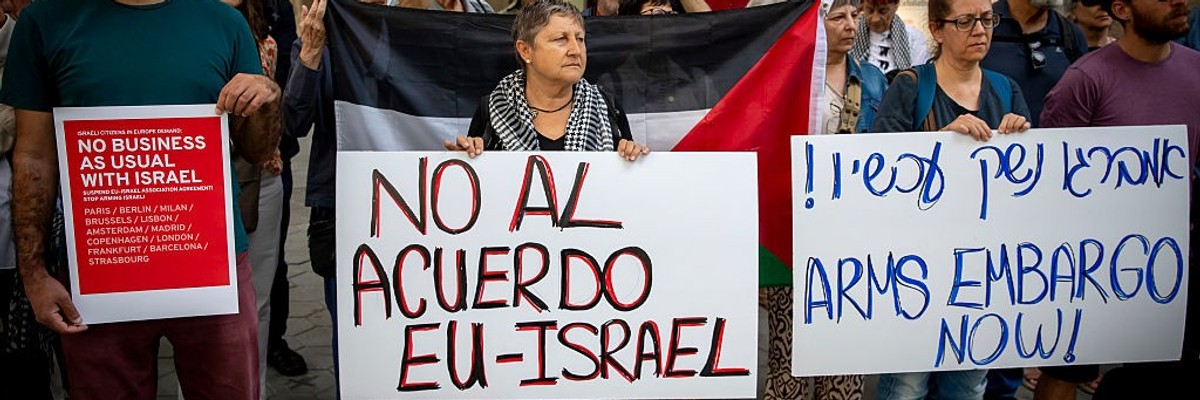
Protesters demand a European Union arms embargo on Israel and rejection of a trade deal with the country as punishmnent for its annihilation of Gaza during a May 27, 2025 demonstration outside the European Commission office in Barcelona. (Photo: Albert Llop/NurPhoto via Getty Images)
“The people have spoken and they refuse to be complicit,” said one campaigner. “Across continents, ordinary citizens demand an end to the fuel that powers settler colonialism, apartheid, and genocide.”
Large percentages of people in five nations want arms, fuel, and machinery embargoes on Israel in response to its obliteration and starvation of Gaza, a poll published Thursday revealed.
The survey—which was conducted last month by Pollfish for the Global Energy Embargo for Palestine and endorsed by Progressive International—queried people in Brazil, Colombia, Greece, South Africa, and Spain about whether their governments, fuel companies, weapons makers, and heavy machinery manufacturers should stop, reduce, continue, or increase business with Israel.
Nearly two-thirds of Spanish respondents said they strongly support or support their government taking action “to reduce trade in weapons, fuel, and other relevant goods to pressure Israel to end its military actions in Gaza.” In Greece, 63% back an embargo, while 35% oppose it. Sixty percent of Colombians, 58% of South Africans, and 48% of Brazilians strongly or somewhat support punitive sanctions on Israel.
Conversely, 27% of Brazilians said they do not support or strongly oppose an embargo on Israel, while 20% of South Africans, 14% of Colombians and Greeks, and 12% of Spaniards feel the same.
Support for ending or reducing weapons transfers was strong in all five nations, with 76% of Colombian respondents, 75% of Spaniards and Greeks, 66% of South Africans, and 59% of Brazilians favoring such action.
A majority of respondents in all five countries also said that companies providing arms, fuel, or heavy machinery to Israel “should be held responsible for how those products are used in Gaza.”
📊 New poll: People across the world say companies selling weapons, fuel, or heavy machinery to Israel should be held accountable for how those products are used in Gaza.🇪🇸 76%🇬🇷 71%🇨🇴 70%🇧🇷 62%🇿🇦 60%#EnergyEmbargoNow #NoFuelForGenocide@progintl.bsky.social
“The people have spoken and they refuse to be complicit,” Global Energy Embargo for Palestine campaigner Ana Sánchez said in a statement.
“Across continents, ordinary citizens demand an end to the fuel that powers settler colonialism, apartheid, and genocide,” Sánchez added. “No state that claims to uphold democracy can justify maintaining energy, military, or economic ties with Israel while it commits a genocide in Palestine. This is not just about trade; it’s about people’s power to cut the supply lines of oppression.”
The poll was published 670 days into Israel’s U.S.-backed assault and siege on Gaza, which has left at least 226,600 Palestinians dead, maimed, or missing and hundreds of thousands more starving amid increasingly deadly famine as Israel blocks aid from entering the embattled enclave.
The far-right government of Israeli Prime Minister Benjamin Netanyahu—a fugitive from the International Criminal Court wanted for alleged crimes against humanity and war crimes in Gaza—is moving ahead with plans for the “full conquest,” reoccupation, and ethnic cleansing of the strip, which U.S. President Donald Trumpwants to transform into “the Riviera of the Middle East.”
Israel’s conduct in the war is the subject of an International Court of Justice genocide case brought by South Africa and supported by around two dozen nations. Among the countries in the survey, Colombia—which severed diplomatic ties with Israel in May 2024—Spain, and Brazil have formally joined or signaled their intent to join South Africa’s case.
The ICJ also found last year that Israel’s occupation of Palestine is an illegal form of apartheid.
“What the Israeli government is doing to the Palestinian people is not war, it is genocide,” Brazilian President Luiz Inácio Lula da Silva said in February 2024 shortly after recalling his ambassador to Tel Aviv. “If this isn’t genocide, I don’t know what is.”
On Thursday, European Commission Executive Vice President Teresa Ribera—who is Spanish—toldPolitico, “If it is not genocide, it looks very much like the definition used to express its meaning.”
“What we are seeing is a concrete population being targeted, killed, and condemned to starve to death,” Ribera said. “A concrete population is confined, with no homes—being destroyed—no food, water, or medicines—being forbidden to access—and subject to bombing and shooting even when they are trying to get humanitarian aid. Any humanity is absent, and no witness[es] are allowed.”
Of the surveyed nations, all but Greece support an arms embargo on Israel. The other four countries took part in last month’s Hague Group emergency ministerial conference in Colombia, which was organized by Progressive International and ended with the publication of a joint action plan for “coordinated diplomatic, legal, and economic measures to restrain Israel’s assault on the occupied Palestinian territories and defend international law at large.”
“The message from the peoples of the world is loud and clear: They want action to end the assault on Gaza—not just words,” Progressive International co-general coordinator David Adler said in a statement accompanying the new survey’s publication.
“Across continents, majorities are calling for their governments to halt arms sales and restrain Israel’s occupation,” Adler added. “That’s why states are coming together through the Hague Group to take concrete measures toward accountability. It’s time for others to follow their lead.”
Meanwhile, a survey published Tuesday by the Israel Democracy Institute revealed that 8 in 10 Israeli Jews “are not so troubled or not at all troubled personally” by “the reports of famine and suffering among the Palestinian population in Gaza.”
Eight people, including a child, starved to death in Gaza that day, on which local officials said that more than 80 Palestinians were killed by Israel’s bombs, bullets, and blockade.
Keir Starmer objects to criticism of the IDF. He asks how could anyone object to them starving people to death, forced marches like the Nazis did, bombing Gaza’s hospitals and universities,mass-murdering journalists, healthworkers and starving people queuing for food, killing and raping prisoners and murdering children. He calls for people to stop obstructing his genocide for Israel.
Only a truly democratic party can provide the space for the policies that are needed to transform society. Up and down the country, there is huge appetite for an economic reset. One that brings water, energy, rail and mail into public ownership. One that invests in welfare, not warfare. One that ends this government’s complicity in genocide and brings about justice for the Palestinian people. One that makes the wealthiest in society pay a bit more in tax to ensure that everyone can live in dignity.
This is the political vision that can inspire hope, not fear. The great dividers want you to think that migrants and minorities are responsible for the problems in our society. They’re not. Those problems are caused by a rigged economic system that protects the interests of billionaires and corporations. By scapegoating migrants and minorities for its own domestic failures, Labour has paved the path for Reform UK. This Labour government is here to appease Reform. We are here to defeat Reform. We are at a critical juncture, and we need an alternative, now.
…
Think of what we could achieve together.
The future we deserve is no pipe dream. Look around you, and you will find proof that a better world is possible. We are not fighting for crumbs. We are fighting for real change – and we are never, ever going away.
dizzy: I need to spend time on other projects for the next few years. We need left bloggers and social media activists. It’s a hard slog to get established but go for the long term. Teams of 10 or more would be ideal because you could share the work, maybe concentrate on your own area of interest. Suggest that you change passwords regularly and drop and replace people who don’t pull their weight. In a few years, ready for the next election, you should be kicking and taking on number 10’s influence and influencers reported in this article.


 An online energy bill