The study was published as President Donald Trump was blasted for an executive order that one critic said shows he wants to turn the Alaskan Arctic into the “the world’s largest gas station.”
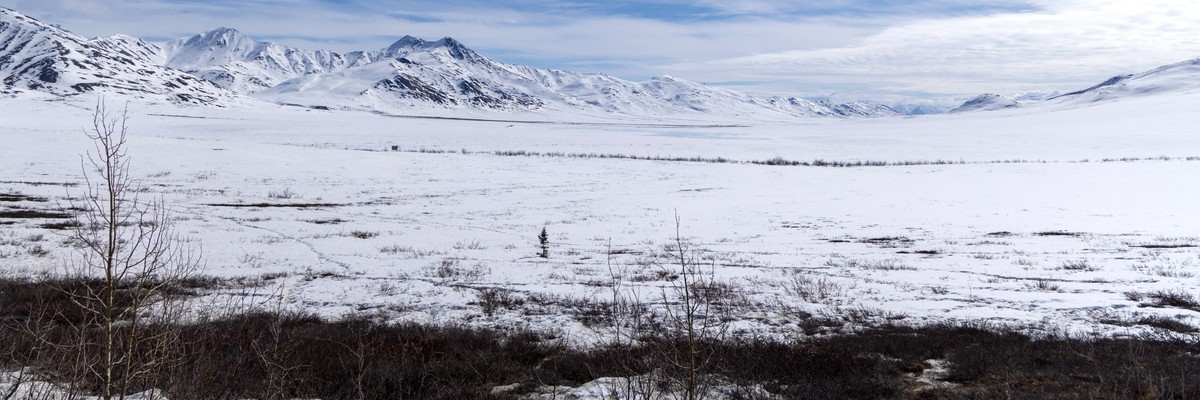
For thousands of years, the land areas of the Arctic have served as a “carbon sink,” storing potential carbon emissions in the permafrost. But according to a study published in the journal Nature Climate Change Tuesday, more than 34% of the Arctic is now a source of carbon to the atmosphere, as permafrost melts and the Arctic becomes greener.
“When emissions from fire were added, the percentage grew to 40%,” according to the Woodwell Climate Research Center, which led the international team that conducted the research.
The study, which was first reported on by The Guardian, was released the day after President Donald Trump issued multiple presidential actions influencing the United States’ ability to confront the climate crisis, which is primarily caused by fossil fuel emissions, including one directly impacting resource extraction in Alaska, a section of which is within the Arctic Circle.
Sue Natali, one of the researchers who worked on the study published in Nature Climate Change, told NPR in December (in reference to similar research) that the Arctic’s warming “is not an issue of what party you support.”
“This is something that impacts everyone,” she said.
As the permafrost—ground that remains frozen for two or more years—holds less carbon, it releases CO2 into the atmosphere that could “considerably exacerbate climate change,” according to the study.
“There is a load of carbon in the Arctic soils. It’s close to half of the Earth’s soil carbon pool. That’s much more than there is in the atmosphere. There’s a huge potential reservoir that should ideally stay in the ground,” said Anna Virkkala, the lead author of the study, in an interview with The Guardian.
The dire warning was released on the heels of Trump’s executive order titled “Unleashing the Alaska’s Extraordinary Resource Potential” that calls for expedited “permitting and leasing of energy and natural resource projects in Alaska,” as well as for the prioritization of “development of Alaska’s liquefied natural gas (LNG) potential, including the sale and transportation of Alaskan LNG to other regions of the United States and allied nations within the Pacific region.”
The order also rolls back a number of Biden-era restrictions on drilling and extraction in Alaska, which included protecting areas within the Arctic National Wildlife Refuge from oil and gas leasing.
“Alaska is warming four times faster than the rest of the planet, a trend that is wreaking havoc on communities, ecosystems, fish, wildlife, and ways of life that depend on healthy lands and waters,” said Carole Holley, managing attorney for the Alaska Office of the environmental group Earthjustice, in a statement Monday.
“Earthjustice and its clients will not stand idly by while Trump once again forces a harmful industry-driven agenda on our state for political gain and the benefit of a wealthy few,” she added.
Trump wants to turn the Alaskan Arctic into the “the world’s largest gas station,” said Athan Manuel, director of Sierra Club’s Lands Protection Program, in a statement Monday. “Make no mistake, Trump’s rushed and sloppy actions today are an existential threat to these lands and waters, and the communities and wildlife that depend on them.”
UK Labour government’s budget by Rachel Reeves doesn’t really matter in the bigger picture. While we have Israel’s continuing genocide (genocides?) with the UK Labour government a major active participant the real big issue is the hugely devastating floods in Spain. ‘This Is Climate Change’: Devastating Flooding Kills More Than 70 in Spain.
The problem is that World governments are going to do very little to address climate change until they are forced to. It’s only getting worse since it’s not addressed despite fossil fuel industries and governments being aware for 60 years. Climate campaigners are imprisoned instead of the real climate criminals.
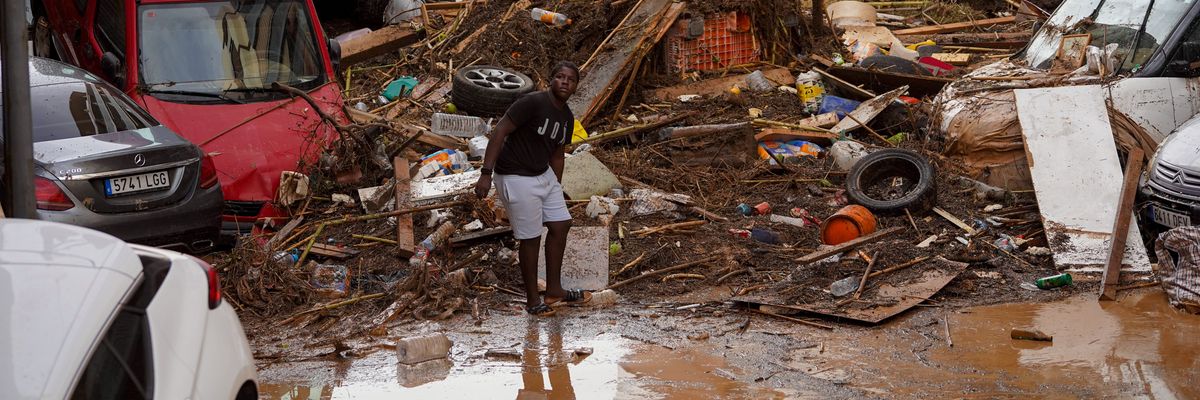
A view of the damaged area after a deluge brought up to 200 liters of rain per square meter (50 gallons per square yard) in hours in towns across the region of Valencia, Spain on October 30, 2024. (Photo: Alex Juarez/Anadolu via Getty Images)
“These disasters are only getting worse, and stopping the industries and systems driving climate collapse is the only rational response,” one climate group said.
Spain’s deadliest flooding in 30 years killed at least 72 people as torrential rain slammed the eastern region of Valencia on Tuesday, with some towns recording a year’s worth of rain in a single day.
The flooding sent churning muddy water down narrow streets, tossing cars, downing trees, bulldozing bridges and buildings, and trapping people in rising flood waters.
“The neighborhood is destroyed, all the cars are on top of each other, it’s literally smashed up,” Christian Viena, who owns a bar in Valencia’s Barrio de la Torre, told The Associated Press. “Everything is a total wreck, everything is ready to be thrown away. The mud is almost 30 centimeters (11 inches) deep.”
As of Wednesday morning, officials reported 70 deaths in Valencia and two in the bordering region of Castilla La Mancha. However, the death toll could rise as search and rescue operations continue amid difficult conditions, such as power outages and blocked roadways. Many people remain missing with their fates uncertain.
This includes residents of Utiel in Valencia, whose mayor, Ricardo Gabaldón, told Spanish broadcaster RTVE that Tuesday was the “worst day of my life.”
“We were trapped like rats,” Gabaldón said. “Cars and trash containers were flowing down the streets. The water was rising to 3 meters (9.8 feet).”
One person who was rescued was Denis Hlavaty, who spent the night perched on the edge of the roof of a gas station where he works.
“It’s a river that came through,” Hlavaty told Reuters, adding, “The doors were torn away and I spent the night there, surrounded by water that was 2 metres (6.5-feet) deep.”
“The fossil fuel industry increases the climate emergency, destroys the balance of critical ecosystems, and puts people’s lives in danger.”
The storm also canceled high-speed rail travel between Valencia and Madrid and Barcelona, and derailed one high-speed train near Malaga, though no one was injured.
While the rains had tapered off in Valencia by Wednesday morning, the rest of the country is not out of danger, as the storm is projected to move northeast.
“We mustn’t let our guard down because the weather front is still wreaking havoc and we can’t say that this devastating episode is over,” Spanish Prime Minister Pedro Sánchez told the nation on television Wednesday.
Even if the death toll does not rise, Tuesday’s floods are already the deadliest in Spain since 1996, when a flood near the Pyrenees killed 87. They are also the deadliest in Europe since floods in 2021 that killed at least 185.
In the immediate term, Tuesday’s deluge was caused by a phenomenon called a gota fría, or “cold drop,” a storm formed as cold air moves over the warm Mediterranean. In Spain, these kinds of storms are also commonly referred to with the acronym DANA—for Depresión Aislada en Niveles Altos, or isolated high-level depression.
However, scientists observe that the climate crisis is making rainstorms like this one more extreme, as warmer air can hold more moisture to dump when conditions are right. For Europe specifically, the warming of the Mediterranean causes more water to evaporate from its surface, super-charging rainstorms.
“Events of this type, which used to occur many decades apart, are now becoming more frequent and their destructive capacity is greater,” Ernesto Rodriguez Camino, senior state meteorologist and a member of the Spanish Meteorological Association, told Reuters.
The Spanish flooding comes a little more than a month after record rainfall swamped Central Europe and Eastern Europe, in an event that scientists concluded was made approximately twice as likely and 7% more severe by the climate crisis fueled primarily by the burning of fossil fuels.
“When we talk about climate change and climate emergency, it’s often perceived as an abstract concept far from our daily reality,” Eva Saldaña, the executive director of Greenpeace Spain, said in a statement. “Unfortunately, this is climate change: the intensification of extreme weather phenomenons like what happened tonight, with the level of destruction greater each time. Ignoring it causes deaths that we cannot allow.”
In a post on social media, Greenpeace Spain said that fossil fuel companies including the Spanish Repsol should pay for the damages.
“DANAS are more intense every time due to climate change,” the group wrote. “The fossil fuel industry increases the climate emergency, destroys the balance of critical ecosystems, and puts people’s lives in danger.”
Extinction Rebellion Global agreed. “These disasters are only getting worse, and stopping the industries and systems driving climate collapse is the only rational response,” the group wrote on social media.
The U.S.-based Climate Defiance, meanwhile, shared images of flood-ravaged streets with dismissals often leveled at climate activists.
Yellow Dot Studios, Don’t Look Up director Adam McKay’s climate-focused media studio, also shared an image of cars dropped in piles in the street by the flood waters to call out the double-standard in how direct-action climate protests and the corporate crimes of the fossil fuel industry are punished.
Friends of the Earth Spain focused on the human impacts, arguing that urgent climate action meant “putting people’s lives, and not economic models, at the center.”
“Don’t prioritize sending people to work in extreme and dangerous conditions,” the group wrote. “It is a priority to take effective, ambitious, and urgent measures in response to the climate crisis we are living through.”
Original article by Brett Wilkins republished from Common Dreams under Creative Commons (CC BY-NC-ND 3.0).
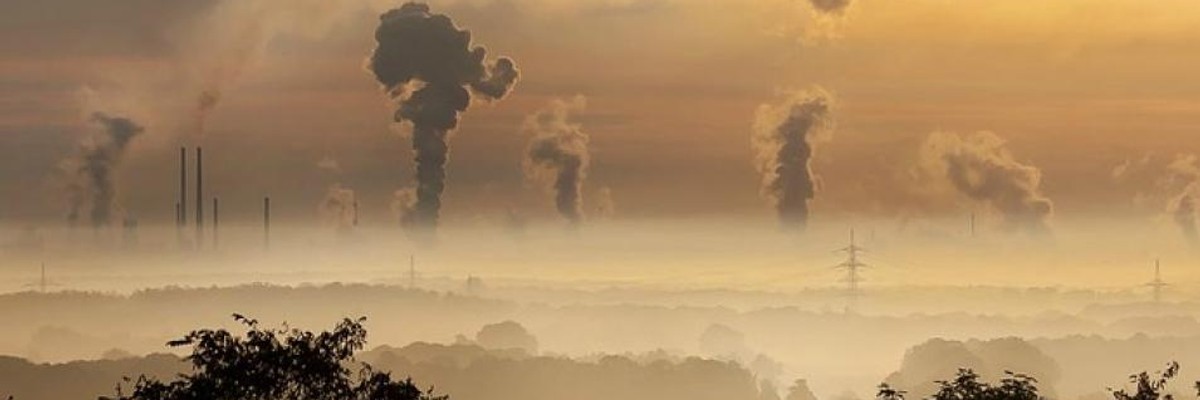
Carbon emissions and haze are seen near factories and a power plant. (Photo: Pixabay/Creative Commons)
“Closing the emissions gap means closing the ambition gap, the implementation gap, and the finance gap,” said U.N. Secretary-General António Guterres. “Starting at COP29.”
The world’s nations must commit to dramatically slashing greenhouse gas emissions in the near future or risk a “catastrophic” rise in global average temperatures, a key United Nations climate report published Thursday warned.
“It is still technically possible to meet the 1.5°C goal” set out in the Paris agreement, “but only with a G20-led massive global mobilization to cut all greenhouse gas emissions, starting today,” the United Nations Environmental Program (UNEP) said in a summary of its annual Emissions Gap Report.
“Nations must collectively commit to cutting 42% off annual greenhouse gas emissions by 2030 and 57% by 2035 in the next round of Nationally Determined Contributions (NDCs)—and back this up with rapid action—or the Paris agreement’s 1.5°C goal will be gone within a few years,” UNEP warned.
“Failure to increase ambition in these new NDCs and start delivering immediately would put the world on course for a temperature increase of 2.6-3.1°C over this century,” the agency said. “This would bring debilitating impacts to people, planet, and economies.”
New UNEP emissions gap report highlights a "massive gap between rhetoric and reality" and calls for a "quantum leap" in ambition to deliver Paris goals, as the world is way off-track today.
UNEP said “solar, wind, and forests” have the potential to help the world “get on a 1.5°C pathway.” However, “sufficiently strong NDCs would need to be backed urgently by a whole-of-government approach, measures that maximize socioeconomic and environmental co-benefits, enhanced international collaboration that includes reform of the global financial architecture, strong private sector action, and a minimum six-fold increase in mitigation investment.”
“G20 nations, particularly the largest-emitting members, would need to do the heavy lifting,” the agency added.
The task is daunting—according to the report, human emissions of greenhouse gases—CO2, methane, nitrous oxide, and fluorinated gases—reached a record 57.1bn tons of CO2 equivalent (GtCO2e) last year.
“The emissions gap is not an abstract notion,” U.N. Secretary-General António Guterres stressed in a video message on the UNEP report. “There is a direct link between increasing emissions and increasingly frequent and intense climate disasters.”
“Around the world, people are paying a terrible price,” he continued. “Record emissions mean record sea temperatures supercharging monster hurricanes; record heat is turning forests into tinder boxes and cities into saunas; record rains are resulting in biblical floods.”
“Today’s Emissions Gap report is clear: We’re playing with fire; but there can be no more playing for time,” Guterres added. “We’re out of time. Closing the emissions gap means closing the ambition gap, the implementation gap, and the finance gap. Starting at COP29.”
Annual greenhouse gas emissions reached an all-time high last year.
The U.N. chief was referring to the United Nations Climate Change Conference, which is set to take place next month in Baku, Azerbaijan—a nation that is “aggressively” expanding fossil fuel production.
UNEP Executive Director Inger Andersen said in a statement:
Climate crunch time is here. We need global mobilization on a scale and pace never seen before—starting right now, before the next round of climate pledges—or the 1.5°C goal will soon be dead and well below 2°C will take its place in the intensive care unit. I urge every nation: No more hot air, please. Use the upcoming COP29 talks in Baku, Azerbaijan, to increase action now, set the stage for stronger NDCs, and then go all-out to get on a 1.5°C pathway.
Even if the world overshoots 1.5°C—and the chances of this happening are increasing every day—we must keep striving for a net-zero, sustainable, and prosperous world. Every fraction of a degree avoided counts in terms of lives saved, economies protected, damages avoided, biodiversity conserved, and the ability to rapidly bring down any temperature overshoot.
Climate scientists and green groups expressed alarm over the UNEP report.
“The Emissions Gap Report is yet another clear warning about what needs to be done and fast,” Andreas Sieber, associate director of policy and campaigns at 350.org, said in a statement. “Last year at COP28, nations agreed to transition away from fossil fuels. The report makes it crystal clear that governments must translate this decision into action in their national climate pledges if they are serious about the just energy transition.”
Greenpeace International climate politics expert Tracy Carty said that “for 15 years, the UNEP has been sounding the alarm on the great chasm between political will for climate action and the worsening emissions trajectory fuelling rising temperatures.”
“These reports are a historical litany of negligence from the world’s leaders to tackle the climate crisis with the urgency it demands, but it’s not too late to take corrective action,” Carty continued. “We challenge leaders to embark on wholesale change in their 2035 climate plans, to come to COP29 prepared to finance climate action and to make up for lost time.”
The UNEP Emissions Gap Report 2024 is out, and it highlights the urgency for countries to raise their 2030 climate targets and act swiftly.
Rachel Cleetus, policy director and a lead economist in the Climate and Energy Program at the Union of Concerned Scientists, issued a statement arguing that the new UNEP report “forcefully confirms that nations’ efforts to cut heat-trapping emissions have been grossly insufficient to date.”
“Global heating records are being topped year after year, and people and ecosystems worldwide are suffering the devastation of unrelenting climate change disasters and increasingly irreversible impacts,” she noted. “To put it bluntly, decades of inadequate action have put the 1.5°C goal further out of reach and world leaders are failing their people. The consequences are profound—but the policy choices decided now are as crucial as ever to limit future harm.”
Cleetus continued:
The best way forward is to implement sweeping changes to the global energy system by phasing out the destructive products fossil fuel companies are peddling and investing big in renewable energy solutions to sharply curtail heat-trapping emissions. Also urgent are scaled-up investments in climate resilience to cope with impacts already locked in. Rich, high-emitting nations—including the United States—are most responsible for these calamitous circumstances. Those living in climate-vulnerable, low-income countries that contributed very little to the fossil fuel pollution driving this crisis need more than hollow words; they need wealthy countries and other major emitters to live up to their responsibilities.
“At the upcoming U.N. climate talks, wealthy nations must significantly grow the amount of climate financing available to ensure all countries can slash their global warming emissions and prepare for the more frequent and severe climate impacts that are the punishing consequence of a warming world,” Cleetus added.
Original article by Brett Wilkins republished from Common Dreams under Creative Commons (CC BY-NC-ND 3.0).
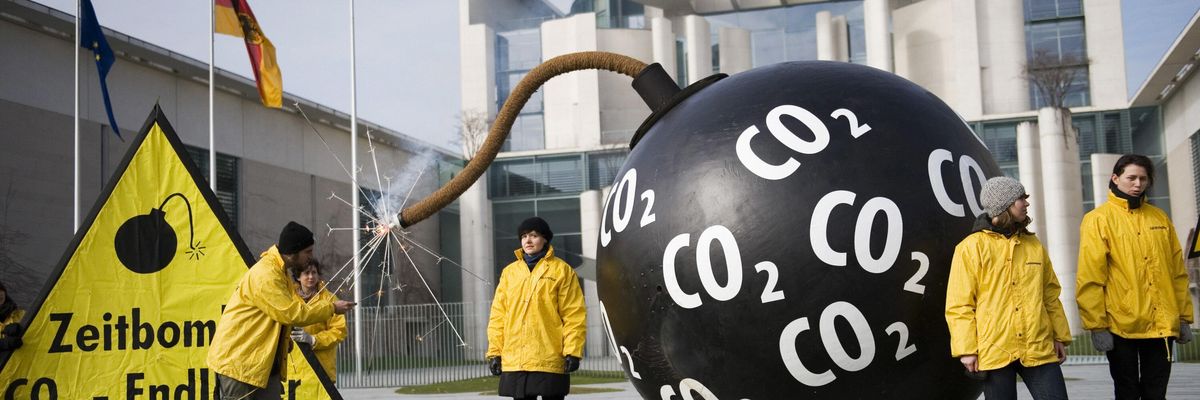
Greenpeace activists light up a mock bomb labeled “CO2” during a campaign in front of the German Chancellery in Berlin on March 25, 2009. (Photo: Michael Gottschalk/DDP/AFP via Getty Images.
As attendees gathered in the south of France Thursday for the start of a European Union-hosted summit on carbon capture and storage, an international coalition of green groups warned against funding “reckless, unscientific, and lobbyist-driven” false climate solutions and instead urged investment in “a just transition that prioritizes renewable energy, energy demand reduction, and energy efficiency.”
“Today the Industrial Carbon Management Forum (ICMF) kicks off in Pau, France,” 43 organizations wrote in a letter to the European Commission. “This forum has been revealed to be dominated by fossil fuel interests to the exclusion of civil society stakeholders and other expert voices with critical views.”
🚨 As the #ICMForum kicks off, civil society groups blow the whistle on the Europen Union’s reckless, unscientific, lobbyist-led Carbon Capture and Storage plans!
— Center for International Environmental Law (@ciel_tweets) October 10, 2024
The letter points to a report published Thursday by the Institute for Energy Economics and Financial Analysis (IEEFA), which concluded that “most of Europe’s planned carbon capture and storage (CCS) applications are too expensive to work on a commercial basis and are nowhere near ready to be rolled out.”
According to the report, Europe’s planned CCS projects will cost an estimated €520 billion ($569 billion), which IEEFA energy finance analyst and report author Andrew Reid said “will force European governments to introduce eye-wateringly high subsidies to prop up a technology that has a history of failure.”
The green groups’ letter also notes widespread criticism of CCS, which has been panned by Food & Water Watch—whose European branch signed the letter—as a “false climate solution” and a “lifeline for the fossil fuel industry.”
The signers wrote that the United Nations Intergovernmental Panel on Climate Change “has labeled CCS as one of the most costly and least effective emissions reduction methods, and an Oxford study found high-CCS pathways could cost $30 trillion more globally than renewable alternatives,” the signers wrote, referring to the United Nations Intergovernmental Panel on Climate Change.
The letter continues:
As well as being prohibitively expensive, plans for carbon capture and storage (CCS) at scale face overwhelming technical challenges and the records show 50 years of failure. Even with $83 billion in investment since the ’90s, research found that nearly 80% of large-scale projects fail. The industry itself has acknowledged that for all these efforts, only 52 metric tons of carbon dioxide have ever been stored long-term, highlighting the unlikeliness of achieving the E.U.’s stated goal of storing 280 metric tons of CO2 by 2040…
The union has already spent over €3 billion ($3.3 billion) on CCS and hydrogen projects—hydrogen is often paired with CCS to attempt to capture the carbon dioxide emissions released during hydrogen production from fossil fuels in order to label hydrogen a low-carbon fuel. However, this ignores the ineffectiveness of CCS to reduce emissions and the continued use of fossil fuels in the process.
“We cannot afford to give further investments to the fossil fuel industry to gamble with our future and our tax money,” the green groups stressed. “Money allotted to CCS would be better spent on the communities and countries that need it most and on ensuring a full and fair phaseout of fossil fuels.”
In stark contrast, E.U. Energy Commissioner Kadri Simson said during the opening session of the CCS summit that the 27-nation bloc’s climate target plan “underlines that industrial carbon management is not just an alternative, it is a vital complement to renewable energy and energy efficiency.”
The letter’s signers are calling on E.U. policymakers to:
Stop wasting money on CCS projects and commit to a full phaseout of fossil fuels;
Reject the influence of the fossil fuel industry;
Commit to a full consideration of the scientific and real-world evidence of CCS’ failures, limitations, and challenges; and
Invest instead in real climate, health, and nature solutions that deliver a transition to a clean, healthy, and safe economy.
“The current fossil fuel industry influence on the E.U.’s carbon capture policy undermines the E.U.’s ability to meet its climate goals and responsibilities, and is damaging its reputation and leadership,” the groups asserted. “Rejecting the influence of the fossil fuel industry and investing in climate action that can actually deliver emissions cuts and steer a just transition from the fossil fuel economy is crucial if the E.U. is to deliver real solutions for climate, nature, and people.”