2024 ‘Virtually Certain’ to Be Hottest Year on Record: EU Climate Agency

Spread the love

Original article by Julia Conley republished from Common Dreams under Creative Commons (CC BY-NC-ND 3.0). 

A resident tries to fight a wildfire burning on September 17, 2024 in Marco de Canaveses, Portugal. (Photo: Octavio Passos/Getty Images)

A new report contained “the bleakest news possible, especially with a climate denier U.S. president in office for the next four years,” said one climate scientist.

A day after U.S. voters elected climate-denying Republican Donald Trump in the presidential race, soon ushering in an administration that is sure to expand fossil fuel drilling, the European Union’s Earth observation agency announced that 2024 is “virtually certain” to be the hottest year on record and to hit a worrying temperature milestone.

The year is expected to be the first on record in which the temperature is more than 1.5°C hotter than before the Industrial Revolution, according to the Copernicus Climate Change Service (CCCS). The Paris climate agreement of 2015 urged countries to curb greenhouse gas emissions with the goal of limiting planetary heating to 1.5°C by the end of the century.

Over the past 12 months, said CCCS, global temperatures were 1.6°C warmer than the yearly average from 1850-1900.

https://twitter.com/OceanTerra/status/1854419940087906769?ref_src=twsrc%5Etfw%7Ctwcamp%5Etweetembed%7Ctwterm%5E1854419940087906769%7Ctwgr%5E603fae17c6b14c6a10b87145e07821d8631d7159%7Ctwcon%5Es1_c10&ref_url=https%3A%2F%2Fwww.commondreams.org%2Fnews%2F2024-hottest-year

Sorry, this content could not be embedded.
X

“The average temperature anomaly for the rest of 2024 would have to drop to almost zero for 2024 to not be the warmest year,” said CCCS.

Last month was the second-hottest October ever recorded, with temperatures 1.65°C higher than preindustrial levels. It was the 15th month in the past 16 to be hotter than 1.5°C over preindustrial temperatures.

While a single year above the 1.5°C mark does not necessarily indicate that the Paris climate goal is out of reach, CCCS director Carlo Buontempo said the planet has “never had to cope with a climate as warm as the current one.”

“This inevitably pushes our ability to respond to extreme events—and adapt to a warmer world—to the absolute limit,” he told The Guardian.

Climate scientist Bill McGuire called the Copernicus report “the bleakest news possible, especially with a climate denier U.S. president in office for the next four years.”

Trump has pledged to expand fossil fuel extraction and do away with climate regulations introduced by the Biden administration, telling oil executives he would do so if they contributed $1 billion to his campaign in what was described as a quid pro quo.

The CCCS—which based its analysis on billions of measurements from satellites, ships, aircraft, and weather stations—noted in its report that October saw numerous extreme weather events tied to the warming planet. Heavy rains led to severe flash flooding in Spain, killing more than 200 people. Above average precipitation was also seen in Norway, France, China, southern Brazil, and parts of Australia, while Florida faced Hurricane Milton just two weeks after Hurricane Helene killed more than 230 people.

The World Meteorological Organization last week announced that carbon dioxide concentrations in the atmosphere are accumulating faster than at any other time in human history, rising more than 10% in the last two decades.

“The most effective solution to address the climate challenges is a global commitment on emissions,” Buontempo told The Guardian.

BBC journalist Navin Singh Khadka said on the news network that if the 1.5°C breach continues “in the long term, then we are warned there will be catastrophic consequences.”

https://twitter.com/NavinSinghKhadk/status/1854542180431343837?ref_src=twsrc%5Etfw%7Ctwcamp%5Etweetembed%7Ctwterm%5E1854542180431343837%7Ctwgr%5E603fae17c6b14c6a10b87145e07821d8631d7159%7Ctwcon%5Es1_c10&ref_url=https%3A%2F%2Fwww.commondreams.org%2Fnews%2F2024-hottest-year

Sorry, this content could not be embedded.
X

Original article by Julia Conley republished from Common Dreams under Creative Commons (CC BY-NC-ND 3.0). 

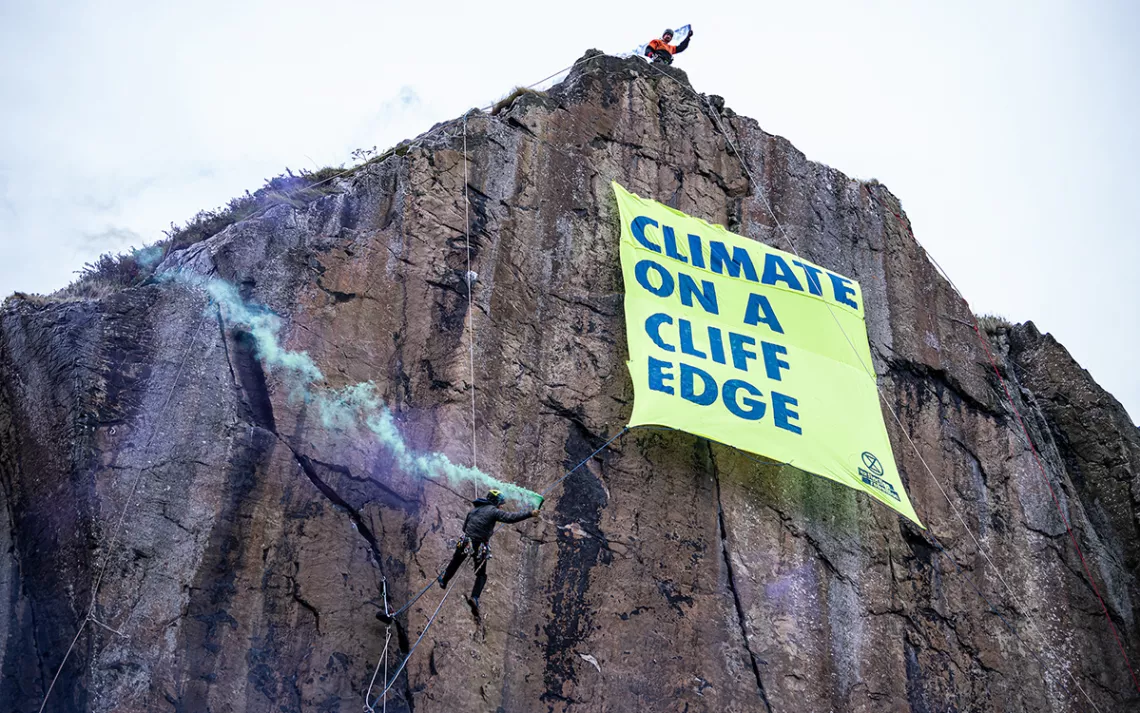
Experienced climbers scale a rock face near the historic Dumbarton castle in Glasgow, releasing a banner that reads “Climate on a Cliff Edge.” One activist, dressed as a globe, symbolically looms near the edge, while another plays the bagpipes on the shores below. | Photo courtesy of Extinction Rebellion and Mark Richards
Continue Reading2024 ‘Virtually Certain’ to Be Hottest Year on Record: EU Climate Agency

Fossil-Fueled Hurricane Milton Hammers Florida With Violent Winds, Massive Flooding

Spread the love

Original artitcle by Jake Johnson republished from Common Dreams under Creative Commons (CC BY-NC-ND 3.0). 

A vehicle is stranded on a water-flooded street after Hurricane Milton made landfall in Brandon, Florida on October 9, 2024.
 (Photo: Miguel J. Rodriguez Carrillo/AFP via Getty Images)

“If politicians had listened to scientists decades ago, and worked to gradually rein in fossil fuel pollution, the ocean wouldn’t be so boiling hot—and Hurricane Milton wouldn’t have had the fuel to balloon into such a monster storm.”

Hurricane Milton made landfall south of Tampa, Florida late Wednesday as a Category 3 storm after rapidly intensifying in the Gulf of Mexico, bringing devastating flooding and powerful winds that destroyed homes and knocked out power for millions.

Several tornadoes triggered by the monstrous storm—which was made stronger by ocean temperatures pushed higher by fossil fuel-driven climate change—killed an unspecified number of residents on Florida’s Atlantic Coast, according to local authorities.

The Associated Press reported that “about 125 homes were destroyed before the hurricane came ashore, many of them mobile homes in communities for senior citizens.”

More than a million Floridians were under evacuation orders as Milton barreled toward the state.

While Milton was downgraded to a Category 2 storm shortly after making landfall and was tracking away from Florida’s East Coast Thursday morning, the National Weather Service warned that “life-threatening storm surge, extreme winds, and flooding rains will continue to occur.”

Video footage posted to social media provided a glimpse of the flooding in downtown Tampa:

Experts characterized Milton, which followed closely on the heels of Helene, as a historically powerful hurricane, pointing to its rapid transformation from a tropical storm into a Category 5 hurricane.

“Milton is the quickest storm on record to rapidly intensify into a Category 5 in the Gulf of Mexico,” according to CBS News meteorologist Nikki Nolan.

Ahead of Milton’s arrival in Florida, climate advocates and scientists pointed to the role of the fossil fuel industry and its political allies in misleading the public about the impacts of oil, gas, and coal emissions and obstructing action to confront the threat posed by warming temperatures.

“Things didn’t have to be this way,” Kathy Baughman McLeod, the CEO of Climate Resilience for All, wrote Wednesday. “If politicians had listened to scientists decades ago, and worked to gradually rein in fossil fuel pollution, the ocean wouldn’t be so boiling hot—and Hurricane Milton wouldn’t have had the fuel to balloon into such a monster storm.”

Original artitcle by Jake Johnson republished from Common Dreams under Creative Commons (CC BY-NC-ND 3.0). 

Continue ReadingFossil-Fueled Hurricane Milton Hammers Florida With Violent Winds, Massive Flooding

Deadly Flooding in Europe Shows ‘Dramatic Consequences’ of Climate Change

Spread the love

Original article by Olivia Rosane republished from Common Dreams under Creative Commons (CC BY-NC-ND 3.0). 

The Danube Canal overflows its banks in Vienna’s city center on September 15, 2024. 
(Photo: Alex Halada/AFP via Getty Images)

“What you see here is worse than in 1997, and I don’t know what will happen because my house is under water and I don’t know if I will even return to it,” one storm evacuee said.

Extreme flooding has claimed the lives of at least seven people in Central and Eastern Europe and forced thousands to flee their homes over the weekend.

Storm Boris—a low pressure system—has been lashing the area since Thursday, with major cities seeing a month’s worth of rain and some areas seeing their heaviest rainfall in 100 years between Saturday and Sunday.

“We are again facing the effects of climate change, which are increasingly present on the European continent, with dramatic consequences,” Romanian President Klaus Iohannis said, as The Guardian reported.

The storm has been deadliest in Romania, where four people were killed on Saturday and a fifth on Sunday, according toCNN. Hundreds of people also had to be rescued from rising waters.

The most impacted part of Romania was Galati, where the storm damaged around 5,400 homes—and around 700 in the village of Slobozia Conachi alone.

“This is a catastrophe of epic proportions,” Mayor Emil Dragomir said, as The Guardian reported.

“The idiotic media have failed to make it clear what’s coming—and this is still the beginning.”

The sixth death came in Austria, where a firefighter battling flooding perished on Sunday. Authorities have declared a disaster for Lower Austria, where Vienna is located, and staged nearly 5,000 rescues there Saturday night. The storm also shut down rail service in the eastern part of the country.

“We are experiencing difficult and dramatic hours in Lower Austria,” said the provincial governor Johanna Mikl-Leitner, as The Associated Press reported. “For many people in Lower Austria these will probably be the most difficult hours of their lives.”

In Poland, one person drowned in the hardest-hit region of Kłodzko, where around 1,600 people were forced to evacuate and 17,000 lost power.

In another town of Stonie Slaski, flood waters overwhelmed a dam and collapsed a bridge, while the river in Glucholazy overflowed its banks.

“The situation is still very dramatic in many place[s],” Polish Prime Minister Donald Tusk said on Sunday, according to CNN. “Unfortunately, these situations are repeating themselves in many places… but some residents sometimes underestimate the level of threat and refuse to evacuate.”

The storm also pummeled parts of Slovakia, Hungary, and the Czech Republic, where some of the highest rainfall totals in the region were reported and where four people are still missing.

The storm forced 10,000 people from the city of Opava to flee their homes, and Mayor Tomáš Navrátil said conditions were worse than in 1997’s so-called “flood of the century,” according to AP.

“What you see here is worse than in 1997, and I don’t know what will happen because my house is under water and I don’t know if I will even return to it,” Lipová-lázne resident Pavel Bily said, as The Guardian reported.

The rains are expected to continue at least through Monday.

In 2021, World Weather Attribution said that the climate emergency has made extreme flooding in Europe more likely. The storm also followed the hottest summer on record, as well as a warm beginning to September in the region, and warmer air can hold more moisture.

“People are in prison today for trying to warn the public how bad things are going to get,” author Matthew Todd wrote on social media in response to footage of a dam bursting in Poland. “Scientists have taken to the streets to warn us.”

“The idiotic media have failed to make it clear what’s coming—and this is still the beginning,” Todd continued. “Educate everyone you know.”

Original article by Olivia Rosane republished from Common Dreams under Creative Commons (CC BY-NC-ND 3.0). 

Continue ReadingDeadly Flooding in Europe Shows ‘Dramatic Consequences’ of Climate Change

‘Time for Urgent Action Is Right Now’: Summer 2024 Was Hottest on Record

Spread the love

Original article by Jake Johnson republished from Common Dreams under a CC licence.

People try to protect themselves from the sun and cool off in Najaf, Iraq on August 20, 2024. (Photo: Karar Essa/Anadolu via Getty Images)

“If you keep doing the same thing, you cannot expect to get any different result,” said the director of the Copernicus Climate Change Service. “Unless we limit greenhouse gases, we will only see an exacerbation of these temperatures.”

Scientists with the European Union’s climate service said Friday that Earth experienced its hottest summer on record for the second consecutive year in 2024 as unprecedented and deadly heatwaves scorched large swaths of the planet, intensifying the urgency of large-scale policy changes to phase out the fossil fuels that are driving temperatures to alarming new heights.

The Copernicus Climate Change Service (C3S) said the three-month period between June and August saw global-average temperatures that were 0.69°C, or 33.24°F, higher than the average summer temperatures seen from 1991 to 2020.

“During the past three months of 2024, the globe has experienced the hottest June and August, the hottest day on record, and the hottest boreal summer on record,” said C3S deputy director Samantha Burgess. “This string of record temperatures is increasing the likelihood of 2024 being the hottest year on record.”

“The temperature-related extreme events witnessed this summer will only become more intense, with more devastating consequences for people and the planet, unless we take urgent action to reduce greenhouse gas emissions,” Burgess added.

Temperatures in Europe were 1.54°C, or 34.77°F, above the 1991-2020 average, a record temperature surge that had deadly consequences in GreeceItaly, and other nations.

But The Washington Post‘s Sarah Kaplan noted that the consequences of the record-shattering summer heat “were felt by people on every continent, from world-class athletes competing in the Paris Olympics to refugees fleeing from wars.”

She continued:

Wildfires fueled by heat and drought raged through the Brazilian Pantanal, a vital wetland known to store vast amounts of carbon. A turbocharged monsoon triggered landslides that killed hundreds of people in India’s Kerala state. The Atlantic Ocean saw its earliest Category 5 hurricane on record, while deadly floods have wreaked havoc from Italy to Pakistan to Nigeria to China.”

It was a summer of unrelenting humidity and heat too extreme for the human body to withstand. In June, at least 1,300 pilgrims visiting the Muslim holy city of Mecca died amid temperatures of 50 degrees Celsius (122 degrees Fahrenheit). Another 125 people were reported dead in Mexico during a July streak of exceedingly hot nights that researchers say was made 200 times as likely because of climate change. And in the Arctic archipelago of Svalbard, one of the world’s northernmost inhabited areas, August temperatures soared more than 2.5 degrees Celsius (4.5 degrees Fahrenheit) above the previous record.

Carlo Buontempo, the director of C3S, told the Post that “if you keep doing the same thing, you cannot expect to get any different result.”

“Unless we limit greenhouse gases,” Buontempo added, “we will only see an exacerbation of these temperatures.”

Original article by Jake Johnson republished from Common Dreams under a CC licence.

Continue Reading‘Time for Urgent Action Is Right Now’: Summer 2024 Was Hottest on Record

Pacific Islands Summit Highlights Disproportionate Climate Impacts

Spread the love

Original article by Brett Wilkins republished from Common Dreams under a CC licence.

Leaders of Pacific island nations gather in Nuku’alofa, Tonga on August 26, 2024 for the 53rd Pacific Islands Forum Leaders Meeting (PIFLM53).
 (Photo: Pacific Islands Climate Action Network/X)

U.N. Secretary-General António Guterres stressed that “the region urgently needs substantial finance, capacities, and technology to speed up the transition and to invest in adaptation and resilience.”

As more than 1,500 delegates from over 40 nations gathered in Tonga for the 53rd Pacific Islands Forum Leaders Meeting, climate defenders on Monday urged the world’s biggest polluters to do much more to phase out the fossil fuels that are driving a planetary emergency disproportionately affecting low-lying island countries, which are among the world’s lowest greenhouse gas emitters.

“Tonga’s vision for the 53rd Pacific Islands Forum Leaders Meeting (PIFLM53) is for the Pacific to move beyond policy deliberation to implementation—to achieve transformation by building better now,” summit organizers said in a statement affirming the event’s mission to “develop collective responses to regional issues and deliver on their vision for a resilient Pacific region of peace, harmony, security, social inclusion, and prosperity.”

“We may be small island countries but we are a force to be reckoned with.”

Addressing attendees at the summit’s opening ceremony in the Tongan capital of Nuku’alofa, Pacific Islands Forum (PIF) Secretary-General Baron Waqa of Nauru called for regional unity to tackle common challenges.

“We may be small island countries but we are a force to be reckoned with,” he said. “We are at the center of geostrategic interest, we are at the forefront of a battle against climate change and its impacts.”

Speaking at Monday’s opening session, United Nations Secretary-General António Guterres lamented that “humanity is treating the sea like a sewer. Plastic pollution is choking sea life. Greenhouse gases are causing ocean heating, acidification, and a dramatic and accelerating rise in sea levels.”

Guterres—who warned in Samoa last week that low-lying island nations face the threat of climate “annihilation”—said that “Pacific islands are showing the way to protect our climate, our planet, and our ocean: By declaring a climate emergency and pushing for action, and with your declarations on sea-level rise, and aspirations for a just transition to a fossil fuel-free Pacific. But, the region urgently needs substantial finance, capacities, and technology to speed up the transition and to invest in adaptation and resilience.”

“The young people of the Pacific have taken the climate crisis all the way to the International Court of Justice,” Guterres added. “You have also rightly recognized that this is a security crisis—and taken steps to manage those risks together.”

Mahoney Mori, who chairs the Pacific Youth Council and is the PIFLM53 youth representative from the Federated States of Micronesia, called out the international community’s failure to adequately fund climate mitigation initiatives like the loss and damage fund—which developing nations say will require an annual investment of at least $400 billion, or nearly 10 times the amount pledged at last year’s United Nations Climate Change Conference in Dubai.

“Despite the commendable pledges from the United Nations and world leaders such as the Paris agreement, the existing global finance mechanisms still hindered community-based and youth organizations from accessing critical support,” Mori said. “The Pacific’s grassroots organizations struggle to meet global standards amidst this crisis and time is running out.”

As leaders met for PIFLM53 amid torrential rains, a 6.9-magnitude earthquake rocked Tonga’s main island of Tongatapu. While there was no damage reported and no tsunami warning issued, summit attendees said the temblor underscored vulnerabilities faced by low-lying island nations.

Leaders and activists from Pacific island nations took aim at regional giant Australia—which has been perennially ranked as one of the world’s worst climate-wreckers in U.N.-backed Sustainable Development reports—for insufficient climate action.

“We recognize Australia’s desire to present itself as a climate leader and co-host the COP alongside the Pacific,” Pacific Islands Climate Action Network regional director Rufino Varea said in a statement, referring to Australia’s bid to help lead the 2026 United Nations Climate Change Conference, or COP31.

“However, true leadership must not merely be aspirational; it must be actionable,” Varea continued. “To date, Australia has expanded gas production instead of aligning its practices with the urgent needs of the Pacific. This does not reflect the leadership we need.”

“If Australia is to demonstrate genuine commitment, it must align its domestic and international climate policies with our goals and advocate earnestly for a fossil fuel-free Pacific,” he stressed. “It must also commit to ambitious climate actions, ensure effective climate finance is delivered to Pacific island countries, and contribute substantially to the loss and damage fund.”

“If these steps are not taken, we risk witnessing a COP that concedes failure—declaring that critical targets were missed, and that Pacific communities continue to be exploited as mere labor resources for the enrichment of others,” Varea added.

Original article by Brett Wilkins republished from Common Dreams under a CC licence.

Continue ReadingPacific Islands Summit Highlights Disproportionate Climate Impacts