Climate Adam discusses climate capture and storage. The video is over a year old and Adam refers to COP28 while COP29 was the most recent. Does he mention that there are huge fossil fuel subsidies from governments to the fossil fuel industry for CCS i.e. yet more profit on top of huge profits for destroying the climate and planet?
Rising desertification shows we can’t keep farming with fossil fuels
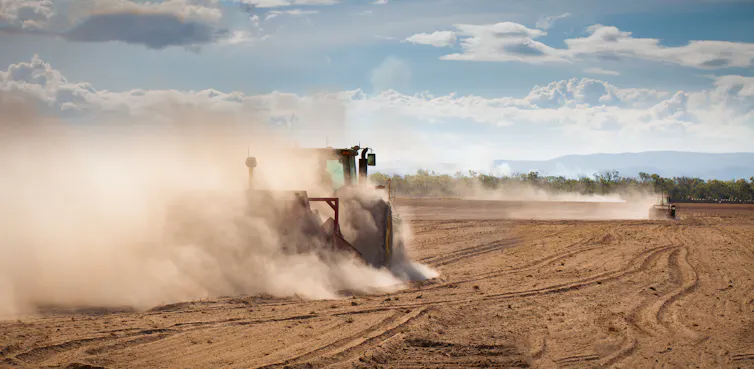
Three-quarters of Earth’s land has become drier since 1990.
Droughts come and go – more often and more extreme with the incessant rise of greenhouse gas emissions over the last three decades – but burning fossil fuels is transforming our blue planet. A new report from scientists convened by the United Nations found that an area as large as India has become arid, and it’s probably permanent.
A transition from humid to dry land is underway that has shrunk the area available to grow food, costing Africa 12% of its GDP and depleting our natural buffer to rising temperatures. We have covered several consequences of humanity’s fossil fuel addiction in this newsletter. Today we turn to the loss of life-giving moisture – what is driving it, and what we are ultimately losing.

This roundup of The Conversation’s climate coverage comes from our award-winning weekly climate action newsletter. Every Wednesday, The Conversation’s environment editor writes Imagine, a short email that goes a little deeper into just one climate issue. Join the 40,000+ readers who’ve subscribed.
Why is the land drying out so fast? It’s partly because there is more heat trapped in the atmosphere by greenhouse gases emitted from burning fossil fuels. This excess heat has exacerbated evaporation and is drawing more moisture out of soil.
‘Oil, not soil’
Climate change has also made the weather more volatile. When drought does cede to rain, more of it arrives in bruising downpours that slough the topsoil.
A stable climate would deliver a year’s rain more evenly and gently, nourishing the soil so that it can nurture microbes that hold onto water and release nutrients.
This is the kind of soil that industrial civilisation inherited. It’s disappearing.
“Soil is being lost up to 100 times faster than it is formed, and desertification is growing year on year,” says Anna Krzywoszynska, a sustainable food expert at the University of Sheffield.
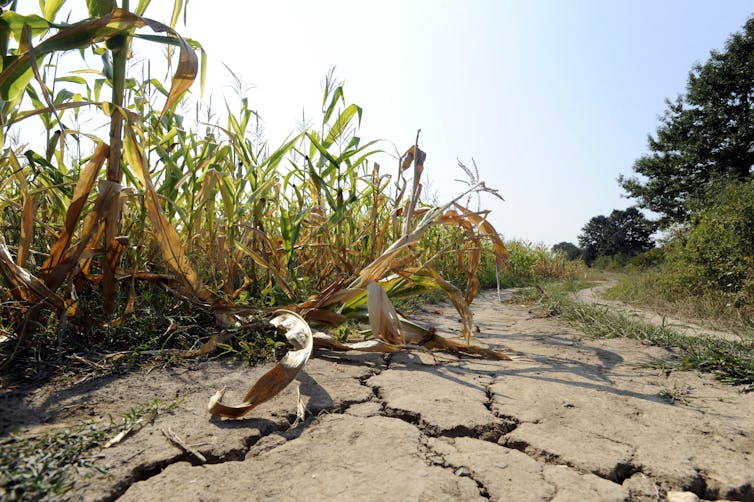
“The truth is, the modern farming system is based around oil, not soil.”
Fossil fuels have unleashed agriculture from the constraints of local ecology. Once, the nutrients that were taken from the soil in the form of food had to be replaced using organic waste, Krzywoszynska says. Synthetic nitrogen fertilisers, made with fossil energy at great cost to the climate, changed all that.
Next came diesel-powered machinery that brought more wilderness into cultivation. Farm vehicles as heavy as the biggest dinosaurs now churn and compact the soil, making it difficult for earthworms and assorted soil organisms to maintain it.
Tractors and chemicals served humanity for a long time, Krzywoszynska says. But soil is now so degraded that no amount of fossil help can compensate.
“Across the world, soils have been pushed beyond their capacity to recover, and humanity’s ability to feed itself is now in danger.”
Green pumps and white mirrors
The primary way that we have been making up for lost food yield is turning more forests into farms. This is accelerating our journey towards a drier, less liveable world because forests, if allowed to thrive, create their own rain.
“Water sucked up by tree roots is pumped back into the atmosphere where it forms clouds which eventually release the water as rain to be reabsorbed by trees,” say Callum Smith, Dominick Spracklen and Jess Baker, a team of biologists at the University of Leeds who study the Amazon rainforest.
“In the Amazon and Congo river basins, somewhere between a quarter and a half of all rainfall comes from moisture pumped from the forest itself.”
Some experts have argued that the UN report understates Earth’s growing aridity by overlooking the water that is held in snow caps, ice sheets and glaciers. Climate change is melting this frozen reservoir, which also serves as a seasonal source of water.

“And as water in its bright-white solid form is much more effective at reflecting heat from the sun, its rapid loss is also accelerating global heating,” says Mark Brandon, a professor of polar oceanography at The Open University.
How do we adapt our relationship with the land to remoisturise the world? Krzywoszynska argues that there is no easy solution, but the future of food-growing “is localised and diverse”.
“To ensure that we eat well and live well in the future, we’ll need to reverse the trend towards greater homogenisation which drove food systems so far.”
The good news, according to Krzywoszynska, is that farmers are experimenting with methods that restore the soil even as they produce a diverse range of nutritious food. These innovators need rights and secure access to the land, the opportunity to share their experiences and financial and political support.
“Regenerating land is a win-win, for humans and their ecosystems, if we dare to look beyond the immediate short-term horizon,” she says.
Jack Marley, Environment + Energy Editor, The Conversation
This article is republished from The Conversation under a Creative Commons license. Read the original article.
Oil and Gas Investments of Donald Trump’s New UK Ambassador
Original article by Adam Barnett republished from DeSmog

Campaigners warn that the UK will face “pressure from American fossil fuel interests” to slow its energy transition.
U.S. president-elect Donald Trump’s pick to be UK ambassador runs a firm with investments in several oil and gas companies, DeSmog can reveal.
Billionaire Warren Stephens, a major Trump donor who was nominated on Monday to be the next UK ambassador, is chairman, president, and CEO of Stephens Inc., one of the largest privately-owned investment banks in the U.S..
The firm’s portfolio includes at least five companies that make their money from oil and gas exploration and production, including one, Stephens Natural Resources, which is “solely owned” by the Stephens family business.
“President-elect Trump’s promise to boost U.S. fossil fuel production is reflected in his choice of UK ambassador, raising concerns about the potential impact on the UK’s own climate leadership”, said Fossil Free Parliament campaigner Carys Boughton.
Tessa Khan, executive director of the environmental campaign group Uplift, told DeSmog the appointment was a sign that “the UK is going to be under pressure from American fossil fuel interests to slow its transition away from oil and gas”.
Trump has vowed to “drill, baby, drill” for oil and gas in the U.S. while his presidential campaign received the backing of major fossil fuel interests. The president-elect has called climate change a “hoax” and is expected to once again pull the U.S. out of the flagship 2015 Paris Agreement, which established a global ambition to limit warming to 1.5C above industrial levels.
The Stephens hire comes just weeks after the UK Labour government unveiled an ambitious new climate target to cut emissions by 81 percent by 2035. The move was criticised by Conservative Party leader Kemi Badenoch, who this week flew to Washington DC reportedly to build ties with senior Republicans ahead of a second Trump presidency.
As DeSmog revealed last week, Badenoch has hired advisors who have criticised climate action and have links to fossil fuel-funded think tanks. Badenoch, who describes herself a “net zero sceptic” has also received donations from the head of Net Zero Watch, a climate science denial group.
Oil and Gas Investments
Stephens Inc.’s investments in oil and gas include Stephens Natural Resources, a company run by Warren’s uncle Witt Stephens.
The company, which trades as Stephens Production, “has a rich history of drilling and producing both oil and natural gas”, according to its website, and “continues to expand its production and reserves in the continental U.S. and offshore Gulf of Mexico”.
The company is “solely owned” by the Stephens family, whose investment stretches back to 1953, according to the website.
Stephens Inc.’s other current investments, which date back to the mid-2010s, include Four Corners Petroleum, an oil exploration and production company based in Colorado.
Stephens Inc. lists RK Supply in its portfolio, a “leading distributor of piping, oil and gas valves, fittings, and other oilfield service equipment” based in Texas. It also lists Dakota Midstream, a company that “provides infrastructure support to oil and gas exploration and production”, based in Colorado.
Another company in the Stephen Inc. portfolio, Texas-based Basin Oil & Gas, buys “non-operating oil and gas interests”, and is developing carbon capture and sequestration projects. Carbon capture is a favoured climate solution of the oil and gas industry, and is often used simply to extract more fossil fuels.
Stephens Inc. lists a firm called Capture Point in its portfolio, which specialises in enhanced oil recovery – a method for extracting hard-to-get oil. Capture Point told DeSmog that Stephens Inc. was not an investor in the company, though did not respond when asked if Stephens Inc. was previously an investor.
All the companies cited were approached for comment.
Trump Tensions
Stephens’s appointment comes at a critical time for the UK’s energy transition, and highlights the differences between the new Labour government and the incoming Trump administration.
Prime Minister Keir Starmer last month attended the COP29 climate summit in Baku, Azerbaijan, pledging that the UK would restore its role “as a climate leader on the world stage”. In its 2024 election manifesto, Starmer’s Labour Party pledged to ban all new licenses for oil and gas exploration in the North Sea. However, after five months in office, the government has yet to implement that promise.
“While the UK government has pledged to turn the UK into a ‘clean energy superpower’, it has not enacted its manifesto commitment to ban new licenses, nor provided a plan for a just transition away from fossil fuels”, Carys Boughton told DeSmog.
“Trump’s choice of ambassador will gift the fossil fuel industry yet more influence within UK politics, which is particularly concerning while the government is still wavering on the future of fossil fuels.
“It is therefore yet more important that the government take action to restrict fossil fuel industry influence – to protect its developing climate and energy policy from the industry’s polluting interests.”
As DeSmog has reported, Trump’s would-be energy secretary Chris Wright, chief executive of fracking company Liberty Energy, has praised Danish climate crisis denier Bjorn Lomborg as a friend. Wright’s nomination was welcomed by the CO2 Coalition, a climate science denial group which has received funding from the Koch Industries oil dynasty.
Analysis by the climate outlet Heated found that all of Trump’s cabinet picks have made misleading statements about climate change.
Science denial and an enthusiasm for fossil fuels are also views shared by Trump’s UK supporters. In September, DeSmog reported that Trump ally Nigel Farage, the Clacton MP and leader of Reform UK, was a keynote speaker at an event in Chicago run by the Heartland Institute, where he called on the U.S. to “drill, baby, drill” for more fossil fuels.
“It’s no surprise that this appointment – like the rest of Trump’s administration – is shot through with oil and gas interests”, Uplift’s Tessa Khan, told DeSmog.
“Fossil fuel companies will prove extremely influential in the incoming U.S. government, and they want nations across the world to remain hooked on oil and gas for years to come just so they can keep profiting.
“The UK is going to be under pressure from American fossil fuel interests to slow its transition away from oil and gas. To succumb would be against the UK’s national interest”.
Original article by Adam Barnett republished from DeSmog
‘Unsettling New Milestone’: Top 12 US Billionaires Now Control $2 Trillion in Wealth
Original article by Eloise Goldsmith republished from Common Dreams under Creative Commons (CC BY-NC-ND 3.0).

“The oligarchic dozen is richer than ever, and they are endowed with extreme material power that can be used to pursue narrow political interests at the expense of democratic majorities,” according to the author of a new analysis.
Just 12 U.S. billionaires now have a collective net worth of over $2 trillion—a figure that amounts to a little less than a third of total federal spending in 2023—according to an analysis out Tuesday from Inequality.org, a project of the Institute for Policy Studies (IPS).
The $2 trillion number is also twice the amount of wealth that the top 12 US billionaires held in 2020, according to researchers at IPS, a progressive organization.
The full list of 12 billionaires includes Jeff Bezos, Bill Gates, Mark Zuckerberg, Warren Buffett, Elon Musk, Steve Ballmer, Larry Ellison, Larry Page, Sergey Brin, Jim Walton, Rob Walton, and Jensen Huang.
“This is an unsettling new milestone for wealth concentration in the United States. The oligarchic dozen is richer than ever, and they are endowed with extreme material power that can be used to pursue narrow political interests at the expense of democratic majorities,” wrote the author of the analysis, Omar Ocampo, a researcher at IPS.
New to the “oligarchic dozen” is Jensen Huang, the co-founder and CEO of the tech company Nvidia. Nvidia, which became the most valuable publicly traded company this year, has seen its profits jump thanks to the world’s ravenous appetite for the artificial intelligence chips that the firm produces. According to the analysis, Huang’s personal wealth “has skyrocketed from $4.7 billion in 2020 to $122.4 billion—a mind-boggling 2,504 percent increase—over the last four years.”
Each of the billionaires on the list “owns or is a controlling shareholder of a business that is investing billions of dollars in artificial intelligence,” according to Ocampo, which raises concerns about their respective carbon footprints.
Fueling AI is energy intensive, and AI data centers in the U.S. are largely powered by fossil fuels, meaning their proliferation poses a threat to the environment and a transition to a green economy.
Ocampo also discusses the political reach of the billionaires on the list. Elon Musk and Jeff Bezos, who respectively own X and The Washington Post, “have both purchased large media platforms, which has granted them the ability to set the terms of public debate with the hopes of influencing public opinion in their favor.”
Musk specifically has established himself as a major power broker within the GOP. The billionaire spent hundreds of millions helping to re-elect Donald Trump and is now poised to play a major role in the president-elect’s administration, helping oversee a new advisory committee tasked with slashing government spending.
As of early December, Trump had tapped an “unprecedented” total of seven reported billionaires for key positions in his administration, according to a separate piece of analysis by Inequality.org.
“We see the effects of this growing concentration of wealth and economic inequality everywhere—plutocratic influence on our politics, wealth transfers from the bottom to the top, and the acceleration of climate breakdown,” Ocampo wrote on Tuesday.
Original article by Eloise Goldsmith republished from Common Dreams under Creative Commons (CC BY-NC-ND 3.0).
- Trump Offers Key Pentagon Job to Billionaire Whose Firm Trained Khashoggi’s Murderers
- Trump’s Billionaires Cometh
- ‘By and For the Ultra-Wealthy’: Here Are the Billionaires Set to Run Trump’s Administration
- ‘Disgusting’: Global 1% Captured $42 Trillion in New Wealth Over Past Decade
- Wealth of the Top 1% in US Hits All-Time High of $45 Trillion
- World’s 500 Richest People Gained $1.2 Trillion in Wealth in 2019: Analysis
- Global Wealth Tax Could Raise $2.1 Trillion Annually for Climate Action and More
Group That Calls CO2 ‘Essential’ Praises Trump Energy Secretary Pick Chris Wright
Original article by Geoff Dembicki republished from DeSmog
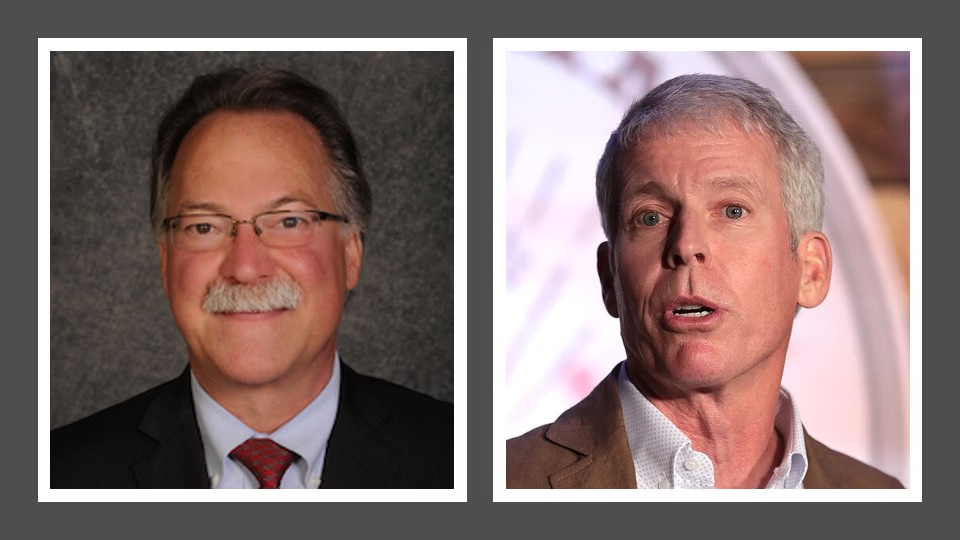
The head of the CO2 Coalition tells DeSmog that Wright agrees carbon dioxide is “not the demon molecule, it’s the miracle molecule.”
Donald Trump’s pick to lead the Department of Energy, Chris Wright, is receiving enthusiastic approval from a climate obstruction organization that argues global carbon dioxide emissions should be increasing because the gas is “essential for life.”
“I had a chance to sit down one-on-one with Chris in 2022 in his Denver office,” claimed Gregory Wrightstone, executive director of a group called the CO2 Coalition. For nearly a decade, the organization has publicly disputed the fundamentals of climate science while receiving donations from foundations linked to corporate backers, including the oil and gas billionaire Charles Koch.
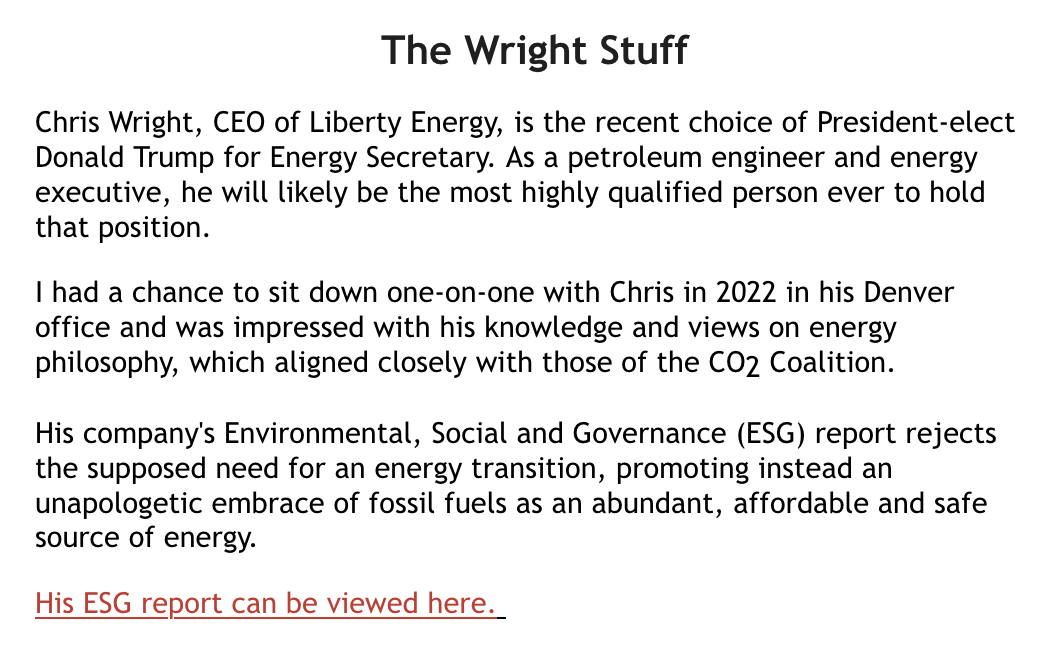
Wrightstone, who detailed the encounter with Wright in a recent newsletter, “was impressed with his knowledge and views on energy philosophy, which aligned closely with those of the CO2 Coalition.”
In a phone interview with DeSmog, Wrightstone elaborated on that alignment, explaining that “the main thing that he and I and the CO2 Coalition agree on is that increasing CO2 is a net benefit, it’s not the demon molecule, it’s the miracle molecule.”
Wright is currently the CEO of the fracking services company Liberty Energy and would bring no political or government experience to the role of energy secretary. Yet Wrightstone concluded that because Wright is “a petroleum engineer and energy executive, he will likely be the most highly qualified person ever to hold that position.”
After Trump announced the nomination last week, some industry observers hailed the appointment as a sign of political moderation within the Republican cabinet, with the head of the Colorado Oil and Gas Association arguing that Wright is “a pragmatic problem solver” and “not a climate denier.”
Yet the full-throated praise that Wright is receiving from the likes of Wrightstone raises serious questions about whether the future energy secretary even thinks climate change is a problem worth addressing, said Connor Gibson, an independent research specialist who’s spent years tracking the CO2 Coalition and other groups that obstruct climate action including for Greenpeace USA.
“The CO2 Coalition has been a persistent voice undermining the ABCs of climate change — that it’s happening, that it’s caused by human fossil fuel use, and that it’s going to be dangerous,” he told DeSmog.
Wright didn’t respond to questions via his company Liberty Energy nor via the Trump-Vance transition team.
Backed by Koch
In email correspondence with DeSmog, Wrightstone explained how his meeting with the future nominee for energy secretary came about several years ago: “I was speaking at an event in Denver and set up a meeting in his office,” he wrote.
“We had a wide-ranging conversation, but I can’t recall any particular details,” he added during a phone interview. Yet Wright made a positive impression on the executive director of the CO2 Coalition. “The key takeaway is that he’s a big supporter of the continuing use of fossil fuels, including coal, oil, and natural gas,” Wrightstone said.
According to Wrightstone, he and Wright’s views align on other key points, including the factually incorrect or dubious claims that “there is no man-made climate crisis,” “science is not consensus and consensus is not science,” “fossil fuels cannot be replaced by intermittent and unreliable solar and wind power,” and “history tells us that warmer periods have been beneficial, while cold periods have been horrific to humanity.”
These talking points have for years been disseminated by the CO2 Coalition, which was recently cited by Alberta’s United Conservative Party in a resolution that abandoned the oil-producing Canadian province’s net-zero targets and officially recognized “that CO2 is a foundational nutrient for all life on Earth.”
Gibson referred to the CO2 Coalition in a recent report he co-wrote along with Robert Brulle of Brown University as an “organization solely focused on disputing climate change science.”
During the first Trump administration, William Happer of the CO2 Coalition was appointed to the National Security Council but exited after only a year. White House advisors reportedly feared that his extreme views were a liability to Trump’s reelection. In 2017, Happer argued that the “demonization” of carbon dioxide “really differs little from the Nazi persecution of the Jews, the Soviet extermination of class enemies, or ISIL slaughter of infidels.”
Nevertheless, the CO2 Coalition received more than $76,000 from foundations linked to the oil and gas billionaires Charles and David Koch during Trump’s first term, according to Gibson’s report. Greenpeace calculations show the group got $620,000 in Koch-related contributions between 2004 and 2015.
“We have not received Koch Industries money since I’ve been here,” Wrightstone, who took over in 2021, said when asked about Koch contributions.
Gibson argues that Wright, as a fossil fuel executive, is slightly more nuanced in expressing his views on climate change than his supporters at the CO2 Coalition. Wright acknowledges that human-caused global heating is real and potentially a problem while saying in a video posted to his LinkedIn last year that “there is no climate crisis.”
“It seems to me to be the calculated words of a CEO who recognizes that there is a potential liability of telling an outright lie to the public,” Gibson said. “Yet the effect of his comments is to leave people with the impression that climate change is not happening.”
Original article by Geoff Dembicki republished from DeSmog