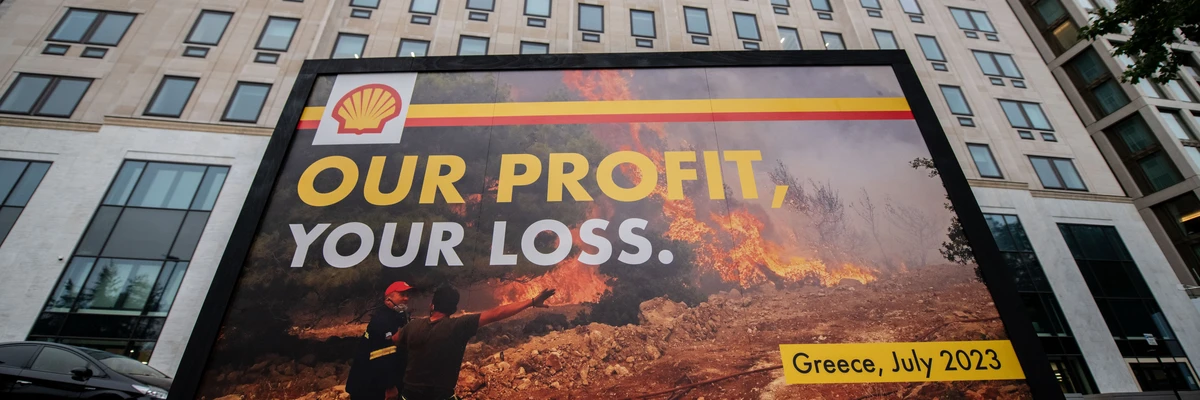
Greenpeace activists display a billboard during a protest outside Shell headquarters on July 27, 2023 in London. (Photo: Handout/Chris J. Ratcliffe for Greenpeace via Getty Images)
BP is expected to announce it will slash its renewable energy investments and instead focus on increasing oil and gas production.
The energy giant will outline its strategy later following pressure from some investors unhappy its profits and share price have been much lower than its rivals.
Shell and Norwegian company Equinor have already scaled back their plans to invest in green energy. Meanwhile US President Donald Trump’s “drill baby drill” comments have encouraged investment in fossil fuels and a move away from low carbon projects.
Some shareholders and environmental groups have voiced concerns over any potential ramping up on production of fossil fuels.
Five years ago, BP set some of the most ambitious targets among large oil companies to cut production of oil and gas by 40% by 2030, while significantly ramping up investment in renewables.
It is now expected to abandon it altogether while confirming it is cutting investments in renewable energy by more than half in what chief executive Murray Auchincloss called a “fundamental reset”.
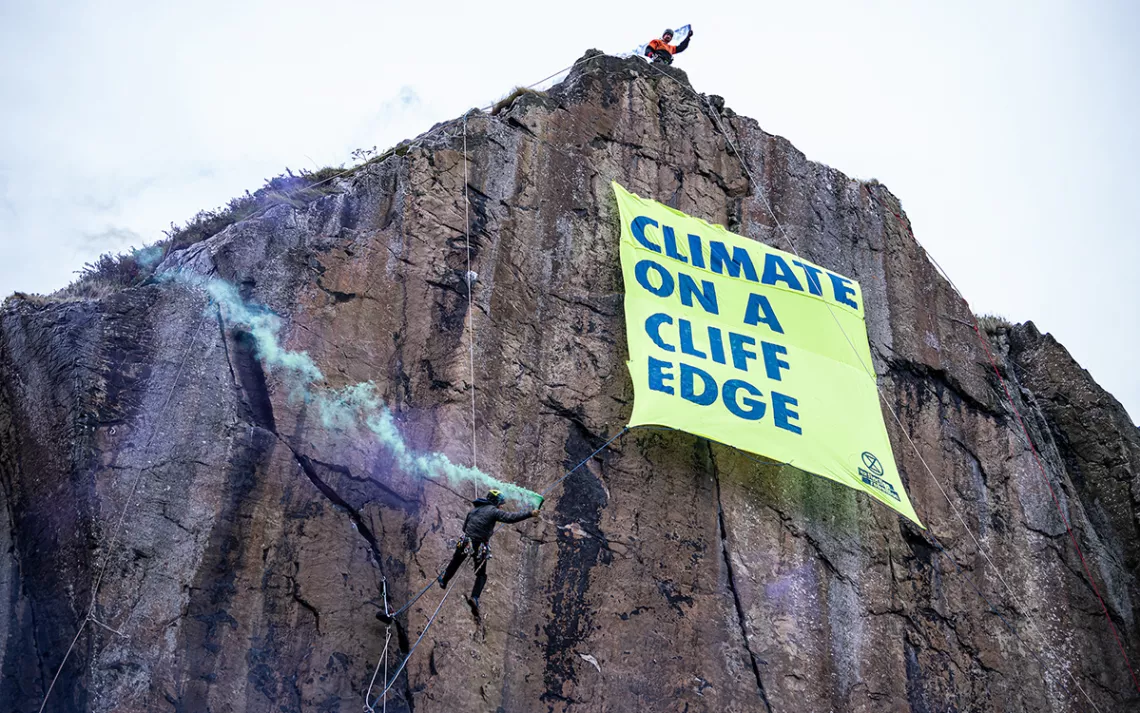
Experienced climbers scale a rock face near the historic Dumbarton castle in Glasgow, releasing a banner that reads “Climate on a Cliff Edge.” One activist, dressed as a globe, symbolically looms near the edge, while another plays the bagpipes on the shores below. | Photo courtesy of Extinction Rebellion and Mark RichardsNeo-Fascist Climate Science Denier Donald Trump says Burn, Baby, Burn.
dizzy: Fossil fuels are no longer reliable high-return investments.
Last month’s Los Angeles fires were one of the costliest disasters in US history
Last month was the world’s warmest January on record raising further questions about the pace of climate change, scientists say.
January 2025 had been expected to be slightly cooler than January 2024 because of a shift away from a natural weather pattern in the Pacific known as El Niño.
But instead, last month broke the January 2024 record by nearly 0.1C, according to the European Copernicus climate service.
The world’s warming is due to emissions of planet-heating gases from human activities – mainly the burning of fossil fuels – but scientists say they cannot fully explain why last month was particularly hot.
It continues a series of surprisingly large temperature records since mid-2023, with temperatures around 0.2C above what had been expected.
“The basic reason we’re having records being broken, and we’ve had this decades-long warming trend, is because we’re increasing the amount of greenhouse gases in the atmosphere,” Gavin Schmidt, director of Nasa’s Goddard Institute for Space Studies, told BBC News.
Climate Science Denier Donald Trump says Burn, Baby, Burn.Elon Musk urges you to be a Fascist like him, says that you can ignore facts
and reality then.
Labour’s new ambassador to the U.S. founded Global Counsel, a firm with major fossil fuel clients.
Labour’s top diplomat to Donald Trump’s United States leads a public affairs firm that has attempted to influence the new UK government on behalf of the oil and gas giant Shell, and the coal mining company Anglo American.
Peter Mandelson – who was a Cabinet minister under former Labour prime ministers Tony Blair and Gordon Brown – has been accepted as the UK’s ambassador to the U.S. by Trump’s new administration.
In addition to his new diplomatic role, which he will formally begin in February, Mandelson is president and chair of Global Counsel, a London-based political consultancy and lobbying organisation. He will retain shares in the company even after taking up his new position in Washington DC, the Financial Times has reported.
According to official records, after July’s general election Global Counsel lobbied the new Labour government on behalf of Shell, one of the world’s most polluting companies.
Shell is still committed to exploring for new sources of oil and gas and does not have any plans to reduce the overall amount it produces by 2030, in contravention of climate science. In 2021, the District Court of the Hague found that the total CO2 emissions of the Shell group exceeded the emissions of many states, including the Netherlands.
Lobbyists must declare if they have attempted to arrange meetings or influence ministers or senior civil servants on behalf of their clients. However, the contents of these discussions are not publicly available.
Global Counsel seemingly has close ties to the Labour Party. Prior to the 4 July election, the company supplied a staff member to Tulip Siddiq, who served as financial secretary to the Treasury until 14 January, a donation in kind worth £35,835, according to the register of MPs’ financial interests.
Global Counsel is one of seven consultancies with a history of donating to Labour that have lobbied on behalf of fossil fuel clients since July’s election.
The client list at Mandelson’s lobbying firm also includes Anglo American, a British mining multinational which is a major producer of coal, and U.S. multinational bank JP Morgan, which has financed $430 billion in fossil fuel projects since the 2015 Paris Agreement, including $40 billion in 2023, according to the NGO Banktrack.
Another client, UK bank Standard Chartered, has financed $71 billion in fossil fuel projects in the same period, including $7 billion in 2023.
Other Global Counsel clients include food and beverage giant Nestle, which has emissions three times the size of its home country Switzerland, and the controversial tech firm Palantir, founded by Trump ally Peter Thiel.
Mandelson, who called Trump “reckless and dangerous to the world” in 2019, this week told Fox News his previous remarks were “ill-judged and wrong”, and that he has a “fresh respect” for the new U.S. president.
Global Counsel, and the Cabinet Office were approached for comment.
Transatlantic Ties
Mandelson’s appointment comes at a crucial time for climate policy, with a transatlantic network of political actors working increasingly closely to derail global action to achieve net zero emissions.
Since his inauguration last week, President Trump has removed the U.S. from the flagship 2015 Paris climate accord, banned offshore wind farms, and declared a “national energy emergency” in order to open new oil and gas projects.
His plans could add an extra four billion tonnes of carbon dioxide equivalent to U.S. emissions by 2030, according to the climate publication Carbon Brief.
Trump received more than $32 million from the oil and gas sector for his 2024 campaign. The fossil fuel industry spent $445 million on political donations, lobbying and advertising between January 2023 and November 2024 to influence Trump and Congress, according to the green advocacy group Climate Power.
As DeSmog revealed last month, Mandelson’s counterpart, Trump’s ambassador to the UK Warren Stephens, runs a firm with investments in several oil and gas companies, including one wholly owned by his family business.
The UK government is committed to removing fossil fuels from the UK’s power system by 2030, but this week approved a third runway at Heathrow Airport – the second most polluting airport in the world, according to a 2021 study – and pledged to remove environmental regulations on new building projects.
According to the UN’s Intergovernmental Panel on Climate Change (IPCC), the world’s foremost climate science body, the next few years are crucial if we want to limit the worst effects of global warming, including drought, flooding, and heat waves.
To keep within the 1.5C warming limit set by the Paris Agreement, the IPCC says that emissions need to be reduced by at least 43 percent by 2030 compared to 2019 levels, and at least 60 percent by 2035.
A court has ruled that consent for two new Scottish oil and gas fields was granted unlawfully and their owners must seek fresh approval from the UK government before drilling can begin.
The written judgement on the Rosebank and Jackdaw fields came after a case brought by environmental campaigners, Uplift and Greenpeace, at the Court of Session in Edinburgh.
In his judgement, Lord Ericht said a more detailed assessment of the fields’ environmental impact was required, taking into account the effect on the climate of burning any fossil fuels extracted.
He said work on both fields could continue while the new information was gathered but no oil and gas could be extracted unless fresh approval was granted.
Permission for the Rosebank oil development, 80 miles west of Shetland in the North Atlantic, was granted in autumn 2023.
In a 57-page judgement, Lord Ericht wrote that there was a public interest in having the decision “remade on a lawful basis” because of the effects of climate change – which he said outweighed the interests of the developers.
The UK government is set to back plans for a third runway at Heathrow, the country’s busiest airport, and to expand two other airports near London: Gatwick and Luton. The move is designed to support the government’s “mission” to grow the economy.
Air transport is notoriously hard to decarbonise. Unlike the energy system, or even road transport, there is no renewable alternative to switch to immediately. If electric or hydrogen planes become reality, it won’t be for many years yet. Therefore it’s not clear this airport expansion can fit within the UK’s legal and arguably moral requirement to cut emissions and remain within its carbon budget.
It certainly goes against what the government’s official advisory body the Committee on Climate Change (CCC) recommends. The CCC’s 2023 report to parliament stated that: “No airport expansions should proceed until a UK-wide capacity management framework is in place to annually assess and, if required, control sector GHG [greenhouse gas] emissions and non-CO₂ effects.”
Those non-CO₂ effects of aviation include water vapour, soot and other gases like nitrous oxides and sulfur dioxide, all released directly into the high atmosphere where they help form heat-trapping clouds. Estimates suggest they could triple the greenhouse impact of aviation.
In 2019, the last year of available data pre-COVID, domestic and international aviation accounted for around 8% of the UK’s total emissions. The non-CO₂ effects makes aviation a larger contributor to climate change than that number suggests.
The sector itself struggles to build a coherent decarbonisation roadmap based solely on “supply-side” improvements to things like fuel efficiency or, in a recent example from EasyJet, thinner paint. The demand side – taking fewer flights, frequent flyer levies, or restrictions on domestic flights as have been introduced in France – is rarely mentioned.
Unfortunately aviation is a prime example of the Jevons effect where any improvement in efficiency has been wiped out by increased demand. With a growing global middle class pursuing a higher consumption lifestyle, aviation emissions continue to grow even while other sectors have shows some efforts to reduce their own.
A third runway at Heathrow was first proposed back in the 2000s. This photo is from a 2016 protest. Dinendra Haria / shutterstock
The UK has mandated that synthetic aviation fuel (SAF), a more sustainable alternative to regular jet fuel, must make up 10% of aviation fuel by 2030. But only 1.2% of aviation fuel is currently SAF and the industry has not published any plans to show it can scale up in time. Indeed, the sector’s own plans for growth will outstrip efforts to decarbonise through synthetic fuel, delivering a neutral effect at best.
The consumer-facing airport sector has also been accused of greenwash. For instance, Luton Airport recently published adverts making the claim that its own expansion would be stopped if it did not meet stringent environmental targets. However, the Advertising Standards Authority found that consumers would naturally believe that would include air traffic and not just terminal operations (a terminal’s heating or lighting is, of course, largely irrelevant when its core business is as emissions-intensive as flying).
The difficulty of decarbonising aviation while the sector still grows is exemplified by the government’s recently launched consultation on adopting the Corsia carbon offsetting scheme for international flights and how it might work with existing cap and trade schemes. All of which encourage or excuse excess emissions through a charging mechanism.
Growing pains
“Kickstarting economy growth” and “Make Britain a clean energy superpower” are two of the UK government’s six “missions”. However, by expanding airports in support of the former, it risks failing the latter.
A new report by thinktank the New Economics Foundation shows that airport expansion could balance out all of the emissions saved by the government’s clean power plans by 2050.
There is evidence that airport expansion can bring some of the economic benefit that government needs. However, another New Economics Foundation report has found that air travel is no longer a catalyst for productivity growth. So the economic benefits of a new runway are really confined to the airport operation itself – projects for engineers and builders, service jobs for people living near Heathrow, and so on.
Aviation is the privilege of the richer part of society, both globally and within the UK. Figures from Our World in Data shows the richest 50% of the global population produces 90% of the aviation emissions.
While many more UK residents have experienced flying than in the past, most flights are still taken by a small, wealthy subset of the population, which will typically capture the largest share of any new capacity. Each year, around half of British residents do not fly at all.
The focus on London airports for the largest scale expansions will shift the balance of the economy further towards south-east England, and increase inequality within the UK economy. And while these plans might bring some of the GDP gains the government is desperate to deliver, all the evidence shows they will be at the expense of its environmental targets.