An activist from the environmental movement Extinction Rebellion holds up a sign reading “Oil Kills” as police officers remove him from the premises of DNB Bank during a protest in Oslo, Norway on August 21, 2025. (Photo by Javad Parsa/NTB/AFP via Getty Images)
“Requiring governments to assess the global climate consequences of oil and gas combustion before approving new fossil projects is common sense, and long overdue,” said one campaigner.
Although the European Court of Human Rights on Tuesday sided with the Norwegian government over six young adults and a pair of climate groups, the plaintiffs still welcomed the tribunal’s ruling as “a major step forward,” in the words of Frode Pleym, head of GreenpeaceNorway.
The case stems from the Norwegian Ministry of Petroleum and Energy granting 10 exploration licenses to 13 companies for fossil fuel production in the Arctic Barents Sea in 2016. The plaintiffs argued that doing so violated Article 8 of the European Convention on Human Rights, or the right to respect for private and family life.
The court unanimously held that “there had been no violation” of Article 8, but it also affirmed that the government must conduct a full environmental impact assessment, including greenhouse gas emissions from combustion, for any new petroleum production.
“It’s a relief to see the court recognize what science has told us for years—that new oil and gas fields threaten our most basic human rights,” Pleym said in a statement. “Requiring governments to assess the global climate consequences of oil and gas combustion before approving new fossil projects is common sense, and long overdue.”
Young Friends of the Earth Norway, which sued alongside Greenpeace and the six individuals, also praised the ruling as progress.
“This decision is a quantum leap for climate accountability,” said the group’s leader, Sigrid Hoddevik Losnegård. “The government can no longer continue its oil and gas policy as if climate change doesn’t exist. This judgment will have ripple effects far beyond Norway.”
I can think of at least seven ways fossil fuel producers could wiggle out of this, but still: holy shit this is huge.
The plaintiffs noted in a joint statement that the ruling “builds on” recent decisions from the International Court of Justice and the UK Supreme Court. The ICJ said in a landmark advisory opinion in July that countries have a legal obligation to take cooperative action to address the fossil fuel-driven climate emergency. At the time, Danilo Garrido, legal counsel at Greenpeace International, hailed the development as “the start of a new era of climate accountability at a global level.”
That decision came roughly a year after the UK’s top court ruled that Surrey authorities’ approval of the Horse Hill drilling project “was unlawful” because they didn’t consider “emissions that will occur when the oil produced is burnt as fuel,” as required by law. Friends of the Earth UK called the ruling “a heavy blow for the fossil fuel industry” that could impact other projects.
The European court’s Tuesday decision came less than two weeks away from the start of the 30th United Nations Climate Change Conference in Belém, Brazil. In preparation for COP30, the UN on Tuesday released a report warning that governments’ climate plans would reduce fossil fuel emissions by just 10% by 2035 compared to 2019 levels, far short of what is needed to meet the Paris Agreement goal of limiting temperature rise this century to 1.5°C above preindustrial levels.
As Oil Change Internationalpointed out in a June report, Norway and three other wealthy nations—Australia, Canada, and the United States—account for the majority of planned oil and gas expansion over the next decade. This month, the group commissioned a poll that found a majority of Norwegians believe their country should either stop exploring for new oil and gas or slow down the pace.
“The data show that Norwegians increasingly want political leadership that aligns the country’s oil policy with its climate goals,” Oil Change’s North Sea campaign manager, Silje Lundberg, said Monday. “People are calling time on endless oil expansion—it’s the government that’s stuck in the past. The public clearly wants a plan to phase down oil and gas and deliver real climate leadership, not more empty talk from ministers protecting the industry.”
Orcas comment on killer apes destroying the planet by continuing to burn fossil fuels.Donald Trump urges you to be a Climate Science denier like him. He says that he makes millions and millions for destroying the planet, Burn, Baby, Burn and Flood, Baby, Flood.Nigel Farage urges you to ignore facts and reality and be a climate science denier like him and his Deputy Richard Tice. He says that Reform UK has received £Millions and £Millions from the fossil fuel industry to promote climate denial and destroy the planet.
The UK’s Climate Change Act is a landmark piece of legislation that guides the nation’s response to global warming and has proved highly influential around the world.
Increasingly, the law has come under attack from right-wing politicians, who want to scrap the UK’s net-zero target and the policies supporting it.
Conservative leader Kemi Badenoch has announced that her party would “repeal” the Climate Change Act entirely, if her party is able to form the next government.
The opposition leader said she still believed that “climate change is real”, but offered no replacement for the legislation that the Conservatives have backed since its inception.
Her proposal drew intense criticism from scientists, business leaders and even senior Conservatives, who argued that abandoning the act would harm the UK economy and drive more climate extremes.
Meanwhile, the hard-right populist Reform UK party – which is currently leading in the polls – has also rejected climate action and promised to “ditch net-zero”.
Below, Carbon Brief explains what the Climate Change Act does – and does not – mean for the UK, correcting inaccurate comments as the UK’s political right veers further away from the previous consensus on climate action.
It is well-known that the Climate Change Act was voted through the UK parliament with near-unanimous cross-party support. In October 2008, some 465 MPs voted in favour, including 263 Labour members, 131 Conservatives, 52 Liberal Democrats. Just five Conservatives voted against.
Less widely appreciated is the fact that the Labour government only agreed to legislate in the face of huge public and political pressure, including from then-Conservative leader David Cameron.
Jill Rutter, senior fellow at thinktank the Institute for Government (IfG), tells Carbon Brief that the Conservatives “can also claim significant credit for the Climate Change Act”.
This is at odds with comments made by Badenoch, who described it as “Labour’s law”, when pledging to repeal it if she were ever elected as prime minister.
In early 2005, two Friends of the Earth campaigners – Bryony Worthington and Martyn Williams – had drafted a Climate Change Bill, inspired by the “worsening problem of climate change and the inadequacy of the government’s policy response”, according to a 2018 academic paper.
Worthington tells Carbon Brief they had “decided [the government’s plan] was rubbish and we needed a different approach”, based on five-yearly carbon budgets rather than single-year goals.
Their draft was introduced into parliament that July, as a private members’ bill, by high-profile backbench MPs from the three main political parties: Labour’s Michael Meacher; the Conservatives’ John Gummer (now Lord Deben); and Norman Baker for the Liberal Democrats.
This was the centrepiece of Friends of the Earth’s “Big Ask” campaign, gaining huge public support and backing from more than 100 other NGOs, 412 MPs and celebrities such as Radiohead frontman Thom Yorke.
Then, in December 2005, Cameron was elected Conservative leader, using support for climate action as part of his efforts to “‘decontaminate’ the Tory brand”, according to an IfG retrospective.
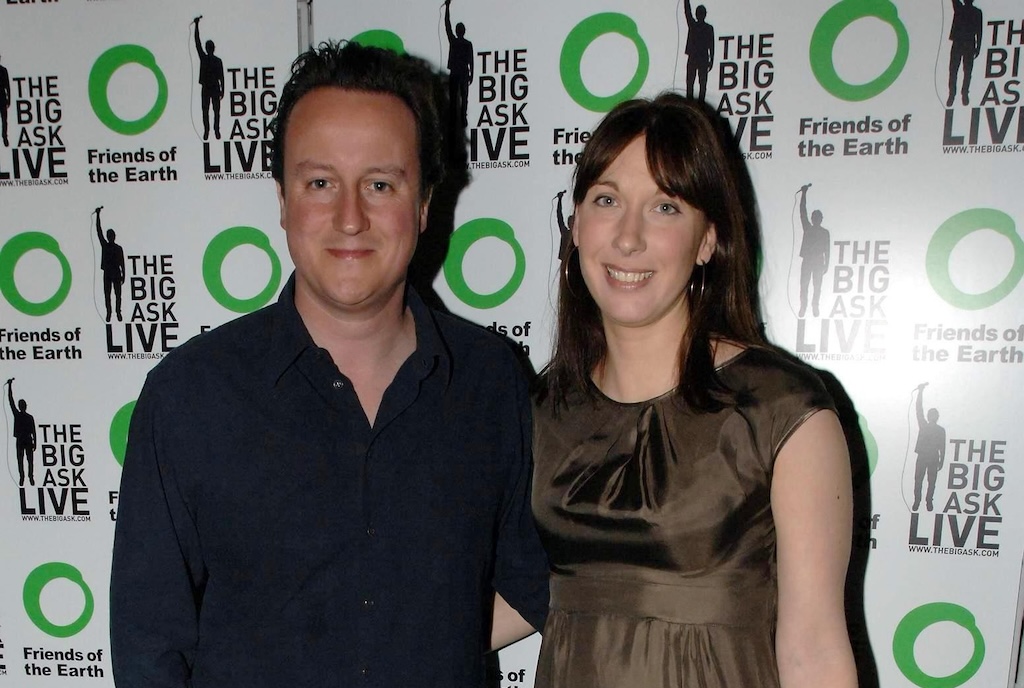
With the Labour government still resisting the idea of new climate change legislation, Cameron made what the IfG called a “really significant political intervention” on 1 September 2006, throwing his weight behind the “Big Ask” and publishing his own draft bill, on green recycled paper.
Former UK conservative leader David Cameron and his wife Samantha at Friends of the Earth’s “Big Ask” Benefit Concert, 2006. Credit: PA Images / Alamy Stock Photo
As the Guardian reported at the time, a letter from Cameron and others “call[ed] on the government to enshrine annual targets for carbon dioxide (CO2) emissions into a bill, to be introduced in the next Queen’s speech…the government believes a bill is unnecessary”.
At prime minister’s questions on 25 October 2006, Cameron continued to press Labour prime minister Tony Blair, who was still not committed to legislation.
Cameron went beyond the “Big Ask” draft by calling for an independent commission with executive powers, able to adjust the UK’s climate goals. Cameron asked Blair:
“Are we getting a bill: yes or no?…Will it include the two things that really matter: annual targets and an independent body that can measure and adjust them in the light of circumstances?”
The IfG says a former aide to David Miliband, who was then environment secretary, “remembers him commenting that Labour could not get into the position of being the only major party not in favour of the proposed bill”.
Finally, in November 2006, the Labour government confirmed in the Queen’s speech that it would introduce a new climate change bill.
Emphasising the cross-party consensus, Lord Deben tells Carbon Brief: “It was the Tories who wrote it and it was the Labour Party who accepted it – and all parties supported it.” He adds:
“It’s not just that every Tory leader since [then] has supported climate change, the Climate Change Act [and the] Climate Change Committee, but it’s simply that, actually, they ought to, because they invented it.”
The Labour government published its own draft climate change bill in March 2007 and this, after lengthynegotiation, went on to become the 2008 act.
Cameron continued to campaign for “independent experts, not partisan…ministers” to set the UK’s statutory climate targets, but this responsibility was, ultimately, left to the government.
Rutter tells Carbon Brief that, in pledging to repeal the 2008 act, Badenoch is “rejecting” a Conservative “inheritance” on climate change that runs back to Margaret Thatcher. She says:
“One of the defining features of climate policy to date in the UK has been the political consensus that has underpinned it. That may have been because Margaret Thatcher was the first leading world politician to draw attention to climate change in 1989 [via a speech at the UN in New York].”
Rutter adds that David Miliband had only been able to convince then-chancellor Gordon Brown to accept legally binding targets as a result of Cameron’s enthusiasm for the cause. She says:
“Although it was Labour legislation, brought forward by David Miliband (though implemented by brother Ed), the reason Miliband was…able to convince a sceptical Gordon Brown at the Treasury that the UK should set legally binding targets, was the enthusiasm with which new Conservative leader David Cameron embraced the Friends of the Earth ‘Big Ask’ campaign as part of his moves to detoxify the Conservative party after its 2005 defeat. Theresa May then increased the target [in 2019] from 80% to net-zero as part of her legacy. It is that long Conservative inheritance on climate action that Badenoch is now rejecting.”
The Climate Change Act sets out an overall “framework” for both cutting the UK’s emissions and preparing the country for the impacts of climate change.
At its heart is a legally binding goal for reducing greenhouse gas emissions by 2050. Originally envisaged as a 60% reduction on 1990 levels, this was quickly increased to 80%.
In 2019, amid a surge in concern about climate change, the then-Conservative government strengthened the target again to a reduction to “at least 100%” below 1990 levels, more commonly referred to as net-zero.
Section 1 of the Climate Change Act. Source: UK government.
On the pathway to this long-term goal, the act also requires the government to set legally binding interim targets known as ”carbon budgets”. These must be set 12 years in advance, to allow time for the government and the rest of the economy to plan ahead.
The carbon budgets set limits on emissions over five-year periods, providing greater flexibility than annual goals, while tackling the cumulative emissions that determine global warming.
Section 13 of the act specifies that the government has a “duty to prepare proposals and policies for meeting carbon budgets”. There is also a requirement for the government to explain how its actions will achieve its climate goals.
(In addition, the act requires the government to set out a programme of measures for climate adaptation and how it intends to meet them.)
The final key pillar of the act is the creation of the Climate Change Committee (CCC), an independent advisory body. The CCC advises – but does not decide – on the level at which carbon budgets should be set and the climate-related risks facing the UK.
The committee also produces annual assessments of “progress” and recommendations for going further, which the government is obliged to respond to, but not to accept.
Each time the secretary of state sets out their plan for a new carbon budget – taking the CCC’s advice into account – or responds to a progress report from the committee, parliament scrutinises the government’s activities.
Contrary to recent criticisms from the opposition Conservatives and the hard-right populist Reform UK, however, the act says nothing at all about how the government should meet its targets.
The only requirement is that the government’s plan should be capable of meeting its targets.
Moreover, it was the Conservatives under Cameron that had wanted to give the CCC executive and target-setting powers. This was opposed at the time by the then-Labour government.
Rachel Solomon Williams, executive director of the Aldersgate Group, notes on LinkedIn that this was a “closely debated” issue, but that, ultimately, the act puts the government “in control”:
“A closely debated aspect of the bill at the time was whether the CCC should have an executive or an advisory function. In the end, it was appointed as an expert advisory committee and the government remains entirely in control of delivery choices.”
The Conservative press release announcing Badenoch’s plan to “repeal” the act is, therefore, incorrect to state that the legislation “force[s]” governments to introduce specific policies.
(Speaking at the 2025 Conservative party conference, shadow energy secretary Claire Coutinho caricatured what she called “Ed Miliband’s…act” as requiring “1970s”-style “central planning” that “dictate[s] what products people must buy, and when”.
Just 18 months earlier, she, as energy secretary, had written of her “government’s unwavering commitment to meeting our ambitious emissions targets, including the legislated carbon budgets and the net-zero by 2050 target”.)
The press release also falsely describes the targets set under the act as “arbitrary” and falsely suggests they were set without consideration for the impact on jobs, households and the economy.
(In 2021, Badenoch herself, then a government minister, told parliament: “We will put affordability and fairness at the heart of our reforms to reach net-zero.”)
Specifically, section 10 of the act lists “matters to be taken into account” when setting carbon budgets, including the latest climate science, available technologies, “economic circumstances”, “fiscal circumstances” and the impact of any decisions on fuel poverty.
As for the net-zero target, the Intergovernmental Panel on Climate Change (IPCC) has concluded that reducing emissions to net-zero is the only way to stop global warming. The target was set on this basis, following detailed advice from the CCC that took climate science, economic and social factors into account.
The Conservatives have also taken aim at the CCC itself as part of their rejection of the Climate Change Act, highlighting the committee’s advice on meat consumption and flying.
In an echo of widely circulated conspiracy theories, Badenoch even told the Spectator that the CCC “wants us to eat insects”. This is not true.
Despite the framing by right-leaning media and politicians, the CCC’s recommendations for contentious topics such as meat consumption and reductions in flight numbers are modest.
The committee notes that “meat consumption has been falling” without policy interventions and says this will help to free up land for tree-planting. It says “demand management measures” to curb flight numbers “may” be needed, but only if other efforts to decarbonise aviation fail.
More importantly, the government decides how to meet the carbon budgets. It can – and often does – ignore recommendations from the CCC, including those on diets and airport expansion.
Yet serious efforts to weigh up the costs and the benefits have concluded – again and again and again – that it would be cheaper to cut emissions than to face the consequences of inaction.
Indeed, this was precisely the conclusion of the landmark 2006 Stern Review, to which the 2008 Climate Change Act partly owes its existence. The review said:
“[T]he evidence gathered by the review leads to a simple conclusion: the benefits of strong and early action far outweigh the economic costs of not acting.”
More specifically, it said that the cost of action “can be limited to around 1% of global GDP [gross domestic product]”, whereas the damages from climate change would cost 5% – and as much as 20% of GDP.
When the act was passed in 2008, it was again estimated that the UK would need to invest around 1% of GDP in meeting its target of cutting emissions to 80% below 1990 levels by 2050.
Since then, estimates of the cost of cutting emissions have fallen, as the decline in low-carbon technology costs has outperformed expectations. At the same time, estimates of the economic losses due to rising temperatures have tended to keep going up.
(Some years after the review’s publication, Stern said he had “got it wrong on climate change – it’s far, far worse…Looking back, I underestimated the risks.”)
When it recommended the target of net-zero by 2050, the CCC estimated that the UK would need to invest 1-2% of GDP to hit this goal. It later revised this down to less than 1% of GDP.
Most recently, the CCC revised its estimates down once again, putting the net cost of reaching net-zero at £116bn over 25 years – roughly £70 per person per year – or just 0.2% of GDP.
In July 2025, the independent Office for Budget Responsibility (OBR) went on to estimate that the UK could take an 8% hit to its economy by the early 2070s, if the world warms by 3C.
It concluded that while there were potentially significant costs to the government from reaching net-zero, these would be far lower than the costs of failing to limit warming.
Despite all this, Conservative leader Badenoch has falsely argued that the UK’s net-zero target will be “impossible” to meet without “bankrupting” the country and that the the Climate Change Act has “loaded us with costs”.
Her party has also pledged to “axe the carbon tax” on electricity generation – a significant source of government revenue – claiming that this “just adds extra costs to our bills for no reason”.
Prof Jim Watson, director of the UCL Institute for Sustainable Resources, tells Carbon Brief that the costs of climate policies are “sometimes exaggerated” and are not the main reason for high bills:
“Policies that are in place to meet the UK’s carbon targets have costs, but these costs are sometimes exaggerated. These policies are not the primary cause of the energy price shock businesses and households have experienced over the past three years.”
Watson says that high gas prices were the “main driver” of high bills and adds that shifting away from fossil fuels “will also reduce the UK’s exposure to future fossil-fuel price shocks”.
How nearly 70 countries followed the UK’s Climate Change Act
In the interview announcing her ambition to scrap the Climate Change Act, Badenoch falsely told the Spectator that the UK was “tackl[ing] climate change…alone”. She said:
“We need to do what we can sensibly to tackle climate change, but we cannot do it alone. If other countries aren’t doing it, then us being the goody-two-shoes of the world is not actually encouraging anyone to improve.”
This is a common claim among climate-sceptic politicians and commentators, who argue that the UK has gone further than other nations and that this is unfair. Badenoch’s predecessor, Rishi Sunak, used similar reasoning to justify net-zero policy rollbacks.
The UK has indeed been a leader in passing climate legislation, but it is far from the only country taking action to tackle climate change.
The Climate Change Act was among the first comprehensive national climate laws and the first to include legally binding emissions targets.
It has inspired legislation around the world, with laws in New Zealand, Canada and Nigeria among those explicitly based on the UK model.
Indeed, 69countries have now passed “framework” climate laws similar to the UK’s Climate Change Act, as the chart below shows. This is up from just fourwhen the act was legislated in 2008. Of these, 14 are explicitly titled the “climate change act”.
Cumulative number of countries with “climate change framework laws”, as defined by the Climate Change Laws of the World database. When countries have updated laws or introduced additional framework legislation, duplicates have been removed. Source: Climate Change Laws of the World.
The UK was also the first major economy to legislate a net-zero target in 2019, but since then virtually every major emitter in the world has announced the target. (Not all of these targets have been put into law, as the UK’s has.)
When the UK announced its target in June 2019, around 1% of global emissions were covered by net-zero targets. By the end of that year, France and Germany brought this up to nearly 4%.
Over the following years, major economies including China and India announced net-zero targets, meaning that around three-quarters of global emissions are now covered by such goals, as the chart below shows.
(This figure would be even higher if the Trump administration in the US, which accounts for around a tenth of annual global emissions, had not abandoned the nation’s net-zero target.)
Global greenhouse gas emissions covered by national net-zero targets (dark blue) and those that remain uncovered (light blue). Shares of emissions are derived from a 2024 dataset that includes both fossil-fuel and land-use emissions. Source: Net Zero Tracker, Jones et al (2024).
While it is true that the UK is “only responsible for 1% of global emissions”, as Badenoch has also noted, this does not mean its actions are inconsequential. Around a third of global emissions come from countries that are each responsible for 1% of global emissions or less.
Moreover, as a relatively wealthy country that is responsible for a large share of historical emissions, manyargue that the UK also has a moral responsibility to lead on climate action.
This historical responsibility is implicitly invoked by the Paris Agreement, which recognises countries’ “common but differentiated responsibilities” for current climate change.
Finally, Badenoch’s position diverges from that of recent Conservative leaders.
Theresa May and Boris Johnson spoke positively of the UK “leading the world” in low-carbon technology and expressed pride about the nation’s climate record.
They framed the UK’s success in tackling climate change as a good reason to do more, rather than less. “Green” Conservatives also argue that the UK should race to gain a competitive advantage in producing low-carbon technologies domestically.
Responding to Badenoch’s plan to scrap the act, May issued a statement criticising the “retrograde step” following nearly two decades of the UK “[leading] the way in tackling climate change”.
The debate over the future of the Climate Change Act, triggered by the Conservative pledge to repeal it, comes ahead of two key moments for the legislation.
First, the government has until the end of October 2025 to publish a new plan for meeting the sixth carbon budget (CB6), covering the five-year period from 2033-2037.
In 2021, the then-Conservative government passedlegislation to cut emissions to 78% below 1990 levels during the sixth carbon budget period, centred on 2035. The government set out its “carbon budget delivery plan” for CB6 in October 2021, as part of a wider net-zero strategy.
In July 2022, however, this plan was ruled unlawful by the High Court for failing to publish sufficient details on exactly how the target would be met. The revised plan, published in March 2023, was once again found unlawful by the High Court in May 2024.
The High Court then gave the government a deadline of May 2025 to publish another version, later extended to October 2025 as a result of last year’s general election.
Second, the government has until June 2026 to legislate for the seventh carbon budget, covering the period 2037 to 2042. This legislation will be subject to a vote in parliament.
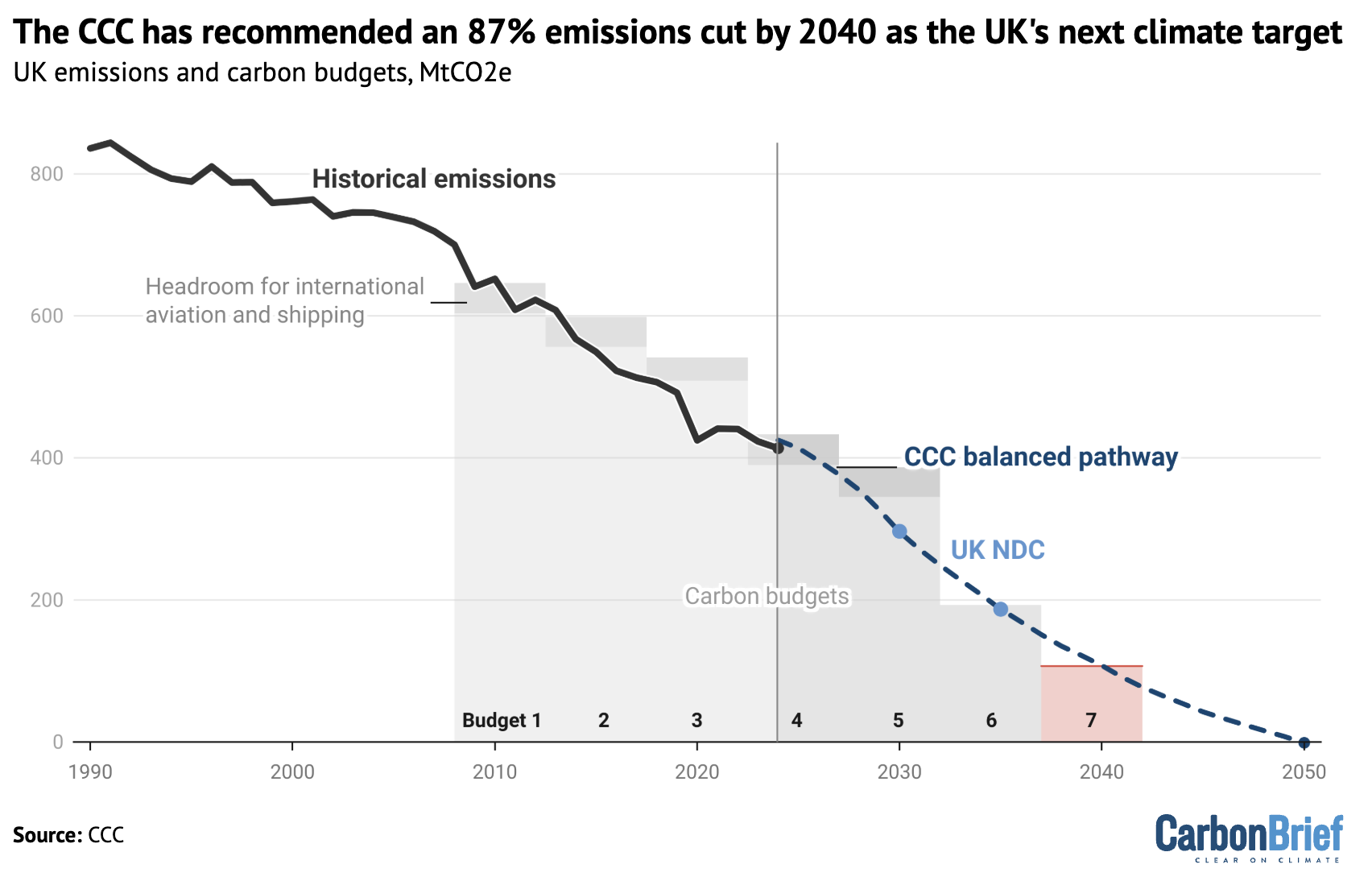
In February 2025, the CCC advised the government to set this budget at 87% below 1990 levels, in order to stay on track for the goal of net-zero by 2050, as shown in the chart below.
UK greenhouse gas emissions, including international aviation and shipping (IAS), MtCO2e. Lines show historical emissions (black) and the CCC’s “balanced pathway” to reaching net-zero. Legislated carbon budgets levels are shown as grey steps. The first five budgets did not include IAS, but “headroom” was left to allow for these emissions (darker grey wedges). Source: CCC.
Both the CB6 delivery plan this October and the parliamentary vote over CB7 next June are likely to be hotly contested, with the Conservatives and Reform having come out against climate action.
After publishing two unlawful carbon budget delivery plans and ahead of a widely anticipated election loss, the Conservatives began calling for greater scrutiny around carbon budgets in 2023.
Then-prime minister Rishi Sunak said in September of that year that parliament should be able to debate plans to meet the next carbon budget, before voting on the target. He said:
“So, when parliament votes on carbon budgets in the future, I want to see it consider the plans to meet that budget, at the same time.”
Then-secretary of state Coutinho subsequently wrote that a draft delivery plan for CB7 should be published alongside draft legislation setting the level of the carbon budget. She also argued that CB7 be debated on the floor of the House, rather than in the “delegated legislation committee”.
In response, the current government has pledged to provide “further information” to parliament, ahead of the vote on CB7. In a July 2025 letter to the chair of the House of Commons Environmental Audit Committee (EAC), energy secretary Ed Miliband wrote:
“Prior to parliament’s vote, we will publish an impact assessment which will clearly articulate the full range of benefits and costs of the government’s chosen CB7 target and the cross-economy pathway to deliver it.”
However, Miliband said the government would not publish a CB7 delivery plan until “as soon as reasonably practicable after” the parliamentary vote on the level of the budget.
The EAC itself is holding an inquiry on the seventh carbon budget and how the “costs of delivering it will filter through to households and businesses”. It is likely to report back in February 2026.
What would happen if the Climate Change Act was repealed?
If any future government wanted to repeal the Climate Change Act and its legally binding net-zero goal, it would not be a straightforward process.
The government would need to introduce a new bill in parliament just to repeal the act.
This process would involve seeking approval from both the House of Commons and the House of Lords before receiving Royal Assent to become law. Within the make-up of the current UK parliament, it is likely that such a bill would face significant challenges.
Any new law repealing the Climate Change Act would need to introduce new climate commitments of a similar nature – or else the UK would be in breach of several international laws and treaties, explains Estelle Dehon KC, a barrister specialising in climate change. She tells Carbon Brief:
“In short, repeal of the Climate Change Act without any replacement commitments of a similar type would be in breach of the UK’s international obligations under: the climate change treaties (so UNFCCC, Kyoto and Paris); international human rights law and customary international law, as well as specific sources like UN Convention on the Law of the Sea.”
Under the Paris Agreement, the UK has made pledges to cut its emissions by 2030 and 2035, known as “nationally determined contributions” (NDCs).
The UK’s NDCs are directly informed by its domestic emissions-cutting targets, known as carbon budgets. The act specifies that the government has a “duty to prepare proposals and policies for meeting carbon budgets”.
Any move in breach of international laws and treaties could be vulnerable to legal challenges, particularly in light of a recent opinion on climate change by the International Court of Justice.
Repealing the Climate Change Act could also put the UK in opposition with its international trade agreements.
The most recent trade agreement between the UK and the EU states that each party “reaffirms its ambition of achieving economy-wide climate neutrality by 2050”.
It also contains rules on “non-regression” in relation to climate protection.
Nigel Farage urges you to ignore facts and reality and be a climate science denier like him. He says that Reform UK has received £Millions and £Millions from the fossil fuel industry to promote climate denial and destroy the planet.Donald Trump urges you to be a Climate Science denier like him. He says that he makes millions and millions for destroying the planet, Burn, Baby, Burn and Flood, Baby, Flood.Elon Musk urges you to be a Fascist like him, says that you can ignore facts and reality then.
Gatwick says its plans will generate an additional 14,000 jobs. Photograph: Gareth Fuller/PA
Heidi Alexander approves expansion to allow 100,000 more flights a year
Gatwick airport’s £2.2bn second runway plan has been given the go-ahead by the transport secretary, Heidi Alexander.
With the privately financed project, the West Sussex hub is aiming to increase its capacity by 100,000 flights a year.
Gatwick will move its emergency runway 12 metres north, enabling it to be used for departures of narrow-bodied planes such as Airbus A320s and Boeing 737s.
The new runway is expected to add 14,000 jobs and as much as £1bn in extra economic activity.
Alexander backed the scheme as a “no-brainer” for economic growth, a government source said on Sunday, suggesting flights could take off from the new full runway by 2029.
Environmentalist have slammed the government’s decision to approve a second Gatwick runway.
Green party leader Zack Polanski has said:
“Signing off on a second runway at Gatwick is a disaster. It ignores basic climate science and risks undermining efforts to tackle the climate crisis. Labour keeps wheeling out the same nonsense about growth, but at what cost? What this really means is more pollution, more noise for local communities, and no real economic benefit.
Expanding Gatwick is a tired, 20th-century answer to a 21st-century crisis. Labour’s obsession with ‘growth at all costs’ is driving us deeper into a climate breakdown and social inequality crisis.”
Rosie Downes, head of campaigns at Friends of the Earth, argues that the economic case for the expansion is ‘massively overstated’:
“With emissions from aviation rising as climate extremes increasingly batter the planet with more intense floods, droughts and wildfires, it’s a struggle to see how the government can conclude expansion at Gatwick is a wise move.
“The Secretary of State says a second runway is a “no-brainer” for the economy, but the economic case for airport expansion is massively overstated. Any growth in air passengers leaving the country is likely to mean more UK tourists using their spending power overseas than anything we might gain from visitors.
Activists from Just Stop Oil hanging a banner above the M25
ENVIRONMENTAL groups Friends of the Earth (FoE) and Greenpeace UK will intervene in appeals challenging sentences given to climate protesters who blocked the M25.
Roger Hallam, Daniel Shaw, Louise Lancaster, Lucia Whittaker De Abreu and Cressida Gethin were jailed in July.
Mr Hallam, co-founder of Just Stop Oil, was sentenced to five years while the other four protesters received four-year sentences for disrupting traffic by climbing motorway gantries in November 2022.
The appeal will be heard on January 29-30, 2025, alongside cases involving 16 other Just Stop Oil activists.
FoE argues the sentences breach human rights laws and is calling for “proportionate” penalties for protesters.
The group’s senior lawyer, Katie de Kauwe, said the sentences “show the chilling effect of the previous government’s anti-protest laws in stifling our democracy and allowing the government of the day to curb dissent.”
She said: “In what functioning democracy can it be right for those peacefully raising the alarm about the climate crisis to receive longer jail sentences than people who participated in racially motivated violence this summer, and deliberately targeted migrants, refugees and Muslim communities?
“Peaceful protesters shouldn’t be locked up, period.”
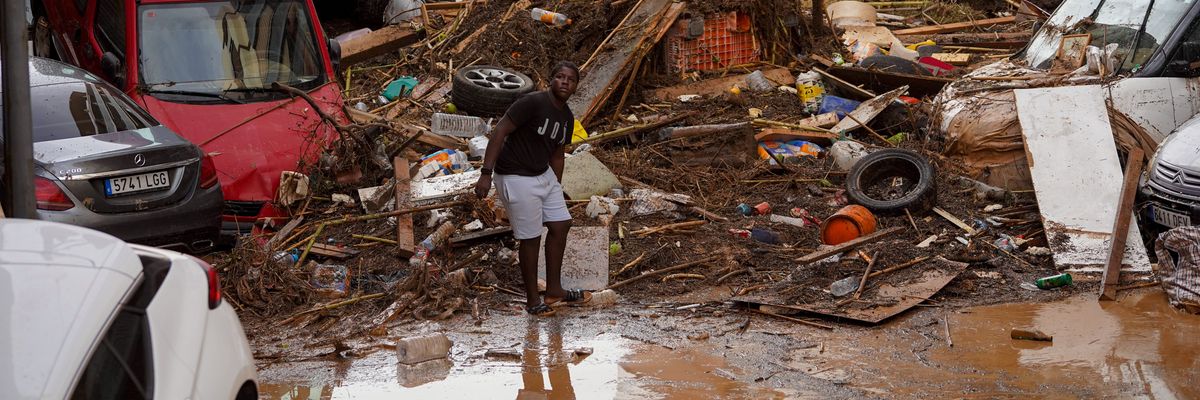
A view of the damaged area after a deluge brought up to 200 liters of rain per square meter (50 gallons per square yard) in hours in towns across the region of Valencia, Spain on October 30, 2024. (Photo: Alex Juarez/Anadolu via Getty Images)
“These disasters are only getting worse, and stopping the industries and systems driving climate collapse is the only rational response,” one climate group said.
Spain’s deadliest flooding in 30 years killed at least 72 people as torrential rain slammed the eastern region of Valencia on Tuesday, with some towns recording a year’s worth of rain in a single day.
The flooding sent churning muddy water down narrow streets, tossing cars, downing trees, bulldozing bridges and buildings, and trapping people in rising flood waters.
“The neighborhood is destroyed, all the cars are on top of each other, it’s literally smashed up,” Christian Viena, who owns a bar in Valencia’s Barrio de la Torre, told The Associated Press. “Everything is a total wreck, everything is ready to be thrown away. The mud is almost 30 centimeters (11 inches) deep.”
As of Wednesday morning, officials reported 70 deaths in Valencia and two in the bordering region of Castilla La Mancha. However, the death toll could rise as search and rescue operations continue amid difficult conditions, such as power outages and blocked roadways. Many people remain missing with their fates uncertain.
This includes residents of Utiel in Valencia, whose mayor, Ricardo Gabaldón, told Spanish broadcaster RTVE that Tuesday was the “worst day of my life.”
“We were trapped like rats,” Gabaldón said. “Cars and trash containers were flowing down the streets. The water was rising to 3 meters (9.8 feet).”
One person who was rescued was Denis Hlavaty, who spent the night perched on the edge of the roof of a gas station where he works.
“It’s a river that came through,” Hlavaty told Reuters, adding, “The doors were torn away and I spent the night there, surrounded by water that was 2 metres (6.5-feet) deep.”
“The fossil fuel industry increases the climate emergency, destroys the balance of critical ecosystems, and puts people’s lives in danger.”
The storm also canceled high-speed rail travel between Valencia and Madrid and Barcelona, and derailed one high-speed train near Malaga, though no one was injured.
While the rains had tapered off in Valencia by Wednesday morning, the rest of the country is not out of danger, as the storm is projected to move northeast.
“We mustn’t let our guard down because the weather front is still wreaking havoc and we can’t say that this devastating episode is over,” Spanish Prime Minister Pedro Sánchez told the nation on television Wednesday.
Even if the death toll does not rise, Tuesday’s floods are already the deadliest in Spain since 1996, when a flood near the Pyrenees killed 87. They are also the deadliest in Europe since floods in 2021 that killed at least 185.
In the immediate term, Tuesday’s deluge was caused by a phenomenon called a gota fría, or “cold drop,” a storm formed as cold air moves over the warm Mediterranean. In Spain, these kinds of storms are also commonly referred to with the acronym DANA—for Depresión Aislada en Niveles Altos, or isolated high-level depression.
However, scientists observe that the climate crisis is making rainstorms like this one more extreme, as warmer air can hold more moisture to dump when conditions are right. For Europe specifically, the warming of the Mediterranean causes more water to evaporate from its surface, super-charging rainstorms.
“Events of this type, which used to occur many decades apart, are now becoming more frequent and their destructive capacity is greater,” Ernesto Rodriguez Camino, senior state meteorologist and a member of the Spanish Meteorological Association, told Reuters.
The Spanish flooding comes a little more than a month after record rainfall swamped Central Europe and Eastern Europe, in an event that scientists concluded was made approximately twice as likely and 7% more severe by the climate crisis fueled primarily by the burning of fossil fuels.
“When we talk about climate change and climate emergency, it’s often perceived as an abstract concept far from our daily reality,” Eva Saldaña, the executive director of Greenpeace Spain, said in a statement. “Unfortunately, this is climate change: the intensification of extreme weather phenomenons like what happened tonight, with the level of destruction greater each time. Ignoring it causes deaths that we cannot allow.”
In a post on social media, Greenpeace Spain said that fossil fuel companies including the Spanish Repsol should pay for the damages.
“DANAS are more intense every time due to climate change,” the group wrote. “The fossil fuel industry increases the climate emergency, destroys the balance of critical ecosystems, and puts people’s lives in danger.”
Extinction Rebellion Global agreed. “These disasters are only getting worse, and stopping the industries and systems driving climate collapse is the only rational response,” the group wrote on social media.
The U.S.-based Climate Defiance, meanwhile, shared images of flood-ravaged streets with dismissals often leveled at climate activists.
Yellow Dot Studios, Don’t Look Up director Adam McKay’s climate-focused media studio, also shared an image of cars dropped in piles in the street by the flood waters to call out the double-standard in how direct-action climate protests and the corporate crimes of the fossil fuel industry are punished.
Friends of the Earth Spain focused on the human impacts, arguing that urgent climate action meant “putting people’s lives, and not economic models, at the center.”
“Don’t prioritize sending people to work in extreme and dangerous conditions,” the group wrote. “It is a priority to take effective, ambitious, and urgent measures in response to the climate crisis we are living through.”


![The target for 2050: (1) It is the duty of the Secretary of State to ensure that the net UK carbon account for the year 2050 is at least [F1100%] lower than the 1990 baseline. (2)“The 1990 baseline” means the aggregate amount of— (a)net UK emissions of carbon dioxide for that year, and (b)net UK emissions of each of the other targeted greenhouse gases for the year that is the base year for that gas.](https://www.carbonbrief.org/wp-content/uploads/2025/10/cca-rag-scaled.webp)