Prime Minister Sir Keir Starmer (right) and then British ambassador to the US Peter Mandelson during a welcome reception at the ambassador’s residence in Washington, DC, February 27, 2025
LABOUR MP Ian Byrne got to the heart of the Mandelson crisis in the Commons on Wednesday. Namely, he made the point that it is in fact a Mandelson-McSweeney-Labour Together scandal and the measures taken by the government in the wake of the New Labour grandee’s disgrace only scratch the surface of what is needed.
Byrne told MPs that the row over Mandelson’s appointment as ambassador to Washington in December 2024 “was not just a catastrophic error of judgment that has caused profound damage to this government’s reputation.
“It was the result of a clique at the top of the party, as we have seen with the Morgan McSweeney and Labour Together scandal, which I and colleagues … have called on the Prime Minister and the general secretary of the Labour Party to launch an independent investigation into.”
Socialist Campaign Group secretary Richard Burgon underlined the point, asking how Mandelson was even considered for the Washington job.
“It is because it suited the interests of a tiny faction in the Labour Party, funded by big business, which wanted Mandelson at the heart of things in order to shift a Labour government away from the agenda that a real Labour government should have.
“That is why Mandelson was popular with these people … and that is why, despite his despicable character, despite his greed and his avarice, he was put in that position.”
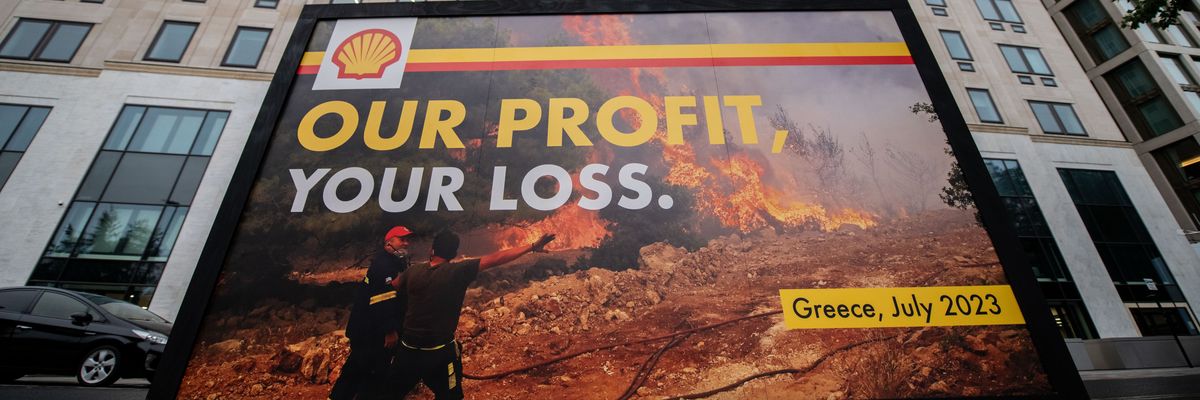
Geenpeace activists set up a billboard during a protest outside Shell headquarters amid the company’s profits announcement on July 27, 2023 in London, England. (Photo: Handout/Chris J Ratcliffe for Greenpeace via Getty Images)
“We cannot let countries and communities that have done the least to cause climate change pay the price for Shell’s greed,” one green group said.
A little more than a week after Earth endured its four hottest days on record, fossil fuel giant Shell announced higher second-quarter profits than expected at $6.3 billion.
The company also announced a new share buyback program worth $3.5 billion through September, CNBC reported.
“It is shameful that Shell, as one of the world’s largest and most profitable fossil fuel companies, continues to reap billions in profits off the back of its planet-wrecking oil and gas operations,” Chiara Liguori, the senior climate justice policy adviser at Oxfam Great Britain, said in response to the news. “At a time when the company should be taking strong action to cut emissions it is instead weakening its climate targets and continues to invest in new oil and gas projects, in favor of short-term shareholder returns.”
“That the profits of two companies alone can outweigh the GDP of six countries already being battered by the climate crisis lays bare the shameful inequity at the heart of the fossil fuel economy.”
Shell’s announcement covers the months of April through June 2024. While the company made 19% less than it did during the first three months of the year, it made $400 million more than London Stock Exchange Group predicted for the quarter, according to CNBC.
A Global Witness analysis concluded that Shell paid $23 billion to shareholders since June 2023. Every month in that same 13-month period saw temperatures averaging 1.5°C or more above preindustrial levels—the more ambitious temperature goal enshrined in the Paris agreement. Each month in that stretch was also the hottest of its kind on record.
“Wildfires raging across the Arctic Circle and temperature records breaking by the day should be a wake-up call,” Greenpeace U.K. said on social media. “But Shell continues to bank billions from digging up climate-wrecking fossil fuels.”
Shell’s announcement caps a month in which high global temperatures fueled a number of extreme weather events. July began with Hurricane Beryl forming as the earliest ever Category 4 and Category 5 Atlantic hurricane on record, before it devastated several Caribbean islands. Last week, a fast-moving wildfire forced more than 20,000 people to flee historic Jasper in the Canadian Rockies before it destroyed nearly a third of the town. The same week, Typhoon Gaemi dumped more than 1,000 millimeters of rain on Taiwan in less than 24 hours.
“As people flee wildfires in Canada, floods in Taiwan, and rebuild in the wake of Storm Beryl, Shell is doubling down on fossil fuels, U-turning on renewables, and profiting to the tune of billions from an intensifying climate crisis,” Alice Harrison, head of Fossil Fuel Campaigns at Global Witness, said in a statement.
Shell’s announcement also comes days after BP posted $2.8 billion in second-quarter profits.
Global Witness calculated that BP and Shell’s second-quarter profits combined would be enough to pay one-tenth of the $100 billion in climate-related loss and damage money that developing nations have requested by 2030.
At the same time, the two oil giants’ profits over the past year—£31.2 billion ($39.8 billion)—exceed the £27.7 ($35.3) billion combined gross domestic products of the six nations most impacted by Beryl: Barbados, the Cayman Islands, Dominica, Jamaica, St. Vincent and the Grenadines, and Grenada, according to Global Justice Now.
“That the profits of two companies alone can outweigh the GDP of six countries already being battered by the climate crisis lays bare the shameful inequity at the heart of the fossil fuel economy,” Izzie McIntosh, climate campaigner at Global Justice Now, said in a statement. “People in the Caribbean devastated by the impacts of Hurricane Beryl are left to pick up the pieces, while rich shareholders and fossil fuel CEOs get to rake in the profits, removed from the chaos they’ve played a leading role in creating.”
The climate justice organizations called for governments to take action to stop fossil fuel companies before they can further destabilize Earth’s climate.
“We need accountability and a government that isn’t afraid to stand up to them—it can start by introducing measures to make these polluting megacorporations pay up for the climate damage they’ve caused in the Global South, as well as a fossil fuel phaseout,” McIntosh continued.
Harrison agreed: “We can’t keep letting polluters off the hook. Governments should be holding fossil fuel majors to account for the crisis they created and forcing them to pay for the damage they are inflicting on millions of families around the world.”
Oxfam G.B. and Greenpeace U.K. recommended policies for the United Kingdom—where Shell and BP are headquartered—specifically.
“As global temperatures and the huge costs of tackling the climate crisis continue to rise, the U.K. government has a chance to ensure those most responsible for contributing to global greenhouse gas emissions, like Shell, are held to account by taxing them more,” Liguori said. “This could help raise the vital funds needed to ensure a fair switch to clean, renewable energy in the U.K. as well as fulfilling our international commitments to support communities worst-hit by climate change to adapt and recover.”
Greenpeace concluded: “We cannot let countries and communities that have done the least to cause climate change pay the price for Shell’s greed. The new Labour government must prove it is different to its predecessor by reining in the fossil fuel giants and imposing bold new taxes on polluters to force them to pay their climate debts at home and abroad.”
Al Gore, former vice president of the United States, speaks onstage at The New York Times Climate Forward Summit 2023 at The Times Center on September 21, 2023, in New York City. (Photo: Bennett Raglin/Getty Images for The New York Times)
“They are continuing to do similar things today to try to fool people and pull the wool over people’s eyes just in the name of greed,” the former vice president said.
In reflecting on nearly 50 years of climate advocacy, former Vice President Al Gore said that he had “underestimated” the greed of the fossil fuel industry.
The remarks came in an interview published in USA Today on Sunday. When asked if he had any regrets, Gore responded that he had “put every ounce of energy” he had into climate advocacy, but added:
“I was pretty slow to recognize how important the massive funding of anti-climate messaging was going on. I underestimated the power of greed in the fossil fuel industry, the shamelessness in putting out the lies.”
“They are continuing to do similar things today to try to fool people and pull the wool over people’s eyes just in the name of greed,” Gore continued.
“What’s at stake is so incredible.”
Gore, who tried to raise awareness about the climate crisis in the U.S. House of Representatives as early as 1981 and brought the issue to national attention in 2006’s documentary An Inconvenient Truth, has taken a harsher tone against oil, gas, and coal companies in recent months. In August 2023, he said that the “climate crisis is a fossil fuel crisis,” and in September, he implored the industry to “get out of the way.” In December, he lamented that the industry had “captured the COP process,” referring to the appointment of the United Arab Emirates national oil company CEO Sultan Ahmed Al Jaber to preside over the United Nations’ COP28 climate conference in that country.
In the USA Today interview, Gore also named the fossil fuel industry when asked about his greatest frustration.
“Well, that we haven’t made more progress,” Gore answered, “and that some of the fossil fuel companies have been shameless in providing, continuing to provide lavish funding for disinformation and misinformation.”
“What’s at stake is so incredible,” he added.
However, Gore told USA Today that he tried not to focus on his anger, but instead on continuing to raise awareness about the crisis and what can be done about it. And he remained hopeful that his grandchildren would live in a world in which people had come together and acted in time.
“We’ve got all the solutions we need right now to cut emissions in half before the end of this decade,” he said. “We’ve got a clear line of sight to how we can cut the other 50% of emissions by mid century.”
He also encouraged more people to get involved with the climate movement.
“I would say the greatest need is for more grassroots advocates because the most persuasive advocates are those in your own community,” he said.
The American public believes fossil fuel companies should pay for their deceit. Our job is to make sure they do.
For decades, the fossil fuel industry has misled the public about the climate impacts of its products. Internal documents prove companies like Exxon knew since the 1970s that burning oil and gas drives catastrophic global warming. Yet rather than warn society, they denied the science and obstructed climate action at every turn.
This corporate deception continues today, but the public is catching on in a big way. New polling from Data for Progress reveals 70% of Americans support making Big Oil pay for the climate damages their products have caused. With climate disasters growing in frequency and severity, people are fed up footing the bill for Big Oil’s greed.
Such greed should disgust us all. But outrage alone achieves nothing.
Critically, the American public believes Big Oil should pay for their lies. The new polling reveals that 77% of Americans agree that if oil and gas companies misled the public about climate impacts, they should help cover resulting climate costs. This consensus crosses political divisions. Agreement spans 91% of Democrats, 75% of Independents, and 63% of Republicans—an exceptionally high level of bipartisan agreement.
The poll also shows a sharp rise in support for making polluters pay over time. Similar polls in 2021 and 2019 found roughly 60% and 57% of Americans backed accountability, respectively. In just a few short years, support for accountability has jumped nearly 20 percentage points. Now near three-quarters of Americans are in agreement around the belief that Big Oil should pay for the harms it sowed through decades of deception.
The costs of warming are no longer abstract statistics. They can be seen in the devastation of communities across America. In 2021 alone, extreme weather fueled by climate change inflicted over $165 billion in damages nationwide. Floods, wildfires and storms killed hundreds and displaced countless more. Low income and minority communities suffered most, abandoned by the very corporations who caused this crisis.
At the same time these climate impacts accelerate, the fossil fuel industry is raking in massive profits. Just last quarter, Chevron pocketed $11.2 billion and Exxon secured $19.7 billion. Rather than invest in renewables or pay for the harms they’ve caused, they’re doubling down on fossil fuels, scooping up sister-companies and stoking fears of monopolization in the public and leadership alike.
New lawsuits are seeking damages for Big Oil’s climate deception, and they’re gaining traction.
By misleading the public on climate science for so long, the industry secured decades of unchecked emissions to swell its bottom line. But now, the deadly consequences of its lies are coming to bear. Record heat, drought and near-weekly hurricanes make clear we rapidly must transition from fossil fuels to avert utter climate catastrophe.
The public correctly realizes these corporations should pay for the crisis they knowingly fueled. Our leaders must stand up to polluters and enact policies to rein in their abuses. A future free from fossil fuels is possible, and we now have the political will to make it happen.

 Prime Minister Sir Keir Starmer (right) and then British ambassador to the US Peter Mandelson during a welcome reception at the ambassador’s residence in Washington, DC, February 27, 2025