Report Reveals $2 Billion of New Financing by Big Banks for Oil and Gas in the Amazon

Spread the love

Original article by Julia Conley republished from Common Dreams under Creative Commons (CC BY-NC-ND 3.0). 

The Pastaza River and the Heart island are seen in the southern Ecuadorian Amazon Rainforest on April 12, 2023. 
Photo by Misha Vallejo Prut for The Washington Post via Getty Images)

“These investments are complicit in genocide: They are killing our culture, our history, and destroying the biodiversity of the Amazon.”

A day after the Brazilian state-run oil firm Petrobras announced it would begin drilling for oil near the mouth of the Amazon River “immediately” after obtaining a license despite concerns over the impact on wildlife, an analysis on Tuesday revealed that banks have added $2 billion in direct financing for oil and gas in the biodiverse Amazon Rainforest since 2024.

The report from Stand.earth—and Petrobras’ license—come weeks before officials in Belém, Brazil prepare to host the 2025 United Nations Climate Change Conference (COP30), where advocates are calling for an investment of $1.3 trillion per year for developing countries to mitigate and adapt to the climate emergency.

Examining 843 deals involving 330 banks, Stand.earth found that US banks JPMorgan ChaseBank of America, and Citi are among the worst-performing institutions, pouring between $283 million and $326 million into oil and gas in the Amazon.

The biggest spender on oil and gas in the past year has been Itaú Unibanco, the Brazilian bank, which has sent $378 million in financing to oil and gas firms for extractive activities in the Amazon.

“Oil and gas expansion in the Amazon endangers one of the world’s most vital ecosystems and Indigenous peoples who have protected it for millennia,” said Stand.earth. “In addition to fossil fuels leading global greenhouse gas emissions, in the Amazon their extraction also accelerates deforestation, and pollutes rivers and communities.”

The group’s research found that banks have directly financed more than $15 billion to oil and gas companies in the Amazon region since the Paris Agreement, the legally binding climate accord, was adopted in 2016. Nearly 75% of the investment has come from just 10 firms, including Itaú, JPMorgan Chase, Citi, and Bank of America.

The analysis comes weeks after the UN-backed Net-Zero Banking Alliance said it was suspending its operations, following decisions by several large banks to leave the alliance that was established in 2021 to limit banks’ environmental footprint, achieve net-zero emissions in the sector by 2050, and set five-year goals for reducing the institutions’ financing of emissions.

“Around 1,700 Indigenous people live here, and our survival depends on the forest. We ask that banks such as Itaú, Santander, and Banco do Nordeste stop financing companies that exploit fossil fuels in Indigenous territories.”

Devyani Singh, lead researcher for Stand.earth’s new bank scorecard on fossil fuel financing, noted that European banks like BNP Paribas and HSBC have “applied more robust policies to protect the sensitive Amazon rainforest than their peers” and have “significantly dropped in financing ranks.”

But, said Singh, “no bank has yet brought its financing to zero. Every one of these banks must close the existing loopholes and fully exit Amazon oil and gas without delay.”

More than 80% of the banks’ Amazon fossil fuel financing since 2024 has gone to just six oil and gas companies: Petrobras, Canada’s Gran Tierra, Brazil’s Eneva, oil trader Gunvor, and two Peruvian companies: Hunt Oil Peru and Pluspetrol Camisea.

The companies have been associated with human rights violations and have long been resisted by Indigenous people in the Amazon region, who have suffered from health impacts of projects like the Camisea gas project, a decline in fish and game stocks, and a lack of clean water.

“It’s outrageous that Bank of America, Scotiabank, Credicorp, and Itaú are increasing their financing of oil and gas in the Amazon at a time when the forest itself is under grave threat,” said Olivia Bisa, president of the Autonomous Territorial Government of the Chapra Nation in Peru. “For decades, Indigenous Peoples have suffered the heaviest impacts of this destruction. We are calling on banks to change course now: by ending support for extractive industries in the Amazon, they can help protect the forest that sustains our lives and the future of the planet.”

Stand.earth’s report warned that both the Amazon Rainforest—which provides a habitat for 10% of Earth’s biodiversity, including many endangered species—and the people who live there are facing “escalating threats” from oil and gas companies and the firms that finance them, with centuries of exploitation driving the forest “toward an ecological tipping point with irreversible impacts that have global consequences.”

Oil and gas exploration is opening roads into intact parts of the Amazon and other forests, while perpetuating the new fossil fuel emissions that scientists and energy experts have warned have no place on a pathway to limiting planetary heating.

“With warming temperatures, the delicate ecological balance of the Amazon could be upset, flipping it from being a carbon-absorbing rainforest into a carbon-emitting savannah,” reads the group’s report.

Jonas Mura, chief of the Gavião Real Indigenous Territory in Brazil, said “the noise, the constant truck traffic, and the explosions” from Eneva’s projects “have driven away the animals and affected our hunting.”

“Even worse: they are entering without our consent,” said Mura. “Our territory feels threatened, and our families are being directly harmed. Around 1,700 Indigenous people live here, and our survival depends on the forest. We ask that banks such as Itaú, Santander, and Banco do Nordeste stop financing companies that exploit fossil fuels in Indigenous territories.”

“These companies have no commitment to the environment, to Indigenous and traditional peoples, or to the future of the planet,” he added. “These investments are complicit in genocide: They are killing our culture, our history, and destroying the biodiversity of the Amazon.”

Original article by Julia Conley republished from Common Dreams under Creative Commons (CC BY-NC-ND 3.0). 

Orcas comment on killer apes destroying the planet by continuing to burn fossil fuels.
Donald Trump urges you to be a Climate Science denier like him. He says that he makes millions and millions for destroying the planet, Burn, Baby, Burn and Flood, Baby, Flood.
Nigel Farage urges you to ignore facts and reality and be a climate science denier like him and his Deputy Richard Tice. He says that Reform UK has received £Millions and £Millions from the fossil fuel industry to promote climate denial and destroy the planet.

Continue ReadingReport Reveals $2 Billion of New Financing by Big Banks for Oil and Gas in the Amazon

World faces choice between war or peace, Xi Jinping warns at WWII anniversary parade

Spread the love

https://morningstaronline.co.uk/article/world-faces-choice-between-war-or-peace-xi-jinping-warns-wwii-anniversary-parade

 The Chinese flag is raised ahead of a military parade to commemorate the 80th anniversary of Japan’s World War II surrender held in front of Tiananmen Gate in Beijing, September 3, 2025

THE world is facing a choice between peace or war, Chinese President Xi Jinping warned today during celebrations to mark the end of World War II. 

He was joined in Beijing by Russian President Vladimir Putin, North Korean leader Kim Jong Un and dozens of other world leaders at China’s largest-ever military parade.

The three leaders met for the first time, holding private talks after the parade in a show of diplomatic unity.

China also flexed its military muscle during the parade marking 80 years since the country’s victory over Japan, revealing aerial and underwater drones, hypersonic missiles and fighter jets and bombs.

Addressing more than 50,000 people in Tiananmen Square, Mr Xi said: “Today, humanity is again faced with the choice of peace or war, dialogue or confrontation, win-win or zero-sum.”

He declared that China “is never intimidated by any bullies” and “unstoppable.”

Mr Xi also said that the world must “never return to the law of the jungle, where the strong prey on the weak” during a lunch reception speech stressing the establishment of the United Nations and international law as achievements of anti-fascist victory.

“We sincerely hope that all countries will draw lessons from history, value peace and work together to … create a brighter future for humanity,” he said.

He concluded by toasting to “common prosperity for all humankind.”

https://morningstaronline.co.uk/article/world-faces-choice-between-war-or-peace-xi-jinping-warns-wwii-anniversary-parade

Elon Musk urges you to be a Fascist like him, says that you can ignore facts and reality then.
Donald Fuhrump says that Amerikkka doesn't bother with crimes or charges anymore, not being 100% Amerikkkan and opposing his real estate intentions is enough.
Donald Fuhrump says that Amerikkka doesn’t bother with crimes or charges anymore, not being 100% Amerikkkan and opposing his real estate intentions is enough.
Continue ReadingWorld faces choice between war or peace, Xi Jinping warns at WWII anniversary parade

Despite History of Fabrication, Press Uncritically Covers IDF-Provided Documents on Hamas

Spread the love

Original article by Bryce Greene republished from FAIR under a Creative Commons Attribution-NonCommercial-NoDerivs 3.0 Unported License.

The New York Times (10/12/24) says it “verified” supposed Hamas documents provided to the paper by Israel—which turns out to mostly mean that that the Israeli military “concluded the documents were real.”

Earlier this month, the New York Times (10/12/24), Washington Post (10/12/24) and Wall Street Journal (10/12/24) each published front-page articles based on different sets of documents handed to them by the Israeli military.

Israel claims it seized all the documents—in the form of meeting minutes, letters and planning documents—in its ground invasion of Gaza, and that they reveal insights into Hamas’s operations prior to the October 7 attacks. The documents include alleged evidence of Hamas’s pre-10/7 coordination with Iran, plans to blow up Israeli skyscrapers, and even a scheme to use horse-drawn chariots in an attack from Gaza.

Documents received directly from intelligence agencies should always be treated with skepticism, and that’s especially true when their government has a well-documented history of blatant lying. Yet leading newspapers took these Israeli document dumps largely at face value, advancing the agenda of a genocidal rogue state.

A history of lying

Fake “Hamas” documents were being cited in the press as recently as September 2024 (Middle East Eye9/9/24).

Israel’s use of fabrications to shape public perception is well known, and was put on display early in the assault on Gaza that began last October. After an explosion at Al Ahli hospital killed and injured hundreds (misreporting of which caused a great deal of confusion), the media naturally pointed the finger at Israel. The Israeli government, concerned about the public backlash, denied responsibility, claiming that the explosion was caused by a misfired rocket from Palestinian Islamic Jihad. (See FAIR.org11/3/23.)

To back up their claims, Israel released a recording allegedly capturing two Palestinian militants discussing Palestinian Islamic Jihad’s responsibility for the strike. However, an analysis by the firm Earshot found that the audio was the result of two separate channels being edited together (Channel 4, 10/19/23). In other words, Israel engineered a phony audio clip in an attempt to clear itself of war crimes  in the public mind.

Investigations based on open sources have since come to various conclusions about the attack (Guardian, 10/18/23Bellingcat, 10/18/23; Human Rights Watch, 11/26/23AP, 11/22/23; Michael Kobs, 2023New Arab, 2/19/24), but Israel’s fraudulent attempt to manipulate evidence certainly suggests that they had something to hide, and demonstrates their lack of reliability as a media source. Recently, the UN released a report accusing Israel of systematically targeting healthcare infrastructure in Gaza, making their denials of this earlier attack far less credible.

In another instance, Israel presented 3D renderings of a supposed Hamas “command center” beneath Al Shifa hospital, claiming it was based on intelligence. However, no such command center was ever found (FAIR.org12/1/23). Upon storming the hospital, Israel staged scenes in order to bolster claims that the facility was used by militant groups. The deception was so blatant that mainstream outlets were openly calling it out.

Recently Israel was caught actually providing fabricated documents to the press with the aim of manipulating public opinion. Earlier this year, the Israeli government provided documents to both the Jewish Chronicle (9/5/24) and the German paper Bild (9/6/24) that purportedly showed that Hamas had no interest in a ceasefire, and had a plan to sneak the late Hamas chief Yahya Sinwar out of Gaza to Iran, along with some of the remaining hostages. The reports were then uncritically repeated in outlets like the Times of Israel (9/6/24).

Shortly after these documents were published, the Israeli paper Yedioth Ahronoth (9/8/24) reported on an internal IDF investigation that found that they had been leaked to foreign media as part of a campaign to “shape public opinion on Israel.” The documents were determined to be forgeries, after a comprehensive search of all databases containing documents found in the wake of Israel’s operations. The IDF told the paper that an investigation was underway to determine the origin of the leak.

This non-exhaustive list of examples demonstrates a pattern of Israel engineering misleading narratives to shape public opinion, and fabricating the evidence needed to do so.

Questionable authenticity

WaPo: Captured documents reveal Hamas’s broader ambition to wreak havoc on Israel
The Washington Post (10/12/24) reported that “the documents’ authenticity could not be definitively established”—but there’s no trace of that doubt in the story’s headline or subhead.

Whether they are authentic or not, it is clear that the documents leaked to the Wall Street Journal, New York Times and Washington Post serve the same purpose of propagandizing on behalf of Israel. In an attempt to preserve some journalistic integrity, the Post and Times both gave separate justifications for why they believed the respective documents leaked to them were authentic.

The Post was quick to note that “the documents’ authenticity could not be definitively established,” but gave readers the impression there was reason to believe they were real. First, it claimed that the contents of the documents it received were

“broadly consistent” with US and allies’ post–October 7 intelligence assessments about Hamas’s long-range planning and complex relationship with Iran.

Then it wrote that unnamed US and Israeli officials they shared the documents with did not express concerns about their authenticity. (Iranian and Hamas officials they consulted didn’t comment on the documents but accused Israel of having a history of “fabricating documents.”)

The New York Times consulted former Hamas member Salah al-Din al-Awawdeh, whom the paper frequently quotes on matters related to Hamas, and an unnamed Palestinian analyst with “knowledge of Hamas’s inner workings.” It also said an internal Israeli military report concluded the documents were authentic, and the paper “researched details mentioned in the meeting records to check that they corresponded with actual events.” It said “Hamas and Hezbollah did not respond to requests to comment” and that Iran “denied the claims made in the minutes.”

The Wall Street Journal story did not describe any attempt to verify the authenticity, and only reported that the paper “hasn’t independently verified the documents.”

But given Israel’s track record, there is no epistemologically sound way of verifying the validity of documents provided by the Israeli government without confirmation from Hamas itself. Citing sources who say that the documents resemble Hamas documents, without noting Israel’s history of creating credible forgeries, creates a patina of credibility without actually substantiating anything.

Advancing Israel’s agenda

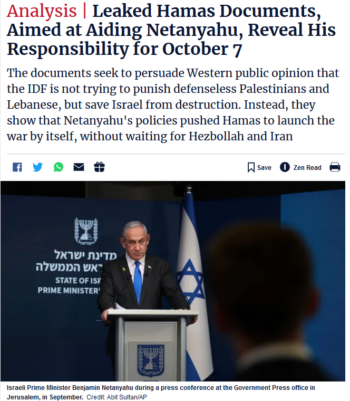
Haaretz: Leaked Hamas Documents, Aimed at Aiding Netanyahu, Reveal His Responsibility for October 7
Haaretz (10/14/24): The documents bolster Netanyahu’s claim that Israel is “fighting a terrifying ‘axis of evil’ led by Iran that threatens to destroy Western culture as a whole.”

The Israeli paper Haaretz (10/14/24), which took the documents as authentic, argued that their release by Israel was “Aimed at Aiding Netanyahu.” While both the Times and the Post have largely advanced Israel’s agenda over the past year of bombing (FAIR.org10/13/232/1/2410/7/24), both papers are considered to be on the critical end of the press spectrum in the US, particularly towards Netanyahu. As Haaretz explained, this perception enhances the propaganda value of the document leak: “The Times and the Post enjoy greater credibility when they fall in line with Israel’s narrative.”

While Haaretz made no note of the leaked documents provided to the Wall Street Journal, the article ironically acknowledged that

having them published by Fox News or even the Wall Street Journal would have looked like an Israeli public diplomacy operation rather than a legitimate journalistic investigative report.

Haaretz noted that the documents promote narratives that “Israel would be happy to burn into the world’s consciousness,” namely the well-known propaganda effort to equate Hamas with organizations that are universally reviled by Americans. The Post documents purportedly outlined a Hamas plan to blow up a skyscraper in Tel Aviv, evoking the September 11 attacks against the World Trade Center:

The Hamas documents are supposed to bolster Netanyahu’s claim that Israel isn’t fighting against a liberation movement seeking to free the occupied Palestinian people, or even against a paramilitary organization that is poorly funded and trained and lacks planes, the Iron Dome anti-missile system, tanks and artillery….

Rather, it is fighting a terrifying “axis of evil” led by Iran that threatens to destroy Western culture as a whole.

Haaretz also argued that this kind of propaganda campaign was designed to ensure that the violence continues to escalate:

In this spirit, the documents are supposed to justify Israel’s counterattack, which has so far caused enormous death and destruction in Gaza and, to an increasing degree, also in Lebanon.

Obvious PR value

WSJ: Israel Says Documents Found in Gaza Show Hamas’s Attack Planning, Iran Ties
Unlike the New York Times or Washington Post, the Wall Street Journal (10/12/24) acknowledged in its headline that the revelations in the documents are what “Israel says” they show.

While Haaretz overlooked the story from the Wall Street Journal, the same logic can be applied to the documents given to that paper as well. The Journal was apparently curious about the political purpose of the documents, noting that “the officials who provided the documents declined to say why they were releasing them now.”

The Journal wrote that the documents “suggest that Hamas leader Yahya Sinwar was negotiating with Iran over funding for a planned large-scale assault on Israel as far back as 2021,” and gave specific dollar amounts that Iran provided to Hamas’s armed wing. The obvious public relations value of these documents was that they boosted the negative image of Iran prior to Israel’s recent attack on that country.

Israel’s campaign of genocide in Gaza and greater war in the Middle East has been successful in part because the Israeli government can count on Western press to present and contextualize facts in a way that advances their narrative. Despite Israel’s long history of fabrications, the corporate media will dutifully republish documents, statements and explanations with complete credulity.

Original article by Bryce Greene republished from FAIR under a Creative Commons Attribution-NonCommercial-NoDerivs 3.0 Unported License.

Continue ReadingDespite History of Fabrication, Press Uncritically Covers IDF-Provided Documents on Hamas

Israeli Bombing of Gaza Ranks Among ‘Most Devastating’ in History

Spread the love

Original article by BRETT WILKINS republished from Common Dreams under Creative Commons (CC BY-NC-ND 3.0).

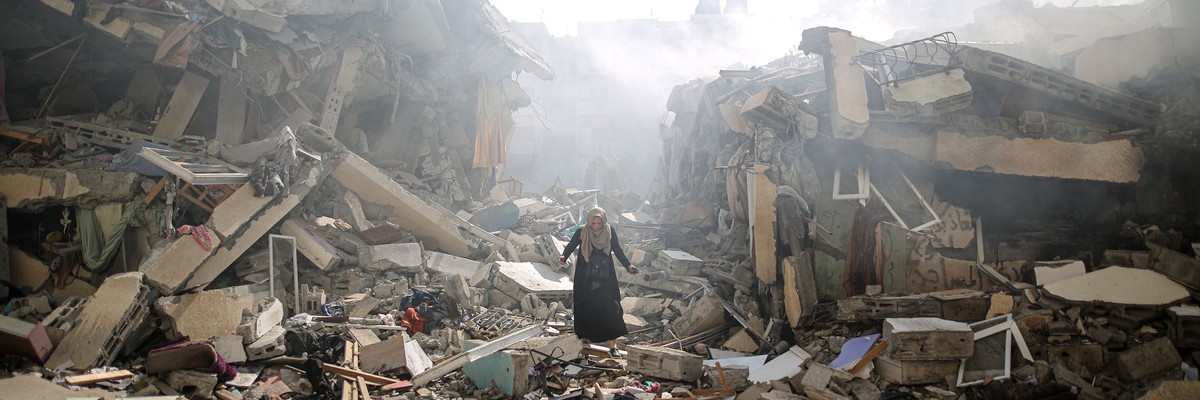
A survivor of Israel’s bombardment of Gaza makes her way through the rubble of the al-Zahra neighborhood on October 19, 2023.  (Photo: Mustafa Hassona/Anadolu via Getty Images)

“Gaza is one of the most intense civilian punishment campaigns in history,” said a U.S. military historian as Israel’s use of arms including 2,000-pound “bunker-buster” bombs pushed the Palestinian death toll over 20,000.

As the Palestinian death toll from Israel’s 10-week annihilation of the Gaza Strip passed 20,000, warfare experts said this weekend that the retaliatory campaign ranks among the deadliest and most destructive in modern history.

Gaza health officials said Friday that 390 Palestinians were killed and 734 others wounded in the besieged strip over the previous 48 hours, driving the death toll from 77 days of near-relentless Israeli attacks to 20,057, with another 53,320 people injured. More than 6,000 women and over 8,000 children have been killed—approximately 70% of all fatalities.

That’s more than twice the number of civilians—and over 14 times as many children—as Russian forces have killed in Ukraine since February 2022.

Thousands more Palestinians are missing and feared buried beneath the rubble of the hundreds of thousands of buildings destroyed or damaged by Israeli bombardment.

“The scale of Palestinian civilian deaths in such a short period of time appears to be the highest such civilian casualty rate in the 21st century,” Michael Lynk, who served as the United Nations special rapporteur on human rights in the Palestinian territories from 2016 to 2022, told The Washington Post on Saturday.

Robert Pape, a U.S. military historian and University of Chicago professor, told The Associated Press that “Gaza is one of the most intense civilian punishment campaigns in history.”

“It now sits comfortably in the top quartile of the most devastating bombing campaigns ever,” he added.

By comparison, the 2017 U.S.-led coalition battle for Mosul, Iraq during the war against the so-called Islamic State—widely viewed as among the most intense urban assaults in recent decades—killed approximately 10,000 civilians, around a third of them from aerial bombardment.

Pape said that by some measures, Israel’s bombing of Gaza is surpassing the Allied “terror bombing” of German cities during World War II.

He noted that U.S. and U.K. airstrikes obliterated about 40-50% of the urban areas of the 51 German cities bombed between 1942-45, and that around 10% of all buildings in Germany were destroyed. In Gaza, approximately 1 in 3 buildings have been destroyed. In northern Gaza, over two-thirds of all buildings have been leveled.

“Gaza is now a different color from space. It’s a different texture,” Corey Scher, who studies natural disasters and wars using satellite remote sensing at the City University of New York’s Graduate Center, told the AP.

Experts point to the types of munitions being used by Israeli forces as a major reason why so many Gazans are being killed and injured. These include U.S.-supplied 1,000-pound and 2,000-pound guided “bunker-buster” bombs, which Israel says are necessary to target Hamas’ underground tunnels.

These massive bombs turn “earth to liquid,” Marc Garlasco, a former Pentagon defense official and war crimes investigator for the United Nations, told the AP. “It pancakes entire buildings.”

Garlasco said that 2,000-pound bombs mean “instant death” for anyone within about 100 feet of the blast, with shrapnel posing a deadly danger for people up to 1,200 feet away.

In a separate interview with CNN, Gerlasco said that the intensity of Israel’s bombardment of Gaza has “not been seen since Vietnam,” when U.S. airstrikes killed up to hundreds of thousands of Vietnamese, Cambodians, and Laotians. The U.S. dropped more bombs on tiny, non-belligerent Laos than all sides combined unleashed during World War II.

“You’d have to go back to the Vietnam War to make a comparison,” Garlasco added. “Even in both Iraq wars, it was never that dense.”

The use of such heavy ordnance in close proximity to critical civilian infrastructure like hospitals has alarmed observers.

“What we have been witnessing is a campaign that was planned, it was a plan, definitely, to close down all the hospitals in the north,” Léo Cans, head of mission for Palestine with Doctors Without Borders, told the Post.

Aided by AI-based target selection systems, Israel Defense Forces (IDF) commanders are approving bombings they know will cause large numbers of civilian casualties. In a bid to assassinate a single Hamas commander, the IDF dropped at least two 2,000-pound bombs on the densely populated Jabalia refugee camp on October 31, killing more than 120 civilians.

Although the United States—which has killed more foreign civilians this century than any other armed force in the world—provides Israel with thousands of 1,000 and 2,000-pound bombs, its own military avoids using such massive ordnance in civilian areas due to the devastation they cause.

“It certainly appears that [Israel’s] tolerance for civilian harm compared to expected operational benefits is significantly different than what we would accept as the U.S.,” Larry Lewis, research director at the Center for Naval Analyses and a former U.S. State Department senior adviser on civilian harm, told CNN.

That includes the risk of killing Israel’s own citizens and others held hostage by Hamas in Gaza.

Lewis added that the Jabalia strike was “something we would never see the U.S. doing.”

That isn’t entirely true; during the 1991 Gulf War the U.S. dropped a pair of 2,000-pound Raytheon GBU-27 Paveway III laser-guided bombs on the Amiriyah air raid shelter in Baghdad, killing at least 408 Iraqi civilians in one of the deadliest single airstrikes in modern history. U.S. officials claimed they thought the shelter, which was used during the Iraq-Iran war, was no longer a civilian facility.

“The use of 2,000-pound bombs in an area as densely populated as Gaza means it will take decades for communities to recover,” John Chappell, advocacy and legal fellow at the Washington, D.C.-based advocacy group Center for Civilians in Conflict, told CNN.

Even more concerning for some experts is Israel’s use of unguided, or “dumb” bombs, against civilian targets in Gaza.

While IDF spokesman Daniel Hagari said that “we choose the right munition for each target so it doesn’t cause unnecessary damage,” the death and destruction in Gaza—and Israeli officials’ own words—tell an entirely different story.

Early in the war, Hagari declared that “Gaza will never return to what it was,” clarifying that “the emphasis is on damage and not on accuracy.”

Meanwhile, numerous Israeli officials advocated the complete destruction of Gaza, with more than a few government figures—including Prime Minister Benjamin Netanyahu and other Cabinet members—making statements supporting genocide against the Palestinian people.

U.S. President Joe Biden—who has affirmed his “unwavering” support for Israel and is seeking $14.3 billion in additional military aid for the country, which already gets almost $4 billion annually from Washington—has implored Israeli leaders to stop the “indiscriminate” bombing of Gaza, even as his administration thwarts international cease-fire efforts and restocks the IDF’s arsenal.

Chappell stressed that “the devastation that we’ve seen for communities in Gaza is, unfortunately, co-signed by the United States.”

“Too much of it is carried out by bombs that were made in the United States,” he added.

Ahmed Abofoul—a Gaza-born, Netherlands-based attorney with ‎the Palestinian human rights organization Al-Haq who has lost 60 of his relatives to Israeli bombing— said in Friday interview with Democracy Now! that “the American government is complicit in this genocide.”

“There is blood of Palestinian children on their hands,” he added. [Biden] said Israel is engaged in indiscriminate bombing. This is a war crime. So, the question is: Why do you then send weapons to Israel? The position of the U.S. is quite hypocritical.”

Original article by BRETT WILKINS republished from Common Dreams under Creative Commons (CC BY-NC-ND 3.0).

Continue ReadingIsraeli Bombing of Gaza Ranks Among ‘Most Devastating’ in History

Israel is assassinating journalists in Gaza

Spread the love

Original article by Amanda Yee republished from peoples dispatch under a Creative Commons Attribution-ShareAlike 4.0 (CC BY-SA) license.

As part of its genocidal onslaught on Gaza, Israel is killing media workers at an unprecedented rate, seemingly to prevent the world from seeing the unspeakable atrocities it carries out.

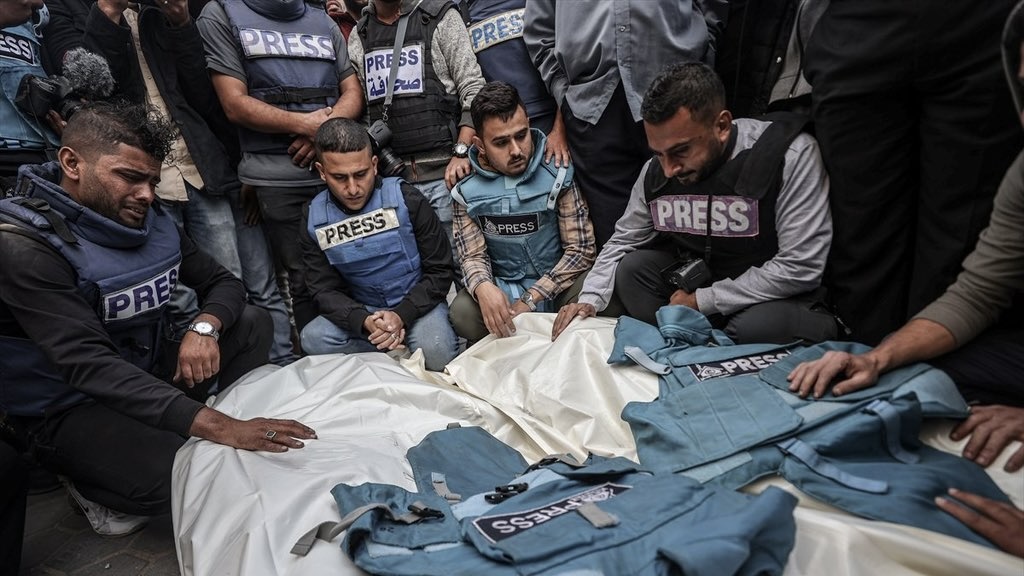
Relatives, colleagues and loved ones of Palestinian journalists Sari Mansour and Hasona Saliem, who were killed while working, mourn during funeral ceremony in Deir al-Balah, Gaza on November 19, 2023. Photo: Anadolu Ajansı / Ali Jadallah

Israel is intentionally assassinating journalists in Gaza. As it wages its genocidal onslaught on the enclave, having murdered at least 13,000 Palestinians so far, Israel is simultaneously killing media workers in order to prevent the world from seeing the unspeakable atrocities it carries out.

The situation at hand is as dire as it is unprecedented. Since October 7, the Israeli military has killed 60 media workers, according to the Gaza Government Media Office. The Committee to Protect Journalists has stated this is the deadliest month for attacks on journalists since it started keeping record in 1992. Additionally, many other Palestinian reporters outside of Gaza face intimidation and harassment by Israeli forces.

“We have never experienced anything like this and we are overwhelmed,” admitted Nasser Abu Bakr, head of the Palestinian Journalists’ Syndicate, a Ramallah-based trade union representing Palestinian media workers. “We are losing colleagues and friends every day as a result of the ongoing Israeli genocide against the Palestinian people and the policy of targeted killing against journalists.”

“We can’t keep up with the number of attacks against our journalists,” Abu Bakr continued. “We are receiving more calls and information about … incidents than we can process. Our journalists have always been a target for the Israeli military, but Israel moved from killing [an average of] one Palestinian journalist a year before October 7 to killing [over] one a day.”

And it’s not just Palestinian reporters the Israel Defense Forces (IDF)  is attacking—any journalist who may potentially disseminate information critical of Israel is a potential target.

Among the long list of reporter casualties is Reuters photojournalist Issam Abdallah, who was killed by an October 13 Israeli strike on the Lebanese border while covering clashes between Hezbollah and the IDF. According to an independent investigation by Reporters Without Borders (RWB), Abdallah was explicitly targeted by Israeli forces—he was clearly identified as a journalist through his press helmet and vest, and he was standing next to a vehicle marked “press” on its roof. Immediately before the attack, other journalists in the area had witnessed an Israeli helicopter flying overhead, so the military was able to clearly see that Abdallah was a non-combatant. According to ballistic analysis done by RWB, the missiles were launched from the side of the Israeli border and “two strikes in the same place in such a short space of time (just over 30 seconds), from the same direction, clearly indicate precise targeting.”

Not even the families of journalists are safe from Israeli retaliation. After learning on air that an Israeli air raid had killed his wife, son, daughter, and grandson, Gaza Al Jazeera bureau chief Wael Al-Dahdouh rushed to the hospital, followed by press cameras. Upon finding his son there, he knelt over his lifeless body and lamented, “They take revenge on us with our children.”

On November 7, Mohammad Abu Hasira, a correspondent for Palestinian news agency Wafa, was killed by an Israeli air raid, along with 42 members of his family. And just days before that, an Israeli strike killed Palestine TV reporter Mohammad Abu Hattab and 11 members of his family in south Gaza, including his wife, son, and brother.

Israel invents lies to justify war crimes

Just as it has claimed that Hamas was hiding in Gaza hospitals, near schools, and in ambulance convoys in order to justify its bombing and killing of civilians, Israel has peddled the same predictable excuses for these targeted assassinations of journalists. In a chilling November 2 article that effectively doubles as a hit list, the Jerusalem Post spotlighted several independent Palestinian journalists who had been reporting from Gaza and smeared them as part of “Hamas’s propaganda team.”

Then, pro-Israel media watchdog group HonestReporting released a report on November 8 claiming—with little evidence—that the Associated Press, CNN, The New York Times, and Reuters freelance photographers in Gaza knew in advance of the October 7 Palestinian Resistance counter-offensive and even collaborated with Hamas in order be on location to get their shots during the operation.

Israeli officials quickly jumped on the story to vindicate their assassination campaign against Palestinian reporters.

In response to the report, former Minister of Defense and current member of Israel’s war cabinet Benny Gantz said, “Journalists found to have known about the massacre, and [who] still chose to stand as idle bystanders while children were slaughtered, are no different than terrorists and should be treated as such.”

Danny Danon, Israel’s representative to the United Nations, went so far as to declare that these reporters would be put on a hit list, stating on X, “Israel’s internal security agency announced that they will eliminate all participants of the October 7 massacre. The ‘photojournalists’ who took part in recording the assault will be added to that list.”

Gil Hoffman, executive director of HonestReporting, later admitted that he had no evidence to substantiate the claims made, but was just “raising questions.” According to Hoffman, he and HonestReporting “don’t claim to be a news organization.”

Accusations that Palestinian reporters are embedded within and acting in coordination with Hamas lay the propaganda groundwork to depict journalists as legitimate military targets.

Israel restricting information coming out of Gaza

Not only is the IDF killing Palestinian journalists on the ground, but the Israeli government is actively denying access to foreign press into Gaza. The only reporters allowed into the strip are those embedded within the IDF, and media outlets such as NBC and CNN have confirmed that in exchange for access, they must submit all materials to the Israeli military prior to broadcast for review and approval.

Additionally, the Palestinian Journalists’ Syndicate reported that as many as 50 media outlets in Gaza have been partially or entirely destroyed by Israeli air strikes since October 7. If Israel is not outright bombing news outlets, then they are actively trying to repress the flow of information coming out. In late October, the Israeli government approved regulations that would allow it to shut down any foreign news channel if it believed the outlet posed a threat to national security. This regulation was then used to block the programming and website of Lebanese outlet Al Mayadeen, because of its “wartime efforts to harm [Israel’s] security interests and to serve the enemy’s goals,” according to a statement released by the Israeli security cabinet.

In the absence of foreign press bearing witness to Israel’s atrocities in Gaza, Palestinian civilians have taken to documenting the horrors themselves and sharing them on social media sites such as X and TikTok for the outside world to see.

The Israeli government has responded by repeatedly shutting down internet and communications systems across Gaza, even further restricting the flow of information coming out.

History of Israel targeting journalists

Even before its current war on Gaza began on October 7, Israel had a long history of targeting reporters and news networks. During its 2021 military incursion on Gaza, Israel was accused of “silencing” journalists by press freedom advocates after it bombed the offices of Al Jazeera and the Associated Press. This occurred just days after it had bombed another building that housed a number of other news outlets, including Al Araby TV, Al Kofiya TV, and Watania News Agency, among others.

According to the Palestinian Journalists’ Syndicate, Israel killed 55 journalists from 2000 to 2022, either by live fire or bombardment. This figure includes Shireen Abu Akleh, the beloved Palestinian-American journalist and longtime Al Jazeera correspondent who was shot by Israeli forces while reporting on IDF raids in Jenin, as well as Yaser Murtaja, a cameraman for Palestinian network Ain Media, who was shot and killed by the IDF while covering the 2018 Great March of Return.

Like so many other Palestinian journalists Israel murdered on the job, Abu Akleh and Murtaja were both wearing their press vests at the time of their killings. Immediately after his death, Israel predictably—with no evidence—rushed to accuse Murtaja of being a Hamas fighter in order to cover its tracks.

The day after Murtaja’s killing, Israel’s then-Defense Minister Avigdor Lieberman bluntly stated, “In the march of terror, there were no innocent civilians. They were all Hamas.”

Israel is losing the information war

Israel relies on its advanced military weaponry and billions of dollars in funding from the US to carry out its genocidal violence against the Palestinian people across Gaza, Jerusalem, and the West Bank. Its Hasbara and “Brand Israel” campaigns work around the clock to justify its war crimes through outright lies and disinformation.

However, Israel has suffered significant losses in the information war as reports and images of the atrocities have reached millions across the world, many of whom have joined the mass mobilizations in support of the Palestinian cause. On the international stage, Israel is further politically isolated, with more and more countries cutting ties or recalling their diplomatic staff.

This battle of ideas cannot be won through sheer force and US-backed military superiority. Israel cannot prevent information about its atrocities from leaking out, especially in an age of social media in which ordinary Palestinians are emboldened to act as citizen journalists, documenting what they are living through in Gaza for the world to see. As Israel escalates its assassination campaign against media workers, support for the Palestinian Resistance continues to grow.

Grim as the current situation may seem, it speaks to the reality at hand: The people of the world are waking up to the atrocities carried out by the Zionist state and refusing to allow it to continue.

And that speaks to another reality: Israel is living on borrowed time, and that time is running out.

Amanda Yee is a journalist and organizer based out of Brooklyn. She is the managing editor of Liberation News, and her writing has appeared in Monthly Review Online, The Real News Network, CounterPunch, and Peoples Dispatch. Follow her on X @catcontentonly.

This article was produced by Globetrotter.

Original article by Amanda Yee republished from peoples dispatch under a Creative Commons Attribution-ShareAlike 4.0 (CC BY-SA) license.

Continue ReadingIsrael is assassinating journalists in Gaza