Analysis Reveals Wall Street Titans Behind Big Oil Profiteering Push in Venezuela

Spread the love

Original article by Stephen Prager republished from Common Dreams under Creative Commons (CC BY-NC-ND 3.0).
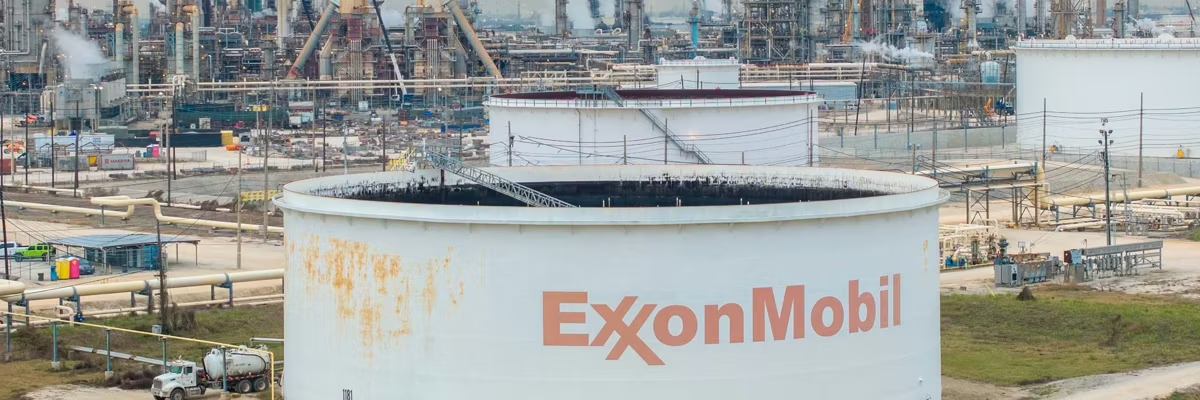
In an aerial view, the ExxonMobil Baytown Refinery is seen on January 13, 2026, in Baytown, Texas. (Photo by Brandon Bell/Getty Images)

Since 2021, top Wall Street banks have committed more than $124 billion in investments to the nine companies set to profit most from the toppling of Venezuela’s government.

As oil industry giants are being set up to profit from President Donald Trump’s invasion of Venezuela, a new analysis shows the ample backing those companies have received from Wall Street’s top financial institutions.

Last week, Bloomberg reported that stock traders and tycoons were “pouncing” after Trump’s kidnapping of President Nicolás Maduro earlier this month, after having pressured the Trump administration to “create a more favorable business environment in Venezuela.”

RECOMMENDED…

VENEZUELA-US-CONFLICT-CRISIS-OIL

Democrats Launch Probe to Learn What Trump Told Oil Giants About Venezuela Attack—and When
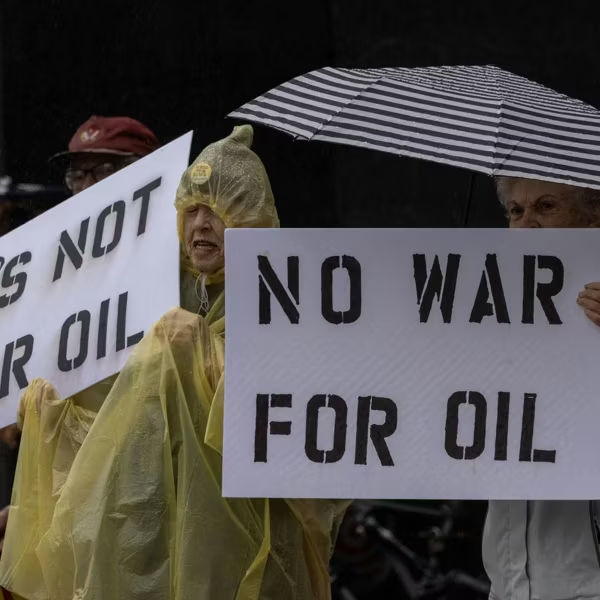
People participate in a “No War on Venezuela” protest

Trump Meeting With Big Oil Underscores Venezuela Agenda: Enriching ‘Himself and His Fossil Fuel Donors’

dataset compiled by the international environmental advocacy group Stand.earth shows the extent to which these interests are intertwined.

Stand.earth found that since 2021, banks—including JPMorgan Chase, HSBC, TD, RBC, CitigroupWells Fargo, and Bank of America—have committed more than $124 billion in investments to the nine companies set to profit most from the toppling of Venezuela’s government.

More than a third of that financing, $42 billion, came in 2025 alone, when Trump launched his aggressive campaign against Venezuela.
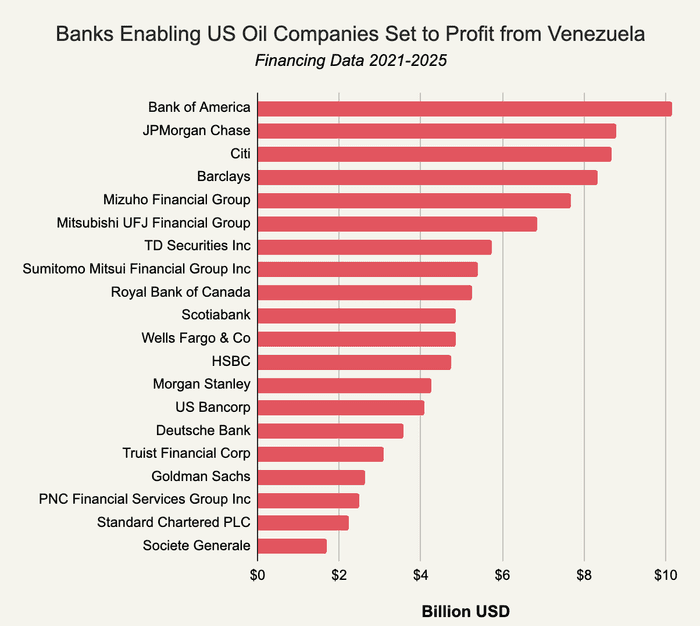
(Graphic from Stand.earth)

Among the companies expected to profit most immediately are refiners like Valero, PBF Energy, Citgo, and Phillips 66, which have large operations on the Gulf Coast that can process the heavy crude Venezuela is known to produce. These four companies have received $41 billion from major banks over the past five years.

Chevron, which also operates many heavy-crude facilities, benefits from being the only US company that operated in Venezuela under the Maduro regime, where it exported more than 140,000 barrels of oil per day last quarter.

At a White House gathering with top oil executives on Friday, the company’s vice chair, Mark Nelson, told Trump the company could double its exports “effective immediately.”

According to Jason Gabelman, an analyst at TD Cowen, the company could increase its annual cash flow by $400 million to $700 million as a result of Trump’s takeover of Venezuelan oil resources.

Chevron was also by far the number-one recipient of investments in 2025, with more than $11 billion in total coming from the banks listed in the report—including $1.78 billion from Barclays, another $1.78 billion from Bank of America, and $1.32 billion from Citigroup.

According to Bloomberg, just weeks before Maduro’s removal, analysts at Citigroup predicted 60% gains on the nation’s more than $60 billion in bonds if he were replaced.

Even ExxonMobil, whose CEO Darren Woods dumped cold water on Trump’s calls to set up operations in Venezuela on Friday, calling the nation “uninvestable,” potentially has something major to gain from Maduro’s overthrow.

Exxon and ConocoPhillips each have outstanding arbitration cases against Venezuela over the government’s 2007 nationalization of oil assets, which could award them $20 billion and $12 billion, respectively.

The report found that in 2025, ExxonMobil and ConocoPhillips received a combined total of more than $12.8 billion in investment from major financial institutions, which vastly exceeded that from previous years.

Data on these staggering investments comes as oil companies face increased scrutiny surrounding possible foreknowledge of Trump’s attack on Venezuela.

Last week, US Senate Democrats launched a formal investigation into “communications between major US oil and oilfield services companies and the Trump administration surrounding last week’s military action in Venezuela and efforts to exploit Venezuelan oil resources.”

Richard Brooks, Stand.earth’s climate finance director, said the role of the financial institutions underwriting those oil companies should not be overlooked either.

“Without financial support from big banks and investors, the likes of Chevron, Exxon, ConocoPhillips, and Valero would not have the power that they do to start wars, overthrow governments, or slow the pace of climate action,” he said. “Banks and investors need to choose if they are on the side of peace, or of warmongering oil companies.”

Original article by Stephen Prager republished from Common Dreams under Creative Commons (CC BY-NC-ND 3.0).

Elon Musk urges you to be a Fascist like him, says that you can ignore facts and reality then.
Donald Fuhrump says that Amerikkka doesn't bother with crimes or charges anymore, not being 100% Amerikkkan and opposing his real estate intentions is enough.
Donald Fuhrump says that Amerikkka doesn’t bother with crimes or charges anymore, not being 100% Amerikkkan and opposing his real estate intentions is enough.
Orcas discuss how Trump was re-elected and him being an obviously insane, xenophobic Fascist.

Continue ReadingAnalysis Reveals Wall Street Titans Behind Big Oil Profiteering Push in Venezuela

BP has been rowing back on renewables for years. So why was it helped by ‘net zero’ banks?

Spread the love

Original article by Rob Soutar republished from TBIJ under a Creative Commons Attribution-NonCommercial-NoDerivs 3.0 Unported License.

Oil companies’ move to double down on fossil fuels should come as no surprise to anyone – not least its financers

Last week, BP’s CEO Murray Auchincloss said his company had gone “too far, too fast” in its plan to transition away from fossil fuels. BP still says it aims to be a net zero company by 2050 but it will now take a different path to the one it set out in 2021 … doubling down on fossil fuels in the meantime.

Perhaps the move shouldn’t have come as a surprise. After all, BP is a commercial enterprise with a responsibility to deliver returns for its shareholders. And since Russia’s invasion of Ukraine, which led many countries to prioritise energy security over long-term sustainability, oil and gas have remained reliably lucrative.

What’s more, the company made a similar announcement two years ago, saying it would be ramping up its investments in oil and gas.

But if BP had indicated such a significant change in direction so long ago, how did it continue to raise billions from banks that said they’d only do business with “net zero” companies?

Milestone moment?

At the 2021 climate talks in Glasgow, a number of the world’s leading banks made landmark pledges: to slash the footprint of their own operations and, crucially, the emissions of their lending and investment portfolios.

It was hailed as a watershed moment. In theory, the vast stockpiles of money that had supported fossil fuel expansion would now be cut off for companies without net zero ambitions. The same year, the International Energy Agency warned that there must be no new oil and gas projects if the world is to reach net zero by 2050.

Yet throughout 2023, after it said it would invest significantly more in fossil fuels, BP raised more than $5bn with help from “net zero” banks including NatWest, HSBC and Barclays.

The deals illustrate a core problem with the banks’ net zero commitments. A key condition for companies they agreed to do business with was the existence of a “credible” transition plan. But it wasn’t always clear how the banks were assessing that credibility.

Even before Auchincloss’ announcement last week, the world-leading Grantham Research Institute assessed the credibility of oil and gas companies’ transition plans – and found that BP’s fell well short.

That lack of clarity on what was “credible” left the banks with enough wriggle room to maintain relationships with huge fossil fuel companies.

Recommended Articles

And those relationships have proved profitable. Since May 2021, global banks that have committed to net zero have poured almost $1 trillion into companies pursuing expansion of oil and gas projects that would push the world beyond its survivable limits.

Looking long-term

The policy environment has changed since Glasgow, when both fossil fuel companies and banks launched net zero targets. BP is not the only company of its kind to have “reset” its core business to oil and gas. But critics say that recent moves to boost fossil fuels and ensure quick returns are alarmingly short-sighted.

In the UK, the costs of getting to net zero are cheaper than was anticipated just five years ago, according to a recent report by the Climate Change Committee. And in a low-carbon economy, fossil fuels could nosedive – leaving the oil and gas fields currently in development as “stranded assets” with little value.

But crucially, the banks face considerable risks too. Their previous promises to work only with clients committed to the transition were made for a reason: they were feeling the pressure from climate-conscious investors.

If the banks are found to have broken these promises, they could well be held to account by regulators – not to mention see their credibility shattered in the eyes of their investors.

Reporter: Rob Soutar
Deputy editor: Chrissie Giles
Editor: Franz Wild
Fact checker: Ero Parksakoulaki
Production editor: Alex Hess

TBIJ has a number of funders, a full list of which can be found here. None of our funders have any influence over editorial decisions or output.

Original article by Rob Soutar republished from TBIJ under a Creative Commons Attribution-NonCommercial-NoDerivs 3.0 Unported License. Corrected a reference to “oil company’s” in the subheading in this version.

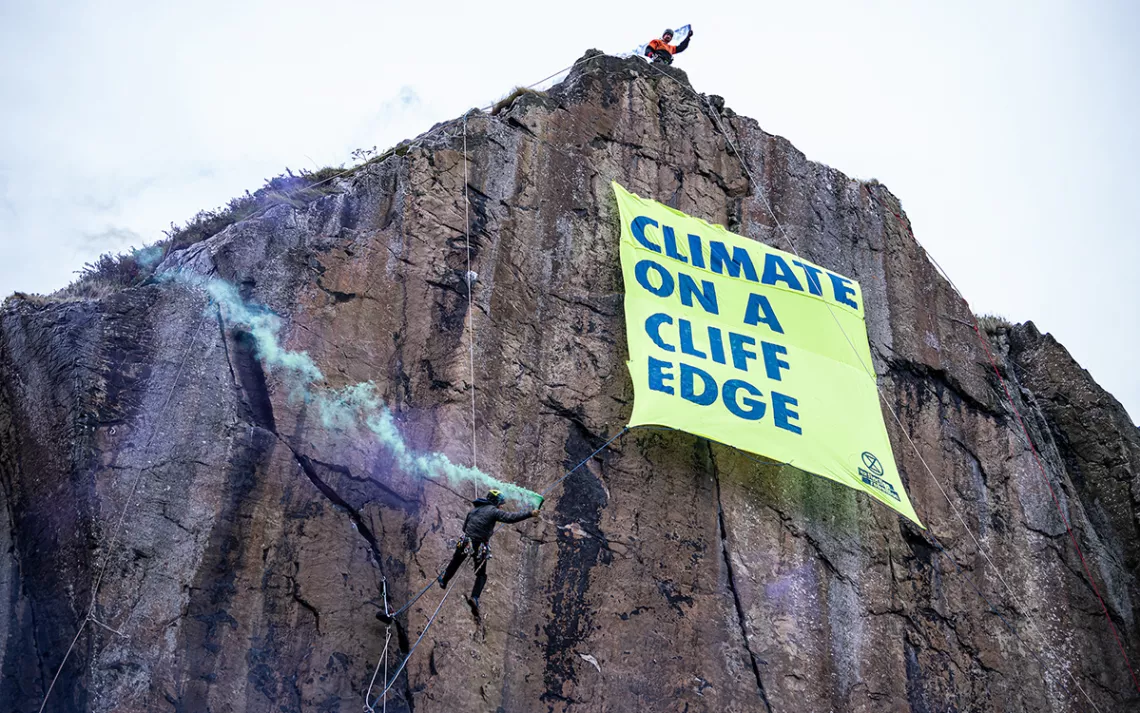
Experienced climbers scale a rock face near the historic Dumbarton castle in Glasgow, releasing a banner that reads “Climate on a Cliff Edge.” One activist, dressed as a globe, symbolically looms near the edge, while another plays the bagpipes on the shores below. | Photo courtesy of Extinction Rebellion and Mark Richards
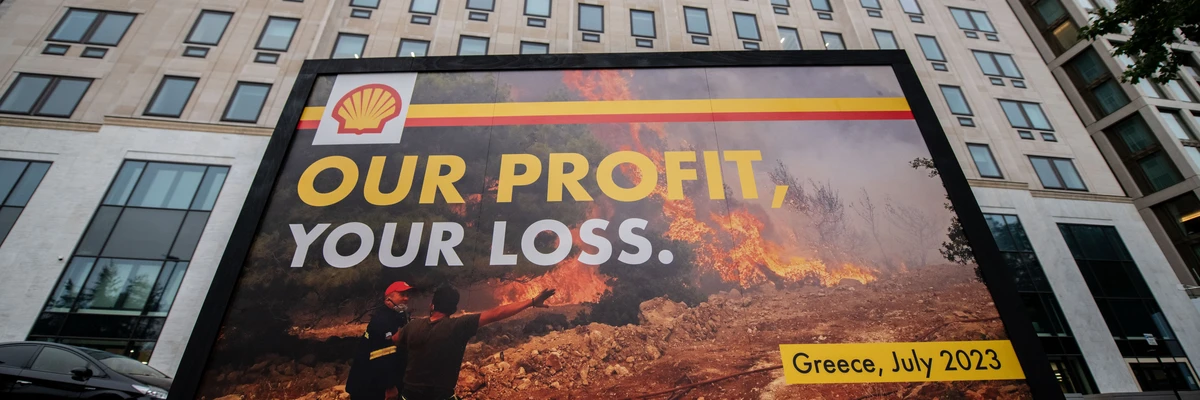
Greenpeace activists display a billboard during a protest outside Shell headquarters on July 27, 2023 in London.
Greenpeace activists display a billboard during a protest outside Shell headquarters on July 27, 2023 in London. (Photo: Handout/Chris J. Ratcliffe for Greenpeace via Getty Images)
Neo-Fascist Climate Science Denier Donald Trump says Burn, Baby, Burn.

Continue ReadingBP has been rowing back on renewables for years. So why was it helped by ‘net zero’ banks?

Bankers roll in cash as pensioners freeze and children forced to go hungry

Spread the love

https://morningstaronline.co.uk/article/bankers-roll-in-cash-as-pensioners-freeze-and-children-forced-to-go-hungry

People walking near the Bank of England

RACHEL REEVES’S decision to protect fat cat bankers has lost the public £15 billion — money that could have saved freezing pensioners and hundreds of thousands of children from going hungry, a damning new report found today.

Campaigners for a windfall tax on banking profits slammed the Chancellor after it emerged that Britain’s four biggest banks made a record £45.9bn in profits for 2024.

Positive Money found that the policy, called for by unions and left MPs, would have brought in an additional £14.7bn for the Exchequer this year after Lloyds Bank became the last of the so-called Big Four to announce its £6bn pre-tax profits for last year.

The group calculated that increasing the existing surcharge on bank profits from 3 to 35 per cent, in line with the government’s windfall tax on energy companies, could have raised this sum from Lloyds, HSBC, Barclays and NatWest alone.

This would be enough to cover the cost of scrapping the two-child benefit cap — fives times over.

Article continues at https://morningstaronline.co.uk/article/bankers-roll-in-cash-as-pensioners-freeze-and-children-forced-to-go-hungry

Keir Starmer, Angela Rayner and Rachel Reeves wear the uniform of the rich and powerful. They have all had clothes bought for them by multi-millionaire Labour donor Lord Alli. CORRECTION: It appears that Rachel Reeves clothing was provided by Juliet Rosenfeld.
Keir Starmer says pensioners can freeze to death and poor children can starve and be condemned to failure and misery all their lives.

Editorial:The stark division in modern capitalist Britain – people or profits

Continue ReadingBankers roll in cash as pensioners freeze and children forced to go hungry

‘Financing the Arsonists’: Scientists Arrested During Citigroup Climate Protest

Spread the love

Original article by EDWARD CARVER republished from Common Dreams under Creative Commons (CC BY-NC-ND 3.0).

Police arrest a climate protester at Citigroup’s headquarters in New York City on June 12, 2024. (Photo: Bank On Our Future/X)

“I invite you to join us, at any level of risk tolerance,” said one participant in the New York demonstration. “It feels deeply meaningful—even joyful—to be a part of this movement and to stand on the right side of history.”

Police arrested 28 people, including several scientists, protesting outside Citigroup’s headquarters in New York City on Wednesday as climate campaigners continued a series of actions targeting the bank for financing oil and gas projects.

Dozens of scientists and allies, some wearing white lab coats, marched to the bank’s entrances holding signs and banners with messages like “The Science Is Clear,” as they condemned Citigroup for financing nearly $400 billion in fossil fuel extraction in the eight years after the 2015 Paris agreement was signed.

Several scientists gave speeches before or as they were being arrested.

“I have studied climate change since 1982,” Sandra Steingraber, a biologist and retired scholar in residence at Ithaca College, said in a speech outside the Wall Street giant’s entrances. “I’ve testified. I’ve sent letters to the White House. I’ve met with the science advisor. I went to the Paris Climate talks. But carbon dioxide levels just reached a new high, and Citi here is financing the arsonists.”

Police arrested Steingraber, who, as she was being taken away in handcuffs, declared: “I’m not interested in writing eulogies for the species that I study!”

The scientists’ protest was part of a series of climate actions undertaken as part of the Summer of Heat, a program organized by Climate Defenders, Climate Organizing Hub, New York Communities for Change, Planet Over Profit, and Stop The Money Pipeline (STMP).

A total of 28 people were arrested Wednesday, including several scientists, Alec Connon, STMP co-director, told Common Dreams. Dozens of campaigners were also arrested at Citigroup’s headquarters on both Monday, in a highly-attended kickoff to the summer activism series, and Tuesday, in an orca-themed follow-up.d

During Wednesday’s protest, the scientists delivered a joint letter, published Monday by the Union of Concerned Scientists and addressed to Citigroup’s leadership, urging the bank to stop financing fossil fuel projects scientists delivered a letter addressed to Citigroup’s leadership urging the bank to stop financing fossil fuel projects.

Activist pressure on major banks has risen in recent years following revelations—notably in the annual Banking on Climate Chaos report, published by nonprofit groups—about the key role they’ve played in funding oil, gas, and coal projects. The most recent report found that the world’s 60 largest banks had provided $6.9 trillion in funding to the fossil fuel industry in the eight years after the Paris Agreement.

The pressure has had an effect on some banks: HSBC and, more recently, Barclays have declared that they would stop financing new oil and gas projects. However, the Bureau of Investigative Journalism has reported that HSBC remains involved in fossil fuel deals.

Bank loans to fossil fuel companies are used not just to continue extraction at existing sites but also to explore and develop new reserves, even though the International Energy Agency has said there can be no more such development if climate goals are to be met. Citigroup has funded more new extraction than any bank in the world, the Banking on Climate Chaos report found.

Yet in response to Monday’s action, Citigroup claimed it was part of the transition to a green economy.

“Citi respects the advocacy of climate activists, and we are supporting the transition to a low-carbon economy through our net zero commitments and our $1 trillion sustainable finance goal,” a bank spokesperson said a statement, according to media outlets. “Our approach reflects the need to transition while also continuing to meet global energy needs.”

The statement did not win over climate activists. “This is the sort of bald-faced corporate lie that could cost us our planet,” Peter Kalmus, a NASA climate scientist, wrote in a Newsweek op-ed published Wednesday.

Kalmus attended Wednesday’s protest. Standing outside Citigroup’s headquarters, he said, “We’ve written thousands and thousands of papers and they have not listened to us. They’re fools. They’re stupid. They’re being unwise. They have to start listening to scientists.”

Summer of Heat organizers have events planned throughout the summer. In the op-ed, Kalmus reached out to readers to join the effort.

“I invite you to join us, at any level of risk tolerance,” he wrote. “In my experience, and in the experience of many other climate activists I know, civil disobedience has been a very effective way to create social change. And a big change is happening: A transition from a profit-above-life, colonial-extractivist, genocidal mindset, to a loving, sharing, interconnected mindset. It feels deeply meaningful—even joyful—to be a part of this movement and to stand on the right side of history.”

Original article by EDWARD CARVER republished from Common Dreams under Creative Commons (CC BY-NC-ND 3.0).

Continue Reading‘Financing the Arsonists’: Scientists Arrested During Citigroup Climate Protest

Santander arranged billion-dollar oil bond after making green pledge

Spread the love

Original article by Nimra Shahid Rob Soutar republished from The Bureau of Investigative Journalism under a Creative Commons Attribution-NonCommercial-NoDerivs 3.0 Unported License.

HSBC also helped on refinery deal that will boost Amazon oil production

The Pastaza River complex, the largest wetland in the Peruvian Amazon, is a hub of biodiversity. It is home to nearly 300 species of fish and rare birds, and a source of food for the numerous Indigenous communities that live there. Its freshwater tributaries, lakes and palm swamps offer a vital buffer against climate change and its international importance is recognised by Ramsar, the UN convention on wetlands conservation.

Slicing through this land is the Norperuano pipeline, a huge 1,100km structure owned by the national oil company PetroPerú. The pipeline has been the source of more than 53 oil leaks since 2013. PetroPerú spent more than $80m on cleaning up spills related to it between 2017 and 2020.

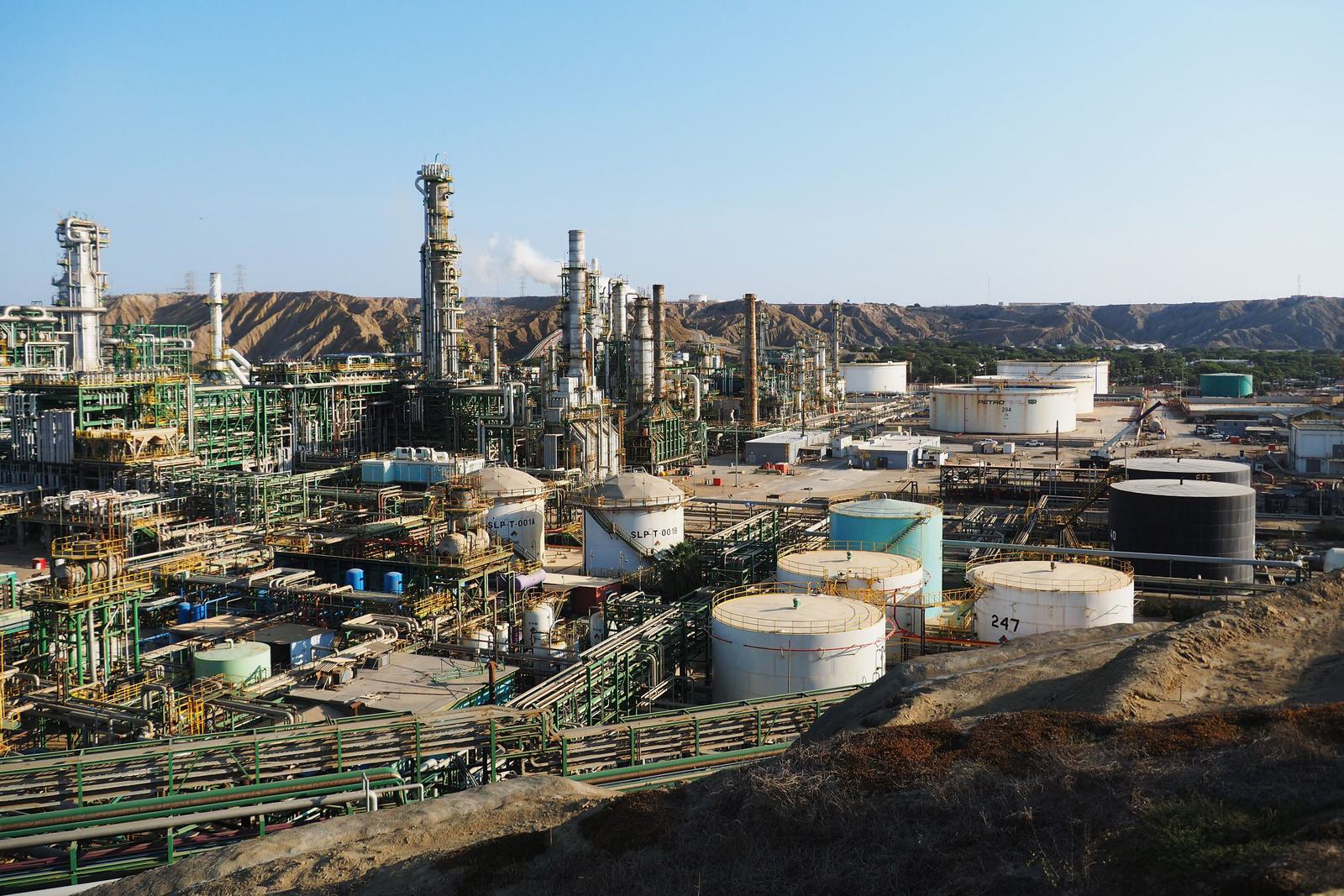
In December, PetroPerú hailed the completion of a $5bn, 10-year project revamping its Talara refinery on the country’s Pacific coast. This new-look facility will be the destination for huge amounts of oil being carried by the Norperuano pipeline across the country from the rainforest, where PetroPerú is set to drill at two controversial new sites. And working behind the scenes to aid the financing of this project have been major international banks that claim to hold strict green policies.

In 2021, Santander helped coordinate a bond that raised $1bn for PetroPerú, which sought funds to upgrade its Talara refinery and expand its capacity to process oil from the Amazon. Two years previously, it had ruled out providing finance or services for “projects or activities in recognised Ramsar sites”. HSBC, which has a similar policy restricting finance that affects wetlands, also worked on the deal.

The money raised by the bond was to be spent on the Talara upgrade, which PetroPerú says helped the facility “produce cleaner fuels” and expanded its processing capacity by nearly 50%, to 95,000 barrels of oil per day.

Much of that oil is likely to be transported through the Norperuano pipeline from the Peruvian Amazon, where PetroPerú has extraction contracts for two drilling sites, one of which also overlaps with the Pastaza wetlands.

“There can be no financing for a company that needs to expand oil production in areas as sensitive as Ramsar sites,” said Leila Salazar-López, executive director of Amazon Watch. She added that it was “difficult to understand” how a company that has demonstrated an inability to stop spills and repair its damage “can gain the confidence of ‘climate-responsible’ investors”.

Santander told TBIJ it did not comment on clients or transactions but said it “operates strict policies that govern our financing. This includes our social, environmental and climate change risk management policy, which governs our criteria to lend to sectors such as energy, mining, metals, and soft commodities.”

HSBC said: “We are committed to supporting a just transition in developing markets and are, therefore, engaging with clients on their transition plans and operating models. Our work with clients is in line with our policies which include specific standards for environmental and human rights considerations.”

Original article by Nimra Shahid Rob Soutar republished from The Bureau of Investigative Journalism under a Creative Commons Attribution-NonCommercial-NoDerivs 3.0 Unported License.

Continue ReadingSantander arranged billion-dollar oil bond after making green pledge