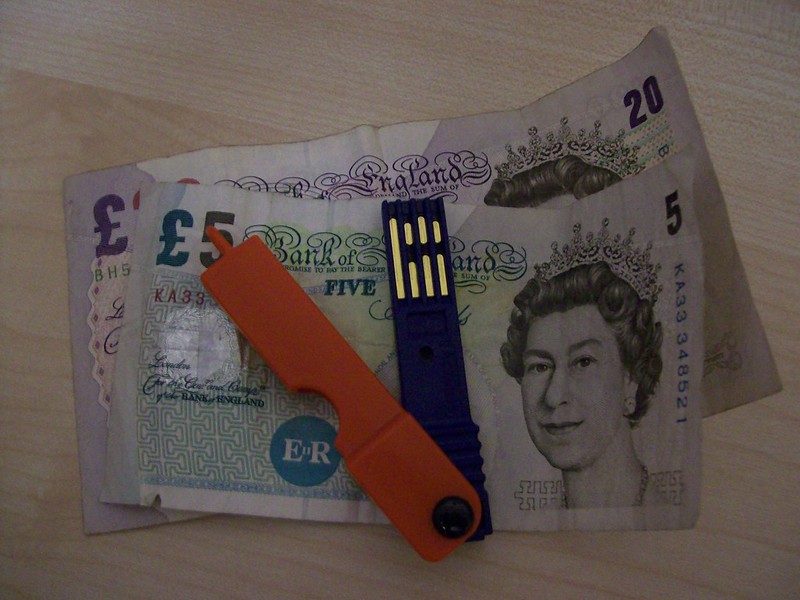
CAMPAIGNERS intensified demands for limits on rent hikes after damning new research found that rents are soaring at triple the rate of inflation.
New figures from the Office for National Statistics have shown that the average rent in Britain has increased by 7.7 per cent to £1,332 in the last 12 months to March.
The increase is three times more than the current level of Consumer Price Index inflation, which measures how much the overall price of everyday goods and services has increased.
The figures show a steep 8.9 per cent increase in Wales, where the average rent is £792. In Scotland, rents were up by 5.7 per cent to £1,001.
According to a December 2024 report from Zoopla, rents for new lets are now £270 per month higher than they were three years ago.
The figures mean that a staggering £3,240 has been added to the annual cost of renting since 2021, equating to a 27 per cent increase.
Generation Rent chief executive Ben Twomey said: “When we are forced to spend too much of our income on rent, the effects ripple across the rest of our lives.
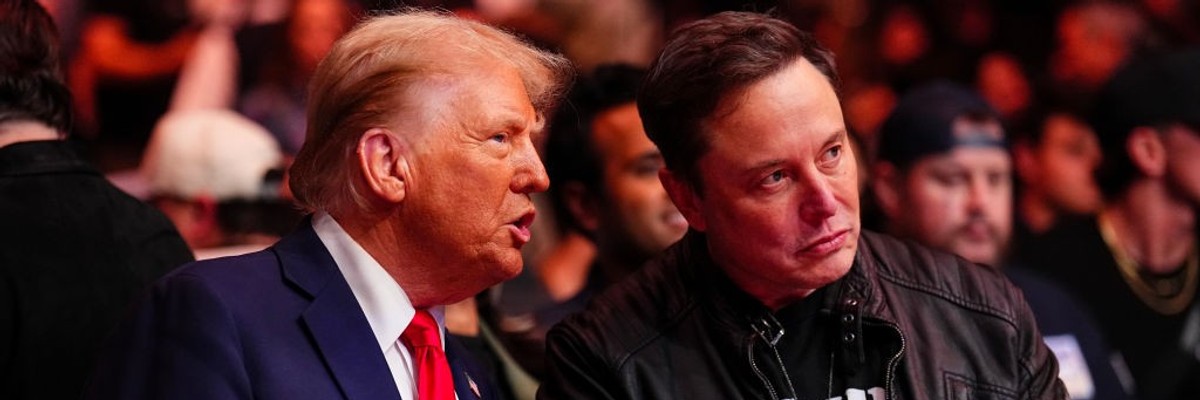
President-elect Donald Trump and Elon Musk talk ringside during the UFC 309 event at Madison Square Garden on November 16, 2024 in New York City. (Photo: Chris Unger/Zuffa LLC)
It appears that Trump has entered into a power-sharing agreement with Musk and several other wealthy individuals including Vivek Ramaswamy, Robert F. Kennedy Jr., and David Sacks.
Democracy decays into oligarchy when a few individuals accumulate most of the political power.
The reelection of Donald Trump has accelerated the decline of the United States into oligarchy. Trump has had billionaire donors for each of his presidential campaigns, but in 2024 the role of these wealthy donors expanded. Donors such as Elon Musk made gigantic contributions to Trump’s campaign; in return for this they are taking an active role in the Trump White House. Perhaps, this time around, Trump turned the oval office into a time-share.
On December 19, Elon Musk led the call for House Republicans to repudiate a continuing resolution they had just negotiated to keep the federal government running through the end of the year. Perhaps Musk’s charter includes coordination with Congress.
When Elon Musk and Vivek Ramaswamy speak of increasing government efficiency, they usually start with services for the unfortunate.
It appears that Trump has entered into a power-sharing agreement with Musk and several other wealthy individuals including Vivek Ramaswamy, Robert F. Kennedy Jr., and David Sacks. However this arrangement works, it’s likely that the Trump administration will cater to billionaires—Sen. Bernie Sanders (I-Vt.) observed that the 13 billionaires chosen by Trump to serve in his administration have a combined wealth of at least $383 billion.
What do these billionaires want? The oligarchs and billionaires want lower taxes and reduced government regulations. Of course, each billionaire has a particular set of interests; for example, David Sacks, Trump’s “AI and crypto czar,” is a venture capitalist with heavy investment in AI and crypto. Sadly. most of the oligarchs are climate-change deniers.
The oligarchs want more wealth. Robert Reich observes:
Since [1980], the median wage of the bottom 90% has stagnated. The share of the nation’s wealth owned by the richest 400 Americans has quadrupled (from less than 1% to 3.5%) while the share owned by the entire bottom half of America has dropped to 1.3%… The richest 1% of Americans now has more wealth than the bottom 90% combined.
The oligarchs share a fiscally conservative agenda. They intend to shrink the size of the federal government. The particulars vary but the oligarchs are not concerned with the size of the defense budget; their cost-cutting focus is on programs that service the poor and disadvantaged—such as Medicaid. When Elon Musk and Vivek Ramaswamy speak of increasing government efficiency, they usually start with services for the unfortunate.
What are the practical consequences of this shift to oligarchy? It’s unsettling to be in a political situation where we do not understand who is in charge at the White House. We don’t know how power-sharing will work. The relationship between Trump and Congress has been fraught. The shift to oligarchy will make this relationship even more difficult.
Will the oligarchs fix the economy? Trump was elected because he promised to fix the economy. Most Americans believed he would drive down inflation; they thought Trump would reduce the cost of food, housing, and household and medical expenses. Since November 5, Trump has given no indication of how he plans to do this. Perhaps he has lost interest.
During the presidential campaign, Trump said his inflation-fighting agenda would rely upon tariffs, but it’s likely that the oligarchs will influence how Trump’s tariff strategy plays out. Musk has huge business interests in China, and it’s unlikely that he would support a tariff policy that would hurt his relationships with the country.
Trump has appointed a “czar” for immigration (Tom Homan), energy (Doug Burgum), and AI & Crypto (Sacks). Trump has not appointed a czar for inflation. With much fanfare, Trump has appointed a commission on “government efficiency;” they’ve already started meeting. Trump has not appointed to a commission to curb inflation.
After January 20, Trump will own inflation and the economy. Trump’s immigration “purge” will drive up the cost of food. Trump’s tariffs will drive up the cost of household expenses.
Trump’s trying to ignore inflation. Or turn it over to an oligarch co-president. Stay tuned.
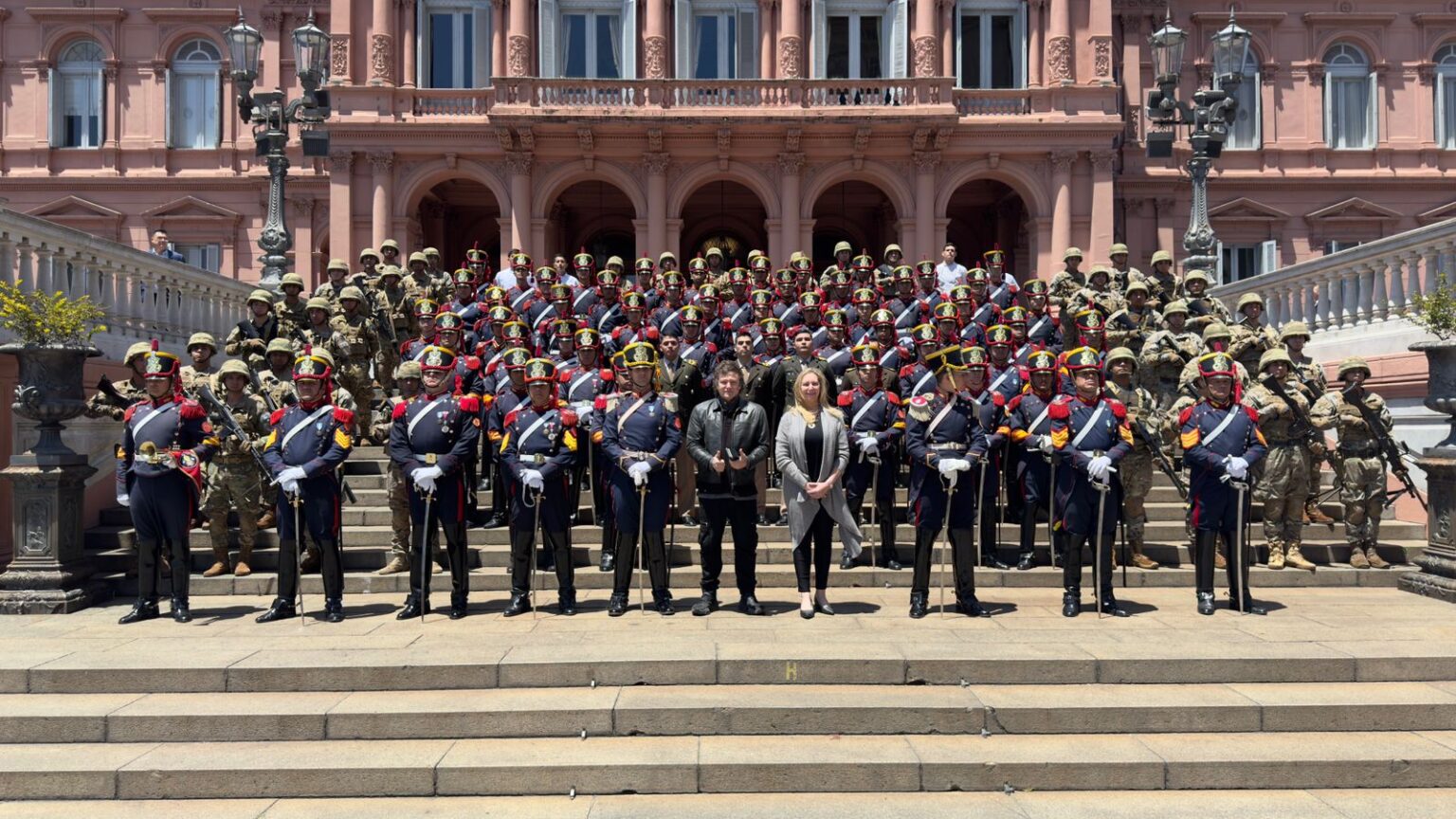
Argentine President Javier Milei. Photo: Milei / X
At one year of Milei’s presidency, we take stock of his economic policies, the impact on the working class, and perspectives for the future
A year ago, what many considered unthinkable a couple of years ago happened: Javier Milei, the eccentric libertarian economist who was almost compulsively invited by the media to increase ratings, was sworn in as president of Argentina. Gone was the neoliberal and demure option of the Argentine right wing that managed to triumph with Mauricio Macri, as well as the always latent Peronist option, which could not overcome the obstacles that the government of Alberto Fernandez left in its path.
Milei became a celebrated outsider who confronted his adversaries directly (often insulting and humiliating them), promising to lift the country out of poverty through a radical liberalization of the economy, with bold, or absurd, proposals to dollarize the economy and the eliminate the central bank. Indeed, his style as a guest on television programs was not too far removed from his actions as president of Argentina.
Erika Giménez, social communicator and a journalist with ARG Medios told Peoples Dispatch that Milei arrived with a promise that he was going to “break the State” and end all state social programs and aid to impoverished sectors because they are “a waste of money that prevents Argentina’s resurgence as a great country.” Did he succeed in his grandiose vision? What did the “lion” of Argentina manage to accomplish in his first year of governance?
Falling inflation and rising poverty
One of Milei’s main obsessions was to reduce inflation at all costs. After several setbacks that ended up increasing inflation, in October it was recorded that inflation had risen by 2.3%, the lowest percentage in several years. To achieve this, he had no qualms about firing tens of thousands of state workers (almost 36,000 according to the National Institute of Statistics and Census) and aggressively cutting the number of ministries (from 18 to 9). Social programs that had been a bulwark of the Republic for several decades were eliminated. Of the state workers who survived the layoffs, almost all have seen a reduction in their purchasing power as a consequence of the economic retrenchment policies.
Similarly, despite the fact that year-on-year inflation stood at 193%, retirees’ pensions only increased by 105%, meaning that retired elderly workers today, thanks to Milei’s government, can buy fewer things than before, because their pension was not adjusted for inflation. This incongruity provoked several mobilizations by retirees.
Likewise, Milei has refused to increase the public education budget so as not to affect the much-desired “fiscal balance”, which has led to a decline in the quality of education in the country. Also, hospital workers (doctors, nurses, and others) have reported that they have lost almost 104% of their purchasing power, which puts the country’s health care system at risk.
In addition, according to Erica Giménez, inflation is currently decreasing, among other things, because people are not able to buy goods, which causes stores to reduce prices to sell more. This can lead to a distorted view of inflation as the only measure of economic improvement because, in reality, it is actually masking a more serious problem: people have lost purchasing power. “[The decrease in inflation] is quite a deceptive figure because people cannot consume because their salary is not enough to do so…The macroeconomic meters improve (as Milei wants) by not generating fiscal deficit, but this happens at the cost of the increase of unemployment, of retirement pensions, of the most needy, and of so many who are nowadays below the poverty line,” Giménez affirms.
One of the cases which shone a light on the ridiculous nature of his radical adjustment was what happened with the social kitchens, soup kitchens run oftentimes by left and progressive community organizations. Milei’s government and his Minister of Human Capital Sandra Pettovello were involved in a serious controversy when it was shown that, while the kitchens were subjected to serious budget cuts as part of the fiscal adjustment which made it impossible to feed the increasing number of hungry people, several tons of food were rotting in State warehouses. The Argentine courts had to order the immediate distribution of the food.
The defunding of university education
Probably the most important internal challenge faced by Milei during this first year was the massive demonstrations of students, professors, and university workers against the Executive’s refusal to increase the university budget. The Legislature had passed a law allowing for the budget increase, but Milei refused to comply with it and vetoed it completely. This generated a lot of discontent among Argentine students who took to the streets against the austerity policies of Milei’s libertarian government, and even went so far as to take over dozens of universities and hold university classes in the streets as a form of protest.
Giménez says in this regard, “Those who lose the most with [the veto of the law] are the professors of public universities who today are within the poor population…According to several surveys, the majority of the population agrees with the public character of health, education, etc., and of the Argentine State as protector and benefactor of these areas, so Mieli’s discourse against universities did not work because…public university education has great popular support.”
International relations
Milei has repeatedly stated that Argentina was, at some point in its history, the first world power. Therefore, what his government should do, according to his rhetoric, is to turn it into a great world power again. This “messianic” bet is synthesized in the often-used slogan “Make Argentina Great Again”, which evidently is reminiscent of Trump’s MAGA. “But Argentina never had a geopolitical weight that Milei says it once had as a first power,” Giménez tells us.
During the vote on whether or not to lift the US economic blockade of Cuba, Argentina voted along with almost all countries to call for an end to the blockade. In retaliation, Milei fired his foreign minister for this vote. According to Giménez, Argentina has historically voted against the blockade and supported other progressive international issues because it hopes that other countries will support its intention to recover the Malvinas Islands, which are currently under British control. Milei however, has wanted to assume a Trumpist international logic, says Giménez, and has assumed a fight against LGBTIQ+ groups and measures to curb climate change, while manifesting strong support in favor of Israel and the United States.
That is why the discussions at the UN on the prevention of violence against girls and women, the ceasefire in Palestine, and the withdrawal of the Argentine delegation from COP29, show the rejection of certain political causes which the president himself calls “the Cultural Battle”. As part of this battle he has attacked journalists, politicians and intellectuals, and founded the new think tank Faro Foundation whose objective is to: “To promote the ideas of economic liberalism and the historical values of Argentine culture, in order to contribute to the economic and social development of our Nation, fighting the cultural battle.” This confrontational attitude has led him to have several impasses with regional political leaders such as Colombian President Gustavo Petro.
But this confrontational attitude, more typical of a media commentator, has its limits. For example, Giménez reminds us that after announcing before his presidency that he would never negotiate with China because they are communists, Milei eventually had to negotiate with Beijing because of the importance of that country for the Argentine economy.
Likewise, Milei has openly positioned himself behind the geopolitical line of US President-elect Donald Trump, attending several select meetings organized by the US president. Milei, according to Giménez, intends to position himself, unsuccessfully, as an international leader who will inspire a global political transformation. Perhaps that is why he has made more trips abroad than within the country, especially to the United States. Likewise, his closeness with the International Monetary Fund stands out.
His revisionist ideological struggle
Milei has also had a significant impact on the ideological dispute in Argentina with his bizarre and aggressive speeches.
For example, he said that he would be delighted to drive the last nail in the coffin of former Peronist president Cristina Fernández, who is the subject of a judicial process that seeks to disqualify her politically and put her in prison.
He has also questioned the figures of human rights organizations on the number of dead and disappeared caused by the last military dictatorship in Argentina. His vice-president, Victoria Villarruel, is a descendant of a military family and before his death, had paid a personal visit to Rafael Videla, head of the last military dictatorship. Milei wants Argentines to forget the dictatorship as if it’s something that can be left behind, says Giménez. In order for Milei to advance his political and ideological project to “make Argentina great again”, he must break certain established and socially consensual notions “and generate other discourses closer to capitalism, revisionist, discuss the importance of the university and public employment…and that includes relativizing one of the darkest periods of Argentine history such as the military dictatorship,” Giménez explains.
Milei has vigorously gone after his ambitious goals of economic liberalization and austerity, without asking “at what cost?” The significant rejection of such policies by broad sectors of the population and the deepening of social conflict will continue and intensify. Milei still has three years left in his presidency, so the future of his government is uncertain. What is certain is that he does not seem to be slowing down his pretensions, but rather accelerating the radical neoliberal program that he defends to the hilt.
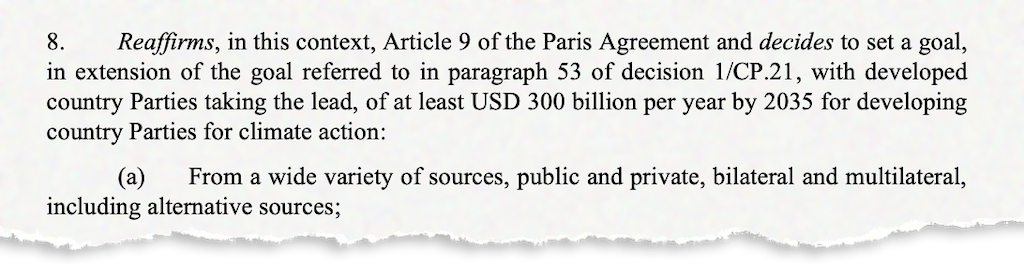
At COP29 in Baku, developed-country parties such as the EU, the US and Japan agreed to help raise “at least” $300bn a year by 2035 for climate action in developing countries.
The goal was welcomed by global-north leaders and presented as a “tripling” of the previous target for international climate finance.
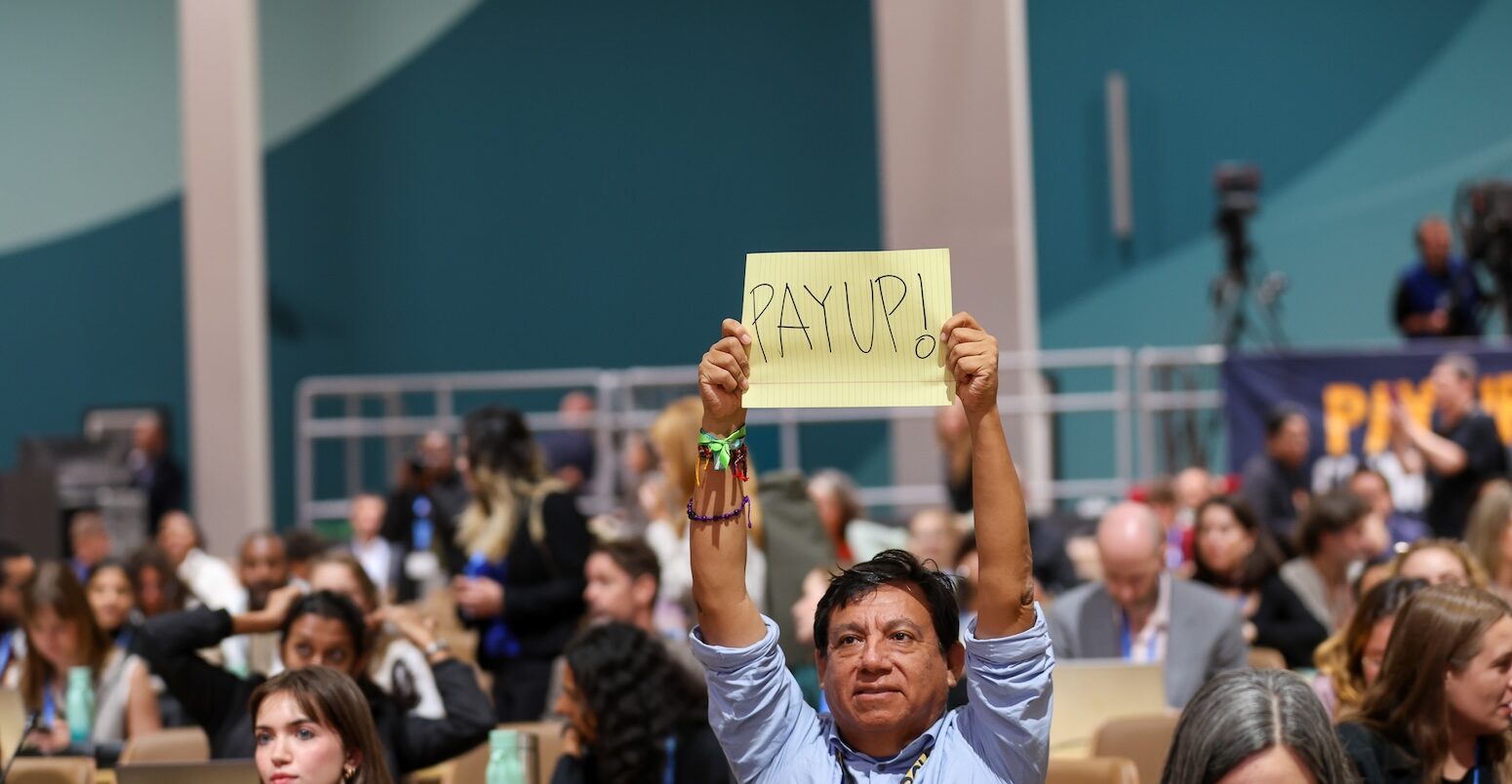
Yet it faced a strong backlash from many developing countries, with some branding it a “joke” and “betrayal”.
Closer analysis of the goal and climate-finance data helps to explain this response.
Analysts have shown that the target is achievable with virtually “no additional budgetary effort” from developed countries, beyond already-committed increases.
Counting money already being distributed by emerging economies such as China – as “encouraged” under the new goal – could bring the total to $265bn by 2030. This could mean the target is well on its way to being met by that date, with minimal extra effort.
Moreover, as activists and academics have noted, the $300bn target does not account for inflation. When this is factored in, its “real” value could shrink by around a quarter.
The new target has emerged against a backdrop of financial strain and political uncertainty in developed countries.
At the same time, developing countries have stressed that they need climate finance to reach the “trillions of dollars” needed to cut emissions and protect themselves from climate change.
This article looks at three ways in which the $300bn goal could be met with little extra financial effort by developed countries – and provide fewer benefits for developing countries than the figure suggests.
1. Much of the goal will be met with ‘no additional effort’
The $300bn climate-finance target agreed at COP29 in Baku will be met with finance from a “wide variety of sources”, largely coming from developed countries.
This part of the “new collective quantified goal” (NCQG) for climate finance is likely to be made up of public finance provided directly by governments, as well as money from MDBs, specialised climate funds and private finance “mobilised” by public investments.
The wording of the $300bn goal frames it as an extension of the $100bn target. This was the amount that developed countries agreed in 2009 to raise for developing countries annually by 2020 – a goal that was extended through to 2025 by the Paris Agreement.
Beyond the central goal of $300bn, the NCQG also includes a much broader “aspirational” target of $1.3tn a year in climate finance by 2035.
However, this is harder to assess, as the text of the deal is vague about who will be responsible for raising the funds, which could include various sources that are beyond the jurisdiction of the UN climate process.
Developed countries and MDBs had already committed to raising their climate-finance contributions before a deal was struck at COP29, as noted in a joint analysis by the Natural Resources Defense Council (NRDC), ODI, Germanwatch and ECCO.
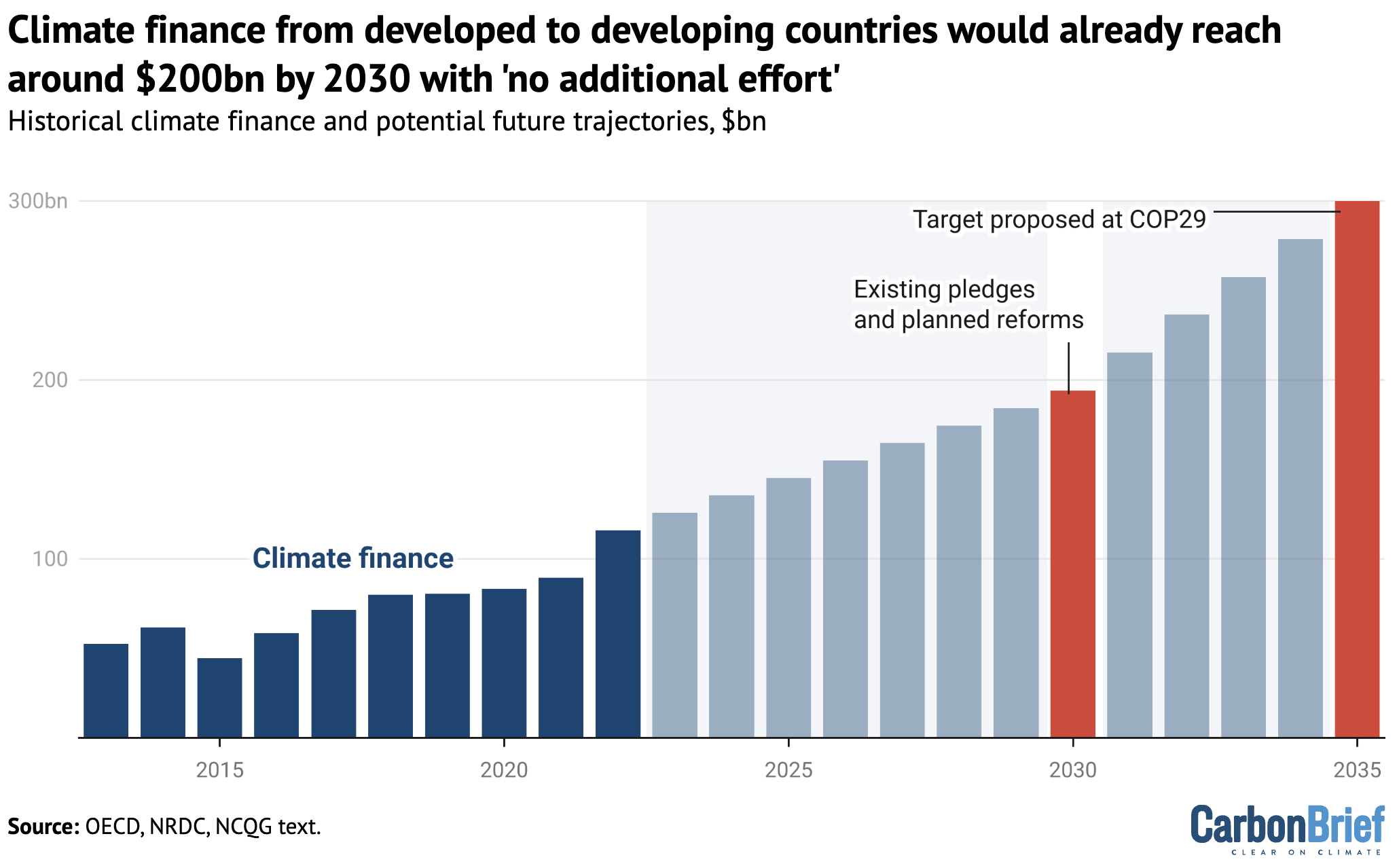
The collective impact of these pre-existing commitments can be seen below, with climate finance from developed countries set to increase from $115.9bn in 2022 – the most recent year for which data is available – to $197bn in 2030. This can be seen in the chart below, which does not account for inflation. (See: Inflation wipes out much of the increase in climate finance.)
Estimated climate finance in 2030, based on funds that have already been pledged, and target set at COP29 for 2035 (red). Dark blue bars show historical climate finance recorded by the Organisation for Economic Co-operation and Development (OECD), 2013-2022 (grey). The light blue bars indicate an estimated trajectory to reach the 2030 and 2035 levels. These figures do not account for inflation. Source: OECD, NRDC, NCQG text.
The expected increase between 2022 and 2030 comes from a few different sources.
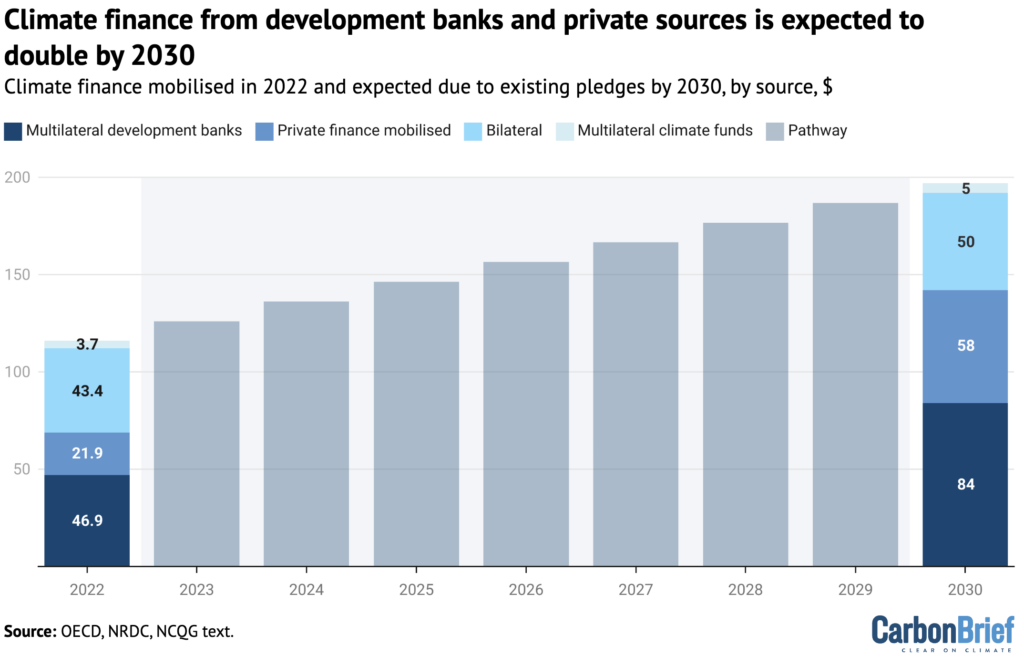
The analysts calculated that climate finance distributed “bilaterally” – as grants or loans via overseas aid and other public funding – was already expected to increase $6.6bn annually by 2025, based on existing pledges, bringing the total to $50bn. (The chart above assumes that bilateral finance remains at this level up to 2030.)
They also estimated that existing pledges and reforms at specialised climate funds, such as the Green Climate Fund and Climate Investment Funds, would add another $1.3bn per year by 2030. This would bring their contribution to $5bn.
The biggest increase that was already locked in before the COP29 deal was a pledge by MDBs – which provide 40% of existing climate finance – to increase their contributions further.
A joint statement by the World Bank, the Asian Development Bank and others in the first week of COP29 committed to raising $120bn of climate finance per year by 2030 for low- and middle-income countries. Of this, $84bn can be attributed to developed countries, based on their shareholdings in these banks.
On top of this, the climate-finance analysts estimated that $58bn of private finance would be mobilised by these bilateral and multilateral contributions in 2030 – up from $21.9bn in 2022.
The chart below shows the estimated breakdown, by source, of climate finance in 2030, compared to 2022.
Historical climate finance in 2022 and estimated climate finance in 2020, by source. Source: OECD, NRDC, NCQG text.
These expected increases over the course of this decade mean that with “no additional efforts”, beyond what had already been agreed prior to COP29, developed countries would have been on a trajectory to reach around $200bn per year by 2030, and $250bn per year by 2035. (The latter was the first numerical target proposed by developed countries at COP29, which was, ultimately, negotiated upwards to $300bn on the final day.)
NRDC climate-finance expert Joe Thwaites, one of the researchers who undertook the Natural Resources Defense Council’s (NDRC) analysis, tells Carbon Brief that bilateral funding directly from governments is the “big constraint” in climate finance. COP29 came just after the re-election in the US of climate-sceptic Donald Trump and many European countries have cut their aid budgets. Thwaites says:
“The MDBs are growing and doing all kinds of reforms and getting bigger and better, but the bilaterals are what are politically very stuck.”
Moreover, the COP29 climate-finance deal contains no pledge by developed countries to provide a set amount of public, bilateral finance, despite strong pressure from developing countries to include such a goal.
Following COP29, Thwaites released updated modelling to calculate different ways of reaching the $300bn target. He wrote:
“What is clear is that $300bn by 2035 is eminently achievable, with little to no additional budgetary effort required from developed countries, let alone other contributors, to meet the goal.”
2. Developing-country contributions could cover part of the goal
Unlike the earlier $100bn target, contributions from developing countries could count towards the new climate finance goal.
Only developed countries are obliged to provide climate finance to developing countries under the Paris Agreement. But the NCQG outcome says that developing countries can “voluntarily” declare any climate-related funds they contribute, if they choose to do so.
This allowed negotiators at COP29 to skirt the controversial issue of formally expanding the list of official donors that are required to help with financial aid.
Developed countries had previously been pushing to enlist relatively wealthy developing nations, such as China and the Gulf states, to share the financial burden.
Several countries described since the early 1990s as “developing” under the UN’s climate convention are known to already make large, climate-related financial contributions to other developing countries. Examples include China’s Belt and Road initiativesupporting clean-energy expansion and South Korea’s contributions to the GCF.
In fact, at COP29 China announced for the first time that it had “provided and mobilised” more than $24.5bn for climate projects in developing countries since 2017 – confirming that its contributions are comparable with those of many developed countries.
This roughly aligns with calculations by research groups that have placed China’s annual climate finance at around $4bn a year.
Both developed and developing countries pay money into MDBs. As well as “encouraging” developing countries to voluntarily contribute directly to climate finance, the NCQG outcome also specifies that these countries could start counting the share of climate-related money paid out of MDBs that can be traced back to their inputs.
Roughly, 30% of the banks’ “outflows” can be attributed to developing countries in this way.
Counting the developing-country share of the projected increase in climate finance from MDBs by 2030 would add an extra $36bn to the global total, plus an extra $20bn of private finance mobilised by the funds.
It is not possible to say for sure how much climate finance new contributors such as China will choose to officially declare.
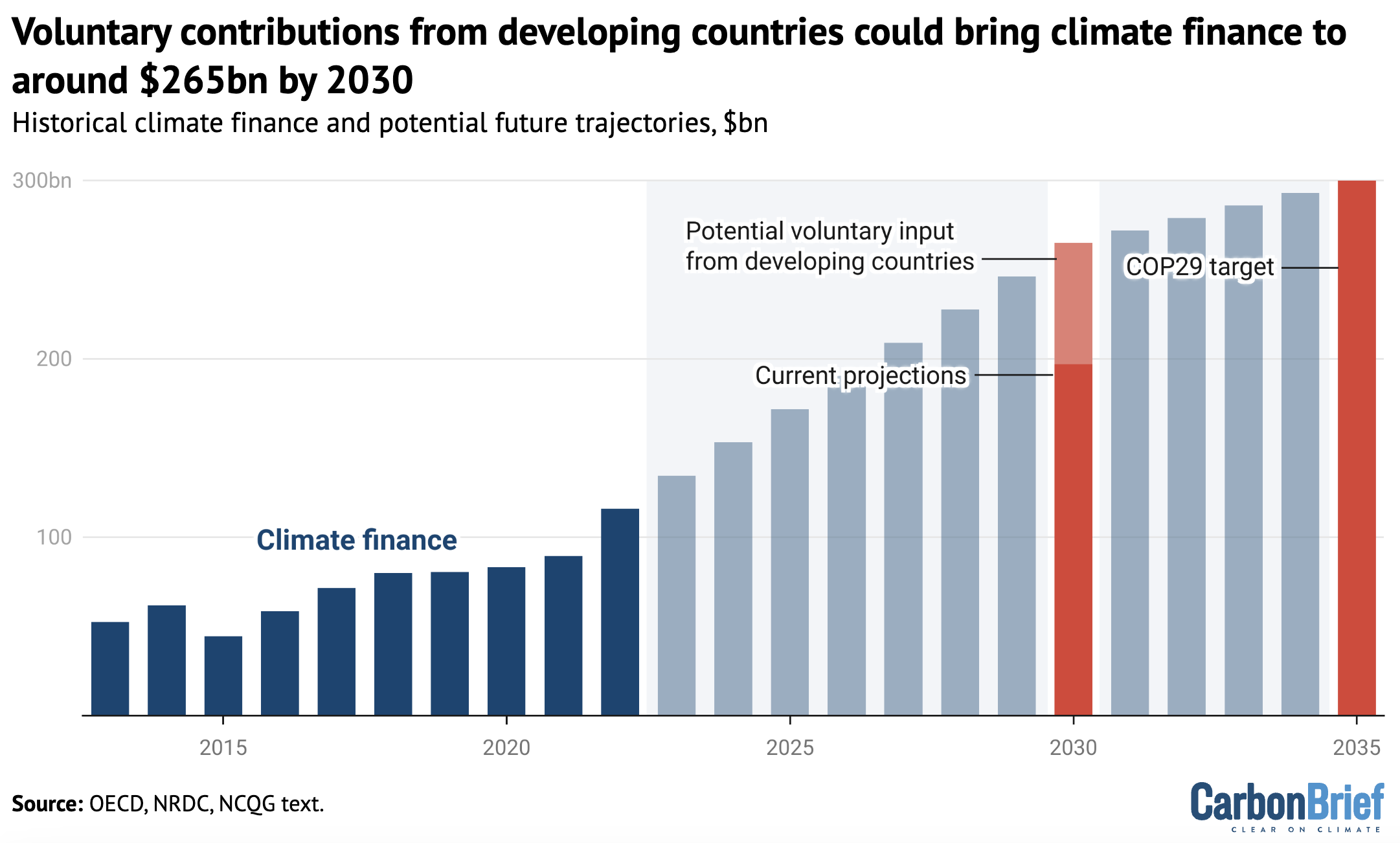
However, the chart below shows an estimate based on an “illustrative scenario”, by NRDC and others, of bilateral finance and multilateral climate funds, combined with expected MDB outflows and the associated private finance that this would mobilise. This could bring total annual climate finance up to $265bn by 2030.
Potential voluntary contributions of climate finance by developing countries, including bilateral finance, contributions to multilateral funds, outflows from MDBs allocated to developing countries and private finance mobilised by developing country contributions to MDBs (lighter red), on top of estimated climate finance from developed countries in 2030 (red). The second red bar indicates the NCQG climate-finance target agreed for 2035 at COP29. The light blue bars indicate an estimated trajectory to reach the 2030 and 2035 levels. These figures do not account for inflation. Source: OECD, NRDC, NCQG text.
Some observers at COP29 said they hoped that officially counting developing-country contributions towards UN “climate finance” targets would enable parties, such as the EU, to set more ambitious goals.
However, Michai Robertson, lead finance negotiator for the Alliance of Small Island States (AOSIS), dismissed this as an “accounting trick”, because these funds are already being provided.
Li Shuo, head of the China climate hub at the Asia Society Policy Institute (ASPI), tells Carbon Brief that the NCQG outcome could bring more attention to China’s climate-related aid and lead to “stronger and better climate support from Beijing”. However, he notes that this is in the context of a low-ambition global target that is a “far cry” from what is needed:
“I take this as a classic example of geopolitical competition weakening environmental ambition, namely, the geopolitical desire of including China as a donor without corresponding desire of developed countries to contribute more limited the overall scale of climate finance.”
3. Inflation wipes out much of the increase in climate finance
One issue that has surfaced in the wake of COP29 is the impact of inflation. Campaigners have noted that the failure to factor this into the 2035 climate-finance target means that, by the time it is met, the true value of the money pledged will be far lower than it is today.
In an article highlighting this issue, the Guardian reported that the $300bn goal was, therefore, “not the tripling of pledges that has been claimed”.
Researchers had flagged this before COP29, pointing out that the previous $100bn annually by 2020goal, which was first set in 2009, had also not accounted for inflation.
They noted that merely correcting the $100bn for inflation would bring it to between $139bn and around $150bn a year. (Such calculations depend on the rate of inflation applied to the starting figure, as well as the base year for the calculation.)
Civil-society groups at COP29, such as Power Shift Africa, estimated that the impact of inflation would cut the “real” value of the $300bn to $175bn in today’s money by 2035. This is based on an annual inflation rate of 5%.
In its analysis, the Guardian opted for an inflation rate of 2.4% – based on the average rate in the US over the past 15 years. This is taken to reflect the conditions for governments contributing climate finance and the currency much of it would be provided in.
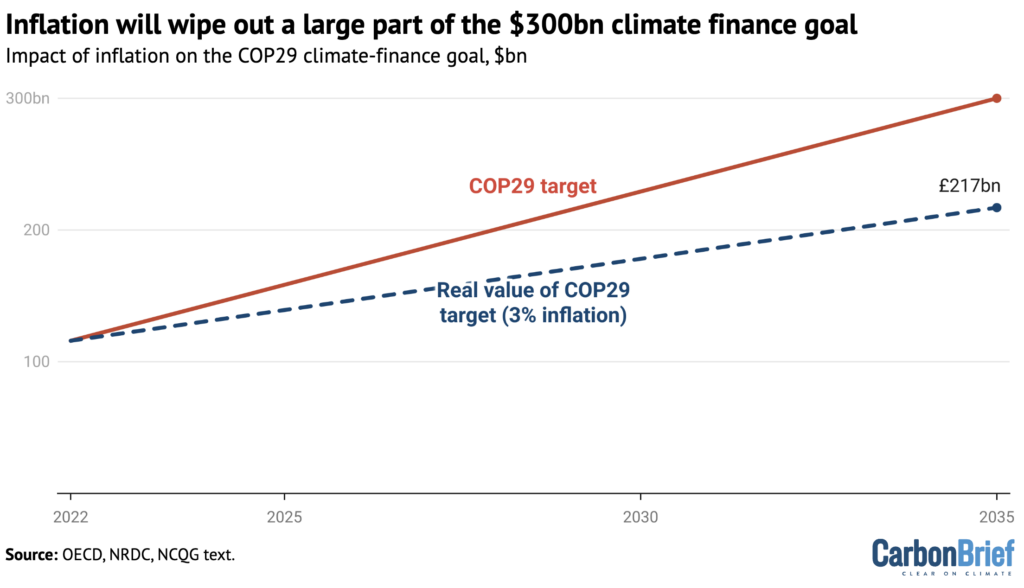
The figure below shows the impact of an inflation rate of 3%. This is based on input from economists and analysis by the Center for Global Development (CGD), which, in turn, is based on the World Bank’s global GDP deflator.
If inflation over the next decade follows this trend, the $300bn pledged in 2024 would only be worth $217bn in today’s money in 2035 – a 28% reduction in value.
In order to offer climate finance with a real value of $300bn in 2035, countries would have needed to set a goal for that year of around $415bn.
Increase in climate finance between 2022 and 2035 under the NCQG commitment in nominal terms (red line), and based on the “real” value of the $300bn climate-finance pledge in 2024 value terms (blue dotted line). Source: Carbon Brief calculation based on a 3% inflation rate, as used by CGD.
(The figures in the chart above cannot be directly compared with the existing pledges made by governments and MDBs, as those too would need to be adjusted for inflation.)
CGD modelling suggests that if developed countries’ climate-finance contributions simply increase in line with expected inflation and gross national income (GNI) growth, they would reach $220bn by 2035.
The CGD analysts write in a blog post that “by the time the new goal is met, beneficiary countries will find that the purchasing power of these resources has eroded significantly”.
Independentexperts, as well as climate-vulnerable countries themselves, emphasised both before and during COP29 that more than $1tn dollars will be needed each year to help developing countries deal with climate change. Many developing nations said that around $600bn of this should come directly from developed countries’ public coffers.
With such a relatively small amount of finance pledged for the NCQG, some developing countries have already indicated that they may scale back their future climate ambitions.
THE cost-of-living crisis is still hammering households in every corner of the country, the TUC warned today, as inflation figures remained unchanged and Britain is believed to have slipped into recession.
The union body called for ministers to extend cost-of-living payments which are set to end by March after figures by the Office for National Statistics (ONS) revealed that Consumer Price Index (CPI) inflation remained at 4 per cent in January.
Food prices fell for the first time by 0.4 per cent since September 2021, with the cost of bread and cereals, cream crackers and chocolate biscuits falling, the ONS said.
The costs are still 7 per cent higher than a year ago.
Prime Minister Rishi Sunak insisted that the economy has “turned the corner” following the data.
But the ONS is due to publish gross domestic product (GDP) figures for December on Thursday and is predicted by experts to reveal that Britain’s economy contracted for the second quarter in a row in the final three months of 2023.