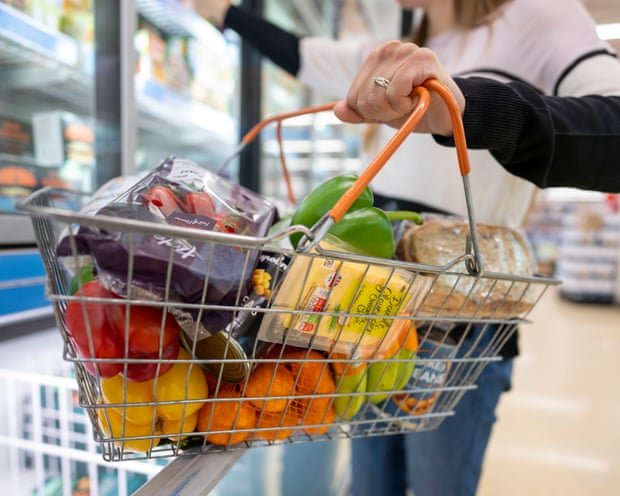
In-store inflation has been led by higher prices for tinned and packaged food, which increased by 2.5% last month on an annual basis. Photograph: Matthew Horwood/Getty Images
In-store inflation rises to an annual 1.5% in August, according to a survey for the British Retail Consortium
The pace of price rises in UK shops rose to its highest level in two years in August, a trade body index shows, with higher energy costs pushing up the price of food and AI chip demand making technology more expensive.
In-store inflation stepped up to 1.5% year on year in August, up from 0.9% in July, led by prices for tinned and packaged food which increased by 2.5% against 1.1% in the prior month, according to data from the research company NIQ for the British Retail Consortium.
Inflation for fresh produce remained high at 3%, amid pressure on growers from the hot dry summer plus hefty fuel and energy costs. However, that marked a slight easing off from the 3.1% recorded in July,
…
The evidence of higher shop prices comes after the boss of Asda said he was seeing inflation on some fresh food begin to rise after a hot dry summer that affected crop yields.
Cereals including wheat and barley were hit particularly badly, according to the Agriculture and Horticulture Development Board. Its first harvest report of 2026 said the hot weather had resulted in the earliest harvest since records began in 2006.
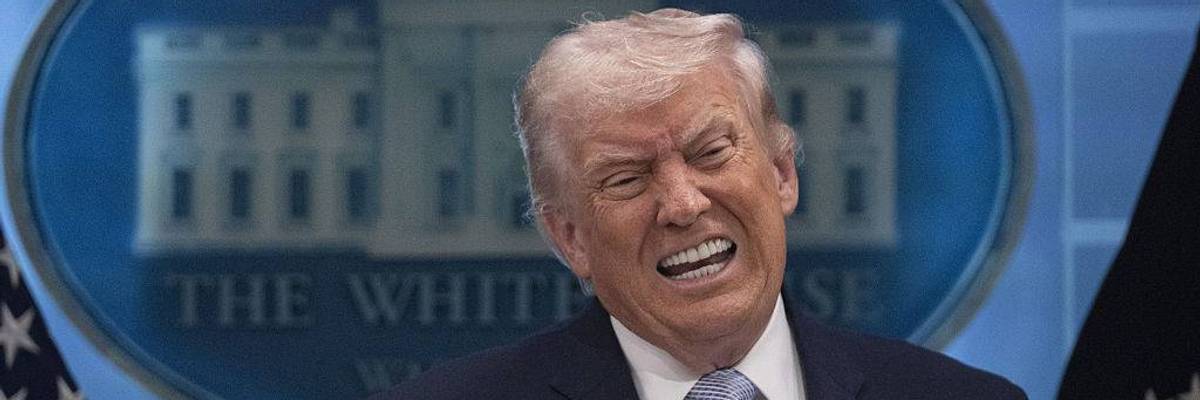
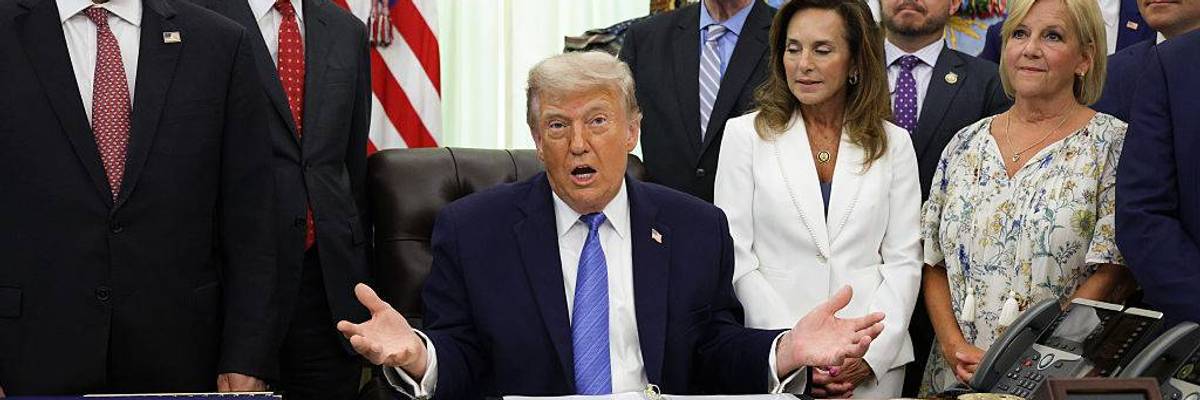
President Donald Trump holds a press conference in the White House on April 6, 2026, in Washington DC. (Photo by Celal Gunes/Anadolu via Getty Images)
As inflation has wiped out wage growth, 53% of voters said they were worse off financially than when Trump took office, including nearly a quarter of Republicans.
President Donald Trump’s approval rating has hit a new low as the majority of Americans—including many of his own voters—now say they are economically worse off under his second administration.
In a Reuters/Ipsos poll released Monday, just 33% of Americans said they approved of Trump’s performance in the White House, while 64% disapproved, a drop from 35% approval earlier in the month. They’re the worst marks he’s received during this term and are tied with his worst ever, which came in December 2017.
Trump’s nadir comes as a majority of Americans say their finances have gotten worse since he came to power. In a Financial Times poll released on Sunday, more than 53% of registered voters said they were worse off since January 2025. This includes 57% of independents, but also nearly a quarter of Republicans.
— Politics & Poll Tracker 📡 (@PollTracker2024) August 17, 2026
Voters’ economic angst aligns with what the metrics show. After hitting a three-year peak of 4.2% in May, inflationwas still higher in July than it was when Trump took office, at 3.4%. Real wages declined as hourly pay failed to keep up with inflation, and the economy shed 23,000 jobs last month.
Trump responded to this bleak report by celebrating that the economy was “doing unbelievably from the standpoint of Wall Street,” with the stock market continuing to soar.
FT/FocalData poll | 8/7-8/10
Would you say you feel better off financially since Donald Trump took office in January?
❌Worse off 53% ✅Better off 21% About the same 26% —– Do you think the economy is going in the right or wrong direction?
— Politics & Poll Tracker 📡 (@PollTracker2024) August 16, 2026
The pocketbook issues faced by many Americans have been made worse by Trump’s war with Iran, which has caused oil prices to spike, triggering a surge in gasoline prices and inflation that has rippled throughout the economy.
The war began unpopular and has only grown more so as the conflict, which Trump said would be over in weeks, approaches its sixth month. In a Reuters poll released in late July, only about a third of Americans said they supported it.
After backing out of a peace agreement earlier this summer, Trump has doubled down on the war in recent weeks. Americans, regardless of party, are now overwhelmingly doubtful that it will end any time soon.
Among all adults, 4 in 5 said they believed the war would “go on for a long time.” This includes 80% of independents, but also 71% of Republicans. Across all parties, just 16% said they believed the war would “end in a matter of weeks.”
There are increasing signs that even Trump’s core base is beginning to sour on him. An Economist/YouGov poll out last week showed that his overall approval among GOP voters had fallen to a second-term low of 79%.
Even more concerning for him is a decline in enthusiasm among supporters: Where 68% said they “strongly approve” of Trump near the start of his term, just 48% now feel that way.
Democratic voters, meanwhile, appear fired up as November approaches. A Washington Post/Ipsos poll from July showed that Democrats have a 10-point advantage over the GOP among those who say they are certain to vote.
Climate science denier Donald Trump confirms that he knows nothing about democracy and that more liquid gold is being secured according to his policy of global privateering.Orcas discuss Donald Trump and the killer apes’ concept of democracy. Front Orca warns that Trump is crashing his country’s economy and that everything he does he does for the fantastically wealthy.
President Donald Trump speaks before signing the Secure America Act in the Oval Office of the White House on June 10, 2026 in Washington, DC. (Photo by Alex Wong/Getty Images)
“There you have it: President Trump loves that you’re paying higher prices,” said Sen. Elizabeth Warren.
US President Donald Trump’s remarks Wednesday expressing “love” for new inflation figures were seen as yet another callous dismissal of the economic pain facing the nation’s working class as price hikes driven by the Iran war erase wage gains and make it harder for Americans to afford basic needs.
“You know who doesn’t love inflation, Mr. President?” asked Sen. Bernie Sanders (I-Vt.) rhetorically. “Working families struggling to afford gas, groceries, and other necessities because of your disastrous actions.”
Asked about the new inflation numbers in the Oval Office on Wednesday, Trump said, “I love it, the numbers were great.”
“I love the inflation,” the billionaire president continued, celebrating figures showing that the Consumer Price Index hit a new three-year high last month.
Reporter: Are you concerned, Mr. President, about the latest inflation number which came out this morning?
Much of May’s inflation was driven by increases in the cost of fuel, which is a direct result of Trump starting an illegal war of choice with Iran in February.
An analysis published by Ben Zipperer, senior economist at the Economic Policy Institute, found that the price increases caused by the Iran war have been so large that they’ve wiped out any prior gains in real wages during Trump’s second term.
Zipperer also warned that “as long as the war continues, there is a heightened threat that price increases will spill over to the broader economy, triggering a more permanent increase in the cost of living and further reductions in real earnings.”
Fresh data released Thursday by the BLS signals that inflation isn’t slowing down anytime soon. According to the BLS’ latest Producer Price Index (PPI) report, wholesale prices in May posted a yearly increase of 6.5%, the fastest rate since November 2022.
Because PPI measures input costs paid by businesses, it is usually predictive of future retail increases as companies pass the cost increases off to consumers.
Rep. Don Beyer (D-Va.) was among the lawmakers highlighting and condemning the president’s remarks.
“Trump just said ‘I love the inflation,’” Beyer wrote. “I guess he doesn’t care if you’re being squeezed by higher costs as long as he and his cronies get richer.”
Sen. Elizabeth Warren (D-Mass.) wrote on social media, “So there you have it: President Trump loves that you’re paying higher prices.”
Andrew Mamo, a Democratic campaign adviser, said in an interview with The Hill that “every day the president says he loves something Americans clearly hate is a good day for Democrats.”
In interviews with The New York Post published on Wednesday, multiple Republican strategists expressed concern not only about the rise in inflation, but Trump’s apparently blasé attitude about the impact it’s having on Americans’ pocketbooks. The president’s latest remarks came weeks after he confessed, on camera, that he doesn’t “think about Americans’ financial situation” as he wages war on Iran.
One former Trump campaign adviser told the Post that comments about “loving” inflation “are simply not productive unless he’s looking forward to the impeachments from the Democrats in 2027.”
Another GOP strategist told the Post that the clip of Trump saying he loved inflation would be “the centerpiece of a lot of effective ads” targeting Republicans this fall.
GOP strategist John Feehery went on the record to tell the Post that Trump needed to wrap up his war with Iran by early next month or “independents are going to swing hard against the Republicans in the election.”
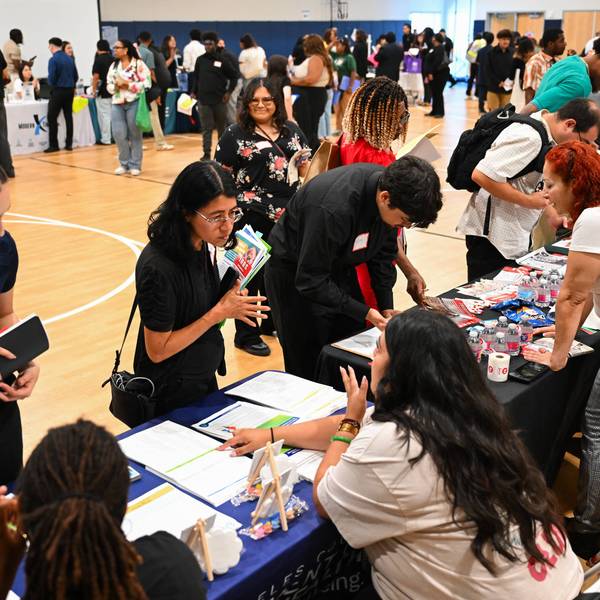
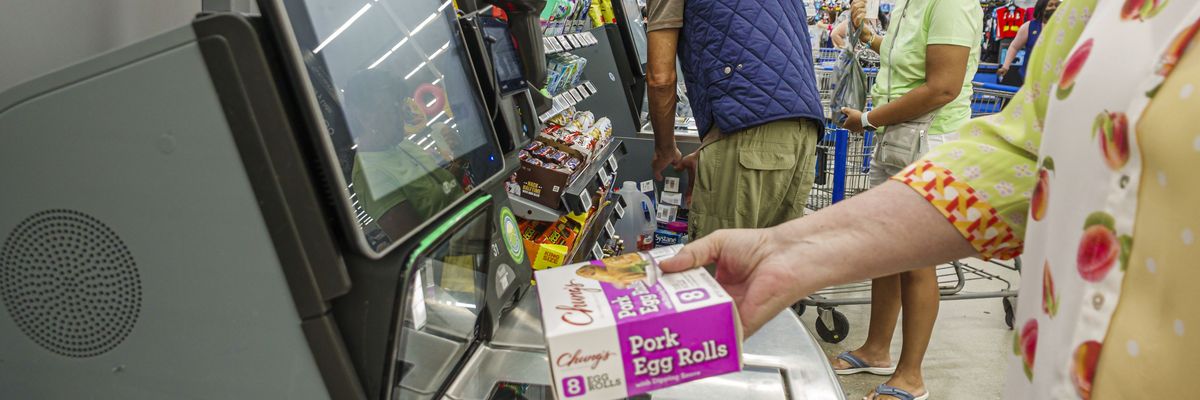
A Doral, Florida resident checks out at a Walmart on October 10, 2025. (Photo by Jeffrey Greenberg/Universal Images Group via Getty Images)
“While President Trump claimed that he would bring down prices, the reality is that Americans have seen their costs soar even higher since he took office.”
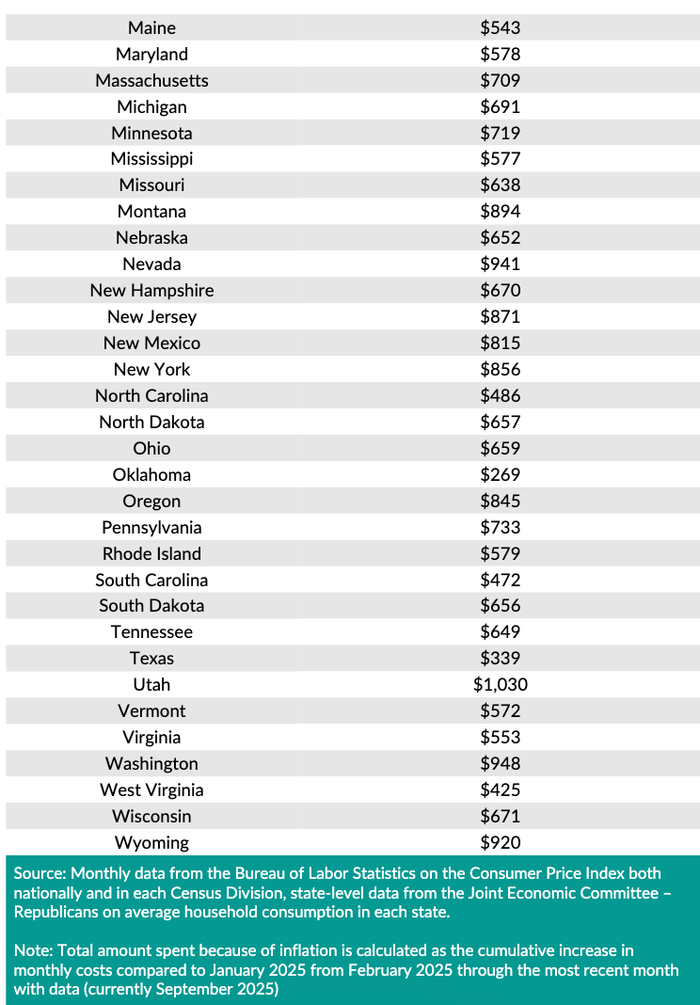
Democrats on the congressional Joint Economic Committee released a report Thursday detailing how much more the average American family in every US state is having to spend monthly to cover the rising costs of food, shelter, energy, and other necessities under the leadership of President Donald Trump.
The panel released its report on the same day the Trump administration was supposed to publish the October Consumer Price Index (CPI) data. The closely watched CPI report was delayed by the shutdown, and the Trump White Housesaid Wednesday that it’s likely the figures will never be released.
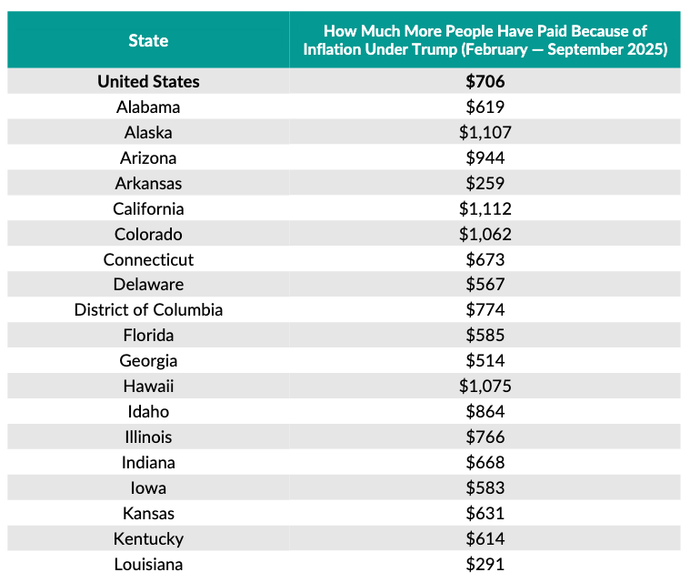
Deploying the same methodology that Republicans used to track cost increases under former President Joe Biden, JEC Democrats found that the average US family is spending roughly $700 more per month on basic items since Trump took office in January, pledging to bring prices “way down.”
“While President Trump claimed that he would bring down prices, the reality is that Americans have seen their costs soar even higher since he took office,” said Sen. Maggie Hassan (D-NH), the JEC’s ranking member. “As families across the country spend more to pay their bills and put food on the table, Democrats and Republicans should be working together to lower costs. Instead, President Trump is pushing ahead with reckless tariffs that continue to fuel inflation and drive prices up even higher.”
In some states—including Alaska, California, and Colorado—average families are spending over $1,000 more per month to maintain their living standards as costs continue to rise, in part due to Trump’s erratic tariff regime.
The report’s findings run directly counter to Trump’s triumphant rhetoric on inflation and the US economy more broadly.
CNN‘s Daniel Dale noted earlier this week that Trump has been on a “lying spree about inflation,” falsely claiming that “every price is down” and that “everybody knows that it’s far less expensive under Trump than it was under Sleepy Joe Biden.”
“None of that is true,” Dale wrote. “Prices are up during this administration. Average prices were 1.7% higher in September than they were in January, according to the most recent figures from the federal Consumer Price Index, and 3% higher than they were in September 2024. There has been inflation every month of the term, and far more products have gotten costlier than cheaper.”
“Inflation not only very much continues to exist but has been accelerating since the spring,” Dale added. “As of September, the year-over-year inflation rate had increased for five consecutive months.”
Orcas discuss Donald Trump and the killer apes’ concept of democracy. Front Orca warns that Trump is crashing his country’s economy and that everything he does he does for the fantastically wealthy.Orcas discuss how Trump was re-elected and him being an obviously insane, xenophobic Fascist.
The Trump administration is a serious threat to democracy. They’re also laughably incompetent. But the result is no laughing matter.
…
Clown-show fascism describes a regime marked simultaneously by hubristic and defiant assaults on the democratic and constitutional order on the one hand and, on the other, a nearly laughable incompetence in just about every other area of the regime’s activity. The first characteristic certainly applies to the Trump administration, and it’s chilling and frightening and not at all funny. Just ask Mahmoud Khalil.
Yet at the same time, in other areas, the incompetence has been staggering. Trump’s constant about-faces and walk backs on tariffs have been an international embarrassment. Elon Musk’s DOGE has fired federal workers willy-nilly only to turn around and rehire many after the Musketeers realized they weren’t deep-state bloodsuckers and the work they did was kind of essential, after all—you know, like the people who tend the country’s nuclear weapons stockpile.
It can be hilarious to watch. But it carries two consequences that are no laughing matter.
First and more obviously, we have the prospect of the impact of Trump’s tariffs policy on real people. Will they cause inflation and a recession, as most experts now believe? As fate would have it, Trump will go to bed the night of his 100th day in office—Tuesday—and wake up the very next morning to the release of the first-quarter GDP number. Economists expect anemic results. The Atlanta Fed even predicts negative growth, around -2.5 percent. During Trump’s first week in office, its forecast nudged a gaudy 4 percent, but the president’s actions have liberated that figure ever downward.
Second and more insidiously: Even the gross incompetencies take us into treacherous territory because they contribute to making this all about one man, the man who must be in front of the cameras every day. He doesn’t have policies so much as he has urges, which he must announce to the world on a constant basis in a desperate plea that we keep him front of mind at all times. Some of those urges are cruel; some of them are a joke. What unites them is that they make the story entirely about him.
That is not how it’s supposed to work in democracies. Which we still are, for now, as we reach this 100-day mark. Only 1,361 to go.
Neo-Fascist Climate Science Denier Donald Trump says Burn, Baby, Burn.Elon Musk urges you to be a Fascist like him, says that you can ignore facts and reality then.