Media Faces Reckoning After Helping Trump Downplay Project 2025 on Campaign Trail

Spread the love

Original article by Stephen Prager republished from Common Dreams under Creative Commons (CC BY-NC-ND 3.0). 

The Democratic National Committee sponsors a billboard about then-Republican candidate Donald Trump and Project 2025 at 12th & Vine Streets on September 9, 2024, in Philadelphia, Pennsylvania. (Photo by Lisa Lake/Getty Images for the Democratic National Committee)

“A Trump denial is not a fact,” said one media critic.

As President Donald Trump openly embraces Project 2025, mainstream media outlets are facing criticism for their role in helping him downplay his ties to the wildly unpopular far-right governing playbook in the lead-up to his reelection last year.

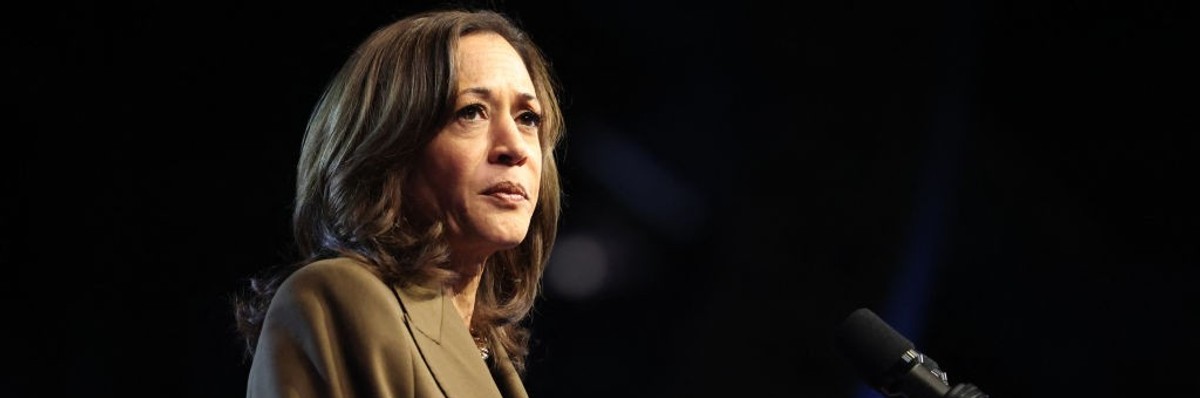
After she became the Democratic nominee in July, former Vice President Kamala Harris made the Heritage Foundation’s over 900-page manifesto for “the next conservative president” central to her case against Trump during the 2024 election, often referring to it as “Trump’s Project 2025.”

She and other Democrats warned that if he retook power, he would swiftly enact many of its most extreme and unpopular proposals and dramatically expand executive power while doing it.

Among those proposals were steep cuts to social safety net programs like Medicaid and the Supplemental Nutrition Assistance Program (SNAP), the “mass deportations” of millions of immigrants, the elimination of the Department of Education, new restrictions on abortions, the gutting of climate protections, and the replacement of career civil servants with political appointees, among many others.

Democrats amplified the plan’s danger at the Democratic National Convention and in campaign ads, and Trump began to distance himself from the platform. Despite the fact that as many as 140 people who’d worked in his first administration—including Paul Dans, Heritage’s director of Project 2025—had a hand in its creation, Trump said: “I know nothing about Project 2025. I have no idea who is behind it.”

This was demonstrably untrue, even at the time. Media Matters for America dug up a clip from as far back as May 2023 of Dans stating that “President Trump’s very bought in with this,” speaking of the program.

Project 2025 was almost inconceivably unpopular. An NBC News poll from September 2024 showed that while 57% of registered voters viewed the plan negatively, just 4% viewed it positively.

But in the critical months leading up to the election, many media outlets took Trump’s denial at face value, publishing fact checks and other commentary that painted Democrats’ warnings about his connection to the plan as alarmist or misleading.

Responding to a social media post in July stating that “Trump has made his authoritarian intentions quite clear with his Project 2025 plan,” a fact check by USA Today rated the statement “false,” because, as the headline said, “Project 2025 is an effort by the Heritage Foundation, not Donald Trump.”

In September, after Harris confronted Trump about Project 2025 at the first and only debate between the two, the paper published another fact-check with the headline: “Harris repeats claim that Project 2025 is Trump’s plan. That’s still not right.”

In response to Harris’ claim during the debate that Project 2025 was “a detailed and dangerous plan… that the former president intends on implementing if he were elected,” Washington Post fact-checker Glenn Kessler, whose coverage received a fair bit of criticism during the 2024 cycle, reported in bold text that “Project 2025 is not an official campaign document.”

CNN fact check of the Harris campaign’s social media in September remarked that one account “frequently invokes Project 2025,” before caveating that “Project 2025 is not Trump’s initiative, and he has said he disagrees with some of its proposals.”

In an October interview on CBS‘s“Face the Nation,”anchor Norah O’Donnell, Harris attempted to warn about Project 2025, before O’Donnell responded: “You know that Donald Trump has disavowed Project 2025. He says that is not his campaign plan.”

After nine months back in power, the website Project 2025 Tracker estimates that Trump has already implemented approximately 48% of the objectives outlined in the policy document.

In addition to his key campaign promises many of his second administration’s policies are highly specific to Project 2025, such as his pledge to abolish the Federal Emergency Management Agency (FEMA), his efforts to privatize the National Weather Service (NWS), his reconfiguration of Title X funding to promote pregnancy, and his elimination of the Office for Civil Rights and Civil Liberties.

Trump is no longer hiding his connection to Project 2025, having brought in many of its hiring picks and authors to staff his administration almost immediately after his victory last November.

This week, he began to boast about it openly. As his Office of Management and Budget (OMB) director, Russ Vought, one of Project 2025’s architects, began using the current government shutdown to unilaterally cut off funding to infrastructure projects in blue states and cities, Trump lauded him as “he of PROJECT 2025 Fame.”

“This was always the plan,” Harris responded on social media.

While many commentators expressed outrage that Trump blatantly lied about his connections to Project 2025, others dredged up old clips of newspapers and anchors taking him at his word.

“All those 2024 media fact checks that said, ‘Donald Trump and the Trump campaign deny any connection to Project 2025’ look pretty ridiculous right now,” said MeidasTouch editor-in-chief Ron Filipkowski. “A Trump denial is not a fact. You just used his lies to ‘debunk’ a reality that was obvious to anyone paying attention.”

Mehdi Hasan, the founder of the independent media company Zeteohighlighted the CBS interview, saying Trump’s embrace of Project 2025 was “embarrassing not just for Norah O’Donnell but a whole host of leading American anchors and reporters who echoed Trump’s false denials.”

“Nothing showed the difference between mainstream and independent media better than the response to Trump’s obvious lie about not knowing anything about Project 2025,” said David Pepper, author of the book Saving Democracy: A User’s Manual. “Most mainstream media started fact-checking those who claimed a connection to be somehow false. Others ‘both sides’ed’ it. Far more in independent media called it out as a whopping lie.”

Original article by Stephen Prager republished from Common Dreams under Creative Commons (CC BY-NC-ND 3.0). 

Elon Musk urges you to be a Fascist like him, says that you can ignore facts and reality then.
Donald Fuhrump says that Amerikkka doesn't bother with crimes or charges anymore, not being 100% Amerikkkan and opposing his real estate intentions is enough.
Donald Fuhrump says that Amerikkka doesn’t bother with crimes or charges anymore, not being 100% Amerikkkan and opposing his real estate intentions is enough.
Orcas discuss how Trump was re-elected and him being an obviously insane, xenophobic Fascist.

Continue ReadingMedia Faces Reckoning After Helping Trump Downplay Project 2025 on Campaign Trail

As Trump II Begins, Bezos Swaps Scrutiny for ‘Storytelling’

Spread the love

Original article by Julie Hollar republished from FAIR under a Creative Commons Attribution-NonCommercial-NoDerivs 3.0 Unported License.

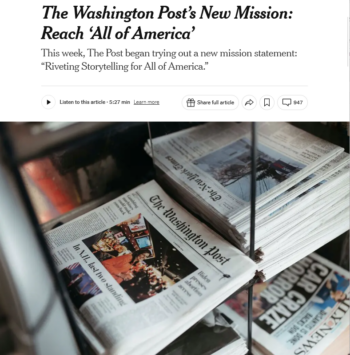
As the Washington Post faces a staff rebellion and plummeting subscription rates, billionaire owner Jeff Bezos has introduced a new mission statement: “Riveting Storytelling for All of America.”

The Washington Post‘s new slogan, “Riveting Storytelling for All of America,” is “meant to be an internal rallying point for employees,” the New York Times (1/16/25) reported.

The new path forward, as introduced in a slide deck to staff by Suzi Watford, the paper’s chief strategy officer, demands that the paper “understand and represent interests across the country,” and “provide a forum for viewpoints, expert perspectives and conversation” (New York Times1/16/25). It will do this as “an AI-fueled platform for news” that delivers “vital news, ideas and insights for all Americans where, how and when they want it.”

This appears to mean shifting resources toward opinion, specifically opinions from the right. According to the New York Times report:

Bezos has expressed hopes that the Post would be read by more blue-collar Americans who live outside coastal cities, mentioning people like firefighters in Cleveland. He has also said that he is interested in expanding the Post’s audience among conservatives.

The Post has already begun to consider ways to sharply increase the amount of opinion commentary published on its website, according to two people with knowledge of the talks. An adviser to the Post, Lippe Oosterhof, has conducted brainstorming sessions about a new initiative that would make it easier to receive and publish opinion writing from outside contributors.

How AI is meant to play into this is unclear.

The Post already has more columnists than you can shake a stick at. This new direction sounds like the Foxification of the Washington Post, a move away from any attempt to hold the powerful to account, toward inexpensive clickbait punditry.

‘Make money’

The red area represents the proportion of Jeff Bezos’s total wealth that would be required to cover the Washington Post‘s losses for a year.

Watford’s slide deck presented three pillars of the Post‘s new model: “great journalism,” “happy customers” and “make money.” The Post lost roughly $77 million in 2023. (It also lost some 250,000 subscribers after Bezos killed the paper’s planned endorsement of Kamala Harris—FAIR.org10/30/24.)

In order to make money, its new “Big Hairy Audacious Goal” (yes, that’s what the Post slide deck apparently called it) is to reach 200 million “paying users.” The paper currently has about 3 million subscribers, making it an “audacious” goal indeed. As the Times pointed out, even if the Post could achieve the impossible task of monetizing every visit to its website, no major corporate media outlet has been getting more than 100 million monthly unique visits—paying and non-paying—outside of the spike in traffic around the election.

Back in 2019, the Post was claiming 80–90 million unique visitors per month. Those visits peaked in November 2020 at 114 million, but quickly and steadily dropped after Biden’s inauguration. The Post stopped posting its audience numbers online after January 2023, when they were down to 58 million.

Of course, most online corporate media have been struggling. The thing about the Post is that its absurdly wealthy owner, the second-richest person on Earth, can easily afford to lose $77 million a year. That’s 0.03% of Bezos’s current net worth.

‘We are deeply alarmed’

Guardian (1/15/25): “The plea from staff…comes a week after the Post laid off roughly 100 employees…roughly 4% of the publication’s staff.”

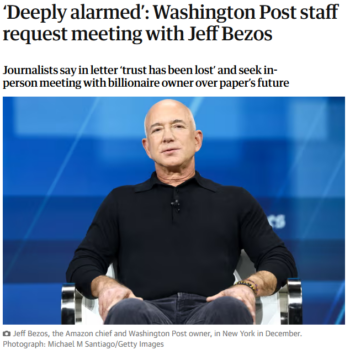
No doubt the Post needs help. Just days before the new mission statement was revealed, over 400 staff members signed a letter to Bezos asking for a meeting (Guardian1/15/25).  The letter read:

We are deeply alarmed by recent leadership decisions that have led readers to question the integrity of this institution, broken with a tradition of transparency, and prompted some of our most distinguished colleagues to leave, with more departures imminent.

Bezos’s response—a slide deck about “riveting storytelling” on “an AI-driven platform” that prioritizes churning out opinions to draw in conservatives—is hardly likely to ease the mind of any serious journalist at the paper.

Nor is trying to “expand the Post audience among conservatives,” while still paying lip service to “great journalism,” likely to solve the Post‘s problems. As CNN‘s former CEO Chris Licht discovered (FAIR.org6/8/23), you can’t do good journalism while trying to appeal to both sides in the context of an increasingly radical right, because that side demands acceptance of lies and conspiracy theories that are incompatible with actual journalism.

When Bezos bought the Post (Extra!3/14), he assured the paper’s employees that “the paper’s duty will remain to its readers and not to the private interests of its owners.” That sentiment was repeated in Watford’s slide deck this week. But Bezos’s actions in the past months—including the killing of the Harris endorsement, Amazon donating $1 million donation to Trump’s inaugural fund and paying Melania Trump $40 million for her self-produced documentary, and, most recently, Bezos appearing onstage with other multibillionaires at Trump’s inauguration—make clear that the principle is as meaningless to Bezos as the slogan that debuted after Trump’s first election: “Democracy Dies in Darkness.”

That slogan will continue to adorn the front page for the time being, perhaps in the hope that readers searching for an actual news organization that holds those in power to account will be fooled into subscribing.


ACTION ALERT: You can send a message to the Washington Post at letters@washpost.com.

Please remember that respectful communication is the most effective. Feel free to leave a copy of your message in the comments thread here.

FAIR’s work is sustained by our generous contributors, who allow us to remain independent. Donate today to be a part of this important mission.

Original article by Julie Hollar republished from FAIR under a Creative Commons Attribution-NonCommercial-NoDerivs 3.0 Unported License.

Continue ReadingAs Trump II Begins, Bezos Swaps Scrutiny for ‘Storytelling’

Movement leaders in the US say Trump’s agenda will be met with a strong fightback

Spread the love

Original article republished from peoples dispatch under a Creative Commons Attribution-ShareAlike 4.0 (CC BY-SA) license.

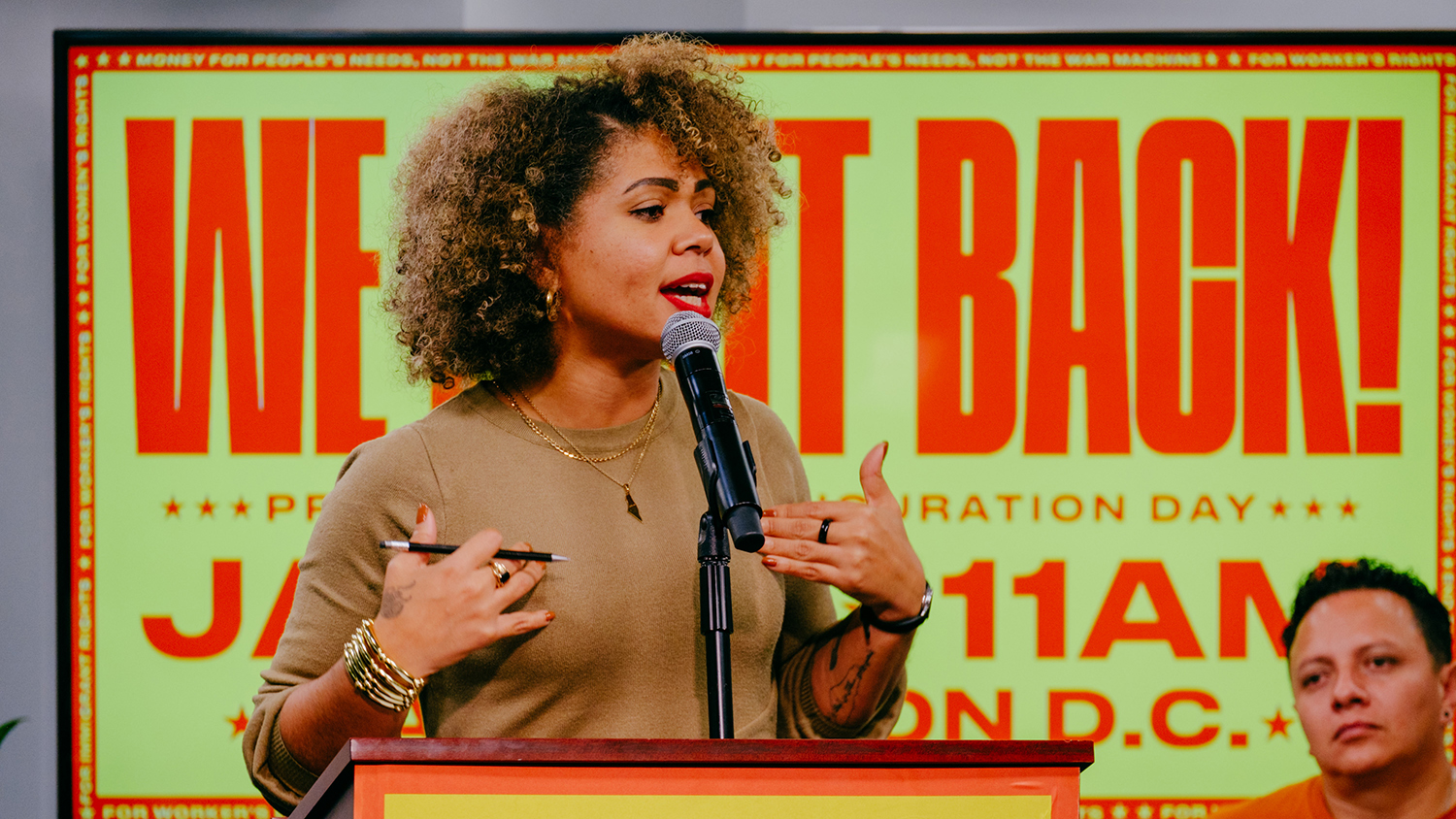
Claudia De la Cruz speaks at “What is to be done?” panel on November 8 (Photo: Wyatt Souers)

US-based movement leaders take up the task of answering the burning question: “What is to be done?”

Just two days after Donald Trump’s landslide victory against Vice President Kamala Harris, US socialists and movement leaders took up the task of answering the burning question: What is to be done following Trump’s win?

Hundreds of people gathered at the People’s Forum in New York City on November 8 for a panel discussion which featured the presidential candidate of the Party for Socialism and Liberation, Claudia De la Cruz, who ran against both Trump and Harris in a explicitly socialist campaign, Brian Becker, executive director of the anti-war organization the ANSWER Coalition, Eugene Puryear, journalist with BreakThrough News, Jorge Torres, part of the National Day Laborer Organizing Network with extensive experience organizing undocumented immigrant workers, and Miriam Osman, leader in the Palestinian Youth Movement, which has played a central role in the Palestine solidarity movement across North America.

Layan Fuleihan, Education Director of the People’s Forum, opened up the discussion. “We, the workers, the social movements, the immigrant families, the young people, the anti-war movement, the working class as a whole, we are faced with many urgent questions,” she said. 

“How will we confront this continual rise of the right? Will we be driven by fear and apathy or pessimism? Will we stay home? Or will we organize our forces and chart our own path forward? Will we follow the lead of the Democratic Party and mourn their loss? Or will we assert that we reject the billionaire agenda no matter which party is executing its orders?”

Speakers put the blame for Trump’s win not on a shift to the right by working class people, but on the failures of the Democratic Party. Claudia De la Cruz spoke to what she called the “scapegoating of working class sectors” by the Democrats. 

“They are saying we have to blame Black men, that we have to blame Latino men, that we have to blame immigrant communities, that we have to place judgment on those who didn’t go out and vote,” she said. 

In reality, according to De la Cruz, “it is the spinelessness of the Democratic Party that has brought us here.” 

“While Trump won this election, we cannot pretend that the Democrats have not allowed and conducted attacks against the working class people for decades,” De la Cruz said. “If we think about the last 16 years, the Democratic Party had power for 12 of those years, and they didn’t do anything. Not a single thing to protect or expand our rights. In fact, they sat back and watched how our rights were placed on a chopping block and said, we can’t do anything about it.” 

Torres, who himself comes from a migrant background and was undocumented, spoke not only of the fear that exists within immigrant communities of Trump’s anti-migrant policy promises, but also the resolve to fight back. According to Torres, for the past few months, immigrant day laborers within the NDLON network were very scared of what would happen in the event of a Trump win. Trump has promised to deport between 15 to 20 million people in the largest mass deportation in US history, a policy which could result in family separations affecting up to 1 in 3 Latinos in the country. 

But this did not paralyze these communities, who instead came together in a renewed resolve to “start organizing for real,” Torres described. Communities began to ask one another, “What does that mean when we say the people save the people?”

“We made a decision that it was about time to organize local communities in popular committees across the country,” Torres said. “We decided to organize popular assemblies across the country. In around one month we organize almost 25 assemblies across the country. And now we have almost 45+ committees led by workers, led by undocumented people, led by people that really are directly impacted.” Torres also mentioned that NDLON is working closely with the Landless Rural Workers’ Movement (MST) in Brazil, speaking to deep ties of international solidarity.

According to Torres, “most of the committees have lost their belief and hope and the Democratic Party or the Republican Party.” 

“By now it is time to organize, and we just have us, and we don’t have no one else,” Torres asserted. 

According to Eugene Puryear, Trump’s policy promises to round up migrant workers should be a call to action for a mass movement to defend immigrant communities. This movement can find inspiration from the history of the movement for the abolition of slavery in the United States. Puryear recalled the history of the Fugitive Slave Act, which imposed harsh punishments on those who sheltered runaway slaves. But this certainly did not stop abolitionists and anti-slavery activists from protecting slaves anyway. 

“Whether or not the law said one thing, there was a higher law: that they had to fight against slavery no matter the risk,” Puryear described. 

“So [abolitionists] formed things called vigilance committees, all across the country, that said that when a fugitive slave is brought before the bar into the courthouse, we will go to the courthouse and we will physically resist the imposition of returning them back. That we will physically remove them from the courthouse if we have to, and put them on the Underground Railroad and send them to Canada. And maybe we won’t succeed. Maybe we’ll be beaten. In many cases, these were serious tussles. People were pulling out guns. Maybe we’ll even be killed. But we would rather risk our lives than allow our formerly enslaved brothers and sisters to be taken back.”

There are parallels between the Fugitive Slave Act of 1850 and Trump’s promise to remove tens of millions of migrants from the country by force, Puryear argued. And the historic tasks of the mass movement, therefore, are similar to those shortly before slavery was abolished. “You can say it’s scary, and it is scary. You can say it’s odious, it is odious. But when they start bringing the trucks around to round people up, you can also say, I’m going to step outside of my door and I’m going to link arms with my neighbors. And if you’re going to throw them out, you better throw me out with them because we’re standing together no matter what,” Puryear said.

Brian Becker also echoed this same militant fighting spirit, rooted in the lessons of past movements. Becker drew attention in particular to the movement that arose after 2016 in opposition to Trump’s first election. 

“There’s another side to the question of what is to be done, and that is what is to not be done,” Becker said. “Let’s learn the lesson of the first Trump administration when Trump came into office. So many people went to the airports because he said, we’re going to ban Muslims from coming into the country. Massive protests on Inauguration Day. We outnumbered Trump supporters. This was the anti-Trump resistance,” he described.

“But what happened? The Democratic Party completely co-opted that movement, completely took over that movement, because they said you have to resist Trump, the person, which meant that the best and practical way to do it, is to get rid of Trump by electing the Democrats.”

This co-optation marked the end of this mass movement, which because merely a “tail to the Democratic Party,” Becker described. 

According to Becker, “the problem isn’t just Trump. The problem is the capitalist system and the ruling class parties. The Democrats and the Republicans are not an opposition to capitalism. They are the voice of capitalism.”

Becker spoke to the need to “build a political program” independent of the two establishment parties, which speaks to the needs of the masses of people. 

Miriam Osman of the Palestinian Youth Movement spoke to the way that the movement in solidarity with Palestine has given people in the US renewed political clarity regarding the similarities between both major parties. “Our task is to draw more and more people into our struggle against the shared enemy, the shared enemy of the Palestinian people, the shared enemy of the working people of the world, and the shared enemy of working people in the United States,” which is the US ruling class, Osman articulated. “Our task is to build power. Our task is to unify our efforts, because this is the only thing that’s going to give us the force to transform this system.”

Original article republished from peoples dispatch under a Creative Commons Attribution-ShareAlike 4.0 (CC BY-SA) license.

Continue ReadingMovement leaders in the US say Trump’s agenda will be met with a strong fightback

Israel Bombs Refugee Camps After Inking $5.2 Billion Deal for US F-15 Fighter Jets

Spread the love

Original article by Jake Johnson republished from Common Dreams under Creative Commons (CC BY-NC-ND 3.0).

Palestinians carry a body pulled from the rubble after an Israeli attack on the Nuseirat refugee camp on November 7, 2024.
 (Photo: Ali Jadallah/Anadolu via Getty Images)

“Despite overwhelming evidence that the Democratic Party’s most devoted constituents wanted to end sales of weapons to Israel, the Biden administration kept sending them.”

The Israeli military on Thursday bombarded refugee camps in northern and central Gaza hours after inking a $5.2 billion deal with the United States to acquire more than two dozen F-15 fighter jets made by the American aerospace giant Boeing.

The agreement, part of a broader military aid package approved by the Biden administration and the U.S. Congress earlier this year, was finalized hours after Vice President Kamala Harris lost the 2024 election to Republican nominee Donald Trump following a campaign in which she resisted calls to support an arms embargo against Israel.

Though Trump at times tried to posture as a pro-peace candidate during the race, he publicly and privately signaled support for Israel’s war on Gaza and Lebanon, telling far-right Israeli Prime Minister Benjamin Netanyahu during a recent call, “Do what you have to do.”

Israel’s Ministry of Defense called the F-15 deal “a landmark transaction” for fighter jets “equipped with cutting-edge weapons systems.” The ministry said deliveries of the aircraft will begin in 2031.

“While focusing on immediate needs for advanced weaponry and ammunition at unprecedented levels, we’re simultaneously investing in long-term strategic capabilities,” the ministry said. “This F-15 squadron, alongside the third F-35 squadron procured earlier this year, represents a historic enhancement of our air power and strategic reach—capabilities that proved crucial during the current war.”

Shortly following the announcement, Israeli forces killed at least 22 people in attacks on the Jabalia refugee camp and Beit Lahiya in northern Gaza—where Israel is engaged in an active campaign of ethnic cleansing—and on the Nuseirat refugee camp in the center of the Palestinian territory.

Norwegian Refugee Council secretary-general Jan Egeland, who traveled to areas of northern and central Gaza this week, said in a statement Thursday that the “complete destruction” he witnessed there was “worse than anything I could imagine as a long-time aid worker.”

“What I saw and heard in the north of Gaza was a population pushed beyond breaking point,” said Egeland. “Families torn apart, men and boys detained and separated from their loved ones, and families unable to even bury their dead. Some have gone days without food, drinking water is nowhere to be found. It is scene after scene of absolute despair.”

“This is in no way a lawful response, a targeted operation of ‘self-defense’ to dismantle armed groups, or warfare consistent with humanitarian law,” he added. “What Israel is doing here, with Western-supplied arms, is rendering a densely populated area uninhabitable for almost two million civilians.”

https://twitter.com/NRC_Egeland/status/1854475419820384729?ref_src=twsrc%5Etfw%7Ctwcamp%5Etweetembed%7Ctwterm%5E1854475419820384729%7Ctwgr%5E786972bfce2ae460a65a50d99cc09bd45682b470%7Ctwcon%5Es1_c10&ref_url=https%3A%2F%2Fwww.commondreams.org%2Fnews%2Fisrael-bombs-refugee-camps

Sorry, this content could not be embedded.
X

Israel’s latest deadly attacks on Gaza came after the conclusion of a U.S. election in which Gaza featured prominently, with Palestinian rights advocates warning that continued American support for Israel’s assault would be politically damaging for Democrats—on top of being morally reprehensible and unlawful, given Israel’s obstruction of humanitarian aid and repeated targeting of civilians.

New York Times writer Peter Beinart argued in a column Thursday that the election’s outcome appeared to show that such concerns were justified.

“Despite overwhelming evidence that the Democratic Party’s most devoted constituents wanted to end sales of weapons to Israel, the Biden administration kept sending them, even after Prime Minister Benjamin Netanyahu of Israel expanded the war into Lebanon,” Beinart wrote. “And not only did Ms. Harris not break with Mr. Biden’s policy, she went out of her way to make voters who care about Palestinian rights feel unwelcome.”

“There is only one path forward,” Beinart continued. “Although it will require a fierce intraparty brawl, Democrats—who claim to respect human equality and international law—must begin to align their policies on Israel and Palestine with these broader principles. In this new era, in which supporting Palestinian freedom has become central to what it means to be progressive, the Palestinian exception is not just immoral. It’s politically disastrous.”

Layla Elabed and Abbas Alawieh, co-founders of the Uncommitted National Movement, said in a statement Wednesday that “while there are many factors at play” in Harris’ loss, “one undeniable truth remains: Neglecting the voices of those impacted by war has consequences.”

“Today, our message is clear: This moment requires more than resilience; it demands decisive action,” said Elabed and Alawieh. “The Biden-Harris administration must put an end to the flow of weapons that fuel this cycle of violence. If they do not, the Democratic Party risks saddling our coalition of voters with the ever-increasing weight of a legacy intertwined with endless war and suffering.”

Original article by Jake Johnson republished from Common Dreams under Creative Commons (CC BY-NC-ND 3.0).

Continue ReadingIsrael Bombs Refugee Camps After Inking $5.2 Billion Deal for US F-15 Fighter Jets

Democrats’ Unquestioning Support of Israeli War Crimes Puts 2024 at Increasing Risk

Spread the love

Original article by James Zogby republished from Common Dreams under Creative Commons (CC BY-NC-ND 3.0). 

U.S. Vice President and Democratic presidential candidate Kamala Harris speaks during a campaign event at the Expo at World Market Center in Las Vegas, Nevada, September 29, 2024  (Photo by Ronda Churchill/AFP via Getty Images)

In our 30 years of polling Arab American voters, we haven’t witnessed anything like the role that the war on Gaza is having on voter behavior.

For Arab Americans, Israel’s war on Palestinians in Gaza looms large and will play a significant role in this November’s election. This is one of the key observations emerging from a mid-September nationwide poll of 500 Arab American registered voters conducted by John Zogby Strategies for the Arab American Institute.

A full year of this devastating assault on Gaza has reshaped the Arab American electorate, souring their attitude toward the Democratic Party, sapping their enthusiasm to vote in this election, and negatively impacting their inclination to vote for Vice President Kamala Harris for President.

Since we first began polling Arab Americans 30 years ago, the community has consistently favored the Democratic Party, with the margin of that support holding steady at nearly two to one for the past decade and a half. The Biden administration’s handling of the crisis in Gaza, however, has eroded that support resulting in Arab Americans now evenly divided between the two parties—38.5% for each. Equally revealing is the fact that by a slight margin (46% to 44%) voters in the community say they would prefer to see Republicans controlling the next Congress.

Arab American voter turnout has consistently been in the 80% range. But this year only 63% of the community say they are enthusiastic about voting in November, likely impacting voter turnout in November.

All of this has taken a toll on Harris’ prospects for winning Arab American votes in her contest with former President Donald Trump. While President Biden won 59% of the Arab American vote in 2020, compared with 35% for Trump, this year’s poll shows that in a multi-candidate matchup both candidates are in a virtual dead heat in the 41-42% range. More ominous for Harris is that when only considering likely voters, Trump leads 46% to 42%.

Arab American voter turnout has consistently been in the 80% range. But this year only 63% of the community say they are enthusiastic about voting in November, likely impacting voter turnout in November.

While a few unscientific “polls” have suggested that a third-party candidate would garner a majority of the Arab American vote, this AAI poll shows that not to be the case. All of the third-party candidates combined receive just 12% of the Arab American vote. Instead, it’s Trump who is the beneficiary of the community’s anger and, I might add, even despair over the Biden administration’s failure in addressing the crisis in Gaza.

This may be surprising given Trump’s record and recent statements, but there are a few factors that may account for this development. On the one hand, it may be that as a result of the year-long trauma, there is a desire to punish Democrats. Additionally, it appears that despite Trump’s dismal record with regard to the Israeli-Palestinian conflict and his total support for Israel’s aims in the war, the data from the AAI poll shows that sub-groups previously aligned with the Republican Party are returning to the fold and voting for that party’s candidate. All of which lends emphasis to the way the Gaza crisis has impacted this election.

Further evidence of Gaza’s role is the 81% of Arab Americans who say that Gaza will be an important consideration in their vote. For example, when asked if Harris were either to demand an immediate ceasefire and unimpeded humanitarian aid to Palestinians in Gaza or to withhold diplomatic support for and arms aid to Israel until it implements a ceasefire and withdraws its forces from Gaza, Harris’ vote among Arab Americans would increase to around 62%. This new Harris tally captures one-third of Trump voters, while virtually wiping out the votes that would go to the third-party candidates. If Trump were to make the same demands on Israel, he too would benefit increasing his vote tally to 56%. This increased vote count for Trump comes from one-quarter of Harris voters and one-half of the votes going to third-party candidates.

The year-long unfolding genocide in Gaza and the catastrophe now facing Lebanon has impacted every component sub-group within the community

While these measures are needed and important to end the war, announcing such a policy change in the midst of a campaign might be considered a heavy lift. Other less dramatic steps could have been taken to win more Arab American support. For example, Harris lost an important opportunity to send a message to Arab Americans demonstrating concern for Palestinians when her campaign refused to include a Palestinian American with family in Gaza to speak at the Democratic convention. When asked if it would have made a difference in how they would vote if the Harris campaign had invited a Palestinian American to speak, the response was a substantial “yes.” If the campaign had done so, Harris’ vote tally from Arab Americans would have increased to 61%. That moment was squandered, but others may still arise and if Harris still wants Arab American support, then these opportunities shouldn’t be passed over.

In our 30 years of polling Arab American voters, we haven’t witnessed anything like the role that the war on Gaza is having on voter behavior. The year-long unfolding genocide in Gaza and the catastrophe now facing Lebanon has impacted every component sub-group within the community, with only slight variations among religious communities and countries of origin, immigrant or native-born, gender and age groups. With little over one month remaining before the election, Arab Americans and, as our polls of U.S. voters have shown, those who share their concerns (young and non-white voters) will be watching to see if their deeply felt concerns with Gaza and now Lebanon will be recognized and respected with a promise for change.

Original article by James Zogby republished from Common Dreams under Creative Commons (CC BY-NC-ND 3.0). 
Continue ReadingDemocrats’ Unquestioning Support of Israeli War Crimes Puts 2024 at Increasing Risk