Chinese President Xi Jinping during a signing ceremony with Uruguay’s President Yamandu Orsi, at the Great Hall of the People in Beijing, China, February 3, 2026
CHINA’S President Xi Jinping called today for a more “equal and multipolar world.”
He made the remarks during a meeting in Beijing with Uruguayan President Yamandu Orsi, who was paying the first visit by a South American leader to China since the United States launched its illegal and unprovoked raid on Venezuela on January 3, during which President Nicolas Maduro and first lady Cilia Flores were kidnapped.
More than 100 people were killed during the US attack.
Mr Xi voiced support for Latin America and Caribbean nations’ efforts to upholding their sovereignty, security and development interests in the current volatile international climate.
…
Mr Xi said: “The world today is undergoing profound changes unseen in a century, with a complex and volatile international situation and escalating unilateral bullying,” adding that China had always attached great importance to its ties with Latin America.
Donald Trump holds a press conference after US forces captured Venezuelan leader Nicolas Maduro and launched a ‘large-scale strike’ on the Latin American country | Jim Watson / AFP via Getty Images)
The US has a long history of military intervention in Latin America, but never before has it been so brazen
As the days pass, shock subsides over the kidnapping of Venezuelan president Nicolás Maduro and his wife, Cilia Flores, which was ordered by Donald Trump and carried out by the US military. That the victim is a dictator has helped to justify the illegal use of brute force.
There is a long history of US military intervention in Latin America. It’s been the expression of the most enduring principle that has governed relations in the American continent.
Everything Trump did in the first year of his second presidential term was old news: tariff wars, interventions in the internal affairs of other countries, threats, extortion and the revival of the old Monroe Doctrine.
What is new is the brazenness, the absence of even the slightest legal justification, or even the effort to frame actions within some interpretation of international law, however twisted it may be. There is no talk of democracy, freedom or human rights for millions of Venezuelans.
This is an unexplained and uncontested exercise of power. “What’s next, Mr President, Colombia?” journalists asked Trump like subjects asking their emperor. “It sounds good to me,” he replied. Mexico, Colombia, Cuba, Greenland… “American dominance in the Western Hemisphere will never be questioned again.”
The threat is material – Maduro in handcuffs, the naval deployment in the Caribbean, the boats bombed for months – and at the same time diffuse. No one knows what the logic or the alleged motive for the next action will be.
The effect of Trump’s actions, already tested with the so-called “peace deal” for Palestine in the aftermath of the Israeli genocide in Gaza, is to sow confusion and division, and paralysis. The era of this new power has begun with little to oppose it, and with international laws useless like broken toys. And we are all warned.
Maduro was extracted from his bunker in eight minutes, which was enough time to kill 32 Cuban guards who were protecting him. The rest of the regime remains intact, now as the executive arm of Trump’s designs, which have articulated only one priority: oil.
When asked about elections, democracy or the release of some 800 political prisoners, Trump and his secretary of state, Marco Rubio, reply that all this “is premature”. The nature of the events indicates the coup was orchestrated with a part of the regime whose head was Maduro.
Nothing remains of Venezuela’s Bolivarian revolution, not even dignity. Delcy Rodríguez, Maduro’s vice-president and one of the most vocal figures in his administration, has been appointed interim president, with Trump’s acquiescence. She and her brother Jorge, the president of the National Assembly, Diosdado Cabello, the minister of the interior, and Vladimir Padrino López, the head of the armed forces, have become administrators of a Trump protectorate – a new, perhaps provisional, status quo that sets Venezuela and all of Latin America sailing into uncharted waters.
The eternal misunderstanding
In a speech to the US Congress 202 years ago, US president James Monroe laid the foundations for his new country’s relationship with the other republics emerging across the American continent amid struggles against the European colonial powers.
That relationship would be one of US dominance and Latin American subordination, although the Monroe Doctrine was presented as a warning against new European colonial adventures in America.
“America for Americans” – Monroe’s phrase that coined the eternal misunderstanding – postulated that America, the continent, was for them, who called themselves “Americans”. In that single remark, the rest of the American peoples were left in an inferior category, confined to their nationalities or to a subordinate belonging to the same single continent (Latin Americans, South Americans, Central Americans or Caribbeans). Never simply Americans.
Other US presidents followed Monroe’s lead. More than five decades after his doctrine came Rutherford Hayes’s corollary of 1880, on the need for the US to have exclusive control in Central America and the Caribbean, and therefore of any interoceanic canal, followed by Theodore Roosevelt’s corollary of 1904, which postulated the freedom of the US to intervene by force in any country on the continent if it considered that its interests were affected.
Just a few weeks ago, on the anniversary of the Monroe Doctrine, Trump published his own corollary, which contains nothing new, though the foreign power to keep away now is no longer Europe but China. The novelty lies in what began in Venezuela.
The question of democracy
In December, the UN reported that Venezuela’s human rights situation was continuing to deteriorate. In 2021, the International Criminal Court’s prosecutor opened a formal investigation into crimes against humanity, such as torture, disappearances and executions at the hands of the state.
Like Delcy Rodríguez now, Maduro became interim president in 2013 after the death of leader Hugo Chávez. Shortly afterwards, he won the elections by a narrow margin and, from 2015 onwards, took an openly authoritarian turn when he refused to recognise the result of parliamentary elections that left him without a majority in the National Assembly.
Opponents of the regime tried different approaches to overthrow it. To name just a few: peaceful demonstrations, violent actions, calls for a military uprising, attempts to get neighbouring governments to blockade the country, support for economic sanctions by the US and the European Union, complaints to international organisations, boycotts of elections they considered rigged, negotiations with the regime mediated by third countries, and massive participation in elections. None of this moved the needle.
Despite the opposition’s victory in the 2024 presidential elections, Maduro was once again proclaimed president, through fraud.
Then Trump reappeared, with a military deployment unseen in decades, indiscriminate bombing of ships in the Caribbean and the Pacific, and persecution and stigmatisation of Venezuelan migrants as terrible criminals and mentally ill people ravaging US cities.
The main opposition leader, María Corina Machado, who recently won the Nobel Peace Prize, clung to this strategy like a lifeline in the storm. She argued that the military siege, the accusations of narco-terrorism against Maduro and his circle, and the imminent military action by Washington would bring down the regime and open the door to a transition. Shortly after Maduro’s kidnapping, Machado proclaimed: “Today we are prepared to assert our mandate and take power.”
Trump’s response could not have been colder. He removed her from the scene, claiming she lacked the necessary “respect” and “support” for the moment.
In an interview with Fox News on Monday, Machado tried again to court Trump and said she wanted to give him her Nobel Peace Prize, which the US president has long coveted and considers himself deserving of. Days later, Trump indicated to Fox News that he might meet with her in Washington, saying: “I understand she’s coming in next week sometime, and I look forward to saying hello to her.” The Norwegian Nobel Institute was forced to clarify that its peace prizes cannot be transferred to third parties.
There were celebrations by Venezuelans in exile in cities across the western hemisphere when Maduro’s overthrow was announced, but not within Venezuela. Maduro no longer governs there, but the same regime does, under Trump’s shadow.
Donald Trump holds a press conference after US forces captured Venezuelan leader Nicolas Maduro and launched a ‘large-scale strike’ on the Latin American country | Jim Watson / AFP via Getty Images)
As the days pass, shock subsides over the kidnapping of Venezuelan president Nicolás Maduro and his wife, Cilia Flores, which was ordered by Donald Trump and carried out by the US military. That the victim is a dictator has helped to justify the illegal use of brute force.
There is a long history of US military intervention in Latin America. It’s been the expression of the most enduring principle that has governed relations in the American continent.
Everything Trump did in the first year of his second presidential term was old news: tariff wars, interventions in the internal affairs of other countries, threats, extortion and the revival of the old Monroe Doctrine.
What is new is the brazenness, the absence of even the slightest legal justification, or even the effort to frame actions within some interpretation of international law, however twisted it may be. There is no talk of democracy, freedom or human rights for millions of Venezuelans.
This is an unexplained and uncontested exercise of power. “What’s next, Mr President, Colombia?” journalists asked Trump like subjects asking their emperor. “It sounds good to me,” he replied. Mexico, Colombia, Cuba, Greenland… “American dominance in the Western Hemisphere will never be questioned again.”
The threat is material – Maduro in handcuffs, the naval deployment in the Caribbean, the boats bombed for months – and at the same time diffuse. No one knows what the logic or the alleged motive for the next action will be.
The effect of Trump’s actions, already tested with the so-called “peace deal” for Palestine in the aftermath of the Israeli genocide in Gaza, is to sow confusion and division, and paralysis. The era of this new power has begun with little to oppose it, and with international laws useless like broken toys. And we are all warned.
Maduro was extracted from his bunker in eight minutes, which was enough time to kill 32 Cuban guards who were protecting him. The rest of the regime remains intact, now as the executive arm of Trump’s designs, which have articulated only one priority: oil.
When asked about elections, democracy or the release of some 800 political prisoners, Trump and his secretary of state, Marco Rubio, reply that all this “is premature”. The nature of the events indicates the coup was orchestrated with a part of the regime whose head was Maduro.
Nothing remains of Venezuela’s Bolivarian revolution, not even dignity. Delcy Rodríguez, Maduro’s vice-president and one of the most vocal figures in his administration, has been appointed interim president, with Trump’s acquiescence. She and her brother Jorge, the president of the National Assembly, Diosdado Cabello, the minister of the interior, and Vladimir Padrino López, the head of the armed forces, have become administrators of a Trump protectorate – a new, perhaps provisional, status quo that sets Venezuela and all of Latin America sailing into uncharted waters.
The eternal misunderstanding
In a speech to the US Congress 202 years ago, US president James Monroe laid the foundations for his new country’s relationship with the other republics emerging across the American continent amid struggles against the European colonial powers.
That relationship would be one of US dominance and Latin American subordination, although the Monroe Doctrine was presented as a warning against new European colonial adventures in America.
“America for Americans” – Monroe’s phrase that coined the eternal misunderstanding – postulated that America, the continent, was for them, who called themselves “Americans”. In that single remark, the rest of the American peoples were left in an inferior category, confined to their nationalities or to a subordinate belonging to the same single continent (Latin Americans, South Americans, Central Americans or Caribbeans). Never simply Americans.
Other US presidents followed Monroe’s lead. More than five decades after his doctrine came Rutherford Hayes’s corollary of 1880, on the need for the US to have exclusive control in Central America and the Caribbean, and therefore of any interoceanic canal, followed by Theodore Roosevelt’s corollary of 1904, which postulated the freedom of the US to intervene by force in any country on the continent if it considered that its interests were affected.
Just a few weeks ago, on the anniversary of the Monroe Doctrine, Trump published his own corollary, which contains nothing new, though the foreign power to keep away now is no longer Europe but China. The novelty lies in what began in Venezuela.
The question of democracy
In December, the UN reported that Venezuela’s human rights situation was continuing to deteriorate. In 2021, the International Criminal Court’s prosecutor opened a formal investigation into crimes against humanity, such as torture, disappearances and executions at the hands of the state.
Like Delcy Rodríguez now, Maduro became interim president in 2013 after the death of leader Hugo Chávez. Shortly afterwards, he won the elections by a narrow margin and, from 2015 onwards, took an openly authoritarian turn when he refused to recognise the result of parliamentary elections that left him without a majority in the National Assembly.
Opponents of the regime tried different approaches to overthrow it. To name just a few: peaceful demonstrations, violent actions, calls for a military uprising, attempts to get neighbouring governments to blockade the country, support for economic sanctions by the US and the European Union, complaints to international organisations, boycotts of elections they considered rigged, negotiations with the regime mediated by third countries, and massive participation in elections. None of this moved the needle.
Despite the opposition’s victory in the 2024 presidential elections, Maduro was once again proclaimed president, through fraud.
Then Trump reappeared, with a military deployment unseen in decades, indiscriminate bombing of ships in the Caribbean and the Pacific, and persecution and stigmatisation of Venezuelan migrants as terrible criminals and mentally ill people ravaging US cities.
The main opposition leader, María Corina Machado, who recently won the Nobel Peace Prize, clung to this strategy like a lifeline in the storm. She argued that the military siege, the accusations of narco-terrorism against Maduro and his circle, and the imminent military action by Washington would bring down the regime and open the door to a transition. Shortly after Maduro’s kidnapping, Machado proclaimed: “Today we are prepared to assert our mandate and take power.”
Trump’s response could not have been colder. He removed her from the scene, claiming she lacked the necessary “respect” and “support” for the moment.
In an interview with Fox News on Monday, Machado tried again to court Trump and said she wanted to give him her Nobel Peace Prize, which the US president has long coveted and considers himself deserving of. Days later, Trump indicated to Fox News that he might meet with her in Washington, saying: “I understand she’s coming in next week sometime, and I look forward to saying hello to her.” The Norwegian Nobel Institute was forced to clarify that its peace prizes cannot be transferred to third parties.
There were celebrations by Venezuelans in exile in cities across the western hemisphere when Maduro’s overthrow was announced, but not within Venezuela. Maduro no longer governs there, but the same regime does, under Trump’s shadow.
Elon Musk urges you to be a Fascist like him, says that you can ignore facts and reality then.Donald Fuhrump says that Amerikkka doesn’t bother with crimes or charges anymore, not being 100% Amerikkkan and opposing his real estate intentions is enough.Orcas discuss how Trump was re-elected and him being an obviously insane, xenophobic Fascist.
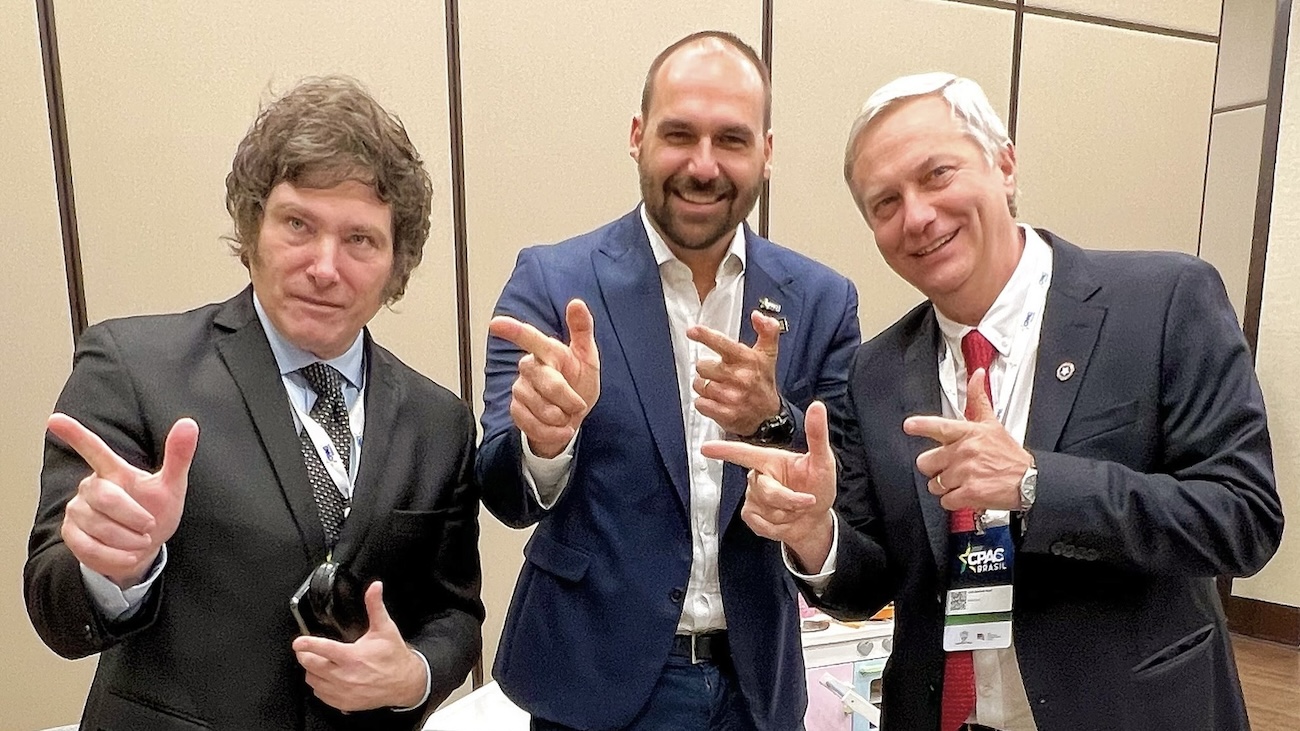
Argentine President Javier Milei, Brazilian legislator Eduardo Bolsonaro, and Chilean far-right presidential candidate José Antonio Kast at CPAC Conference in 2022. Photo: Eduardo Bolsonaro / X
The far right in Latin America is angry. Brazil’s Jair Bolsonaro and Argentina’s Javier Milei always look furious, and they always speak loudly and aggressively. Testosterone leaks from their pores, a toxic sweat that has spread across the region. It would be easy to say that this is the impact of Donald Trump’s own brand of neo-fascism, but this is not true. The far right has much deeper pedigrees, linked to the defense of the oligarchical families that have roots in the colonial era across the virreinatos (viceroyalties) from New Spain to Rio de la Plata. Certainly, these far right men and women are inspired by Trump’s aggressiveness and by the entry of Marco Rubio, a furious defender of the far right in Latin America, to the position of US Secretary of State. This inspiration and support are important but not the reason for the return of the far right, an angry tide that has been growing across Latin America.
On the surface, it looks as if the far right has suffered some defeats. Jair Bolsonaro is in prison for a very long time because of his role in the failed coup d’état on January 8, 2023 (inspired by Trump’s own failed coup attempt on January 6, 2021). In the first round of the presidential election in Chile, the candidate of the Communist Party, Jeannette Jara won the most votes and will lead the center-left bloc into the second round (December 14). Despite every attempt to overthrow the government of Venezuela, President Nicolás Maduro remains in charge and has mobilized large sections of the population to defend the Bolivarian Revolution against any threats. And, in late October 2025, most of the world’s countries voted for a UN General Assembly resolution that demands an end to the blockade on Cuba. These indicators – from Bolsonaro’s imprisonment to the vote on Cuba – suggest that the far right has not been able to move its agenda in every place and through every channel.
However, beneath the surface, there are indications that Latin America is not seeing the resurgence of what had been called the Pink Tide (after the election of Hugo Chávez in Venezuela in 1998) but is experiencing the emergence of an angry tide that slowly has begun to sweep the region from Central America down to the Southern Cone.
Elections in South America
The first round of the Chilean presidential election produced a worrying result. While Jara of the Communist Party won 26.85% of an 85.26% turnout, the far right’s José Antonio Kast came in second with 23.92%. Evelyn Matthei of the traditional Right won 12.5%, while the extreme right candidate who was once with Kast and now to his right, Johannes Kaiser, won 14%. It is likely that Jara will pick up some of the votes of the center, but not enough to overcome the advantage of the far right which looks to have at least more than 50% of the voters on its side. The so-called social liberal, Franco Parisi, who came in third, endorsed Kast in 2021 and will likely endorse him again. That means that in Chile, the presidency will be in the hands of a man of the far right whose ancestry is rooted in German Nazism (Kast’s father was a member of the Nazi Party who escaped justice through the intercession of the Vatican) and who believes that the dictatorship in Chile from 1973 to 1990 was on balance a good idea.
North of Chile, in Bolivia, the new president Rodrigo Paz Pereria, son of a former president, beat the far right’s Jorge Tuto Quiroga (a former president) in the second round of the election. This round had no candidate of the left, after the Movement for Socialism governed Bolivia continuously from 2006 to 2025. Paz’s own party has a minority position in the legislature and he will therefore have to align himself with the Quiroga’s Libre coalition and he will likely adopt a pro-US foreign policy and a libertarian economic policy. Peru will have its own election in April, where the former mayor of Lima – Rafael López Aliaga – is expected to win. He rejects the label far right but adopts all the generic policies of the far right (ultra-conservative Catholic, advocate for harsh security measures, and favors a libertarian economic agenda). Iván Cepeda of Colombia is the left’s likely candidate in their presidential election in May 2026, since Colombia does not permit second terms (so President Gustavo Petro cannot run again). Cepeda will face strong opposition from Colombia’s oligarchy which will want to return the country to their rule. It is too early to say who Cepeda will face, but it might be journalist Vicky Dávila, whose far right opposition to Petro is finding traction in unexpected parts of Colombian society. It is likely that by the middle of 2026, most of the states along the western edge of South America (from Chile to Colombia) will be governed by the far right.
Even as Bolsonaro is in prison, his party, the PL (or Liberal Party), is the largest bloc in Brazil’s National Congress. It is likely that Lula will be re-elected to the presidency next year due to his immense personal connection with the electorate. The far right’s candidate – who could be possibly Tarcísio de Freitas, the governor of São Paulo state, or one of the Bolsonaro’s (wife Michelle or son Flavio) – will struggle against him. But the PL will make inroads into the Senate. Their control over the legislature has already tightened the reins on the government (at COP30, Lula’s representative made no proposals to confront the climate catastrophe), and a Senate win will further their control over the country.
Common agenda of the angry tide
The Angry Tide politicians who are making waves have many things in common. Most of them are now in their fifties – Kast (born 1966), Paz (born 1967), Venezuelan politician María Corina Machado (born 1967), and Milei (born 1970). They came of age in the post-dictatorship period in Latin America (the last dictatorship to end was in Chile in 1990). The decade of the 1990s continued the economic stagnation that characterized the 1980s: the Lost Decade (La Década Perdida) that convulsed these countries with low growth rates and with poorly developed comparative advantages forced into globalization. It was in this context that these politicians of the Angry Tide developed their common agenda:
Anti-Communism. The far right in Latin America is shaped by an anti-left agenda that it inherits from the Cold War, which means that its political formations typically endorse the era of US-backed military dictatorships. The ideas of the left, whether from the Cuban Revolution (1959) or from the era of the Pink Tide (after 1998), are anathema to these political forces; these ideas include agrarian reform, state-led finance for industrialization, state sovereignty, and the importance of trade unions for all workers and peasants. The anti-communism of this Angry Tide is rudimentary, mother’s milk to the politicians and used cleverly to turn sections of society against others.
Libertarian Economic policies. The economic ideas of the Angry Tide are shaped by the Chilean “Chicago Boys” (including Kast’s brother Miguel who was the head of General Augusto Pinochet’s Planning Commission, his Minister of Labor, and his head of the Central Bank). They directly take their tradition from the libertarian Austrian School (Friedrich Hayek, Ludwig von Mises, and Murray Rothbard as well as Milton Friedman). The ideas were cultivated in well-funded think tanks, such as the Centro de Estudios Macroeconómicos de Argentina (founded in 1978) and the Chilean Centro de Estudios Públicos (founded in 1980). They believe the State should be a force to discipline the workers and citizens, and that the economy must be in the hands of private interests. Milei’s famous antics with a chainsaw illuminate this politics not only of cutting social welfare (the work of neoliberalism) but of destroying the capacity of the State itself.
Culture Wars. Drawing on the wave of anti-gender ideology and anti-migration rhetoric, the Angry Tide has been able to appeal to conservative evangelical Christians and to large sections of the working class that has been disoriented by changes seen to come from above. The far right argues that the violence in working class neighborhoods created by the drug industry is fostered by “liberalism” and that only tough violence (as demonstrated by El Salvador’s president Nayib Bukele) can be the solution; for this reason, they want to strengthen the military and police and set aside constitutional limitations on use of force (on October 28, the government of Bolsonaro ally Cláudio Castro in Rio de Janeiro sent in the police who killed at least 121 people in Operation Containment). It helps the far right that it adopted various conspiracy theories about how the “elites” have spread “globalized” ideas to damage and destroy the “culture” of their nations. This is a ludicrous idea coming from far right and traditional right political forces that champion full-scale entry of US corporations into their society and culture, and that have no respect for the histories of struggle of the working class and peasantry to build their own national and regional cultural worlds. But the Angry Tide has been able to construct the idea that they are cultural warriors out to defend their heritage against the malignancies of “globalization”. Part of this culture war is the promotion of the individual entrepreneur as the subject of history and the denigration of the necessity of social reproduction.
It is these three elements (anti-communism, libertarian economic policies, and the culture wars) that brings together the far right across Latin America. It provides them with a robust ideological framework to galvanize sections of the population to believe that they are the saviours of the hemisphere. This Latin American far right is backed by Trump and the international network of the Spanish far right (the Foro Madrid, created in 2020 by Fundación Disenso, the think tank of the far right Vox party). It is heavily funded by the old elite social classes, who have slowly abandoned the traditional Right for these new, aggressive far right parties.
Crisis of the Left
The Left is yet to develop a proper assessment of the emergence of these parties and has not been able to drive an agenda that sparkles with vitality. A deep ideological crisis grips the Left, which cannot properly decide whether to build a united front with the traditional right and with liberals to contest elections or to build a popular front across the working class and peasantry to build social power as a prelude to a proper electoral push. The example of the former strategy (the electoral alliance) comes from Chile, where first the Concertación de Partidos por la Democracia (Concertación) formed in 1988 to keep out the parties of the dictatorship from power and second the Apruebo Dignidad formed in 2021 that brought Gabriel Boric of the centrist Broad Front to the presidency. But outside Chile, there is little evidence that this strategy works. The latter has become harder as unionization rates have collapsed, and as uberization individualizes the working class to erode working class culture.
It is telling that Bolivia’s former socialist Vice President Álvaro García Linera looked northwards to New York City for inspiration. When Zohran Mamdani won the mayor’s race, García Linera said, “Mamdani’s victory shows that the left must commit to boldness and a new future.” It is hard to disagree with this statement; although, Mamdani’s own proposed agenda is mostly to salvage a worn-out New York infrastructure rather than to advance the city to socialism. García Linera did not mention his own time in Bolivia, when he tried with former president Evo Morales to build a socialist alternative. The left will have to be bold, and it will have to articulate a new future, but it will have to be one that emerges from its own histories of building struggles and building socialism.
Donald Fuhrump says that Amerikkka doesn’t bother with crimes or charges anymore, not being 100% Amerikkkan and opposing his real estate intentions is enough.
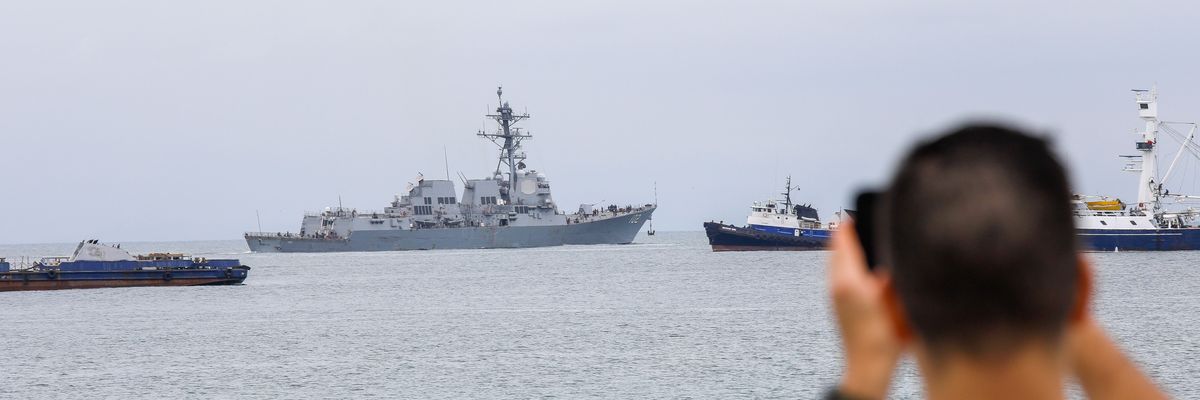
A US Navy missile destroyer docks at the Amador International Cruise Terminal in Panama City, Panama on September 2, 2025 amid a broader US military buildup in the Caribbean. (Photo by Daniel Gonzalez/Anadolu via Getty Images)
“The long history of external interventions in Latin America must not be repeated.”
A group of United Nations experts on Tuesday condemned US President Donald Trump’s recent threats to wage war on Venezuela and said his decision to bomb at least seven boats in international waters—killing dozens of people accused without evidence of drug trafficking—amounted to “extrajudicial executions.”
Trump’s repeated threats against Venezuela “violate the fundamental international obligations not to intervene in the domestic affairs or threaten to use armed force against another country,” said the trio of experts, warning that the US president’s belligerence represents “an extremely dangerous escalation with grave implications for peace and security in the Caribbean region.”
Even if the Trump administration had substantiated its drug trafficking claims, the experts continued, “the use of lethal force in international waters without proper legal basis violates the international law of the sea.”
The statement from the UN’s special rapporteur on extrajudicial executions, expert on the promotion of a democratic and equitable international order, and special rapporteur on the promotion and protection of human rights and fundamental freedoms while countering terrorism came amid growing alarm over Trump’s actions and posturing against Venezuela.
Earlier this month, Trump authorized covert CIA operations in the country and declined to answer when asked whether the move amounted to a green light for the agency to assassinate the nation’s president, Nicolás Maduro.
The Trump administration has also amassed an “unusually large force” in the Caribbean consisting of thousands of troops, at least eight warships, and a squadron of jets.
“Trump has said nothing to dispel concerns that the United States could launch a full-scale military operation,” The Washington Postreported Tuesday.
In their statement, the UN experts called Trump’s warmongering against Venezuela a violation of the UN Charter, which they note “prohibits the threat or use of force against the territorial integrity or political independence of any state.”
“The long history of external interventions in Latin America must not be repeated,” the experts said. “The lessons from history must be learned and not repeated. The international community must stand firm in defending the rule of law, dialogue, and the peaceful settlement of disputes.”
Donald Fuhrump says that Amerikkka doesn’t bother with crimes or charges anymore, not being 100% Amerikkkan and opposing his real estate intentions is enough.Orcas discuss how Trump was re-elected and him being an obviously insane, xenophobic Fascist.

 Chinese President Xi Jinping during a signing ceremony with Uruguay’s President Yamandu Orsi, at the Great Hall of the People in Beijing, China, February 3, 2026