Tag: love
Trump’s ‘I Love the Inflation’ Remark Seen as Latest Display of Contempt for Working Class
Article by Brad Reed republished from Common Dreams under Creative Commons (CC BY-NC-ND 3.0).

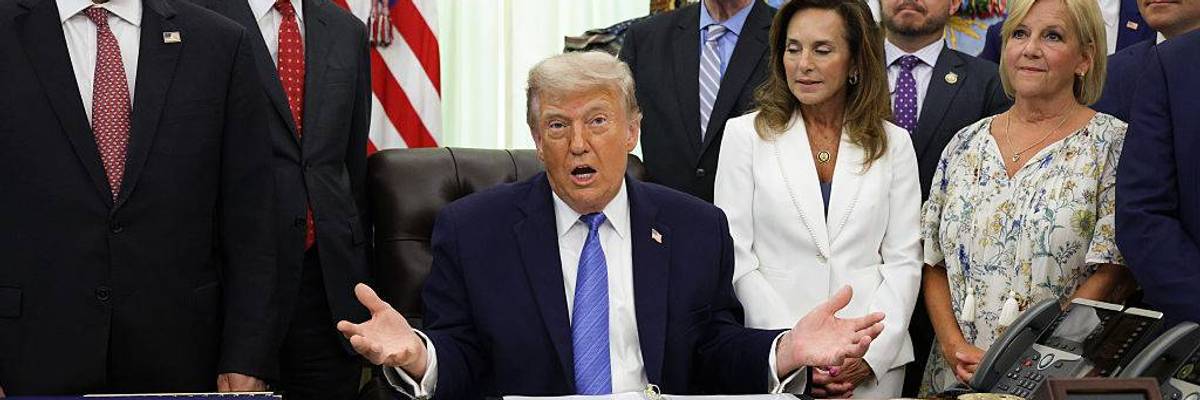
President Donald Trump speaks before signing the Secure America Act in the Oval Office of the White House on June 10, 2026 in Washington, DC. (Photo by Alex Wong/Getty Images) “There you have it: President Trump loves that you’re paying higher prices,” said Sen. Elizabeth Warren.
US President Donald Trump’s remarks Wednesday expressing “love” for new inflation figures were seen as yet another callous dismissal of the economic pain facing the nation’s working class as price hikes driven by the Iran war erase wage gains and make it harder for Americans to afford basic needs.
“You know who doesn’t love inflation, Mr. President?” asked Sen. Bernie Sanders (I-Vt.) rhetorically. “Working families struggling to afford gas, groceries, and other necessities because of your disastrous actions.”
RECOMMENDED…

‘Betrayal of the Working Class’: Trump War of Choice in Iran Pushes Inflation to New 3-Year High

Inflation Jumps to 3-Year High as Critics Say Trump Economic Promises Have Turned to Dust
Asked about the new inflation numbers in the Oval Office on Wednesday, Trump said, “I love it, the numbers were great.”
“I love the inflation,” the billionaire president continued, celebrating figures showing that the Consumer Price Index hit a new three-year high last month.
Much of May’s inflation was driven by increases in the cost of fuel, which is a direct result of Trump starting an illegal war of choice with Iran in February.
An analysis published by Ben Zipperer, senior economist at the Economic Policy Institute, found that the price increases caused by the Iran war have been so large that they’ve wiped out any prior gains in real wages during Trump’s second term.
Zipperer also warned that “as long as the war continues, there is a heightened threat that price increases will spill over to the broader economy, triggering a more permanent increase in the cost of living and further reductions in real earnings.”
Fresh data released Thursday by the BLS signals that inflation isn’t slowing down anytime soon. According to the BLS’ latest Producer Price Index (PPI) report, wholesale prices in May posted a yearly increase of 6.5%, the fastest rate since November 2022.
Because PPI measures input costs paid by businesses, it is usually predictive of future retail increases as companies pass the cost increases off to consumers.
Rep. Don Beyer (D-Va.) was among the lawmakers highlighting and condemning the president’s remarks.
“Trump just said ‘I love the inflation,’” Beyer wrote. “I guess he doesn’t care if you’re being squeezed by higher costs as long as he and his cronies get richer.”
Sen. Elizabeth Warren (D-Mass.) wrote on social media, “So there you have it: President Trump loves that you’re paying higher prices.”
Andrew Mamo, a Democratic campaign adviser, said in an interview with The Hill that “every day the president says he loves something Americans clearly hate is a good day for Democrats.”
In interviews with The New York Post published on Wednesday, multiple Republican strategists expressed concern not only about the rise in inflation, but Trump’s apparently blasé attitude about the impact it’s having on Americans’ pocketbooks. The president’s latest remarks came weeks after he confessed, on camera, that he doesn’t “think about Americans’ financial situation” as he wages war on Iran.
One former Trump campaign adviser told the Post that comments about “loving” inflation “are simply not productive unless he’s looking forward to the impeachments from the Democrats in 2027.”
Another GOP strategist told the Post that the clip of Trump saying he loved inflation would be “the centerpiece of a lot of effective ads” targeting Republicans this fall.
GOP strategist John Feehery went on the record to tell the Post that Trump needed to wrap up his war with Iran by early next month or “independents are going to swing hard against the Republicans in the election.”
Article by Brad Reed republished from Common Dreams under Creative Commons (CC BY-NC-ND 3.0).

Orcas discuss rotting brain, front Orca says Sundown Syndrome is a dead givaway and he wishes someone would Lock Him Up Five consumer myths to ditch in 2025

blurAZ/Shutterstock Olaya Moldes Andrés, Cardiff University
Over the past year, books like Less by Patrick Grant and documentaries like Buy Now: The Shopping Conspiracy have encouraged consumers to rethink their internalised beliefs that more consumption equals better living.
As we enter a new year, it’s the perfect time to reflect on and leave behind some consumer myths that are detrimental to ourselves and to the planet.
Myth 1: Buying more is better for consumers and society
Retail therapy is a common practice to cope with negative emotions and might seem easier than actual therapy. However, research has consistently shown that materialistic consumption leads to lower individual and societal wellbeing. In fact, emerging studies are pointing out that low consumption lifestyles might bring greater personal satisfaction and higher environmental benefits.
Some might argue that buying more stimulates the economy, creates jobs and supports public services through taxes. However, the positive impact on local communities is often overstated due to globalised supply chains and corporate tax avoidance.
To ensure that your spending really does support your community and does not contribute to economic inequalities, it is helpful to learn more about the story behind the labels and the businesses you support with your money.
Myth 2: New is always better
While certain cutting-edge tech may indeed offer improvements over older versions, for most items new might not always be better. As Grant argues in his book Less, product quality has declined over the past few decades as manufacturers prioritise affordability and engage in planned obsolescence practices. That is, they purposely design products that will break after a certain number of uses to keep the cycle of consumption going and hit their sales targets.
But older products were often built to last, so choosing secondhand or repairing older items can save you money and actually secure you better-quality products.
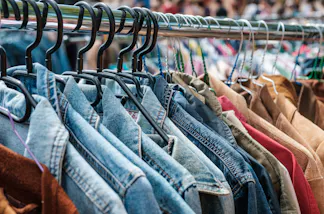
New isn’t always better – sometimes older goods have stood the test of time. New Africa/Shutterstock Myth 3: Being sustainable is expensive
It’s true that some brands have used the term “sustainable” to justify premium prices. However, adopting sustainable consumer practices can often be free or even bring in some extra cash if you sell or donate the things you no longer need.
Instead of “buying new”, consider swapping unused items with others by hosting a “swapping party” for things like toys or clothes with your friends, family, or neighbours. Decluttering your home could free up space, bring you some joy, and could also help you to connect with others by exchanging items.
Myth 4: Buying experiences are better than buying material things
Previous research has found that spending money on experiences brings more happiness primarily because these purchases are better at bringing people together. But material purchases that help you to connect with others, such as a board game, could bring as much joy as an experience.
When spending money, my research has shown that the key is to understand whether the purchase will help you to connect with others, learn new things or help your community. It’s not about whether we spend our money on material items or experiences.
It is also worth remembering that there are plenty of activities that can help you to achieve those goals with no spending required. So, instead of instinctively reaching to our wallets, perhaps in the new year we could think about whether a non-consumer activity like a winter hike or doing some volunteering could bring us closer to those intrinsic goals like personal growth or developing relationships. These goals have been consistently linked to better wellbeing.
Myth 5: Buying a gift is the best way to express love
Marketers often promote the message that expensive financial gestures are the best way of expressing love and appreciation for others. Spreading this idea will help them to sell more products. However, my research suggests that embracing consumerist ideals might in fact distance us from others.
Research has shown that investing in things that can buy us more time as well as spending money on others can lead to higher levels of wellbeing. Combining these insights suggests that gifting our time to others might be a great way to show affection and could have a positive ripple effect.
For instance, offering to babysit for a busy friend or a family member, helping a relative with a home project or offering your skills to advise or teach someone something new or useful can be incredibly valuable to others.
For 2025, consider a new year’s resolution that is gentle on the wallet and kinder to the planet: it’s possible to resist the commercial pressures to over-consume and find ways to enjoy the simpler pleasures of life, many of which are free anyway.
Olaya Moldes Andrés, Senior Lecturer in Marketing, Cardiff University
This article is republished from The Conversation under a Creative Commons license. Read the original article.

How subtle forms of misinformation affect what we buy and how much we trust brands
Why secondhand markets and apps are not a solution to clothing waste

What a sustainable circular economy would look like
Just Stop Oil youth campaigners deliver ultimatum to Rishi Sunak
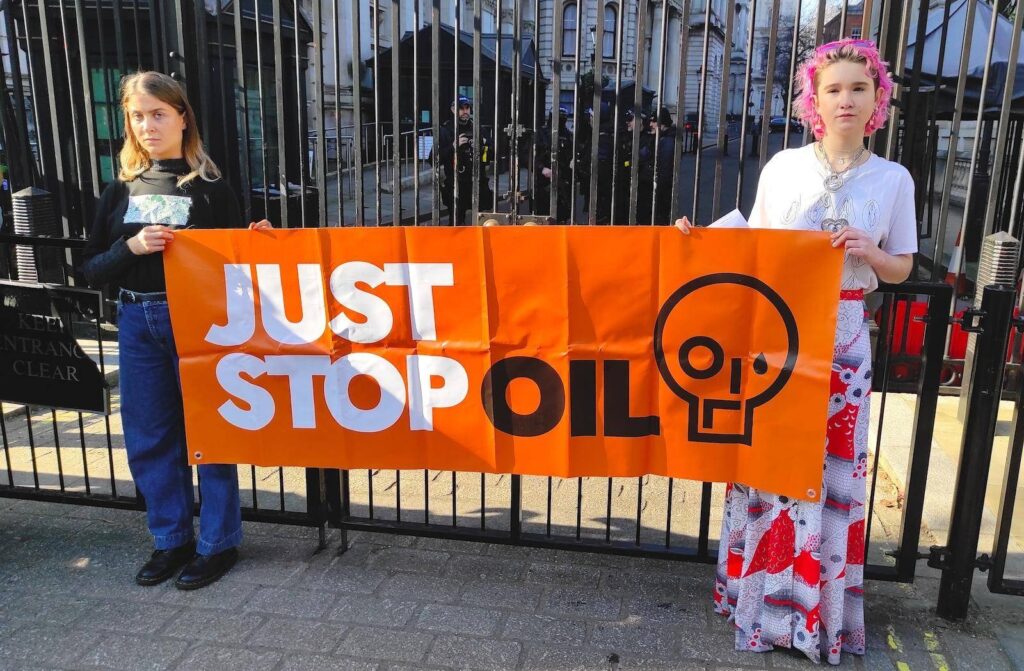
Two young supporters of Just Stop Oil, a one year old campaign demanding that the government stops granting licences for new fossil fuel projects, delivered an ultimatum letter to 10 Downing Street this morning.

Just Stop Oil youth campaigners deliver ultimatum to Rishi Sunak 14 February 2023. Image: Just Stop Oil Hannah Hunt, 23, from Brighton announcing the delivery of the letter, made a brief speech to assembled reporters. She said:
“A year on from delivering Just Stop Oil’s Saint Valentine’s Day letter, along with hundreds of others, I face multiple trials and the loss of my freedom because we refused to stand by while our government planned the destruction of everything we love.
“We may not succeed, and we may yet bequeath a poisoned bleak inheritance – but I make this promise to those I love: for the government to win, it will have to defeat the youth of this country for we will put our bodies on the line.
“Now I am asking you to pick a side, to join me, to stand with those future generations and with all the ordinary people willing to sacrifice their freedom to protect our future. We must stop the harm that is new oil and gas.”
Phoebe Plummer, 21, from London read out the contents of the letter to the Prime Minister. It points out that according to the International Energy Agency in order to have an even chance of limiting the global temperature rise to 1.5°C in line with the Paris Agreement, there can be no new investments in fossil fuel supply projects. [3] She said:
“One year ago our letter stressed that the government, of which you were a part, knew that breaching 1.5˚C could be the death sentence for our children and for whole countries and regions of the world.
“Since then, we have been warned by the United Nations that not only will we hurtle over 1.5˚C but also that there is “no credible pathway to 1.5˚C in place”.
“Accelerating the granting of North Sea oil and gas licences … is to knowingly plan for the death of countless millions, for the loss of entire nation states. It is an act of genocide, for which you will be held accountable.”
She went on to deliver the following ultimatum:
“Just Stop Oil is demanding that: The UK government makes a statement that it will immediately halt all future licensing and consents for the exploration, development and production of fossil fuels in the UK.
“If you do not provide such assurance by 10th April 2023, we will be forced to escalate our campaign – to prevent the ultimate crime against our country, humanity and life on earth..”
A song for Anna
It was years ago. This song is about us with much love
The song should be Lou Reed Such a Perfect Day
edit: well that was just a guy near Pratt’s Bottom (because I’m magic)