Prime Minister Andy Burnham leaves 10 Downing Street, London, September 1, 2026
IF IT is too early to come to any rounded judgement regarding Andy Burnham’s programme and policies – that should wait until the budget next month — it is not too soon to express concern about his government’s course in relation to the vital issue of housing.
Here he is in danger of following Keir Starmer in under-delivering. One pledge after another has been discarded or diluted.
First, a suggestion of introducing a private-sector rent freeze was dropped without explanation.
This would have been a far more substantive measure to tackle the cost-of-living crisis than anything else the new government has announced, and would have indicated whose side Burnham is on – working people rather than rapacious landlords.
Second, a clear commitment to promote council housing has been watered down in favour of more amorphous concepts of social or “affordable” housing. Only three of the more than 30 bodies to get new government funding for construction are actually councils.
…
Now we learn that Labour’s manifesto promise to stop the sale of newly built housing to overseas investors is being dropped. Such homes often remain empty and unused while big business around the world watches their value appreciate.
The reason for the latest U-turn is bosses’ claims that stopping such sales would make many housing construction projects commercially unviable.
That is a capitulation to the capitalist outlook which treats homes as profit opportunities rather than places to live.
…
The lesson of the last 40 years is that reliance on the market and private house builders leads to chronic shortages, as homes are built only for profit. That they are often left empty in the hands of millionaire investors just adds to the scandal.
…
The labour movement must place pressure on the Prime Minister and on Rayner to end the back-sliding on this issue, freeze rents, end house sales to overseas investors and get Britain building.
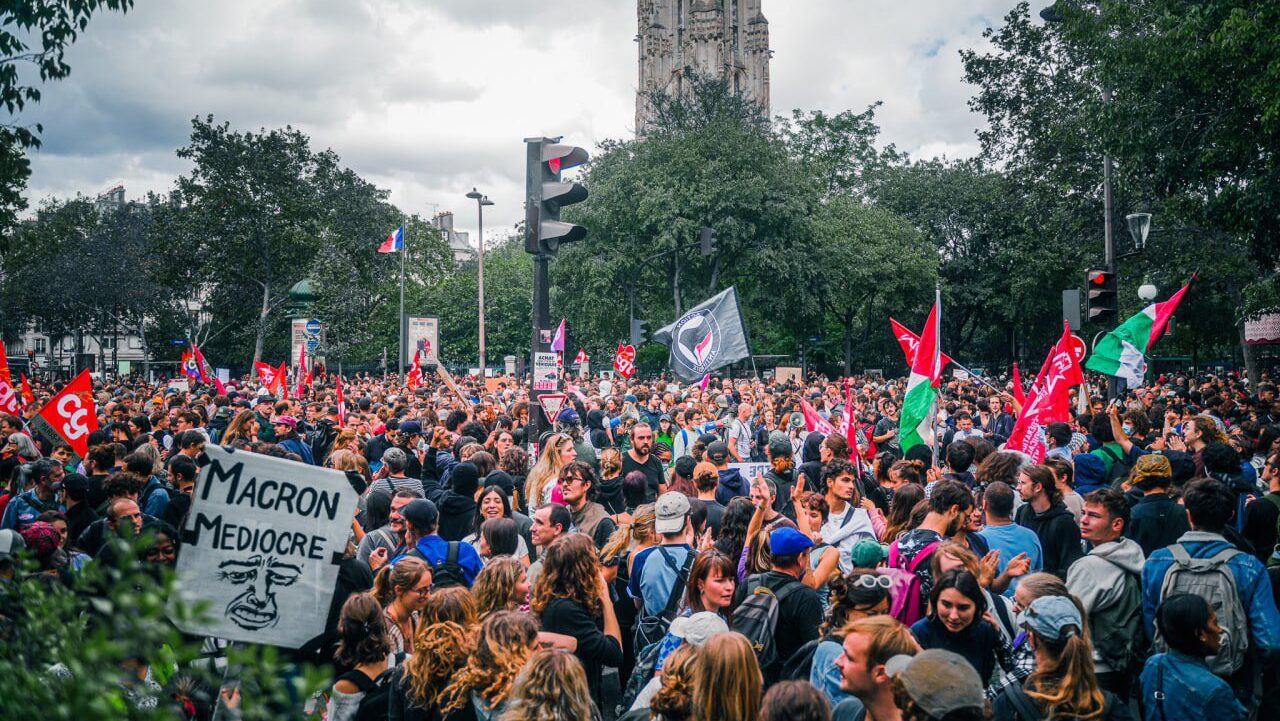
September 10 mobilization in Paris. Source: Mathilde Panot/X
Hundreds of mobilizations across France signaled public rejection of President Emmanuel Macron’s austerity path.
Hundreds of mobilizations, including picket lines and strikes, took place across France on September 10, signaling general rejection of a new wave of austerity policies advanced by the neoliberal camp. Trade unions reported significant participation in multiple sectors, including railways, education, culture, and health – where at least 100 work stoppages occurred during the day.
Grassroots networks estimate that approximately 500,000 people joined the demonstrations, held under the slogan “Let’s Block Everything” (Bloquons tout). Student collectives and Palestine solidarity groups were among those contributing to the day, among many others. Actions took place not only in major cities like Paris and Marseille but also in smaller towns such as Albi and Pau. The day was also marked by a heavy police presence and reports of violence against protesters, including the use of tear gas.
The mobilization came just days after another prime minister appointed by President Emmanuel Macron, François Bayrou, lost a confidence vote in the National Assembly. Macron quickly replaced him with former defense minister Sébastien Lecornu, a representative of the center’s right-wing faction. The appointment irked the public further. Maurizio Coppola of the Italian left party Potere al Popolo, who took part in the actions, told Peoples Dispatch: “Many saw this hasty appointment of a new prime minister as a provocation on the eve of the mobilization.”
Demonstrators also saw Lecornu’s appointment as a sign that Macron continues to pursue policies repeatedly rejected by the public. In a recent speech, France Unbowed (La France Insoumise) leader Jean-Luc Mélenchon highlighted the devastating social impact of neoliberal economic policies, pointing out that thousands of children and hundreds of thousands of people in France are homeless. Poverty and inequality, he described, plague the country. The trade union group Solidaires offered similar reflections on the day of action: “After the fall of the Bayrou government, the head of state’s desire to pursue the same policy in the service of special interests can only exacerbate fiscal and social inequalities and the ecological crisis.”
“He must go”
“Macron is to blame for this situation,” Mélenchon wrote on September 10. “He and his decisions are responsible for the chaos. He makes no effort whatsoever to show that he is receiving or listening to the messages coming from the National Assembly or the country. On the contrary, he brazenly pushes ahead to show that he remains in control of his strange and absurd plans. He must go.”
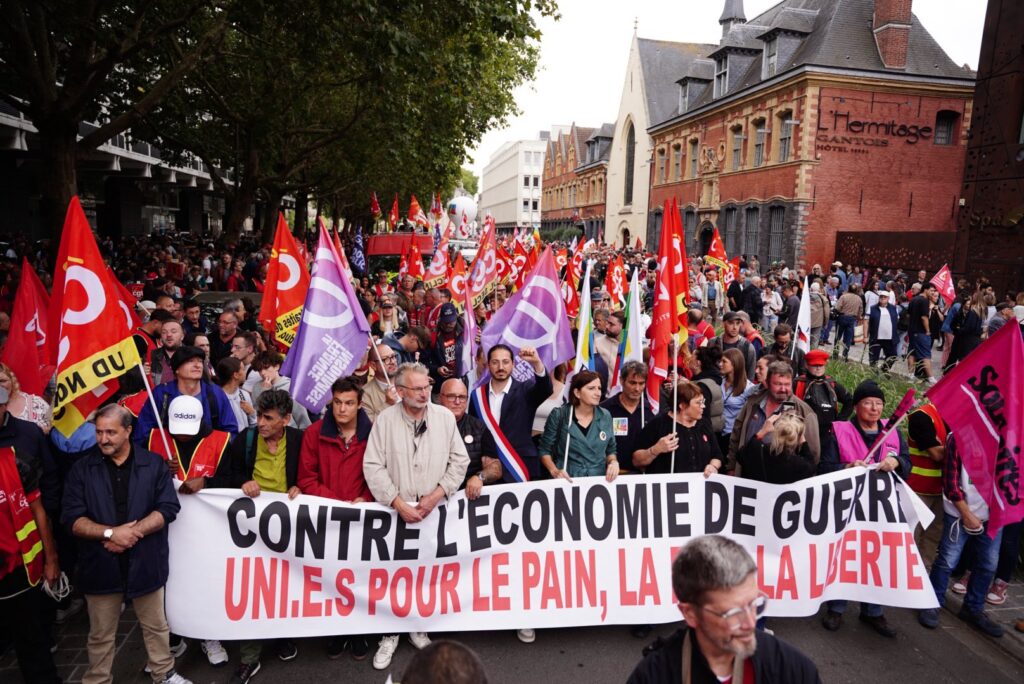
Protesters marching with banner: “Against the war economy. United for bread, peace, and liberty.” Lille, September 10, 2025. Source: Aurélien Le Coq/X
France Unbowed has campaigned for Macron’s removal since the 2024 national election, when he blocked the progressive New Popular Front (Nouveau Front Populaire) from forming a cabinet despite its electoral result, instead entrusting government formation to a succession of neoliberals. The party renewed its call after Bayrou’s collapse but also threw its weight behind the ongoing grassroots struggles. Coppola noted that activists from France Unbowed were active in preparing demonstrations across communities, helping amplify and link popular demands. “Their elected representatives marched with the protesters, defending them from police violence through their institutional status,” he added.
The role of organized labor
Despite the success of the day of action, questions remain. One concerns the role of labor unions, Coppola suggests. While certain unions and confederations, notably Solidaires, joined the call for September 10, others kept more distance. Branches of the General Confederation of Labor (Confédération générale du travail, CGT) and Workers’ Force (Force Ouvrière) participated in the actions, but their leadership chose to emphasize a strike call for September 18. By doing so, these organizations echoed popular demands against austerity but did not fully align themselves with the grassroots initiative.
The ability of grassroots groups and labor unions to connect over and channel the anger that fueled the “Let’s Block Everything” protests may have an important impact on the mobilization’s long-term success. As Coppola points out, “where strikes and blockades were successful, this was only possible thanks to the presence of organized labor.” However, he also adds that some unions joined the day of action only because rank-and-file members pushed for it, highlighting how bottom-up participation remains vital across the struggle.
Another unresolved question is the feasibility of France Unbowed’s proposal to remove Macron. While such an outcome would potentially be a significant victory against austerity, it would trigger new presidential elections with uncertain results. In 2024, the far-right National Rally (Rassemblement National) secured more votes than the left-progressive alliance, making the prospect of an extreme right president a genuine risk.
Nevertheless, the message of September 10 was unmistakable and is unlikely to fade soon. “The message was clear everywhere: no to the [austerity] financial maneuver, [yes to the] strengthening of public services and workers’ rights, taxing the rich, and above all, the resignation of President Macron,” Coppola concluded.
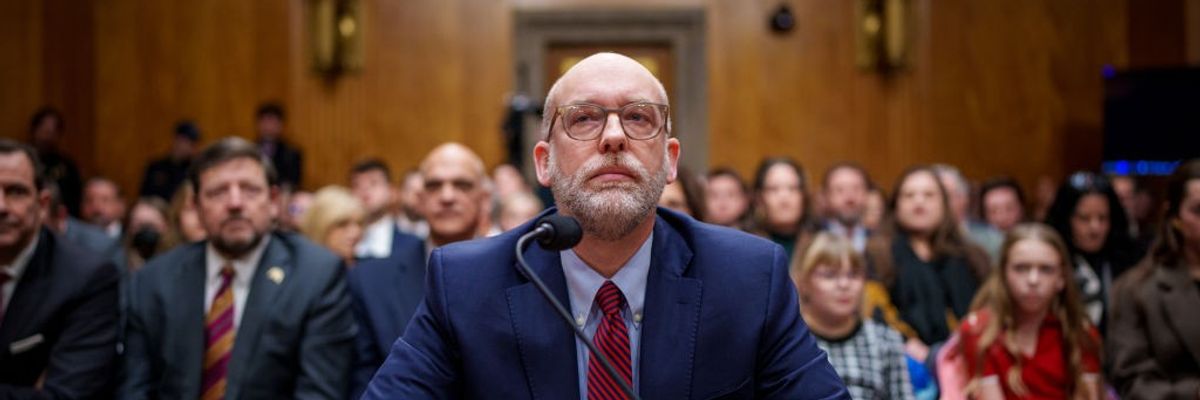
Russell Vought, President Donald Trump’s pick to lead the White House budget office, arrives for a Senate confirmation hearing on January 15, 2025. (Photo: Andrew Harnik/Getty Images)
“Now that Vought is officially running the show, he’ll be able to unleash his radical agenda across the federal government. And if the courts stop him, he’s got a billionaire friend with the government’s keys and checkbook: Elon Musk.”
In a party-line vote late Thursday, the U.S. Senate confirmed right-wing extremist and Project 2025 architect Russell Vought to lead the White House budget office as the Trump administration works to unilaterally dismantle entire federal agencies and choke off funding already approved by Congress.
Vought’s confirmation, backed only by Republican votes in the Senate, comes after the chamber’s Democrats used up all 30 hours of debate on his nomination to warn of the damage he could inflict as director of the Office of Management and Budget.
Lawmakers and progressive activists echoed those warnings in the wake of his confirmation. Alex Jacquez, chief of policy and advocacy at the Groundwork Collaborative, said in a statement that “Vought’s fingerprints are all over last week’s illegal funding freeze.”
“Halting funding for Americans’ healthcare, childcare, and food assistance wasn’t a bug,” said Jacquez. “It was by design, and Project 2025 is the blueprint. Now that Vought is officially running the show, he’ll be able to unleash his radical agenda across the federal government. And if the courts stop him, he’s got a billionaire friend with the government’s keys and checkbook: Elon Musk.”
During his confirmation process, Vought expressed agreement with Trump’s view that the 1974 Congressional Budget and Impoundment Control Act (ICA)—a law passed in response to former President Richard Nixon’s refusal to spend congressionally approved funds on programs he opposed—is unconstitutional, a view that Musk has also expressed.
Politico reported Thursday that Vought “is expected to soon press his theory on impoundments, the idea that the president can ignore congressional spending edicts.” Analysts have argued that even without the ICA, unilateral impoundments of the kind the Trump White House is expected to pursue in the coming months and years would still be unconstitutional.
Rep. Rosa DeLauro (D-Conn.), the top Democrat on the House Appropriations Committee, said in a statement Thursday that “in confirming Vought, Republicans have put their stamp of approval on ending American democracy—built on three co-equal branches of government—and on creating a government of billionaires, by billionaires.”
“Our nation is facing an extraordinary crisis,” said DeLauro. “Donald Trump is attempting to claim absolute power for the presidency. The chaos, confusion, and flagrantly unconstitutional actions of the early days of this administration are largely of Vought’s design and doing. With Vought’s encouragement, the administration has taken the groundless position—and demonstrated—that they believe the White House has the absolute power to determine spending, and that they can choose to simply not fund programs and services that Congress has promised to the American people. This could not be further from the truth.”
“The Constitution empowers Congress, not the president, with the power of the purse,” DeLauro continued. “The president is not a king who can pick and choose which laws to follow and which laws to ignore. But the president is relying on the guidance and counsel of Russ Vought to do just that.”
In one of his appearances before the Senate last month, Vought told lawmakers that he views the Clinton-era welfare reform law that doubled extreme poverty as a crowning achievement and declared that “we need to go after the mandatory programs,” which include Social Security, Medicare, and Medicaid.
“Vought is an extremist who has made clear he’ll ignore our nation’s laws, cut funding that helps people across the country, and give Trump unprecedented and unconstitutional power,” warned Sen. Patty Murray (D-Wash.), the top Democrat on the Senate Appropriations Committee, following Vought’s confirmation. “There will be consequences.”
Climate Science Denier Donald Trump says Burn, Baby, Burn.Elon Musk urges you to be a Fascist like him, says that you can ignore facts
and reality then.
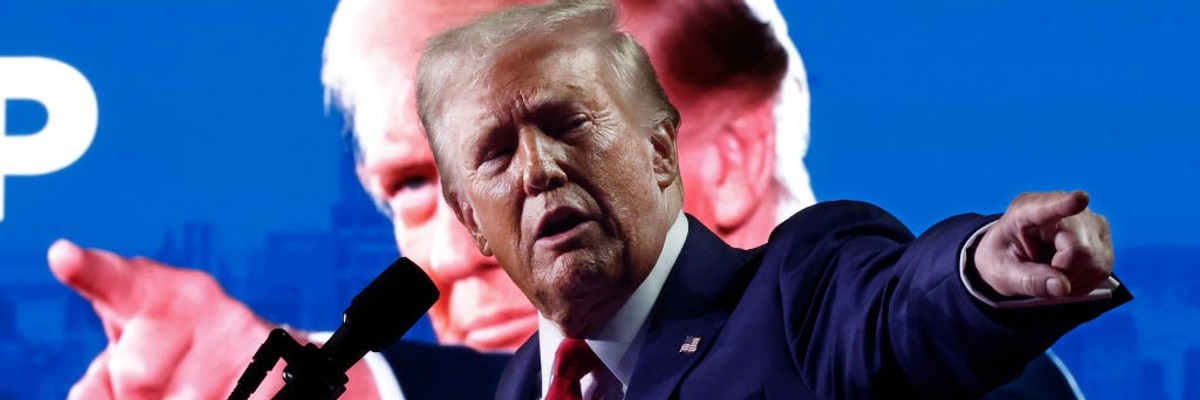
Republican presidential nominee, former President Donald Trump speaks during a campaign rally at Van Andel Arena on November 05, 2024 in Grand Rapids, Michigan. (Photo by Chip Somodevilla/Getty Images)
The formation of a united front against this far-right realignment is more important and urgent than ever before.
It’s official. Neoliberal fascism has become mainstream in the United States. This is the only rational conclusion that one can draw from Trump’s decisive victory in the 2024 election. Indeed, Trump’s historic victory (which includes leading the GOP to a much larger-than-expected Senate majority and potentially in control of the House) has changed the nature of the Republican Party and shifted the center of gravity in U.S. politics in such earth-shattering fashion that it has led to the actual collapse of the Democratic Party.
Neoliberal fascism is now the dominant politico-ideological orientation in the United States and its dire consequences will undoubtedly be felt for years to come both inside the country and across the world. In this context, the formation of a united front against fascism is more important and urgent than ever before.
Under the leadership of Donald Trump, a political movement has been born that encompasses different major coalitions (working-class voters, women [whose share of support for Trump, ironically enough, went up by 2 percentage points from the last election], Christian fundamentalists, minorities [Black, Hispanic, Asian voters] and youth [though largely white and conservative], and the ultra-wealthy) all of whom have been drawn to the “America First” slogan.
As such, the followers of Trump’s movement are apparently enthused by the idea of witnessing the radical restructuring of the federal government (the shrinking of government agencies accompanied by the expansion of the powers of the presidency) and retribution for the great leader’s political enemies; they are apparently in favor of rolling back civil and human rights and in approval of “law and order” politics which includes, among other things, militarizing the police and carrying out a militarist plan to deport millions of undocumented immigrants and banning sanctuary cities; they are apparently in support of a political agenda that targets climate change and curtails measures that protect the environment; and they are apparently in approval of massive tariffs on all imports as a tool of economic competition and tax cuts to benefit the rich.
The GOP is now Trump’s party, and it is fascistic. It was a fallacy all along on the part of many Democrats to think that MAGA Republicans were a minority within the GOP. Kamala Harris exhibited anything but political savviness by going after wavering Republicans, flip flopping on key issues, and ignoring the needs of working-class people. Thus, as Bernie Sanders aptly put it, “It should come as no great surprise that a Democratic Party which has abandoned working class people would find that the working class has abandoned them.”
The Democrats should have learned from the mistakes of Social Democratic parties in Europe, which abandoned working class people and subsequently opened the door to authoritarian populist leaders who promised voters fed up with neoliberal policies a return to a “golden age” of economic independence, national identity and traditional social values. But they didn’t because Democrats have become the party of Wall Street and jet-setting celebrities.
The question now facing progressive and radical forces in the US is what to do next. Questions over political identity, vision and strategy ought to dominate public discussions in the weeks and months ahead. A united front against Trump must be formed in order to curtail the scope of his neoliberal fascist plans. As things stand, there are virtually no checks on Trump in his second term. And he cones into office armed with a Supreme Court ruling that grants the president immunity from prosecution for criminal acts committed while in office.
Dark times lie ahead. Many of those who voted for Trump will come to regret their choice, but that’s of little consolation now to the rest of society. Now it’s up to the rest of us to become more involved ever more passionately in pedagogical projects and political struggles that would build walls of resistance against a fascist takeover in the US. The fascist threat is real, and the Democratic Party bears much responsibility for democracy’s imminent demise.
The country needs a new vision and new politics. A powerful popular mass political response is urgently needed. It can happen. It must happen. The time to get organized in a much more serious and effective way is now.
Financial meltdown, environmental disaster and even the rise of Donald Trump – neoliberalism has played its part in them all.
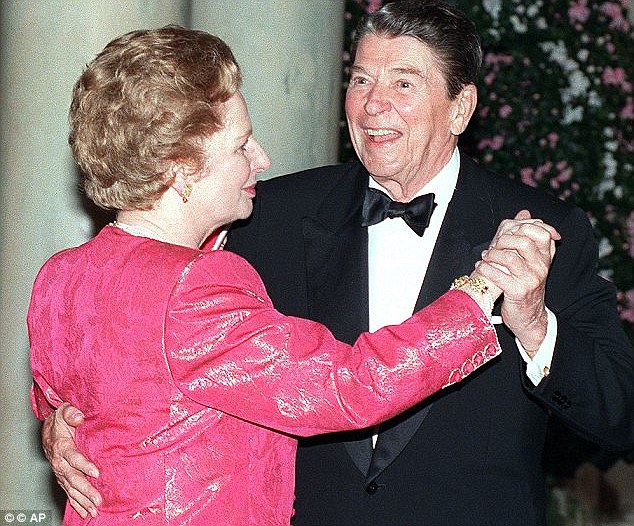
Thatcher dances with Ronald Reagan. Public domain image.
…
So pervasive has neoliberalism become that we seldom even recognise it as an ideology. We appear to accept the proposition that this utopian, millenarian faith describes a neutral force; a kind of biological law, like Darwin’s theory of evolution. But the philosophy arose as a conscious attempt to reshape human life and shift the locus of power.
Neoliberalism sees competition as the defining characteristic of human relations. It redefines citizens as consumers, whose democratic choices are best exercised by buying and selling, a process that rewards merit and punishes inefficiency. It maintains that “the market” delivers benefits that could never be achieved by planning.
Attempts to limit competition are treated as inimical to liberty. Tax and regulation should be minimised, public services should be privatised. The organisation of labour and collective bargaining by trade unions are portrayed as market distortions that impede the formation of a natural hierarchy of winners and losers. Inequality is recast as virtuous: a reward for utility and a generator of wealth, which trickles down to enrich everyone. Efforts to create a more equal society are both counterproductive and morally corrosive. The market ensures that everyone gets what they deserve.
…
As Naomi Klein documents in The Shock Doctrine, neoliberal theorists advocated the use of crises to impose unpopular policies while people were distracted: for example, in the aftermath of Pinochet’s coup, the Iraq war and Hurricane Katrina, which Friedman described as “an opportunity to radically reform the educational system” in New Orleans.
…
The privatisation or marketisation of public services such as energy, water, trains, health, education, roads and prisons has enabled corporations to set up tollbooths in front of essential assets and charge rent, either to citizens or to government, for their use. Rent is another term for unearned income. When you pay an inflated price for a train ticket, only part of the fare compensates the operators for the money they spend on fuel, wages, rolling stock and other outlays. The rest reflects the fact that they have you over a barrel.
…
Neoliberal policies are everywhere beset by market failures. Not only are the banks too big to fail, but so are the corporations now charged with delivering public services. As Tony Judt pointed out in Ill Fares the Land, Hayek forgot that vital national services cannot be allowed to collapse, which means that competition cannot run its course. Business takes the profits, the state keeps the risk.

 Prime Minister Andy Burnham leaves 10 Downing Street, London, September 1, 2026