Four London councillors have been disciplined by their local party after calling for a ceasefire
A Labour politician suspended for backing a ceasefire in Gaza has labelled the party leadership’s stance on the conflict as “utterly shameful”.
Martin Abrams was one of four councillors in Lambeth, south London, suspended by the local Labour group on Monday night after voting for a motion put forward by the local Green Party.
It called for “an immediate ceasefire and the end to human rights atrocities in the Israel/Palestine conflict”.
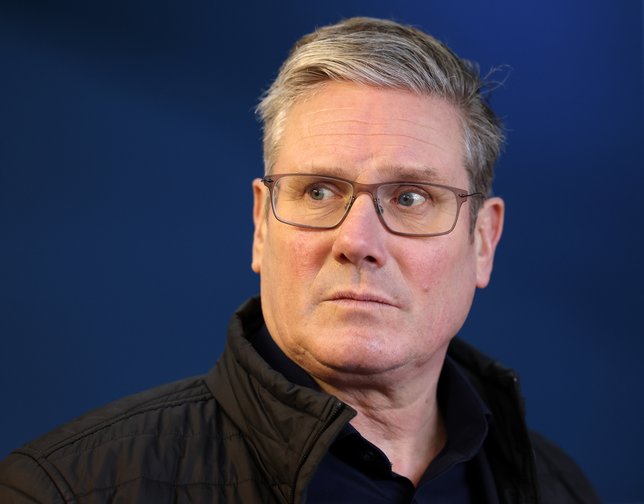
Speaking to openDemocracy, Abrams hit out at Keir Starmer and the Labour leadership for its position on the conflict, which has seen over 50 Labour councillors resign since 7 October.
“It is truly a moment of great shame for the Labour Party for us to be in this place,” Abrams said. “I will continue speaking out for what I believe is right because there is a complete absence of that happening from Keir Starmer and the Labour Party leadership.”
Abrams said Starmer’s leadership on Gaza has been “utterly shameful”, adding: “It has been from the very beginning.”
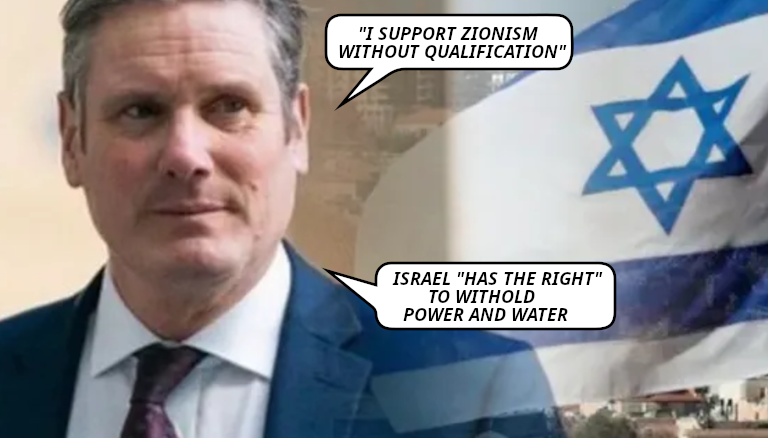
He referenced an interview on LBC radio in which Starmer, the UK’s former top prosecutor, appeared to sanction collective punishment of the Palestinian people by Israel – which is illegal under international law. Starmer has since denied this is what he meant.
Last week, chaos ensued in Parliament as Labour refused to back an SNP-tabled motion on a ceasefire. Although Labour has now supported a ceasefire, the party has been criticised for doing so through its own parliamentary motion, which was less critical of Israel than the SNP’s original text.
Abrams, who is Jewish, said Lambeth Labour’s decision to suspend him had been “disproportionate” considering it was a vote on “calling an end to the slaughter of children”. But he said he would not resign from his position as a councillor and would continue “standing up for the oppressed people”.
End the bloodshed
Abrams told openDemocracy that the crisis had taken a toll on councillors hoping to represent their ward.
“Many of us are very emotionally impacted by this because we’re solid members of our local communities. Some of us are Jewish, some of us are Muslim,” he said. “The vast majority of us are humanitarians and want to see an end to the bloodshed and the fighting.”
Lambeth Labour, which decided to suspend the four members following a disciplinary hearing on Monday, had said the motion risked “exacerbating the impacts of the deeply worrying rise in antisemitic and Islamophobic hate crime across London witnessed in recent weeks.”
Sonia Winifred, another Labour councillor who voted for the motion, resigned as a councillor after being suspended. Winifred is a veteran Windrush campaigner, and said on Twitter the decision had left her with “no choice” but to resign.
Grassroots group Momentum said: “This is an outrageous attack on a Jewish Labour councillor for having the temerity to stand up for the people of Gaza. Martin is a principled socialist and internationalist – and it is shocking that he has been forced out for standing up for a position endorsed by the majority of voters. This anti-democratic decision should be immediately reversed.”
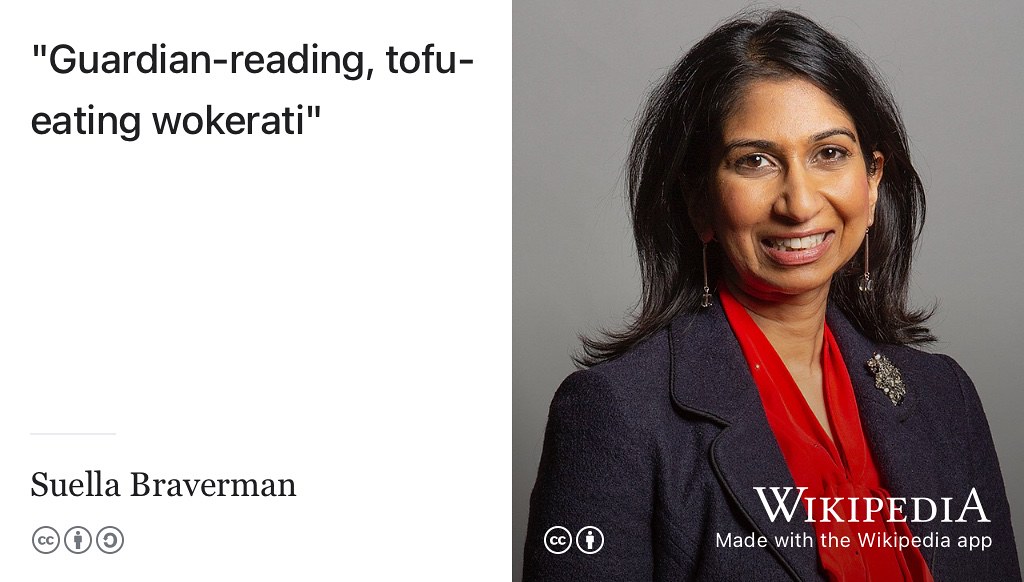
Former home secretary Suella Braverman at a ‘Stand With Israel’ rally in London’s Trafalgar Square in January 2024. Braverman’s Home Office sent a letter to police chiefs warning of a potential rise in antisemitic hate crimes in the wake of Hamas’s 7 October attacks on Israel but did not even consider sending a similar letter about rising Islamophobia, new documents reveal. Both communities experienced significant rises in hate crime as the conflict in the Middle East escalated | Chris J Ratcliffe/Getty Images
Government spoke about threat of antisemitism but did not consider making equivalent warning about anti-Muslim hate
The Home Office appears to have given no consideration to the threat of Islamophobic hate crime in the wake of Hamas’s attacks on Israel, despite warning chief constables about the “obvious risk” of rising antisemitism, openDemocracy can reveal.
It comes as the government is embroiled in a row about its perceived unequal treatment of antisemitism and Islamophobia. Incidents of both have soared since 7 October.
Oxford councillor Shaista Aziz said Muslim women were particularly at risk from rising hate crime, and told openDemocracy that the Home Office’s lack of action was “outrageous, yes, horrific, yes, but not surprising”.
On 10 October, then home secretary Suella Braverman wrote to police chiefs in England and Wales urging them to watch for rising antisemitism, particularly on pro-Palestinian marches.
The letter asked police to consider whether holding a Palestinian flag on a march or singing “from the river to the sea, Palestine will be free” could be considered a terrorist offence.
But requests made by openDemocracy under the Freedom of Information Act found that the Home Office held no evidence of any meetings, phone calls, emails or briefing papers from the same period of time regarding the possibility of publishing a similar letter about hate towards Muslim and pro-Palestinian groups.
Aziz said: “It sends a very clear message to British Muslims that ‘you’re not a priority for us,’ as opposed to: ‘You are facing a sustained rise in violence and extremism, and it’s our job as a government to put things in place to ensure that people are protected.’”
The independent councillor, who quit Labour in October in protest at Keir Starmer’s apparent suggestion that Israel’s attacks on Gaza were justified, also called out Labour’s own record on Islamophobia. She pointed to the fact no one had faced consequences for briefing a deeply offensive line to the press that Muslim councillors quitting the party meant Labour was “shaking off the fleas”.
Labour MP Clive Lewis told openDemocracy the “hierarchy of racism” in the government and society at large benefited only the far right. “This doesn’t help the Muslim community and it sure as hell doesn’t help the Jewish community,” he said. “This divide and rule policy is not just wrong – it’s dangerous.”
Lee Anderson, the Tories’ former deputy chair, was suspended from the Conservative Party this weekend after claiming in an appearance on GB News that “Islamists” had “got control” of the mayor of London, Sadiq Khan.
Conservative ministers have been reluctant to criticise Anderson, who has not apologised. Deputy prime minister Oliver Dowden yesterday refused to say whether his claims were Islamophobic in interviews with both the BBC and ITV, and transport secretary Mark Harper this morning again declined to call them racist – instead telling both the BBC and Sky News that they were simply “wrong”.
Anderson’s comments had echoed a column Braverman wrote in The Telegraph last week, in which she claimed that “Islamists” were “in charge” of Britain.
Braverman was forced out of office in November after she accused the police of left-leaning bias, helping incite a far-right mob to storm the Cenotaph on Remembrance Day. She is yet to face repercussions from the Conservative Party for the latest column.
Alba Kapoor, head of policy at the anti-racist Runnymede Trust charity, said: “This latest revelation shows what we have sadly already suspected: that this government has a flagrant disregard for its duty to protect Muslim communities.
“As instances of Islamophobia continue to skyrocket following last October, Muslim communities face persistent racist attacks. But instead of taking any action to challenge that, senior Conservative politicians and former cabinet members are busy stoking Islamophobic sentiment, and building divisive narratives.
“That the prime minister refuses to even call these instances out as racism is a clear sign of a government that is disgracefully failing Muslims across the country. This woeful situation will continue to cause profound harm unless meaningful action is taken to protect Muslim people at this time.”
The government stumped up funding to tackle both Islamophobia and antisemitism last year. It has committed £29.4m a year to providing security for mosques and Muslim schools, and £18m a year for equivalent safety measures for synagogues and Jewish schools, until 2025.
But it has had no independent adviser on Islamophobia for 20 months. Imam Qari Asim was dismissed from the role in June 2022, after being accused of backing a ban on a film that was said to exacerbate sectarian tensions between Muslims. Asim said the government’s claim that he acted to “limit free speech” was “inaccurate”.
A government spokesperson said: “There is no place for hate in our society and we condemn the recent rise in reported anti-Muslim and antisemitic hatred.
“We expect the police to fully investigate all hate crimes and work with the Crown Prosecution Service to make sure the cowards who commit these abhorrent offences feel the full force of the law.
“Following recent events, we have also made further funding available to Muslim and Jewish communities, to provide additional security at places of worship and faith schools.”
We’re up against industry giants at the British Journalism Awards for our work on the NHS, politics and civil rights
openDemocracy has been shortlisted for news provider of the year at the British Journalism Awards | openDemocracy
OpenDemocracy has been shortlisted for the most prestigious prize of its 22-year history: news provider of the year at the British Journalism Awards.
We are one of six news organisations to be shortlisted for the award, putting us up against industry giants Sky News, The Guardian, The Times, the Daily Mail, and the Financial Times.
The news follows a year in which openDemocracy broke scandal after scandal in the UK, revealing the hands of lobbyists, corporations and vested interests behind crucial decisions about the NHS, housing, the Covid inquiry and restrictions on protest.
Satbir Singh, the CEO of openDemocracy, said: “Being shortlisted for an award of this size is such a well-deserved boost for this brilliant team. And being up against five much larger newsrooms shows we really do punch above our weight.
“I’m extremely proud of how far we’ve come and look forward to our next chapter.”
Ramzy Alwakeel, the head of news, said: “I’m beyond proud of everyone. To come out of this year with our biggest-ever award nomination is a giant credit to this team’s brilliance and commitment.”
openDemocracy reporter Adam Bychawski has also been individually shortlisted in the health and life sciences category.
Image of Elmo (left) and former Prime Minister Tory idiot Boris Johnson (right)
A Cabinet Office scientist who raised concerns over ‘stay alert’ was told it was ‘too late’. SAGE was not even asked
The government’s scientific advisers said they were cut out of decisions on pandemic messaging and compared Boris Johnson to Donald Trump after he tweeted out new guidance before they could flag concerns.
The Covid inquiry today heard the Scientific Advisory Group for Emergencies (SAGE) was not given the chance to advise on the ‘stay alert’ slogan before it was announced by the PM on social media in May 2020. The new messaging, which replaced the ‘stay home’ slogan as the first wave of the virus began to ease off, was heavily criticised at the time for being confusing.
An email was shown from Theresa Marteau, a member of the Scientific Advisory Group for Emergencies (SAGE), in which she told fellow members that the ‘stay alert’ messaging had “the potential to do much damage” and said “our advice has not been sought”.
Marteau said the proposed new guidance could increase the R number – the average number of secondary infections produced by a single infected person – bringing “all the expected negative health and economic consequences”.
She told colleagues that government officials should be urgently made aware of their “concerns” and they needed to “intervene” before the message went out to the public that evening.
But further emails showed the scientists’ responding to Johnson tweeting out the message before they were able to advise on it. They expressed concern about his decision and one wrote: “We have learnt so much from Donald Trump…”
Another email shown to the inquiry revealed that a behavioural scientist in the Cabinet Office who worked on government communications did raise concerns about the guidance after finding out about it, “only to be told it was too late”.
The official said, in another email shown to the inquiry, that their team had not been consulted. In the email to SAGE members, they wrote: “The messages are kept so elusive by a small group of mainly number 10 advisers”.
They added: “I am so sorry that despite being the behavioural scientists inside the government communications service we don’t have a handle on this either. It’s so often partially political and in this case I was also told they wanted to keep it deliberately small so that there’s not too many cooks, which is also a cultural issue.”
In another email, the head of the SPI-B group of behavioural scientists said chief scientific adviser Sir Patrick Vallance had issued a warning that members of SAGE and SPI-B should avoid “getting drawn into a govt operational move and losing reputation as a response”.
The email also suggested those inside No.10 were “concerned about our correspondence”.
Lucy Yardley, co-chair of the SPI-B group and a behavioural science expert, said following this incident: “Things didn’t improve in terms of being consulted…on the whole the communications tended to go ahead with very little input from SPI-B.”
Days after the new messaging was announced, Johnson was accused of misleading Parliament by suggesting Vallance and chief medical officer Chris Whitty had signed off on it.
James Rubin, who chaired the group alongside Yardley, earlier told the inquiry that their advice was not heeded and that it “seemed to disappear into a black hole”.
Rubin gave the example of explicitly advising the government against using fear in their messaging when a new variant of Covid arose in December 2020.
“We argued against [using fear] on multiple occasions,” he said.
The inquiry was then shown WhatsApp messages from Matt Hancock, then health secretary, and Simon Case, cabinet secretary.
In the exchanges, Hancock and Case said they intended to “frighten the pants off everyone with the new strain” and that “ramping up..the fear/guilt factor [is] vital”.
Yardley also expressed her concern about the government’s Eat Out to Help Out campaign.
“The ‘Eat Out to Help Out’ slogan… that came at a really crucially problematic time, because it was during the summer and that was when there was a really missed opportunity. That was when the infections were low and we could have all hopefully kept them low”, she said.
The conflict in the Middle East has led British political actors to try and redefine what is ‘acceptable speech’
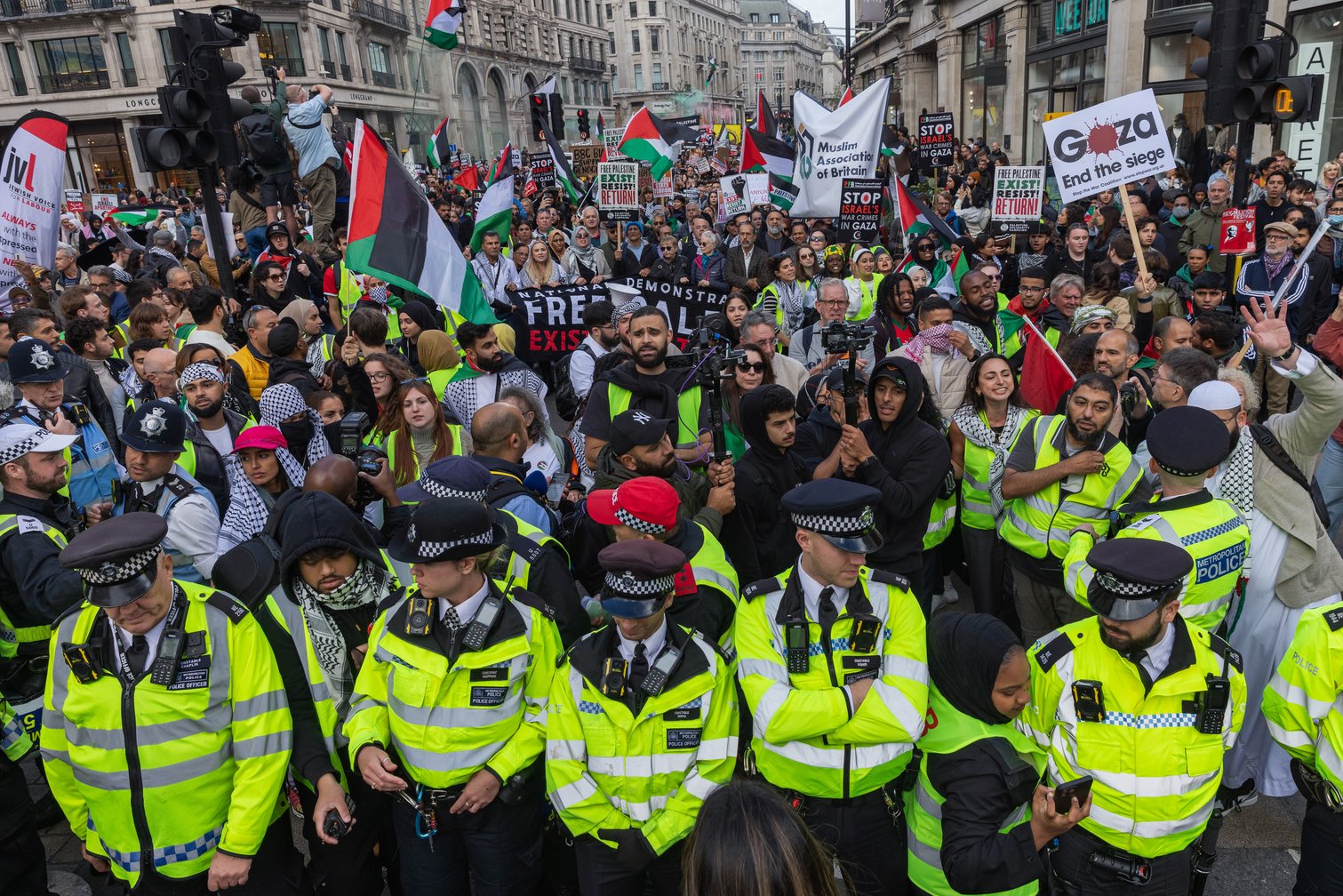
Police and protesters at the March for Palestine in London on Saturday | Mark Kerrison/In Pictures via Getty Images
As a humanitarian crisis unfolds in the Middle East, the UK government and its backers in the media have sought to marginalise and silence dissenting voices by targeting protest movements showing solidarity with the Palestinian cause.
Hundreds of people in Israel were killed, just over a week ago, in a brutal attack by Hamas. In response, Israel has moved swiftly against Hamas and the Palestinian population living in the Gaza strip. It has cut off their electricity and prevented the entry of food, water and medical supplies as it commences a devastating bombardment of homes and civilian infrastructure, leaving hundreds dead.
The reaction to these unfolding events in Britain has been one of shock and anger. Amongst the political class, a closing of the ranks has occurred, shoring up support for Israel as it strikes against the Palestinian population. And as part of this, political actors have sought to demarcate new boundaries on what is acceptable speech in the UK.
Foreign secretary James Cleverly on Tuesday urged pro-Palestinian protesters to stay at home. And home secretary Suella Braverman wrote to police chiefs asking them to take action against acts of protest that – in whose eyes it was not clear – might indicate support for Hamas.
She singled out the waving of the Palestinian flag in particular as being illegitimate “when intended to glorify acts of terrorism”, and asked that the police “consider whether chants such as: ‘From the river to the sea, Palestine will be free’ should be understood as an expression of violent desire to see Israel erased from the world” and therefore a “racially aggravated” crime.
The Telegraph has also reported that Robert Jenrick, the immigration minister, has commissioned officials in the Home Office to consider how they could revoke visas and expel foreign students who “praise Hamas”.
There are undoubtedly circumstances in which the use of particular chants or imagery could be inflammatory or even threatening. But the purpose of these statements is not to protect British communities (that much is clear from Braverman’s failure to issue a similar letter warning against attacks on Muslim or pro-Palestinian groups). The purpose is rather to intimidate would-be protestors and delegitimise criticism of Israel by aligning it with criminality.
The government’s views on acts of protest are mirrored by the official opposition: a diktat sent out by Labour Party general secretary David Evans warned members, councillors and MPs against attending pro-Palestine demonstrations. Labour has gone further still by also forbidding debate on Israel-Palestine in local party branches – a censorship not even attempted by Tony Blair during the lead-up to the Iraq war.
The results of Braverman’s provocation can already be seen. On Wednesday, Greater Manchester Police arrested four people for breaching the peace “during events… marking the Hamas-Israel conflict”, later de-arresting three of them. A video taken at the scene of the arrest and posted online shows a young man being led into a police van, a Palestine flag wrapped around his shoulders, as concerned onlookers shout at officers: “He has done nothing wrong,” and: “Freedom of speech.”
The Metropolitan Police Service itself appears to have ruled out any crackdown on people waving the Palestinian flag. But on Thursday night, the Palestinian Literature Festival was forced to cancel a book launch for Jewish American journalist Nathan Thrall’s latest book ‘A Day in the Life of Abed Salama: A Palestine Story,’ “after the Metropolitan Police Service contacted the host organisation and asked that it be cancelled ‘due to security concerns’.”
And at London’s ‘March for Palestine’ demonstration on Saturday, legal observers from Black Protest Legal Support witnessed the police make arrests of protesters who had refused to remove the ‘keffiyeh’ – a chequered black and white scarf that is symbolic of Palestinian nationalism and is traditionally worn around the head. In a statement, the Met Police confirmed four arrests for failing to remove face coverings that concealed the arrestee’s identity – at least one person has been subsequently charged, whilst others have been referred to youth offending teams.
These events (and the statements that preceded them) should be of concern not just to advocates of the Palestinian cause, but to anyone concerned about the erosion of democratic norms: here is the government using the murder of Israeli civilians abroad to attack free speech and the right to protest here in the UK.
One lawyer who spoke to openDemocracy this week linked Braverman’s crackdown on Palestinian flag-waving to the Public Order Act. That piece of legislation (which received royal assent in May 2023) was intended to break the backs of the climate movement, making it far easier for police forces to deem acts of protest illegal and criminalise those in attendance or organisers, for even minor disruption.
And last year, the Met Police used the spectre of Covid to target and criminalise those protesting against police brutality at a vigil for Sarah Everard, who was murdered by police officer Wayne Couzens.
Each crisis – climate, Covid, war – is seized upon by the state, government and media, as an opportunity to stifle dissent and curtail free speech. And it is through this framing that we can understand the response of the political and media establishment in the UK to Israel-Palestine: not simply as solidarity with the Israeli people but as an opportunity to attack our rights.
Attacks on freedom of speech relating to Palestine are not new. Palestinians in Britain have long experienced marginalisation and silencing, especially when giving voice to views on the “Palestinian experience of colonialism”.
This has been seen in particular within academia, which has become a battleground over acceptable speech on Israel-Palestine. In British schools, pupils have been sanctioned for expressing vocal support for Palestine, including with detentions and suspensions. Fear about reprisals, including referrals to the government anti-extremism programme Prevent, has been described as having a ‘chilling effect’ on engagement of students with the topic of Palestine.
This is part of a broader effort by the UK Home Office to identify protest movements and left-wing struggles as being outside of acceptable debate, with recent changes to the training on Prevent categorising “socialism” and “anti-fascism” under the heading “terrorist ideologies”. This process of delegitimisation is often backed by the media. In recent days attacks on free speech on Palestine have intensified.
On Wednesday, a report in the Times was published that “identified a dozen academics at Oxbridge and Russell Group universities who have posted statements appearing to justify the weekend’s attacks on Israel”. In one case, an academic had simply called for solidarity with the Palestinian struggle.
Much of the right-wing press has also chosen this moment to campaign for the BBC to refer to Hamas as a terrorist organisation, a term the BBC says does not meet impartiality rules – with the front page headline of Thursday’s Daily Mail eschewing proclamations on the outbreak of war and instead asking: “The King Calls Them Terrorists, Why Can’t The BBC?”. Defence secretary Grant Shapps also criticised the BBC on Radio 4 over the decision in a combative interview. The prominence this demand has been given raises questions about the priorities of the British press at such a high stakes moment.
Gaza is already partially reduced to rubble by Israeli airstrikes. More than two million people are experiencing total siege, bombardment and the removal of all basic human rights. Chemical weapons have now been confirmed as being in play and preparations are underway for a ground offensive by Israeli troops, with the 1.1 million Palestinians living in the most populated area of Gaza given 24 hours to move further south. This will almost certainly mean further atrocities.
The government and opposition both stand steadfastly behind Israel. Number 10 has said the UK will send surveillance aircraft and two Royal Navy ships to the eastern Mediterranean in plans “to support Israel”. The foreign secretary, James Cleverly, has himself travelled to Israel to “underline UK’s unwavering solidarity in the face of terror”. And both the leader of the opposition, Keir Starmer, and his shadow attorney general, Emily Thornberry, have refused to criticise Israel’s actions in Gaza or describe the “collective punishment” of civilians as a war crime.
This shocking complicity must be loudly challenged. Yet, as with the arrival of any shocking event, the political class moves quickly to turn the dial down ever further on legitimate speech.
If a ceasefire does arrive, without dissenting voices, the missing context – the dislocation of Palestinians in 1948, the occupation of the West Bank since 1967 and the 16-year blockade of Gaza – will continue not to be heard. As long as this silencing act continues, both the Palestinian and Israeli people will continue to suffer.