Indigenous demonstrators shout slogans during a demonstration at Parque Central Cayambe, Ecuador, as part of the national strike on October 1, 2025 | Felipe Stanley/Agencia Press South/Getty Images
Taking from Trump’s playbook and reviving colonial trope, President Noboa labelled Indigenous protesters ‘terrorists’
Recent years have seen Western governments extoll their democratic values while leading increasingly harsh crackdowns on dissent, with activists arrested and accused of terrorism.
Now, Ecuador has gone even further. President Daniel Noboa’s far-right government met recent nationwide anti-austerity protests with a brutality that has left two protesters dead, 473 injured, 12 missing, and 206 detained, according to the Alliance of Human Rights Organisations of Ecuador.
A 31-day national strike erupted on 22 September, nine days after Noboa removed fuel subsidies, raising the price of diesel by 55% from $1.80 to $2.80 per gallon. The demonstrations, which disrupted the movement of goods and people across the country as protesters blocked main roads, were led by Ecuador’s largest Indigenous organisation, the Confederation of Indigenous Nationalities, which represents many of the people who will be the hardest hit by the price hikes.
The government responded by imposing a state of emergency and deploying troops to break up protesters, leading to state-inflicted violence that drew criticism from civil rights groups in Ecuador and across the world.
Human Rights Watch reported it had “verified 15 videos” of “soldiers or police officers forcibly dispersing peaceful demonstrations and using tear gas and other ‘less lethal’ weapons recklessly and indiscriminately”, while Amnesty International warned of “excessive use of force against protesters by the security forces, possible arbitrary arrests, as well as the opening of abusive criminal proceedings and freezing of bank accounts belonging to social leaders and protesters”.
The unrest came as Ecuadorian voters prepare to vote on a series of referendums on 16 November. Perhaps the most controversial question they will answer is over whether to accept foreign military bases on Ecuador’s territory.
The ballot does not explicitly refer to the United States, but it may as well do; this week, US homeland security secretary Kristi Noem made her second visit to the Latin American country in four months to scout out locations for new US military bases.
Noboa’s government has long pushed for greater alignment with the US. While Ecuadorian opposition leaders warn that US military bases would threaten Ecuador’s sovereignty, both Noboa and Donald Trump’s administrations argue that they would help to stop transnational crime gangs from using the country to smuggle drugs from South America into the US.
Although polls suggest a slight majority of voters are against the bases, many are still undecided. Regardless of how they vote, Trump’s influence over Noboa’s government is already clear from the reaction to the recent Indigenous-led demonstrations. Taking from the US president’s playbook, ministers accused protesters of carrying out “terrorist acts” – directly echoing language used against activists in the US – and at least 13 people have been charged with terrorism after allegedly attacking the offices of police in Otavalo, a city in northern Ecuador.
This decision to cry terrorism is part of a strategy to turn social discontent into a security threat. Rather than answering the demands of protesters – the majority of whom were the poor people, transport workers and Indigenous peoples who will be hardest hit by fuel price increases – the government has chosen to criminalise dissent and militarise social conflict to protect its austerity measures from popular resistance.
But protest is not terrorism. It is the democratic voice of those who suffer most from inequality.
Unequal sacrifices
In Ecuador, an oil-producing country, the dispute over fuel subsidies is a recurring issue.
The subsidies have kept prices for petrol and diesel artificially low since the 1970s, but consecutive governments have argued they put too much strain on the national budget, costing the state billions, while international financial institutions have criticised them for “distorting” the economy. In 2022, the subsidies were equivalent to around 2% of Ecuador’s GDP, according to a report by the Ministry of Economy and Finance.
But for farmers, truck drivers and informal workers, the subsidies provide indispensable respite from low incomes and rising living costs. Therein lies the clash: what governments see as an easy way to make savings on their balance sheet will mean hunger for many ordinary people.
One key measure of the cost of living in Ecuador is the monthly price of the ‘basic family basket’, a government-defined set of goods needed to sustain a family of four, including food, clothing, medicine, household items and transport costs. In May this year, the price of that basic family basket reached $812, while the monthly minimum wage remained at $470. This disparity will only worsen with the removal of the diesel subsidy, which will make transport, food and the production of goods more expensive.
Previous attempts to scrap the fuel subsidies have caused the social unrest that has marked Ecuadorian politics in recent years. Two previous governments tried to do so in 2019 and 2022. Both instances sparked huge demonstrations that forced ministers into U-turns.
This time, Noboa’s government, which was elected in 2023, does not appear to be backing down. The Confederation of Indigenous Nationalities eventually called off their strike on 23 October in the wake of the state’s brutal repression, having been unable to secure any concessions.
If the government does succeed in removing the subsidies, it will lead to rising costs that will not be borne equally across Ecuador, a plurinational and multi-ethnic country where wealth is concentrated in certain areas and among certain racial groups.
The most recent data finds that 72% of the population self-identifies as mestizo, a term that refers to a person of mixed European and Indigenous American ancestry. The next largest demographic group is the Montubio people (7.4%), a rural ethnic group from coastal Ecuador; followed by Afro-Ecuadorians (7.2%), who also primarily live in the coastal provinces; then Indigenous people (7%) who largely live in the highlands and Amazon; and white people (6.1%), who have historically been based in larger cities.
The Afro-Ecuadorians and Indigenous populations in the country’s Amazon and rural coastal provinces will suffer most from the increases in transport and labour costs. Many of the families who will be affected are already impoverished, with a 40% poverty rate in these areas, far above the national rate of 28%.
Ecuador’s coast is dominated by export-oriented agribusiness and ports; the Andean highlands by public administration, services and manufacturing; while the oil extraction in the Amazonian east accounts for a large part of the country’s national income, without translating into local well-being.
The paradox is evident: the territories that produce wealth also face the greatest inequalities and deficits in health, education and basic services.
Women will also be hit harder by the removal of the fuel subsidies than men. The country’s 3.6% unemployment rate masks key gender inequalities; among women the rate is 4.6%, compared to 2.8% among men. Similarly, only 27% of women have access to adequate employment, with sufficient income and stability, compared to 41% of men, according to official figures.
The greater job insecurity created by rising food and household goods prices will disproportionately affect women. They will be forced to work longer hours to survive, particularly where they are responsible for the care of children or elderly relatives – another burden that disproportionately falls on women.
There is no neutrality in austerity: there is a regressive redistribution that privileges fiscal balance at the expense of the country’s most impoverished.
‘Terrorism’ and state coercion
While protests started in the immediate aftermath of the announcement on 13 September that the subsidies would be scrapped, the coordinated national strike began on 22 September.
Over the following 31 days, news broadcasts were full of images of this resistance across Ecuador: closed roads in Cuenca, pots and pans banging in Quito, women and children fleeing tear gas in San Rafael de la Laguna.
President Noboa imposed a state of emergency in many provinces, a measure that suspends constitutional guarantees such as the freedom of assembly, the inviolability of the home and correspondence, and the freedom of movement due to curfews. Last year, the Constitutional Court issued a warning to the president over the repeated use of this tool, which it said should be applied only in “extraordinary” circumstances.
By also condemning the protesters as “terrorists”, the government aims to delegitimise collective action, depoliticise the dispute over income and enable repression. Labelling Indigenous people as ‘offenders’ revives an old colonial trope of ‘internal enemies’, where racialised bodies are seen as a threat to order.
Noboa’s discourse is also part of a well-known Latin American genealogy: during the years of counterinsurgency, the labels of ‘subversion’ and ‘terrorism’ justified massacres, states of siege and arbitrary detentions. Today, that same language is being revived to shield a neoliberal model that is based not on consensus but on coercion.
For now, the question is not whether Ecuador can sustain fuel subsidies in the long term, but who gets to decide this. Removing subsidies without dialogue or progressive compensation mechanisms is governing against the majority.
A truly democratic policy would require real dialogue with Indigenous, Afro-Ecuadorian and peasant organisations, and including their voices in defining policies on the prices of utilities, including fuel, water and energy.
Wage and labour reform is also needed to link the minimum wage to the cost of the basic basket of goods and reduce gender and ethnic gaps, as well as territorial investment in the Amazon and rural areas to provide health, education and basic services. Finally, the demilitarisation of social conflict and the repeal of laws that criminalise protest.
The Noboa government seems to be choosing another path: shielding austerity with repression. But labelling those who defend life and bread for their families as terrorists does not resolve the conflict: it deepens it.
Protest is the language of those who refuse to be expelled from history by a model that promises order in exchange for inequality and silence.
*Rose Barboza is a Brazilian researcher and doctoral candidate in Social Sciences at the Centre for Social Studies, University of Coimbra, Portugal. She specialises in transitional justice, feminist epistemologies and critical race theory. Her current work explores comparative cases of state repression and social movements across Latin America.
How anti-protest legislation eroded democratic rights | Illustration by James Battershill
Conservative ministers loudly championed free speech – right up until they outlawed it. Now, we’re all at risk
Paul Raithby had been arrested before, but today was supposed to be different.
A veteran environmental activist and a member of Just Stop Oil and Extinction Rebellion (XR), Raithby had ended up in cells after climate actions such as blocking roads, tunnelling, slow marching and protesting at London’s Heathrow Airport.
But today, Raithby’s job was simple. Drive a red van loaded with cleaning products and water sprayers to Lloyd’s insurance market in central London, where his fellow activists were staging an ‘Insure Our Future’ action, part of a global campaign to ask companies to stop insuring fossil fuel projects. The activists planned to clean up after themselves to prevent the fake ‘oil’ – a mix of water, food dye and cornstarch – spilling off the tarpaulin where their ‘drowning in oil’ protest performance piece was taking place.
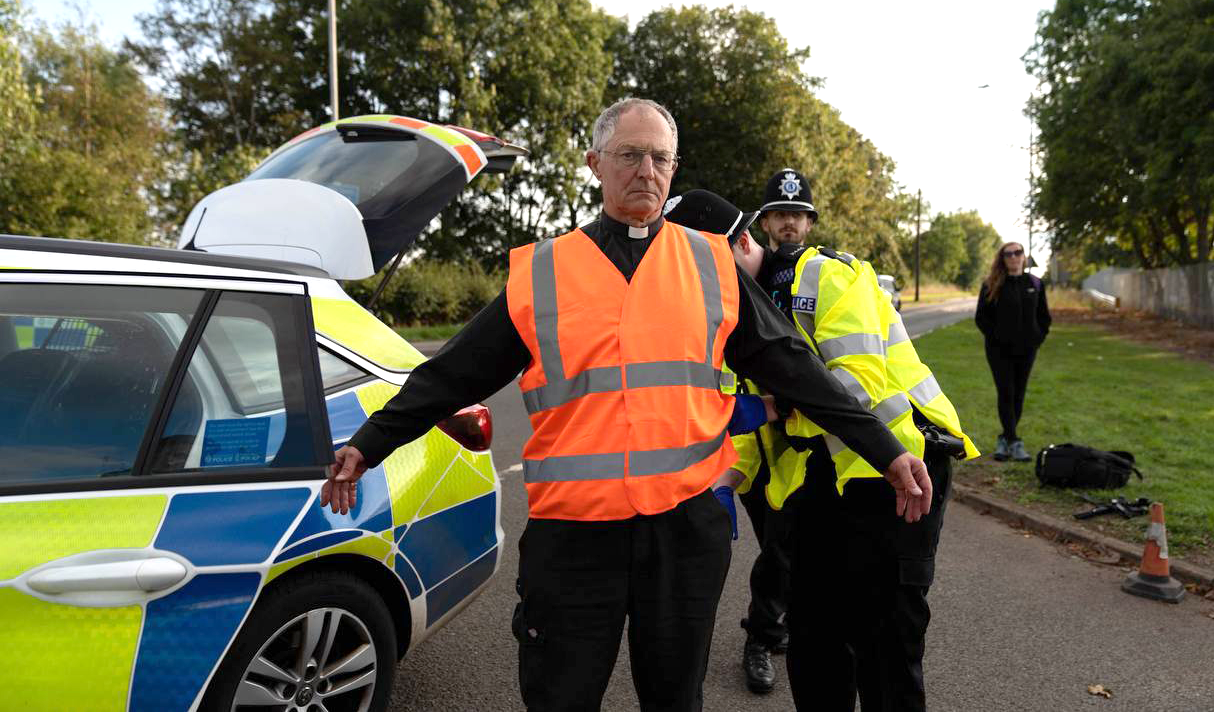
But officers raided the van and arrested Raithby, claiming – among other things – that an empty paint pot in the back of the van was part of a conspiracy to commit criminal damage. “The police saw the pot containing dried paint, the water sprayers, and put two and two together and made five.” Raithby said.
“I was on the rota to drive the XR van that day,” Raithby told openDemocracy. “We loaded up the van, including the water sprayers. I didn’t know what they were going to be used for, but you’d struggle to cause any criminal damage with the things. They aren’t like fire extinguishers, they are low-pressure, backpack water sprayers. We drove to the drop-off point, and the police were all over us.
“The police said the van had been seen handing out flares the day before, which was not true. Then they tried to say I was not insured to drive the van. Then they tried to say the van was not roadworthy even though it had passed its MOT the month before. So they impounded the van, and I ended up in the crown court accused of planning criminal damage.”
If it sounds ridiculous, that’s because it is. As solicitor Raj Chada, a partner at Hodge, Jones and Allen who has represented protesters including Raithby in recent years, said: “Nothing illustrates the absurdity of prosecution decisions when it comes to protest cases than the decision to prosecute Paul Raithby for having a canister full of water”.
But stringent new protest laws introduced by the Conservatives, first under the Police, Crime, Courts and Sentencing Act 2022 and then the Public Order Act 2023, mean this is the new, surreal reality for anyone who chooses to protest or gets caught up in a protest in England and Wales. A whole raft of legislation has made it harder to take part in protest, intensified the punishment for anyone guilty of protest offences, and clogged up courts with cases such as Raithby’s, where there is little to no chance of conviction.
In my younger days, I was a feminist activist. I remember jumping up onto a bench, loudhailer in hand, shouting statistics about men’s violence against women and girls to a bemused crowd. Reading about the new legislation made me wonder whether the actions that I used to do unthinkingly would now be unthinkable. I wanted to find out what impact the new protest laws have on our freedom to protest and therefore on our democratic rights. In essence, is the old adage, ‘if you do nothing wrong, you have nothing to fear’, still true today?
That’s why I have spent the past six months investigating the extent of the new anti-protest laws and their impact on democratic freedoms. I sent dozens of Freedom of Information requests to police forces, universities and government departments; interviewed dozens more activists, lawyers and former police officers; attended protests, and scoured through parliamentary debates, all to understand how a government that proclaimed to be a defender of free speech instead created the greatest threat to our civil liberties for generations.
“We used to have protests where some people would be the ‘arrestables’,” said Kristin, an XR activist who asked openDemocracy not to publish her surname. “They would be the ones who would volunteer to do the part of the action that could lead to arrest.”
She took a deep sigh.
“Now, we are all arrestables.”
And “all” means us all – not just climate protesters willing to glue themselves to tarmac, or throw washable powder on Stonehenge.
“What authoritarian governments and regimes do is take a wedge issue and use it as the thin end of the wedge,” Labour MP Clive Lewis told openDemocracy. “They pick particular issues which they feel a section of the public may be exasperated about, or have concern about, or there’s been a media storm about, and they then use that to prise open your rights, and to change the law.
“They can say – you have nothing to worry about. It’s these other people we’re after. The climate protesters, Gaza protests, Black Lives Matter; these are the people we’re going after. You don’t have to worry about your project. But it doesn’t work like that, because once the law is there, the law can then expand to target anyone, depending on any new government front that opens up.
“Liberty is something to be protected, and it has to be universal, otherwise next it will be your liberties that will be attacked and undermined,” he said.
New laws, new powers
In 2019, parts of central London were temporarily brought to a halt as a group of climate protesters gathered on Tower Bridge, demanding a global rebellion against the climate crisis. The protest was joyful, with one woman who attended recalling “a real warm and feminine energy”.
Similar rebellions, often with theatrical and artistic elements, spread to cities across the country, in London, Brighton, Bristol, Leeds, Glasgow and elsewhere. Though police officers were often present, the atmosphere was quite jovial, according to various activists who attended. “The police have the same worries about the climate we have,” said Raithby. “We used to have chants reaching out to the police and saying we are doing this for their children too.”
The following year, another wave of protests hit the UK’s streets – this time in response to the murder of George Floyd by a police officer in the US. Black Lives Matter marches and vigils took over cities, and in Bristol led to the pulling down of a controversial statue of the notorious enslaver Edward Colston.
The Conservative government had a dilemma. Its MPs had built up a reputation as defenders of free speech against what they described as woke, “cancel culture”-driven snowflakes intent on shutting down debate. In 2020, the Conservatives had condemned a failed attempt by a Labour MP to introduce buffer zones around abortion clinics – spaces where anti-abortion protests are banned – as an affront to free speech and protest. But they also wanted to stop the climate and BLM protests that challenged their policy platform, and which they perceived as threatening both the economy and their rule.
The answer was a two-pronged attack. The first was a wholesale culture war against ‘social justice’, which presented BLM, climate, feminist and migrant rights activists as a fifth column determined to bring the country to a halt. The second was passing new and draconian legislation to tackle this so-called left-wing ‘threat’.
People arrested for protesting outside court say Suella Braverman’s latest clampdown won’t deter them
On 9 March 2021, Braverman’s predecessor as home secretary, Priti Patel, introduced the Police, Crimes, Sentencing and Courts (PCSC) Bill, naming both XR and BLM protests as its targets. The act became law in early 2022, creating a new definition of “serious disruption” to give the police licence to ban actions that prevent or disrupt people’s daily activities, including journeys and goods deliveries, “in a way that is more than minor”.
The legislation also got rid of the common law offence of public nuisance, creating the more serious and more broad offence of “intentionally or recklessly causing public nuisance”. The new law criminalised an action that “creates a risk of or causes serious harm to the public or a section of the public, or prevents the public or a section of the public from exercising their rights.”
“Take a protest action such as obstructing a highway, maybe one of the London bridges,” said Nic Harries, a retired solicitor who works closely with XR. “Under the old laws, a conviction for such obstruction would incur nothing more than a fine. Now, under Section 78 of the PCSC, such protest activity could well be considered to be a public nuisance, which carries a maximum ten-year prison sentence.”
The changes in the law have had a “chilling effect”, Harries added. “There will always be a hardcore of activists who will be up for getting arrested no matter what. But there are far more people who are anxious about not being arrested and not going through the court process and ending up with a conviction.
“It’s very hard for people who want to go and participate as there can never be an assurance that you’ll never be arrested, because now you just don’t know.”
I asked the 43 police forces across England and Wales how they were implementing the new laws, requesting data on arrests made for the offences of “intentionally or recklessly causing a public nuisance” and “wilful obstruction of a highway”.
Unsurprisingly, the results were variable, with some forces policing more protests than others.
Between summer 2022 and 30 November 2024, 30 forces made 1,151 arrests for public nuisance. Seven forces made no arrests, while the remaining six refused to answer my request. In the same time period, 28 forces made 1,234 arrests for obstructing the highway. Nine forces made no arrests for that offence and six refused the request on grounds that it would cost too much in staff’s time to compile the data.
London’s Metropolitan Police made the largest number of arrests for both offences: 174 for public nuisance and 955 for highway obstruction.
I also asked police forces how often they have used powers introduced in Section 75 of the act that allow police to prevent protests causing serious disruption, such as noise or property damage. Five forces had used the powers a total of 39 times, with Wiltshire police having used the powers the most frequently: 26 times.
Wiltshire was also the only force in England and Wales to confirm it had used new powers to restrict one-person protests that cause serious disruption, having done so on 10 occasions. Five forces refused to answer the request, and the remaining 33 had not used the power.
Katie Burrell is an XR activist who became one of the first protesters caught up in the new legislation, when she took part in a 2023 action that interrupted a women’s golf tournament sponsored by the AIG insurance firm – part of the group’s campaign to encourage insurance firms to divest from fossil fuel projects.
“We thought if we were arrested it would be for aggravated trespass,” said Burrell, a 51-year-old who spent her career working in communications. “Then they told us it was for public nuisance. At first, I thought that’s not so bad, that sounds better than trespass. Until I looked it up and saw it meant a maximum of ten years in prison.”
The case was set for June 2026, three years after the action took place, with Burrell put on bail. “So you can imagine having that hanging over you for all that time,” Burrell said. The charges against her were eventually dropped due to a lack of evidence.
Burrell does not believe the public is on board with the crackdown on protest. “I took part in a road sit-in, in Clapham [in south London], in 2021 so before the new laws,” she said. “We chose a place where you could drive around us if needed. And I remember, this woman came out and I thought she might be annoyed but she actually brought me a glass of water and said that what we were doing was brilliant. A dad was watching us and talking to his children about the suffragettes.”
Then a police car arrived. Two officers got out and physically dragged Burrell off the road as members of the public looked on.
“It really upset the spectators, to see the police dragging a woman in this way.” Burrell said. “It’s just a form of oppression. It’s another form of oppression.”
Katie Burrell at an XR protest in London | Crispin Hughes/supplied by Katie Burrell/XR
The PCSC also introduced new penalties to “conspire” to cause a public nuisance, an offence that hung over Just Stop Oil activist James Skeet for two years before he and five of his fellow activists were acquitted in Southwark Crown Court in March 2025, with two of his colleagues found guilty. The group had been arrested for activities relating to a planned blockade of the M25, the motorway that encircles most of Greater London and is one of the busiest roads in the UK.
“I was staying in a house that got hit by a SWAT team,” Skeet told openDemocracy, recalling the night of his arrest in 2022. “The door got kicked in, and I got pinned to the sofa, at 1am.”
In the years between his arrest and court date, Skeet remained confident that the charges would not stick. “There’s no evidence of what they are alleging, and I know that because no evidence exists. But obviously it’s still a bit scary,” he said when we spoke in the run-up to his trial.
At the time, Skeet was on bail. “My bail conditions mean I can’t take part in any protest,” he explained. “So my right to protest has basically been curtailed since 2022.” He also expressed concerns that he and Just Stop Oil had been placed under a “pervasive surveillance campaign” while he awaited court. As the new anti-protest laws are categorised as far more serious offences than their predecessors, they allow for greater police surveillance. ‘It’s sort of terrifying,” he said.
Skeet owns his house and told me he felt “under duress” to plead guilty or to go to court without legal representation in order to protect his financial assets – pointing out that this “is counter to the right to a fair trial in the convention of human rights”.
As with everyone I spoke to, Skeet’s fear was real but his main concerns were not for his own safety, but the safety of the planet and the ways in which these new laws deny people the chance to take to the streets and fight for their future.
“It’s all pretty stressful and I haven’t been sleeping that well,” he said. “The way that I’ve tried to make peace with it is, if my experience of the climate crisis is some time in prison or a threat to my property, I think that that still leaves me in quite a privileged position.
“Because look, 30 million people got displaced in Pakistan in 2022 because of flooding, mothers in Valencia are having to drag their babies from the mud due to floods, there are floods in Manchester where people have lost everything. I can still count myself lucky.”
I couldn’t help but admire his statement of compassion for those suffering around the world. I am not sure I, facing a spell in prison for protest, would be quite so caring or philosophical.
Despite the crackdown that led to Burrell and Skeet’s arrests, the PCSC failed to stop protests. At least seven major climate demonstrations – including on the M25 – took place in the first four months after the law was passed in January 2022.
Faced with this reality, the Conservative government felt the legislation had not gone far enough. Rambunctious debates in the House of Commons and the Lords had defeated multiple powers that it wanted to introduce in the law, such as the ability to ban individuals from a protest and a ban on locking on (when protesters attach themselves to another person, land or an object in order to make it more difficult to remove them).
Ministers were not happy with the act they had ended up with. So they tried again.
Back to the benches
In May 2022, just months after the PCSC came into law, Patel launched her second attempt to crackdown on protest: the Public Order Act (POA).
“The Public Order Act is crazy,” Skeet said. “You basically had laws in the PCSC rejected by Parliament and the home secretary comes back and tries to crowbar them back in.”
Where the PCSC had failed, the POA was determined to achieve. It introduced a new definition of “serious disruption”, expanded the list of “key infrastructure” to make it a crime to disrupt ‘B’ roads (secondary, non-motorway roads), and forced through previously defeated offences such as locking on or being equipped to lock on, such as carrying a bike lock or ties.
It also reintroduced Serious Disruption Prevention Orders, which allow police to pre-emptively stop someone from taking part in a protest. An FOI request I submitted revealed these powers had not yet been used by the 40 forces that responded to my request, nor the transport and military police.
The effort to bring previously rejected laws back from the dead caused unrest in the House of Lords. During a debate in the upper chamber in November 2022, Green Party peer Jenny Jones remarked: “This is actually a zombie bill that the government have dragged out of its grave because they do not like opposition at all.”
Labour peers Peter Hain, Vernon Coaker and Shami Chakrabarti also expressed frustration over the POA, warning that it would criminalise a vast, law-abiding majority. But the law even troubled traditional antagonists of “woke” culture, such as Claire Fox, a crossbench peer who was appointed to the Lords by Tory prime minister Boris Johnson.
“When I explained to some people, including two Conservative councillors, how this bill could be used against the protests against low-traffic neighbourhoods [a climate initiative that involves closing some roads], they said, ‘Don’t be ridiculous. This bill is about stopping Extinction Rebellion,’” Fox told the House of Lords.
She added: “The government are […] shooting themselves in the foot and confusing members of the public, who think that this will be directed only at one type of protester. It will not.”
But this wasn’t a mistake, it’s what the government was counting on. By focusing relentlessly on how the new laws would target unpopular protests, such as Just Stop Oil blocking the M25, it created a public enemy of climate activists, ‘social justice warriors’ and ‘activist’ lawyers. This was the plan when then-home secretary Suella Braverman branded protesters the “tofu-eating-wokerati”, and when her boss prime minister Liz Truss called them the “anti-growth coalition”. The government turned protest into a culture war, an us vs them fight. The woke snowflakes vs the strongmen trying to protect the public from disruption.
Only, that’s not how laws work. These are sweeping powers that have taken away all of our civil liberties, not just the protest rights of people we don’t like. Politicians and commentators who supported the anti-protest legislation have since criticised its use to convict anti-abortion protesters for demonstrating in the ‘buffer zones’ that were introduced around reproductive health clinics in 2023.
Lewis, the Labour MP, is concerned that the government’s focus on climate protests is helping to normalise opposition to tackling the climate crisis. “It’s made the ground fertile for far-right arguments against net zero,” he said. “We’ve shut down a legitimate area where those peaceful protests were keeping the climate crisis in the public eye and keeping pressure on the government. That’s been taken out of the picture, in effect, and that’s had a chilling effect on the debate more generally.”
Despite the objections by peers from all parties, the Public Order Act 2023 was passed on 3 May 2023.
Three days later, at King Charles’ coronation, republicans felt the full force of the new powers. Sixty-four people were arrested in London, including one royalist who was falsely identified as a Just Stop Oil protester and detained for 13 hours. The Met Police later expressed “regret” that its officers had arrested six people from anti-monarchy campaign group Republic, releasing them without charge.
As with the PCSC, I submitted Freedom of Information requests to police forces in England and Wales to see how often the new anti-protest powers have been used.
Once again, it was a variable picture. The majority of arrests made under the POA between the law being passed in May 2023 and November 2024 when I submitted my FOI requests, were for interfering with the operation of key infrastructure, such as roads: 36 of the 43 forces had made 786 arrests, of which 729 were by the Met.
Thirty-five forces said they had made a total of 87 arrests for locking on, with seven forces having made a combined 43 arrests for being equipped to lock on. There was one arrest, in Northamptonshire, for obstruction of major transport works. The majority of those arrested, where data was recorded, were white British individuals.
There are real concerns, however, about the potential racialised impact of the new laws. The POA gave police new powers to stop and search without suspicion if an officer “reasonably believes” a protest offence may be committed. Crossbench peer David Pannick told the House of Lords that these powers risked disproportionately impacting “Black people, in particular, many of whom feel that those in Parliament do not represent them, and for whom peaceful protest is even more important”.
He continued: “You are seven times more likely to be stopped and searched by the police using ‘with suspicion’ powers, and 19 times more likely to be stopped and searched by the police using ‘without suspicion’ powers, if you are Black than if you are white.” He pointed out that both ‘suspicion-led’ and ‘suspicionless’ powers – measures the Lords rejected when the government previously tried to pass them in the PCSC bill – were included in the POA.
The chilling effect
“The mood and the approach of the policing of that action was very different to how it was in 2019,” said Lindsay Parkin, an experienced activist and Greenpeace member. “The public perception of climate protest has been managed in ways that mean it is now legitimate to shut us up and put us in prison.”
In September last year, Parkin was one of 20 activists arrested during a protest outside Unilever’s London office – the first mass arrest for locking on. He later told openDemocracy that he had been “curious” to see how the new offences would be policed when he volunteered to take part. The case against him was eventually dropped for lack of evidence.
Parkin is concerned about the chilling effect the new legislation has on protesters. “I think it will probably be effective in suppressing participation in these kinds of activities or, to put it another way, our own government might succeed in frightening people out of challenging them,” he said.
The chilling effect, warned Paul Stephens and Richard Ecclestone – former police officers who now act as protest liaisons for XR – is also linked to how the new laws have given forces new licence to police protests more aggressively than they have in the past. This is, in part, because protests have been placed in the criminal sphere, rather than a human right.
Ecclestone says the approach to managing protest has changed since he was policing animal rights protests in the 1990s. “We were never there to arrest people and put them before the court and get them convicted,” he said. “Our role was to get them out of the road so the trucks could get through – it was all about safety.”
Now, Ecclestone said the police’s goal is to find reasons to arrest. “When XR started, you felt safe as a protester,” he said. “You felt able to express your right to protest without the risk of ending up with a massive fine and a criminal record, or even going to prison, which is what people face now.
“The difference five years has made to being able to express your view in public has changed beyond all recognition. That is the terrifying thing because if ordinary people can’t go and protest, what’s the difference between the UK and Russia?”
“If ordinary people can’t go and protest, what’s the difference between the UK and Russia?”Richard Ecclestone
“The new laws have led to a shift from policing with consent, to enforcement,” warned Stephens. He added that the legislation is vague enough that people are being arrested “on spurious grounds”.
“Recently, we’ve had two cases where the police have gone into an office building where an XR sit-in is taking place – no obstruction, no intimidation – and they’ve arrested the people inside and we knew that there was not going to be a charge because it’s not sufficient for aggravated trespass. But the police try to argue intimidation, and then the person arrested is put on bail and has to live under bail conditions for months.”
What’s crucial to this, Stephens explained, “is the police were quite happy to arrest people knowing they weren’t going to get charged. They were arresting people, not for putting them before court, but in order to disrupt that protest and to deter them from doing it next time. In addition, with every arrest they record fingerprints, DNA, facial image and personal details. From the perspective of ‘chilling protest’ it is a win-win for police. From the perspective of healthy democracy, it is dire, and will ultimately serve to radicalise people beyond peaceful protest.”
This trend of looking for reasons for arrest, Stephens said, goes beyond protest and impacts other forms of public gatherings.
“Did you hear about the carol service?” Stephens asked me. “You should talk to the people at the carol service.”
The carol service
On 14 December 2024, a group of pro-Palestine carol singers gathered on a street corner near Westminster’s Parliament Square, a grassy area outside the British Parliament where political demonstrators often gather to protest or attract the attention of politicians to their cause. The group was made up of Christians, Jewish people and Muslims, as well as people from other faiths and those with no faith.
“We were a vigil, not a protest,” said Ruby Rehamn from Newham’s Palestinian Solidarity Campaign. “To recognise the victims of genocide. There were plans to have carols, to have blessings and readings, speeches and poetry. All quite beautiful really. We wanted it to be a healing experience.”
There were two police officers on the scene, and Rehman asked them if it was okay to do some carol singing. “We were on the pavement, not on the grass of Parliament Square. The police seemed to be appreciating it, and they were listening to the children singing.”
Rehman said she spoke to police at around 4.15pm, as her group was setting up. At the time, she said, officers were fine with the group’s plans.
But it was not long before the mood changed. The police started to gather around a lot more and surrounded the protestors.
“When I explained that we had asked and been told it was okay to sing some carols, they said that we couldn’t be there past 4.30pm.” Rehman said. “They hadn’t told us that before.”
By this point, Helen Burnett, a priest in the Church of England and a member of Christians for Palestine, was reading a blessing to the gathering. “The police started accusing us of shouting and being angry,” said Rehman. “We were taken aback, we were not shouting! They became really aggressive with us. I actually hugged Helen as I could hear the stress in her voice. It was emotional. We were upset because we were being asked to stop but we were not getting angry.
“There were children that were shaking trying to pack up the candles, these little electronic candles, and they had to switch them off, and they were just panicking doing that,” said Rehman. “And I related to them, because the thought of their mums being arrested was just horrifying. There were elderly people there. Parents with their children. There were four nuns present. It was just how hard and how angry they were that we were there, singing carols.
“I said to a police officer: please don’t arrest these people, we’ve done nothing wrong.”
What Rehman says happened next is extraordinary. The police officer on the scene told her that he was not going to arrest them – “they even looked a bit awkward, asking us to pack our stuff away” – but she could hear someone whom she presumed to be a police commander over the radio shouting, “arrest them all”.
“The police accused us of being part of a separate rally,” Rehman explained. “But we kept saying to them that we are a different group, we have different leaflets, we are just singing carols. It didn’t matter, we had to pack up and go.”
Burnett was another of the organisers. “I could hear the word arrest [from panicked attendees],” she said. “I was aware that I needed to try and hold the circle and to hold the space that we created. Because I’ve got people here who have not turned out expecting to be arrested. So this isn’t something where we’re going to go, well, we’re going to stay, come what may. We had to keep everybody safe.”
“These things are peaceful,” she said. “They bring solace. But I think they saw us as dangerous, an interfaith carol service against genocide. We are standing together and they want us to be a binary.”
The police used new powers granted in Section 14 of the Public Order Act 1986, which allows for the dispersal of a static protest. The PCSC updated the section to gives officers powers to disperse if they “reasonably” believe a protest may result in “serious” public disorder, damage to property or disruption, or will create noise that has “a relevant impact on persons in the vicinity”.
“We weren’t protesting, we were singing carols,” said Diana Neslen, a Jewish woman who co-organised the event. “They seemed to be psyched up about people who support Palestine just as they are psyched up about climate protesters.”
The group complied with police and left without any arrests being made, but were left shaken at being forced to cut their peaceful vigil short. Rehman told openDemocracy she still has “arrest nightmares”.
Neslen submitted a complaint to the Met Police about its actions. “They investigated and they couldn’t find why there was a problem,” she said, with obvious frustration. “Then they gave reasons allied with Section 14, which is normally used when the crowd is being unruly or unsafe or going on to the road, or if you’re upsetting a group.”
“Who were we upsetting?” Rehman asked. “Nobody. It was just us and the police.”
Daughter of terror attack victim Makram Ali says politicians are ‘fuelling fire’ by equating Muslims with extremism
The Metropolitan Police said in a statement provided to openDemocracy: “On 14 December 2024, police officers were present at a number of public events taking place across Westminster. The event in question was subject to conditions under Section 14 Public Order Act. This requires a public event to commence and conclude at specified times and to only gather at a location approved by police. A number of attendees breached these conditions. Officers engaged with these individuals and they dispersed willingly. No arrests were made.”
The Met also said that, as far as it is aware, at no point was an order given for officers to make mass arrests.
“If it was Section 14, they should have been told what the grounds were,” Stephens said. “If it was a dispersal, they should have received the grounds in writing. They had no grounds. You’ve got a multi faith carol singing that’s been shut down with no reason given. If you’re going to start closing down things like that, and then not give any reason why you did it, that’s sinister.”
Down the Strand
My journey with this story ends on a bright, freezing January day in central London. The white, 19th century buildings of the Royal Courts of Justice are cut out against a frosty blue sky. Below, a crowd of 1,000 protesters – ranging in age from pensioners to those barely out of their teens – sit on the cold hard road outside, blocking traffic in both directions along the Strand.
Members of the group hold placards featuring images of political prisoners past and present. Raithby is there, as is Stephens, who is liaising with the vast police presence who remonstrate with protesters to move on and return to the designated area of protest, a small sliver of road outside the courts.
“The police are behaving themselves,” Stephens quipped. “When they have the world’s best human rights lawyers watching through the windows.”
Even so, I have prepared for this event expecting trouble. A journalist from LBC radio station was wrongfully arrested when covering a Just Stop Oil protest and so I’m equipped with a full security briefing. It’s a long way from my youthful feminist protest days, when my colleague squared up to a beat officer who tried to prevent us from reclaiming the night from men’s violence.
The action outside the courts that I have come to report on is in solidarity with the ‘Lord Walney 16’, a group of imprisoned Just Stop Oil protesters serving a combined sentence of 41 years for their roles in a number of different actions. Their case is being heard in the Court of Appeal, where the prosecuting barrister tells the panel of three judges that the appellants’ right to protest does not protect them from their criminal activities.
The bustling activity outside is at odds with the grandeur of the wooden-panelled room with wine-coloured velvet curtains. Speakers addressing the protesters include Frank Hewetson, who was held in a Russian jail in 2013 following a Greenpeace action, a rabbi and a quaker, and activists linking the repression of the Palestinian people with the climate crisis. A sound system plays a comedy dance track celebrating nature TV presenter Chris Packham, who is taking part, as is celebrity chef and campaigner Hugh Fearnley Whittingstall.
Paddy, a young climate activist who asked that we don’t publish his surname, tells me he has come down from Glasgow to join the sit-in. “My friend was imprisoned for her involvement in a Palestinian Action protest,” he said. “Law and democracy in this country is being corrupted by the oil and arms industry.”
Another attendee is Rebecca Johnson, who tells me she took part in demonstrations at the Royal Air Force’s Greenham Common station in Berkshire in the 1980s. Back then, feminist peace activists camped out at the RAF base to successfully campaign against nuclear arms. “We showed that non-violent activism works,” Johnson explained.
“My first sentence was for 14 days in prison for basically standing up and saying, ‘I will not accept a legal bind over not to live at Greenham Common, because the work that we’re doing is keeping the peace’. Today, these people are facing years in prison,” she added. “From teenagers right up to elderly women with children, with grandchildren, who are doing their utmost to prevent the combination of climate destruction and breakdown.”
The action outside the courts today is peaceful and well-attended. There is some bafflement from passers-by, and a group of young professionals behind me are having a robust debate about the purpose of protest and the impact of the anti-protest laws. If even the suits in central London are against the POA, then who are these new laws for, I wonder.
But polling suggests the new legislation is popular with the general public, who have seemingly been persuaded by politicians and the UK’s largely right-wing media that protest is against them, rather than a human right that protects them. The Labour Party, which entered office at last summer’s election, has given no sign it will repeal the laws, with the party’s home secretary Yvette Cooper continuing an appeal launched by her Tory predecessor against a High Court ruling declaring the anti-protest legislation unlawful.
That appeal was ultimately unsuccessful. The Court of Appeal ruled against the government this month, backing a legal challenge launched by human rights NGO Liberty in 2023 over the powers handed to the police to prevent any protest deemed to cause “more than minor disruption” in the POA. Liberty argued this was unlawful as Parliament had already democratically rejected the powers just a few months earlier in the PCSC.
The courts will decide in the coming weeks if the relevant parts of the legislation will be quashed.
“We launched this legal action two years ago to ensure that governments are not able to sneak in legislation via the back door that weakens the rights of all of us,” said Liberty lawyer Katy Watts. “This judgment is a victory for Parliament and the rule of law. The regulations are just one of many anti-protest laws introduced in recent years which have criminalised protesters and clamped down on the ways we can make our voices heard.
“Protest is a fundamental right and the cornerstone of our democracy. It must not be undermined by governments who want to shut down the ways we hold them to account.”
Keir Starmer confirms that his government is cnutier than Suella Braverman on killing the right to protest.A Just Stop Oil participant getting arrested at Kingsbury oil terminal. A JSO / Vladamir Morozov image.
British chancellor Rachel Reeves has backed ‘catastrophic’ plans to build a third runway at Heathrow | Ian Forsyth/Getty Images
Rachel Reeves and Keir Starmer appear happy to pursue growth at any cost – including the destruction of the planet
Last weekend the temperature at the North Pole was 20℃ above average, taking it above ice’s melting point in what was described as “a very extreme winter warming event” by Mika Rantanen of the Finnish Meteorological Institute.
Four days later, things got worse still. The Copernicus Climate Change Service reported that last month was the warmest January ever recorded at 1.75℃ hotter than pre-industrial times. This is especially worrying since scientists expected temperatures to fall this year as La Nina took over from the previous year’s El Nino. We now face the worrying possibility that the impact of cooling La Ninas might be declining.
Amid these developments, British chancellor Rachel Reeves has backed plans to build a third runway at Heathrow, which climate campaigners warn would be “catastrophic”, and reports have emerged that she is also poised to support the opening of the giant Rosebank oilfield in the North Sea, which energy secretary Ed Miliband has described as “climate vandalism”.
Reeves’ drive for economic growth at the expense of the planet is a far cry from the strong green agenda that the Labour Party seemed to favour ahead of last year’s general election.
Labour’s apparent change of heart unfortunately coincides with Donald Trump taking office in the US. The climate science community is now braced for the impact of Trump’s newly appointed Department of Government Efficiency, led by billionaire Elon Musk, running a coach and horses through the US foreign aid programme.
Trump’s administration has also already started removing or downgrading mentions of climate change from federal government web pages – a sign that we are in a worse position than a decade ago after the 2015 Paris climate summit, when there were indications that the dangers of climate breakdown were at last being appreciated at higher political levels.
Now, one of the world’s leading climate specialists, professor James Hansen of Columbia University, says that the international target agreed upon at the Paris summit of limiting global temperature rises to 2℃ is “dead”. The pace of global heating had been “significantly underestimated”, he explained.
The fossil carbon states and corporations with their coal, oil and gas markets, meanwhile, are more certain about their prospects and happy to promote their wares with enthusiasm. There were 2,500 oil, gas and coal lobbyists at the 2023 Dubai COP28 climate summit, four times as many as attended the previous year in Egypt.
If forced onto the defensive, fossil fuel giants have several options. One is to move the focus away from mitigation to adaptation, another is to boost the potential of carbon capture and storage, and yet another is geoengineering.
Then, if all else fails they can fall back on direct air capture; removing carbon from the air once it is dispersed in the atmosphere, rather than as it is emitted. In other words, we should accept the likelihood of an “overshoot” of carbon emissions and hope that future technologies can save the day!
None of these scenarios has any current relevance as none can be developed in anything remotely like the time available given the speed of climate breakdown. There has to be urgent political change at the highest level to engage in emergency decarbonisation.
At a lower level, there is some good news at least. The cost of producing electricity from renewable sources is continuing to fall and the whole process of embracing renewables could accelerate if just one or two countries demonstrated just how quickly change can come.
The UK is in a hugely favoured position to do so, having huge scope to expand land-based wind and solar power as well as offshore wind. That should be one of the British government’s two absolute priorities, the other being a rapid programme of home and workplace insulation.
Further moves would be an immediate tightening up of house building regulations requiring much higher levels of insulation together with grants and loans for home environmental improvements. Transition to electrical vehicles should be accelerated along with much expansion of public transport.
Changes in agriculture must be brought in to cut down on greenhouse gas emissions, with methane emission control frequently being overlooked. Air and marine transport must also be subject to far greater emissions control. Any plans to expand existing airports must be abandoned as nonsensical, and subsidies for oil and gas production should be transferred to renewables.
All this, and much more, would cost money, and a lot of it, but there is plenty of that around, readily available from many sources including rigorous control of tax evasion and avoidance, together with new wealth taxes. If climate breakdown is recognised for what it is, the greatest threat to UK security, then the entire ‘defence’ budget should be rethought in this light. More than this, any government that recognises the challenge facing every one of us would see the need to borrow to help fund the response.
So, what of Labour so far? Regrettably, there is little to applaud despite the efforts of a rather isolated few on the front benches and a handful of backbenchers such as Clive Lewis. The party’s brave words of a year ago are difficult to find and Labour is now about growth at almost any cost – destruction of the planet included. The lobby brigade is winning.
Even carbon capture and nuclear power are now hailed by the Labour government as part of the answer even though the first is unproven and the second will take decades to bring in while we only have years, not decades, to make the change.
Perhaps Labour will come to its senses as climate disasters accelerate but it is now a party that has lost any sense of mission. It has forgotten its history, how a Labour government of the late 1940s took on seemingly impossible tasks and succeeded in many respects against the odds. Can the party change now? Perhaps, but don’t hold your breath.
Keir Starmer, Angela Rayner and Rachel Reeves wear the uniform of the rich and powerful. They have all had clothes bought for them by multi-millionaire Labour donor Lord Alli. CORRECTION: It appears that Rachel Reeves clothing was provided by Juliet Rosenfeld.
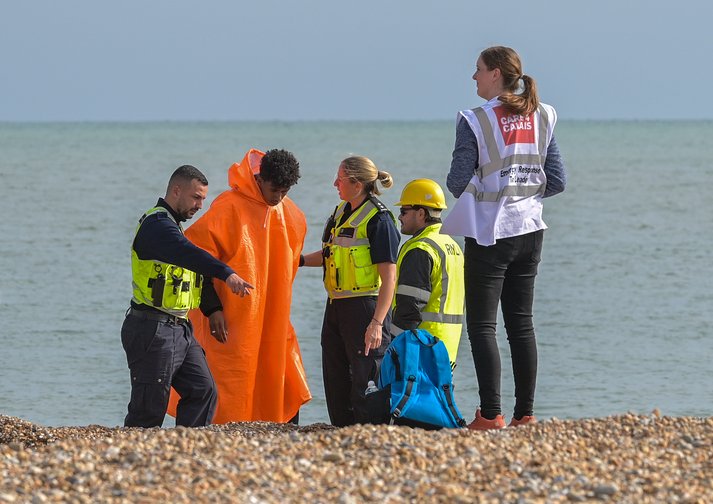
Border force and police officers take people to shore after they arrived in Kent in October 2022 | Stuart Brock/Anadolu Agency/Getty Images. All rights reserved
I was labelled a ‘smuggler’ and spent over two years in prison for touching the tiller on a dinghy. That’s not justice
Samyar Bani, 42, is an Iranian refugee who travelled to the UK in a dinghy on 1 June 2019. He was arrested on arrival and convicted of assisting unlawful entry into the UK in November 2019. His initial sentence of six years was later reduced to five. An appeal hearing in December 2021 then acquitted him of all charges. The appeals judge determined that the law had been interpreted incorrectly, as Bani and co-passengers had intentionally been picked up by police before disembarking on UK shores. This interview has been edited for clarity and length, and the final transcript was reviewed by Samyar before publication. It is part of the seriesHow migration became a criminal offence.
Melissa Pawson (BTS): Can you tell us why you left Iran?
Samyar Bani: I had a problem with the government there. So I came to England to ask for help as an asylum seeker.
Melissa:What was the journey from Iran like?
Samyar: I left my home country on 1 January 2017. First, I went to Turkey and stayed there for six months. Then I went to Greece. There are so many refugees in Greece. I tried to claim asylum there, but they didn’t accept my claim.
I like Greece. They have good weather, and Athens reminds me of my city, Shiraz. But I wasn’t allowed to stay. So I went to Germany. I was there for four months, but I couldn’t stay there either. They made a mistake in my asylum claim and rejected me as well.
I liked living in Germany, because I have a sister there. But Germany doesn’t like me. So I came to England.
Melissa:Did you travel through Calais?
Samyar: Yes, I lived in the Jungle there for around two months. There were too many people in the Jungle, and everyone was planning to go to England to claim asylum.
Editor’s note: the Jungle was the nickname of a large informal encampment on the outskirts of Calais, France. It was demolished in 2016 but undocumented peoplecontinued to live in the area.
When I was going to France from Germany on the train, I was searching on Google and Telegram and Facebook, and I found lots of information telling me that England supports people like me. I read that England understands that Iran isn’t a democracy. Because of that, I thought UK would support me.
So me and four other Iranians bought a boat together to come here.
Melissa:Why did you decide to buy the boat by yourselves?
Samyar: Because smugglers are so expensive. I think they charge around £2,500 per person. I don’t have that kind of money. Instead, each of us put in £500 for the boat to come here. We were six in the boat, including a child around 10 years old.
Melissa: So you crossed the English Channel and were picked up by the UK Border Force boat. Did they arrest you straight away?
Samyar: The police arrested everyone and sent us to the immigration detention centre. We stayed there the first night, and they transferred me to a hotel in London the next day.
They arrested me at the hotel after I’d been there for just one night. It was 6 or 7pm. Six people came to the hotel. One of them had a gun – it was a big one like a machine gun. There was no interpreter. They put my hands behind my back and arrested me. Then they transferred me to Kent police station.
I touched the tiller for maybe four or five seconds, that’s it
Melissa:You must have been very confused and scared.
Samyar: I was really confused. I was lying awake in the cell thinking maybe I’m not in England. Maybe I came to a different country. Every night after that I was talking to myself, asking, why does England think I’m a smuggler, why did England arrest me? This is wrong. This isn’t Iran, it’s not a dictatorship.
I kept thinking maybe the police would come to apologise. They would tell me, Mr. Bani, we were wrong. Sorry, you’re free now. Later, this just became a wish.
I was scared and stressed. It was a very dark time for me. I was alone, with no family or friends. I didn’t speak English.
Melissa: Did an interpreter and a lawyer explain what was happening at any point?
Samyar: After I’d been in the police station for two days, an interpreter came to speak to me. But he was from Afghanistan and spoke Pashto – I speak Farsi, which is a completely different language. Then a solicitor came. Then I got a different solicitor. I wasn’t allowed to choose either of them, they were just assigned to me. The second solicitor didn’t have time for me, he was really busy. He just came once and spoke to me for a short time. My case was very serious, but he barely gave me any time.
Melissa: Did they tell you what you had been accused of?
Samyar: They said I’m a smuggler. But I’m not a smuggler, I’m not trafficking people. They said they had video evidence showing me driving the boat, but the video was very short. When I took the tiller I was just following the orders of the police who were directing our boat. Before they took the video, there were different people driving boat.
We had bought the boat together. I wasn’t in command of this trip. I’m not a boat driver – I don’t even know how to swim, and I’d never seen a boat before the day we bought one. But I sat in the wrong place in the dinghy, near the engine, and ended up touching the tiller for maybe four or five seconds. That’s it. But that was enough.
The police know that real smugglers don’t come to England, but every boat has to be steered somehow. The people on board do that. So why not put everyone in jail? Why just me?
Melissa: Did you see the police recording you while you were in the boat?
Samyar: Yes, we saw them. And when the police took us onto their boat, everybody was scared. But I told them, “the police won’t kill you.” They want to help refugees.
Melissa: Were you able to speak to your family while you were being held?
Samyar: No, because I didn’t have their phone number. I had saved their number on my phone, like anyone else would, but the police took it from me when I went into custody.
I couldn’t speak to my wife for three years. She thought I’d died.
I wrote dozens of applications to ask my caseworker, my solicitor, anyone, to please get me back my mobile. Just so I can write the number down and then they could take back it again.
Melissa: That must’ve been incredibly difficult for you and your family. How did you find her number again?
Samyar: My sentence finished in December 2021, but they didn’t give me my phone back right away. I was living on the streets, with nowhere to go, when I found out about a charity called Care4Calais. They helped me to contact a solicitor and I was transferred to a hotel.
That solicitor wrote to the court so many times. It took maybe five months for the police to give my phone back. Maybe the police just really liked my mobile, I don’t know.
It hadn’t been used in more than two years and wouldn’t turn on at first. But I finally got the phone numbers from it and I called my wife.
Melissa: What was that phone call like?
Samyar: She was very confused. She asked me why I hadn’t spoken to her in three whole years. It was very, very hard.
I was so scared I’d be recognised. All the newspapers said I’m a smuggler. My picture was in the BBC
Melissa: How is your wife now, is she okay?
Samyar: She’s doing better now. She was struggling with depression before because I had disappeared.
Melissa: And how did the sentencing affect you?
Samyar: I changed my hair and my beard because I was so scared I’d be recognised. All the newspapers said I’m a smuggler, and my picture was in the BBC.
That wasn’t all undone when the appeal went through. I didn’t see any big headlines saying, ‘Bani is not guilty, he’s not a smuggler’. So I didn’t feel safe, even though I was free again.
It’s not been easy. I’m doing better now at least – better than prison.
Melissa: Can you tell us what your time in prison was like?
Samyar: I was in prison for just over two years after the sentencing. Including my time in remand, I was in prison for two and a half years.
Prison is bad for everybody. But for people who are not guilty, it’s so much worse. All the time, you’re thinking, why am I here?
I was in there with people who had been jailed for life. Some of them had murdered people, committed rape, attacked people, robbed, laundered money, run drugs operations. I remember asking someone what they’d done and they said, “I just killed one person”.
It was terrible.
Melissa: This sounds like a really scary experience. Can you tell us about the appeal?
Samyar: I went to the Royal Courts of Justice in London, and three judges reviewed my case. Three or four days later, they all agreed that a big mistake had been made because I hadn’t broken the law. They said I hadn’t come here illegally because we were transferred to the port by the police.
So then I was free. But I had to wear an electronic tag on my leg for six months. The Home Office said this is an immigration tag, but if that’s the case then I don’t understand why they don’t make everyone wear one. Surely the law is for everybody?
And when I got to the hotel two weeks later, there were lots of other asylum seekers there. But I was the only one with an electronic tag.
In Iran, if you change your religion the government will put you in prison and you could get the death penalty. That’s if people don’t kill you first
Melissa: You said you were first homeless after you were released – where were you sleeping?
Samyar: I slept on the streets for two weeks. It was rainy and people were everywhere getting ready for Christmas. It was a very hard time.
I went to a church and I told them I’m homeless. I showed them my immigration papers, but they said they couldn’t help because I didn’t have refugee status or a visa. And I wasn’t allowed to rent a house – I could only get support from the Home Office.
Melissa: What happened after that?
Samyar: My solicitor wrote lots of letters to the Home Office, and finally they helped me to get accommodation in a hotel.
But it wasn’t a hotel for asylum seekers, it was a quarantine hotel. So many people had Covid 19, and I caught it too. I had a very high temperature, I felt like I was dying. I was there for maybe two months, and then I was transferred to a hotel in Newcastle. After that they sent me to a shared house in Stockton-on-Tees.
Six months after I was released from prison, the Home Office sent me a letter telling me I have leave to remain for five years. That was in June 2022. I had good evidence and lots of paperwork, because I changed my religion in Iran.
I don’t believe in Islam, so I converted to Christianity. But in Iran, if you change your religion the government will put you in prison and you could get the death penalty. That’s if people don’t kill you first. Some people think that if they kill a convert, they’ll be rewarded by Allah.
This is fake. My religion is for me, and your religion is for you.
Melissa: Was this one of the reasons why you had to leave Iran?
Samyar: Yes, because I was scared that the government would arrest me and kill me. Then I came to England, and it was the same thing I was afraid of in Iran. I wasn’t guilty, but I was in prison anyway.
Melissa: And what’s your situation like now in Birmingham?
Samyar: I had to leave the Home Office accommodation two months after I got my visa, but I had no way of renting a place without help. I needed council support because I don’t have a guarantor.
I went to a charity called Open Door and they supported me to rent a shared room. I was 40 years old at the time – it’s hard to be sharing.
Then later an Iranian person helped me to rent a room in a house in Birmingham.
I haven’t started work yet because of my mental health and the arthritis in my back. I often get flashbacks from my time in prison – maybe one day is good, then the next day is bad. The Job Centre supports me but it’s not very much. I get around £300 in benefits for food and everything, and some of that has to go towards rent.
I’d like to get back into work, and I have lots of skills. I’m a tradesman – I design and fit kitchens. In Iran I had a house fitting company, and we did tiling, plumbing, plastering.
The Job Centre said I should do a very basic job like cleaning, but I can do more than that. I tried to take the certificates for plumbing and carpentry. I tried three times. But they refused me because my English isn’t good enough.
I’m working on that. I’m doing an English course, but my brain is so busy worrying about my family. Maybe after my family comes and we live together, I’ll feel well enough to focus on my courses, and I can get the certificate to do a carpentry job.
Melissa: Are you applying for your wife and daughter to join you in the UK?
Samyar: I already did, but it was refused. It’s because I had an Islamic marriage. I don’t believe in Islam, and I didn’t want an Islamic marriage. But if I’d had a different marriage in Iran, the government would’ve arrested me. My mother and father are Muslim, so I had no choice.
This has created a big problem for me. The Home Office said I didn’t have the right evidence, but I do. I have the marriage contract, and I have pictures and evidence showing that me and my wife lived together for a long time.
I’m appealing, but my solicitor said there’s a waiting list. It could be two years, it could be ten years. I don’t know. I just have to wait.
Melissa: It must be very hard, having been apart from them for so long.
Samyar: I have no choice. I can just talk to my wife on the phone. We can’t live together. The courts and immigration offices in this country, they don’t care about love. All they’re interested in is evidence.
Police understand who a smuggler is, and they don’t sit in the boat. They just do this so they can close the border to refugees
Melissa: We spoke before about how the courts decided you were a smuggler. What does the word ‘smuggler’ mean to you?
Samyar: A smuggler lives in France or a different country. You’ll never see a smuggler. They’re very clever, they won’t sit in the boat because it’s dangerous. A smuggler is someone who just likes money. They just take money.
Police understand who a smuggler is, and they don’t sit in the boat. They just pretend it’s different so they can close the border to refugees. It’s the same as the plan for Rwanda.
It’s not good for human rights. A better plan would be a visa for refugees, so we don’t have to make this journey in the first place.
Melissa: How would life have been different if this kind of visa had been available to you?
Samyar: I didn’t want to sit in the dinghy to come to UK. But I didn’t have a choice. Humans need life. My country wasn’t safe for me, so I came to the UK. That’s why I left my father, my mother, my wife and my daughter. I didn’t come here for money. I just came here to get help because Iran isn’t safe for me.
I had a good job in Iran – I liked my work, I liked my city. Shiraz is very beautiful, and it has good weather. All my family live there too – I have a big family. Now I’m alone here.
I like human rights, and I thought I might have mine respected here. But this is just a wish now. No country has real human rights.
Explore the rest of the series
This series looks at how the UK, EU and bordering countries are increasingly treating migration as a criminal offence, and targeting migrants and solidarity actors in the name of ‘anti-smuggling’ and ‘border control’.
March for Palestine | Mark Kerrison/In Pictures via Getty Images
A new generation across the UK is demanding political representation. But this unstoppable force is meeting an immovable object, the Labour Party
A new generation across the UK is demanding political representation. Yet, this unstoppable force is now meeting an immovable object, the Labour Party.
On one hand, despite its failure to leave behind much grassroots organisation, Jeremy Corbyn’s leadership galvanised millions. This generation now knows what it’s like to have a voice in the political mainstream. It won’t tolerate being shut out of the political process indefinitely. The success of Green and independent candidates at this year’s general election was in part driven by this fact.
Meanwhile, the realities of climate breakdown, renewed austerity and a genocide in Gaza continue to alienate many. The British public backs the renationalisation of energy by a margin of four to one, the introduction of a wealth tax by a margin of eight to one, and a ban on arms exports to Israel by about three to one.
On the other hand, the Labour Party is a fortress. Many advisors and politicians of the Labour right regarded the party’s defeat under Corbyn in 2019 as a lucky escape, and remain terrorised by the prospect of losing their careers to an insurgent political force. Starmerism is a relentless campaign on behalf of this professional political class, which is determined to shut the left out. Their hubris is an existential threat not just to Labour’s role as a political home for the left, but to the party itself.
Both wings of the Labour Party are being blindsided by this process. The Labour right, and the commentariat that lives in its orbit, likes to think in terms of historical cycles and playbooks. The crushing of the post-Corbynite left was a repeat of Kinnock’s expulsion of the Militant Tendency. 2024 was just 1997 with TikTok.
Starmer’s first act in government – blaming the outgoing administration for an economic mess and indicating a shift towards austerity – was both a conscious mimicry of Tory George Osborne and an homage to New Labour’s fiscal hawkishness.
The Labour left’s attachment to the past is more nostalgic. Its leaders – Aneurin Bevan, Tony Benn, Corbyn – are stripped of their failings and revered. Its heroic defeats – the 1981 Deputy Leadership campaign, the Greater London Council’s fight for survival, Corbyn’s general elections – are endowed with their own folklore.
Life on the outside is unthinkable and futile, as illustrated by every past attempt (the Socialist Labour Party, the Socialist Alliance, Respect, the Trade Union and Socialist Coalition, Left Unity) to build an alternative. “It is the Labour Party or it is nothing”, as Bevan once wrote, chiding members of the Independent Labour Party when they split in 1932.
Both wings of Labour are good at producing a sense of collective memory that reinforces the party’s standing as immutable, and which relates new events to past ones. Neither are good at understanding when reality diverges from the historical script.
In 2015, the left challenged for power, and in doing so broke the old system. Tony Blair did not bother to get rid of Tony Benn. Yet Starmer almost immediately expelled Corbyn and changed Labour’s rule to ensure that no one like him could lead the party again. He has already suspended seven MPs for voting to abolish the two-child benefit cap. It is only a matter of time until more feel forced to rebel.
A politics from below
The real politics happens outside parliament. We’ve already witnessed huge protests take shape against the massacre in Gaza, and the coming years could see mass movements and industrial unrest over cuts and living standards. Having lived through the Corbyn years, the participants of these movements are unlikely to be satiated by the prospect of a soft left Labour leader some time in the 2030s.
Labour’s initial plans will provide some relief. The Employment Rights Bill is likely to be the most significant improvement in workers’ rights in decades. The renationalisation of the railways will also prove popular. But what happens once these progressive measures have been exhausted?
The Green Party came second behind Labour in 39 seats. Pro-Palestinian Independent candidates have made inroads into safe Labour areas. For this to have happened while Labour was in opposition is unprecedented. Unless the new government rapidly shifts its approach on public spending, redistribution and green investment, it will face an earthquake.
“Unless the new government shifts its approach on public spending, redistribution and green investment, it will face an earthquake”
To have any success, the post-Corbynite left will have to ditch its obsession with icons and celebrities. Despite its roots in social movements, Corbynism became a tightly centralised project, in which activists were given little, if any, role in determining policy and strategy. Even now, discussion of the left’s future beyond Labour seems to centre on the intentions of Corbyn, his former advisors, prominent commentators, or MPs.
Building a serious political project is about representing a solid base in society. This task flows from organising, and having roots in social and industrial struggle, not how many Twitter followers you have.
The green surge
Much of the left will also have to get over its age-old sectarianism towards the Greens, who have emerged as by far the most serious organised force to Labour’s left.
If you listen to many old Labour left activists, or read many socialist newspapers, you will be presented with a critique of the Greens that is at least two decades old. They are portrayed as ‘Tories on bikes’ and alternative medicine enthusiasts. Their ability to win seats in North Herefordshire and Waveney is said to be the product of triangulation towards right-wing rural voters. The compromises of Green parties in France and Germany are held up as the inevitable destiny of the UK Greens.
On the contrary, the Greens have become a major force precisely by occupying a space to the left of their sister parties in continental Europe. Since the turn of the millennium, their membership has risen twelve-fold to around 60,000. Waves of new members – from the ‘green surge’ of 2014 to today’s recruits – comprise its activist base.
Many joined on a radical environmental basis, but just as many did so to oppose austerity, champion freedom of movement, or fight for Palestinian rights. There might be a case that their time would be better spent in Labour, or that party affiliation often operates more like a consumer identity than a political strategy. But the existence of a genuinely left-wing, and increasingly successful, Green Party in Britain is simply a fact. Any attempt to rebuild the left as an electoral force – from within Labour or outside – must take account of this.
The landscape of the British left following the fall of Corbynism is still emerging. The only people who are definitely wrong are those who claim to know exactly what will happen. Perhaps Starmer will move back to the centre-left. Perhaps the social and industrial movements won’t materialise. There are many socialists – including me – who remain in Labour and will keep chipping away.
One thing we can be certain of is that things will never go back to the way they were before the Corbyn moment. The late 2010s unleashed forces that are only beginning to shape our politics. The left must adapt if it is to survive.