In July, Thames Water had agreed £750m of funding, with the first payment expected to be made on 31 March. Photograph: Maureen McLean/Shutterstock
Decision raises concerns about financial future of UK’s biggest water company
Investors at Thames Water have pulled the plug on £500m of emergency funding, raising concerns about the financial future of the country’s largest water company.
The beleaguered utilities firm announced this morning that its shareholders had refused to provide the first tranche of £750m funding set to secure its short-term cashflow, after the company had failed to meet certain conditions.
…
The crisis for Thames Water comes after devastating data on the scale of raw sewage discharges into rivers and seas this week.
Thames Water, who admit in their business plan they have been “sweating assets”, oversaw a 163% [increase?] in the duration of sewage dumping into rivers as their creaking infrastructure failed to cope with rainfall levels.
Thames is also at the centre of a major investigation by the water regulator Ofwat into sewage dumping from its treatment works, which could lead to massive financial penalties being imposed on the company.
…
Thames Water said on Wednesday that investors believed the conditions of funding had not been met and the £500m of new equity would not be handed over in the coming days.
A statement on behalf of Thames’s shareholders appeared to blame Ofwat: “After more than a year of negotiations with the regulator, Ofwat has not been prepared to provide the necessary regulatory support for a business plan which ultimately addresses the issues that Thames Water faces. As a result, shareholders are not in a position to provide further funding to Thames Water.
“Shareholders will work constructively with Thames Water, Ofwat and government on how to address the consequences of Ofwat’s decision.”
Perhaps our government imagines bulldog spirit will protect us from the dangerous substances that Europe rules unsafe
It’s a benefit of Brexit – but only if you’re a manufacturer or distributor of toxic chemicals. For the rest of us, it’s another load we have to carry on behalf of the shysters and corner-cutters who lobbied for the UK to leave the EU.
The government insisted on a separate regulatory system for chemicals. At first sight, it’s senseless: chemical regulation is extremely complicated and expensive. Why replicate an EU system that costs many millions of euros and employs a small army of scientists and administrators? Why not simply adopt as UK standards the decisions it makes? After all, common regulatory standards make trading with the rest of Europe easier. Well, now we know. A separate system allows the UK to become a dumping ground for the chemicals that Europe rules unsafe.
While negotiating our exit from the EU, the government repeatedly promised that environmental protections would not be eroded. In 2018, for example, the then environment secretary Michael Gove, in a speech titled Green Brexit, claimed “not only will there be no abandonment of the environmental principles that we’ve adopted in our time in the EU, but indeed we aim to strengthen environmental protection measures”. Such pledges turn out to be as dodgy as a £3 coin with Boris Johnson’s head on it.
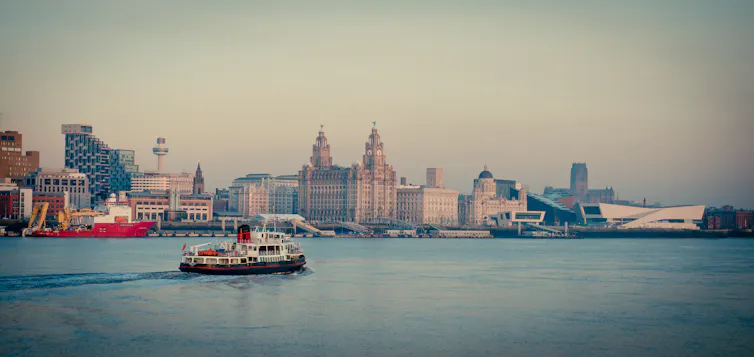
Heavy industry and dense urban populations both contribute to high levels of effluent containing toxic forever chemicals that don’t biodegrade. Shaun Jeffers/Shutterstock
Huge volumes of toxic and cancer-causing forever chemicals are flowing into the River Mersey in north-west England. With a busy, industrialised skyline and both Manchester and Liverpool nearby, it’s the second-most populated river catchment in the UK after the Thames.
None of England’s rivers are in good chemical health. The recent State of Our Rivers 2024 report from The Rivers Trust found that one of the most concerning groups of synthetic chemicals, per- and polyfluorinated substances (PFAS), contaminates almost every river in England.
My team of hydrologists and I found that levels of two cancer-causing PFAS washing off the land and into the Mersey – perfluorooctane sulfonate (PFOS) and perfluorooctanoic acid (PFOA)– are among the highest in the world. Both PFOS and PFOA, now banned in most countries, were used to make many consumer and industrial products including furniture, cookware and fire-fighting foams.
Our study established that around 50% of PFOS, a type of PFAS that’s classed as probably carcinogenic, in the River Mersey was coming from supposedly clean water discharges from 44 different wastewater treatment works. PFAS are found in treated water because they are very difficult to remove using current water treatment technologies. Almost all wastewater treatment work effluents in the UK contain PFAS.
Our research highlights that we don’t really know where the remaining 50% of that PFOS is coming from. Other potential sources include runoff from airports where big amounts of fire-fighting foams are used, agricultural land and landfills. Some PFAS could contaminate groundwater or surface waters used as drinking water.
PFAS chemicals are all around us and impossible to avoid. Found in everything from food packaging to cosmetic products, they are also used to manufacture green energy technologies like electric cars and wind turbines.
Whenever PFAS are used to make these products they end up draining into rivers, so wildlife and humans living in the river basin are exposed to them. We don’t really know the long-term implications of the current exposure levels. But these chemicals will persist. If we keep discharging them into the environment, PFAS exposure levels – and potential risk to humans – can increase through drinking water contamination and accumulation in the food chain.
Pinpointing exactly where, how and when these chemicals enter rivers is not straightforward so scientists and governments don’t really have the regulatory measures and tools to hold polluters to account.
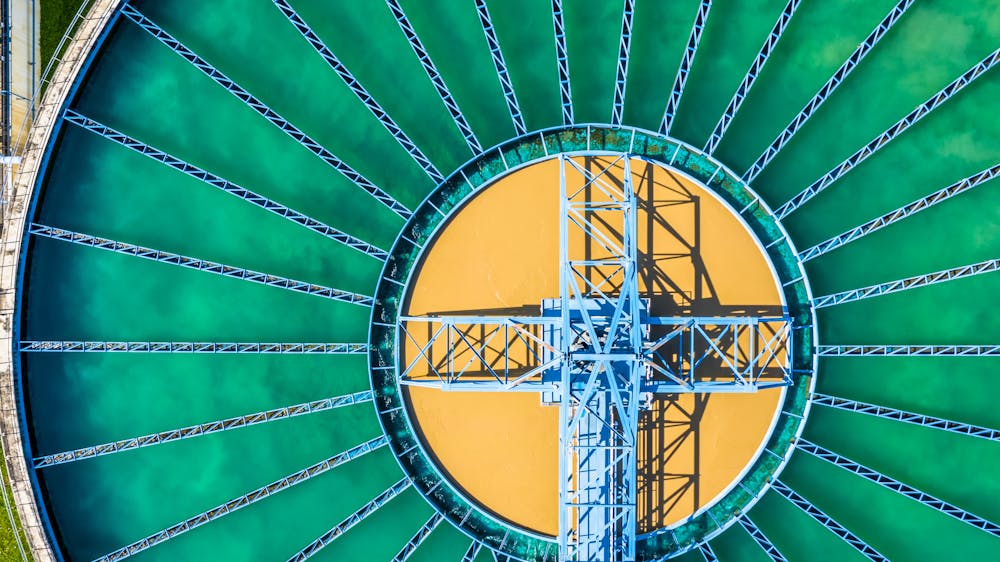
Significant PFAS levels were found in effluent from 44 wastewater treatment plants flowing into the River Mersey. Avigator Fortuner/Shutterstock
Dilute, disperse and detect
Since the 1850s, the Mersey has been a hub of industry, particularly for cotton manufacturing and chemical production. Most cities, including Liverpool and Manchester, have been built close to rivers and seas, partly to dilute pollution and transport it away. Out of sight, out of mind.
Today, enormous volumes of toxic waste are discharged into rivers and seas because dilution reduces chemical concentrations to extremely low or undetectable levels. But undetectable does not mean toxic chemicals are not present.
PFAS are ubiquitous. These forever chemicals have been detected almost everywhere we look, including in Antarctica, in whales and polar bears and in rainwater. Most people on Earth probably have detectable concentrations of PFAS in their blood. An estimated [97% of the US population] have PFAS in their blood, according to one study of 1,682 people.
A state of flux
Governments need to phase out PFAS from society to reduce human exposure and halt their accumulation in the environment and wildlife. The development of safer, healthier, greener alternatives is essential.
Even if the tap gets turned off immediately, the PFAS already in the environment, and in the River Mersey, will persist for thousands of years. To prevent further PFAS entering our rivers, more needs to be known about how they move into and through river systems. As part of our study, we measured this flux.
Instead of measuring a chemical’s concentration, flux is a measure of how much PFAS, for example in kilograms per year, flows off the land and out to sea. By measuring PFAS flux at multiple locations across a river basin like the Mersey, we can distinguish different sources of PFAS to the river, such as runoff from landfills, and establish how much comes from that source.
Governments and environmental regulators need more data like this to develop strategies that will prevent PFAS entering rivers. Our study not only confirmed wastewater treatment works effluents as a source of PFAS to the Mersey, we established exactly how much is coming from that source. This direct accountability is required to effectively target regulations and apply measures that make a difference.
Greater understanding of the flux and movement of PFAS in rivers and seas will help ensure better monitoring and regulation of these toxic forever chemicals – especially in hotspots like the Mersey that should be a top priority for enforcement.
Don’t have time to read about climate change as much as you’d like?
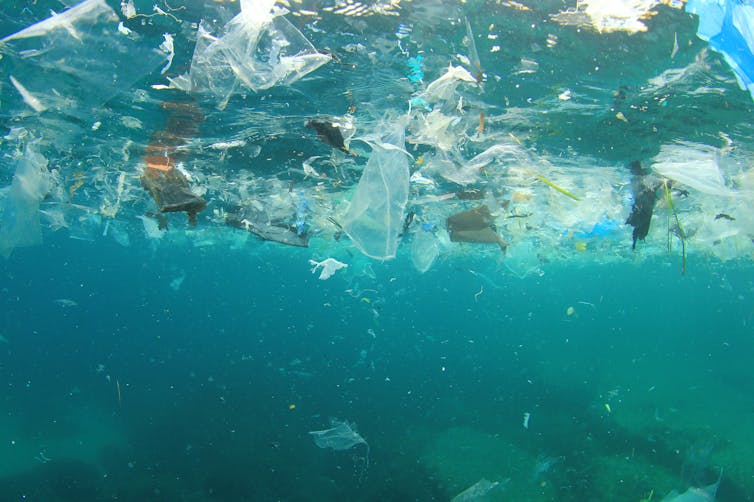
So much ocean plastic originates from sources on land, but once floating in the sea it poses a risk to marine wildlife and habitats. Rich Carey/Shutterstock
Plastic has been found in every single part of the ocean, from the surface to the seafloor and from the tropics to the poles. Land-based sources of plastic account for the majority of this pollution, with plastic bags, bottles, wrappers, food containers and cutlery among the most common items found.
These items are often buoyant and float on the sea surface. As they travel long distances, they get pushed by the wind, waves and currents. This means they have the potential to cause harm far beyond the country from which they originated. For example, land-based plastic waste from Indonesia has been shown to travel over 4,000km to the Seychelles.
As it travels, plastic litter can cause harm to wildlife. Megafauna (large marine animals) can eat or become entangled in it. Consuming plastic litter can block or damage the gastrointestinal tract of animals, causing significant health impacts or death.
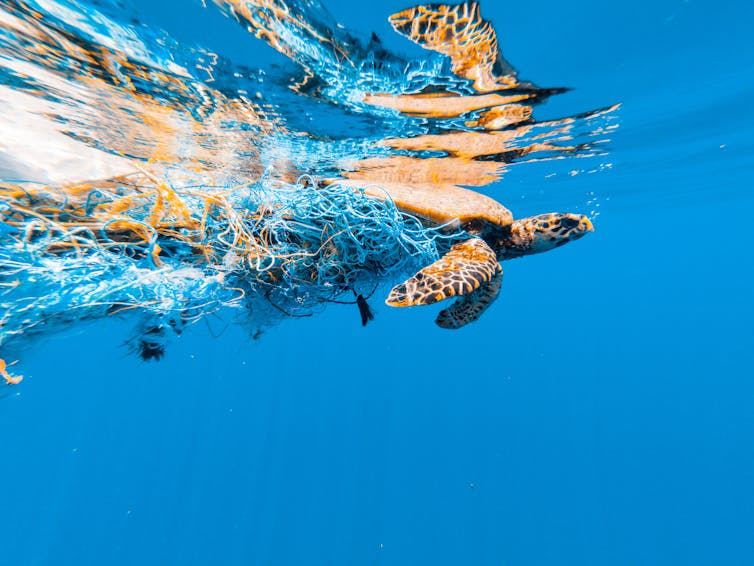
While ghost fishing gear (lost fishing nets that float freely) is the most common entanglement threat to marine megafauna, they can also become entangled in land-sourced plastics such as plastic bags, frisbees, potato nets, elastic bands and other circular plastics. This can cause severe trauma to the animal, and in some cases entanglement causes death.
If plastic is transported towards the shore, it can get caught or lodged in shallow environments where it can entangle or cover plant or animal habitats, causing damage. Plastic entanglement can cause breakage, and if it covers a habitat it will restrict access to food or light.
At Plymouth Marine Laboratory, our team of marine researchers have developed a risk assessment approach to understand where this plastic litter could cause the most harm in the North Atlantic, and which countries that plastic originated from. Our research highlighted five areas of high risk – the US Atlantic, the US Gulf of Mexico, the UK, French Atlantic and Portuguese Azores.
Reducing risk
In our new study, we assessed the risk of land-sourced plastic litter to marine megafauna. That includes seabirds, whales and dolphins, seals and sea lions, manatees and dugongs, sharks and rays, tuna and billfish. We also assessed the risk to shallow water habitats including coral reefs, mangroves, seagrass beds, saltmarsh and kelp seaweed beds.
Using a particle tracking model, we tracked the flow of buoyant plastic litter released from the rivers of 16 countries bordering the North Atlantic between 2000 and 2015 using the most recent data available. Billions of virtual particles were released at the mouths of the rivers each month, with surface currents and wind used to drive their movement. After 15 years of tracking, our model showed us where plastic was likely to accumulate.
We also assessed the vulnerability of each of the megafauna groups and shallow water habitats to this plastic. For marine megafauna, we developed vulnerability scores by quantifying the amount of scientific evidence of ingestion or entanglement in land-sourced plastic. For habitats, we developed vulnerability scores by quantifying the scientific evidence available for this plastic causing harm by entanglement or smothering.
Marine wildlife such as this green sea turtle can become entangled in ghost fishing gear that is left floating in the sea. Mohamed Abdulraheem/Shutterstock
To assess risk, we mapped the vulnerability and distribution of each megafauna group or habitat against the abundance of plastic. Each point within the map was given a risk score from zero to five. The greatest risk occurred in areas where high numbers of vulnerable megafauna or habitats overlapped with high concentrations of plastic.
Managing the plastic problem
We found that much of the modelled plastic litter causing risk in the UK originated from UK rivers. In other high-risk zones such as the Azores and the US Gulf of Mexico, plastic primarily originated from other regions. More than 99% of plastic litter in the Azores was estimated to come from the other countries, mainly Caribbean islands and the US.
The potential of this plastic to travel vast distances across the ocean makes management of this pollutant particularly difficult. More than 90% of plastic waste in the Dominican Republic and Haiti are estimated to be mismanaged. This waste has the potential to cause ecological harm across both sides of the Atlantic.
UN member nations have agreed to forge an international legally binding agreement to tackle plastic pollution, called the Global Plastics Treaty, with negotiations expected to be completed by the end of this year. This study highlights the importance of the treaty in ensuring international cooperation to reduce plastic consumption and waste, including the provision of financial support to help lower-income nations such as the Caribbean islands implement measures. Identification of high-risk zones will also help prioritise areas where interventions and monitoring should be targeted.
Even if all plastic intervention measures are implemented, it is likely that substantial amounts of plastic will still enter our oceans. The production, sale and distribution of many of single-use items are likely to be phased out under the Global Plastics Treaty, as nations move to restrict avoidable plastic products.
While global measures are hugely important in the fight against plastic, the choices of consumers also play a significant role. Reducing, re-using and recycling plastic are powerful ways to cut your plastic footprint. At both ends of the spectrum, the choices made at international and household level can be good news for marine wildlife.
Don’t have time to read about climate change as much as you’d like?