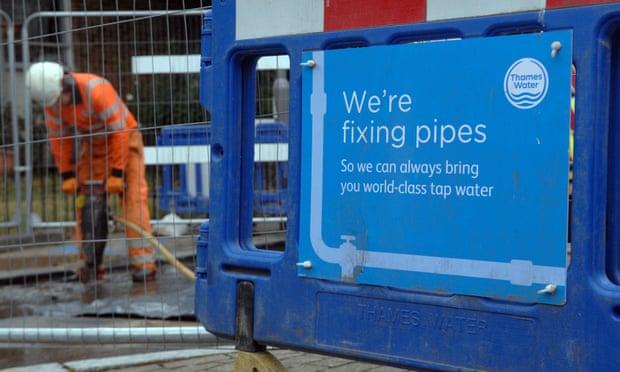
Thames Water, the UK’s largest such firm, is fighting for its survival after years of poor performance, fines and hefty dividend payouts Photograph: Gill Allen/REX/Shutterstock
Guardian Exclusive: UK’s biggest water company assessed risks before cutting back on cost of environmental work, investigation shows
Thames Water intentionally diverted millions of pounds pledged for environmental clean-ups towards other costs including bonuses and dividends, the Guardian can reveal.
The company, which serves more than 16 million customers, cut the funds after senior managers assessed the potential risks of such a move.
Discussions – held in secret – considered the risk of a public and regulatory backlash if it emerged that cash set aside for work such as cutting river pollution had been spent elsewhere.
This could be seen as abreach of the company’s licence commitments and leave it vulnerable to accusations it had broken the law, according to sources and material seen by the Guardian.
Thames Water continued to pay staff bonuses worth hundreds of thousands of pounds, and also paid tens of millions in dividends as recently as March this year, while cutting back on its spending promises. The company did so despite public claims from its leaders that improvements to its environmental performance, including on pollution, were a priority.
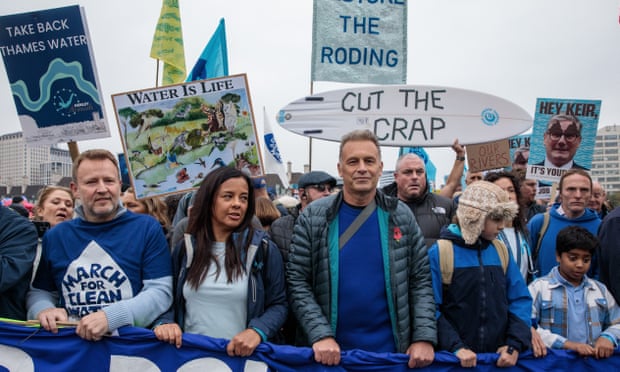
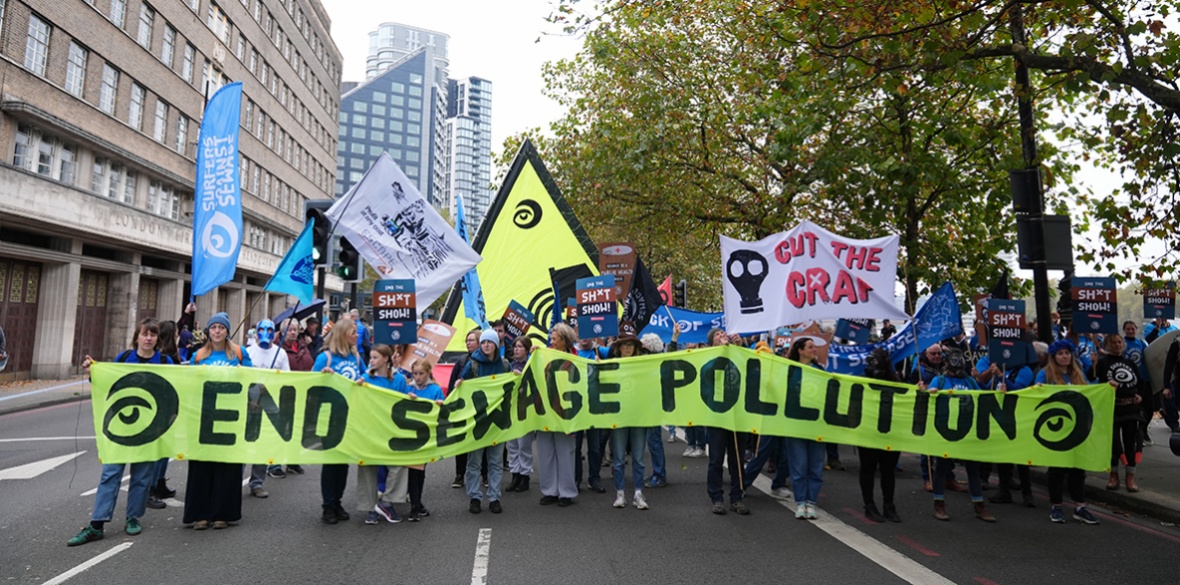
Wildlife presenter Liz Bonnin and naturalist and TV presenter Chris Packham join thousands of environmental campaigners from more than 130 organisations in a March for Clean Water on 3 November 2024 in London. Photograph: Mark Kerrison/In Pictures/Getty Images
On March 2 2022, delegates to the UN environment assembly adopted an ambitious resolution to develop the text of a new treaty by the end of 2024 to end plastic pollution. With 24 days of formal negotiation between almost 200 countries completed, spread over meetings in Peru, France, Kenya and Canada, the fifth and final negotiation meeting is about to take place in Busan, South Korea. This is crunch time. Agreement must be found or the opportunity to take global action to tackle plastic pollution might be lost.
I have studied international action to tackle plastic pollution for the past decade. During this time, I have witnessed remarkable growth in plastic waste – an estimated 400 million tonnes is thrown away every year. Plastic pollution is now ubiquitous.
The issue of plastic pollution has moved up the public and political agenda in a way few could have predicted. Global action has always been the missing piece of the picture, as the plastics economy transcends national boundaries, and actions in one jurisdiction, while locally beneficial, tend not to address global pollution patterns.
To tackle plastic pollution, a shift in the entire plastics economy is needed. This should focus on reuse and refill schemes, which reduce the need for new plastic products and the substitution of plastics with other materials that are less polluting or harmful.
With my team of policy researchers, I have attended the last three plastics treaty negotiation meetings as an observer to gauge progress towards a global treaty. For the most part, progress has been slow, largely because of delaying and blocking tactics by a few countries that depend on fossil fuel industries. Lobbying from the petrochemical industry frustrates progress further. Given the tight timescale to agree the treaty, I worry that no agreement will be reached.
Three priorities
Final negotiations must include three things.
An immediate priority is to agree on the rules governing how decisions are taken in the negotiations between member states, known as the “rules of procedure”. At present, decisions are taken by consensus, meaning all delegations must agree before a decision is reached.
Given the entrenched positions of some countries, consensus-based decision-making is unlikely to yield rapid agreement because the positions of some nations are so far apart. The rules of procedure needs to include a voting mechanism so that when there is decisive agreement between most nations a decisions can be taken and progress can be made, when consensus cannot be reached.
The second critical issue is finance. Plastic pollution is a challenge most acutely faced by low- and middle-income countries. The plastics treaty is only likely to be effective if there’s adequate funding for countries most affected by plastic pollution to take action.
As witnessed in the climate debate, finance is incredibly contentious and raises critical questions. That includes who will pay for the problems plastic pollution has already caused and the new measures to tackle plastic pollution, plus how supporting countries can best provide necessary technology and training.
The role of the private sector is also significant in the plastics economy, and discussions are underway about innovative options for private finance to support treaty implementation. For the treaty to be credible, agreement on the broad terms of a finance mechanism for treaty implementation is essential.
The treaty must also focus on actions most likely to reduce plastic pollution. There is clear evidence that reducing the production of primary plastic polymers reduces plastic pollution most efficiently and effectively.
Plastic is made at such a rate that it is impossible for waste management systems to keep up. So a treaty that focuses on waste management will not reduce plastic pollution significantly enough. Only putting the brake on plastic production will stop the inundation of plastic waste.
There are, of course, many other important elements to agree on during negotiations. Criteria must be set to identify problematic, unnecessary and avoidable plastics that companies should stop making. Problematic plastics have harmful effects on human health or the environment, so any chemicals of concern must be removed from plastic materials and products. Unnecessary plastics are those with a function that is deemed non-essential, while avoidable plastics have an essential function but could be replaced by a non-plastic alternative.
Left activists in the country blame the government’s reluctance to act against big polluters despite its impact on the most of the people who are risking their health to pursue their livelihoods.
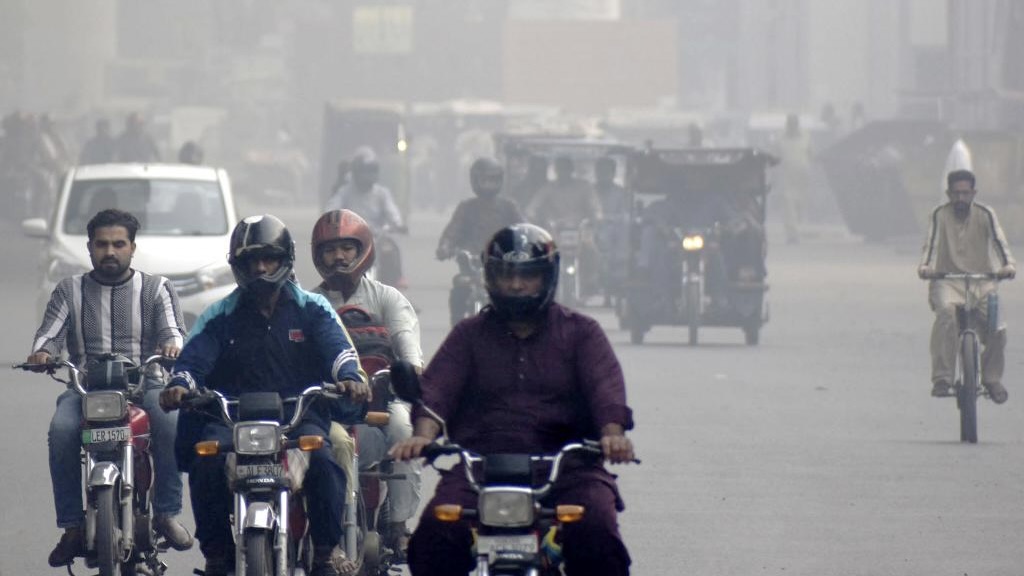
A thick layer of toxic smog has covered the atmosphere of Pakistan’s Punjab province for the last two weeks, making its air hazardous for millions of people in cities such as Lahore and Multan.
Lahore, the capital of Punjab and the second largest city of Pakistan has emerged as the world’s most polluted city with its AQI hitting above 1,000 for several days this week. The AQI on Wednesday was recorded at 815. Other cities in the Punjab province, such as Multan, Bahawalpur and Faisalabad too recorded an average AQI above 400 in the same period.
An AQI above 300 is considered hazardous for human living.
The high level of pollutants (PM 2.5) in the air has forced the Pakistani authorities to shut down schools and colleges until November 17 and public parks until November 18. It has also issued orders to shut the shops and commercial activities early asking citizens to minimize venturing out and to wear masks.
The number of people reporting respiratory issues have reached nearly 70,000 daily in the province according to theAssociated Press.
Prolonged exposure to smog leads to a large number of health problems such as irritation in the eyes, respiratory issues among others. Every year millions of people die due to air pollution.
According to the World Health Organization (WHO) “fine particles matter (PM 2.5) can penetrate [the human body] through the lungs” and blood streams causing major damages to human organs and can cause lung cancer, asthma, stroke and other diseases. Such exposure among children can affect their growth both physically and psychologically and can have lifelong effects.
Smog has become a regular feature in Pakistan’s Punjab province in recent years due to rising pollution caused by the high number of vehicles, increasing urbanization with a high density population, and an increase in polluting industries and agricultural activities.
According to Marriyum Aurangzeb, a senior minister in the Punjab government, Lahore endured 275 days of unhealthy AQI levels over the past one year with average temperature rising by 2.3 degree celsius.
Failure of the state
Punjab is Pakistan’s largest province with over 117 million people. The government led by Mariyum Nawaz of Pakistan Muslim League (PML) has been accused of taking inadequate measures to control the situation. In the name of fighting against polluters it has only targeted farmers and brick kilns and has been reluctant to hold larger and more powerful polluters such as big industries and the transport sector, Dawn reported.
According to the Punjab government’s own study, unfit vehicles apparently are the primary polluters (around 43%) in the province but the government has failed to curb their movement.
Ammar Ali Jan, head of the Haqooq-e-Khalq Party (HKP) has been consistently raising the issue of smog which makes the atmosphere “unfit for human survival.” Noting that in this inhuman condition only the rich who can afford to buy air purifiers can survive terming the government’s inactivity to provide relief to the people as a “criminal and insane” policy of “privatization of clean air.”
High pollution disrupts normal life for all sections of the population. However, it disproportionately affects the working class population as they are unable to follow the protection measures such as staying at home and wearing masks given the nature of their livelihoods.
In a recent tweet he also said that “climate catastrophe in Punjab is a result of a development model that turned our cities into concrete jungles.” He accused the Maryum Nawaz government for remaining “hopelessly non serious about confronting the challenge” and instead favoring big polluters such as “land mafia,” and “car/oil companies” in the state.
In light of the government’s lack of response, various left and progressive student organizations in the country called for a protest in front of the Punjab provincial assembly on Thursday, November 14. They demanded urgent action to fight climate change and the smog problem in the country.
People take part in the Clean Water march in central London, to demand tougher action on keeping the UK’s rivers and seas clean, November 3, 2024
THE River Action campaign has hired a top litigator as it intensifies efforts to hold polluters account and restore Britain’s waterways.
Emma Dearnaley, previously legal director at the Good Law Project, will join the group as its new head of legal in January.
She fought several cases in her former job, including a successful challenge against the Department for Environment Food and Rural Affairs that led to the government expanding the scope of its Storm Overflows Discharge Reduction Plan to include coastal waters.
River Action chief executive James Wallace said: “This is a shot across the bow for polluters and the government alike.
“The law is one of our strongest tools, not only to compel polluters to repair and update their infrastructure but also to compel the government to adequately fund environmental regulators.
“After 14 years of budget cuts, it’s time for the Environment Agency to have the resources to enforce the law against agricultural, sewage and chemical polluters and for Ofwat to stop water companies polluting for profit.”
New research from the Badvertising campaign highlights an alarming trend.
As an insurgent sport among the sweat and strain of more traditional exertions, esports — short for electronic sports and synonymous with gaming — had a chance to chart a new course. Free from the sponsorship links with polluting industries that tarnish many established sports, and with an overwhelmingly young and growing player and fanbase, esports could have created a blueprint for sport in the 21st century and the critical climate issues it faces.
Unfortunately, esports have fallen into the same trap as football, cricket, and many other popular but easily exploited sports: It has become a playground for some of the world’s biggest polluters to promote themselves and mislead fans. Competitive gaming has made the leap from dimly lit bedrooms to the world stage, but, in the process, has slipped on an oil slick.
New research from the Badvertising campaign highlights the alarming trend of esportswashing. Taking a cue from the old tobacco industry playbook, major polluters are trying to co-opt a new generation and normalise climate polluting products and lifestyles. Since just 2017, at least 33 polluting sponsorship deals have been struck between the global esports industry and high-carbon polluters. Of these, 27 have been deals with car manufacturers, five with major fossil fuel companies, and two with the armed forces of the United States — the planet’s thirstiest consumer of oil.
Petrostates too, such as Saudi Arabia and Qatar, have sensed the opportunity and spent hugely into the esports sector, sponsoring teams of young gamers and even hosting tournaments in energy-hungry, air-conditioned arenas. In fact, the inaugural Esports World Cup is culminating in Riyadh, Saudi Arabia, where over 1,500 professional gamers have competed across 21 games, with over a million fans following online.
Despite its relative novelty, esports presents a huge opportunity for polluting companies feeling the heat on climate. It is a booming industry. There are already an estimated 500 million esports fans around the world. While this is just a fraction of the three billion active gamers, there is serious room for expansion — and polluters can see the opportunity to groom the next generation.
Shrewd Move
Alongside the massive growth of the industry is the esports loyal fanbase. It’s international, overwhelmingly young, and male. In the UK, over 50 percent of esports fans are aged between 18 and 34, and overwhelmingly male. Globally, in 2021, more than six in every 10 internet users watching esports were aged between 16 and 35 years old. To put this youthfulness in perspective, only one-in-four ‘die hard’ football fans globally are between 25 and 34 years old.
Built around this fanbase is a vibrant digital culture and community, buoyed by the proliferation of streaming platforms and threaded together through memes which are indecipherable to outsiders. Like with all great sports, it is the community that brings esports to life and makes it such a spectacle. Tapping into this community, and leveraging its global digital networks, is a shrewd move for companies clinging to a dwindling social license of public acceptance.
High-carbon industries targeting younger audiences is not new and comes in many forms, but esports presents an opportunity to communicate with hundreds of millions of young and loyal fans. It is an added irony that these young audiences will be the worst hit by climate breakdown — a crisis that the latest sponsor of their beloved esports is disproportionately responsible for.
Once again, regulators are asleep at the controls. The rise of esportswashing and its potential impact on younger minds requires bolder and better advertising regulation and coordination with the game franchises. But action to date has been limited.
The immersive nature of esports presents an added challenge for regulators and the limited scope they currently exercise to protect young people from exploitative influences. In-game advertising blurs the divide between what is advertising and what is the game. Take Shell’s foray into Fortnite in 2023, where players were encouraged to fill up their digital cars at a digital petrol station to promote its V-Power Nitro+ fuel. Here, the advertisement was part of the game. It is only a matter of time before other polluting companies take Shell’s lead.
With esports fans and athletes facing a precarious future in a warmer world, those responsible for this burgeoning sport and the community built around it must take the threat posed by polluting sponsorship seriously. To protect athletes, gamers and fans around the world, esports teams and governing bodies need to align their commercial partnerships with their values, duty of care to players and audiences, and policies for a liveable future and thriving environment. And when top gamers and streamers speak out about their fears of climate breakdown, they should be supported and nurtured.
Esports are on the cusp of repeating the mistake of other traditional sports in letting themselves be used as a billboard to promote polluters, but it is not too late to clean up. Those polluters that are gaming the climate should not be given free reign to game young minds too; or it could soon be game over for everyone.