COP29 puts world on course for more extreme weather – and more deaths

Spread the love

Original article by Paul Rogers republished from Open Democracy under a Creative Commons Attribution-NonCommercial 4.0 International licence.

After a disappointing COP29, we should prepare for more extreme weather events like the floods that hit Valencia last month
 | David Ramos/Getty Images

Summit proves change won’t come until floods and wildfires are killing tens of thousands in rich Global North cities

While COP29 in Baku narrowly avoided collapsing, its results were bitterly disappointing for delegations from across the Global South, who ended up with barely a quarter of the annual $1.3trn of support they were seeking by 2035 to respond to climate breakdown.

Quite apart from other factors, more than 1,500 pro-carbon lobbyists worked hard to limit progress and ensure that burning oil, gas and coal at profit continues for as long as possible whatever the global consequences. After all, the world’s fossil fuel industries rake in around a trillion dollars in profits a year.

Meanwhile, more and more examples are emerging of accelerating climate breakdown. The flooding in Valencia is just one, but scarcely noticed in Europe is the thoroughly weird weather being experienced in the eastern United States.

This autumn there have been over five hundred wildfires in New Jersey alone, a 5,000-acre fire has been burning for a week on the New York-New Jersey border prompting a voluntary evacuation, and New York City’s Fire Department was called out to deal with 271 brush fires in the first two weeks of November alone.

As if timed for that and certainly released with COP29 in mind, Carbon Brief, a website covering the latest developments in climate science, climate policy and energy policy, has mapped every published study on ‘impossible’ weather events – record heatwaves or storms that would not have happened without the overall global climate changes.

The first such study came in 2004, the year after weeks of extreme heat hit Europe and killed 70,000 people across the continent over several months. That early example of an ‘impossible’ weather event kick-started a new field of research known as ‘extreme event attribution’, which looks at how climate change has influenced extreme weather.

There are now 600 studies of 750 such extreme events spanning the past 20 years – a tiny fraction of the total number of these kinds of events. Of these 750, Carbon Brief found that scientists and researchers had concluded that 74% were made more likely or more severe because of climate change.

This has added to the growing sense of urgency right across the climate science community coupled with a highly critical view of the whole COP process. Even before the dismaying summit in the Azerbaijani capital, both last year’s COP in Abu Dhabi and the year before in Egypt were notable for their lack of progress even as the urgency of preventing climate breakdown was becoming more and more obvious.

There are other risks to global security including nuclear weapons, pandemics, cyber warfare, AI misuse and the progressive destruction of biodiversity, but climate breakdown is different from all of these. It is not a future risk, it is a current happening, it is accelerating, and we now have very few years left to get on top of it. If we don’t then a worldwide catastrophe with many hundreds of millions dying and societal collapse will become increasingly likely.

Does it have to be like that?

As things stand, in terms of changing attitudes, developments in renewables, resistance of the fossil carbon industries and, of course, Donald Trump’s looming presidency in the US, a reasonable prognosis for the next decade has three elements.

First, the use of renewable energy resources does continue to increase but not at anything like the rate required, so net carbon emissions will continue to rise, not fall, for most of the next ten years. Second, resistance to decarbonisation will continue from many quarters, no doubt now including the White House. Finally, severe weather events will become both more common and more destructive.

Eventually, and it might take more than a decade, the disasters will be so great, including sudden weather events in rich cities in the Global North killing many tens of thousands of people, that public pressure across the world will force governments to respond. There will be no alternative to engage in truly transformative change.

But what that means is that the task ahead by then will be hugely greater than if the transformation starts much sooner, so timescales become crucial, especially what can speed up the process.

There is, though, one thing to remember at a time of widespread pessimism. If nations had got their act together 25 years ago after the Kyoto Protocols, were signed we would be in a far more favourable position worldwide than we are now. We are acting more than two decades late.

But climate breakdown is not happening as a slow, steady process of change, creeping up almost unawares. If that had been the case then with all the reasons not to act, especially the global fossil carbon lobby, we would have been in an even worse position now. Instead, it is happening at variable rates in two respects, some parts of the world – such as the polar regions – are warming up much faster than others and extreme weather events are happening much more often.

We are therefore getting a foretaste of what will affect everyone a few years before it does, and this gives us just a little more time to act. It means that the next ten years, and perhaps even the five years to 2030, will be the key time for us to come to terms with the transformation in society that is essential for global well-being. That is possible, just.

Original article by Paul Rogers republished from Open Democracy under a Creative Commons Attribution-NonCommercial 4.0 International licence.

Continue ReadingCOP29 puts world on course for more extreme weather – and more deaths

Children in care ‘feeling unsafe and uncared for’

Spread the love

https://morningstaronline.co.uk/article/children-in-care-feeling-unsafe-and-uncared-for

Vulnerable kids are being placed in caravans and AirBnBs by a social care system that puts ‘profit above protection,’ Children’s Commissioner warns

Vulnerable kids are being placed in caravans and AirBnBs by a social care system that puts ‘profit above protection,’ Children’s Commissioner warns

BRITAIN’S most vulnerable children are being placed in caravans and Airbnbs by a social care system that puts “profit-making above protection.”

In a heartbreaking report, the Children’s Commissioner for England Dame Rachel de Souza slammed the “stark failure of the children’s social care system” as she told of an autistic teenager left in an Airbnb for nine months.

The girl was put there under supervision by her council following pressure to discharge her from hospital having not met the criteria to be held under the Mental Health Act.

Dame Rachel also described how a teenage girl who suffered parental domestic violence and neglect being given a supervised crisis placement in a caravan, before being housed in a children’s home 120 miles from her grandparents.

The commissioner called for “radical investment in creating new and safe places for children to live” and an end to “profiteering in children’s social care.”

https://morningstaronline.co.uk/article/children-in-care-feeling-unsafe-and-uncared-for

Continue ReadingChildren in care ‘feeling unsafe and uncared for’

Taxing Big Oil would grow UN climate loss & damage fund twentyfold, analysis finds

Spread the love

A small tax on just seven of the world’s biggest oil and gas companies could grow the UN Fund for Responding to Loss and Damage by more than 2000% and help address the costs of extreme weather events, according to new analysis published today by Greenpeace International and Stamp Out Poverty. The organisations are calling for a long term global tax on fossil fuel extraction, with year-on-year increases, combined with taxes on excess profits and other levies.

A ‘Climate Damages Tax’ would put a cost on every tonne of carbon emitted by the coal, oil and gas extracted – starting at $5 per tonne and rising each year thereafter. If it was imposed on ExxonMobil, Shell, Chevron, TotalEnergies, BP, Equinor and ENI it could raise $15 billion in the first year alone to help the world’s most climate-vulnerable countries pay for the escalating cost of damage caused by climate change. Currently, just $702 million has been pledged to the loss and damage fund, while the combined profits of those fossil fuel companies exceeds $148 billion.

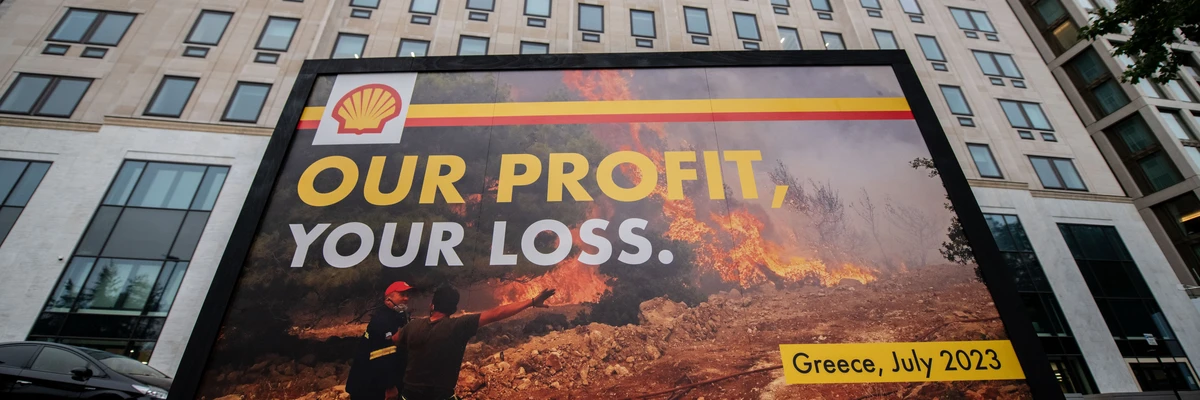
Greenpeace activists display a billboard during a protest outside Shell headquarters on July 27, 2023 in London.
Greenpeace activists display a billboard during a protest outside Shell headquarters on July 27, 2023 in London. (Photo: Handout/Chris J. Ratcliffe for Greenpeace via Getty Images)

Earlier this month, Barbados Prime Minister Mia Mottley, French President Emmanuel Macron and Kenyan President William Ruto stated their support for a Climate Damages Tax.

The briefing also highlights the financial costs of some of this year’s worst weather events that have been attributed to climate change, totalling over $64bn. These include Hurricane Beryl, Hurricane Helene, the heatwave in India in May, Typhoon Carina/Gaemi, the floods in Brazil in May, and the floods in Kenya and Tanzania in April. The costs of damage from the disasters surveyed range from US$2.9bn (Typhoon Carina) to US$ 25bn (heatwaves in India), and present just a fraction of the total cost of loss and damage globally over the last year. 

A Climate Damages Tax imposed only on wealthy OECD countries could play an essential role in helping the poorest and most vulnerable to rebuild after climate-related disasters. Increasing annually by US$5 per tonne of CO2-equivalent based on the volumes of oil and gas extracted, the tax could raise an estimated US$900 billion by 2030 to support governments and communities around the world as they face growing climate impacts.

“While oil and gas giants keep raking in grotesque levels of profit from exploiting resources, the damages resulting from the industry’s operations are disproportionately borne by people who did not cause the crisis,” said David Hillman, Director of Stamp Out Poverty. “A climate damages tax – along with other levies on fossil fuels and high-emitting sectors – will make polluters pay for the cost of climate impacts, as well as supporting workers and affected communities in the transition to clean energy, jobs, and transport.”

“Who should pay? This is fundamentally an issue of climate justice and it is time to shift the financial burden for the climate crisis from its victims to the polluters behind it,” said Abdoulaye Diallo, Co-Head of Greenpeace International’s Stop Drilling Start Paying campaign. “Our analysis lays bare the scale of the challenge posed by climate loss and damage and the urgent need for innovative solutions to raise the funds to meet it. We reject Big Oil’s assault on people and democracy and call on governments worldwide to adopt the Climate Damages Tax and other mechanisms to extract revenue from the oil and gas industry.” 

The Loss and Damage Fund was announced at COP27 in Egypt to help developing countries pay for impacts of natural disasters caused by climate change. Recently renamed the Fund for Responding to Loss and Damage (FRLD), it currently has US$702 million in pledged funds. According to Greenpeace International and Stamp Out Poverty’s calculations, a Climate Damages Tax levied on seven major international oil and gas companies would add in the first year alone US$15.02 billion, corresponding to over 21 times what is currently pledged to the fund. 

Paying the price: The economic impacts of seven extreme weather events in 2024 make the case for why climate polluters should pay”.

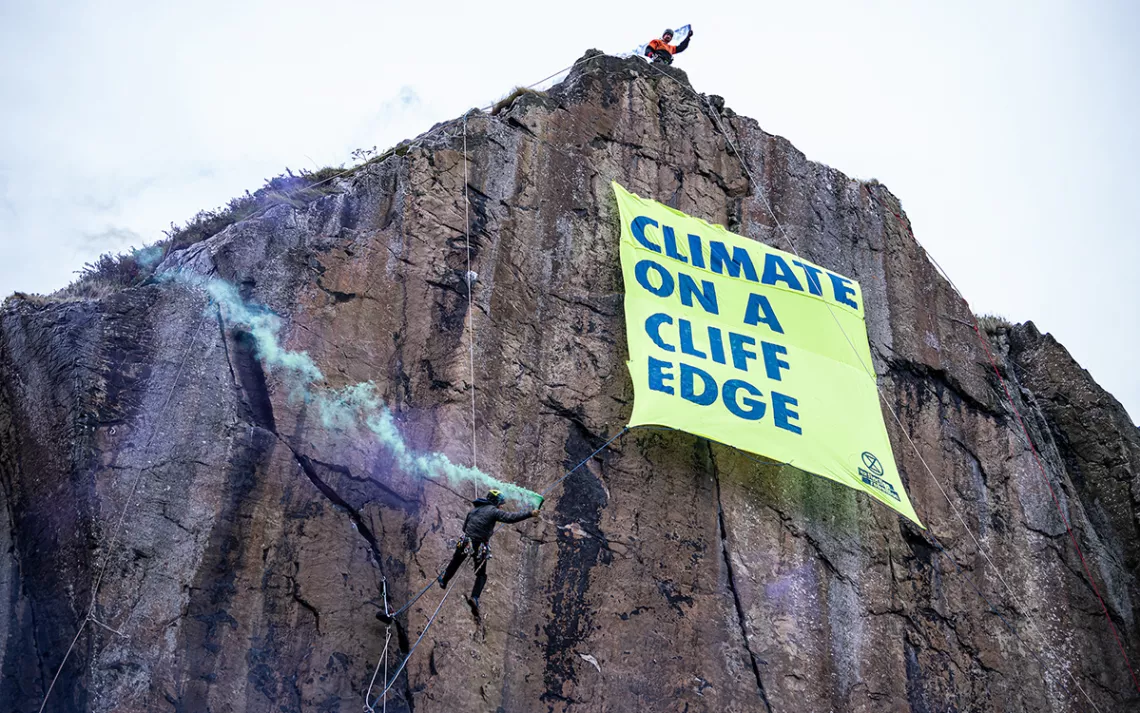
Experienced climbers scale a rock face near the historic Dumbarton castle in Glasgow, releasing a banner that reads “Climate on a Cliff Edge.” One activist, dressed as a globe, symbolically looms near the edge, while another plays the bagpipes on the shores below. | Photo courtesy of Extinction Rebellion and Mark Richards

Continue ReadingTaxing Big Oil would grow UN climate loss & damage fund twentyfold, analysis finds

BP Scraps Target of Reducing Oil Production by 2030

Spread the love

https://www.ecowatch.com/bp-abandons-oil-reduction-target-2030.html

Climate activists protested against BP at the energy giant’s annual general meeting in Aberdeen, Scotland on May 21, 2019. Karen Murray / Friends of the Earth Scotland.

Oil major BP has scrapped its goal of reducing oil and gas production by the end of the decade, angering environmental groups who say the company is prioritizing profits over the planet.

According to three sources who have knowledge on the matter, BP CEO Murray Auchincloss scaled back the company’s energy transition plans in order to regain investor confidence, reported Reuters.

“As Murray said at the start of the year in our fourth-quarter results, the direction is the same but we are going to deliver as a simpler, more focused and higher-value company,” a spokesperson for BP said, as The Times reported.

In 2020, BP unveiled an ambitious strategy to reduce its production by 40 percent, while quickly ramping up renewables by 2030, reported Reuters. In February of 2023, the London-based company pared back the reduction goal to 25 percent, as investors concentrated on near-term profits instead of the energy transition.

In 2022, the oil giant recorded record profits of $28 billion, The Guardian reported.

“It’s clear that Auchincloss is hell-bent on prioritising company profits and shareholder wealth above all else as extreme floods and wildfires rack up billions of dollars in damages, destroying homes and lives all over the world,” said Philip Evans, senior climate campaigner of Greenpeace UK, as reported by The Guardian.

https://www.ecowatch.com/bp-abandons-oil-reduction-target-2030.html

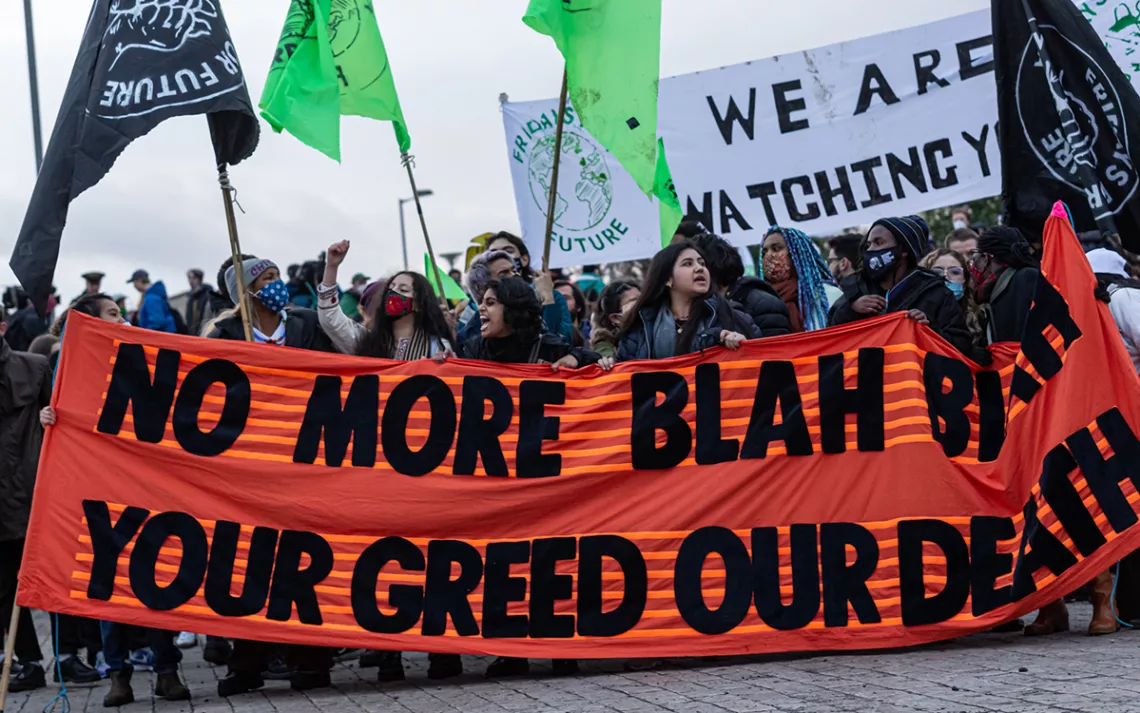
People march through Glasgow, a demonstration led by Fridays for Future. | Photo courtesy of Extinction Rebellion Scotland and Simone Rudolphi

Continue ReadingBP Scraps Target of Reducing Oil Production by 2030

Tory ministers accused of ‘rigging the rules’ to help rail firm bosses get bonuses 

Spread the love

https://leftfootforward.org/2024/04/tory-ministers-accused-of-rigging-the-rules-to-help-rail-firm-bosses-get-bonuses/ Many articles from LeftFootForward today.

‘They are desperate to help their chums, the privateers, keep their private snouts in the public trough’

The Shadow Transport Secretary has accused the Tories of a “scandalous misuse of taxpayers’ money” after it was revealed that more rail operators have had their performance targets lowered, helping company bosses get bonuses. 

At least eight rail firms have had their performance targets lowered by the Government as Labour accused ministers of “rigging the rules” to reward “abject failure”.

In February it was reported that Tory ministers cut the standards for train cleanliness, ticketing, staffing and customer services at Govia Thameslink Railway, after the company had failed to reach service quality standards on most measures. 

Now the Mirror has revealed that a further seven other operators have had service standards on key measures lowered, after failures to meet targets. Government rule changes in 2020 mean that companies are now paid an annual fee for operating lines and have the chance to earn bonuses for performance on top. 

Rail bosses have raked in billions in bonus payments from the Government, with the two Chief Executive of First Group, which owns major stakes in South Western Railway, sharing a £1.3m bonus.

https://leftfootforward.org/2024/04/tory-ministers-accused-of-rigging-the-rules-to-help-rail-firm-bosses-get-bonuses/ Many articles from LeftFootForward today.

Continue ReadingTory ministers accused of ‘rigging the rules’ to help rail firm bosses get bonuses