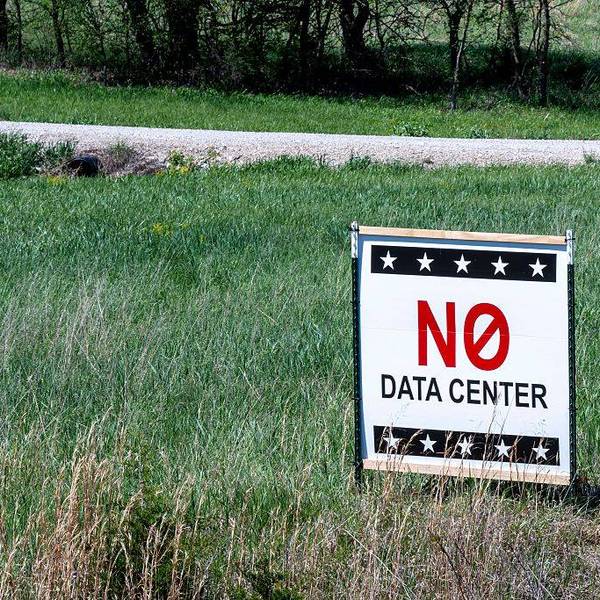
Voters in California City Become First in US to Approve Permanent Ban on Data Centers

Spread the love

Article by Brad Reed republished from Common Dreams under Creative Commons (CC BY-NC-ND 3.0).

Anti-data center protest signs pepper front yards in a nearby residential neighborhood in Monterey Park, California on Wednesday, April 1, 2026.  (Robert Gauthier/Los Angeles Times via Getty Images)

“We hope that other communities will use the model set by residents here… as inspiration to stop data centers from encroaching in their backyard,” said a Monterey Park city councilmember.

Voters in Monterey Park, California on Tuesday overwhelmingly approved a permanent ban on data centers within city limits, becoming the first city in the US to prohibit the power-hungry facilities via a ballot initiative.

In total, the anti-data center resolution passed with 86% voter support, with only 14% of voters opposed. The resolution’s text said that a ban was necessary to “protect air quality, drinking water resources, and public health” and “prevent impacts to electricity and water rates.”

RECOMMENDED…
Rural New Jersey Town Moves to Ban All Data Centers After Community Revolts

Rural New Jersey Town Moves to Ban All Data Centers After Community Revolts

Ocasio-Cortez Corners EPA Administrator on Water Quality Near Data Centers

Ocasio-Cortez Corners EPA Administrator on Water Quality Near Data Centers

Steven Kung, a leader of the local initiative, told ABC 7 Eyewitness News that the result was “a landslide victory.”

Kung listed multiple reasons why residents in the city resoundingly rejected building data centers in their community.

“The noise pollution, the air pollution, the rise in the electricity rates,” he said, “the deal just didn’t make sense and it doesn’t make sense for most, if not all, cities data centers go to.”

In an interview with Politico, Monterey Park Mayor Elizabeth Yang predicted that her city would be far from the last to pass data center bans, noting data center projects have spurred protests across the country.

“A lot of the other cities that are facing data center proposals are going to follow suit,” said Yang. “There’s [a] bad reputation across the board, across the country, from other data centers that have been built in neighborhoods.”

Monterey Park city councilmember Jose Sanchez expressed a similar sentiment, telling The Guardian that he hoped his city would become a inspiration to others.

“We hope that other communities will use the model set by residents here in Monterey Park,” said Sanchez, “as inspiration to stop data centers from encroaching in their backyard.”

Data centers have become political lightning rods in recent months, as residents across the country object to their massive resource consumption, which is leading to a major spike in utility bills, as well as the noise pollution they generate.

Sen. Bernie Sanders (I-Vt.) and Rep. Alexandria Ocasio-Cortez (D-NY) earlier this year introduced a bill that would impose a nationwide moratorium on AI data center construction “until strong national safeguards are in place to protect workers, consumers, and communities, defend privacy and civil rights, and ensure these technologies do not harm our environment.”

poll released on Wednesday by Public First showed US residents more opposed to data center construction than any nation in the world, with just 26% of Americans registering support for building more data centers.

This opposition isn’t merely abstract, as it has caused major headaches for Big Tech firms that have been scrambling to increase their AI models’ compute power.

As The Financial Times reported on Thursday, “dozens of projects collectively worth at least $156 billion have been blocked or stalled since 2025” thanks to local opposition to their development.

Article by Brad Reed republished from Common Dreams under Creative Commons (CC BY-NC-ND 3.0).

Continue ReadingVoters in California City Become First in US to Approve Permanent Ban on Data Centers

The US Environmental Protection Agency’s retreat from science endangers the health of people and the planet

Spread the love
Andromeda stock/Shutterstock

Scott Glaberman, University of Birmingham; H. Christopher Frey, North Carolina State University, and Tamara Tal, Helmholtz Centre for Environmental Research-UFZ

Pollution causes more illness and early death than any other environmental threat, accounting for one in six deaths worldwide. For decades, the US Environmental Protection Agency’s (EPA) Office of Research and Development (ORD) has driven many of the biggest advances for safeguarding human health and ecosystems from chemicals. Now, this scientific research office is being closed down by the US government

Earlier this year, the Trump administration began dismantling the office by terminating programmes, cutting staff, closing laboratories and moving remaining scientists into regulatory offices. Legal challenges temporarily blocked mass government layoffs.

But that changed when a recent Supreme Court ruling gave the Trump administration the green light to proceed with widespread redundancies and the total elimination of ORD.


Get your news from actual experts, straight to your inbox. Sign up to our daily newsletter to receive all The Conversation UK’s latest coverage of news and research, from politics and business to the arts and sciences.


Now, in so doing, the US is not just gutting its own scientific foundation. It’s also putting decades of global progress in chemical safety, pollution control and public health at risk.

ORD is the EPA’s independent science arm, conducting research that supports clean air, water and land. From detecting pollutants and assessing health risks to guiding environmental cleanup, it ensures EPA decisions are grounded in credible, evidence-based research. ORD develops this science under intense scientific, policy, political and legal scrutiny, which means it produces the best available science that is credible and robust.

ORD doesn’t just study pollution, it uncovers threats before they become crises. Take North Carolina’s Cape Fear River, which supplies drinking water to an estimated 2 million people.

While most scientists focused on known pollutants, ORD used advanced screening tools to detect GenX, a little-known synthetic “forever chemical”. Despite evidence that GenX was contaminating the river basin since the 1980s, not much was known about its potential to harm living systems.

waterfront by cape fear river, sunny blue skies
Forever chemicals were found to be polluting North Carolina’s Cape Fear River in the US. Kosoff/Shutterstock, CC BY-NC-ND

ORD rapidly filled this void, linking GenX to decreased birth weight and increased mortality in newborn rats, prompting swift regulatory action against the manufacturer to ensure cleaner, safer water for local communities. No other government agency in the world delivers this kind of rapid, science-led response.

It’s not just the strength of ORD’s science that sets it apart, but also its visionary thinking. Among ORD’s most influential ideas is a model that maps out how a chemical is causing harm.

This works like a chain of building blocks, linking tiny effects (like a chemical disrupting a hormone) to much bigger problems, such as cancer or even extinction. Each step shows how one change leads to another until it reaches something we truly care about. This approach helps scientists detect danger early, before it leads to irreversible damage.

Then there’s the EPA’s groundbreaking work in computational toxicology. Nearly two decades ago, leading scientists warned that chemical safety testing relied too heavily on outdated methods and animal experiments.

In response, ORD built ToxCast, a system that uses tiny cells and computer models to screen thousands of chemicals for effects like endocrine disruption or cell damage. It’s faster, cheaper and more humane, and helps scientists predict which substances may pose serious risks.

These scientific breakthroughs don’t come from policy offices. They require researchers with the independence to explore and innovate.

Beyond the US

Europe has bold goals to phase out animal testing. Much of the science driving this shift comes from ORD.

Tools like Ecotox (the world’s largest chemical toxicity database) and the CompTox dashboard (a platform that links predictive models and non-animal test data for over a million substances) are widely used across the EU and UK. Without ORD, these vital resources, hosted by EPA, could disappear, stalling global progress toward safer, more ethical chemical testing.

EPA also collaborates closely with European partners. It maintains formal agreements and joint programmes with the European Chemicals Agency and the UK’s Department for Environment, Food and Rural Affairs. Areas of focus include air quality, computational toxicology and chemical risk assessment.

ORD has been a leading scientific institution with global reach. Its tools and ideas have shaped how governments detect hazardous chemicals, understand their effects, and protect people and the planet. From toxicity databases to modern, non-animal testing methods, ORD has underpinned how we respond to pollution. Eliminating it could create a dangerous void, just as chemical and climate threats are accelerating.

Don’t have time to read about climate change as much as you’d like?
Get a weekly roundup in your inbox instead. Every Wednesday, The Conversation’s environment editor writes Imagine, a short email that goes a little deeper into just one climate issue. Join the 45,000+ readers who’ve subscribed so far.


Scott Glaberman, Associate Professor of Comparative Toxicology, University of Birmingham; H. Christopher Frey, Glenn E. Futrell Distinguished University Professor of Environmental Engineering, North Carolina State University, and Tamara Tal, Mechanistic Toxicology Group Leader, Helmholtz Centre for Environmental Research UFZ and Professor of Integrated Systems Toxicology, Helmholtz Centre for Environmental Research-UFZ

This article is republished from The Conversation under a Creative Commons license. Read the original article.

Donald Trump urges you to be a Climate Science denier like him. He says that he makes millions and millions for destroying the planet, Burn, Baby, Burn and Flood, Baby, Flood.
Nigel Farage urges you to ignore facts and reality and be a climate science denier like him. He says that Reform UK has received millions and millions from the fossil fuel industry to promote climate denial and destroy the planet.
Neo-Fascist Climate Science Denier Donald Trump says Burn, Baby, Burn.
Continue ReadingThe US Environmental Protection Agency’s retreat from science endangers the health of people and the planet

Doctors protest medical regulator’s inaction on climate

Spread the love

https://morningstaronline.co.uk/article/doctors-protest-medical-regulators-inaction-climate Many articles from Morning Star featured today.

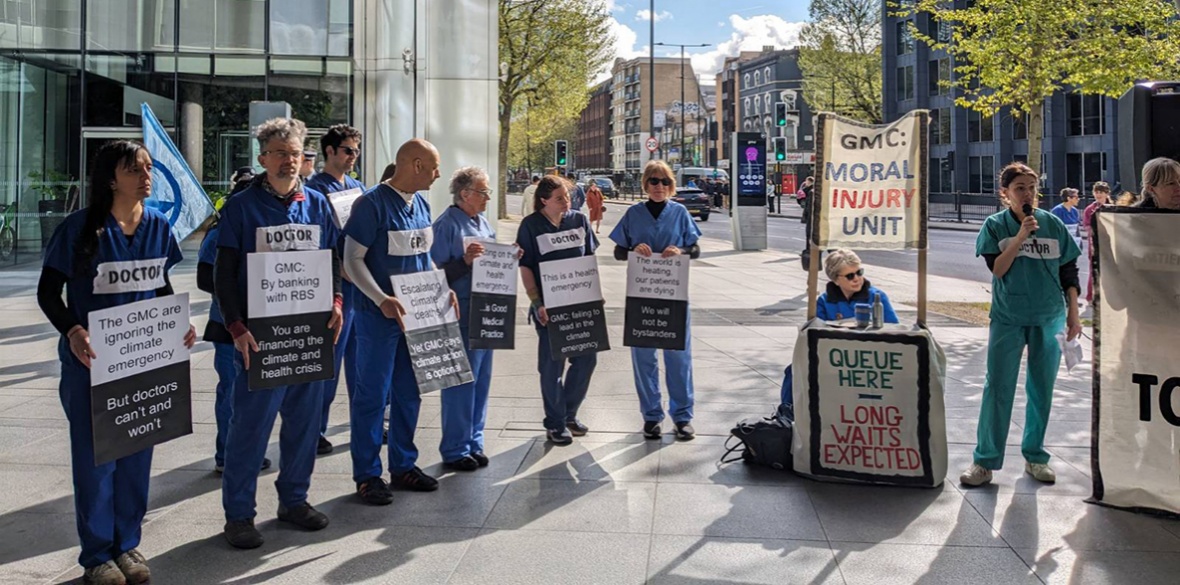
Doctors and patients protest against the medical regulator’s inaction on climate outside the General Medical Council, London, April 18, 2024

DOCTORS linked to the Planetary Health Coalition demonstrated outside the General Medical Council (GMC) today against its failure to address the devastating impact that climate change has on public health.

In a theatrical protest, health workers queued at a “moral injury unit” to present complaints about their difficulties witnessing the effects of the climate emergency.

Protesters placed a giant red whistle outside the regulatory bodies’ offices, urging the organisation to sound the alarm on the impact of environmental destruction, and to integrate these concerns into its ethical standards.

https://morningstaronline.co.uk/article/doctors-protest-medical-regulators-inaction-climate Many articles from Morning Star featured today.

Continue ReadingDoctors protest medical regulator’s inaction on climate

Supreme Court Hears Koch-Backed Cases Designed to Unleash Deregulatory Bonanza

Spread the love

Original article by JAKE JOHNSON republished from Common Dreams under Creative Commons (CC BY-NC-ND 3.0). 

Supreme Court Justice Neil Gorsuch attends an event in Hagerstown, Maryland on March 11, 2022.  (Photo: Andrew Lichtenstein/Corbis via Getty Images)

The conservative-dominated U.S. Supreme Court on Wednesday heard oral arguments in a pair of cases taking direct aim at a critical precedent that, if overturned, would gut federal agencies’ ability to set and enforce regulations—a potentially massive blow to the climate, civil rights, public health, and more.

Central to Loper Bright Enterprises v. Raimondo and Relentless, Inc. v. Department of Commerce is the so-called Chevron doctrine, which stems from a 1984 Supreme Court opinion that said judges should defer to federal agencies’ reasonable interpretation of a law if Congress has not specifically addressed the issue.

The precedent has long been a target of the fossil fuel industry and right-wing groups that are backing the plaintiffs in Loper and Relentless, both of which involve herring fishermen who challenged federal rules requiring them to pay for onboard compliance monitors.

Organizations that have received millions of dollars from the oil-soaked Koch network are supporting the effort to overturn the Chevron doctrine. In Loper, the plaintiffs’ lawyers are “working pro bono and belong to a public-interest law firm, Cause of Action, that discloses no donors and reports having no employees,” The New York Timesreported Tuesday.

“However,” the Times added, “court records show that the lawyers work for Americans for Prosperity, a group funded by [Charles] Koch, the chairman of Koch Industries and a champion of anti-regulatory causes.”

Relentless plaintiffs are represented by the New Civil Liberties Alliance, a right-wing group that has received millions from the Charles G. Koch Charitable Foundation.

Caroline Ciccone, president of the watchdog group Accountable.US, said in a statement Wednesday that “the special interests who spent big to stack the court may get their way if the Supreme Court weakens the government’s ability to hold industry accountable when they pollute for profit.”

“Everything from the climate to consumer safety could be worse off thanks to this potential decision and the corporate lobbyists who brought us to this point,” Ciccone added.

Earlier this week, Accountable.US urged right-wing Justice Neil Gorsuch—who has criticized the Chevron doctrine—to recuse from Loper, citing his ties to a billionaire oil tycoon who is positioned to benefit from a ruling that scraps the decades-old precedent. Justice Clarence Thomas also faced calls to recuse over his ties to the Koch network.

Neither agreed to step away from the case.

At the start of the Supreme Court’s hearing Wednesday, liberal Justice Elena Kagan expressed concern that gutting Chevron would give judges who lack subject-matter expertise power over policy decisions previously made by agencies staffed with scientists and other experts.

“You think that the court should determine whether a new product is a dietary supplement or a drug, without giving deference to the agency where it is not clear from the text of the statute or from using any traditional methods of statutory interpretation whether in fact the new product is a dietary supplement or a drug?” Kagan asked Roman Martinez, an attorney for the plaintiffs in Relentless. “You want the courts to decide that?”

The U.S. Supreme Court, which includes three justices appointed by former President Donald Trump, has recently shown a willingness to curb federal agencies’ power to enforce key laws. In its 2022 ruling in West Virginia v. Environmental Protection Agency, the court’s conservative supermajority limited the EPA’s authority to regulate power plants under the 1970 Clean Air Act.

But environmentalists and others warned that a ruling in favor of the plaintiffs in Loper and Relentless would strike a far more sweeping and devastating blow.

“The consequences of this case will be serious for fishery management, yes,” said Meredith Moore, director of Ocean Conservancy’s fish conservation program. “But it also puts at risk all of the environmental and social programs that keep our air and water clean, our homes and workplaces safe, and ourselves and our children healthy.”

“If the Supreme Court eradicates Chevron deference, it will overturn 40 years of foundational administrative and environmental law that has provided stable public resource management,” Moore added. “It will allow science-based management and agency expertise to be replaced with the inexpert policy and ideological preferences of unelected judges, potentially resulting in dramatically different interpretations of law across the country.”

Tishan Weerasooriya, senior associate of policy and political affairs at Stand Up America, echoed those concerns, saying in a statement that “if the MAGA justices of the court overturn another decades-old precedent, it will greatly reduce the ability of scientists and experts at government agencies to defend every Americans’ right to clean water and air, worker protections, healthcare, and more.”

“Billionaires and elite corporations have been gunning to overturn this precedent for years, hoping to increase their profits even further if experts and scientists are no longer setting safety standards,” said Weerasooriya. “If the Roberts court overturns Chevron, it will continue to erode our fundamental freedoms and safety in deference to the wealthy and corporations.”

Original article by JAKE JOHNSON republished from Common Dreams under Creative Commons (CC BY-NC-ND 3.0). 

Continue ReadingSupreme Court Hears Koch-Backed Cases Designed to Unleash Deregulatory Bonanza

Israel is decimating Gaza’s health infrastructure as disease threatens the majority of its population

Spread the love

The public health situation among people displaced by Israeli attacks worsens by the day, as targeting of health workers and infrastructure continues

Original article by Ana Vračar republished from peoples dispatch under a Creative Commons Attribution-ShareAlike 4.0 (CC BY-SA) license.

Healthcare workers at Al-Awda hospital. Photo: Al-Awda

The number of people infected with contagious diseases in Gaza continues to rise. The latest data from the World Health Organization (WHO) warns that 180,000 people are currently suffering from respiratory infections. Additionally, the UN’s health agency reports that 55,000 people have lice and scabies, 42,000 are experiencing various forms of skin rashes, and 136,000, half of whom are children under 5 years old, have contracted diarrhea.

While these diseases would not be deadly under conditions with a functioning health system and adequate living conditions, in the current situation, they could be life-threatening. “Unless something changes, the world faces the prospect of almost a quarter of Gaza’s 2 million population – close to half a million human beings – dying within a year. These would be largely deaths from preventable health causes and the collapse of the health system,” estimated Devi Sridhar, Chair in Global Public Health at the University of Edinburgh, at the end of 2023.

If a permanent ceasefire does not take immediate effect, though, things are unlikely to change, as reiterated by WHO Director-General Tedros Adhanom Ghebreyesus in a statement. WHO teams, now participating in fairly regular missions on the ground, are sending reports about overcrowding in Gaza’s hospitals and shelters. According to the Palestinian Ministry of Health, on January 4, only 9 out of 36 hospitals were partially functioning in the Strip, resulting in an average bed occupancy of 351% and 261% occupancy in intensive care units.

Israel’s attacks on healthcare in Palestine are affecting everyone, especially the most vulnerable. Cancer and dialysis patients cannot access the specific care they need, and most have not yet been transferred to hospitals abroad as announced. The Ministry of Health estimates that 5,300 patients need to be transferred abroad for treatment, but until January 5, less than 1,000 were moved. This number includes 571 people injured in the attacks and 401 patients who required distinct forms of care, including cancer patients.

Children and pregnant women are also groups most at risk from the attacks and their consequences. Over 5,000 babies were born in Gaza just last month, all requiring adequate care and nutrition. With mothers and families going hungry, it is evident that some of them are also lacking proper food. Among the newborns are about 130 premature babies dependent on incubators, yet most incubators are located in northern Gaza, which, in terms used by the WHO, has become a medical disaster zone.

In addition to going hungry and sleeping in overcrowded tents, newborns and children are also not getting vaccinated. Recounting the experience of a woman who recently gave birth, Nareman, who was “taken from her tent in a temporary camp by horse-drawn carriage to a hospital to give birth to her daughter, before returning to her makeshift home straight after,” the WHO warned that the health system in Gaza is struggling to ensure standard immunization routines. Nareman’s baby is among those who are yet to receive planned vaccines, and she is staying with her sisters and brothers at the camp, who are reportedly in ill health themselves.

The UN Relief and Works Agency for Palestine Refugees in the Near East (UNRWA) has managed to deliver 600,000 key vaccines into Gaza in the period between December 25-29, 2023, and is planning to deliver some 960,000 more together with WHO and UNICEF. Yet, this is no easy feat as Israeli Occupying Forces (IOF) continue to target health infrastructure and health workers. Since the beginning of the attacks on October 7, 326 health workers in Palestine were killed by Israeli attacks, 764 were injured, and 65 were arrested, according to Ministry of Health data.

Many more experienced violence and intimidation by the IOF, including ambulances and partners of the Palestinian Red Crescent Society (PRCS). On January 4, Israeli soldiers attacked a PRCS ambulance. Not long before that, the organization reported attacks targeting the house of Anwar Abu Holi, Director of the Central Gaza Ambulance Center, as well as multiple attacks on the Al-Amal Hospital in Khan Younis.

As shelling in the proximity of the hospital began, Al-Amal offered shelter to approximately 14,000 forcibly displaced people. The attacks, said the PRCS, endangered the lives of thousands. “The displaced persons are living in an atmosphere of horror and panic.”

The attacks that have taken place since the beginning of January killed 7 people, including a days-old baby, injured 11 more, and were reported by the PRCS to be ongoing on January 5, without a meaningful indication they would stop anytime soon.

Original article by Ana Vračar republished from peoples dispatch under a Creative Commons Attribution-ShareAlike 4.0 (CC BY-SA) license.

Continue ReadingIsrael is decimating Gaza’s health infrastructure as disease threatens the majority of its population