Labour is divided over disability cuts – here’s what the public thinks

Spread the love
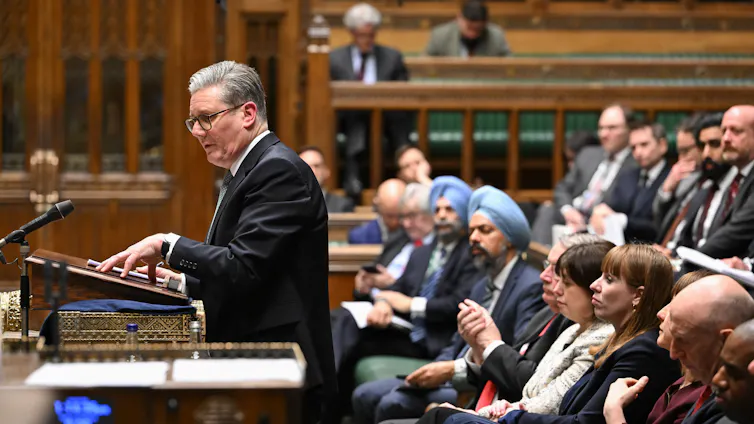
Keir Starmer’s MPs are rebelling en masse against cuts to the benefits system. Flickr/UK Parliament, CC BY-NC-ND

John Curtice, National Centre for Social Research

Keir Starmer has been dealing with his most serious parliamentary challenge since he became prime minister. More than a hundred Labour MPs backed a motion to stop in its tracks the government’s attempt to reduce the welfare bill, including by raising the threshold at which someone can claim disability benefit.

This issue has divided the parliamentary Labour party. But what does the public think?

Although there are signs people recognise that spending on disability benefits is now relatively high, the latest annual British Social Attitudes (BSA) report reveals that it is far from clear that they are supportive of cutbacks. And, unfortunately for the government this is especially true of those who voted Labour last year.

Ever since the late 1990s, BSA has regularly asked its respondents whether they would like “to see more or less government spending than now on benefits for disabled people who cannot work”. In 1998, 78% indicated they would like to see more spending. By 2011, that figure had fallen to 53%, and it was still no more than 56% in 2021.

A chart showing what percentage of the public favour more and less spending on disability benefits.
Attitudes to spending on disability benefits, 1998-2024. British Social Attitudes, CC BY-ND

Now, though, only 45% would like to see more money spent on disability benefits. For the first time, less than half the country backs giving those with a disability more help.

However, that does not mean most voters would like to see actual cutbacks. Only 11% say the government should spend less on disability benefits. The rest are content with the status quo.

Meanwhile, just 5% of those who voted Labour last year back less spending. Over half (53%) are in favour of an increase.

The government’s central argument is that it has become too easy to claim disability benefits and that this is discouraging people from getting back into employment.
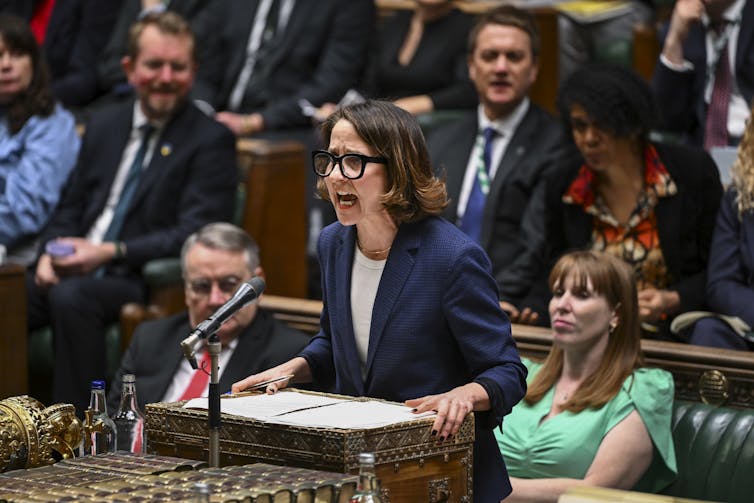
Liz Kendall speaking in parliament.
Work and pensions secretary Liz Kendall first announced the cuts in March 2025. Flickr/UK Parliament, CC BY-NC-ND

There is some support for this view. Among the public in general, 29% say it is “too easy” to claim disability benefit. The trouble is, just as many, 29%, take the opposite view and say it is “too difficult”. The most popular response, given by 35%, is that it is “neither too easy nor too difficult”.

Meanwhile, among Labour voters, the balance of opinion is clearly tilted towards the view that claiming disability benefit is “too difficult”. As many as 39% say so, while only 20% feel it is “too easy”.

Similarly, most voters (62%) feel the requirement for people on disability benefits to take “active measures to find appropriate work” is “about right”. Just 11% feel it is “too weak”, while more than twice as many (23%) believe it is “too tough”. Only 6% of Labour voters believe it is “too weak”.


Want more politics coverage from academic experts? Every week, we bring you informed analysis of developments in government and fact check the claims being made.

Sign up for our weekly politics newsletter, delivered every Friday.


These figures help explain why the government has seemingly been struggling to head off the rebellion. Already burned by voters’ reaction to last year’s cutback to the winter fuel allowance, and with their party trailing Reform in the polls, Labour MPs now find themselves presented with another cut that threatens to be unpopular with many of those who put them into Westminster. Little wonder there are now signs the government is having to bend to their view.

.

John Curtice, Professor of Politics, University of Strathclyde and Senior Research Fellow, National Centre for Social Research

This article is republished from The Conversation under a Creative Commons license. Read the original article.


Continue ReadingLabour is divided over disability cuts – here’s what the public thinks

Unite says bin strike deal closer if council puts public promises in writing

Spread the love

https://morningstaronline.co.uk/article/unite-says-bin-strike-deal-closer-if-council-puts-public-promises-writing

Rubbish bags are taken away on Poplar Road in Birmingham, Aril 16, 2025

THE Unite union called out Birmingham City Council today over the ongoing bin strike negotiations, warning they would be much closer to a deal if the authority “put in writing what it is saying in public.”

More than 350 refuse workers have been on strike since March 11 over plans to cut the vital role of waste recycling collection officer (WRCO).

According to Unite, it will lead to 150 of its members having their pay slashed by up to £8,000 a year.

On Monday, workers rejected the council’s latest offer. Unite said the proposal still involved substantial pay cuts and failed to address other potential wage reductions for 200 drivers.

Birmingham City Council leader John Cotton said that the council made a “fair and reasonable offer that means that no-one has to lose any pay at all, with alternative roles offered within the service, or indeed a promotion to work as a driver.”

He tried again to reassure the public today, telling the BBC “we’re in a position where nobody needs to be losing income.”

But Unite general secretary Sharon Graham said they appeared to be living in a “parallel universe.”

She said: “Yet again, John Cotton is saying one thing in public while his local officers are saying another in the negotiating room and in writing.

“If the council puts in writing what it says in public then we would likely be much closer to a deal.

https://morningstaronline.co.uk/article/unite-says-bin-strike-deal-closer-if-council-puts-public-promises-writing

Continue ReadingUnite says bin strike deal closer if council puts public promises in writing

There is a green elephant in the room with government’s AI plans

Spread the love
Green Party Co-leader Adrian Ramsay. Wikipedia CC.

Responding to the news that Government plans for AI to be “mainlined into the veins” of the nation, Green Party Co-Leader, Adrian Ramsay MP, said

“The potential for AI is huge and Greens welcome the potential it holds, especially in research and innovation. However, this plan comes almost exclusively from engagement with industry and investors and does not account for the views of the public, or the people working in our public services, about where AI should or should not be used. If AI is to serve our public services, its uses must instead be driven by the voices of those most affected by this technology development and deployment. This of course has to include addressing concerns around privacy and rights over their information”

“In addition, there is a green elephant in the room with neither government nor business truly addressing the environmental impacts of AI. One estimate said AI-related infrastructure may soon consume six times more water than Denmark, a country of 6 million people. And a request made through ChatGPT consumes 10 times the electricity of a Google Search. Yet the action plan does not address these crucial questions of environmental sustainability, let alone the debate about the relative gains from AI versus these obvious harms.”

Continue ReadingThere is a green elephant in the room with government’s AI plans

Business as usual as Starmer proves his loyalty with every rightward move

Spread the love
Image of Keir Starmer sucking up to the rich and powerful at the World Economic Forum, Davos

https://www.counterfire.org/article/business-as-usual-as-starmer-proves-his-loyalty-with-every-rightward-move-weekly-briefing/

Lindsey German on … [Keith Starmer] , the establishment’s friend …

The fate of Thames Water should be the end of the privatisation model pioneered by Thatcher in the 1980s. The major utilities and public companies were sold off at undervalued prices, their shares rapidly snapped up by big corporations and investors, prices for consumers rose rapidly, and profits went to shareholders, not to investment. That’s why today the common refrain about most parts of public life in Britain is that nothing works. And it is epitomised by Thames Water drowning in debt and likely to be taken back into public ownership temporarily.

But any form of nationalisation is going to be resisted to the bitter end, not just by the greedy privatised companies themselves, but by the Tories and the increasingly right-wing Labour Party under Keir Starmer. The cheek of the privatised companies was illustrated when the head of another, Severn Trent, convened a meeting of all the water firms to explicitly discuss ways of resisting nationalisation. And it’s no use going to the supposed regulators for help. As the Observer reported, ‘27 former Ofwat directors, managers and consultants [are] working in the industry they helped to regulate, with about half in senior posts.’ So a number of those regulating the industry have moved over to take lucrative positions in…. the privatised water companies.

While investors take the money and run, working class people are left with dire and expensive services that fail frequently because there is no investment. The water companies are publicly disgraced because of their dumping of sewage in rivers and seas, rather than invest in new treatment plants. But in London (and no doubt elsewhere) there have been several burst water mains, risking lives as they cause disruption sometimes for months, because of lack of investment. In the southeast of England, drinking water supplies have failed ‘because of the hot weather’, in what must be the lamest excuse from a company supposed to provide just that.

The answer from government and industry alike is that future investment will have to be paid for by us, through much higher bills and higher taxes. Already gas and electricity is beyond affordable for millions. But the energy companies will set the benchmark for other industries as profits are protected. No wonder nearly 13 million adults struggle to pay bills.

https://www.counterfire.org/article/business-as-usual-as-starmer-proves-his-loyalty-with-every-rightward-move-weekly-briefing/

dizzy: Under Capitalism failing companies would normally go bankrupt so that the companies’ debts would be transferred to it’s creditors. This is not the case with the banks in the banking crisis of 2008, the energy companies failures of recent years and it looks like failing water companies now. Instead of the companies creditors shouldering the debt as part of the normal process, the poor public is instead burdened with it. This is great for the banks of course because it means that they can borrow without any risk of default, knowing that they will profiteer from the public regardless.

Dianne Abbott: The idea of renationalisation refuses to die

Take Thames Water into public ownership petition amasses tens of thousands of signatures

Continue ReadingBusiness as usual as Starmer proves his loyalty with every rightward move