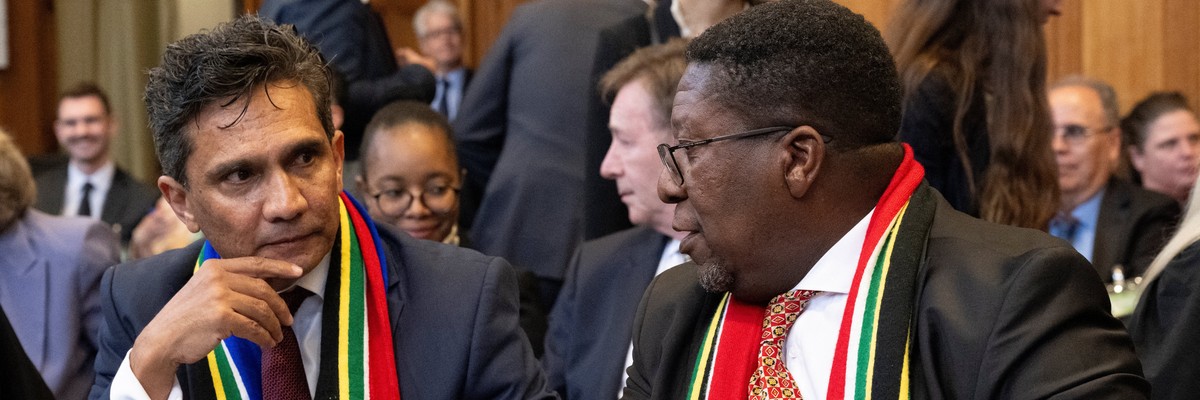
South African legal adviser Cornelius Scholtz (L) and South African Ambassador to the Netherlands Vusi Madonsela attend a hearing at the International Court of Justice (ICJ) on Israel’s incursion in Rafah, Gaza, in The Hague on May 16, 2024. (Photo: Lina Selg/ANP/AFP via Getty Images)
Israel’s assault on Rafah provides “evidence of the crime of genocide,” one legal expert said. “This attack is the final blow that is intended to destroy the Palestinian group in Gaza.”
South African officials on Thursday made their case before the International Court of Justice to stop Israel’s brutal invasion of Rafah, warning once again that Israeli officials have displayed clear “genocidal intent” and “genocidal conduct” in their military campaign in Gaza.
The case for the ICJ to stop the attack on Rafah was made by a number of lawyers, legal experts, and ambassadors, with the South African representatives outlining the bare facts of Israel’s military campaign, blocking of humanitarian aid, and statements of intent, just as they did when the court heard South Africa’s original claim that Israel is committing genocide.
That case, argued in January, resulted in a preliminary ruling in which the court said South Africa had made a “plausible” case and ordered Israel to prevent genocidal acts by the Israel Defense Forces (IDF).
On Thursday, South Africa urged the ICJ to see that Israel has not followed that order.
“It is difficult to imagine that the situation could get worse” than it was in January, international law professor John Dugard told the court. “But unfortunately, it has… Israel has now commenced its long-threatened assault on Rafah. It has ordered the evacuation of Palestinians in Rafah to the barren sand dunes of Al-Mawasi. It has closed critical border crossings to humanitarian aid, medical supplies, goods, and fuel, upon which the population depends.”
“Israel’s actions are in violation of fundamental international humanitarian law, but in addition, they provide evidence of the crime of genocide,” Dugard continued. “This attack is the final blow that is intended to destroy the Palestinian group in Gaza.”
Watch the livestream of the ICJ hearing below:
The South Africans made their case as the U.N. Relief and Works Agency for Palestinian Refugees in the Near East (UNRWA) said Thursday that an estimated 600,000 people have now been forcibly displaced from Rafah by Israel.
Despite tepid warnings from the U.S.—the biggest international funder of the IDF—for Israel to avoid attacking “population centers,” the IDF this week has moved into dense residential neighborhoods in central Rafah.
The U.S. has also called for Israel to allow humanitarian aid into Gaza, but the IDF’s seizure of the Rafah crossing between the enclave and Egypt last week led the World Food Program (WFP) on Thursday to warn that food and fuel rations “will run out in a matter of days.” Dozens of Palestinians have been starved to death so far by Israel’s blocking of relief shipments.
“The threat of famine in Gaza never loomed larger,” said the WFP as South Africa made its case in The Hague.
Three months after giving a 22-minute speech detailing the numerous statements of genocidal intent made by top Israeli officials since the Gaza assault began in October, South African lawyer Tembeka Ngcukaitobi during Thursday’s hearing, used the more recent words of Israeli Finance Minister Bezalel Smotrich, who publicly described the aim of the Rafah invasion as “total annihilation.”
In his presentation before the court, Ngcukaitobi invoked Smotrich’s language by arguing that the Rafah incursion “is the last stage of ‘total annihilation’ of Palestinian life.”
“For Palestinians to be able to continue to exist as a protected group under the Genocide Convention, they need a place from which to rebuild,” he continued. “Rafah is that place, the last stand… Without Rafah, the possibility to rebuild will be lost forever.”
In her speech, Irish lawyer Blinne Ni Ghralaigh outlined other developments in Gaza since the ICJ issued its preliminary ruling that illustrate the need for the court’s “invaluable intervention.”
Ni Ghralaigh detailed the destruction of hospitals like Al-Shifa, where mass graves have been found with the remains of women, children, and medical workers, and warned that “the same fate now awaits Rafah’s remaining hospitals, doctors, and medics.”
She also pointed to evidence that the IDF is treating evacuated areas as “extermination zones,” where soldiers are ordered to kill any remaining people, and its use of an error-prone AI system to target Palestinians.
The South African legal team said the court must order Israel “to immediately take all effective measures to ensure the access of persons able to investigate ongoing atrocities,” and called on the ICJ to “at least modify its provisional measures” from March, when it demanded that Israel allow humanitarian aid into Gaza.
“The court has the power to modify or make an explicit order for Israel to cease its military operations in Rafah, Gaza, and to withdraw from the Gaza Strip,” said Ni Ghralaigh, pointing out that the provisional measure from March could only take full effect if a cease-fire agreement was reached.
“No such resolution is in place. The court must itself, therefore, create the circumstances necessary for its provisional measures to take full effect. It must order Israel to cease its military operations system finally,” she said. “Enough is enough.”
Israel is expected to address the ICJ at a second day of hearings on Friday.
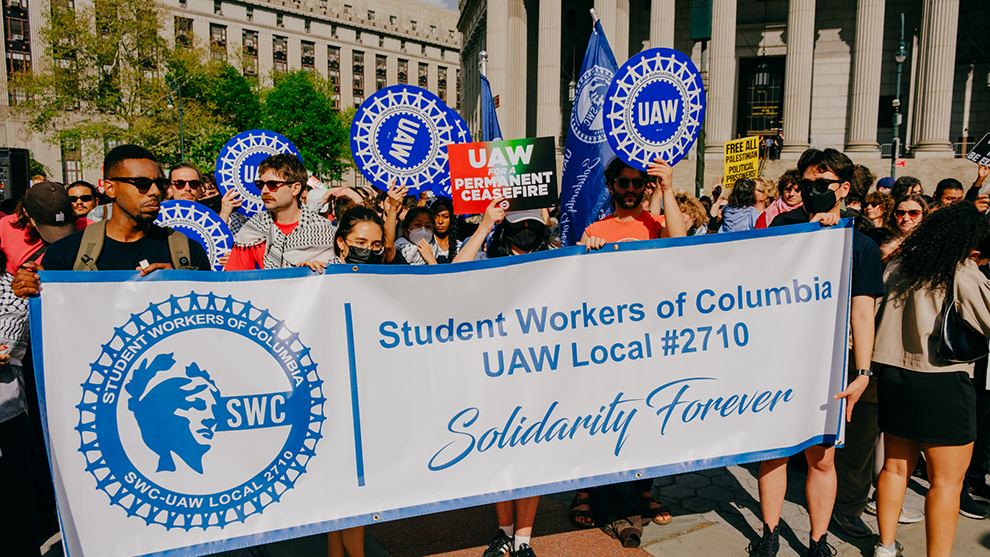
Student workers of Columbia organized in UAW 2710 participate in May Day rally. Photo: Wyatt Souers
On International Workers’ Day, workers around the world continued to join hands with the student movement to stand with Palestine
On May Day, workers around the world mobilized for the liberation of Palestine. “This May Day, workers of the world are called to declare their solidarity with Palestine, to denounce the Israeli Genocide, and to call for an end to all aggressions in the region and to all wars,” wrote the International People’s Assembly.
“Beyond the call for a ceasefire we must say no to the transportation of arms and arms caches to Israel. Workers in all industries – especially workers in the transport sector – that can withhold their labor in order to halt the continued slaughter of the people of Palestine are emphatically called to do so!”
The National Union of Metalworkers of South Africa released a statement calling on workers around the world to mobilize for Palestine. “The working class are the creators of wealth, and it is the united power of the working class that has the power to overthrow hateful, brutal regimes like Apartheid Israel,” wrote the union. “On this Workers Day, we call on workers of the world to unite in defense of Palestine so that its people can be free, from the river, to the sea!”
“The working class in South Africa must celebrate the defeat of Apartheid, because its destruction was due, largely to the unity of workers, who used their labor power to collapse the system through rolling mass action, strikes and protest,” the union added.
Several Palestinian union formations have called the people in the world to action against the ongoing Israeli genocide in Gaza. This includes the Palestinian General Federation of Trade Unions, which in March called on US unions in particular to “be our voice and advocate inside and outside America.”
“What our people are experiencing and what workers and unions in particular, are exposed to is the most horrific catastrophe known to humanity in recent decades,” the PGFTU wrote. “We ask that you convey our message and give voice to the suffering of hungry, starving workers and their families—not just to the American people, not just to your unions, but to the entire world.”
Palestinian trade unions have also responded in support of the student movement for Palestine that has taken the world by storm. “The Union of Agricultural Work Committees (UAWC) in Palestine extends our deepest solidarity to you, the revolutionary youth who are changing the world,” reads a statement of support from a prominent Palestine farmworkers’ union, addressed to the students movement around the world that is taking action in solidarity with Gaza. “We write to you from Palestine to tell you that your actions are resonating across oceans. In you, we see the echoes of our struggle, the echoes of our resistance, and the echoes of our hope.”
“Our people, along with all the workers and free people of the world, commemorate the first of May this year, at a time when they are subjected to the most brutal and fierce campaign of genocide and ethnic cleansing, surpassing in savagery and bloodiness the fascists and the Nazis, at the hands of a group of murderers calling themselves an army for an invasive replacement entity, under the leadership, partnership, support, cover, and complicity of the American administration and the colonial Western imperial powers, the enemies of humanity,” wrote the Popular Front for the Liberation of Palestine in a pre-May Day statement. “We send a salute of respect and pride to the university students all over the world, especially to the students at American universities, who are protesting against the crimes of the occupation and the support of the American administration for it, and who demand a halt to the aggression against the Palestinian people.”
Within the student movement in the US, university workers are mobilizing their unions to stand with their students in solidarity with Gaza. On April 29, within the Gaza Solidarity Encampment at the City College of New York in New York City, university workers organized under the Professional Staff Congress (PSC-CUNY) held a town hall meeting to deliberate on how to use their labor power to support the five demands of the student encampment. The members attending the town hall organized a wildcat sick-out, in which union members will call in sick en masse to disrupt business as usual at the larger City University of New York (CUNY) system. Workers in the United States face a variety of strike prohibitions, including a nationwide ban on striking for political reasons rather than economic issues such as wages and benefits under the Taft-Hartley Act of 1947.
Nevertheless, the PSC faculty at the town hall voted overwhelmingly to stage a sick-out. “At UT Austin, faculty did a one day job action in support of their students. Palestinian trade unions, National SJP, and National Faculty for Justice in Palestine have called for a mass job action on May 1st,” faculty wrote in a statement. “Our students are taking incredible risks to support the Palestinian people. They have asked for our help. We must stand ready to struggle alongside them, and to take these risks.”
Workers organized with the United Auto Workers, which also represents many graduate student workers across the country, staged a rally in Washington Square Park on April 26 in support of their students staging Gaza Solidarity Encampments at NYU, Columbia, and the New School.
Workers engaged in mass mobilizations around the world on May 1.
Thousands took to the streets in major US cities including Washington, DC and Los Angeles. In DC, demonstrators marched to the Gaza Solidarity Encampments at George Washington University.
— Party for Socialism and Liberation (@pslnational) May 1, 2024
✊🏽🇵🇸RIGHT NOW: A massive May Day march is en route to the Gaza Solidarity Encampment at George Washington University pic.twitter.com/esXOVUrhqv
— Party for Socialism and Liberation (@pslnational) May 2, 2024
In New York City, unions such as the United Auto Workers and the New York Taxi Workers Alliance expressed explicit support for the Palestinian cause in a march of 20,000, which ended at the New York University Gaza Solidarity Encampment.
Havana, like every year, was flooded with huge crowds on May Day as President Miguel Diaz-Canel sent an explicit message in support of Palestine and the pro-Palestine student movement. “All our solidarity with the students in the United States, who have taken the side of justice, have come out to support the cause of the Palestinian people, and are brutally repressed on their own university campuses. Today our [May Day] is also going through Palestine,” Diaz-Canel wrote.
In Bogota, President Gustavo Petro made a special announcement during the May Day celebration in front of thousands of Colombians: the nation would officially cut all diplomatic ties with Israel.
The Court has issued orders for Israel to “ensure” the “unhindered provision” of humanitarian aid, as 31 people have been killed due to deliberate starvation in Gaza
Noting that the “catastrophic living conditions of the Palestinians in the Gaza Strip have deteriorated further,” the International Court of Justice (ICJ) has ordered Israel to take additional measures, including “unhindered provision” of basic necessities and humanitarian assistance, as the Occupation continues its genocidal war for the sixth month.
The ruling was issued on March 28 in response to a request by South Africa calling on the Court to take further action “in light of the new facts and changes in the situation in Gaza— particularly the situation of widespread starvation”.
According to the latest Integrated Food Security Phase Classification (IPC) analysis, both North Gaza and Gaza Governorates are “classified in IPC Phase 5 (Famine) with reasonable evidence, with 70% of the population in IPC Phase 5 (Catastrophe).”
On March 24, the head of the UN Relief and Works Agency (UNRWA) stated that Israel had informed the UN that it would no longer approve the agency’s food convoys to north Gaza. Only 11 aid convoys of the World Food Programme have reached the area since the start of 2024.
In January, Israel accused UNRWA, without any concrete evidence, of employing over 450 “military operatives”. Israel’s allies in the west immediately began suspending funding for the agency, even as it has been revealed that Israel had tortured and coerced UNRWA staffers into giving false confessions.
Meanwhile, the US Congress has now voted to defund UNRWA as part of a USD 1.2 trillion spending bill. The legislation, which simultaneously provides the annual USD 3.8 billion in funding to Israel, will also limit aid to the Palestinian Authority (PA) in the occupied West Bank if the Palestinians initiate or support an investigation by the International Criminal Court (ICC) into Israel’s crimes.
South Africa’s request was part of the case it brought against Israel in December, accusing it of violating its obligations under the 1948 Convention on the Prevention and Punishment of the Crime of Genocide. Ahead of a full hearing of the case, South Africa had called on the Court to issue interim measures to prevent “severe and irreparable harm” to the Palestinians as Israel continued and escalated its attacks.
On January 26, the Court found that it was plausible that Israel was committing genocide in Gaza and ordered six measures, including for Israel to “take all measures within its powers to prevent the commission of all acts within the scope of the [Genocide] Convention.”
These acts include killing, causing serious bodily or mental harm, “deliberately inflicting conditions of life calculated to bring about its physical destruction in whole or in part,” and imposing measures intended to prevent births.
As it became immediately clear that Israel had no intentions of obeying these legally binding measures, South Africa approached the ICJ for additional measures in February. However, the Court declined to expand on its order.
Starvation and massacres escalate
In a second attempt on March 6, South Africa stated that Gazans are no longer at “immediate risk of death by starvation,” noting that at least 15 children had died of starvation in the week leading up to its submission.
“These deaths are “man-made, predictable and entirely preventable. It is predicted that they will increase exponentially and not linearly in the absence of a cessation of military activities and a lifting of the blockade,” it had said, adding that Israel had repeatedly used humanitarian aid as a “bargaining chip in negotiations” by creating a “hostile, inoperable environment for aid agencies.”
The application was submitted days after the “Flour Massacre”—neither the first nor the last atrocity of its kind. The massacre “forms part of an escalating pattern of fatal attacks by Israel on the Palestinian people it is deliberately starving, as they seek access to aid,” South Africa stated.
In its ruling on Thursday, the ICJ observed that “Palestinians in Gaza are no longer facing only a risk of famine… but that famine is setting in, with at least 31 people, including 27 children, having already died of malnutrition and dehydration.”
Also cited it a statement made by UN human rights chief Volker Türk that the “situation of hunger, starvation and famine is a result of Israel’s extensive restrictions on the entry and distribution of humanitarian aid and commercial goods, displacement of most of the population, as well as he destruction of crucial civilian infrastructure.”
The Court held that “there is no substitute for land routes and entry points from Israel into Gaza to ensure the effective and efficient delivery of food, water, medical and humanitarian assistance; there is an urgent need to increase the capacity and number of open land crossing points into Gaza and to maintain them open…”
The ruling took “note” of “certain declarations of representatives of the UN and the various organizations… according to which the catastrophic humanitarian situation can only be addressed if the military operations in the Gaza Strip are suspended [emphasis added].”
Also acknowledged is the UN Security Council resolution 2728, which “[d]emand[ed] an immediate ceasefire for the month of Ramadan respected by all parties leading to a lasting sustainable ceasefire.”
Not only was the Resolution’s text amended to call for a “lasting” instead of a “permanent” ceasefire under US’ threat of veto, the US ultimately went on to absurdly claim that the resolution was non-binding—statements also rejected by the UN and other SC member states.
It is important to note that the month of Ramadan, and by extension the proposed ceasefire period, is set to end in less than two weeks.
The Court also noted that since its ruling on January 26, Israel had killed over 6,600 additional people in Gaza and injured another 11,000. Given that the original provisional measures did not address the changes in the situation in Gaza—including the “unprecedented levels of food insecurity” and the increasing risks of epidemics—the ICJ concluded that its original decision had to be modified.
The ICJ “reaffirmed” its previous provisional measures and has ordered three further measures: a) that Israel must take all measures to ensure “without delay, in full cooperation with the UN, the unhindered provision at scale…of urgently needed basic services and humanitarian assistance” and b) ensure “with immediate effect” that its military does not commit acts that violate the rights of the Palestinian people under the Genocide Convention.
Israel has been given one month to submit a report to the Court on all measures taken to implement the order.
In its original application to the Court, South Africa had demanded an order calling on Israel to immediately cease its military operations in and around Gaza. While this measure was not explicitly granted, a ceasefire could be inferred, as South Africa’s foreign minister Naledi Pandor argued, because “without it, the Order would not work,” including the delivery of humanitarian aid.
Nevertheless, while the ICJ ruling did not order cessation of Israel’s military actions on Thursday, seven judges from the Court’s bench issued separate statements stating that the Court should have explicitly ordered a suspension of Israel’s operations, “including its planned military operation in Rafah,” or at least acknowledging that a ceasefire was necessary for its orders to take effect.
“It is indeed the very right of existence of the Palestinian population of Gaza that is currently at risk of irreparable prejudice,” said Judge Abdulqawi Ahmed Yusuf.
Importantly, he stated, “The argument that a State party to the Convention that is involved in a conflict with a non-State actor is not under an obligation to suspend its military operations to prevent genocide or should not be ordered to do so, unless the non-State actor is disarmed, makes no sense whatsoever. It is contrary to the very idea of prevention of genocide and to the objectives of the Convention…”
“All the indicators of genocidal activities are flashing red in Gaza… The provisional measures indicated by the Court are binding. They are not something that a State party to the Convention is free to respect or to ignore according to its own pleasure. They must be implemented,” ICJ Judge Yusuf had said.
“In the same way that a State party to the Convention has a duty to prevent genocide in its territory whatever may be the nature of the forces or actors opposing it, it has also the obligation to prevent genocide in any territory which such party invades or occupies. This is the case with respect to the situation in Gaza.”
This was reiterated in the joint opinion of Judges Xue Hanqin, Leonardo Nemer Caldeira Brant, Juan Manuel Gómez Robledo, and Dire Tladi—“Israel’s dominant control over Gaza explains why Israel has the primary responsibility to ensure unhindered and unimpeded access, in particular the land cross access for the delivery of humanitarian assistance… For that purpose, suspension of military operations… appears indispensable.”
Israel’s “humanitarian camouflage”
During the hearings on the provisional measures in January, Israel had deployed two key arguments to deny that it was committing genocide in Gaza. One being its supposed facilitation of humanitarian assistance to Gaza, even though it had already been reported at the time that the entire population of Gaza was suffering from “crisis or worse” levels of food insecurity; and it’s supposed adherence to international humanitarian law as a way to justify its mass killings and bombings of critical infrastructure.
This second tactic was examined in a report published by the UN Special Rapporteur on the occupied Palestinian territories (OPt), Francesca Albanese, on March 25, titled “Anatomy of a Genocide” which concluded that there were “reasonable grounds to believe that the threshold indicating Israel’s commission of genocide is met.”
The report documents three acts of genocide being committed by Israel—killing members of the group, causing serious bodily or mental harm to members of the group, and deliberately inflicting on the group conditions of life calculated to bring about its physical destruction in whole or in part.
“More broadly, [the context, facts and analysis] indicate that Israel’s actions have been driven by a genocidal logic integral to its settler-colonial project in Palestine.”
“Punishing their indigeneity and rejection of colonization, Israel construed Palestinians as a ‘security threat’ to justify their oppression and “de-civilianization,” namely the denial of their status as protected civilians.”
This “de-civilianization,” Albanese argues, has intensified since October 7 through Israel’s use of International Humanitarian Law (IHL) terminology such as human shields, collateral damage, safe zones, and evacuations, which has “transformed an entire national group and its inhabited space into a destroyable target, revealing an eliminationist conduct of hostilities.”
The report notes that Israel has repeatedly accused Palestinian resistance groups of “deliberately using civilians as human shields” in its wars of aggression on Gaza and the 2018 Great March of Return protests—even as it was later proved that the evidence had been fabricated—to “justify widespread and systematic killing” of Palestinians.
“Israel [has] transformed Gaza into a “world without civilians” in which “everything from taking shelter in hospitals to fleeing for safety is declared a form of human shielding.”
This strategy has been extended to the infrastructure required to sustain life in Gaza—including hospitals—with Israel systematically attacking medical workers and facilities for being Hamas “command centers” or “headquarters,” “legitimizing the destruction of Gaza’s entire healthcare sector.”
The report also connects this policy of shielding with Israel’s evacuation orders, particularly the one issued on October 13 forcing people to move to south Gaza—“Israel illegally categorized the inhabitants of northern Gaza who had remained (including the sick and wounded) as “human shields” and “accomplices” of terrorism.”
“This policy points to the intention by Israel to ‘transform’ hundreds of thousands of civilians into ‘legitimate’ military targets or collateral casualties through impossible-to-follow evacuation orders.” Not only that, Israel targeted evacuees and residents of designated safe zones—“safe areas were deliberately turned into areas of mass killing.”
“Israel considers any object that has allegedly been or might be used militarily as a legitimate target, so that entire neighborhoods can be razed or demolished under fictions of legality… Rationalizing patterns of attacks on civilian objects, knowingly killing civilians en masse, has become military strategy premised upon probable war crimes,” Albanese notes.
Importantly, she also addresses Israel’s use of the notion of “proportionate collateral damage to knowingly shell large numbers of members of the protected group”. The way Israel has gone about this, is by “defining military advantage, in each attack, in relation to the destruction of the whole Hamas organization both politically and militarily.”
“It is manifestly illegal to declare as a war aim the destruction of the other side’s political capacity (particularly in the context of a 56-year military occupation which deprives the occupied population of its right to self-determination.”
Meanwhile, Ireland has announced that it will intervene in the case, as has the State of Palestine, which stated that despite the Court’s orders, “Israel’s relentless aggression persists… violating Palestinian rights under the Genocide Convention.”
“Equally, many states have failed to honor their erga omnes obligations [obligations owed to the international community as a whole] to adhere to and implement the ICJ’s order, thereby entrenching complicity in these grave acts, including the political and military aiding and abetting of the perpetrators of the genocide.”
Israel’s deliberate blocking of humanitarian aid to Gaza has emerged as key weapon against the people of the territory. More than 20 Palestinians have reportedly been killed due to starvation in the last few weeks and numbers are expected to explode in the coming days.
Though Israel denies it has any such policy, almost all UN agencies working to provide aid on the ground in Gaza, as well as several other groups, have termed the deliberate blocking of aid as the most important reason for an imminent famine in the besieged Palestinian territory.
Research conducted by organizations such as Refugees International show that, “Israeli conduct has consistently impeded aid operations within Gaza, blocked legitimate relief operations, and resisted implementing measures that would genuinely enhance the flow of humanitarian aid in Gaza.”
By denying adequate aid to Gaza, Israel has been in violation of the interim order passed by the International Court of Justice (ICJ) on January 26 while hearing the genocide petition filed by South Africa. The ICJ had asked Israel to facilitate “urgently needed basic services and humanitarian assistance to address the adverse conditions of life.”
In its submission to the court in February, Israel claimed it had complied with the ruling. However, UN data shows that the actual number of trucks with aid reaching Gaza decreased by half in February in comparison to the previous month. International organizations still describe experiences where the Israeli Occupying Forces (IOF) block their entry into Gaza, especially North Gaza, after being made to wait for hours on end.
According to Philippe Lazzarini, Commissioner General of UNRWA, in February, on an average just 98 trucks entered Gaza in comparison to around 200 trucks a day in January. Before October 7, Israel used to allow around 500 trucks a day to the besieged territory for a population of over 2.3 million.
Israel’s denial of adequate aid to Gaza also violates the UN Security Council resolution adopted in December which talks about greater access to humanitarian aid to Palestinians in Gaza.
The US, which was the primary mover of the UN security council resolution, recently airdropped aid to Gaza. While delivering his State of the Union address on March 7, President Joe Biden also talked about opening a temporary port in Gaza to deliver faster aid. Both the moves confirm the claims that there is not enough aid reaching Gaza at the moment, despite Israeli claims.
However, the US act is widely seen as a face-saving exercise given the Biden administration’s reluctance to press Israel for a permanent ceasefire in Gaza and its supply of arms and ammunition which is used by Israel to bomb Palestinians.
The Biden administration has failed to make Israel comply with its own National Security Memorandum (NSM 20) as well. It requires that countries seeking security aid from the US make arrangements for adequate humanitarian assistance.
Medea Benjamin of CODEPINK highlighted on her page on X that Biden says “Israel must allow more aid into Gaza and protect civilians. But it doesn’t. And Biden keeps sending them more weapons.”
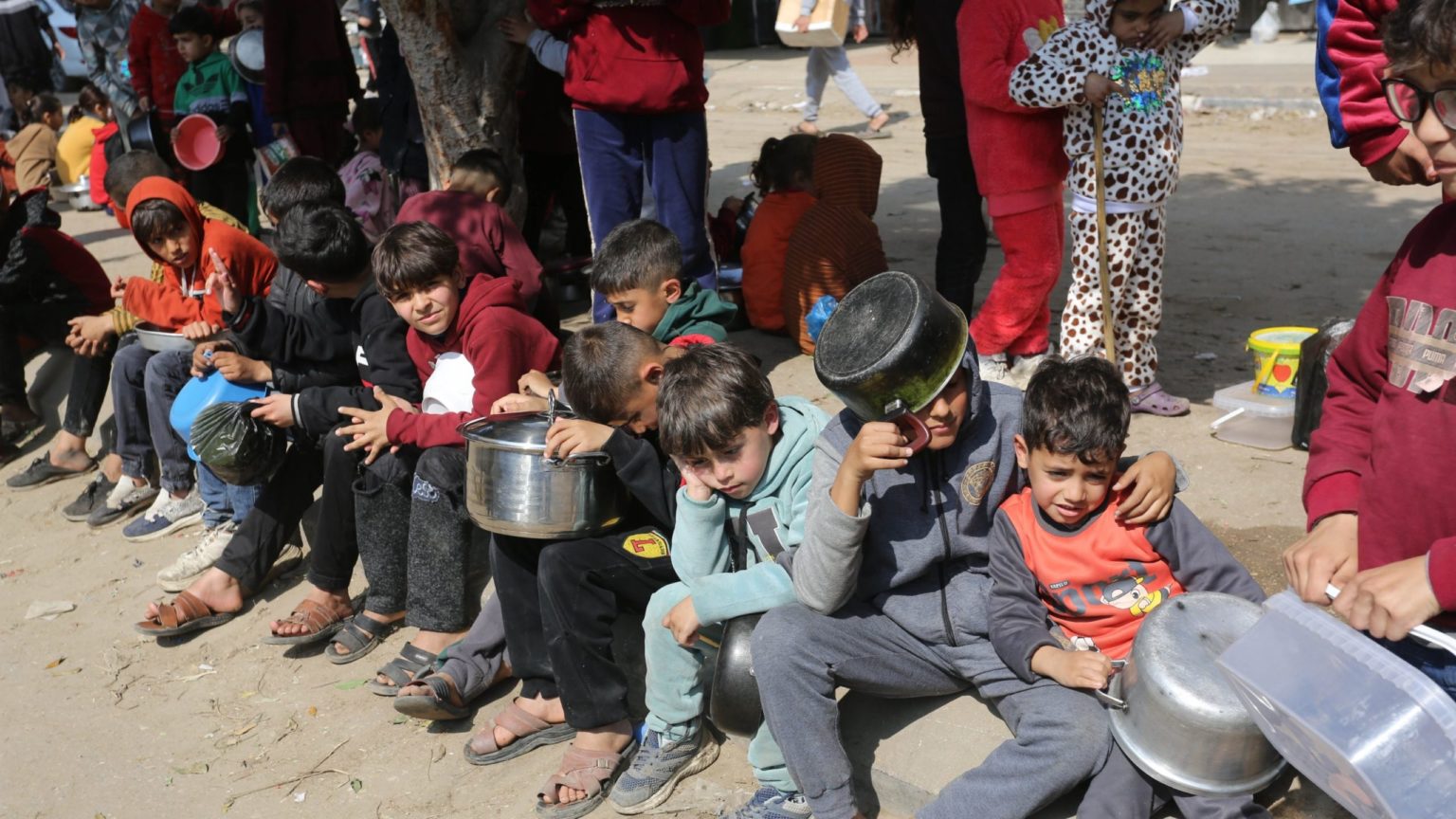
Meanwhile “after five months of war, Palestinians are struggling to find adequate food, water, shelter and basic medicine. Famine level hunger is already widespread and worsening” in Gaza, Refugees International’s report says. The lack of adequate food has significant health implications for children in Gaza who have been the primary victims of Israel’s war since October 7.
Israel weaponized starvation against Palestinians
Israel has killed over ten thousand children in its bombings and ground offensives in Gaza since October 7. In addition to that, the health effects of Israel’s blockade on aid delivery are worsening by the day.
According to the World Health Organization (WHO), 1 in 6 children under 2 years of age in Gaza are acutely malnourished. The combination of food shortages, lack of clean water, and inadequate healthcare provision is having devastating effects, particularly on young children and mothers.
Many women are facing extreme difficulties in initiating and continuing breastfeeding due to their own nutritional status and stress. “People are hungry, exhausted, and traumatized,” said Adele Khodr, Regional Director of UNICEF’s Middle East and North Africa office.
The food shortage in the north is so severe that health workers report 95% of female patients are suffering from anemia. “There have been many operations performed, such as cesarean sections, to remove fetuses, [which] died of malnutrition among women,” Mohammed Salha, director of Al-Awda Hospital, told ActionAid.
Pediatricians at Kamal Adwan Hospital have reported not having the resources to treat more than half the children admitted to the hospital for malnutrition, as there is no food or medical supplement the staff can give them. “The most we can do for them is give them a saline solution or sugar solution,” physician Imad Dardonah told UN teams visiting the institution.
Israeli obstacles to aid delivery also mean that there is not enough infant formula or diapers. On the rare occasions when these essential supplies are found, their cost puts them out of reach for most of the population in Gaza.
A box of diapers in northern Gaza now costs around ILS 200 (USD 55), while monthly income before October 7, 2023, was reported around ILS 1,200 (USD 343)— not even enough to cover a newborn’s monthly supply during her first month of life, let alone food on top of that.
Restrictions are also being applied to the number of international medical teams allowed into Gaza and to field hospitals, which would allow for a partial expansion of much-needed health service capacities.
The siege is causing a devastating paradox: at the same time, there are too few health workers to respond to the needs of the population and those who have been working in Gaza’s healthcare system since October; and there are too many health workers in comparison to the operational surgery capacities—the only remaining functional operation rooms are located at the European Hospital in southern Gaza, according to surgeon Ghassan Abu Sittah.
Some countries have attempted to circumvent Israel’s aid blockade by airdropping supplies, but the amounts reaching the population in Gaza this way are nowhere near sufficient. To adequately stock hospitals and health centers, several international agencies have warned, it is paramount to ensure unimpeded passage for truck convoys carrying a wide range of supplies, not just a specific type of food or sanitary bandages.
When it comes to aid delivery, the UN humanitarian coordinator for the occupied Palestinian territories, James McGoldrick, said, “There is no alternative to food trucks, to road transports.”
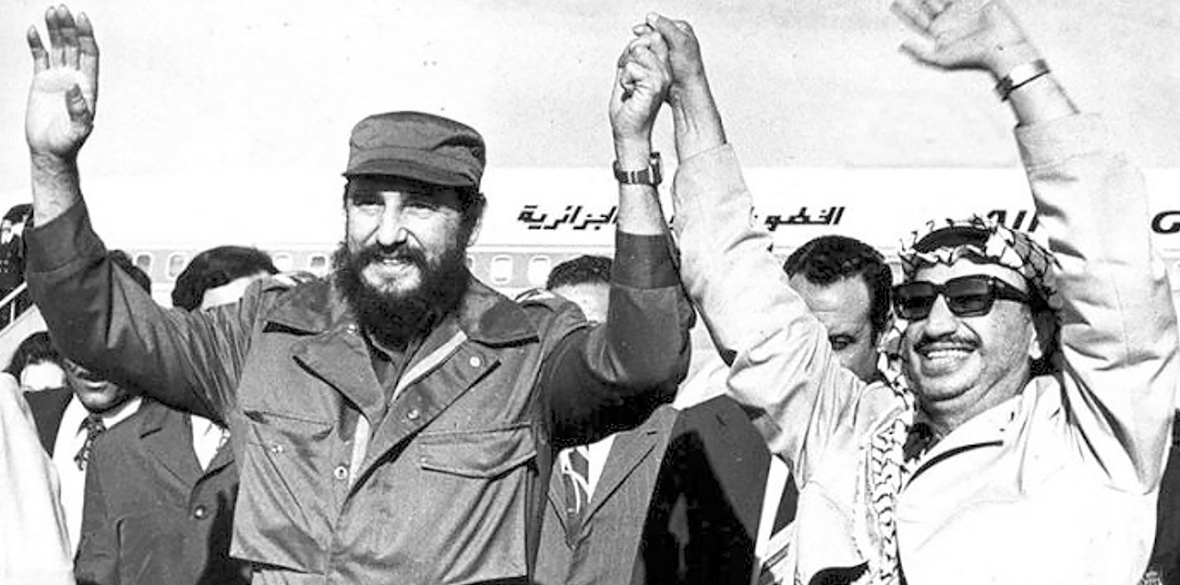
BROTHERS IN ARMS: Fidel Castro welcomes Yasser Arafat on his visit to Cuba in November 1974Photo: Liborio Noval/Granma.cu
Cuba has stood unswervingly by Palestine since 1947 guided by its own rejection of imperialist lawlessness, writes BERNARD REGAN
On January 12 2024 Cuba announced its intention to support the request of the Republic of South Africa to initiate proceedings against Israel in the International Court of Justice.
South Africa’s charge is that Israel is guilty of committing genocide against the Palestinian people in Gaza.
Cuba has a long record of supporting the right of the Palestinian people to self-determination. This record even pre-dates the 1959 Revolution.
In November 1947 Dr Ernesto Dihigo speaking on behalf of Cuba at the United Nations said that Cuba denounced the violation of international law by the United Kingdom. “The Balfour Declaration, in our opinion,” he said, “ is completely without legal value, since the British government offered in it something that it had no right to dispose of, because it was not its own.”
The Cuban revolutionaries saw Palestine as part of the fight against colonialism, neo-colonialism and imperialism.
On June 18 1959, just a six months after the birth of the Revolution, Che Guevara and Raul Castro visited Al Burajj Refugee camp in Gaza, then under the control of the Egyptian government of Gamal Nasser.
Che and Raul were touring countries at the forefront of the struggle against imperialism, talking to leaders and discussing how unity could be built across the continents.
Che reaffirmed Cuba’s support for Palestine at the UN general assembly on December 11 1964, making an excoriating critique of the role of US imperialism and extending solidarity, among others, to the “Arabs of Palestine.” He attacked the role of US imperialism in blocking the rights of peoples to self-determination and for interfering in the internal and sovereign affairs of countries across the continents.