Why Katy Perry’s celebrity spaceflight blazed a trail for climate breakdown

Spread the love
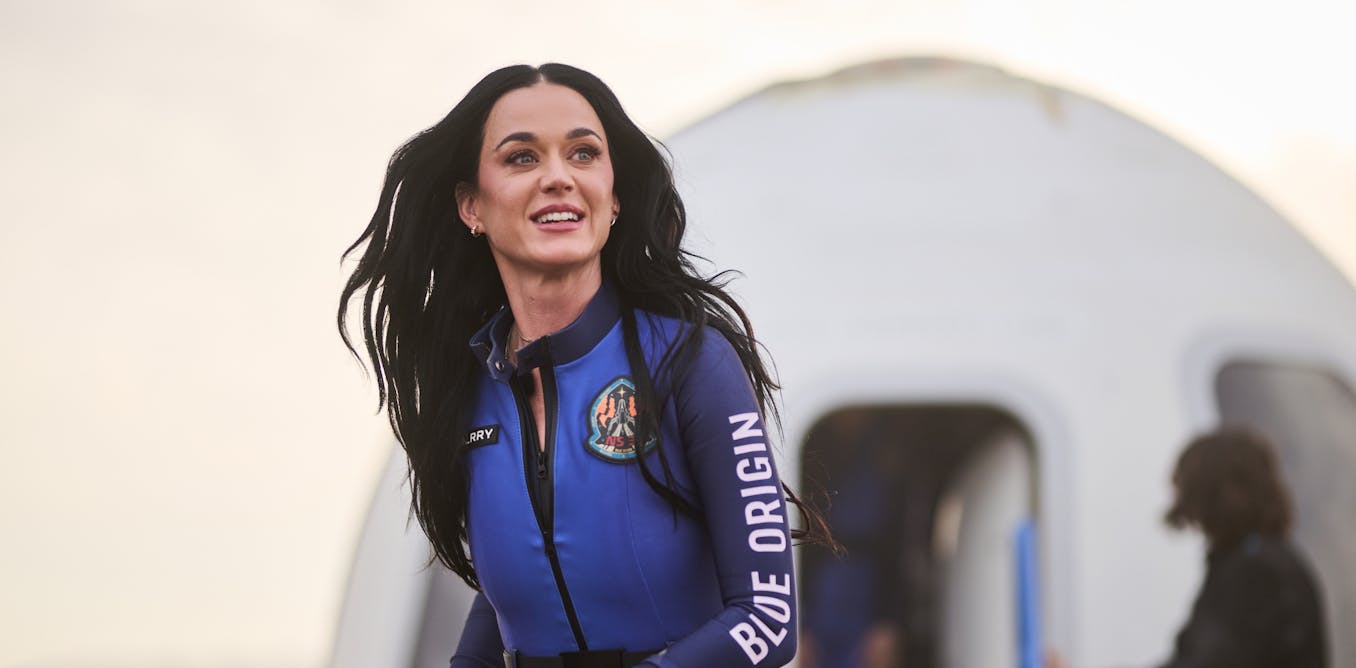
Katy Perry after emerging from the Blue Origin space capsule. EPA-EFE/Blue Origin

Steve Westlake, University of Bath

What’s not to like about an all-female celebrity crew riding a rocket into space? Quite a lot, as it turns out.

Katy Perry and her companions were initially portrayed in the media as breaking down gender barriers. On their return to Earth, the team enthused about protecting the planet and blazing a trail for others. Perry even sang What a Wonderful World during the flight, and kissed the ground on exiting the spacecraft.

But the backlash was swift. Fellow celebrities piled in to highlight the “hypocrisy” of such an energy-intensive endeavour from a former Unicef climate champion. Evidence was quickly presented to dispute the pollution-free claims of the Blue Origin rocket, which is fuelled by oxygen and hydrogen. (In fact, the water vapour and nitrogen oxide emissions it creates add to global heating, on top of the emissions from the programme as a whole.)

But it’s the negative social effects of this kind of display from celebrities (of any gender) that our research sheds light on. I’m part of a team of social scientists researching the powerful effects of politicians, business leaders and celebrities who lead by example on climate change – or don’t.

Social kickback

Space tourism, and other energy-intensive activities by people in the public eye, such as using helicopters and private jets, have a much wider knock-on effect than the direct damage to the climate caused by the activity itself.

We carried out focus groups with members of the public to understand their reactions to the high-carbon behaviour of leaders in politics, culture and business. We also conducted experiments and surveys to test the effects of leaders “walking the talk” on climate change. We found that observing unnecessary high-carbon behaviour demotivates people and reduces the sense of collective effort that is essential for a successful societal response to climate change.

Solving climate change and other environmental crises requires fundamental changes to economies, societies and lifestyles according to climate science. Using much less energy, not just different kinds of energy, can play a big part in halting the damage. And it is the wealthiest people in the richest countries who use the most energy and set the standards and aspirations for the rest of society. That’s why the Blue Origin dream (of space exploration for the unfathomably wealthy) is a nightmare for the climate because it perpetuates an unsustainable culture.

Our findings reveal that when people see public figures behaving like this, they are less willing to make changes to their own lives. “Why should I do my bit for the climate when these celebrities are doing the opposite?” is the question people repeatedly asked in our research.

Many of the changes to behaviour necessary to tackle climate change will require people to accept trade-offs and embrace alternative ways of living. This includes using heat pumps instead of gas boilers, trading in large, fossil-fuelled vehicles (or even avoiding cars altogether) and forgoing flights – because there is no way to decarbonise long-distance flights in time.

When celebrities (or politicians and business leaders, for that matter) ignore the environmental damage of their choices, it sends a powerful signal that they are not really serious about addressing climate change.

Not only does this undermine people’s motivation to make changes, it reduces the credibility of leaders. That in turn makes coordinated climate action less likely, because shifting to a low-carbon society will require public trust in leadership and a sense of collective effort.

Individual choices matter

The widespread aversion to Perry’s space flight contradicts the popular argument that tackling the climate crisis “is not about individual behaviour”.

On the contrary, the response shows that these actions from celebrities and other leaders have much greater symbolic meaning than is captured by the idea of an “individual choice”. People are highly attuned to the behaviour of others because it signals and reinforces the values, morals and norms of our society. As such, few if any choices are truly “individual”.

This message of collective responsibility is one our current economic and political system works hard to suppress by championing unlimited freedom to consume, while ignoring the loss of freedom that such behaviour causes: freedom to live in a stable climate, freedom from pollution, freedom from extreme weather, freedom for future generations.

In fact, research reveals that most people understand the interconnectedness of society and the need for a coordinated response to the climate crisis. Climate assemblies, which convene ordinary citizens to discuss and deliberate a course of climate action, have revealed a willingness to curtail some activities in a fair way.

When it comes to preserving a liveable planet and a stable climate, most people know that space tourism and ultra-high-carbon living are off the agenda. Celebrities have a positive role to play in leading by example. It’s not rocket science.


Don’t have time to read about climate change as much as you’d like?
Get a weekly roundup in your inbox instead. Every Wednesday, The Conversation’s environment editor writes Imagine, a short email that goes a little deeper into just one climate issue. Join the 45,000+ readers who’ve subscribed so far.


Steve Westlake, Lecturer, Environmental Psychology, University of Bath

This article is republished from The Conversation under a Creative Commons license. Read the original article.
Continue ReadingWhy Katy Perry’s celebrity spaceflight blazed a trail for climate breakdown

Emissions of Richest 1% Will Cause 1.3 Million Heat Deaths: Oxfam

Spread the love

Original article by JAKE JOHNSON republished from Common Dreams under Creative Commons (CC BY-NC-ND 3.0). 

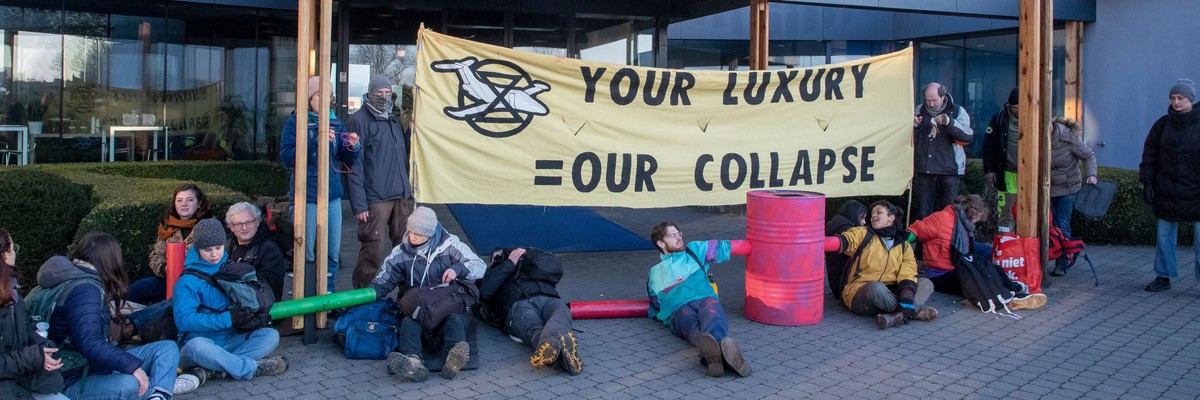
Climate activists of Extinction Rebellion hold a protest action against private jets at the ExecuJet Aviation Group in Zaventem, near Brussels Airport, on February 13, 2023.  (Photo: Nicolas Maeterlinck/Belga Mag/AFP via Getty Images)

“The super-rich are plundering and polluting the planet to the point of destruction and it is those who can least afford it who are paying the highest price.”

The richest 1% of the global population produced 16% of the world’s carbon dioxide in 2019, generating as much planet-warming pollution as the poorest two-thirds of humanity, according to a report released Monday by Oxfam International.

Climate Equality: A Planet for the 99% describes the fossil fuel-driven climate emergency and runaway inequality as “twin crises” that are leaving those least responsible for planetary breakdown to bear the worst consequences, from catastrophic extreme weather to food and water shortages.

“If no action is taken, the richest will continue to burn through the carbon we have left to use while keeping the global temperature below the safe limit of 1.5°C, destroying any chance of ending poverty and ensuring equality,” the report warns. “The world needs an equal transformation. Only a radical reduction in inequality, transformative climate action and fundamentally shifting our economic goals as a society can save our planet while ensuring wellbeing for all.”

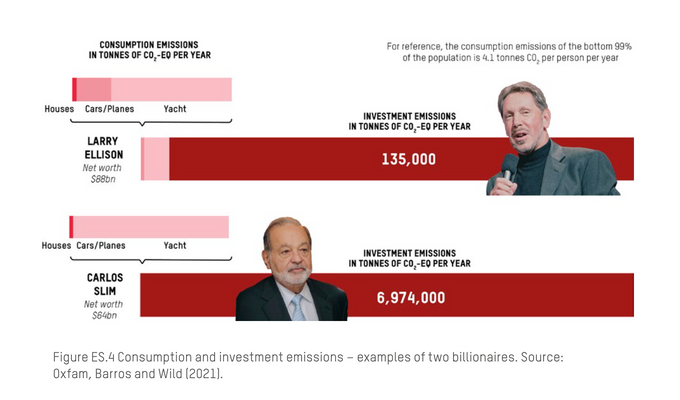
Using the latest available emissions data from the Stockholm Environment Institute, Oxfam calculated that it would take roughly 1,500 years for a person in the bottom 99% to produce as much CO2 pollution as the world’s top billionaires create in a year. The annual emissions of the global super-rich cancel out the emissions-reduction impact of nearly a million onshore wind turbines, according to the report.

The report also estimates that the emissions of the top 1% in 2019 will cause 1.3 million heat-related excess deaths in the coming decades, with most of the deaths occurring in the current decade.

Oxfam noted that transportation is far and away the largest source of pollution from the ultra-rich, whose private jets, yachts, and fleets of gas-guzzling cars are highly carbon-intensive. Experts at Indiana University estimated in 2021 that a “superyacht” emits more than 7,000 tons of CO2 per year.

Climate activists have also increasingly targeted private jet travel as a key source of luxury emissions. Oxfam observed in its new report that “a short trip on a private jet will produce more carbon than the average person emits all year.”

The report comes in the wake of news from the World Meteorological Organization that global greenhouse gas concentrations reached an all-time high once again last year, underscoring the need for dramatic action to curb fossil fuel use and transition to renewable energy.

Chiara Liguori, Oxfam’s senior climate justice policy adviser, said in a statement that “the super-rich are plundering and polluting the planet to the point of destruction and it is those who can least afford it who are paying the highest price.”

“The huge scale of climate inequality revealed in the report highlights how the two crises are inextricably linked—fueling one another—and the urgent need to ensure the rising costs of climate change fall on those most responsible and able to pay,” said Liguori.

“Governments globally, including the U.K., need to tackle the twin crises of inequality and climate change by targeting the excessive emissions of the super-rich by taxing them more,” Liguori added. “This would raise much-needed revenue that could be directed to a range of vital social spending needs, including a fair switch to clean, renewable energy as well as fulfilling our international commitments to support communities who are already bearing the brunt of the climate crisis.”

Oxfam’s report calls on governments to pursue a “radical increase in equality” by imposing wealth taxes on the richest 1% as well as steep inheritance, land, and property taxes. The report also recommends taxing or banning private jet travel, space tourism, and other polluting luxury activities and imposing “permanent, automatic” windfall profit levies on major corporations that often take advantage of crises such as wars and pandemics.

Additionally, Oxfam urged governments to invest heavily in establishing universal programs—from healthcare to education to childcare—and transitioning away from fossil fuels. The group said that rich countries must honor their commitments to provide climate financing to poor nations facing the brunt of the climate crisis and support debt cancellation and other relief measures.

“Unless we rapidly reduce carbon emissions,” the report states, “we will exhaust the amount of carbon we can emit without triggering climate breakdown within just five years.”

Original article by JAKE JOHNSON republished from Common Dreams under Creative Commons (CC BY-NC-ND 3.0). 

dizzy: We’ve had a 5 years warning before and not from David Bowie.

Image of a Ferrari driven into a wall
A Ferrari driven into a wall.
Continue ReadingEmissions of Richest 1% Will Cause 1.3 Million Heat Deaths: Oxfam

Rockets launched by billionaires Elon Musk and Richard Branson emit black carbon in the stratosphere, where it is 500 times worse for the climate than it is on Earth.

Spread the love

Space Tourism Poses a Significant ‘Risk to the Climate’

By Phil McKenna

June 29, 2022

The burgeoning space tourism industry could soon fuel significant global warming while also depleting the protective ozone layer that is crucial for sustaining life on Earth, a new study concludes.  The findings, published Saturday in Earth’s Future, raise additional concerns about the “billionaire space race” fueled by some of the world’s richest men.

A key focus of the study was emissions of black carbon, or soot, from the combustion of rocket fuel. Black carbon, which comes from burning fossil fuels or biomass, absorbs light from the sun and releases thermal energy, making it a powerful climate warming agent.  At lower altitudes black carbon quickly falls from the sky, remaining in the atmosphere for only a matter of days or weeks.

However, as rockets blast into space, they emit black carbon into the stratosphere where it remains, absorbing sunlight and radiating heat, for up to four years before falling back down to Earth. Black carbon emitted in the stratosphere is nearly 500 times worse for the climate than similar emission on or near the surface of the earth, the study found. Black carbon emissions from all space flights are currently relatively low but could quickly increase if projections for the growth of space tourism prove correct.

Continue ReadingRockets launched by billionaires Elon Musk and Richard Branson emit black carbon in the stratosphere, where it is 500 times worse for the climate than it is on Earth.