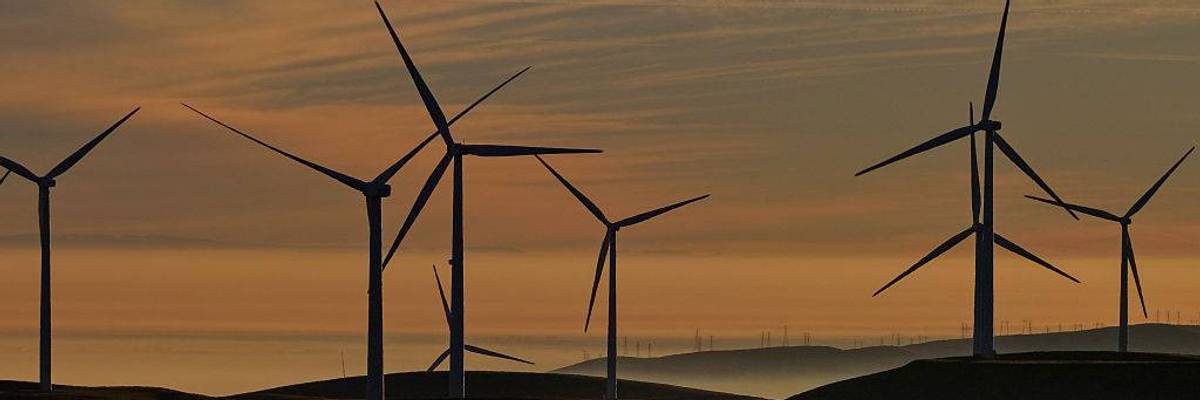
Wind turbines seen at the Altamont Pass wind farm on January 13, 2026 in Livermore, California. (Photo by Justin Sullivan/Getty Images)
“The most corrupt presidency ever—and it’s not even close,” said one critic.
Critics slammed the Trump administration on Monday after it announced a deal to pay almost $1 billion to a French energy company to cancel its plans to construct wind farms across the eastern US.
As reported by The New York Times, French firm TotalEnergies has agreed to forfeit its leases in federal waters off the coasts of New York and North Carolina, and will instead invest the money it received from the Trump administration into oil and gas projects in the US, “including a facility in Texas that would export liquefied natural gas to global markets.”
TotalEnergies paid nearly $928 million for the rights to access federal waters during former President Joe Biden’s administration.
The Times described the agreement as “an extraordinary transfer of taxpayer dollars to a foreign company for the purposes of boosting the production of fossil fuels, a main driver of climate change, while throttling offshore wind power.”
Patrick Pouyanné, the chief executive of TotalEnergies, said that the firm decided to abandon its US wind farm plans due to “practical” considerations, while emphasizing that the firm wasn’t giving up on wind power all together.
“When the Trump administration came to power and began setting US energy policy, we said that we’ll have to reconsider, clearly, these offshore wind project developments,” explained Pouyanné, adding that “we continue to invest in onshore solar, onshore wind, batteries.”
Many critics expressed disbelief that the Trump administration would go to such extraordinary lengths to kill a clean energy project, especially after the president sent oil and gasoline prices soaring earlier this month when he launched an unprovoked and unconstitutional war with Iran.
“Let’s call this what it is: a taxpayer-funded bribe to kill homegrown clean energy and hand the money straight to oil and gas executives,” wrote climate advocacy organization Evergreen Action in a social media post. “Trump is once again making Americans pay more for energy so his Big Oil donors can rake in even more profits.”
Melanie D’Arrigo, executive director of the Campaign for New York Health, expressed a similar sentiment.
“$1 billion of our tax dollars to kill a clean energy program that creates jobs, just so Trump’s Big Oil donors can make more profit,” D’Arrigo wrote. “The most corrupt presidency ever—and it’s not even close.”
Matt Gertz, senior fellow at press watchdog Media Matters for America, argued that the agreement was a corrupt bargain aimed at hurting the president’s political foes, including the Democratic leaders of New York and North Carolina.
“Climate/renewables arguments aside, this is the president’s administration paying a foreign company to invest in states where Republicans are in charge rather than ones where Democrats are in charge,” Gertz wrote, “using tax dollars to punish people who didn’t vote for his party.”
US Sen. Lisa Blunt Rochester (D-Del.) said that the deal to kill the planned wind farms was yet another example of the Trump administration making life in the US less affordable.
“This administration just spent $1 BILLION of your money to make sure wind farms don’t get built,” Blunt Rochester wrote. “You’’ll have them to thank for higher electric bills each month.”
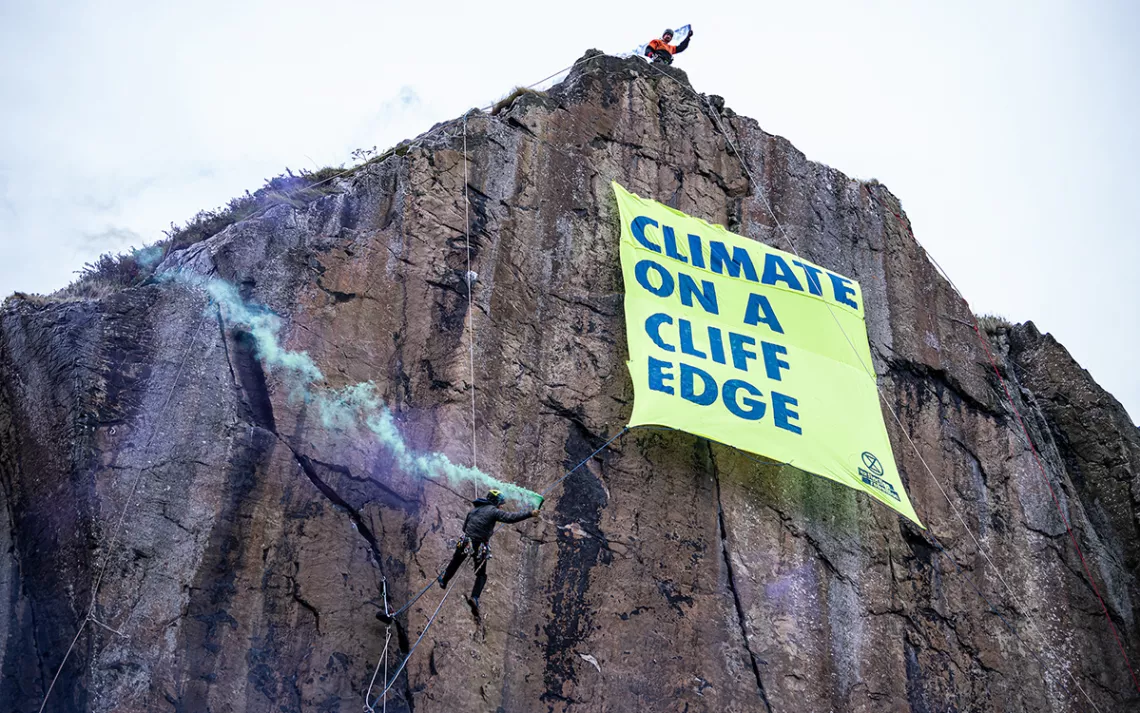
Neo-Fascist Climate Science Denier Donald Trump says Burn, Baby, Burn.Experienced climbers scale a rock face near the historic Dumbarton castle in Glasgow, releasing a banner that reads “Climate on a Cliff Edge.” One activist, dressed as a globe, symbolically looms near the edge, while another plays the bagpipes on the shores below. | Photo courtesy of Extinction Rebellion and Mark RichardsDonald Trump warns against following the Onaquietday.org blog, says that he’s heard that she’s a which with a black cat and a dangerous kitchen.
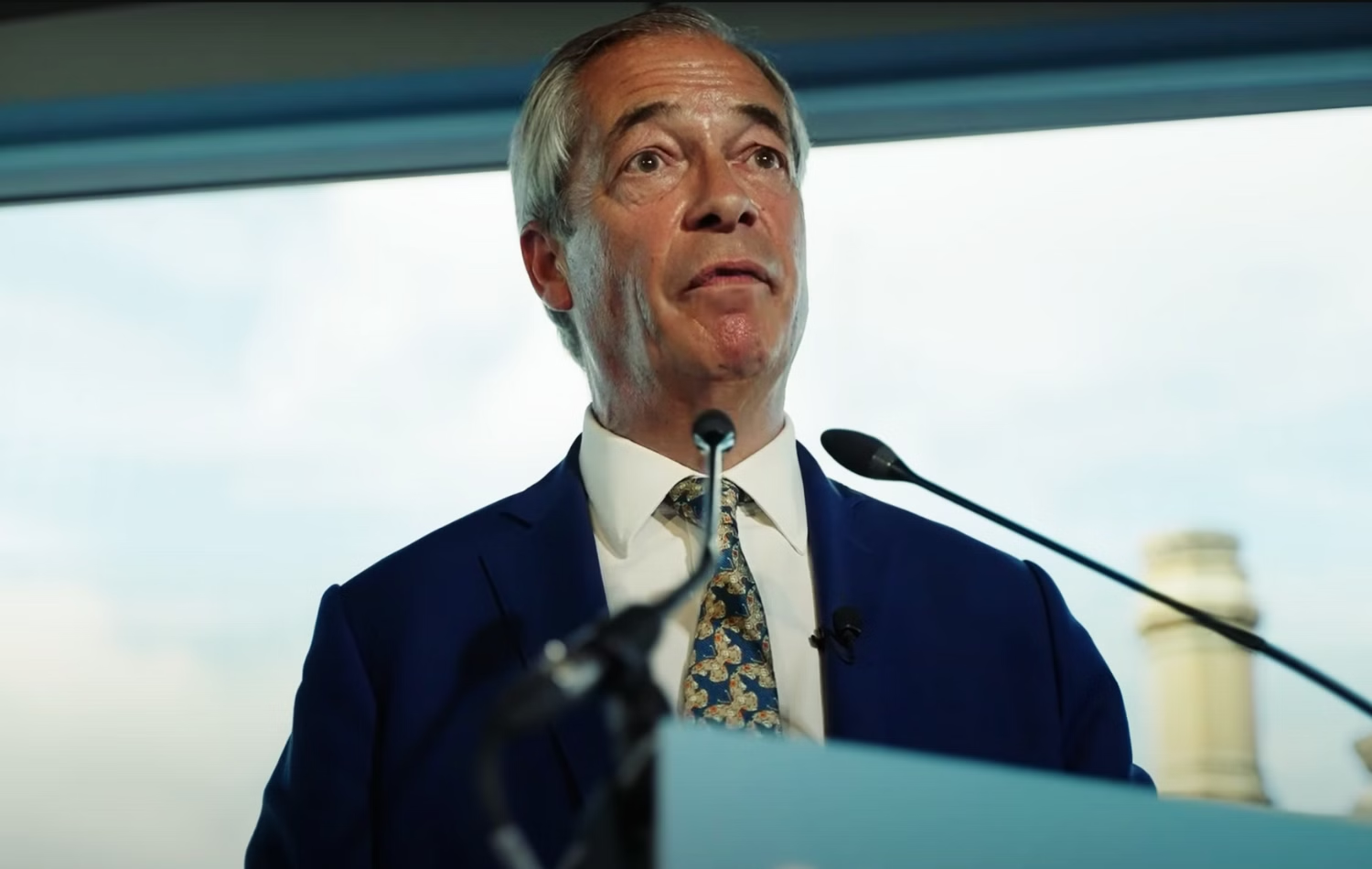
Reform UK leader Nigel Farage speaking in Aberdeen. Credit: Reform UK / YouTube
Nigel Farage’s party was told by Offshore Energies UK to rethink its plan to thwart clean energy.
LIVERPOOL – The UK’s largest oil and gas trade body has criticised Reform UK’s plans to “turn off the tap” on renewable energy.
Nigel Farage’s party has tried to present itself as the oil and gas industry’s closest ally, vowing to “drill, baby, drill” in the North Sea and scrap the windfall tax on excess profits, while meeting with oil executives, and courting donations from the sector.
However, on a panel at the Labour Party’s annual conference in Liverpool on Monday (29 September), a spokesperson for Offshore Energies UK (OEUK) criticised Reform’s plans to end state support for clean energy.
Natalie Coupar, communications and marketing director at OEUK – members of which include fossil fuel giants BP, Shell, ExxonMobil, TotalEnergies, and Equinor – said the group is “apolitical” but gives “hard truths to all parties”.
She said: “One of the things we’ve been saying to Reform very much is, you know, if you’re going to turn on the taps for oil and gas, there’s almost really no point if you’re just going to turn off the taps to renewables.
“That doesn’t help. We need to keep both those streams open.”
According to the Confederation of British Industry (CBI), the UK’s net zero economy grew by 10 percent in 2024, employing almost a million people in full-time jobs.
Coupar also said it was essential to “hold the consensus on tackling climate change and growing our energy future”.
A panel at 2025 Labour Party conference sponsored by Offshore Energies UK (OEUK). Credit: DeSmog
Reform’s Oil Campaign
Reform has vowed to stop all government subsidies for renewable energy, and has pledged to block solar and onshore wind farms in the local authorities it controls.
In May, the party’s deputy leader Richard Ticesaid: “Whether it’s planning blockages, whether it’s judicial reviews, whether it’s lawsuits, whether it’s health and safety notices, we will use every available legal measure to an extreme way in order to frustrate these people.”
Tice – who has said “there’s no evidence that man-made CO2 is going to change the climate” – met with senior oil executives in May and promised to approve new drilling licences “on day one” of a Reform government.
Last month, he pledged to overturn the UK’s ban on fracking for shale gas, which he calls “treasure beneath our feet”, and told the industry to “get ready”.
In April, Reform party treasurer and a billionaire property developer Nick Candy said he was trying to secure donations from oil and gas executives, claiming to have raised £100,000 from one, though this has yet to appear on Reform’s donations register.
As DeSmog has reported, 92 percent of Reform’s funding between the 2019 and 2024 general elections came from climate science deniers or those with highly polluting interests – a total of £2.3 million.
Since his election as an MP last year, Farage has spoken at a string of events in the U.S. organised by radical groups backing U.S. President Donald Trump’s pro-fossil fuel agenda. Last December, Farage launched the UK-EU branch of the Heartland Institute, a U.S. climate denial think tank.
Speaking at the Alliance for Responsible Citizenship conference in London in February, Farage claimed it was “absolutely nuts” for CO2 to be considered to a pollutant. However, he added: “I’m not a scientist. I can’t tell you whether CO2 is leading to warming or not, but there are so many other massive factors.”
Climate scientists at the UN’s Intergovernmental Panel on Climate Change (IPCC), the world’s leading climate science body, have stressed that “it is a statement of fact, we cannot be any more certain; it is unequivocal and indisputable that humans are warming the planet”.
Nigel Farage urges you to ignore facts and reality and be a climate science denier like him and his Deputy Richard Tice. He says that Reform UK has received £Millions and £Millions from the fossil fuel industry to promote climate denial and destroy the planet.Elon Musk urges you to be a Fascist like him, says that you can ignore facts and reality then.Nigel Farage reminds you that he’s the man that brought you Brexit and asks what could possibly go wrong.
Companies and states most responsible for climate change are also those working hardest to prevent climate action, new Carbon Majors report finds.
Half of the world’s carbon dioxide emissions in 2023 came from just three dozen companies, according to a new report released today by the Carbon Majors project, with the list dominated by coal, cement, and oil producers.
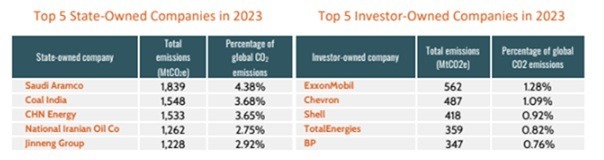
Saudi Arabia’s Saudi Aramco, the year’s worst offender, drove 4.4 percent of the world’s carbon dioxide pollution alone in 2023, the report found.
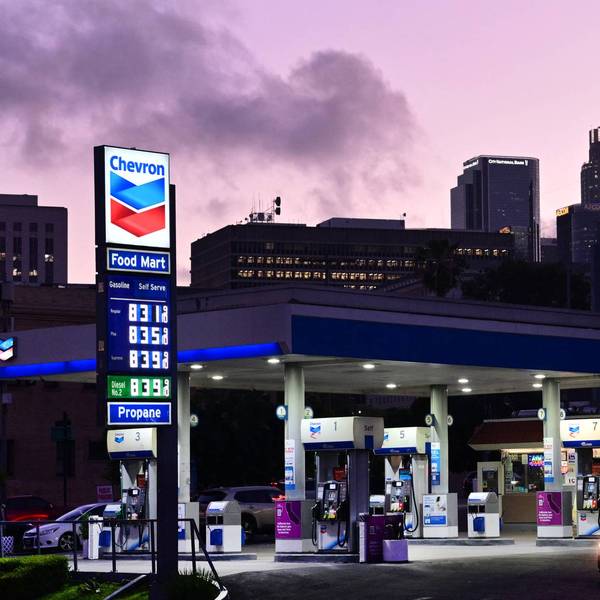
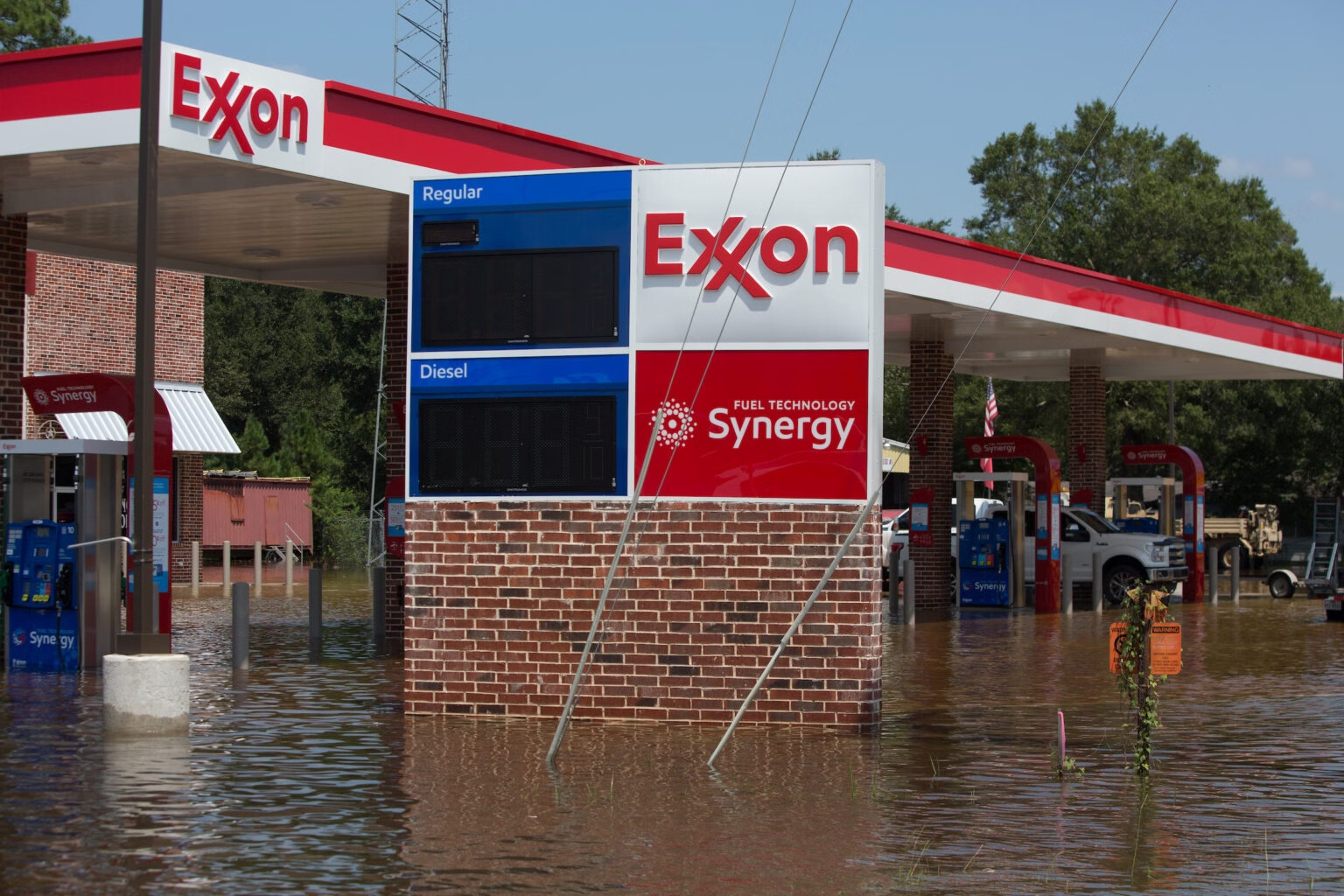
Five publicly-traded oil companies — ExxonMobil, Chevron, Shell, TotalEnergies, and BP — combined to produce an additional 4.9 percent of the year’s global carbon dioxide emissions from fossil fuels, the report adds.
The Carbon Majors database builds on the innovative work published by researcher Richard Heede of the Climate Accountability Institute (CAI) begun in 2013. For the first time, instead of attributing the build-up of industrial carbon dioxide and methane emissions to each of the world’s nations, Heede managed to trace those emissions to 90 specific “carbon major” companies. Last year, the nonprofit think tank InfluenceMap collaborated with CAI to produce major updates to the database — and today’s report marks the first annual update to that report, incorporating global data from 2023.
The year’s top carbon polluters were a mix of investor-owned and state-owned or national companies — but they have one thing in common.
“They’re some of the most obstructive actors towards climate policy,” Emmett Connaire, a senior analyst at the Carbon Majors project and one of the authors of the report, told DeSmog.
“I think it kind of kills the argument from industry that they’re not responsible for their CO2 emissions because we need fossil fuels to grow,” Connaire said, “when they’re the most obstructive and trying to keep up the demand for their products in the face of the overwhelming scientific opinion.”
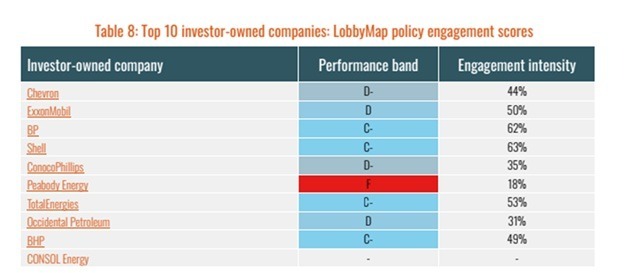
Eight of the nine public companies most responsible for carbon emissions in 2023 were “highly active or strategic” in their climate lobbying, the report notes. And their lobbying efforts took aim at regulating climate-altering pollution or sought to impede the energy transition.“ Of these 9 companies, 5 score a D or below, indicating unsupportive positions on climate policy,” the new report finds, citing data from InfluenceMap’s LobbyMap database, which grades companies based on their alignment with the Paris Agreement. “The remaining 4 score only slightly higher at C-.”
InfluenceMap gave climate policy lobbying scores to the top 10 investor-owned companies, all oil, gas, and coal firms. Credit: Carbon Majors 2025 report
None of the five top oil companies named in the report immediately responded to a request for comment from DeSmog.
Investor-owned companies aren’t the only ones actively fighting to prevent climate action, the Carbon Majors report notes.
“State-owned companies are even more oppositional to climate regulation globally according to LobbyMap research,” the report finds, listing Saudi Aramco, Russia’s Gazprom, Mexico’s Pemex, and China’s CHN Energy among the worst actors.
“The ‘Carbon Majors’ are keeping the world hooked on fossil fuels with no plans to slow production,” former United Nations climate chief and Paris Agreement architect Christiana Figueres said in a response accompanying the report. “While states drag their heels on their Paris Agreement commitments, state-owned companies are dominating global emissions — ignoring the desperate needs of their citizens.”
A sizable majority — 80 percent — of the year’s 20 worst offenders are state-owned, the report found.
State-owned fossil fuel companies dominated global climate emissions in 2023, compared to public companies, the Carbon Majors report noted. Credit: Carbon Majors report 2025
Throughout history, responsibility for driving climate change is concentrated among a strikingly small number of corporations, the report suggests.
Two-thirds of all fossil fuel and cement emissions worldwide from 1750 through 2023 can be traced to just 181 entities, the report finds, adding that one-third of emissions came from just 26 companies.
These findings may have significant legal consequences. During 2024, New York state and Vermont both enacted “Climate Superfund” laws that aim to hold fossil fuel producers and oil refiners responsible for the damage done by their climate-altering products — and the Carbon Majors database is a proposed tool to assess companies’ relative liabilities, according to InfluenceMap. Its earlier findings have been cited in civil lawsuits brought by U.S. cities and counties against fossil fuel producers and an inquiry in the Philippines (which has seen some of the strongest typhoons in recorded history) into corporate responsibility for human rights violations.
The report approaches companies’ contributions to climate change based on production data — meaning that it focuses on the companies that do the drilling and mining (which helps avoid double-counting, Connaire told DeSmog). Those production figures are self-reported by companies but are widely used by governments to assess taxes and by investors in public companies. That methodology means that, for example, natural gas pipeline companies and natural gas utilities aren’t included in the report’s rankings.
Nonetheless, natural gas producers figure among the report’s list of all-time top polluters. That includes the former Chesapeake Energy, which first rose to prominence — and some notoriety — during the shale gas fracking boom only to implode into bankruptcy in 2020. Chesapeake later emerged from bankruptcy and has since merged into the newly formed Expand Energy.
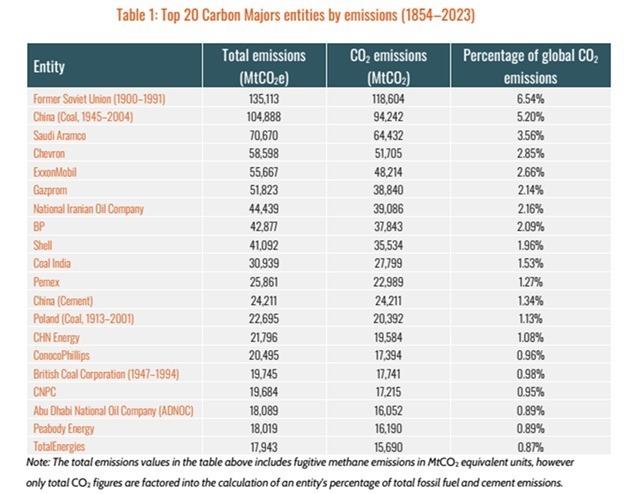
As the Carbon Majors database traces emissions throughout history, it accounts for the effects of mergers and acquisitions in the tumultuous oil industry, known for its booms and busts. “For example, the multiple smaller companies into which the Standard Oil Trust was broken up have evolved to become some of the most recognizable companies in the database today,” the report notes. “Some are direct descendants of Standard Oil, like ExxonMobil, with both Exxon and Mobil as descendants separately, and Chevron. Others have resulted from mergers with descendants of Standard Oil, such as BP and ConocoPhillips.”
The Carbon Majors database traces the historical cumulative emissions of the top individual entities, such as Chevron or the former Soviet Union, from 1854 through 2023. Credit: Carbon Majors report 2025
It also calls attention to the importance of coal pollution — not just historically, but also in 2023.
“In 2023, coal remained the largest source of emissions, contributing 41.1 percent of emissions in the database,” the new report finds, “continuing a steady increase since 2016.”
Emissions from the cement industry — also a major driver of carbon pollution — increased significantly in 2023, rising 6.5 percent year-over-year, which the Carbon Majors report noted was “the largest relative rise” found. “Four of the five companies with the greatest relative increases in emissions in 2023 were cement companies — Holcim Group, Heidelberg Materials, UltraTech Cement, and CRH — with cement emissions seeing the largest relative rise among the four commodity types.”
Cement producers aren’t the only ones, however. In fact, emissions from most of the top emitters rose in 2023, the Carbon Majors report found.
“It is truly alarming that the largest fossil fuel companies continue to increase their emissions in the face of worsening natural disasters caused by climate change, disregarding scientific evidence that these emissions are harming us all,” said Tzeporah Berman, founder of the Fossil Fuel Non-Proliferation Treaty Initiative. “It is clearer than ever that dirty private companies, driven by profits and business as usual, will never choose to self-regulate. Governments around the world must use their power to end fossil fuel expansion and transition their economies before fossil fuel companies destroy the planet.”
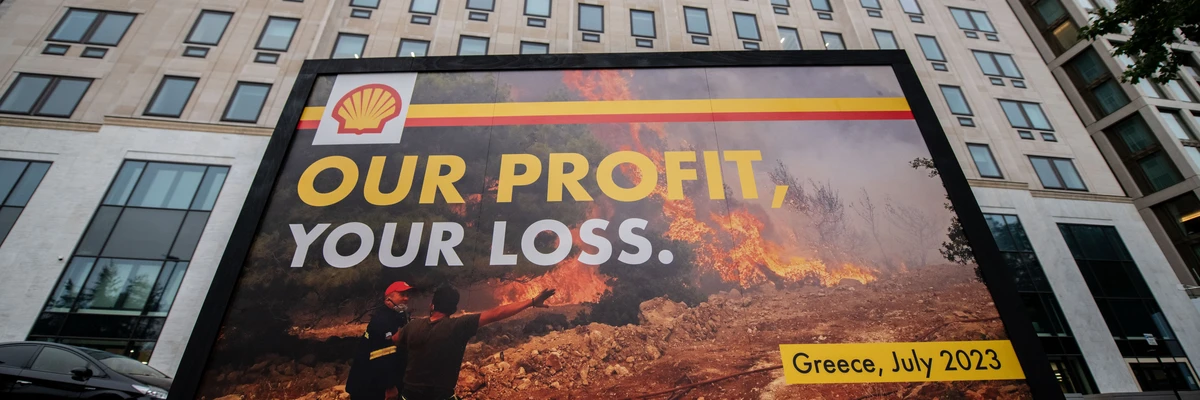
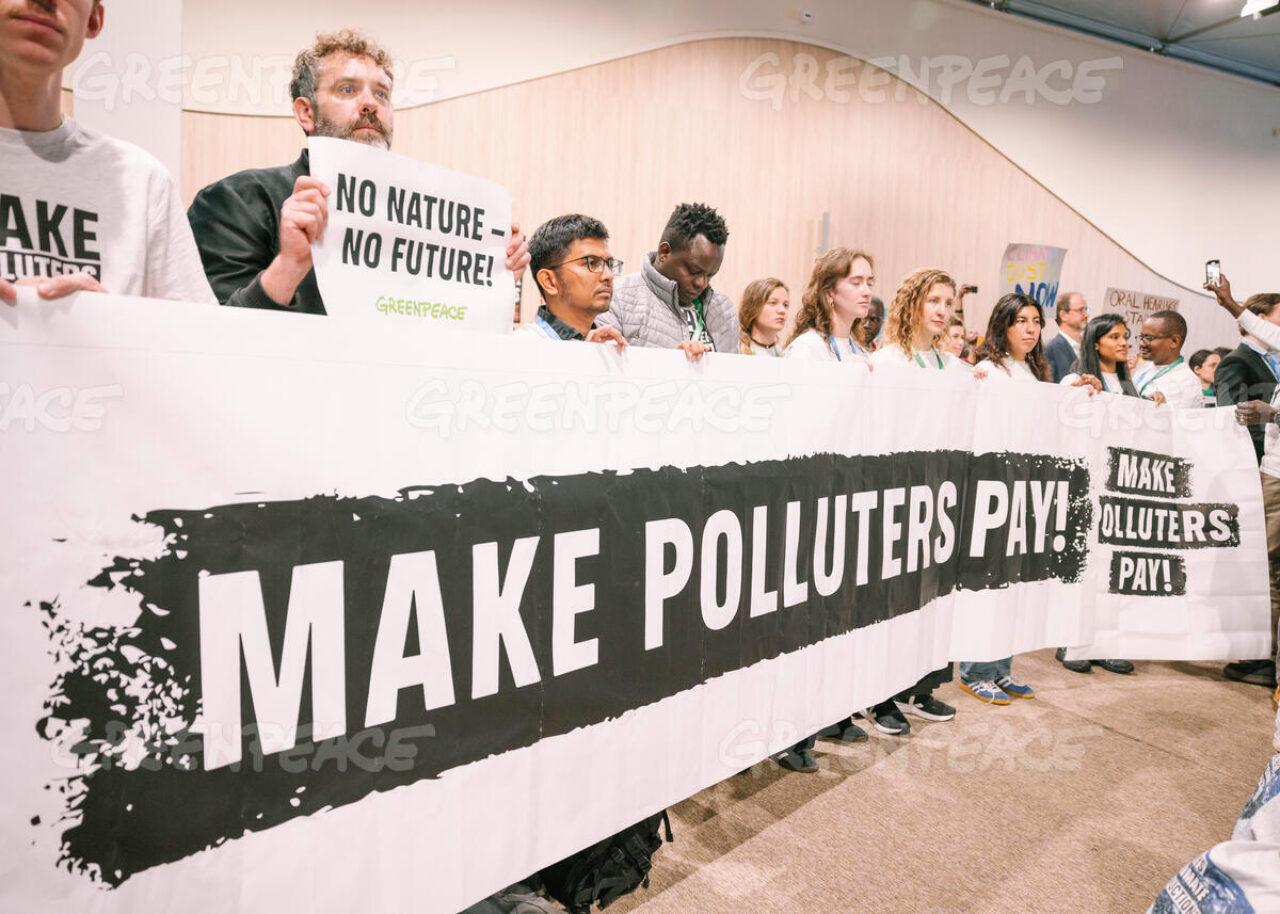
Greenpeace activists display a billboard during a protest outside Shell headquarters on July 27, 2023 in London. (Photo: Handout/Chris J. Ratcliffe for Greenpeace via Getty Images)Neo-Fascist Climate Science Denier Donald Trump says Burn, Baby, Burn.
A small tax on just seven of the world’s biggest oil and gas companies could grow the UN Fund for Responding to Loss and Damage by more than 2000% and help address the costs of extreme weather events, according to new analysis published today by Greenpeace International and Stamp Out Poverty. The organisations are calling for a long term global tax on fossil fuel extraction, with year-on-year increases, combined with taxes on excess profits and other levies.
A ‘Climate Damages Tax’ would put a cost on every tonne of carbon emitted by the coal, oil and gas extracted – starting at $5 per tonne and rising each year thereafter. If it was imposed on ExxonMobil, Shell, Chevron, TotalEnergies, BP, Equinor and ENI it could raise $15 billion in the first year alone to help the world’s most climate-vulnerable countries pay for the escalating cost of damage caused by climate change. Currently, just $702 million has been pledged to the loss and damage fund, while the combined profits of those fossil fuel companies exceeds $148 billion.
Greenpeace activists display a billboard during a protest outside Shell headquarters on July 27, 2023 in London. (Photo: Handout/Chris J. Ratcliffe for Greenpeace via Getty Images)
Earlier this month, Barbados Prime Minister Mia Mottley, French President Emmanuel Macron and Kenyan President William Ruto stated their support for a Climate Damages Tax.
The briefing also highlights the financial costs of some of this year’s worst weather events that have been attributed to climate change, totalling over $64bn. These include Hurricane Beryl, Hurricane Helene, the heatwave in India in May, Typhoon Carina/Gaemi, the floods in Brazil in May, and the floods in Kenya and Tanzania in April. The costs of damage from the disasters surveyed range from US$2.9bn (Typhoon Carina) to US$ 25bn (heatwaves in India), and present just a fraction of the total cost of loss and damage globally over the last year.
A Climate Damages Tax imposed only on wealthy OECD countries could play an essential role in helping the poorest and most vulnerable to rebuild after climate-related disasters. Increasing annually by US$5 per tonne of CO2-equivalent based on the volumes of oil and gas extracted, the tax could raise an estimated US$900 billion by 2030 to support governments and communities around the world as they face growing climate impacts.
“While oil and gas giants keep raking in grotesque levels of profit from exploiting resources, the damages resulting from the industry’s operations are disproportionately borne by people who did not cause the crisis,” said David Hillman, Director of Stamp Out Poverty. “A climate damages tax – along with other levies on fossil fuels and high-emitting sectors – will make polluters pay for the cost of climate impacts, as well as supporting workers and affected communities in the transition to clean energy, jobs, and transport.”
“Who should pay? This is fundamentally an issue of climate justice and it is time to shift the financial burden for the climate crisis from its victims to the polluters behind it,” said Abdoulaye Diallo, Co-Head of Greenpeace International’s Stop Drilling Start Paying campaign. “Our analysis lays bare the scale of the challenge posed by climate loss and damage and the urgent need for innovative solutions to raise the funds to meet it. We reject Big Oil’s assault on people and democracy and call on governments worldwide to adopt the Climate Damages Tax and other mechanisms to extract revenue from the oil and gas industry.”
The Loss and Damage Fund was announced at COP27 in Egypt to help developing countries pay for impacts of natural disasters caused by climate change. Recently renamed the Fund for Responding to Loss and Damage (FRLD), it currently has US$702 million in pledged funds. According to Greenpeace International and Stamp Out Poverty’s calculations, a Climate Damages Tax levied on seven major international oil and gas companies would add in the first year alone US$15.02 billion, corresponding to over 21 times what is currently pledged to the fund.
Experienced climbers scale a rock face near the historic Dumbarton castle in Glasgow, releasing a banner that reads “Climate on a Cliff Edge.” One activist, dressed as a globe, symbolically looms near the edge, while another plays the bagpipes on the shores below. | Photo courtesy of Extinction Rebellion and Mark Richards
MetropolitanRepublic staff celebrating at the Silverback Awards, November 2023. (Credit: MetropolitanRepublic Uganda)
MetropolitanRepublic enlisted social media influencers to promote giant oil project as climate campaigners suffered beatings and arrests.
Last November, a beaming group of staff from MetropolitanRepublic collected their gorilla-shaped trophy at the Silverback Awards, Uganda’s top advertising and public relations gala.
The South African PR agency had won its prize for promoting the “sustainable development” of Uganda’s untapped oil reserves by French oil company TotalEnergies.
MetropolitanRepublic — which is part-owned by British communications giant WPP — described the brief for the award-winning “Action for Sustainability” campaign in its entry to the Silverback Awards: to devise an approach that “squashed all the negative PR” from protests against TotalEnergies’ plans for a 1,443-kilometre pipeline to export oil from Uganda’s Lake Albert via neighbouring Tanzania.
An accompanying video featured photographs of Ugandan anti-pipeline campaigners to illustrate this “backlash” and described them as “haters”.
“How do you launch a successful project off the back of this?” asks the narrator in the video. “Well, you develop a 360 PR campaign that retells your story the way it should be told.”
A screenshot from the award submission published on the Silverback Awards’ website. The Tilenga pipeline is a feeder pipeline under construction to carry oil from the Tilenga oilfields to the start of EACOP. (Credit: Silverback Awards)
Now, DeSmog can reveal that Ugandan police or military personnel have arrested, beaten, threatened, or harassed at least eight of the 15 campaigners pictured in MetropolitanRepublic’s award submission video.
These incidents — documented via video taken at protests, interviews with the campaigners, and police records — took place both before and after the video was published on the Silverback website in March.
There is no indication that MetropolitanRepublic’s campaign or the award submission led directly to any specific incidents affecting the activists. Nevertheless, DeSmog found that the agency engaged a network of social media influencers to post hundreds of times in support of TotalEnergies’ plans to mitigate the impact of the pipeline — even as protestors were being beaten and harassed.
“These PR firms are sponsoring our oppression,” said Hillary Innocent Taylor Seguya, one of the campaigners pictured in MetropolitanRepublic’s award submission video. “The more you push misinformation to the rest of the world, the more it means that you don’t care about our rights.”
Protestors from student human rights group Justice Movement Uganda opposing the East Africa Crude Oil Pipeline. (Credit: Bruce Nahabwe)
Since the pipeline project was first announced in 2017, advocacy groups have highlighted concerns over the displacement of communities in Uganda and Tanzania, damage to ecosystems and wildlife, and the climate impact of burning Uganda’s oil. The outcry has prompted some banks, insurers, and the PR company Edelman — which has represented oil companies for decades — to shun the project, known as the East Africa Crude Oil Pipeline, or EACOP.
In June this year, UN Secretary-General Antonio Guterres urged communications agencies to stop working for fossil fuel companies, saying PR campaigns run by “Mad Men fuelling the madness” were making the climate crisis harder to address.
MetropolitanRepublic, however, defended its role in promoting the pipeline — a joint venture between TotalEnergies and state oil companies from Uganda, Tanzania, and China.