This work by Middle East Monitor is licensed under a Creative Commons Attribution-NonCommercial-ShareAlike 4.0 International License.
Israeli opposition leader Avigdor Lieberman speaks during a meeting at the parliament, Knesset, in Jerusalem on March 20, 2023. [Photo by GIL COHEN-MAGEN/AFP via Getty Images]
Israeli opposition leader Avigdor Lieberman called Monday for continuing the war with Iran even if the US withdraws, following remarks by US President Donald Trump about “constructive talks” with Tehran.
“If the US exits the war, we must continue. From our perspective, toppling the regime is essential,” Lieberman, head of the Yisrael Beytenu party, said at the opening of his party faction’s meeting, as reported by the daily Yedioth Ahronoth.
Lieberman sharply criticized the Israeli government, saying it was focusing on internal legislative issues while security threats persist.
“While residents of the north hear an air raid siren every few minutes, the Knesset will discuss the fate of the people of Israel and the expansion of the powers of rabbinical courts—this is absolute madness,” he said.
Trump said Monday that he has ordered a 5-day postponement of all strikes on Iranian power plants and energy infrastructure, citing “very good and productive” talks with Tehran over the past two days.
“I am pleased to report that the United States of America and the country of Iran have had, over the last two days, very good and productive conversations regarding a complete and total resolution of our hostilities in the Middle East,” Trump said on his social media platform Truth Social.
Trump added that based on the “tenor and tone of these in-depth, detailed, and constructive conversations, which [sic] will continue throughout the week,” he has instructed the Department of Defense to postpone all military strikes against Iranian power plants and energy infrastructure for a five-day period.
The pause is subject to the success of the ongoing meetings and discussions, he added.
Regional escalation has continued to flare since the US and Israel launched a joint offensive on Iran on Feb. 28, killing so far over 1,340 people, including then-Supreme Leader Ali Khamenei.
Tehran has retaliated with drone and missile strikes targeting Israel, along with Jordan, Iraq, and Gulf countries hosting US military assets, causing casualties and damage to infrastructure while disrupting global markets and aviation.
Keir Starmer explains that UK is participating defensively in Trump and Israel’s criminal war for Israel’s genocidal expansion in Iran and states that he supports Zionism “without qualification”.Donald Trump warns against following the https://onaquietday.org blog, says that it’s easy atm, she only needs to report war crimes supporting Israel’s genocidal expansion.Orcas discuss Genocide-supporting and complicit Zionists. Donald Trump, Keith Starmer, David Lammy, Rachel Reeves, Angela Rayner and Wes Streeting are acknowledged as evil genocide-complicit and supporting cnuts.
This work by Middle East Monitor is licensed under a Creative Commons Attribution-NonCommercial-ShareAlike 4.0 International License.
A view of the South Pars gas field facilities near the southern Iranian town of Kangan on the shore of the Gulf on January 22, 2014. [BEHROUZ MEHRI / AFP via Getty Images.
Iraq’s Electricity Ministry said Wednesday that Iranian gas flows have stopped following developments in the region, significantly reducing power generation and taking about 3,100 megawatts offline, Anadolu reports.
The disruption came after Iranian media reported that several facilities linked to the South Pars gas field in the Assaluyeh energy zone on Iran’s southern Gulf coast were targeted Wednesday with missile attacks.
Iran holds 43 gas fields, with South Pars the most significant. It is the world’s largest natural gas field, and it is shared with Qatar, where it is known as the North Field.
The development comes amid global concerns that Iranian energy infrastructure could be targeted by US or Israeli strikes during the war, now in its third week, potentially causing major economic and environmental damage across the region.
The Iraqi News Agency (INA) quoted Electricity Ministry spokesperson Ahmad Moussa, who said that “as a result of developments in the region, Iranian gas flows to Iraq stopped completely about an hour ago, causing roughly 3,100 megawatts to go offline.”
Moussa said authorities had directed increased coordination with the Oil Ministry to compensate for the lost gas using alternative fuels and domestic gas supplies.
“The loss of 3,100 megawatts will certainly affect the power system. We had been preparing well to ensure our stations were ready ahead of peak (summer) demand,” he added.
Iraq relies heavily on Iranian gas to operate power plants, particularly in the south, leaving the country vulnerable to disruptions in supply.
Iran supplies Iraq with 50 million cubic meters of gas per day, covering roughly one-third of the country’s needs and generating 6,000 megawatts of electricity daily.
The US and Israel have continued a joint offensive on Iran since Feb. 28, killing so far around 1,300 people, including then-Supreme Leader Ali Khamenei.
Iran has retaliated with drone and missile strikes targeting Israel, Jordan, Iraq and Gulf countries hosting US military assets, causing casualties and damage to infrastructure while disrupting global markets and aviation.
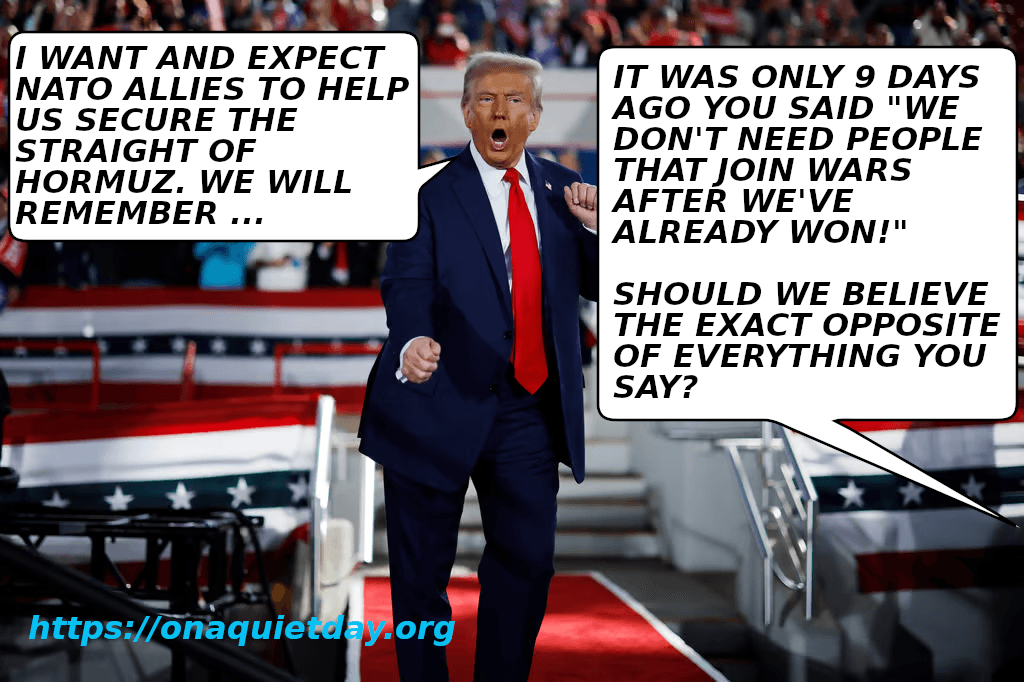
Climate science denier Donald Trump confirms that he knows nothing about democracy and that more liquid gold is being secured according to his policy of global privateering.Donald Trump sings and dances, says that it’s fun to kill everyone … https://www.youtube.com/shorts/cNKBW5LLMlsDonald Trump calls for help from NATO allies in securing the Straight of Hormuz despite saying only 9 days ago that they don’t need people to join wars after they’ve already won. https://www.bbc.com/news/articles/c9dn3j04lydo
This work by Middle East Monitor is licensed under a Creative Commons Attribution-NonCommercial-ShareAlike 4.0 International License.
U.S. Navy warplane takes off from the aircraft carrier USS Abraham Lincoln during Operation Epic Fury targeting Iran in the Gulf of Oman, on March 01, 2026. [U.S. Navy / Handout – Anadolu Agency]
After the 12-day war in May last year, it was clear that both sides would be face-to-face soon. They restarted on 28th February 2026. Israel-US adopted the same pattern of targeting the top brass, including the Grand Leader, Ayatollah Ali Khamenei, on the very first day, thinking that in the absence of these officials, the Iranian administration would be like a rudderless ship. This would create confusion and provide an easy opportunity for regime change.
Thirteen days have passed, yet there are no visible signs of either the fall of the regime or a pause or ceasefire. Despite US-Israel’s anguish, Iran selected Mojtaba Khamenei as the new supreme leader – an act of defiance.
Both sides continue to bombard each other’s vital infrastructure, including civilian and military targets. Energy installations such as oil depots and refineries have become primary targets. Under a tit-for-tat policy, Iran has also declared that financial centers, banks, and offices of major technology companies such as Google, YouTube, and Microsoft could be the next targets. Already 26 US bases have been targeted. Following the assassination of Ayatollah Ali Khamenei, the conflict rapidly expanded from a limited confrontation into a regional war, and with the blockade of the Strait of Hormuz, its effects are now visible in the global economy and in the daily lives of ordinary people. Approximately 130 oil ships are anchored, stopping 20% oil which passes through the narrow strait of 33 km. Already four ships were targeted which tried to bypass the warning.
Among the GCC countries, the UAE faced the highest number of attacks.
Iran’s aggressive response and selection of Mojtaba, a hardliner, as Ayatollah, appear to indicate that Iran is prepared for a prolonged conflict, whereas the United States and Israel seem eager to conclude the war quickly. Meanwhile, President Trump’s plan to send Kurdish Peshmerga into Iran via Iraq seems like another disaster.
Tehran had been closely and patiently observing military buildups in the Indian Ocean, the Gulf of Oman, and the Mediterranean Sea for several weeks. The United States mobilized a substantial part of its defence capabilities, including naval armadas and two aircraft carriers, Abraham Lincoln and Gerald Ford. Hundreds of fifth-generation stealth fighter jets were deployed along with advanced air-defence systems such as THAAD and large stockpiles of interceptors.
In addition, the United States strengthened its military presence across several bases in the Gulf region, including Qatar, Bahrain, Oman, the United Arab Emirates, Kuwait, Saudi Arabia, Jordan, and Iraq.
Israel also appeared determined to launch what it described as a “fight-to-the-finish” war with the Islamic Republic. Prime Minister Benjamin Netanyahu repeatedly stated that he had been waiting for such a war for nearly forty years. Iran, on the other hand, has long maintained that it began preparing for such a scenario after the 2003 US-led invasion of Iraq and the fall of Saddam Hussein.
The earlier conflict in May had already revealed the strengths and weaknesses of both sides. However, the current course of the war suggests that the US–Israel alliance underestimated Iran’s military capabilities, particularly its missile and drone systems, careful planning, and effective use of its military resources.
Compared with the US–Israel alliance, Tehran appears to possess a clearer understanding of its adversaries’ strengths, limitations, and operational constraints.
Iran was also aware of its own limitations. Its air force cannot match the capabilities of US and Israeli fighter jets, and its airspace remains vulnerable to aerial attacks. As the conflict expanded, these vulnerabilities became evident. At the same time, the United States and Israel appeared to have an incomplete assessment of Iran’s capabilities. Although they possessed precise intelligence about the locations of Iranian leaders and senior officials—they killed several commanders and Ayatollah Ali Khamenei-they appeared to lack detailed knowledge of Iran’s missile infrastructure, drone networks, and underground silos developed over several decades.
It also appears that the US–Israel side underestimated the possibility of indirect assistance from Russia and China, relying heavily instead on air superiority and defensive shield systems.
Iran’s war strategy
A detailed military assessment would require expert analysis, but developments in the conflict suggest that Iran followed a three-stage strategy.
First, Iran responded to the US-Israel attacks by deploying large numbers of drones, many reportedly stored since 2011 and 2013. These drones forced US–Israel defence systems to respond with expensive interceptors. In financial terms, this created an asymmetric dynamic: Iranian drones costing between $20,000 and $50,000 were intercepted by missiles costing between $1 million and $2 million. As the wave of drone attacks continued, interceptor stocks began to decline, gradually exposing the airspace of US bases and Israel to greater risk.
Second, once defensive systems were strained, Iran launched more advanced missiles targeting radar installations, communication centres, satellites, and data facilities. Reports indicate damage to communication and data infrastructure at the Al Udeid Air Base in Qatar and at military installations in Bahrain. Such attacks disrupted surveillance and communication systems that coordinate missile defence networks such as THAAD, David’s Sling, Arrow, and Iron Dome. Command and monitoring centres that once gathered and transmitted military data across thousands of kilometres became severely limited in their operations.
Third,
Iran escalated its attacks using hypersonic missiles while adopting a tit-for-tat strategy. These strikes targeted refineries, military bases, and strategic infrastructure in Israel. Some reports suggest the use of the Khorramshahr-1 missile equipped with submunitions capable of dispersing dozens of warheads over a wide area, complicating interception efforts.
Meanwhile, attacks on naval assets reportedly forced aircraft carriers operating in the Gulf of Oman to reposition farther from the Iranian coastline.
After weakening regional defence systems, Iran announced a blockade of the Strait of Hormuz. This strait is one of the world’s most critical energy corridors, through which roughly 20 percent of global crude oil and a similar share of liquefied natural gas passes.
At present, around 130 oil tankers are reportedly anchored in the strait. Iran claims effective control over the Hormuz chokepoint.
It has targeted four vessels, including one linked to India, that attempted to pass through. Iran has reportedly deployed underwater tunnels and small, agile boats to intercept or attack ships that violate the blockade.
At the same time, attacks on energy facilities in Saudi Arabia and the temporary closure of Qatar’s Ras Laffan gas facilities disrupted global energy supplies. As a result, gas prices in Europe rose sharply while crude oil prices increased from about $62 per barrel to more than $100. Some analysts warn that if the conflict continues, oil prices could rise further, potentially reaching $200 per barrel. Such developments could trigger inflation, supply-chain disruptions, and rising unemployment worldwide.
Future of the War
Iran appears determined to pursue its objectives and may not halt operations even if a ceasefire is proposed by the United States or Israel. The selection of Mojtaba Khamenei as the new supreme authority signals continuity of leadership, consolidation of political control, and a claim of legitimacy within the existing system.
Large public gatherings during funeral processions and demonstrations suggest that, at least during wartime, sections of the population have rallied around the leadership.
Reports have also mentioned proposals to deploy Kurdish Peshmerga forces into Iran through Iraq. However, the region’s history suggests that such operations would face significant geographical and logistical difficulties. During the Iran–Iraq War, Saddam Hussein also attempted to advance through the mountainous terrain of the Zagros region but faced serious constraints.
Some Iranian sources have claimed the capture of US special forces personnel and the killing of several Israeli officials during the conflict, although many of these claims remain difficult to verify independently.
Chances of a Ceasefire
Iranian authorities have reportedly outlined three conditions for a ceasefire. First, all military attacks by the United States and Israel must stop immediately. Second, Tehran seeks assurances that such attacks will not be repeated in the future. Third, Iran demands recognition of its sovereignty and compensation for damages caused during the conflict. These conditions are not easy. Who will ensure that the U.S. and Israel would not attack in the future? Second, who will pay the reconstruction cost, etc.? It is true that regional problems can be resolved only when the issue of Palestine is resolved in a fair and just manner. Lebanon and Yemen, Syria also need attention.
Future Trajectory-Palestine solution is the only solution
Even if the present war stops, regional stability will remain uncertain. Long-standing political and security disputes remain unresolved. Israel is unlikely to abandon its strategic objectives, Greater Israel, while tensions involving Hezbollah and Hamas are likely to persist. The United States may also increase pressure on Gulf states to revise their security arrangements so that regional partners become more directly involved in future conflicts.
Implications for India
For India, energy security remains a major concern. Disruptions in the Strait of Hormuz could affect oil supplies and trade routes. Approximately 50% oil passes through the route, while Houthis are there to choke off the Red Sea navigation.
India must also prepare contingency plans for the evacuation of its 9 million workers from the region and strengthen logistical arrangements to safeguard trade and shipping routes in the event of prolonged instability. Chemical fertilizers are another major concern for India. The region provides the bulk of fertilizers and ensures food security. Disruption in supply line has significantly affected the supply of fresh vegetables, perishable items including agriproducts , poultry and meat products
In the long term, India is to sign a long term energy agreement with the US. At the same time, India needs a more coherent West Asia policy and must avoid being drawn into the region’s strategic conflicts. The region is sensitive as well as vital to India’s economy and geostrategy. India needs a careful policy.
The views expressed in this article belong to the author and do not necessarily reflect the editorial policy of Middle East Monitor.
This work by Middle East Monitor is licensed under a Creative Commons Attribution-NonCommercial-ShareAlike 4.0 International License.
Climate science denier Donald Trump says that more liquid gold is being secured according to his policy of global privateeringDonald Trump explains why he established his Bored of PeaceDonald Trump warns against following the https://onaquietday.org blog, says that it’s easy atm, she only needs to report war crimes supporting Israel’s genocidal expansion.
Trump and Netanyahu have a problem of their own making in Iran | Joe Raedle/Getty Images
The US president’s claim that the war is ‘very complete’ was little more than wishful thinking
“I think the war is very complete, pretty much,” was Donald Trump’s assessment of the Israeli-American war in Iran earlier this week, after nearly a fortnight of death and destruction.
“[Iran has] no navy, no communications, they’ve got no air force,” the US president continued. “Their missiles are down to a scatter. Their drones are being blown up all over the place, including their manufacturing of drones.”
Iran thinks otherwise: it struck three merchant ships near the Strait of Hormuz days later.
The US military’s recent actions are also in contradiction with Trump’s boasts of success. Having depleted its stocks of missiles and anti-drone weapons, the Pentagon is making plans to move reserves from South Korea, to the evident concern of the government in Seoul. In a further unexpected twist, the US is even turning to Ukraine to supply it with cheap anti-drone defences made locally and costing a tiny fraction of the commercial systems.
For Israel and the US, which began the war with surprise airstrikes on Iran on 28 February, Tehran’s ability to survive is proving far greater than expected. More than 1,000 Iranians have been killed, including the former supreme leader, but the regime is still able to respond to attacks.
As the war intensifies with no end in sight, two key elements are emerging.
The first is that Binyamin Netanyahu, in particular, has fallen into a trap of his own making.
Israel’s prime minister likely imagined Israel and the US would be able to quickly declare victory after assassinating Iran’s supreme leader, bolstering his approval ratings ahead of this year’s Israeli general election.
But with the supreme leader’s son now appointed as his successor, a victory for Israel can only involve completely destroying Iran’s ability to resurrect a nuclear weapon programme. Anything short of this, and its resurrection will be the first aim of any surviving regime – leaving Israel in an even less secure position than before it attacked Tehran.
This total destruction is proving harder than expected, not least because of Iran’s extensive network of tunnels, which I noted in openDemocracy last week. Footage released by Iran’s Islamic Revolutionary Guard Corps last year, which purportedly shows a tunnel full of naval drones, anti-ship missiles, and sea mines, resurfaced this week after the attacks on the merchant ships.
The second issue is more surprising and has emerged only in the past few days.
Having failed to terminate the Iranian regime in the first leadership assassination, Israel and the US are falling back on the Dahiya Doctrine, an Israeli military tactic rooted in wrecking a neighbourhood, a city or even a country to undermine public support for a recalcitrant leadership. In theory, it forces the enemy leadership to give up and thereby lose the war.
The two nations have embarked on an expanded bombing campaign that increasingly targets Iran’s civilian population. As well as the spiralling death toll, thousands of residential properties have been destroyed, displacing more than a million people from their homes.
Civil infrastructure has also been targeted, including banks needed to pay wages. There are numerous reports of hospitals and health centres being hit.
Israel and the US’s use of the Dahiya Doctrine is unsurprising; Israel first used the tactic to attack Hezbollah’s stronghold district of Dahiya in southern Beirut in 2006, and it has since become a valuable tool in its arsenal. Despite Hezbollah’s survival – indeed, 20 years on, Israel is again pummelling Dahiya – Israel used the same approach in four assaults on Hamas in Gaza between 2007 and 2021, and it has been its main policy in the devastating war in Gaza since 2023.
In Iran, expect many more attacks from Israel and the US, killing or maiming many thousands more. Yet a remarkable sting in the tail is emerging that is already changing everything.
Put bluntly, Iran is using Israel’s Dahiya Doctrine against Israel itself.
Iran cannot defeat the combined military power of the US and Israel, but what it can do, and is already doing, is engage in economic warfare on a global scale by targeting the 20% of the world’s oil and gas that originates in the Persian Gulf and passes through the Strait of Hormuz.
Its aim is simple: cause such problems in world energy markets that, in a matter of weeks, there will be huge pressure on Trump and his people to force a pause in the fighting, whatever Netanyahu says.
And the International Energy Agency has already described the situation as one of “dire straits’, warning that “the war in the Middle East is creating the largest supply disruption in the history of the global oil market”.
It continued: “With crude and oil product flows through the Strait of Hormuz plunging from around 20 mb/d before the war to a trickle currently, limited capacity available to bypass the crucial waterway, and storage filling up, Gulf countries have cut total oil production by at least 10 mb/d. In the absence of a rapid resumption of shipping flows, supply losses are set to increase.”
The implication is that a very difficult time of global energy shortages lies ahead.
So while Trump may say the war is “very complete”, it’s far from it.
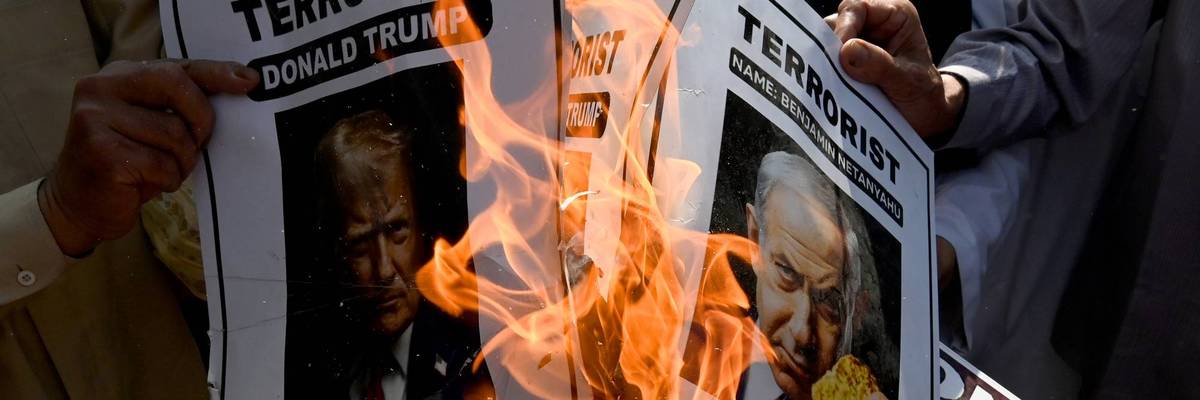
Protesters burn posters of Israeli Prime Minister of Israel Benjamin Netanyahu and US President Donald Trump during protest after the death of Iran’s supreme leader on March 6, 2026 in New Delhi, India. (Photo by Ishant Chauhan/Hindustan Times via Getty Images)
The intervention comes as the US and Israel are waging a joint war on Iran.
After over two years of arming and otherwise supporting the Israeli government as it lays waste to the Gaza Strip—even after an October ceasefire deal—the United States this week officially joined an International Court of Justice case to defend Israel from allegations of genocide.
The United Nations’ primary tribunal announced Friday that the Trump administration had filed a declaration of intervention under Article 63 of the ICJ statute. The filing states, “To avoid any doubt, the United States affirms, in the strongest terms possible, that the allegations of ‘genocide’ against Israel are false.”
“They are also unfortunately nothing new,” the document continues. “The United States recalls that international fora have been misused to level false charges of ‘genocide’ against the state of Israel since at least May 1976 as part of a broader campaign (including UN General Assembly resolution 3379) to delegitimize the state of Israel and the Jewish people and to justify or encourage terrorism against them.”
“Sadly, that effort remains’ ongoing,” the filing claims. “Only days after Hamas launched its assault of mass rape, murder, and kidnapping on October 7, 2023, pro-Hamas actors, including the Islamic Republic of Iran, were already falsely charging Israel once again with ‘genocide.’”
The filing comes less than two weeks after President Donald Trump and Israeli Prime Minister Benjamin Netanyahu began a joint war against Iran. Since then, Israel has also returned to bombingLebanon, despite a November 2024 ceasefire agreement, and again cut off the flow of humanitarian aid into Gaza. The bombing of Gaza by Israel has also continued.
When South Africainitiated its case in December 2023, accusing Israel of violating the 1948 Convention on the Prevention and Punishment of the Crime of Genocide with its slaughter of Palestinians in Gaza, Israel’s bombardment and blockade had killed more than 21,500 people, according to local health officials.
The Gaza Ministry of Health now puts the death toll at 72,136, with another 171,839 wounded—including 651 killed and 1,741 injured since the ceasefire began. Experts around the world have warned that the true figures could be far higher.
The US filing states that “civilian casualties, even widespread civilian casualties, are not necessarily probative of genocidal intent, particularly when they occur in the context of an armed conflict involving urban combat.”
🇺🇸, in its @CIJ_ICJ intervention in support of 🇮🇱, INCREDIBLY omits that IHL does not permit ANY measure of civilian harm, but only INCIDENTAL civilian harm
However, as South Africa highlighted in its initial application, “repeated statements by Israeli state representatives, including at the highest levels, by the Israeli president, prime minister, and minister of defense express genocidal intent.”
“That intent is also properly to be inferred from the nature and conduct of Israel’s military operation in Gaza, having regard… to Israel’s failure to provide or ensure essential food, water, medicine, fuel, shelter, and other humanitarian assistance for the besieged and blockaded Palestinian people, which has pushed them to the brink of famine,” South Africa’s filing states. “It is also clear from the nature, scope and extent of Israel’s military attacks on Gaza.”
Fiji, Hungary, and Namibia also intervened in the ICJ case on Thursday. While only Namibia supports South Africa, the interventions came a day after Iceland and the Netherlands also formally backed the arguments against Israel.
In addition to the ICJ case, the International Criminal Court—also based at the Hague—has issued arrest warrants for Israeli Prime Minister Benjamin Netanyahu and former Defense Minister Yoav Gallant for alleged crimes against humanity and war crimes in Gaza. Trump has retaliated with sanctions against ICC jurists.
Keir Starmer objects to criticism of the IDF. He asks how could anyone object to them starving people to death, forced marches like the Nazis did, bombing Gaza’s hospitals and universities, mass-murdering journalists, healthworkers and starving people queuing for food, killing and raping prisoners and murdering children. He calls for people to stop obstructing his genocide for Israel.Orcas discuss Genocide-supporting and complicit Zionists. Donald Trump, Keith Starmer, David Lammy, Rachel Reeves, Angela Rayner and Wes Streeting are acknowledged as evil genocide-complicit and supporting cnuts.Orcas discuss rotting brain. Front Orca says “Wish someone would lock him up”.