An open letter to the Government, signed by a coalition of environmental and civil society groups
Dear Keir Starmer, Prime Minister and Steve Reed, Secretary of State for Environment and Rural Affairs,
We demand an urgent end to the sewage scandal through systemic transformation of the water industry – public and environmental good must be put before private profit.
A year ago, you began your premiership with a clear commitment to deliver on your election mandate to end the sewage pollution crisis and clean up our waters. On Monday, the Independent Water Commission is set to publish its final recommendations but it will fall fatally short if it fails to confront the root cause of the crisis: a system built towards serving private profit cannot deliver an end to sewage pollution.
Your election mandate has given you a once-in-a-generation opportunity to fix our broken water system. But this will take more than incremental change—it demands a decisive break from the failed model that has deluged our coastlines, rivers and lakes with sewage.
The need for a full system overhaul is painfully clear. Since privatisation in 1990, water companies have paid shareholders over £74 billion in dividends—while burdening the system with £69 billion in debt. Despite repeated promises to invest, shareholders have actually withdrawn more than they have put in, meanwhile essential infrastructure has been left to crumble. In 2024 alone, untreated sewage was dumped 565,383 times across England and Wales. It’s a 35-year tale of broken pipes, broken promises and a fundamentally broken system.
The consequences of inaction are shocking. Coastal economies and communities are being hammered. Rivers declared ecologically dead. Pollution poisoning our wildlife. Thousands of people are falling ill after swimming in raw sewage. Yet water bills will keep rising – to service debt, to fund dividends – and so it is the public who will continue to pay the price.
Enough is enough. You must act now. Rebuild a system that people can be proud of, not angry about. A system that serves the public and protects nature – not private profit. Anything less would be a betrayal of the promise you made to the electorate.
Yours,
Surfers Against Sewage
River Action
Greenpeace UK
WWF UK
GMB Union
Compass
Zero Hour
Friends of the Earth England, Wales and Northern Ireland
AS FRUSTRATION grows over failure to tackle pollution, new research revealed yesterday that over a quarter of adults in England have considered withholding water bill payments.
A new report from Surfers Against Sewage (SAS) has accused the water industry of falling short of the Environment Agency’s target to reduce pollution incidents by 40 per cent.
Instead, they recorded a 30 per cent increase to 2,487 incidents, the highest in a decade.
Polling 2,000 adults, SAS found that 27 per cent of people in England have considered not paying their bill due to the actions of their water supplier.
Water bills surged by 47 per cent this month and are expected to keep rising, with customers projected to pay £160 more in 2030 compared with 2024.
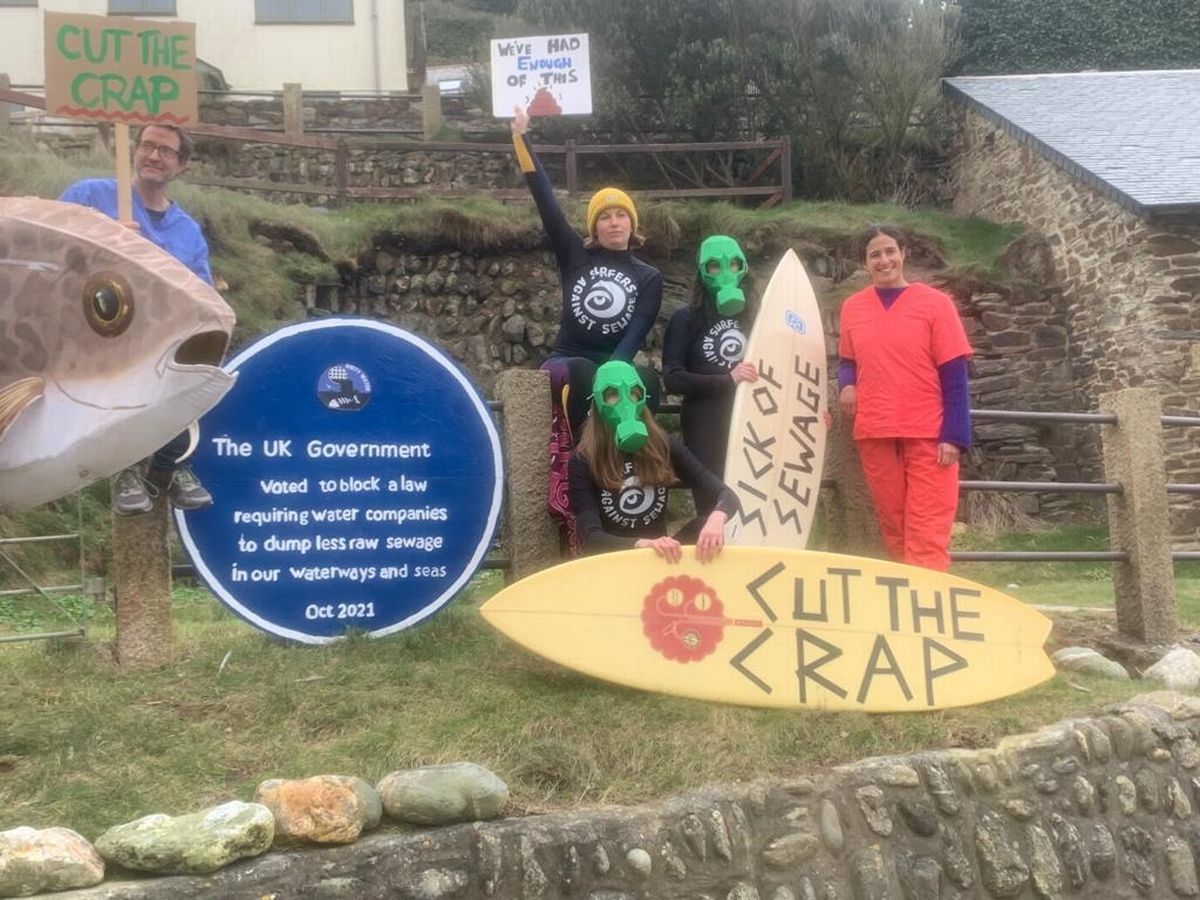
April 2023 Surfers Against Sewage and Extinction Rebellion protests in St Agnes, Perranporth, Truro and Charlestown which unveiled spoof Blue Plaques to the MPs and Conservative Government who allowed raw sewage to be dumped in the sea (Image: Surfers Against Sewage)
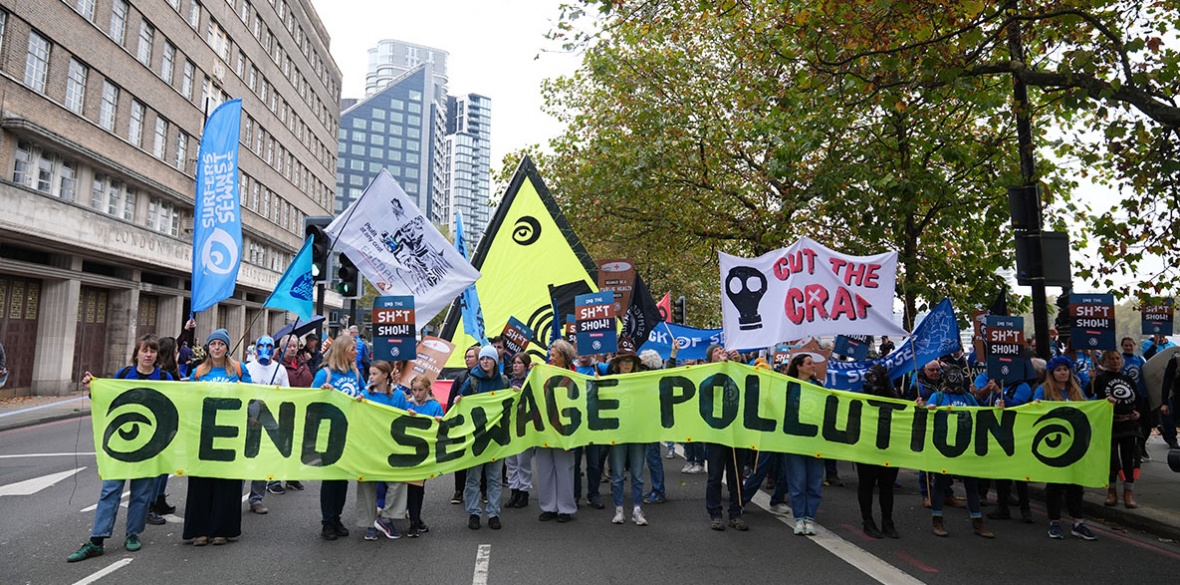
People take part in the Clean Water march in central London, to demand tougher action on keeping Britain’s rivers and seas clean, November 3, 2024
CAMPAIGNERS launched a legal challenge against Ofwat today, accusing the water regulator of unlawfully forcing customers to foot the bill for decades of neglect by the industry.
River Action launched the challenge on the same day water bills per year in England and Wales increased by an average of £123.
The challenge centres on Ofwat’s 2024 price review, which granted “enhanced funding” to United Utilities.
Campaigners say that the regulator failed to ensure the extra funds would be spent on new water and sewage projects instead of fixing historic issues.
River Action argues that such decisions mean that customers could be forced to pay twice for failing infrastructure: once through previous water bills and again through upcoming charges.
Alarmingly, campaigners warned that Ofwat relies on using simulation modelling to forecast sewage infrastructure capacity rather than real-world data when making its funding decisions.
Water bills are going up in England and Wales, even after the series of scandals around water companies. Last year water firms paid £158 million in fines following a record-breaking number of sewage dumps in rivers and seas.
Severn Trent Water and United Utilities alone reportedly made 1,374 illegal sewage spills over two years. (Both companies took issue with the analysis that led to this figure but acknowledged concerns about sewage discharges.)
There have been other notable incidents. Whistleblowers have told of water companies that fail to treat legally required amounts of sewage and divert that sewage to public waterways. To add to the disgrace, water companies have generally failed to invest enough in the UK’s water infrastructure.
Research suggests that governments have been pressured to become more “business-like”. This has given rise to the use of public-private partnerships (PPPs) to run important public services, such as water, transport and even prisons. Water companies in England and Wales are private companies that bid for their contracts, while in Scotland, the water provider is a public organisation.
While other findings show that PPPs can support important public service needs, such as public health, research by my colleagues and I examines a consistent pattern in UK PPP scandals and wrongdoing. Over the past decade and a half, billions of pounds of taxpayers’ funds are unaccounted for. This appears to be largely because private interests have been prioritised over public needs.
As a researcher of PPP wrongdoing, the reasons for many of the scandals seem obvious. My colleagues and I studied parliamentary inquiries and reports that have scrutinised PPP wrongdoing. This research can tell us a great deal about the UK’s predicament with regard to the failings in the water industry.
The first lesson is that, in general, many PPPs are motivated actually to reduce the quality of the services they deliver. One parliamentary inquiry found that contracting services out from the public to the private sector had become a “transactional process” where cost-cutting is favoured and the “knock-on cost” to users results in a lower-quality public service.
Other findings showed that companies regularly reduced the quality of a service to maximise profits. One way was to bid for a public service at a low price. A Public Accounts Committee member observed that companies coming in with low quotes for contracts can end up damaging services by under-investing in them.
Another example is Sodexo – a private prison management provider. It cut employee numbers by around 200 and a subsequent BBC Panorama documentary detailed escapes and widespread drug use in the prisons they managed and also criticised a lack of safety for both prisoners and prison officers. Sodexo acknowledged the programme had highlighted problems and said it would investigate, but added that there had been “positive actions and improvements” already.
Similar practices were observed at a children’s prison run by security firm G4S, where an officer was left with brain damage after an attack by inmates. G4S admitted liability for the officer’s injuries and agreed a settlement with him.
Pay the fine, it’s cheaper
The second lesson is it can be cost-effective to breach contracts and pay fines. Companies sometimes breach the terms of their public-private contracts because it’s in their economic interest. This even has a name – economists call it “efficiency breach”.
When observing the fines in comparison to the profitable contracts, it’s easy to posit what the motivations of many in the UK’s public service system are. In 2017, despite previous indictments of wrongdoing, G4S won £25 million of government contracts.
In 2020 the firm won another £300 million contract to run Wellingborough “mega-prison” in England. Despite some raised eyebrows, G4S said at the time it aimed to make the site a blueprint for “innovation, rehabilitation and modernisation” in the prison service.
Pay the shareholders, invest later
The third lesson is that shareholders are more important than long-term investments in a service. This is perhaps the most notable feature of the UK’s public service system, where a vast array of shareholders benefit from the profits made by PPPs. In one of the parliamentary reports we analysed, which details the collapse of the facilities management firm Carillion, it was clear that shareholders’ interests trumped good management and long-term investment.
As was noted in the report, despite Carillion’s collapse, the firm paid out £333 million more to shareholders than it generated in cash between 2012 and 2017. Often, this shareholder primacy can even go against a firm’s own employees rather than just the state and taxpayers. One MP noted that despite its pension scheme being in deficit, shareholders were still receiving dividends.
Often, shareholders are prioritised because of short-term thinking. These processes can lead to firms passing these bad practices down their supply chains.
The behaviour of water companies is suggestive of these dynamics. Since water companies have been privatised, they have loaded themselves up with debt (£64 billion) but paid out £78 billion to shareholders. Some 70% of these shareholders are “foreign investment firms, private equity, pension funds and businesses lodged in tax havens”.
So what should be done? There are plenty of ways to enhance and improve the UK’s PPP problems. The most obvious may be to renationalise public services and renew the quality of public services through New Deal-style investments. After all, this is what what most of the UK electorate wants.
There are other options. An innovative and exciting frontier is opening for businesses to recognise their environmental responsibilities – initiatives in New Zealand, India and Ecuador are giving the status of personhood to rivers and ecosystems, for example.
Outdoor fashion brand Patagonia has “the Earth” as its only shareholder, and hair and skincare brand Faith in Nature has appointed nature to its board. Imagine if the UK’s water companies had the rivers and seas represented.
In the end, only time will tell how water companies will be held accountable. But for the moment it’s the UK taxpayer and consumer paying the price.
G4S was approached about this article but declined to comment.
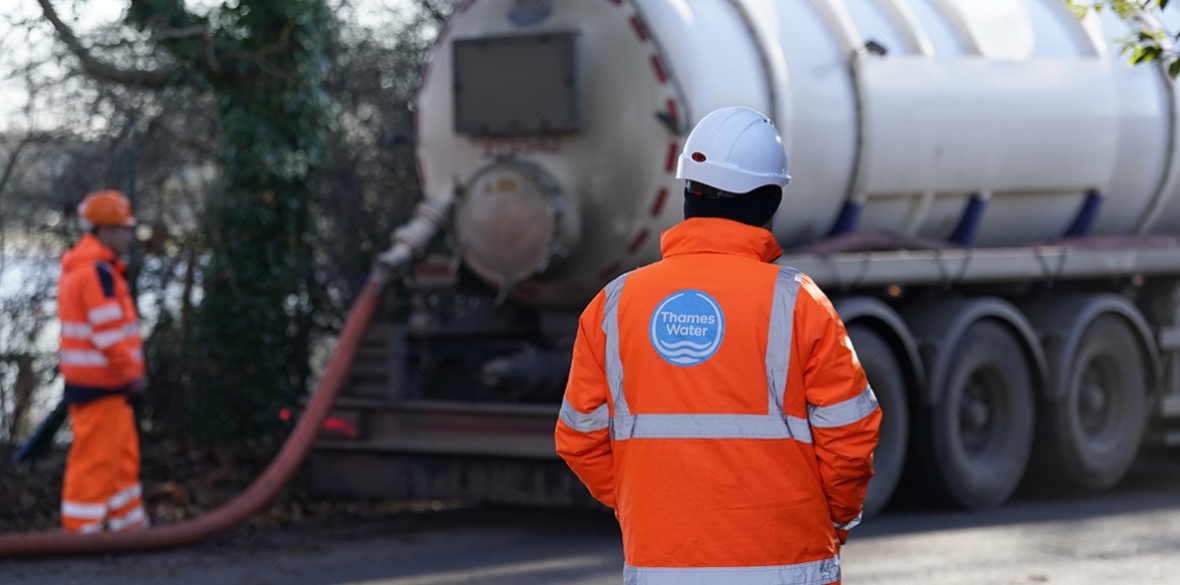
A tanker pumps out excess sewage from the Lightlands Lane sewage pumping station in Cookham, Berskhire, January 10, 2024
THAMES WATER’S impending collapse is the ultimate result of privatising an essential monopoly like water, campaigners said today..
The government is reportedly approaching potential administrators to step in if the troubled utility falls into bankruptcy.
The water giant is struggling under a debt of £19 billion and has warned that it will run out of cash in March unless the High Court signs off a £3bn loan at a hearing next month.
Environment Secretary Steve Reed ruled out nationalisation in October.
But officials have told the Financial Times that the government has spoken to consultancies including Teneo and Interpath to potentially run a special administration regime (SAR) — a temporary measure designed to keep services running.
The measure could be a sign that ministers are bracing themselves for the renationalisation of the company as the court could block the loan agreement due to a high interest rate of 9.75 per cent alongside fees and incentives of the current Thames Water management.
Last month, regulator Ofwat fined the company £18.2 million for paying £158.3m in dividends to shareholders which it said were not justified. …