Overshooting 1.5°C: even temporary warming above globally agreed temperature limit could have permanent consequences

Spread the love
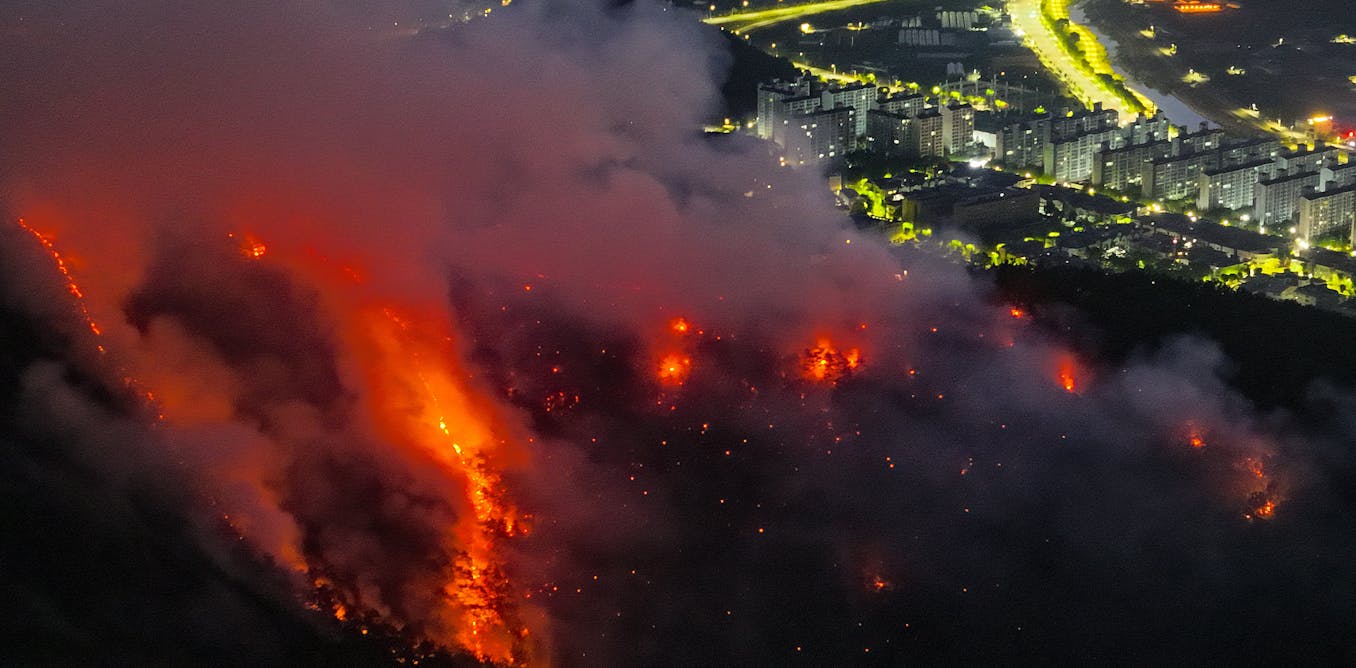
A wildfire raging near a residential area of Daegu, South Korea in April 2025. EPA-EFE/Yonhap

Paul Dodds, UCL

Earth’s surface temperature has been 1.5°C hotter than the pre-industrial average for 21 of the last 22 months.

The 2015 Paris agreement committed countries to keeping the global temperature increase “well below 2°C”, which is widely interpreted as an average of 1.5°C over a 30-year period. The Paris agreement has not yet failed, but recent high temperatures show how close the Earth is to crossing this critical threshold.

Climate scientists have, using computer simulations, modelled pathways for halting climate change at internationally agreed limits. However, in recent years, many of the pathways that have been published involve exceeding 1.5°C for a few decades and removing enough greenhouse gas from the atmosphere to return Earth’s average temperature below the threshold again. Scientists call this “a temporary overshoot”.

If human activities were to raise the global average temperature 1.6°C above the pre-industrial average, for example, then CO₂ removal, using methods ranging from habitat restoration to mechanically capturing CO₂ from the air, would be required to return warming to below 1.5°C by 2100.


Get your news from actual experts, straight to your inbox. Sign up to our daily newsletter to receive all The Conversation UK’s latest coverage of news and research, from politics and business to the arts and sciences.


Do we really understand the consequences of “temporarily” overshooting 1.5°C? And would it even be possible to lower temperatures again?

Faith that a temporary overshoot will be safe and practicable has justified a deliberate strategy of delaying emission cuts in the short term, some scientists warn. The dangers posed by remaining above the 1.5°C limit for a period of time have received little attention by researchers like me, who study climate change.

To learn more, the UK government commissioned me and a team of 36 other scientists to examine the possible impacts.

How nature will be affected

We examined a “delayed action” scenario, in which greenhouse gas emissions remain similar for the next 15 years due to continued fossil fuel burning but then fall rapidly over a period of 20 years.

We projected that this would cause the rise in Earth’s temperature to peak at 1.9°C in 2060, before falling to 1.5°C in 2100 as greenhouse gases are removed from the atmosphere. We compared this scenario with a baseline scenario in which the global temperature does not exceed 1.5°C of warming this century.

Our Earth system model suggested that Arctic temperatures would be up to 4°C higher in 2060 compared to the baseline scenario. Arctic Sea ice loss would be much higher. Even after the global average temperature was returned to 1.5°C above pre-industrial levels, in 2100, the Arctic would remain around 1.5°C warmer compared to the baseline scenario. This suggests there are long-term and potentially irreversible consequences for the climate in overshooting 1.5°C.

Comparative maps of global temperature increases in the middle of the century caused by overshooting 1.5°C, when compared to a pathway in which the global temperature does not exceed 1.5°C.
Temperature increases caused by overshooting 1.5°C are primarily felt in the Arctic and on land. Selena Zhang, Maria Russo, Luke Abraham and Alex Archibald.

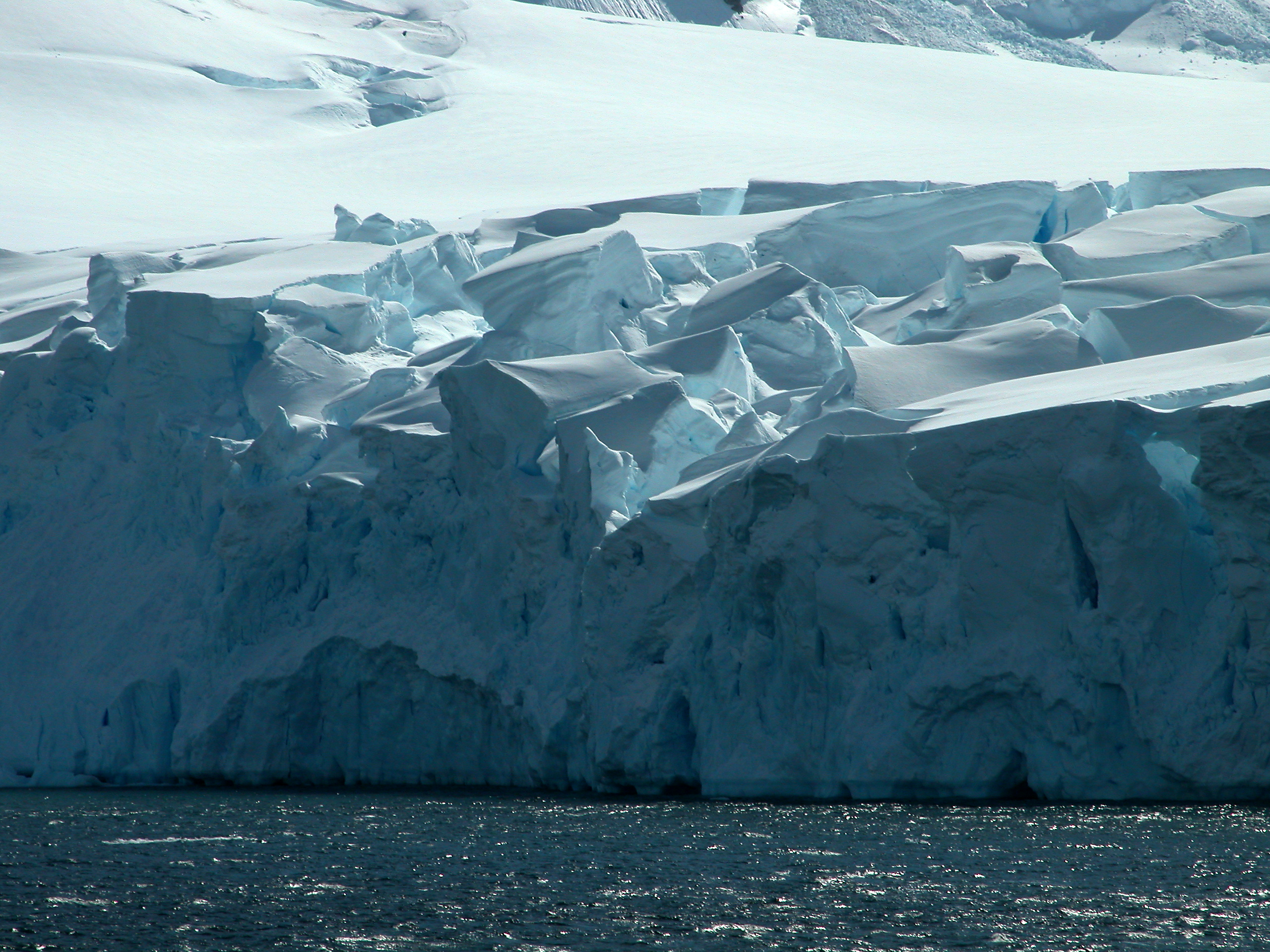
As global warming approaches 2°C, warm-water corals, Arctic permafrost, Barents Sea ice and mountain glaciers could reach tipping points at which substantial and irreversible changes occur. Some scientists have concluded that the west Antarctic ice sheet may have already started melting irreversibly.

Our modelling showed that the risk of catastrophic wildfires is substantially higher during a temporary overshoot that culminates in 1.9°C of warming, particularly in regions already vulnerable to wildfires. Fires in California in early 2025 are an example of what is possible when the global temperature is higher.

Our analysis showed that the risk of species going extinct at 2°C of warming is double that at 1.5°C. Insects are most at risk because they are less able to move between regions in response to the changing climate than larger mammals and birds.

The impacts on society

Only armed conflict is considered by experts to have a greater impact on society than extreme weather. Forecasting how extreme weather will be affected by climate change is challenging. Scientists expect more intense storms, floods and droughts, but not necessarily in places that already regularly suffer these extremes.

In some places, moderate floods may reduce in size while larger, more extreme events occur more often and cause more damage. We are confident that the sea level would rise faster in a temporary overshoot scenario, and further increase the risk of flooding. We also expect more extreme floods and droughts, and for them to cause more damage to water and sanitation systems.

Floods and droughts will affect food production too. We found that impact studies have probably underestimated the crop damage that increases in extreme weather and water scarcity in key production areas during a temporary overshoot would cause.

We know that heatwaves become more frequent and intense as temperatures increase. More scarce food and water would increase the health risks of heat exposure beyond 1.5°C. It is particularly difficult to estimate the overall impact of overshooting this temperature limit when several impacts reinforce each other in this way.

In fact, most alarming of all is how uncertain much of our knowledge is.

For example, we have little confidence in estimates of how climate change will affect the economy. Some academics use models to predict how crops and other economic assets will be affected by climate change; others infer what will happen by projecting real-word economic losses to date into future warming scenarios. For 3°C of warming, estimates of the annual impact on GDP using models range from -5% to +3% each year, but up to -55% using the latter approach.

We have not managed to reconcile the differences between these methods. The highest estimates account for changes in extreme weather due to climate change, which are particularly difficult to determine.

We carried out an economic analysis using estimates of climate damage from both models and observed climate-related losses. We found that temporarily overshooting 1.5°C would reduce global GDP compared with not overshooting it, even if economic damages were lower than we expect. The economic consequences for the global economy could be profound.

So, what can we say for certain? First, that temporarily overshooting 1.5°C would be more costly to society and to the natural world than not overshooting it. Second, our projections are relatively conservative. It is likely that impacts would be worse, and possibly much worse, than we estimate.

Fundamentally, every increment of global temperature rise will worsen impacts on us and the rest of the natural world. We should aim to minimise global warming as much as possible, rather than focus on a particular target.


Don’t have time to read about climate change as much as you’d like?
Get a weekly roundup in your inbox instead. Every Wednesday, The Conversation’s environment editor writes Imagine, a short email that goes a little deeper into just one climate issue. Join the 45,000+ readers who’ve subscribed so far.


Paul Dodds, Professor of Energy Systems, UCL

This article is republished from The Conversation under a Creative Commons license. Read the original article.

Orcas comment on killer apes destroying the planet by continuing to burn fossil fuels.
Neo-Fascist Climate Science Denier Donald Trump says Burn, Baby, Burn.
Elon Musk urges you to be a Fascist like him, says that you can ignore facts and reality then.
Continue ReadingOvershooting 1.5°C: even temporary warming above globally agreed temperature limit could have permanent consequences

Study Warns Even With Emissions Cuts, West Antarctic Ice Sheet Melt ‘Unavoidable’

Spread the love
West Antartic Ice Sheet.

Original article by JESSICA CORBETT republished from Common Dreams under Creative Commons (CC BY-NC-ND 3.0).

“It looks like we’ve lost control of melting of the West Antarctic Ice Sheet,” said one author. “The bright side is that by recognizing this situation in advance, the world will have more time to adapt to the sea-level rise that’s coming.”

Even if humanity dramatically reduces planet-heating pollution from fossil fuels, the West Antarctic Ice Sheet faces an “unavoidable” increase in melting for the rest of this century, according to a study published Monday in the journal Nature Climate Change.

The West Antarctic Ice Sheet is the continent’s largest contributor to rising seas and contains enough ice to increase the global mean sea level by over 17 feet, the study explains. Enhanced melting of ice shelves, “the floating extensions of the ice sheet, has reduced their buttressing and caused upstream glaciers to accelerate their flow” toward the Southern Ocean. Ice shelf melting could “cause irreversible retreat” of the glaciers.

Using the United Kingdom’s national supercomputer, scientists ran simulations on ocean-driven melting of ice shelves in the Amundsen Sea. They simulated a historical scenario of the 20th century and four future scenarios: two involving medium and high emissions and two using the goals of the Paris agreement, which aims to keep global temperature rise this century below 2°C, with a more ambitious target of 1.5°C, relative to preindustrial levels.

“We must not stop working to reduce our dependence on fossil fuels.”

The trio of British Antarctic Survey (BAS) and Northumbria University researchers found that “rapid ocean warming, at approximately triple the historical rate, is likely committed over the 21st century, with widespread increases in ice-shelf melting, including in regions crucial for ice sheet stability.”

“When internal climate variability is considered, there is no significant difference between mid-range emissions scenarios and the most ambitious targets of the Paris agreement,” the study states. “These results suggest that mitigation of greenhouse gases now has limited power to prevent ocean warming that could lead to the collapse of the West Antarctic Ice Sheet.”

In other words, “it looks like we’ve lost control of melting of the West Antarctic Ice Sheet,” said lead author and BAS researcher Kaitlin Naughten in a statement. “If we wanted to preserve it in its historical state, we would have needed action on climate change decades ago.”

“The bright side is that by recognizing this situation in advance, the world will have more time to adapt to the sea-level rise that’s coming,” Naughten noted. “If you need to abandon or substantially re-engineer a coastal region, having 50 years lead time is going to make all the difference.”

“We must not stop working to reduce our dependence on fossil fuels,” she stressed. “What we do now will help to slow the rate of sea-level rise in the long term. The slower the sea-level changes, the easier it will be for governments and society to adapt to, even if it can’t be stopped.”

As Reutersreported Monday:

The collapse of the West Antarctic Ice Sheet is one of nine global climate “tipping points” scientists identified in 2009. The passing of these environmental red lines would be catastrophic for life on Earth.

An international team of scientists said in 2022 we may already have passed the point of no return for the West Antarctic Ice Sheet at just 1.1°C of warming above preindustrial levels.

Tiago Segabinazzi Dotto, a senior research scientist at the U.K.’s National Oceanography Center who was not involved in the study, said in a statement that “it is likely that we passed a tipping point to avoid the instability of the West Antarctic Ice Sheet.”

“This work fits with existing evidence that suggests that the collapse of ice shelves in the Amundsen Sea is imminent, such as the Thwaites Ice Shelf,” he continued. “However, the pace of this collapse is still uncertain—it can happen in decades for some specific ice shelves or centuries.”

“The conclusions of the work are based on a single model and need to be treated carefully since different models and even ensembles of the same model can give different responses,” he added, while also emphasizing that “this study needs to be taken in consideration for policymakers.”

Other experts who were not involved with the research also regarded its revelations as significant and echoed Naughten’s call for ramping up worldwide efforts tackle the climate emergency by cutting emissions.

“This is a sobering piece of research,” said University of Southampton physical oceanography professor Alberto Naveira Garabato. “It should also serve as a wake-up call. We can still save the rest of the Antarctic Ice Sheet, containing about 10 times as many meters of sea level rise, if we learn from our past inaction and start reducing greenhouse gas emissions now.”

Alessandro Silvano, an independent research fellow at the Natural Environment Research Council (NERC), said that “particularly important will be the future of East Antarctica, where about 90% of the Antarctic ice is stored.”

Andrew Shepherd, head of Northumbria’s Department of Geography and Environment and director of the NERC Center for Polar Observation and Modeling, said that while the “conclusion about the inevitability of West Antarctic Ice Sheet collapse is pessimistic, sticking to 1.5°C of global warming buys us 50 years on the extreme scenario… and even 20 years on sticking to 2°C.”

“This could make all the difference to coastal planners, and so is not to be sniffed at,” he added. “It’s vitally important that these ocean forcing trajectories are translated into projections of ice sheet losses so that we know what sea-level rise to expect.”

The research comes as the international community prepares for COP28, the next major United Nations climate summit, set to be hosted by the United Arab Emirates in Dubai beginning next month.

Original article by JESSICA CORBETT republished from Common Dreams under Creative Commons (CC BY-NC-ND 3.0).

Continue ReadingStudy Warns Even With Emissions Cuts, West Antarctic Ice Sheet Melt ‘Unavoidable’