Former Green Party leader says Labour’s support is needed for chance of defeating DHSC move to push ‘associate’ roles that look like doctors but don’t have medical training
Green peer and former Green Party leader Natalie Bennett has heeded the calls of doctors – and independent MP Claudia Webbe, the only MP to speak against the government’s backdoor legislation when it was pushed through – to stop the government’s dangerous new move to have ‘physician associates’ (PAs) and ‘anaesthetist associates’ (AAs) regulated by the General Medical Council (GMC), despite them not having medical training.
90% of doctors believe this move puts patients at risk and at least two patients have died after PAs, who the patients thought were doctors, dismissed serious medical conditions as a muscle strain and a panic attack respectively.
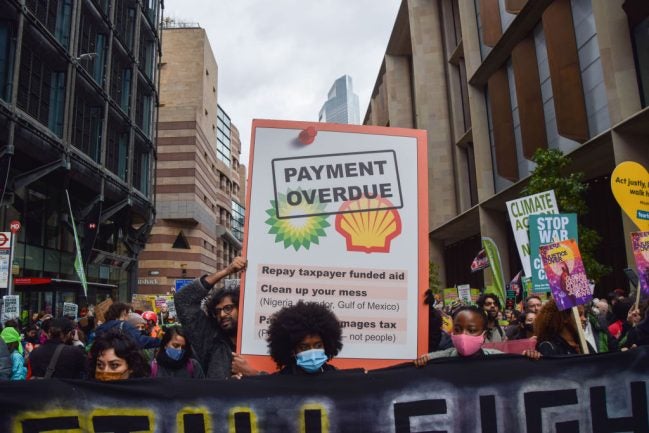
Protestors call out bp and Shell during a demonstration in the City of London in 2021. Credit: Vuk Valcic/SOPA Images/LightRocket via Getty Images.
Shell decreased spending on “renewables and energy solutions” last year, while bp’s spending on “low carbon energy” has flatlined, finds an Energy Monitor analysis of fourth-quarter results.
On Tuesday, UK oil major BP reported that in 2023 it raked in $13.8bn (£10.93bn) in profits. This represented its second-highest annual profit in a decade – despite it being nearly half the record-breaking $27.7bn bp amassed in 2022 after oil prices spiked following Russia’s invasion of Ukraine. Days earlier, Shell also reported better-than-expected profits of more than $28bn, following a record-breaking $40bn in 2022. Yet both oil majors’ spending on renewables has flatlined, finds Energy Monitor‘s analysis of the companies’ filings.
Shell’s annual results show that investment in “renewables and energy solutions” fell from $3.5bn in 2022 to just $2.7bn last year. The company spent just 11.7% of its total capital expenditure (capex) on renewables in 2023 compared with 15.3% in 2022.
By contrast, bp slightly increased its spending on “low carbon energy” from $1.02bn in 2022 to $1.26bn in 2023, although as the chart below shows, spending on renewables by both companies has flatlined over the past five years.
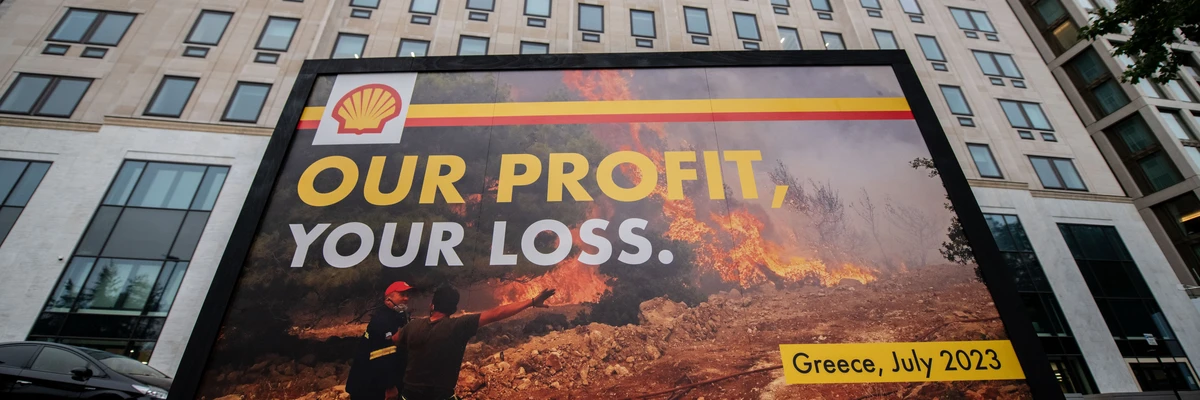
Greenpeace activists display a billboard during a protest outside Shell headquarters on July 27, 2023 in London. (Photo: Handout/Chris J. Ratcliffe for Greenpeace via Getty Images)
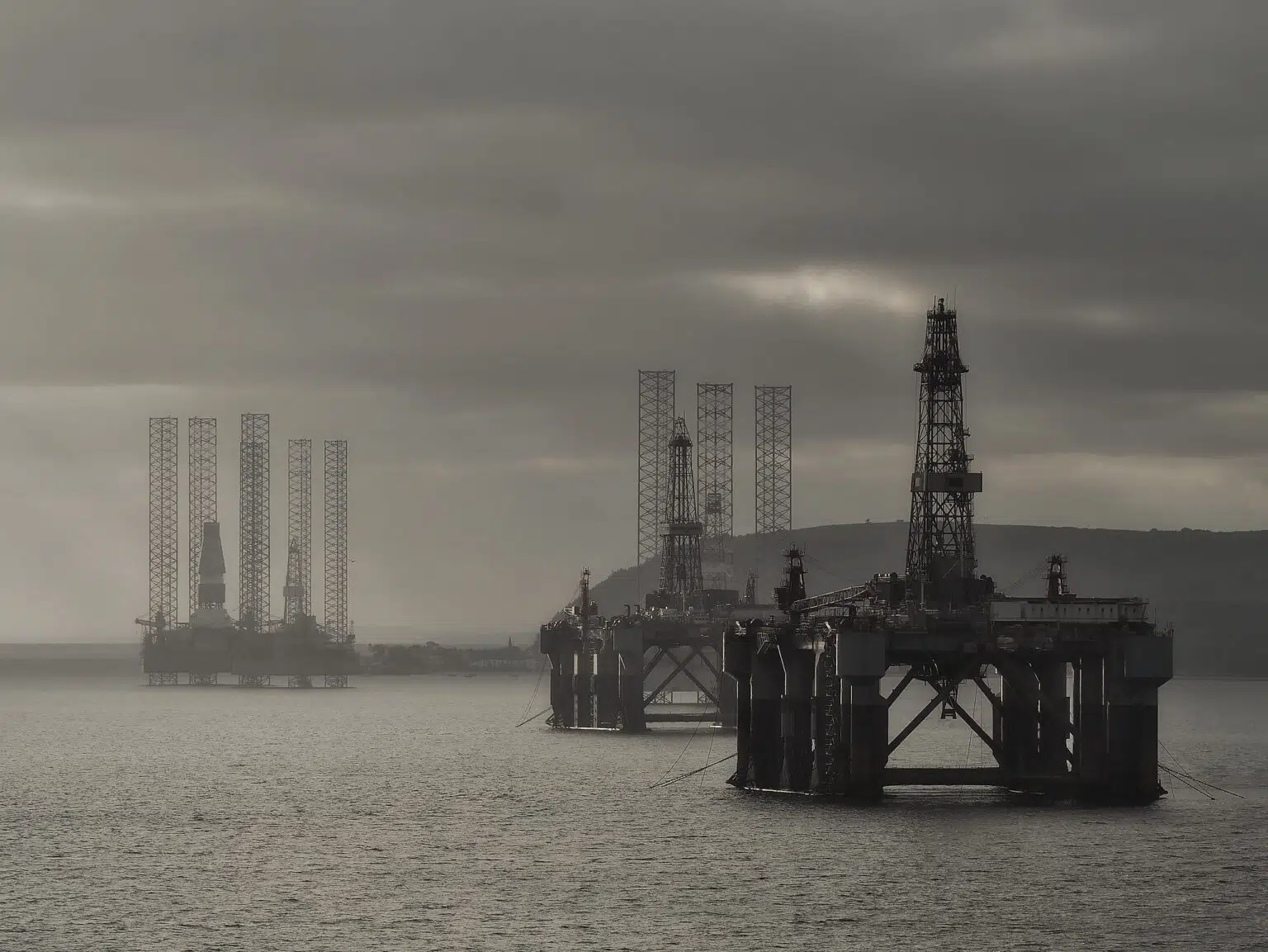
North Sea oil and gas production is expected to plummet in the coming years, as renewables become increasingly competitive. Now, a new report by the think tank Carbon Tracker argues that private equity companies invested in North Sea (UK and Norway) oil and gas assets are particularly vulnerable to losses as demand falls. Private equity’s presence in the North Sea has grown steadily since the 2014 oil price crash.
In 2010, just 8% of North Sea assets were held by private companies, with the remainder owned by publicly listed oil majors and state-owned utilities. Currently, 29.7% of North Sea equity licences are held by current or former private equity-backed ventures, according to recent analysis from the Common Wealth think tank.
Carbon Tracker argues that while all upstream investors risk being saddled with stranded assets as demand for hydrocarbons falls, private equity companies are particularly vulnerable. For starters, the private equity industry is already facing “serious headwinds” as the low interest rate environment that “buoyed private markets” for the last decade “has, at least temporarily, come to an end”.
Greenpeace activists display a billboard during a protest outside Shell headquarters on July 27, 2023 in London. (Photo: Handout/Chris J. Ratcliffe for Greenpeace via Getty Images)
OIL giant BP raked in a profit of $13.8 billion (£11bn) last year as the company continued to prosper on the back of struggling households.
…
Warm This Winter spokeswoman Fiona Waters said that while the figures were less than the record numbers reported in 2022, BP was “still making billions while people’s energy bills continue at unaffordable levels and more and more people are being pushed into poverty.
“Meanwhile, this government continues to hand massive subsidies to these international profiteers,” she added.
“We need real energy solutions, notably renewable energy and proper insulation, to stop this ongoing cycle of obscene profits and to keep ordinary people warm this winter.”
HAPPENING NOW: We're outside of the Norwegian embassy protesting @Equinor's £29 billion profits announced this morning.@Equinor is Norway's *state-owned* oil giant.
Norway portrays itself as a climate leader, but profit from @equinor's fossil fuel projects across the world. pic.twitter.com/6mTxL2wwFz