The UK government has approved the Rosebank oil field in the North Sea. I’ll have a lot to say on this but for a start while it blows any remaining pretence that UK is committed to net zero, the UK government will be massively subsidising a foreign company to extract and take the oil abroad …
… [N]ew estimates by the campaign group Uplift show that Rosebank, expected to cost £4.1bn to develop, could receive an effective taxpayer subsidy worth £3.75bn through tax breaks and the loophole in the government’s windfall tax that spares oil and gas investment.
This would mean that Equinor, the Norwegian state-owned company behind the potential field, would pay only £350m to develop Rosebank, which is three times the size of the Cambo oilfield. Equinor made £62bn last year, and about 80% of the oil from Rosebank is likely to be exported, rather than bolstering the UK’s energy security.
The acclaimed 1990 film Awakenings tells the story of a neurologist who discovers a drug which rouses catatonic patients from decades of “sleep”. It’s a true story, based on Oliver Sacks’ 1973 memoir of the same name.
Sadly, the awakening doesn’t last. The drug wears off. The mirage fades. After a brief window of hope, the patients return to their catatonic state.
Listening to UK prime minister Rishi Sunak’s recent speech, in which he announced the rolling back of policies to achieve net zero, I had a nagging sense that I had seen this movie before.
I had been there when the UK miraculously built a cross-party consensus around climate change. As early as 1989, I’d attended a high-level seminar convened by Sir James Goldsmith (father of Tory peer Zac Goldsmith) to advise Margaret Thatcher on climate policy.
I’d applauded John Prescott’s tireless leadership in negotiating the Kyoto Protocol in 1997. I’d given evidence to the Royal Commission on Environmental Pollution, whose influential 2000 report on Energy – the Changing Climate set the UK on the path to a world-leading Climate Change Act. When it came to a vote only five MPs stood against it.
I’d had what you might call a front row seat as a political consensus on climate change emerged in the UK. But during the long and uncomfortable 25 minutes of Sunak’s speech, I felt I was witnessing a homage to catatonia.
There was so much patently wrong in the speech that it’s difficult to know where to start. Most obviously, the prime minister’s insistence that the UK can still meet its climate commitments, despite putting a brake on policy, bucks his own advisors’ assessment of the country’s progress towards net zero emissions. It also reveals a deep misunderstanding of the science.
Delay is costly
Remaining within the 1.5° or even 2°C thresholds set out in the Paris agreement to avoid catastrophic climate change requires substantial emission reductions now. The climate is indifferent to the date on our targets. Its concern is the volume of carbon in the atmosphere.
As my own analysis has shown, the UK’s fair share of the global carbon budget, taking into account the development needs of the poorest parts of the world, will be exhausted before 2030. Forget 2050. The science is clear. Delay is tantamount to capitulation.
A key economic principle follows from this: the sooner you act, the lower the final bill. The 2006 Stern Review on the economics of climate change showed why. There may be some upfront costs in reaching net zero, and it is clearly the job of government to ensure that these do not fall on the poor. But the long-term costs of refusing to pay are catastrophic.
Those costs are already being counted: fires in Europe and Canada, droughts in North America and Africa, floods in Libya. All this will keep getting worse. Homes in some parts of the US are already “essentially uninsurable” because of climate risk.
The same lesson applies to the transition itself. Research I led has established the principles on which (to use the prime minister’s words) “a fair and proportionate” response to climate change should be based.
Early signals on the direction of regulation; financial and technical support for business and households to make the transition; transparent guidance for those who stand to benefit; and appropriate compensation for those who stand to lose: these are the foundations for clear and consistent policy.
As the chair of Ford UK put it on the same day Sunak tore up Boris Johnson’s 2030 target for the phase-out of diesel and petrol cars: “Our business needs three things from the UK government: ambition, commitment and consistency. A relaxation of 2030 would undermine all three.”
Sunak wasn’t listening. A target set by a predecessor, even from his own party, carries no truck with this prime minister.
He also ditched a ban on new domestic oil boilers in off-grid locations (which could have reduced costs and improved air quality for rural households) and minimum energy efficiency standards for privately rented homes (which could have saved poorer families thousands in energy bills).
Just to emphasise the point, he scrapped a host of made-up policies such as taxes on meat and regulations on carsharing which had never actually existed.
It’s no surprise to find an embattled political party trying to draw clear blue water between itself and the opposition. Buoyed by Labour’s narrow defeat in the Uxbridge and South Ruislip byelection (widely attributed to a backlash against London’s Ulez policy) Tory strategy is now turning net zero into election fodder.
Sunak was swift to deny this charge when it was posed to him by a sympathetic Sun journalist in what seemed like a carefully rehearsed question. Casually couched within a cricket joke, Rishi-the-cricket-fan was able to laugh it off. “No, this is not actually about politics,” he said. “It’s about doing what’s right for the country in the long term.”
It was a stunning revelation. From Aristotle to Hannah Arendt, genuine politics was always about doing what’s right for the long term. Only today is it reduced to shallow electioneering. Not content with betraying the interests of the future, Sunak’s speech has helped turn climate change into a sordid culture war.
After 13 years, single-party rule has become a dangerous thing. Not so much because it stifles dissent, but rather because it has destroyed a vital consensus.
Perhaps consensus is a commodity yet more fragile than consciousness. But its disappearance still carries a sense of political and social loss more tragic even than the final scenes of Awakenings.
Don’t have time to read about climate change as much as you’d like?
Tim Jackson, Professor of Sustainable Development and Director of the Centre for the Understanding of Sustainable Prosperity (CUSP), University of Surrey
Influential right-wing groups are set to host events featuring major polluters, days after Prime Minister Rishi Sunak watered down green targets.
Image of InBedWithBigOil by Not Here To Be Liked + Hex Prints from Just Stop Oil’s You May Find Yourself… art auction. Featuring Rishi Sunak, Fossil Fuels and Rupert Murdoch.
A number of oil and gas firms have been announced as the hosts of stands and events at this year’s Conservative Party conference.
The conference, which is being held from 1 to 4 October in Manchester, will play host to the likes of BP, British Gas’ parent company Centrica, petrochemical giant Valero, and Drax – the UK’s largest CO2 emitter.
Events hosted by the companies will cover a range of energy and climate issues, and will feature senior Conservative MPs and ministers.
A range of influential right-wing organisations will co-host the panels. They include the Spectator magazine and groups based in and around Westminster’s Tufton Street, home to a network of opaquely funded, free market think tanks with a history of criticising climate action and pushing for more fossil fuel exploration.
This news comes as Prime Minister Rishi Sunak this week announced several delays to the government’s net zero policies. Sunak announced on Wednesday that a ban on the sale of new petrol and diesel vehicles will be pushed back from 2030 to 2035, while he also watered down schemes to phase out gas boilers and scrapped new energy efficiency regulations on rented homes.
Dozens of organisations will be running stalls at the Tory conference, including a number of fossil fuel firms and major polluters. These include oil giant BP, petrochemical manufacturer INEOS, and Drax, which operates the UK’s single most polluting power station and has actively attempted to influence government energy policy in its favour.
A “Hydrogen Zone” stand which “showcases what the hydrogen economy could deliver for the UK by 2030” will also exhibit projects from a number of gas extraction and distribution companies including RWE, Centrica, Cadent, Northern Gas Networks, National Gas, SGN, and Wales and West Utilities.
DeSmog has previously revealed that the Conservative Party received £3.5 million in donations from fossil fuel interests and climate science deniers in 2022, while two-thirds of the directors in charge of the party’s multi-million-pound endowment fund have a financial interest in oil, gas, and highly polluting industries.
The CPS
The Centre for Policy Studies (CPS), a Tufton Street think tank, is hosting two separate events at the conference in partnership with gas companies.
Valero, the US-based downstream petroleum company which operates an oil refinery in Pembroke, Wales, is hosting an event with the CPS entitled “How do we decarbonise and remain competitive?” featuring Conservative MPs Gareth Davies and John Penrose.
French gas giant EDF and German-owned energy firm E.ON will also be co-hosting a CPS event asking how energy can be made cheaper. The panel will include Exchequer Secretary to the Treasury Gareth Davies.
The CPS has supported the expansion of fossil fuel exploration. In response to the release of the government’s new “energy security” strategy in April 2022, the think tank included ending the ban on fracking for shale gas in a list of “significant missed opportunities” by the government, along with onshore wind and home insulation.
This followed years of lobbying from the CPS on the subject, including a report in December 2013 entitled, “Why every serious environmentalist should favour fracking”.
In an economic bulletin issued by the CPS in March 2022, the think tank also stated that “we need to continue to support offshore exploration and production activity in the North Sea. As part of this, the government should look at accelerating regulatory approval for upcoming oil and gas projects such as Rosebank… Clair South, Glengorm, Cambo and Bentley”.
The International Energy Agency has stated that new oil and gas exploration is incompatible with net zero.
A DeSmog investigation published earlier this year revealed that three CPS board members have donated £610,000 to the Conservative Party since Rishi Sunak became prime minister.
CPS runs the online publication CapX, which has published a number of articles recently attacking net zero policies. One set of “positive” policy prescriptions featured in a piece by Andrew Hunt included pushes, in place of the “obsession” over net zero, to “force developers to build more beautiful buildings” and “replace ugly road bollards and railings with ‘green street furniture’”.
Vocal climate crisis denier Ross Clark also argued on CapX in February that net zero carries a “perverse incentive to destroy UK jobs”, and that Britain was “highly unlikely” to “get anywhere net zero by 2050”. In another CapX piece, Clark said it would be “impossible” for Britain to electrify its power grid by 2030.
The CPS told DeSmog that, in recent years, it has been “one of the most prominent champions of free-market environmentalism, with a dedicated workstream on net zero.
“Our director, Robert Colvile, has been one of the country’s most prominent advocates of onshore wind and solar, as well as co-authoring the 2019 Conservative Party manifesto, which contained a prominent commitment to net zero.
“Our CapX site offers a platform for robust debate on the policy issues of the day. The most cursory glance at our output would show that this includes publishing many pieces that are strongly supportive of net zero”.
A Spectator Sport
The Spectator magazine will be hosting a Conservative conference event in association with Cadent Gas, discussing public consent for net zero. The event will feature two outspoken climate crisis deniers: Conservative MP Jacob Rees-Mogg who is also a GB News host, and Sherelle Jacobs, a columnist at the Telegraph.
Rees-Mogg is well-known for his anti-net zero views, and was a leading proponent of further fossil fuel extraction during Liz Truss’s short tenure as prime minister.
In August, Rees-Mogg argued that the government should “revisit its approach to net zero” and “cancel the ban” on oil-fired boilers from 2026, points which Sunak mirrored in his recent net zero announcement.
Jacobs has previously argued that climate science is “being manipulated into alarmist fake news,” and more recently claimed that net zero was a “damp squib”.
An Spectator editorial published in reaction to Sunak’s climbdown on net zero measures claimed that the plan to phase-out the sale of new fossil-powered engines was a “always was a conspiracy against the public, justified on very thin environmental arguments,” and that Sunak’s announcement was “an important step”.
The editorial argued for further climate inaction on the basis that Britain contributes less than 1 percent of total annual greenhouse gas emissions. (This argument has been identified as a common example of the key climate delay tactic of “Whataboutism”, in an influential academic paper published by Cambridge University Press).
The Spectator is also hosting a drinks reception with newly formed UK gas infrastructure operator National Gas.
National Gas is also set to host an event at the Conservative conference on the UK’s “need” for hydrogen entitled “Gassed up”. The event is being co-hosted with the influential centre-right think tank Onward. Several of Onward’s former staff members are now working in Sunak’s government.
German fossil fuel giant RWE, which owns and operates Europe’s second most polluting power plant, will also host an event in association with the Conservative Environment Network (CEN). The event will ask whether wind and solar energy are “energy saviours or a blight on our communities?”. The event will feature Lee Rowley, a minister at the Department for Levelling Up, Housing and Communities.
RWE also claims to be the world’s second largest offshore wind company and Europe’s third-largest renewable energy company.
Centrica is co-hosting an event with the CEN asking whether Britain is “winning or losing” at the “green industrial revolution”.
Liquefied Natural Gas supplier Liquid Gas will also host an event on decarbonising rural areas.
The Spectator, the CEN, Onward and the Conservative Party have been approached for comment.
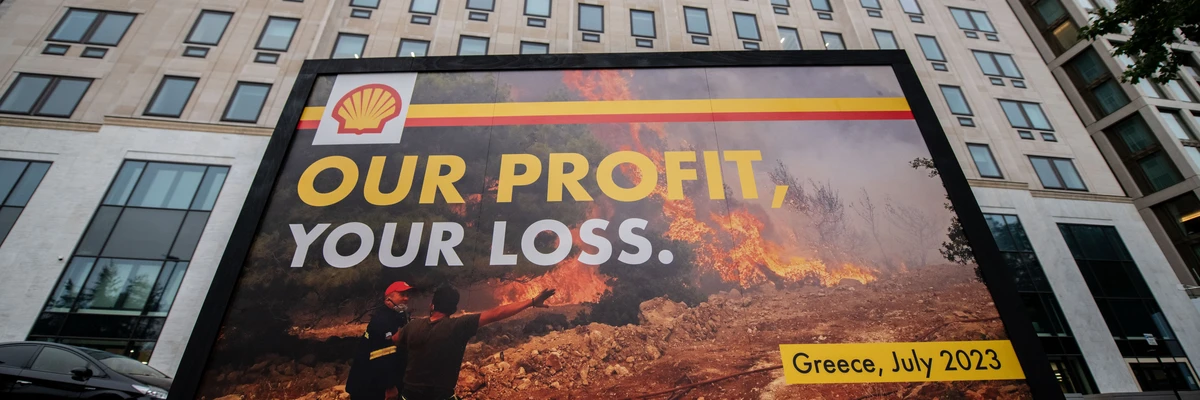
Greenpeace activists display a billboard during a protest outside Shell headquarters on July 27, 2023 in London. (Photo: Handout/Chris J. Ratcliffe for Greenpeace via Getty Images)
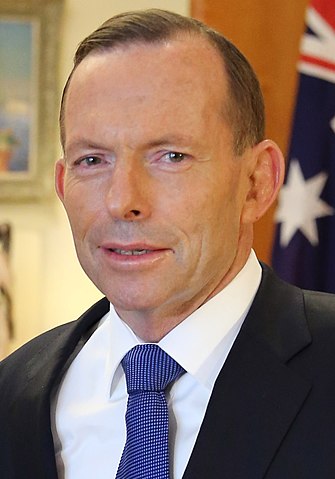
Tony Abbott, CC BY 2.0 <https://creativecommons.org/licenses/by/2.0>, via Wikimedia Commons
Government keeps the ex-Australian leader on the high profile advisory body despite previous calls to sack him over anti-green ties.
Former Australian prime minister Tony Abbott, a director of the UK’s principal climate science denial group, the Global Warming Policy Foundation (GWPF), has been reappointed by the government as an adviser to the prestigious Board of Trade.
Business and Trade Secretary Kemi Badenoch has today announced the 13 advisers who will provide counsel to the Board of Trade – one of the government’s most high profile economic advisory bodies.
The Board of Trade provides advice to the government on its trade deals with foreign countries, which often encompass environmental and climate standards.
The news of Abbott’s reappointment comes as Prime Minister Rishi Sunak is set to make a speech today setting out several delays to the government’s net zero policies. It is thought that he will announce that a ban on the sale of new petrol and diesel vehicles will be pushed back from 2030 to 2035, while also watering down schemes to phase out gas boilers and scrapping new energy efficiency regulations on homes.
Abbott, who was originally appointed to the Board of Trade in September 2020, is one of only four advisers reappointed by Badenoch, who has relaunched the board to focus on exports following her appointment as business and trade secretary earlier this year.
The former Australian leader has been retained despite opposition parties and campaigners calling in February for the government to remove Abbott after he joined the senior ranks of the GWPF.
Abbott has previously said that “climate change is probably doing good” and is a long-standing advocate for coal power, the most carbon-intensive fossil fuel.
Green Party peer Baroness Bennett told DeSmog that, by reappointing Abbott, “Sunak has lined himself up very firmly on the side of Trumpian populism – the direction that the prime minister is clearly increasingly taking as this chaotic Tory government desperately flails its way towards a general election.”
The GWPF was founded by the late Conservative chancellor Nigel Lawson with the purpose of combating what it describes as “extremely damaging and harmful policies” designed to mitigate climate change.
The GWPF has gained a number of high profile directors over the last year. New trustees include Tory peer Lord David Frost, the UK’s former chief Brexit negotiator, Conservative MP Andrea Jenkyns, and Daily Telegraph columnist Allison Pearson.
The GWPF said in 2015 that “policies to ‘stop climate change’ are based on climate models that completely failed to predict the lack of warming for the past two decades”. It has also expressed the view that carbon dioxide has been mis-characterised as pollution, when in fact it is a “benefit to the planet”.
In September 2022, Net Zero Watch – the GWPF’s campaigning arm – published a report which stated that “changing atmospheric carbon dioxide has minimal impact on Earth’s temperature and climate”, and “efforts to decarbonise in the hope of affecting global temperatures will be in vain”.
This year, the world experienced its hottest July on record, with climate change fuelingextreme weather events. The UN’s Intergovernmental Panel on Climate Change (IPCC), the world’s leading climate science body, has warned of the spread of climate misinformation which “undermines climate science and disregards risk and urgency” of cutting emissions.
Tory MP Chris Skidmore, a former energy minister who led a recent review into net zero by the government, said that Sunak risked making “the greatest mistake of his premiership”.
DeSmog has previously revealed that the Conservative Party received £3.5 million in donations from fossil fuel interests and climate science deniers in 2022, while two-thirds of the directors in charge of the party’s multi-million-pound endowment fund have a financial interest in oil, gas, and highly polluting industries.
Businessman David Meller has also been announced as a new adviser to the Board of Trade.
Meller is a Conservative Party donor whose company Meller Designs was given £160 million in personal protective equipment (PPE) contracts during the pandemic via the government’s notorious ‘VIP’ lane.
Meller has donated more than £70,000 to the Conservative Party and its politicians since 2009, including £3,250 to Michael Gove’s short-lived 2016 Conservative leadership bid, with Meller serving as Gove’s finance chair. Meller Designs was referred to the VIP lane by Gove’s office.
Meller has continued to donate to Conservative MPs following the pandemic. Electoral Commission records show that he gave £4,990 to Grant Shapps on 6 July, who was at the time serving as Energy Security and Net Zero Secretary.
There is no suggestion of wrongdoing on the part of David Meller or Meller Designs.
A Department for Business and Trade spokesperson said: “We’ve announced a revamped Board of Trade that brings together a wide range of private sector expertise to help boost British exports, identify barriers to trade and represent the best of Brand Britain to the world.
“All advisers to the board serve in personal capacities, do not speak on behalf of government and do not set government policy.”
Tony Abbott and the GWPF have been approached for comment. David Meller has been approached for comment via Meller Designs.
Image of InBedWithBigOil by Not Here To Be Liked + Hex Prints from Just Stop Oil’s You May Find Yourself… art auction. Featuring Rishi Sunak, Fossil Fuels and Rupert Murdoch.
The tycoon, who is stepping down from News Corp and Fox, has used his outlets to promote denial and delay action, experts say
Scientists have described the media tycoon Rupert Murdoch as a “climate villain” who has used his television and newspaper empire to promote climate science denial and delay action.
…
Prof Michael Mann, a climate scientist at the University of Pennsylvania, said Murdoch had been “one of the most destructive forces in modern history when it comes to climate action”.
“He has wielded his global media empire as a cudgel to sow confusion and doubt about the science and the solutions. He will go down in history as one of the greatest climate villains,” said Mann.
Dr Friederike Otto, senior lecturer in climate science at the Grantham Institute, Imperial College London, said: “There’s no doubt that the Murdoch empire has played an important role in letting the public believe that there was any scientific doubt that the burning of fossil fuel causes the climate to warm and that it is detrimental for society and ecosystems. It is a terrible legacy he leaves, that many people paid for, and are paying for, with their lives and livelihoods.