I’ll return to Rishi Sunak being a climate denier – there’s not much worse you can say about someone is there? totally divorced from reality? able to simply deny scientific argument? It’s really disappointing in a prime minister since they’re supposed to be responsible and dependable.
I’m not the first to call Sunak a climate denier – it’s good to see that Scottish First Minister Humza Yousaf has beaten me to it.
So my first question to climate denier Rishi Sunak is why is he intending to massively subsidize the proposed Rosebank oil and gas field instead of massively subsidizing my energy bill? If he subsidized my energy bill to the same extent, my monthly bill would be reduced from £110 to £10 so why is he financing Norwayians more than UKians?
Timing, they say, is everything. Yesterday, the world’s energy watchdog, the International Energy Agency (IEA), published its latest report, the 2023 Net Zero Roadmap.
The IEA categorically stated that the time for no new oil and gas was over. If we are to keep temperatures to 1.5 degrees, then world leaders must not develop new oil, gas, or coal beyond existing fields.
If we want a liveable planet, we must shift from fossil fuels to renewables.
This is not the first time, either, that the IEA has confirmed that no new oil, gas, or coal fields are compatible with limiting global temperature rise to 1.5ºC.
“Keeping alive the goal of limiting global warming to 1.5 °C requires the world to come together quickly. The good news is we know what we need to do – and how to do it,” said IEA Executive Director, Fatih Birol at the launch of the report. The IEA reiterated the way to do it is not to approve new oil and gas fields.
Campaigners take part in a Stop Rosebank emergency protest outside the U.K. Government building in Edinburgh, after the controversial Equinor Rosebank North Sea oil field was given the go-ahead Wednesday, September 27, 2023. (Photo: Jane Barlow/PA Images via Getty Images)
“The disgraceful decision to give Rosebank the green light shows the extent of the U.K. government’s climate denial,” one activist said.
Regulators in the United Kingdom on Wednesday greenlit the Rosebank oilfield in the North Sea, which campaigners warn contains enough oil and gas to match the yearly emissions of 28 low-income countries.
The U.K. government said it welcomed the approval, in a statement that comes one week after Prime Minister Rishi Sunak announced he was delaying some elements of the country’s net-zero plan.
“By approving Rosebank, Rishi Sunak has confirmed he couldn’t care less about climate change,” climate lawyer and executive director of the advocacy group Uplift Tessa Khan said in a statement. “As we’ve heard repeatedly, our world can no longer sustain new oil and gas drilling. And when we’re witnessing scorching temperatures, wildfires, devastating flooding, and heatwaves in our seas, it could not be clearer that this is a decision by the prime minister to add more fuel to the fire.”
🚨 BREAKING: The UK government has just approved Rosebank, the biggest undeveloped oil field in the UK. We won’t let this stand.
Rosebank, which is located off the northwest coast of the Shetland Islands, is the largest currently undeveloped oil field in the U.K., CNBCreported. Equinor, Norway’s state-owned oil company, has an 80% share in the project, with British company Ithaca Energy holding the remaining 20%.
Equinor said it expected development to begin in 2026-2027 and for the field to produce more than 300 million barrels of oil overall, while Friends of the Earth Scotland said it contained 500 million barrels.
The approval comes despite the fact that the International Energy Agency concluded in 2021 that no new fossil fuel projects should be launched if world leaders wanted to limit global heating to 1.5°C. It also comes on the heels of a government report finding that a record number of people in England died of heat-related causes in 2022.
“This decision is nothing but carte blanche to fossil fuel companies to ruin the climate, punish bill payers, and siphon off obscene profits.”
Green Member of Parliament Caroline Lucas called the approval “the greatest act of environmental vandalism in my lifetime” in a statement posted on X, formerly known as Twitter.
“This is morally obscene,” she added in a second post. “It won’t improve energy security or lower bills—but it will shatter our climate commitments and demolish global leadership. Govt is complicit in this climate crime—as is Labour unless they pledge to do all possible to revoke it.”
Sunak, a conservative, promised to approve hundreds of oil and gas drilling licenses in the North Sea in July, arguing it was necessary for energy security. The opposition Labour Party says it will prioritize renewable energy if it takes power, but will respect any licenses or approvals already in place, according to Reuters.
“The disgraceful decision to give Rosebank the green light shows the extent of the U.K. government’s climate denial,” Friends of the Earth Scotland’s oil and gas campaigner Freya Aitchison said in a statement. “Fossil fuels are driving both climate breakdown and the cost of living crisis yet the U.K. Government is slamming its foot down on the accelerator.”
Aitchison also called on the Scottish government specifically to oppose the project.
“Delivering a fair and fast transition away from fossil fuels is one of the defining challenges of Humza Yousaf’s term as First Minister,” Aitchison said. “This must start with unequivocally condemning Rosebank and opposing the U.K. government’s decision to go ahead with a project that deliberately prioritizes the interests of Equinor while bringing little or no benefit to Scottish people.”
Campaigners also questioned who would benefit from the project. While the government argued that it would inject cash into the economy and create almost 1,600 jobs, activists pointed out that Equinor made £62 billion in pre-tax profits last year and would get more than £3.75 billion in tax breaks for its work on Rosebank, meaning the U.K. would ultimately lose £750 million in tax money from the field’s development.
“The ugly truth is that Sunak is pandering to vested interests, demonstrating the stranglehold the fossil fuel lobby has on government decision-making. And it’s bill payers and the climate that will suffer because of it,” Greenpeace U.K. climate campaigner Philip Evans said in a statement. “Why else would he make such a reckless decision?
“This decision is nothing but carte blanche to fossil fuel companies to ruin the climate, punish bill payers, and siphon off obscene profits,” Evans added.
Opponents of the project have promised to take legal action to stop it.
“There are strong grounds to believe that the way this government has come to this decision is unlawful,” Khan said in a statement. “We shouldn’t have to fight this government for cheap, clean energy, and a liveable climate, but we will.”
I will be suggesting that the appropriate response to UK government’s progressing with the Rosebank oil field is to refuse, block and frustrate it using all means and to campaign against any and all political parties – clearly including the Labour party – that support it. I suggest that it is correct to regard Rishi Sunak’s Conservative party to be indistinguishable to the fossil fuel industry. The Labour party should be regarded similarly. We have to make progress to net zero, that’s clearly not done by pursuing more fossil fuels.
Greenpeace activists display a billboard during a protest outside Shell headquarters on July 27, 2023 in London. (Photo: Handout/Chris J. Ratcliffe for Greenpeace via Getty Images)
In February this year, the UK’s Climate Change Committee (CCC) wrote a letter to government in which it claimed that more domestic oil and gas extraction would have “at most, a marginal effect on prices”, recommending instead that the best way of reducing exposure to volatile energy markets is “cut[ting] fossil fuel consumption, improving energy efficiency, [and] shifting to a renewables-based power system”.
Meanwhile, research from campaign group Uplift reveals that gas from undeveloped UK oil and gas fields in the North Sea, including Rosebank, will deliver at most three weeks of energy to the UK per year, while oil would provide up to five years of oil demand, even if none of it were exported. In reality, most production from North Sea fields, along with Rosebank, which is joint-owned by Norwegian state oil major Equinor (40%), Canadian Suncor Energy (20%) and Israeli-owned Ithaca Energy (20%), is likely to be exported abroad, as is currently the case with 60% and 80% of North Sea gas and oil, respectively.
Further analysis of data from GlobalData reveals just how far burning oil and gas from Rosebank would threaten the UK’s climate targets. According to GlobalData, Rosebank contains the largest untapped oil and gas reserves of all proposed North Sea fields, with 370 million barrels of oil equivalent.
Using US Environmental Protection Agency (EPA) conversion figures – according to which one barrel of oil emits 0.43 tonnes (t) of CO₂ when burnt and 1,000 cubic feet of gas emit 0.0551t of CO₂ when burnt – Rosebank is likely to release 155 million tonnes of carbon dioxide (mtCO₂) into the atmosphere over its lifetime.
However, in a “balanced” net-zero pathway, as per the CCC’s sixth carbon budget, emissions from fossil fuels fall 75% by 2035 from 2018 levels. In total, emissions from “fuel supply” – predominantly made up of fossil fuels – amount to 298mtCO₂-equivalent (mtCO₂e) between 2023 and 2050, meaning lifetime emissions from Rosebank are equivalent to more than half of the UK’s remaining carbon budget for total fuel supply.
…
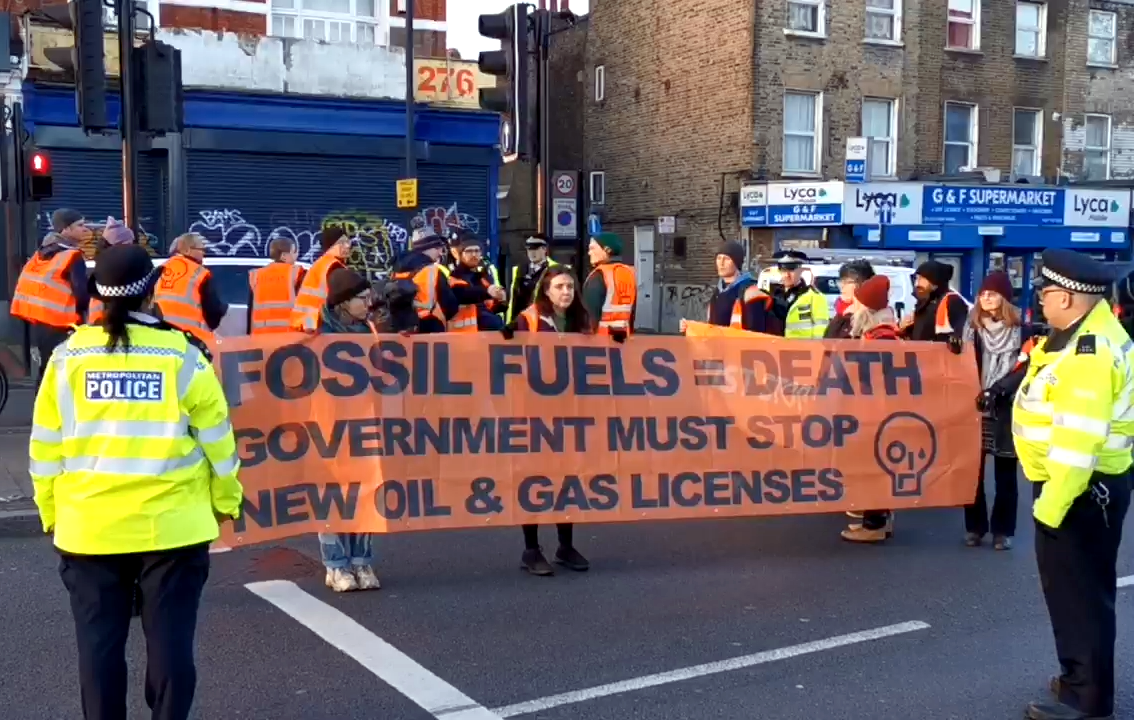
Just Stop Oil protesting in London 6 December 2022.