Original article by Olivia Rosane republished from Common Dreams under Creative Commons (CC BY-NC-ND 3.0).
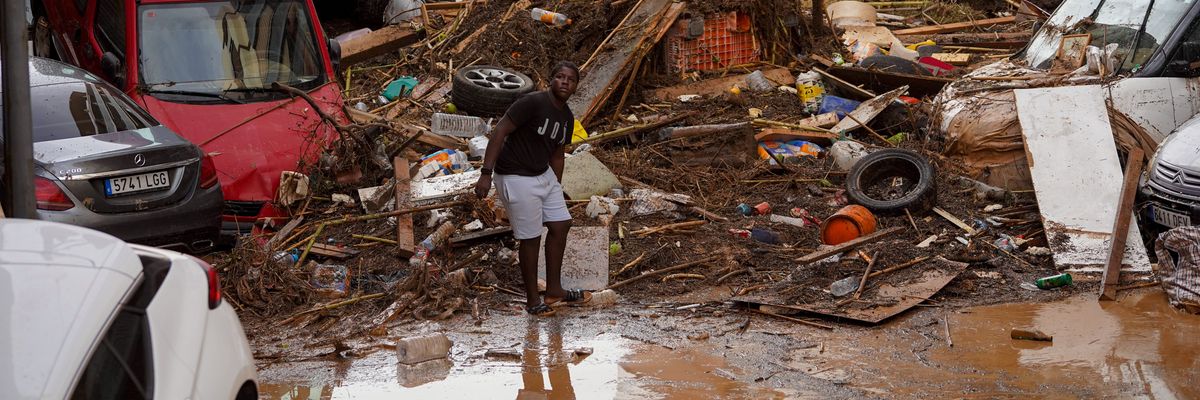
“These disasters are only getting worse, and stopping the industries and systems driving climate collapse is the only rational response,” one climate group said.
Spain’s deadliest flooding in 30 years killed at least 72 people as torrential rain slammed the eastern region of Valencia on Tuesday, with some towns recording a year’s worth of rain in a single day.
The flooding sent churning muddy water down narrow streets, tossing cars, downing trees, bulldozing bridges and buildings, and trapping people in rising flood waters.
“The neighborhood is destroyed, all the cars are on top of each other, it’s literally smashed up,” Christian Viena, who owns a bar in Valencia’s Barrio de la Torre, told The Associated Press. “Everything is a total wreck, everything is ready to be thrown away. The mud is almost 30 centimeters (11 inches) deep.”
Sorry, this content could not be embedded.
X
As of Wednesday morning, officials reported 70 deaths in Valencia and two in the bordering region of Castilla La Mancha. However, the death toll could rise as search and rescue operations continue amid difficult conditions, such as power outages and blocked roadways. Many people remain missing with their fates uncertain.
This includes residents of Utiel in Valencia, whose mayor, Ricardo Gabaldón, told Spanish broadcaster RTVE that Tuesday was the “worst day of my life.”
“We were trapped like rats,” Gabaldón said. “Cars and trash containers were flowing down the streets. The water was rising to 3 meters (9.8 feet).”
One person who was rescued was Denis Hlavaty, who spent the night perched on the edge of the roof of a gas station where he works.
“It’s a river that came through,” Hlavaty told Reuters, adding, “The doors were torn away and I spent the night there, surrounded by water that was 2 metres (6.5-feet) deep.”
“The fossil fuel industry increases the climate emergency, destroys the balance of critical ecosystems, and puts people’s lives in danger.”
The storm also canceled high-speed rail travel between Valencia and Madrid and Barcelona, and derailed one high-speed train near Malaga, though no one was injured.
While the rains had tapered off in Valencia by Wednesday morning, the rest of the country is not out of danger, as the storm is projected to move northeast.
“We mustn’t let our guard down because the weather front is still wreaking havoc and we can’t say that this devastating episode is over,” Spanish Prime Minister Pedro Sánchez told the nation on television Wednesday.
Even if the death toll does not rise, Tuesday’s floods are already the deadliest in Spain since 1996, when a flood near the Pyrenees killed 87. They are also the deadliest in Europe since floods in 2021 that killed at least 185.
In the immediate term, Tuesday’s deluge was caused by a phenomenon called a gota fría, or “cold drop,” a storm formed as cold air moves over the warm Mediterranean. In Spain, these kinds of storms are also commonly referred to with the acronym DANA—for Depresión Aislada en Niveles Altos, or isolated high-level depression.
However, scientists observe that the climate crisis is making rainstorms like this one more extreme, as warmer air can hold more moisture to dump when conditions are right. For Europe specifically, the warming of the Mediterranean causes more water to evaporate from its surface, super-charging rainstorms.
“Events of this type, which used to occur many decades apart, are now becoming more frequent and their destructive capacity is greater,” Ernesto Rodriguez Camino, senior state meteorologist and a member of the Spanish Meteorological Association, told Reuters.
Sorry, this content could not be embedded.
X
The Spanish flooding comes a little more than a month after record rainfall swamped Central Europe and Eastern Europe, in an event that scientists concluded was made approximately twice as likely and 7% more severe by the climate crisis fueled primarily by the burning of fossil fuels.
“When we talk about climate change and climate emergency, it’s often perceived as an abstract concept far from our daily reality,” Eva Saldaña, the executive director of Greenpeace Spain, said in a statement. “Unfortunately, this is climate change: the intensification of extreme weather phenomenons like what happened tonight, with the level of destruction greater each time. Ignoring it causes deaths that we cannot allow.”
In a post on social media, Greenpeace Spain said that fossil fuel companies including the Spanish Repsol should pay for the damages.
“DANAS are more intense every time due to climate change,” the group wrote. “The fossil fuel industry increases the climate emergency, destroys the balance of critical ecosystems, and puts people’s lives in danger.”
Extinction Rebellion Global agreed. “These disasters are only getting worse, and stopping the industries and systems driving climate collapse is the only rational response,” the group wrote on social media.
The U.S.-based Climate Defiance, meanwhile, shared images of flood-ravaged streets with dismissals often leveled at climate activists.
Sorry, this content could not be embedded.
X
Sorry, this content could not be embedded.
X
Yellow Dot Studios, Don’t Look Up director Adam McKay’s climate-focused media studio, also shared an image of cars dropped in piles in the street by the flood waters to call out the double-standard in how direct-action climate protests and the corporate crimes of the fossil fuel industry are punished.
Sorry, this content could not be embedded.
X
Friends of the Earth Spain focused on the human impacts, arguing that urgent climate action meant “putting people’s lives, and not economic models, at the center.”
“Don’t prioritize sending people to work in extreme and dangerous conditions,” the group wrote. “It is a priority to take effective, ambitious, and urgent measures in response to the climate crisis we are living through.”
Original article by Olivia Rosane republished from Common Dreams under Creative Commons (CC BY-NC-ND 3.0).
- Death and Destruction From Helene Show Climate Crisis Isn’t in a Bargaining Mood
- ‘Ancient Heat Records Will Be Broken’: Southern Europe Braces for Unprecedented Temperatures
- ‘Absolutely Gobsmackingly Bananas’: Early Data Shows September 2023 Hottest on Record
- Climate Change Made Libya Flooding Up to 50 Times More Likely, 50% More Intense
- EU Crisis Official Warns of ‘Climate Breakdown’ Amid Deadly Wildfires and Flooding
dizzy: It’s almost as if Elon Musk’s X is censoring the climate crisis!